



Abstract
The overall quality of coach–athlete relationship has been shown to positively associate with coach leadership effectiveness on athletes’ outcomes. Nonetheless, others also showed no associations when each subdimension of coach–athlete relationship was separately examined. This study used canonical correlation analysis (CCA) to examine the complete set of correlations between coach transformational leadership (six dimensions) and quality coach–athlete relationship (six dimensions). A total of 213 athletes (122 male; 91 female) from various performance levels and sports completed a multi-section questionnaire. CCA revealed positive, negative and no correlations between the coach transformational leadership and coach–athlete relationship variable sets. For example, the Direct Commitment dimension of the coach–athlete relationship was negatively related to the Individualised Support dimension and positively associated with the High-Performance Expectation dimension of coach transformational leadership. In light of these results, we discuss whether viewing the coach–athlete relationship as an inherent dimension embedded within the conceptualisation of coach leadership is suitable and accurate.
Introduction
Coach leadership is one of the crucial leadership resources for sports teams. 1 Coach leadership affect many aspects such as team cohesion, 2 athlete performance, 3 and is found to be positively related to team potency. 4 Meanwhile, the notion of coach leadership has developed and expanded beyond its initial coverage to keep pace with the literature updating. For example, Chelladurai and Riemer initially considered coach leadership as ‘a behavioural process that is used to increase athlete performance and satisfaction’. 5 :p.228 Later, Vella et al. 6 argued that coach leadership is a behavioural and interpersonal influencing process that can affect a broader range of athletes’ outcomes beyond performance and satisfaction. Subsequently, building on the definition of coach leadership, Vella and colleagues positioned coach leadership within the definition of coaching effectiveness. According to Cote and Gilbert coaching effectiveness is defined as: ‘The consistent application of integrated professional, interpersonal, and intrapersonal knowledge to improve athletes’ competence, confidence, connection, and character in specific coaching contexts’. 7 :p.316 The main components of coaching effectiveness are: 1) coaches’ knowledge (mainly formed by coaches’ professional, interpersonal, intrapersonal knowledge and integration of the triad of coaches’ knowledge), 2) athletes’ outcomes and 3) coaching contexts. As such Vella et al. postulated that coach leadership resides within coaches’ interpersonal knowledge component of the coaching effectiveness definition. Based on this postulate, Vella et al. explained that coach leadership is, ‘a process of interpersonal influence that is dependent upon the relationship between coach and athlete, and is used to facilitate the athlete outcomes of competence, confidence, connection and character’. 6 :p.431 Overall, Vella and colleagues explained that: 1) the coach–athlete relationship (CAR) is a facilitating tool that increases coach leadership effectiveness; 2) the leadership of the coach affects athletes’ key outcomes as per the definition of coaching effectiveness; and 3) the coaching context as well as coach and athlete characteristics determine coach leadership all of which are in line with the coaching effectiveness conceptualisation.1,6 Coach–athlete relationship plays a prominent part in such coach leadership definition since the application of coach leadership still only influences athletes’ outcomes. Indeed, the good coach leadership can develop good quality interpersonal relationships.8,9 For example, coach transformational leadership behaviours had been found positively associated with CAR. 8 However, the application of coach leadership beyond athletes’ outcomes where it can also affect broader outcomes such as coaches themselves (e.g., coaching competency) 10 and at the organisational level (e.g., team psychological safety). 9 In addition, the relationship between coach leadership and CAR is not just positive, and it can also be non-existent when examining dimensions of CAR completely. 11 Researchers have applied Vella et al.'s theorising to study coach leadership recently. 1 However, although Vella and colleagues’ efforts in developing and expanding the definition of coach leadership are commendable, they may introduce an element of confusion as this relates to the degree to which the concepts of coach leadership, CAR and coaching effectiveness are mutually exclusive. It is crucial to emphasise that we positively reviewed the current coach leadership definition (including CAR). We intend to understand further the coverage/conceptualisation of coach leadership within the existing literature, much like Vella and colleagues did before. The current study aims to reveal complex associations between coach leadership and CAR, to discuss that the inclusion of the CAR in coach leadership definition as a facilitating tool is questionable.
The CAR has been defined as ‘a situation in which a coach's and an athlete's cognitions, feelings and behaviours are mutually and causally interrelated’. 12 :p.4 Coaches and athletes’ feelings, thoughts and behaviours are operationalised through the constructs of closeness, commitment and complementarity, respectively. According to Jowett, 13 Closeness refers to the affective tone of the relationship and includes such relational properties as mutual trust, respect, appreciation and interpersonal liking. Commitment refers to coaches and athletes’ thoughts, intentions and willingness to maintain a bond or close ties over time. Complementarity captures coaches and athletes’ cooperative acts of interactions; these interactions are either corresponding (comparable; e.g., both coach and athlete display behaviours of responsiveness and receptiveness) or reciprocal (give-and-take; e.g., on one hand coach leads and on the other hand an athlete executes). These three dimensions are thought to determine the quality of the CAR from a direct (e.g., I trust my coach) and a meta-perspective (e.g., My coach trusts me). Over the past two decades, there has been a surge of research around CAR, employing the Coach–Athlete Relationship Questionnaire (CART-Q) 14 and exploring the correlates of this key relationship in sport.9,11
We also aligned with the previous research8,15 by using the transformational leadership framework to examine coach leadership. Transformational leadership frameworks originated from organisational psychology have been commonly used to investigate the practical value of coach leadership. 16 Transformational leadership has been proven effective in sports, such as athletes’ performance, 17 intrinsic motivation, 18 and experience of well-being. 19 In addition, transformational leadership behaviours target dual levels – individual and team. 20 Thus, coach transformational leadership influence process is applicable to both individual and team sports athletes.8,18,21 Following the conceptualisation, 22 six dimensions make up transformational leadership and have been proved valid in sports context.23,24 (1) Articulating a Vision meaning that leaders plan a reachable and upbeat version of the future and instil this belief to the followers; (2) Providing an Appropriate Model referring to leaders set the appropriate example in the group for the subordinates to follow; (3) Fostering Acceptance of Group Goals capturing leaders capacity and ability to facilitate teamwork in the group and let the followers cooperate together to strive for a collective goal; (4) High-Performance Expectations (HPE) meaning that leaders express anticipation of high performance in work and followers; (5) Individualised Support (IS) refers to leaders’ behaviours that exhibit concern about the development of individual/s; and (6) Intellectual Stimulation reflects leaders capability to stimulate the followers to generate creative ideas or solutions.
The current coach leadership conceptualisation (including CAR) premise whereby CAR is an internal tool that has the capacity to increase coach leadership effectiveness resides in the notion that when CAR is high/low coach leadership is high/low leading to increases/decreases the effectiveness of coach leadership. They stated ‘the coach-athlete relationship is a tool that coaches can use to increase the effectiveness of leadership behaviours and should be included in the definition’. 6 :p.431 Although empirical research has supported this assumption that coach leadership and CAR are positively associated,8,15 it is only part of the findings due to examining CAR incompletely. For example, the research 15 examined CAR as an overall quality, neglecting the dimensions of CAR. Another study 8 ignored the meta-perspective (My coach trusts me), which is equally essential as the direct-perspective (I trust my coach) of CAR. Coach leadership and CAR are separate multidimensional constructs and thus an examination that takes into consideration their entire structures would provide a more complicated and complete picture. Jowett and Chaundy 11 treated CAR direct and meta-perspective as two independent variables in multivariate regression models revealing CAR can be unrelated to coach leadership. They demonstrated that adding the meta-perspective of CAR to a hierarchical multiple regression model did not change the model's predictability. In contrast, a direct perspective of CAR increased the model's predictability. These results provide a holistic and more accurate representation of how CAR functions in relation to coach leadership.
Second, coach leadership affects outcomes beyond athlete-specific outcomes. The current coach leadership (including CAR) conceptualisation proposed by Vella et al. is in line with coaching effectiveness only affecting athletes’ outcomes. Others also focused on athletes' outcomes from coach transformational leadership such as athletes’ narcissism, 21 athletes' perception of individual goal achievement, 17 and athletes’ perceptions of inside sacrifice. 25 However, improving the athletes' outcomes is the ultimate goal of coaching effectiveness, 7 not coach leadership (including CAR). Coach leadership has the potential to affect a much broader array of outcomes including coach competency (e.g., personal effectiveness) 10 and team cultural (e.g., organisational effectiveness). 9 Recently, Fransen et al. 26 pointed out that coaches are defined as leaders because their goals involved coaching activities as well as building and shaping the team's culture or purposes. Gosai et al. 9 also suggested that coaches are responsible for building a safe team environment. Therefore, only considering athletes’ outcomes as the only duty of coach leadership is somewhat incomplete.
More importantly, it would be amiss not to mention that high-quality coach leadership has been negatively associated with a number of outcomes. Kao and colleagues 10 found that coaches who were perceived with high-quality coach transformational leadership showed a decrease in athletes perceived coaching competency over one season. Furthermore, Bormann et al. 23 demonstrated that the coach transformational leadership behaviour of Providing an Appropriate Model was negatively associated with team performance (team's official standings tables). At the same time, IS and HPE behaviours of transformational leadership did not affect team performance. These negative and uncorrelated predictions were based on treating the measurements (e.g., leadership and coach competency) as two separate constructs where their respective operational and measurement structures were upheld. Treating coach leadership and CAR as separate multidimensional concepts would reveal more complex associations.
Additionally, gender was considered in this study as an extension to previous research that has examined the association between coach leadership and CAR.8,15 Gender as a factor may lead to unique patterns because coaches treat (e.g., communicate, relate, lead) athletes differently by gender. A study 27 alluded to imbalanced privileges between female and male athletes whereby coaches position female athletes below male athletes. Second, athletes have their own preferences, and research findings have revealed that female athletes prefer being coached by male coaches. 28 Third, it has been found when different genders of coaches and athletes work together, their content of empathic accuracy varies. 29 In this study, we expect to uncover a more complex and complete association between CAR and coach leadership by examining all of their subdimensions while considering gender effect.
Method
Participants
A total of 213 athletes from both individual and team sports (e.g., Athletics, Aikido, Archery, Basketball, Cricket, Handball, Rugby, Table Tennis and Volleyball) participated in the study. Participants included 122 (57%) male athletes and 91 female athletes (43%), with their ages ranged from 18 to 35 years (M = 28.25, SD = 2.62). Participating athletes were coached by a larger number of male (n = 158) than female (n = 55) coaches. All participants were based in the United Kingdom, and most of them (n = 208) were enrolled at the UK's university's sports clubs (e.g., Loughborough University, University of Nottingham), while others (n = 5) were enrolled at Wales national sports team. Participants performed at university performance level (n = 152), the highest level of British Universities & Colleges Sport (BUCS), club level (n = 18), regional level (n = 16), national level (n = 16) and international level (n = 11). More than half (n = 138, 65%) of the athletes had less than a 12-month relationship with their current coach, and the remainder (n = 75, 35%) had relationships spanning from 12 to 120 months.
Measurements
Coach leadership
The difference between the current study and the previous work,8,15 we chose Podsakoff et al. 22 Transformational Leadership Inventory (TLI) instead of Differentiated TLI (DTLI) for the following reasons: 1) TLI is an equally influential and effective measurement as the Multifactor leadership questionnaire (MLQ) series, they are all widely used in diverse fields. 30 The validation of TLI in sports context has been demonstrated.23,24 2) items of DTLI are composed of TLI and MLQ-5X, 2 but items from MLQ-5X were received with profound scepticism named ‘omitted variable bias’. 31 Specifically, Antonakis et al. 31 took the MLQ item ‘displays a sense of power and confidence’ as an example. They acknowledged that such an item could reveal confidence; however, other variables at the personal level (e.g., introverted or extroverted) or organisational level (e.g., the degree of resource support) may also affect confidence and were not controlled for in the measurements. A similar item can be found in DTLI, such as ‘Talks optimistically about the team prospects’. Under the premise that such issues have not been addressed, our study is more inclined to use TLI. TLI measures six dimensions of transformational leadership: Articulating a Vision (five items; e.g., ‘my coach is always seeking new opportunities for the team or squad’), Providing an Appropriate Model (three items; e.g., ‘my coach provides a good model to follow’), Fostering the Acceptance of Group Goals (FAGG; four items; e.g., ‘my coach fosters collaboration among work groups’), HPE (three items; e.g., ‘my coach insists on only the best performance’), IS (four items; e.g., ‘my coach shows respect for my personal feelings’) and Intellectual Stimulation (three items; e.g., ‘my coach has provided me with new ways of looking at things which used be to a puzzle for me’.). The response scale ranged from strongly disagree (1) to strongly agree (7). Previous studies have shown sound psychometric properties.22–24 With this sample, the alpha internal consistency values ranged from .70 to .82.
Coach–Athlete relationship
The CART-Q 14 was used to measure the overall quality of relationship between coaches and athletes categorised as direct and meta-perspective: Direct Closeness (four items; e.g., ‘I like my coach’), Direct Commitment (three items; e.g., ‘I am committed to my coach’) and Direct Complementarity (four items; e.g., ‘When I am coached by my coach, I am responsive to her/his efforts’), as well as Meta Closeness (four items; e.g., ‘My coach likes me’), Meta Commitment (three items; e.g., ‘My coach is committed to me’) and Meta Complementarity (four items; e.g., ‘My coach is responsive to my efforts when she/he coaches me’). The response scale ranged from strongly disagree (1) to strongly agree (7). Previous studies have shown sound psychometric properties of validity and reliability.9,11 With this sample, the alpha internal consistency values ranged from .77 to .89
Procedures
Data collection commenced once the study was granted approval by the University Ethics Approvals Sub-Committee. The purpose of this study was communicated to head and assistant coaches of university performance teams and higher performance level teams through onsite visits and emails. For teams that were to be visited onsite, the first author sent out an initial email that described the study and contained the participant information sheet. To avoid athletes and coaches treating the questionnaires as an assessment-like session, the purpose of the questionnaire was emphasised, which was to acquire participants’ honest thoughts toward their coaches. The data were gathered in January and February 2020. On the day of the visit, participants received guidance and completed the questionnaires after training in the sports venue, while coaches were in a different space from the athletes. Participants choose to fill out the questionnaire on paper (n = 162) or online (n = 51) at their own preference. Athletes volunteered their time to the study and consented to participate in this study by initialising written information and a consent form.
Data analysis
This study used Canonical Correlation Analysis (CCA) to analyse the relationship between coach transformational leadership and CAR variable sets using SPSS (version 25). CCA is a multivariate technique that is most appropriate to examine whether and how the two sets of variables are related and lowers the probability of Type I error.32–36 Meanwhile, Sherry and Henson indicated CCA and structural equation modelling both represent the highest level of the general linear model and ‘CCA subsumes both univariate and multivariate methods as special cases’. 33 p37 In CCA, six predictor leadership variables (observed variables) combine into one synthetic predictor (latent variable), and six criterion CAR variables (observed variables) integrate into one synthetic criterion (latent variable). Canonical correlation (rc) is a bivariate correlation between these two synthetic variables, and squared canonical correlation (rc) 2 represents proportion of variance shared by two synthetic variables. 33 A full canonical model can generate as many canonical functions (or called canonical variate) as observed variables in statistics. Researchers only report and interpret the significant canonical functions for which squared canonical correlation (rc)2 is larger than 10%.33,36 The findings of all significant canonical variate are statistically independent. The second or more significant canonical variate is an additional finding to the first canonical variate. With the significant canonical functions, researchers can define the importance of observed variables by structure coefficient (rs) and standardised canonical function coefficients (Coef). And plus-minus signs of structure coefficient (rs) show how observed variables relate in various directions (positive or negative). At last, communality coefficients (h2) revealed the usefulness of observed variables contributing to the canonical model. The cut-off of >.45 for structure coefficients (rs) and communality coefficients (h2) was employed. 33
Results
We employed the screening process that Koehn et al.34,35 conducted CCA in the sports context to assess reliability, normality and multicollinearity. Additionally, as suggested in López de Subijana et al., 8 our study endeavours to uncover the different patterns of different gender combinations by further dividing the participants into eight subgroups (e.g., male athletes, athletes with male coaches and female athletes with male coaches).
Effective size, eligible groups and multicollinearity
TLI and CART-Q were completed with no missing data. We further identified two outliers (Mahalanobis distance, P < .001). 36 Therefore, 211 cases remained for CCA analysis. A research indicated cut-off points for CCA effective size. 32 Canonical correlations (rc) < 0.3 need a sample size of at least 200 and >0.7 need a sample size of 50. The eligible groups were groups of all participants (n = 211), female athletes (n = 90), female athletes with male coach (n = 63) and athletes with male coach (n = 155). These four datasets also passed multicollinearity test where the Variation Inflation Factor scores (ranged from 1.50 to 4.87) were below 10. 37
Normality and reliability
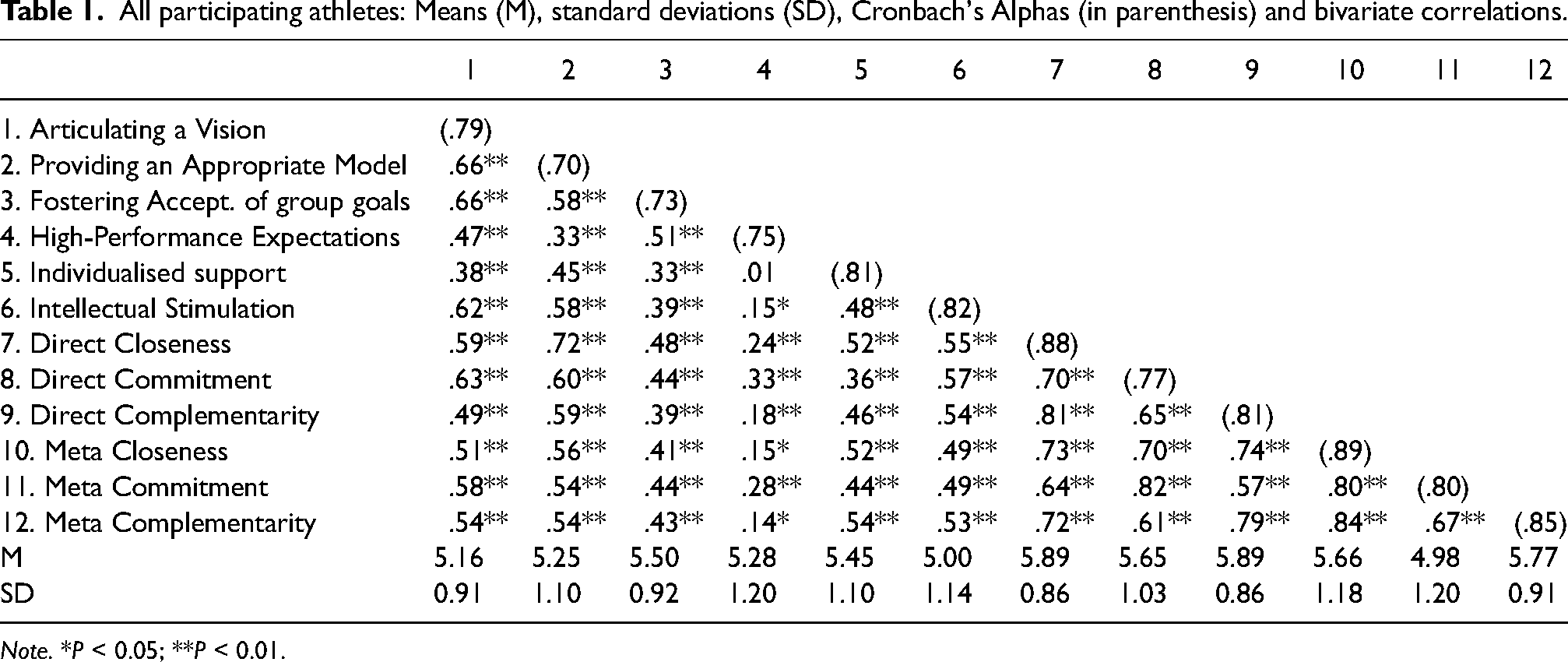
According to West et al. 38 skewness values less than 2 and kurtosis values less than 7 indicate a normal distribution. In this study, the skewness (ranged from −1.53 to 0.006) and kurtosis (ranged from −0.74 to 3.8) across the above-mentioned eligible four data sets were within the cut-off values recommended. The Cronbach alpha values for each dimension in TLI and CART-Q for four groups were higher than the cut-off point .70. 39 Table 1 contains means, standard deviations, bivariate correlations and Cronbach alpha values for the all-participants group.
All participating athletes: Means (M), standard deviations (SD), Cronbach's Alphas (in parenthesis) and bivariate correlations.
Note. *P < 0.05; **P < 0.01.
Canonical correlation analysis
All participating athletes
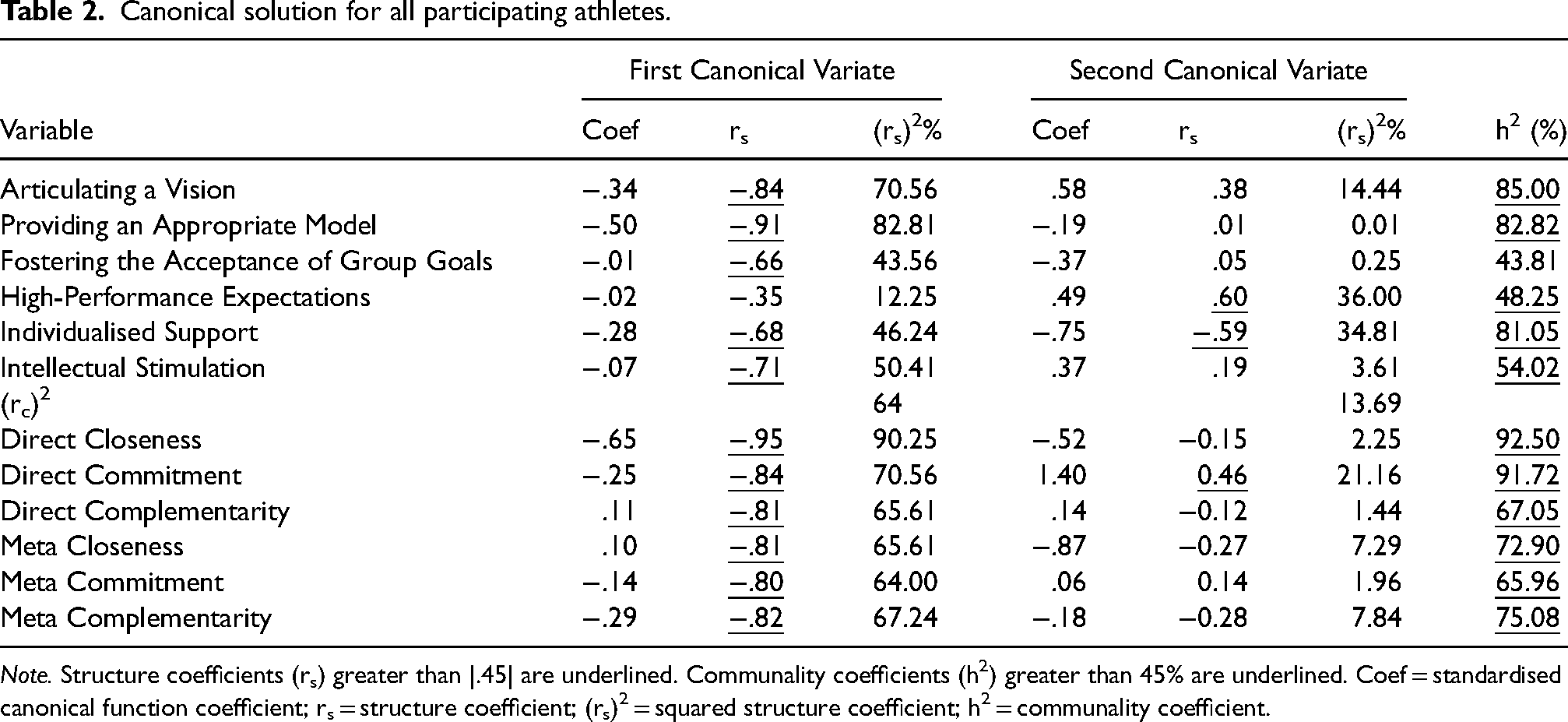
Two significant canonical functions were found (Table 2). The first function (Wilks's λ = .28, F(36, 876.63) = 8.28, P < 0.001, canonical correlation rc = .80) accounts for 64% (rc)2 of the overlapping or shared variance. FAGG variable's h2 is lower than the cut-off 45% indicated that this behaviour did not significantly contribute to the CCA model.
Canonical solution for all participating athletes.
Note. Structure coefficients (rs) greater than |.45| are underlined. Communality coefficients (h2) greater than 45% are underlined. Coef = standardised canonical function coefficient; rs = structure coefficient; (rs)2 = squared structure coefficient; h2 = communality coefficient.
The second function (Wilks's λ = . 75, F(25, 744.47) = 2.38, P < 0.001, canonical correlation rc = .37) accounts for 13.69% % (rc)2 of the overlapping or shared variance. IS behaviours (rs = −.59) were negatively associated with the Direct Commitment (rs = . 46) and positively associated with HPE (rs = .60).
Female athletes
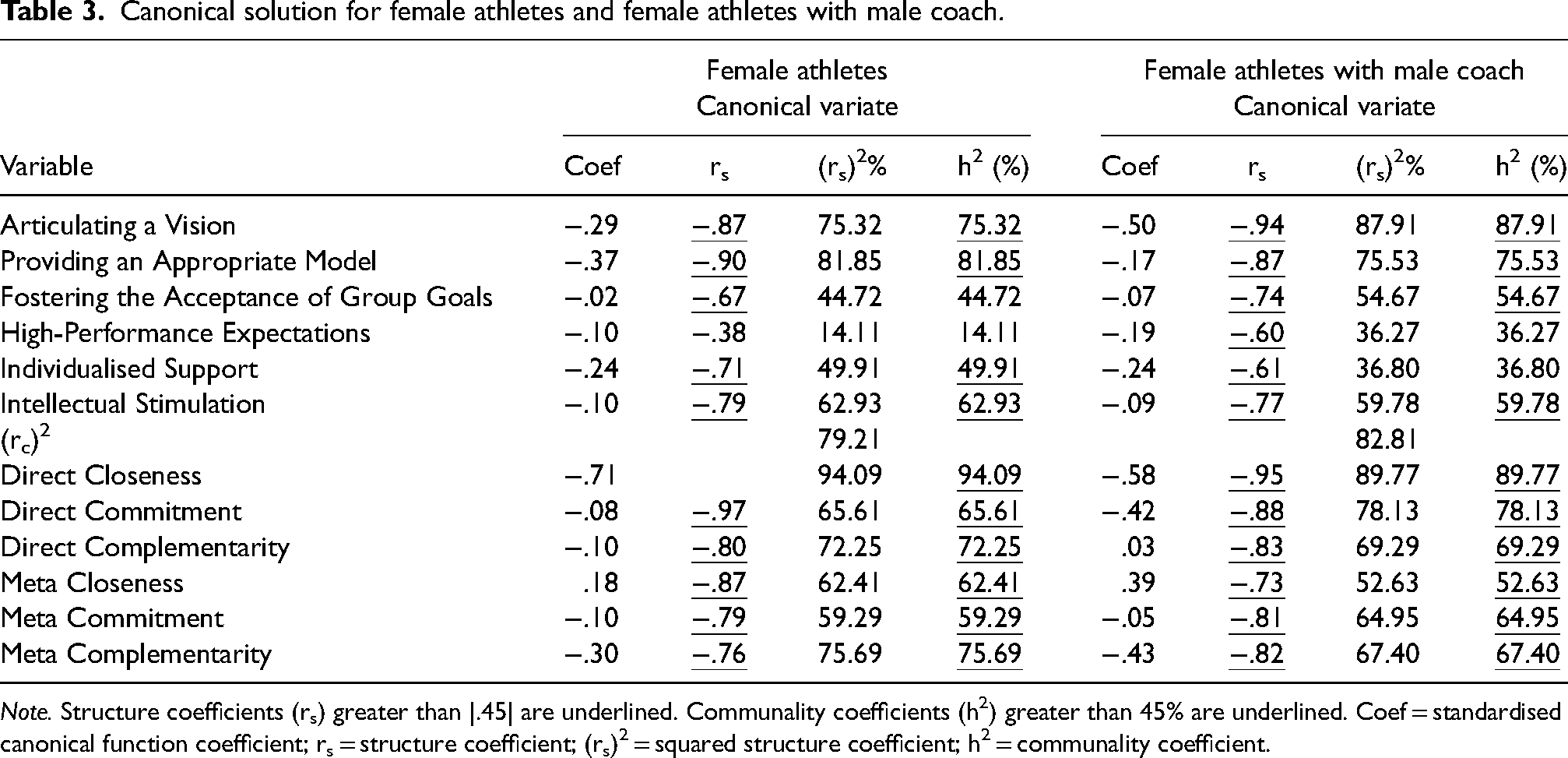
One statistically significant canonical function was found (Table 3). The canonical function (Wilks's λ = .10, F(36, 345.28) = 6.53, P < 0.001, canonical correlation rc = 0.89) accounts for 79.21% (rc)2 of the overlapping or shared variance. HPE and FAGG variable's h2 is lower than the cut-off 45% indicated that these two behaviours did not significantly contribute to the CCA model.
Canonical solution for female athletes and female athletes with male coach.
Note. Structure coefficients (rs) greater than |.45| are underlined. Communality coefficients (h2) greater than 45% are underlined. Coef = standardised canonical function coefficient; rs = structure coefficient; (rs)2 = squared structure coefficient; h2 = communality coefficient.
Female athletes with male coach group
One statistically significant canonical function was found (Table 3). The canonical function (Wilks's λ = .08, F(36, 226.72) = 8.34, P < 0.001, canonical correlation rc = 0.91) accounts for 82.81% (rc)2 of the overlapping or shared variance. HPE and IS variable's h2 is lower than the cut-off 45% indicated that these two behaviours did not significantly contribute to the CCA model.
Athletes with male coach group
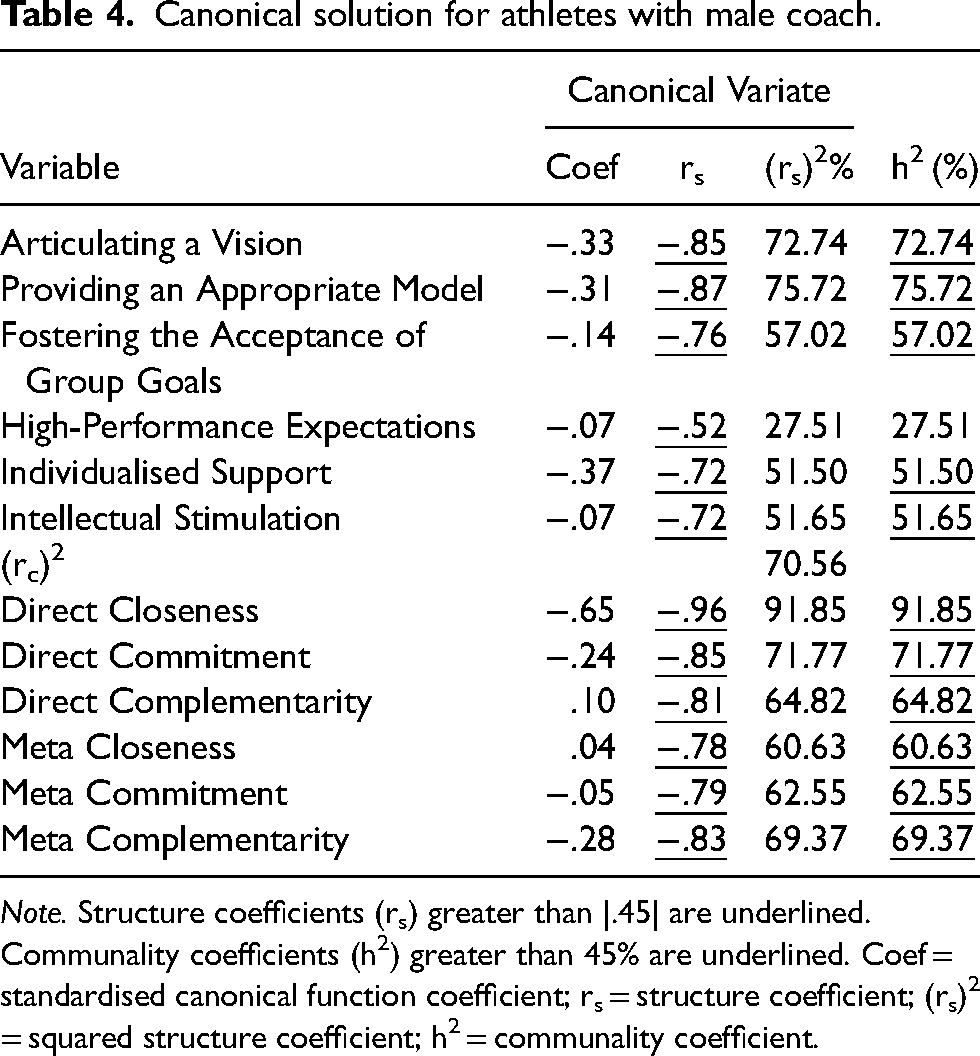
One statistically significant canonical function was found (see Table 4). The canonical function (Wilks's λ = .22, F(36, 630.72) = 8.34, P < 0.001, canonical correlation rc = 0.84) accounts for 70.56% (rc)2 of the overlapping or shared variance. All variables in leadership set and CAR set positively related to each other except HPE did not pass h2 cut-off of 45% that indicated HPE did not significantly contribute to the CCA model.
Canonical solution for athletes with male coach.
Note. Structure coefficients (rs) greater than |.45| are underlined. Communality coefficients (h2) greater than 45% are underlined. Coef = standardised canonical function coefficient; rs = structure coefficient; (rs)2 = squared structure coefficient; h2 = communality coefficient.
Discussion
The study sought to advance insights into the complex association between coach leadership and CAR, to discuss that the inclusion of the CAR in coach leadership definition as a facilitating tool is questionable. Results revealed that the association between coach leadership and CAR is beyond unidirectional, and that gender is a factor leading to unique patterns of associations between the two concepts.
Our findings of first canonical variate were in line with prior research findings,8,9,11,15 while the second canonical variate demonstrated interesting linkages. Specifically, Direct Commitment was negatively associated with IS and positively associated with HPE for all participants. For the first time, our study provided evidence of the potential detrimental effect of coach leadership on quality CAR or the negative associations between these two concepts. IS behaviour is a significant dimension of transformational leadership because it was the behaviour that upgraded typical leadership into transformational leadership. 40 It is also important to note that IS is a leadership behaviour dimension with the largest difference found between female and male leaders. 41 Transformational leadership behaviours target dual levels – individual and team, 20 where IS is a dimension that focuses on the individual level. Coaches who care for or support athletes personally can not only improve their relationship with athletes 42 but also need to be cautious doing it. Our finding suggests that coaches’ IS behaviours are negatively associated with commitment within the CAR. This finding aligned with previous research 43 which suggested that excessively engaging the emotions of followers (athletes) generates burnout. Athletes with high commitment to coaches have already demonstrated their willingness to maintain the long-term bond, but potentially excess support from coaches could possibly make athletes question their athletic ability and their commitment. Instead, athletes with high commitment to coaches are more likely to expect the best performance requests from their coaches. Therefore, this set of findings highlights that coaches will do well to tailor their behaviours to individual athletes since not every transformational leadership behaviour has the same positive effect.
It is important to note that HPE did not pass the cut-off suggesting that HPE did not significantly contribute to the canonical correlation model across the various groups. In other words, coaches' HPE behaviours did not significantly and meaningfully contribute to the shared variance between CAR and coach leadership. This suggests HPE behaviours might have little to no effect on CAR quality. Concerning practical applications, this may suggest that coaches who expect and insist on the highest performances from their athletes can do so without feeling that such high expectations can deteriorate the quality of the CAR. One of the reasons may be that athletes who have high-quality CAR are more likely to not devaluate sport experience. 44 Such positive experience makes athletes willing to perform at their best and expect coaches to want the same for them. Based on the above evidence, the association between CAR and coach leadership is clearly not just a positive one. Such result suggests that CAR should not be viewed as a facilitating tool of coach leadership. HPE's non-significant contribution to the CCA models also support research16,23 on the differentiated or multidimensional conceptualisation of transformational leadership. That is, different coach transformational leadership behaviours did not have the same effect on outcome variables.
The findings further highlighted that the shared variance between coach transformational leadership and CAR varied by gender. Overall, the overlapping variance for coach transformational leadership and CAR was 64% for all participating athletes. Such result extended and supported previous findings that sought to examine the links between coach leadership and CAR. 8 We further examined gender combinations, as López de Subijana et al. suggested. 8 Although our strict screening process did not retain the athletes with female coaches group, the overlap achieved in the all-participants group was lower than that of the other three groups indicating that gender led to unique patterns. A closer examination of the CCA solution for female athletes with male coach’ group and female athletes’ group supplied some insights. HPE and IS's communality coefficient did not pass the cut-off point, indicating that these coach leadership behaviours are not significantly and meaningfully contributing to the canonical model. Further research into unravelling the gender patterns between coach leadership and CAR and understanding the role of HPE and IS is warranted. For example, future research could consider structure equation modelling with a moderator to further explore the relationship between coach leadership and CAR.
It is worth noting that the research framework of the current study is from the widely acknowledged definition of coach leadership 6 and coaching effectiveness model. 7 Future research is recommended to consider other coaching models or theories beyond these frameworks, such as coaching process model 45 and coaching efficacy model, 46 to continue advancing our knowledge on the mechanism of coaching, CAR and leadership. For example, the coaching efficacy model with its four subdimensions (efficacy of game strategy, motivation, technique and character building) also captures coaches’ leading ability and interpersonal dynamics; and it has received growing research attention.47,48 Several limitations of this study need to be acknowledged. Although the sample was heterogeneous, including athletes who performed at international, national and university performance levels and in a range of sports, the generalisability of the findings may be limited to university performance teams’ athletes. Thus, attempting to replicate these findings with samples of different demographic characteristics may be necessary. Second, the cross-sectional, correlational design employed limits to the conclusions drawn, and thus a longitudinal and an experimental design may be beneficial to uncover cause and effect. In a longitudinal research design, Li et al. 49 found that athletes' CAR quality increased after the COVID-19 pandemic lockdown. Exploring changes in the quality of the CAR and coach leadership over time (e.g., pre and mid-season) may reveal novel findings.
To conclude, this study provided statistical evidence revealing the potentially multidirectional relationships between coach transformational leadership and CAR. Although CAR and coach leadership play significant roles, their roles are distinct in coaching effectiveness. 50 More research is warranted to fully understand the interplay between these two concepts and outcomes that go beyond athletes, such as organisational culture, team environment and coach effectiveness (e.g., efficacy, competency, burnout). A clear distinction and exploration of the concepts of coach leadership and CAR would provide a more coherent and a less ambiguous conceptualisation of effective coaching. A deeper understanding of the interactions between coach leadership and CAR by gender is more likely to contribute to better coaching practices.
Footnotes
Acknowledgements
The authors sincerely thank all participating athletes for filling out our questionnaires, and their coaches’ cooperation with this research. The current study was accepted as a poster presentation at International Council for Coaching Excellence (ICCE) 2021 in November 2021 with the title ‘Is Leadership about Relationships? Exploring the link between Coach Transformational Leadership and Coach-Athlete Relationship’. The authors also thank Professor John Antonakis’ expertise advice on psychometric instruments.
Declaration of conflicting interests
The author(s) declared no potential conflicts of interest with respect to the research, authorship, and/or publication of this article.
Funding
The author(s) received no financial support for the research, authorship, and/or publication of this article.
