



Abstract
This study aimed to (a) detail the interlimb asymmetries during multi-directional jumping, change of direction and for ankle dorsiflexion range of motion and (b) determine how asymmetries and performance in multi-directional jumping and ankle dorsiflexion predict performance during change of direction tests. Twenty-two male semi-professional players completed a testing session which consisted of unilateral ankle dorsiflexion range of motion, vertical and horizontal unilateral and lateral countermovement jumps and left and right leg 90° (COD90L&R) and 180° (COD180L&R) change of direction tests. No significant differences between limbs were observed for any of the variables (P > 0.05), though vertical countermovement jump (11.1% ± 9.1%) and dorsiflexion range of motion (10.5% ± 10.3%) imbalances were greater than those during lateral (2.7% ± 2.2%) and horizontal (2.2% ± 1.9%) countermovement jumps, and 90° (3.6% ± 3.1%) and 180° change of direction (2.9% ± 3.6%). Subjects presented 3.4 ± 1.4 real asymmetries (i.e., one greater than the coefficient of variation) across the tests, with all subjects having at least one real asymmetry. Stepwise linear regression models explained a reasonable amount of variance in change of direction180R (70%), COD90L (57%), COD90R (39%), COD180L (23%) using the countermovement jump and dorsiflexion range of motion variables (P < 0.05). The current findings indicate that semi-professional soccer players have real bilateral asymmetries (particularly in countermovement jump and dorsiflexion range of motion), which practitioners should be cognizant of. Given the prediction value, change of direction performance can be predicted using performance and asymmetries during multi-directional jumping and ankle dorsiflexion.
Keywords
Introduction
Soccer is an intermittent sport that incorporates high-intensity actions (e.g., changes of direction, sprinting, jumping) interspersed with periods of low-intensity activity (e.g., standing, walking). 1 Players cover distances ranging from 9 to 14 km per game, up to 1400 changes in activities and 700 change of direction (COD). 1 Moreover, players perform more than 600 accelerations and 600 decelerations per match, but also up to 40 very high-intensity efforts (> 21 km/h), 1 which highlights the prevalence of high-intensity actions during competitive matches. In addition, players of a higher competitive level typically display better performance in sprint, jump, and COD speed tests, than their lower level counterparts. 2 Given the importance of these high-intensity actions, an increased understanding of the physical performance of soccer players might be of value to practitioners.
Interest in the magnitude and direction of interlimb asymmetry (i.e., differences in neuromuscular outputs and/or skill performance between limbs) in neuromuscular capacities (i.e., COD and jumping tasks) has been rising in recent years. 3 From an applied soccer perspective, interlimb asymmetries can be expected due to kicking limb dominance, limb load distribution during multi-directional movements, and the innate unpredictability of playing against opponents. 4 Research on interlimb asymmetries is also particularly important as the existence of bilateral asymmetry represents additional stress placed on the weaker leg, potentially making athletes more predisposed to various injuries during high-intensity activities (e.g., cutting and landings). 5 Moreover, a higher prevalence of bilateral asymmetry (> 10% in unilateral jumping) has been observed in soccer players. 6 Therefore, the study of bilateral asymmetries in soccer populations can be particularly useful for practitioners who wish to reduce existing discrepancies between limbs.
When assessing bilateral asymmetries, single-leg jumping has been widely used because of its time-efficient nature and relatively easy test procedures. 7 However, the magnitude of asymmetry has been shown to be highly task-dependent with large variation reported between tasks, such as jumping, and cutting. 8 For example, in youth athletes, different between-limb asymmetry values according to the physical performance test undertaken.8,9 Typically, higher bilateral asymmetries have been observed in unilateral jumping (ranging from 8.76% to 15.03%), followed by unilateral lateral jumping (ranging from 5.97% to 6.63%), unilateral horizontal jumping (ranging from 3.66% to 4.14%), 90° COD (3.39%), and 180° COD (ranging from 1.83% to 2.21%).4,8–11 Given the task-specificity, detecting interlimb differences should be done via the implementation of multiple tests. Moreover, little is known about the sensitivity of bilateral asymmetry tests to detect existing side differences in other high-intensity activities.
Previous research has examined how interlimb asymmetries influence physical and sports performances. 12 That is, interlimb differences can be detrimental to jumping, kicking and cycling performance. 12 A plethora of literature has demonstrated that greater asymmetries during unilateral hop test are associated with impaired performance of 10-m among 25 elite soccer players (r = 0.70). 13 Similarly, Madruga-Parera, Dos'Santos, et al. 14 reported a significant negative relationship between asymmetries in the concentric phase of an isoinertial exercise and performance during COD180 (r = 0.51–0.59) among 16 semi-professional male soccer players. Bishop, Read, McCubbine, et al. 15 reported that higher bilateral asymmetries from unilateral vertical jumping resulted in slower sprint times during 20-m sprint test (r = 0.49–0.59) among 19 elite youth female soccer players. However, contrasting reports exist whereby greater asymmetries positively influenced performance of 30-m sprint test among youth male soccer players. 6 Furthermore, the amount of ankle dorsiflexion range of motion (DF-ROM) influences movement patterns of lower limbs in different planes of motion. 16 In this regard, the lack of range in the sagittal plane (i.e., reduced ankle dorsiflexion ROM), results in compensation of movement in the frontal plane (i.e., dynamic knee valgus), 16 which could lead to kinetic alterations during cutting task, particularly involving more aggressive cutting angle (≥ 90°). 17 Owing to the conflicting findings in the literature, further research is warranted to determine whether asymmetries are truly associated with decrements in physical performance.
The aim of this study was twofold (a) detail multi-directional (vertical, horizontal, and lateral) jumping asymmetries, COD-based asymmetries, and ankle dorsiflexion asymmetries and (b) examine how asymmetries and performance in multi-directional jumping and ankle dorsiflexion predict performance during COD tests.
Methods
Participants
Twenty-two semi-professionals (third Spanish division) male soccer players (age 25.3 ± 2.2 y, body mass 75.4 ± 7.2 kg, stature 177.3 ± 8.5 cm) volunteered for the study. Fifteen players reported right-leg dominance, i.e., preferred to perform soccer skills. Post hoc observed power calculations (G*Power, version 3.1.9.8; University of Düsseldorf; Düsseldorf, Germany) for linear bivariate regression, including one group (α = 0.05, slope H1 = 0.15), revealed power (β) of 0.21. Data collection was performed in the beginning of the competitive season. All players participated in combined sport-specific (four sessions) and strength (four sessions) trainings plus 1 competitive match per week. At the time of the study, all players were competing at national level. Three players were excluded from the initial sample based on the following criteria: (a) not regularly training during the month prior to testing; (b) musculoskeletal lower limb injury in 3 months prior to testing. Written informed consent was obtained from both the players beginning the investigation. The current study was approved by the Catalan Sports Council Ethics Committee and conformed to the recommendations of the Declaration of Helsinki.
Procedures
A cross-sectional study design was made. Testing sessions were performed in the preseason. Physical performance tests and training sessions were performed under the same environmental conditions (artificial turf field). Testing sessions included the following order of tests: ankle dorsiflexion, countermovement jumps (CMJ; unilateral jumps in vertical, horizontal, and lateral directions) and COD tests. Athletes were asked not to perform intense exercise on the day before a test and to consume their last meal at least 3 h before the scheduled test time.
Warm up. Participants started by performing a specific warm-up procedure consisting of 5 minutes of light jogging and dynamic stretches for the lower body (such as multi-directional lunges, inchworms, bodyweight squats, and spidermans). Upon completion, three practice trials of each test at 75%, 90% and 100% of their perceived maximal effort were provided. Three minutes rest was given between the last practice trial and the start of the first test trial.
Study outcomes
Vertical unilateral countermovement jumps. CMJs were assessed according to the Bosco Protocol. 18 Subjects performed three successful single-leg CMJs with each leg in the vertical directions. Subjects began standing on one leg, descending into a countermovement, and then extending the stance leg to jump as far as possible in the vertical directions. The landing was performed on both feet simultaneously. A successful trial included hands remaining on the hips throughout the movement, and balance being maintained for at least 3 s after landing. If the trial was considered unsuccessful, a new trial was permitted. Each test (right and left) was performed three times with 30 s of recovery between jumps, and 2-min between legs. The jump height was recorded using an infrared optical system (OptoJump Next—Microgate, Bolzano, Italy).
Horizontal unilateral and lateral jumps. Subjects started standing on one leg, descend into a countermovement, and then extended the stance leg to jump as far as possible in the horizontal jump (HJ), and lateral jump (LJ) directions. Landing occurred on the same foot. A successful trial included hands on the hips throughout the movement and if the balance was maintained for at least 3 s after landing. If the trial was considered unsuccessful, a new trial was permitted. In horizontal and lateral directions, the subjects started with the selected leg positioned just behind a starting line. Each test (right and left) was performed 3 times with 30 s of recovery between jumps, and 2-min between legs. The shorter and longest distances of three jumps were used for analysis.
90° COD Speed test (COD90). Both sides of the COD (right direction and left direction) were assessed in a single 90° COD for a total distance of 20 m (Figure 1). A guideline was used as a reference and the path was delimited with cones to avoid curvilinear paths. Three successful trials for each side were performed. The trial was considered successful if the player performed a clear lateral foot plant at the turning point. Each trial was separated by a 3-min rest interval. Total time in the COD90 test was measured with photocell beams (Chronojump Boscosystem, Barcelona, Spain).
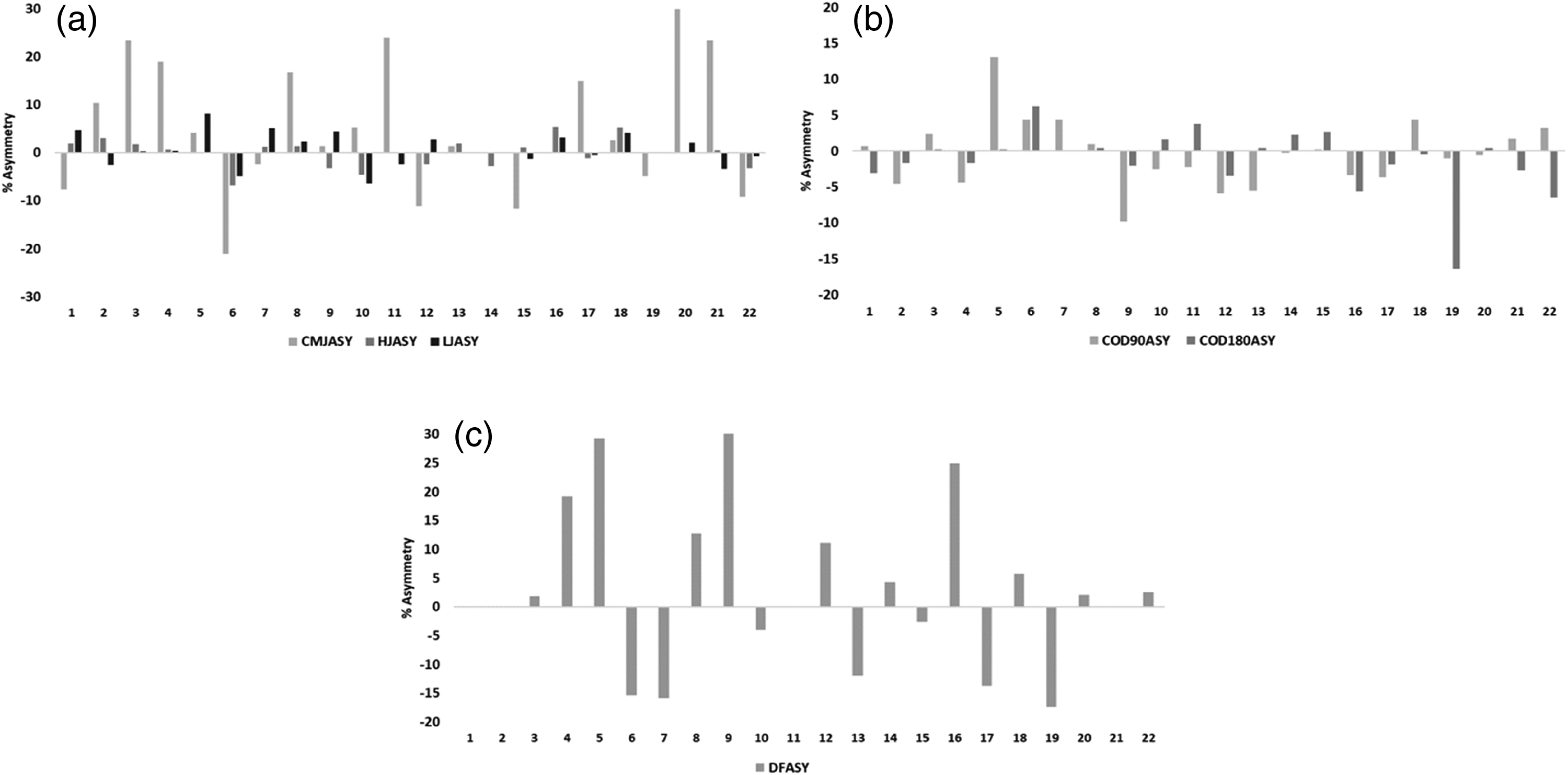
Individual player data showing the magnitude and direction of interlimb asymmetries for all asymmetry tests. (a) CMJASY, HJASY, LJASY; (b) COD90ASY, COD180ASY; (c) DF-ROMASY. Note: Above the 0 line indicates asymmetry favors the right leg and below the 0 line asymmetry favors the left leg. DF-ROM: dorsiflexion range of motion; CMJ: countermovement jump; HJ: horizontal jump; LJ: lateral jumps; COD90: 90° change of direction speed test; COD180: 180° Change of Direction Speed test.
180° COD Speed test (COD180). This test consisted of a circuit of 20 m length, with subjects performing two 180° changes of direction with the same leg. The first COD was done after 7.5 m from the beginning of the test, and the second one was performed after 5 m from the first COD, before finishing in a last running phase of 7.5 m. 8 Total time in the COD180 test was measured with photocell beams (Chronojump Boscosystem). The fastest time of the three trials for each leg was used for analysis. A trial was considered successful if the entire foot crossed over the line while changing direction. Each trial was separated by a 60 s recovery period. To evaluate COD deficit an adapted calculation was used, as described elsewhere. 19
Ankle Dorsiflexion. The degree of inclination was obtained using the Dorsiflex App (Apple Inc., USA) using an iPhone 8. Test procedures occurred following the methodology previously described elsewhere. 20 Participants stand in a bearing lunge position and the device was put with the screen touching the tibia (under the tibial tuberosity, aligning the Z-axis of the phone with the tibia). While maintaining this position, participants were instructed to flex the knee forward without losing the heel contact with the floor. Three trials were allowed for each leg (i.e., left and right), with 10 s of passive recovery between trials. The best score for each ankle among these trials was selected for subsequent analysis.
Statistical analysis. Data are presented in mean ± standard deviation (SD). The asymmetry index (ASY) was determined for all performance tests, using the following formula 21 : ASY = 100/Max Value (right and left)*Min Value (right and left)*-1 + 100. Within-session reliability of test measures computed using an average measure two-way random intraclass correlation coefficient (ICC) with absolute agreement, inclusive of 90% confidence intervals, and the coefficient of variation (CV). The ICC was interpreted as follows: poor (< 0.5), moderate (0.5–0.74), good (0.75–0.9), and excellent (>0.9). 22 CV values were considered acceptable if < 10%. 23 A paired-samples t-test with bootstrapping was used to analyze between-side differences. Real value of asymmetry score was estimated according described elsewhere (i.e., asymmetry value higher than CV). 21 A stepwise linear regression analysis was used to determine the predictors for the dependent performance variables (COD). Regression analyses are presented as r2 values, significance, and Cohen‘s f2 effect size calculations. Effect sizes were interpreted as trivial <0.25-, small 0.25–0.49, moderate 0.50–0.99, and large > 1.0. 24 Researchers were blind to all subjects during analyses. Significance level was set at α = 0.05 for all tests. All statistical analyses were performed using SPSS software (version 24 for Windows; SPSS Inc., Chicago, IL, USA).
Results
Tests reliability
All ICC values ranged from good to excellent (ICC range = 0.76–0.99) and all CV values were acceptable (CV range = 1.07%–3.94%) (Table 1).
Mean values and reliability data for test variables.
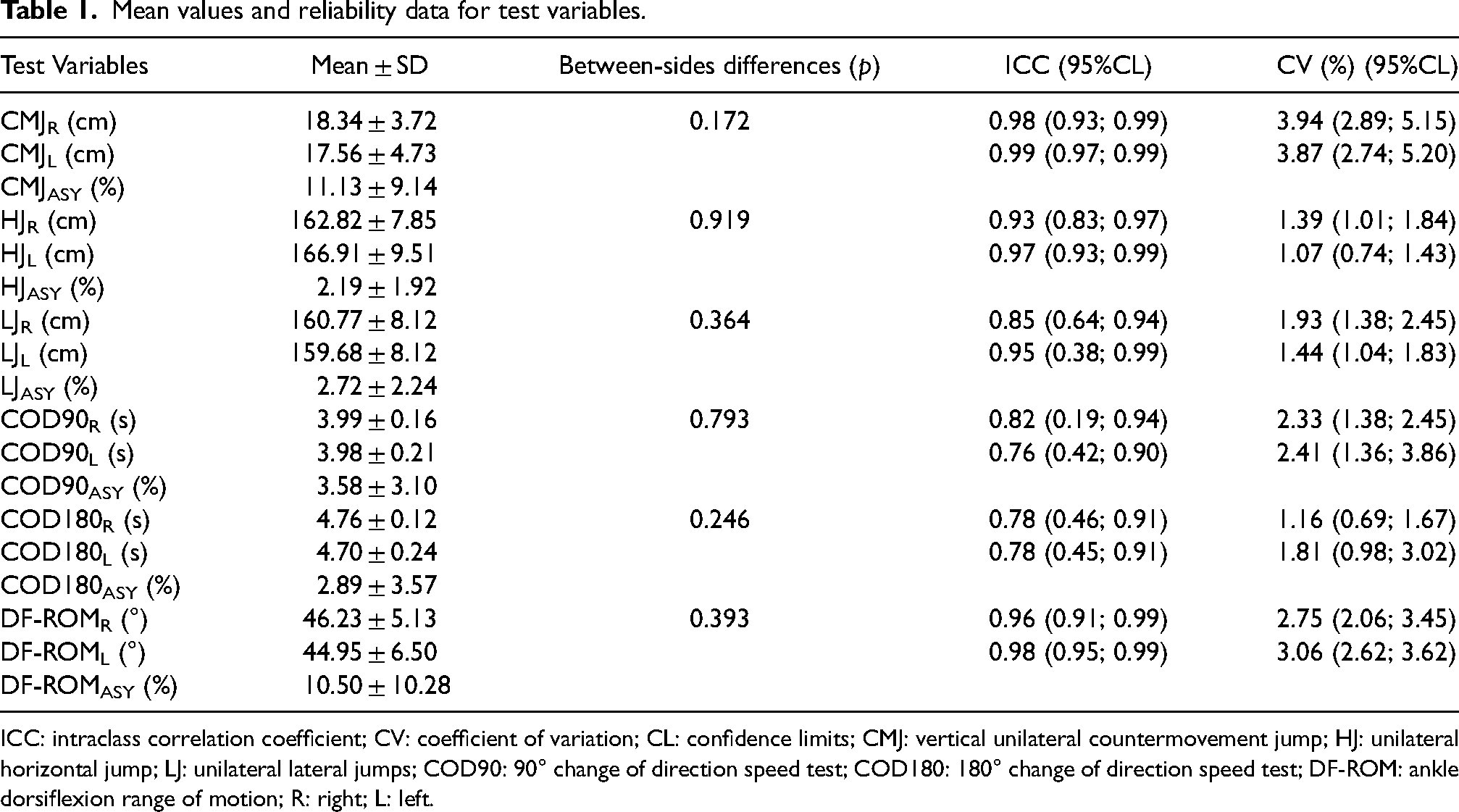
ICC: intraclass correlation coefficient; CV: coefficient of variation; CL: confidence limits; CMJ: vertical unilateral countermovement jump; HJ: unilateral horizontal jump; LJ: unilateral lateral jumps; COD90: 90° change of direction speed test; COD180: 180° change of direction speed test; DF-ROM: ankle dorsiflexion range of motion; R: right; L: left.
Sample description and test outcomes
Descriptive statistics of test outcomes are displayed in Table 1 and Figure 2. No significant differences were observed between sides for any of the test variables (p > 0.05). Highest values of bilateral asymmetry were found in CMJ and DF-ROM tests (10%–11%). Furthermore, most of subjects had CMJASY and DFASY magnitude above 10%. Most subjects had bilateral asymmetry that favored the right limb in CMJASY (n = 13) and LJASY (n = 13), whereas most of subjects had a bilateral asymmetry that favored the left limb in COD90ASY (n = 12).
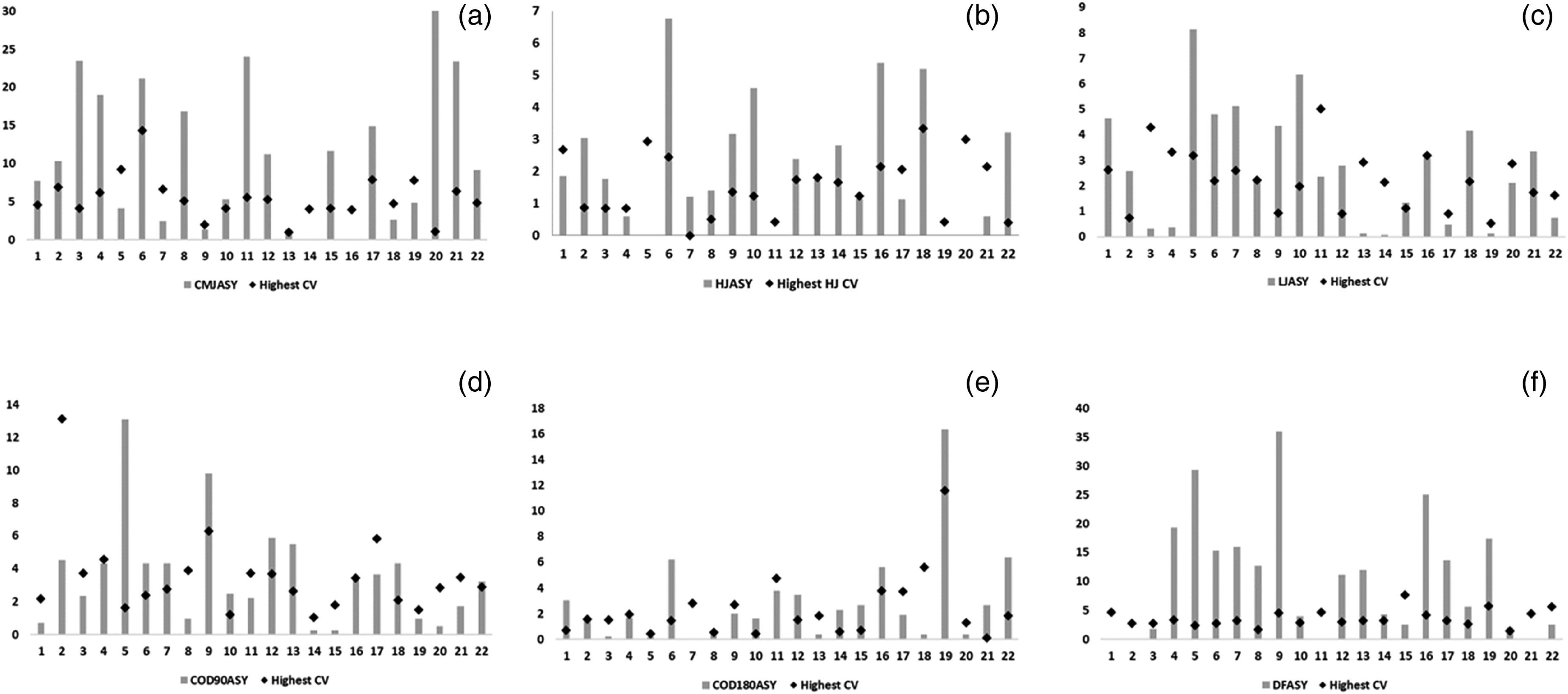
Individual player data showing the magnitude of interlimb asymmetries for all asymmetry tests; and highest coefficient of variation for each test. (a) CMJASY; (b) HJASY; (c) LJASY; (d) COD90ASY; (e) COD180ASY; (f) DF-ROMASY. DF-ROM: dorsiflexion range of motion; CMJ: countermovement jump; HJ: horizontal jump; LJ: lateral jumps; COD90: 90° change of direction speed test; COD180: 180° change of direction speed test.
Furthermore, a higher percentage of subjects had a real asymmetry score (i.e., an asymmetry value higher than CV) in DF-ROMASY (68%, Figure 2F), CMJASY (64%, Figure 2A), and HJASY (59%, Figure 2B). All subjects had at least one real asymmetry; and a mean of 3.36 real asymmetries (SD: 1.36; range = 1–6) per subject was observed (Figure 2). Moreover, only 3 subjects had real asymmetries in all physical performance tests.
Predicting agility tests performance
The CMJR explained a moderate amount of variance for COD90R (adjusted R2 = 0.39, F(1, 21) = 14.134, p < 0.001; β = −0.029, p < 0.001, 95% CI [−0.045, −0.013]) (Table 2). The model predicts that for each centimeter increase in CMJR, COD90R would decrease 0.029 s. Whereas, the LJR explained less amount of variance for COD180L (adjusted R2 = 0.23, F(1, 21) = 7.201, p < 0.05; β = −0.020, p < 0.05, 95% CI [−0.035, −0.004]), with small effect (Table 2). The model predicts that for each centimeter increase in LJR, COD180L would decrease 0.020 s.
Predictors of agility tests performance.
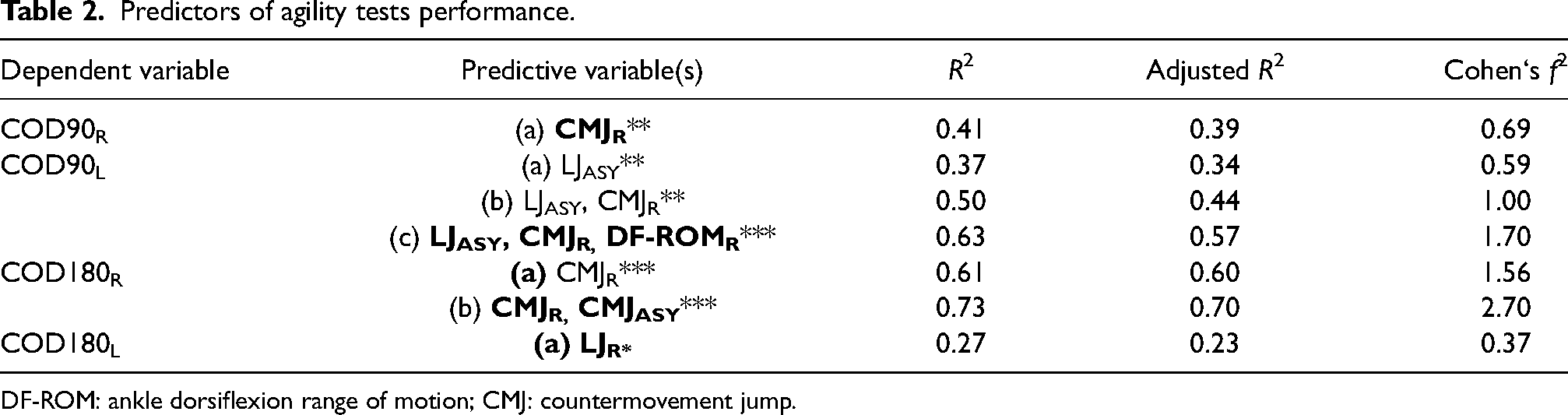
DF-ROM: ankle dorsiflexion range of motion; CMJ: countermovement jump.
The full model for COD90L explained 57% of the variance (adjusted R2 = 0.57, F(3, 21) = 10.408, p < 0.001), with large effect. LJASY (β = 0.046, p < 0.01, 95% CI [0.016, 0.077]), CMJR (β = −0.024, p < 0.05, 95% CI (−0.043, −0.006)) and the DF-ROMR (β = −0.016, p < 0.05, 95% CI (−0.029, −0.003)) were identified as statistically significant predictors in the model (Table 2). The model predicts that for each LJASY increase, COD90L would increase 0.046 s and for each centimeter increase in CMJR, COD90L would decrease 0.024 s (Figure 3A). Finally, for each increase in degrees in DF-ROMR, COD90L would decrease 0.016 s (Figure 3A). The full model for COD180R explained 70% of the variance (adjusted R2 = 0.70, F(2, 21) = 25.084, p < 0.001), with large effect. CMJR (β = −0.029, p < 0.001, 95% CI [−0.037, −0.020]) and the CMJASY (β = −0.005, p < 0.05, 95% CI [−0.008, −0.001]), were identified as statistically significant predictors in the model (Table 2). The model predicts that for each centimeter increase in CMJR, COD180R would decrease 0.029 s and for each increase in CMJASY, COD180R would decrease 0.005 s (Figure 3B).
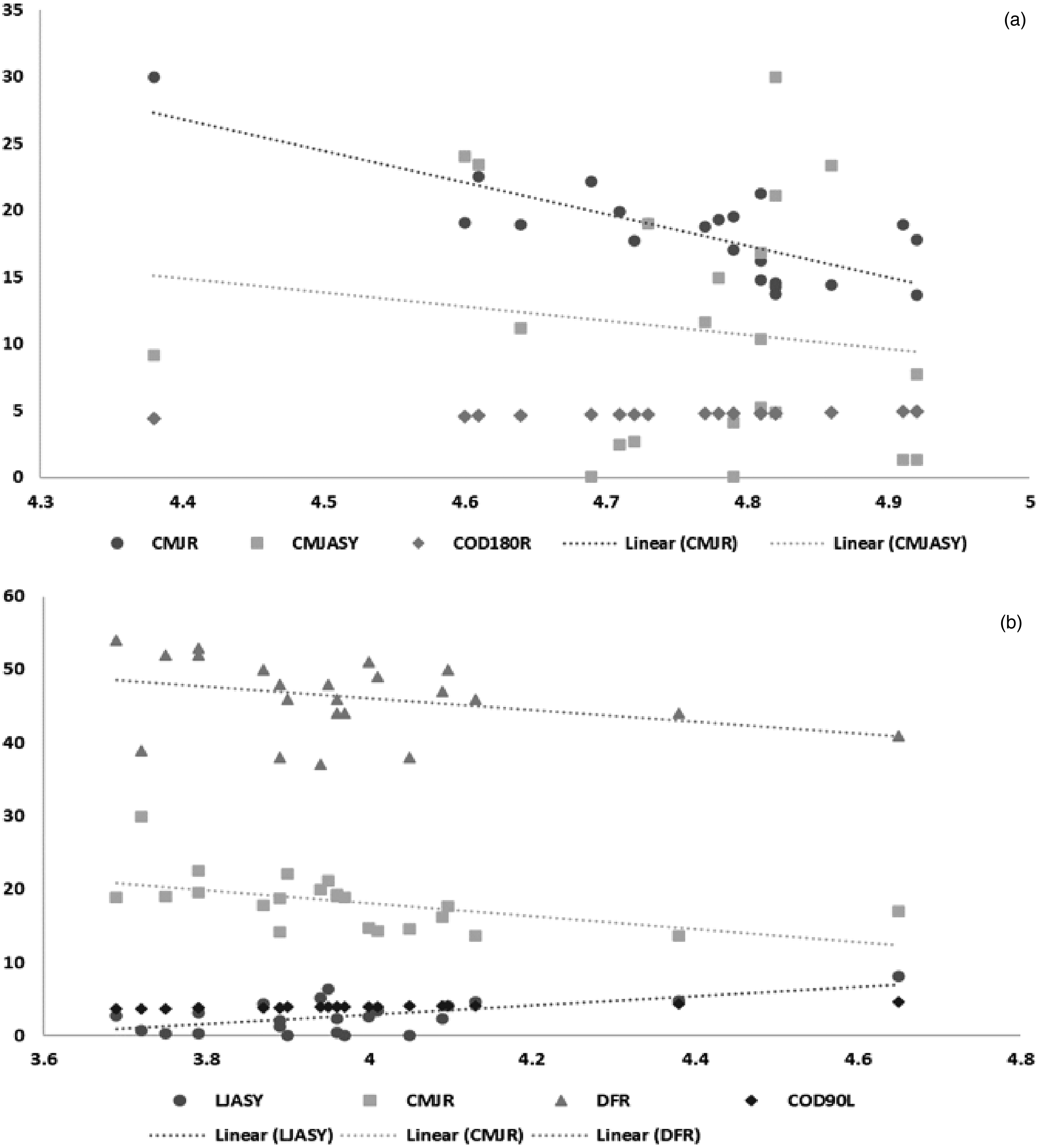
Linear regressions for predicting (A) COD180R and (B) COD90L. COD90: 90° change of direction speed test; COD180: 180° change of direction speed test.
Discussion
The aim of this study was twofold (a) detail multi-directional (vertical, horizontal, and lateral) jumping asymmetries, change-of-direction-based asymmetries, and ankle dorsiflexion asymmetries and (b) examine how asymmetries and performance in multi-directional jumping and ankle dorsiflexion predict performance during COD tests. Most of subjects had CMJASY and DF-ROMASY above the 10% cut-off criterion for bilateral asymmetries. Moreover, a significant association between bilateral asymmetry in different performance tests was observed. Finally, it was possible to significantly predict performance during COD tests (COD90 and COD180), using performance and asymmetries during multi-directional jumping and ankle dorsiflexion tests.
It is widely established that well-developed physical performance is an essential skill among soccer players. 26 The physical performance in the present study is distinct than observed in previous studies carried out on soccer players of different competition levels.4,10,11,14,27,28 Specifically, lower values in single-leg CMJ were obtained in elite male under-23 male academy soccer players (mean CMJR = 15–17 cm; CMJL = 15–17 cm) 11 ; similar in professional soccer players (mean CMJR = 18 cm; CMJL = 18 cm) 4 ; and higher values in male under-18 to under-23 youth soccer players (mean CMJR = 21.80–24.31 cm; CMJL = 22.30–24.88 cm). 10 Despite similarities in terms of strength and conditioning training experience (minimum of 2 years of structured training), differences in training contents, load (i.e., number of sets and repetitions), but also testing procedures (e.g., infrared optical system versus force platform) could explain the differences recognized between-studies. Considering between-studies differences at performance level, subjects might experience distinct match and training load demands, 29 and consequently may have developed physical qualities distinctly. Furthermore, the present study reported lower values for COD180 than in the previous study including semi-professional male soccer players (mean COD180R = 5.21 s; mean COD180L = 5.24 s) 14 ; however, higher values of COD90 were observed compared to other studies involving semi-professional male soccer players (mean COD90R = 3.24 s; mean COD90L = 3.22 s). 28 Specifically, faster 180° COD performance includes significantly higher braking and propulsive forces (particularly horizontal) on the final foot contact. 30 The differences between studies could be explained by the type of surface where the test took place (e.g., turf), and the type of shoe used. For example, one study carried out in laboratory setting including American football players demonstrated the influence of the type of running shoes in knee and ankle kinetics of 180° cutting maneuver. 31 That said, performing 180° cutting maneuver using natural turf studs football shoes resulted in smaller moments, but also reduced peak negative plantar flexor powers when compared to synthetic turf studs. 31
Moreover, lower values of DF-ROM were observed in including semi-professional male soccer players comparing to the present study (mean DF-ROMR = 35.17°; mean DF-ROML = 34.65°). 14 Despite subjects being of the same level of performance (semi-professional), the time of day or season may have influenced DF-ROM. In fact, a previous study on professional soccer players demonstrated a significant influence of data collection timing, respecting match or season. 32 Specifically, lower DF-ROM was obtained in post-season, but not significantly different compared to pre- and mid-season; however, significantly lower DF-ROM was observed 48 h post-match, compared to the pre-match values. 32 That said, discrepancies between studies at testing procedures level can explain differences observed, given that variation of DF-ROM was not explained by match load parameters. 32
Regarding bilateral asymmetries, the present findings showed a high number of subjects with values above 10%. We also report distinct bilateral asymmetries compared to observations in similar soccer population.6,9 For example, most of young sub-elite male soccer players (22 out of 42) had a bilateral asymmetry above 10%. 6 Taking these results into account, it‘s possible that soccer players can be more predisposed to various injuries during high-intensity activities (e.g., cutting and landings), because of additional stress placed on the weaker leg due to bilateral asymmetry. 5 Indeed, in young elite team-sports athletes those more predisposed to injury had single leg countermovement bilateral asymmetry considerably above 10% cut-off criterion (mean CMJASY = 16.98%) compared with non-injured counterparts. 33 Therefore, it is imperative to carry out training strategies (e.g., bilateral and unilateral strength and plyometric training, and balance and core training) to reduce discrepancies between lower limbs, in order to participate in sport in safe manner. 34
We demonstrated that performance and asymmetries during multi-directional jumping and ankle dorsiflexion tests can explain variance during COD tests (COD90 and COD180). Specifically, the CMJR partially explained performance in COD90R, COD90L, and COD180R. The greater performance in a single vertical countermovement jump is associated with eccentric and concentric peak vertical ground reaction force, concentric peak power and concentric peak vertical power/body weight. 35 Furthermore, the single vertical countermovement jump includes peak activity of knee muscle stabilizers (vastus medialis and lateralis), with a greater magnitude resulting in better performance.36,37 Interestingly, the same pattern of muscle activity it was observed in the aggressive cutting angle maneuver (90–180°),17,36 particularly in plant and acceleration steps of 90° cutting maneuver including 4 m approach distance. 17 That said, these data suggest that the effective use of stretch-shortening cycle (SSC) in unilateral jumping, can confer an advantage in SSC in other high-intensity activities (i.e., COD). Furthermore, COD90L performance is also explained by LJASY and DF-ROMR, alongside CMJR. These findings are in line those observed in college students, were CMJR was significantly correlated with left COD performance. 38 Moreover, the influence of ankle dorsiflexion in COD which involves a more aggressive cutting angle (≥ 90°) was previously observed. 17 More aggressive cutting angles require higher braking requirements, 39 and for this reason alterations in ankle dorsiflexion can result in compensatory mechanisms including ineffective frontal and transverse control planes which influences dynamic balance, impairing dynamic performance. 40 Furthermore, alterations in ankle dorsiflexion can influence the ability to lower the body‘s center of mass, 40 critical to perform cutting maneuvers. The ability to keep center of gravity in a low position, involving the ankle and knee should be about or less than 90 degrees is paramount to prepare for any directional change. 41 When male soccer players completed greater COD angles cutting maneuvers, ankle dorsiflexion was higher. 17 COD90 uses greater knee and ankle excursions when compared to less aggressive cutting angle maneuver (45°). 42 Moreover, baseline DF-ROM influences cutting kinematics during unanticipated cutting maneuvers performed by right dominant team-sports athletes (mainly soccer and rugby). 43 Specifically, increases in transverse plane knee ROM, sagittal plane trunk ROM, but also decreases in trunk flexion at initial contact for each increased degree of ankle dorsiflexion. 43
Alterations in ankle dorsiflexion can result in increased subtalar joint pronation, and tibial internal rotation, resulting in dynamic knee valgus. 40 These compensatory mechanisms can result in distinct frontal and transverse control planes, negatively influencing dynamic balance 40 ; and consequently dynamic performance (e.g., COD tests). Moreover, these alterations can influences the ability to lower the body’s center of mass, 40 critical to prepare for any directional change. 41 This ability is higher when CODs involve more aggressive cutting angles (≥ 75°), such as COD90 or COD180, due to the higher braking requirements. 39 That said, present findings suggest discrepancies between limbs in terms of structural properties (i.e., ankle dorsiflexion) can influences the ability of lower limbs to produce and absorb forces, resulting in bilateral asymmetries in dynamic activities (e.g., cutting maneuvers).
Higher performance in unilateral jumping using the dominant leg in soccer (right), 44 and accentuated bilateral asymmetry resulted in better performance in COD180R. The 180°COD performance includes improved isometric and eccentric strength capacities, 45 but also high peak muscle activity of the knee muscle stabilizers (vastus medialis and lateralis). 36 Interestingly, both vertical jumping and 180° COD had similar knee muscle stabilizers (vastus medialis and lateralis) recruitment, but the cutting maneuver required significantly higher activity of adductor longus, semitendinosus, and biceps femoris. 36 Alongside the pattern of activity in knee muscle stabilizers during functional tasks (i.e., unilateral jumping), subjects experienced in main activities of soccer game, i.e., kicking and cutting, higher activity of posterior chain muscles (biceps femoris and gluteus maximus).46,47 That said, athletes may have benefitted from the combination of experience physical and technical requirements of soccer with enhanced unilateral performance, resulting in advantageous 180° COD performance.
Readers should be aware that these findings are based upon third-division semi-professional soccer players. Whilst the standard of our sample is sound, the implications of these findings likely only apply to those of a similar playing level. Indeed, those playing and competing at different levels could have different bilateral asymmetries during jumping and dorsiflexion tasks, and the predictors of COD performance might be different. We cannot suggest that other playing levels improve their CMJR, for example, as it could have implications for injury risk. However, this limitation provides a direction for future work i.e., determining the bilateral asymmetries and predictors of COD performance in other samples of soccer players.
Conclusions
Based on current findings, it seems that coaches and practitioners should be aware that most of the subjects in semi-professional have real bilateral asymmetries in jumping and dorsiflexion tasks. Moreover, a significant association between bilateral asymmetry in different performance tests was observed. We found that it was possible to significantly predict performance during COD tests (COD90 and COD180), using performance and asymmetries during multi-directional jumping and ankle dorsiflexion tests. In fact, the unilateral vertical jumping performance, in the mainly dominant leg in soccer, partially explained most of the performance during COD tests. In this regard, coaches and practitioners can take advantage of carried-out strength and conditioning programs to address bilateral asymmetries, to reduce the amount of stress placed in weaker structures, and consequently obtain a decreased likelihood of injury, but also a well-developed wide range of physical qualities and COD performance. Notwithstanding, practitioners should be aware that higher performance in unilateral jumping associated with higher bilateral asymmetry can result in better performance during 180° COD performance, clearly influenced by sport-specific experiences.
Footnotes
Declaration of conflicting interests
The author(s) declared no potential conflicts of interest with respect to the research, authorship, and/or publication of this article.
Funding
The author(s) received no financial support for the research, authorship, and/or publication of this article.
Ethical approval
The current study was approved by the Catalan Sports Council Ethics Committee and conformed to the recommendations of the Declaration of Helsinki.
