



Abstract
In this pioneering work, we reflect on transfers in women's football. For this purpose, we collected all transfers from the two seasons with the most records in Portugal (the 2019/2020 and 2020/2021 seasons). The four dimensions associated with individual and prestige characteristics conducive to changing clubs, as well as 14 variables, were tested. For treating the problem of the endogeneity of some variables, we used a probit model with instrumental variables. The results obtained showed that high values of “goals per match” increase the probability of a player having an international transfer. Other determinants, such as the position of the transferring club or the player's field position, are also discussed in detail.
Introduction
Women's football has received increasing attention, both in practice and in academic publications. In 2021, there was a 73% increase in the value of official transfers compared to 2020, according to the FIFA Global Transfer Report. 1 There was a 19.3% increase in the number of clubs involved in transfers between 2020 and 2021, from 347 to 414. These figures reflect the growing professionalization of players, clubs, and championships. The amounts spent on transfers grew by 72.8%, as mentioned, from 1.05 million euros in 2020 to 1.83 million in 2021. The previous year, for the first time in the history of women's football, the barrier of one million euros had been broken. However, as so far, no comparable study has been done for identifying determinants for explaining the found heterogeneity of transfer values in the world of women’s football.
Academic attention has also followed this evolution. For example, the Scopus database counted eight articles published in 1980 containing the words “female soccer”; in 2021, the same database identified 515 articles containing the same words. However, if we search for “female soccer transfer determinants” or for “female football transfer determinants,” we only find one document for the first group and none for the second set of words, respectively. Even the found document for “female soccer transfer determinants”—Furley et al. 2 —is not related to the economic study of transfer values as we intend to do in this research.
However, this significant evolution has had different places across the globe. While it has been observed that countries such as France, the United States, or Sweden have a high level of maturity in their women's football competitions, other countries—although also members of the OECD—do not show equivalent maturity levels. In fact, as some of the literature has observed, the evolution of women's football has occurred mainly in societies with greater gender equality, which has allowed for lower costs—also of social or cultural pressure—for the athletes’ option for a football career.
One of the countries that began to show the development of women's football, especially in the early 2000s, was Portugal. However, 20 years later, most contracts still do not involve fees or remuneration attributed to athletes from Portuguese clubs. Despite the remuneration being varied, it is not close to the remuneration attributed to male athletes. Even so, recent seasons have been characterized by an intensification of signings in women's football. This phenomenon affected Portuguese clubs, either as contracting clubs or clubs providing athletes.
Since Portuguese sport—in particular, football—is recognized as a revolving door for many athletes, we intend to identify which variables of the four traditional dimensions for the realization of transfers in men's football will also be significant in the modality for women. The four traditional dimensions are (i) socio-demographic characteristics of the player (assessed by dimensions such as nationality and age); (ii) sports performance of the player (measured by the number of goals scored, by the time of use, or by the number of games in which she participated); (iii) prestige status (division and position of the teams of origin, division and position of the contracting teams, and total titles of the athlete); and (iv) the legal status of the transfer (if definitive transfer, if loan, and the athlete's professional level).
In all, 1304 international player transfers took place in 2021, a 26.2% increase compared to 2020, which saw a growth of 23.3%. In the women's sector, transfers from Brazil to Portugal also dominate worldwide, with 19 deals, followed by the Mexico-United States (17) and Sweden-United States (16) flow.
Although Keira Walsh's move from Manchester City to Barcelona (in summer 2022, involving more than 457,000 euros) updated the previous record of Pernille Harder (who set the 2020 record for transfers involving women's football when she left Wolfsburg for Chelsea in exchange for 350,000 euros), significant differences between women's and men's football persist Neymar's transfer was the most expensive in men's professional football until the July 2021 transfer window. This transfer was 634 times larger than Harder's. Other differences are visible in the television revenue of the men's English League, which is 200 times greater than that of the women's. The winner of the men's Champions League can earn up to 85.1 million euros, while in the women's, it can reach, at best, 1.4 million euros. In the last men's World Cup, France won 38 million euros, while the United States, champions of the last women's World Cup, won 3.3 million—12 times less.
Thus, the remainder of this article is arranged as follows. Section “Literature review—from reviewing the facts to the four test dimensions” is related to the literature review. Section “An empirical analysis of transfers of players from the first and second league Portugal to and from foreign clubs” describes the main numbers associated with the modality and it discusses the methodology (centered on the estimation of the probit model with instrumental variables) and the results achieved. Finally, the section “Conclusion” concludes the article.
Literature review—from reviewing the facts to the four test dimensions
The international panorama
Between 2018 and 2021, the transfer market of the women's football market grew by 300%, according to the International Transfer Snapshot report (FIFA 3 ) carried out by FIFA, which analyzes the development of the area, as well as its income. The study showed that men's football felt the effects of the pandemic. In contrast, women's football grew, even if it is still undervalued and far from the fair and equal visibility that would be necessary. One example of this great market for signings and sales of women's football was the signing by Chelsea Football Club of Pernille Harder, a multi-champion athlete, who was nominated as the best player in the UEFA Champions League (2019–2020) after her performance for Verein für Leibesübungen Wolfsburg. The transaction earned the German club a profit of over 300,000 euros, a transfer record in women's football. Other significant international transactions involved athletes Lucy Bronze, Alex Morgan, and Karina Saevik.
In 2021 alone, 576 players changed teams and moved around US$1.24 million. This value represents an increase of 51% in relation to the previous year, which moved US$ 821,800. However, the remuneration of women's football has increased; in 2018, the year in which the report began to be carried out, women's football generated US$ 258,800, a growth of almost 300% in 4 years (FIFA 3 ).
Authors such as Ravel and Comeau 4 indicate that the appreciation of the investment market happened primarily because of the 2019 Women's Football World Cup in France, which was important for the sport's growth and a milestone for the category. The visibility the sport gained with the success of the competition was one of the factors for this rise. This event registered 1 billion viewers worldwide. Some recent works that analyze FIFA Women's World Cup are Csató ( 5 Chapter 5) and Lapré and Palazzolo. 6 Even the number and value of international transfers in the winter window (usually, the month of January) for women's football clearly shows an uprising trend between 2018 and 2021 (Ponto de partida 7 ): 69 transfers (involving a global value of US$ 223.8 thousand) in 2018; 100 transfers (US$ 54.1 thousand) in 2019; 185 transfers (US$ 193.6 thousand) in 2020; and 177 transfers (US$ 310.1 thousand) in 2021. Other values and details can be examined in sources like FIFA 3 or Forbes. 8
Women's football in Portugal
Coelho 9 mentions that women's football in Portugal had a remarkable development from the 1980s onwards. Few clubs had women's football teams in that period, with Boavista standing out as the club with the most athletes selected for the national team. Considering Coelho's numbers, 9 it is observed that there would be, on average, one female soccer athlete per Portuguese municipality.
In 1984, the National Cup began the first national women's football championship in Portugal. Gradually, several clubs created women's training teams, fundamental for implementing women's football in the country and arousing interest in other athletes for the sport. However, it still lacked visibility through the most relevant clubs associated with the men's football teams. This scenario began to change with the investment made by Sporting Clube de Portugal and Sporting Clube de Braga, which became the first clubs with professional women's football teams in Portugal. 9 Since 2017, the number of athletes with a contract has increased from 22 to 125, with a monthly average of 1500 euros for payment.
As Almeida 10 observes, a foreign player with a contract tends to earn a higher remuneration than a national player. Teams in the main Portuguese competition have heterogeneous budgets, ranging from 100,000 to 2 million euros. Also, as a rule, there are no significant records in Portugal of paid transfers—except Ana Borges, from Chelsea to Sporting, for 30,000 euros, and Milena from Famalicão to China, for 50,000 euros. However, it is recognized that this is a rapidly growing area in Portugal, and in 2021, an agency was created just for the women's segment: Teammate Football Management, founded by Raquel Sampaio, a former player and former manager of Sporting Clube de Portugal.
Coelho 9 mentions that in 2018 there were more than 4000 federated players, the highest number recorded in the history of women's football in Portugal. Therefore, on average, there are now 13 federated players for each Portuguese municipality. In addition to the increase in the number of clubs that created and stimulated the development of women's football, there are also more competitions, with 10 in 2020: five of them dedicated to senior teams, such as the Allianz National Women's Championship, the Women's Portuguese Cup, the Super Cup Women's Football, the Women's Promotion Championship, and the Women's Promotion Cup, the latter two referring to the second division of football. There are also four championships for junior teams, besides the National Junior Women's Under-19 Championship and the National Junior Cup for women.
An empirical analysis of transfers of players from the first and second league Portugal to and from foreign clubs
A descriptive analysis
As already mentioned, there are no significant records in Portugal of paid transfers. However, the last two seasons have seen the most impressive international transfers involving Portuguese clubs with women's football teams. In this work, we will analyze the determinants associated with the transfers of athletes involving foreign clubs and Portuguese clubs with particularly significant records in these first two seasons.
The three Portuguese clubs that most exported talent were Sport Lisboa e Benfica, Sporting de Braga, and Clube Futebol Benfica; each promoted the transfer of two players. In most cases, the transferred players occupy the midfield position (six players) or a forward position (3) while one player occupied the defense. On average, the transferred player played 13.6 games in the original season, scored 8.4 goals, and played 1113.8 min. Of the players transferred, six athletes had at least one international appearance. None of the transferred players won titles for the national team, but on average, the Portuguese player who transferred to foreign clubs had 2.9 club titles in her history.
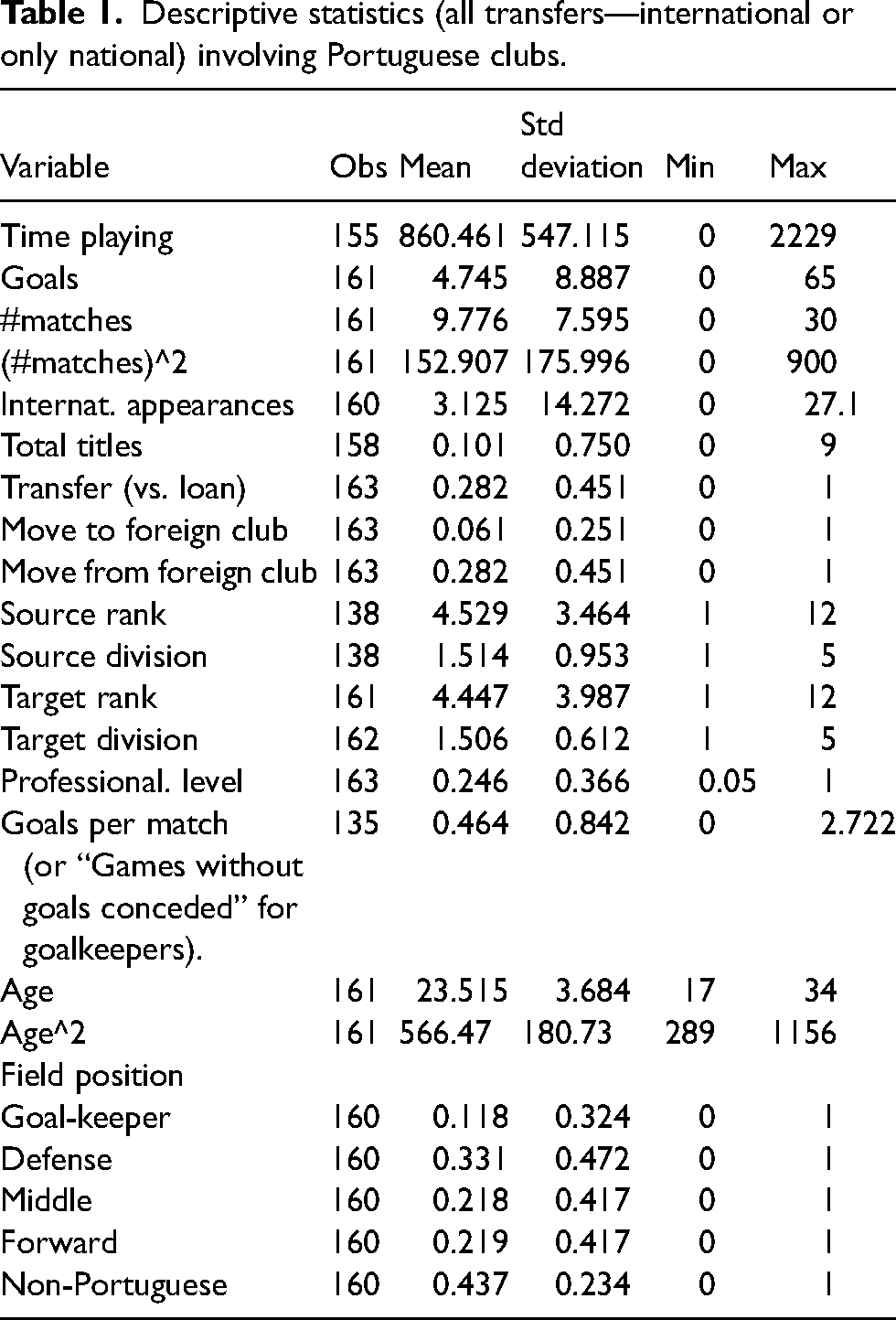
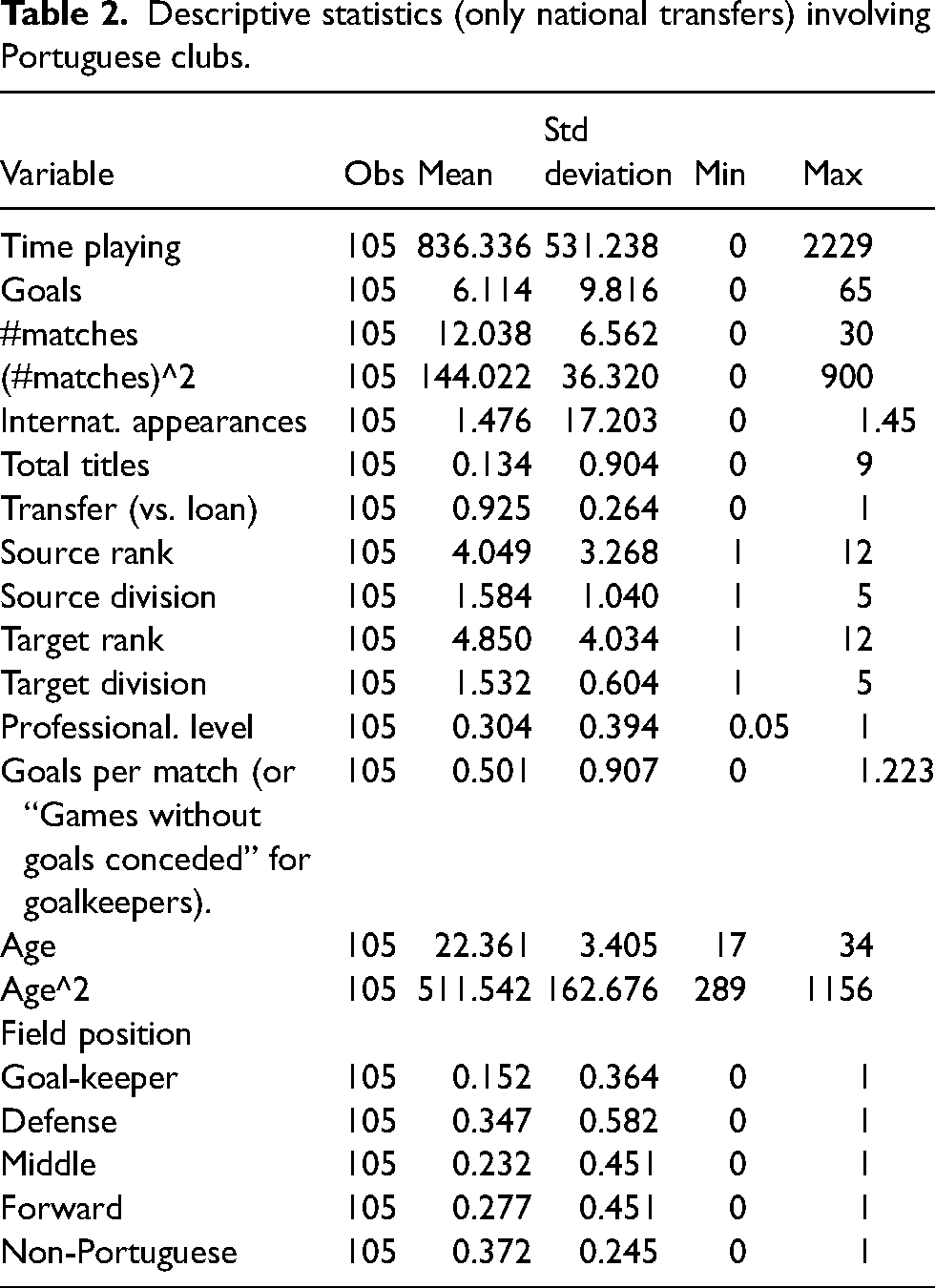
Nine of the 10 transferred players played in the previous season in clubs in the Portuguese first league, and one athlete (Ana Dias) played in the second national division. Most of the players ended the season of origin in the top places of the league table (two players in the first place, one player in second place, and two players in third place, respectively). The clubs to which the Portuguese players were transferred play in the first, second, and third divisions of their respective countries; in addition, one player (Suzane Pires) was transferred to a club that plays in a Brazilian state championship (Campeonato Paulista). The destination clubs are spread over eight countries: three players were transferred to Italian clubs, and one to each of the following leagues: the English, the Spanish, the Hungarian, the Brazilian, the Russian, the Dutch, and the Finnish. Additional details are exhibited in Tables 1 and 2.
Descriptive statistics (all transfers—international or only national) involving Portuguese clubs.
Descriptive statistics (only national transfers) involving Portuguese clubs.
Determinants of transfers in the world of football—the four traditional dimensions
For an original attempt at the literature, we will study these player transfers involving Portuguese clubs and foreign clubs. In the seasons under observation (2019/2020 and 2020/2021), there were 164 player transfers involving Portuguese clubs, of which 107 involved only Portuguese clubs.
The literature on player transfers is already vast, concentrated in the field of men's football (a recent paper on the issue is by Monteiro et al. 11 ). As already commented, the literature on female soccer players is much scarcer, partly because many of the values do not (yet) involve the traditional fees and because the women's sport is more recent. However, this condition does not prevent us from trying to understand whether other influences operate in the mentioned transfers, namely the player's performance by goals scored (in case she is not a goalkeeper) or the achievement of titles in the championship of origin.
We will study the probability of a player from a Portuguese club being transferred to a club abroad and the probability of a player from a foreign club being transferred to a Portuguese club. Such probabilities will be conditioned to the dimensions traditionally pointed out in the literature. This set of variables can be structured in four dimensions: socio-demographic characteristics of the player (nationality and age); sporting performance of the player (measured by the number of goals scored per match or time of use); prestige status (division and position of the teams of origin, division and position of the contracting teams, and the total number of titles of the athlete); and the legal condition of the transfer (if definitive transfer, if loan, and the athlete's professional level). In the following paragraphs, we will detail the four dimensions based on the literature.
Socio-demographic characteristics were studied in analyses by authors such as Mourao 12 or Harkness-Armstrong et al. 13 On the one hand, age is one of the most frequent characteristics in the analyses. Athletes usually have a club change cycle depending on their age, the experience accumulated in the contracting clubs’ levels, and the specific needs of squad renewal (both the ceding team and the contracting team). Nationality is another important dimension 14 ; nationality associated with the same spoken language helps in transmitting information between teammates and coaches, facilitating integration in squads of the contracting team (the so-called reduction of transaction costs).
Performance characteristics are also repeatedly studied. Thus, athletes with a greater number of games played, greater score of goals scored (or, if goalkeepers, games without goals conceded15,16), and greater use of time players are players with a confirmed competitive profile in past seasons.17, 18 Analyses focused on these dimensions were those by Garcia-del-Barrio and Pujol 19 and Čeriová et al. 20 Additionally, there may be periods of greater demand for certain field positions in the contracting clubs and a greater supply of positions in the ceding clubs (e.g. as a result of the action of the training schools for junior players). Thus, in this type of analysis, it is also important to detail the usual position (goalkeeper, defender, midfielder, or forward) in which the player plays. 20
There is then an important set of signals, albeit relatively exogenous to the athlete. For example, it has been observed that athletes from qualified teams (champions or with other meritorious performances) tend to prolong their professional life and are able to try out for contracts in competitive championships abroad.21,22 Thus, both the division and final position of the teams (either the originator team or the contracting team/destination team) are important in influencing the probability of player migration. Additionally, individual titles (both in clubs and national teams), although not the exclusive responsibility of a titled athlete, end up characterizing her as a competent athlete in demanding competitions, contributing to greater attention from larger clubs in international terms.
Finally, the contractual dimension was suggested after reading Feess and Muehlheusser, 23 Terviö, 24 and Depken and Globan. 25 In this case, it is important to discern whether the change of club is contemplated as a transfer (generally associated with a permanent move to the new club) or a loan (temporary change to the new club, with the athlete returning to the original club at the end of the period). Given the advancement of professionalization in the world of women's football, as highlighted by Feess and Muehlheusser, 23 it is also important to identify whether the footballer comes from a professional contract or an amateur athlete relationship.
Empirical section—testing the hypotheses through a probit model
Based on the literature review and the availability of official data (from the Portuguese Football Federation) for the observed changes involving Portuguese athletes and clubs, we collected the following variables for each player: Goals per match of each player, target division (the soccer division of the destination club, one being the Premier National League, two the league immediately below the Premier league, etc.), target rank (the rank of the destination club, one being the first position at the standings table, two the second position at the standings table, etc.), source division (the soccer division of the origin club, one being the Premier National League, two the league immediately below the Premier one, etc.), source rank (the rank of the origin club, one being the first position at the standings table, two the second position at the standings table, etc.), number of played matches, squared number of matches, field position (goalkeeper, defense, middle field, and forward), age, square of age, total number of titles of the player, professionalization level of the player, contractual format (transfer/loan), national-born/foreign, and time playing (in minutes). We also observed whether the change of club, for each player, involved only Portuguese clubs, or if it also involved foreign clubs, either as destination clubs or as clubs of origin. It should be noted that the use of “Square of Matches” and “Square of Age” is in line with several empirical suggestions that have shown how variables associated with “temporal accumulation” tend to exert a nonlinear effect on dimensions related to changes in sports clubs.26–29
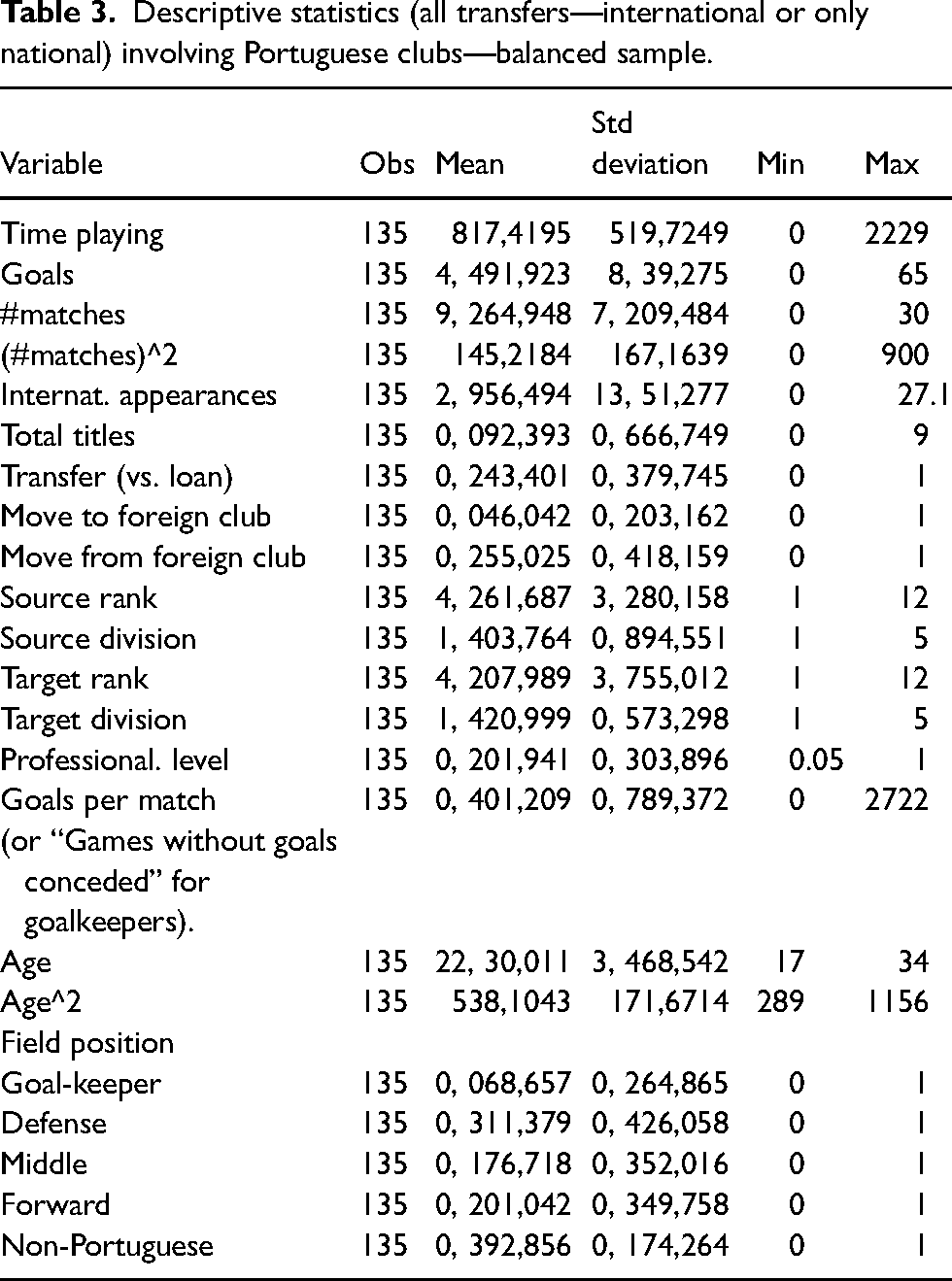
Table 1 reveals the descriptive statistics of the variables we will analyze for all transfers involving players from Portuguese clubs or destined for Portuguese clubs in the 2019/2020 and 2020/2021 seasons. In a summary analysis, we observe the following. The average age was 23.5 years. On average, each of these players scored 0.4 goals per game. Most of them played in the respective major league and clubs at the top of the league table. On average, they had 3.1 international appearances and one title (mostly national) in their history. The median player had played 9.7 games and scored 4.7 goals. On average, the player under observation played 860 min. Table 2 reveals the descriptive statistics of these variables but only considering transfers involving Portuguese clubs (as a source or as a destination of the transfer). Table 3 exhibits the descriptive statistics of these variables considering the balanced sample (the 135 individuals with observations in all variables).
Descriptive statistics (all transfers—international or only national) involving Portuguese clubs—balanced sample.
Given that, in our database, we identified the transfer of female players involving Portuguese clubs as a dichotomous variable (Y), we have to opt for logit or for probit regressions. It is nowadays canonical that logit regressions provide (very) close results to probit regression. Which one each researcher chooses to estimate is mostly a matter of personal choice, and of theoretical rationales. However, there are (empirical) criteria like AIC or BIC helping to provide an empirical basis for the choice. Therefore, considering the statistical values got for each type of regression from AIC and BIC, we opted for probit models (the next tables of results show these AIC and BIC values). If necessary, we can also exhibit full tables for the logit outcomes. Therefore, we will use a probit specification (equations (1.1) to (1.3)).


In these probit specifications, Y' refers to the Φ−1(Y), that is, to the cumulative normal distribution of the dichotomous variable Y. X is a matrix of explanatory variables and β is the related vector of estimated coefficients; ε is the error term.
Let us recall that z can be interpreted as a quantile. So, Φ(z) = P(Z ≤ z), Z∼N(0,1). Therefore, the probit coefficient β can be interpreted as the change in z associated with a one-unit change in X. We know that the effect on z of a change in X is linear, but we recall that the relation between z and the dependent variable Y is nonlinear (because Φ is a nonlinear function of X).
Let us start by studying the probability of a Portuguese female soccer player being transferred to a foreign club. Table 4 shows our estimated model.
Probit model (migration of a female player from a Portuguese club to a foreign club).
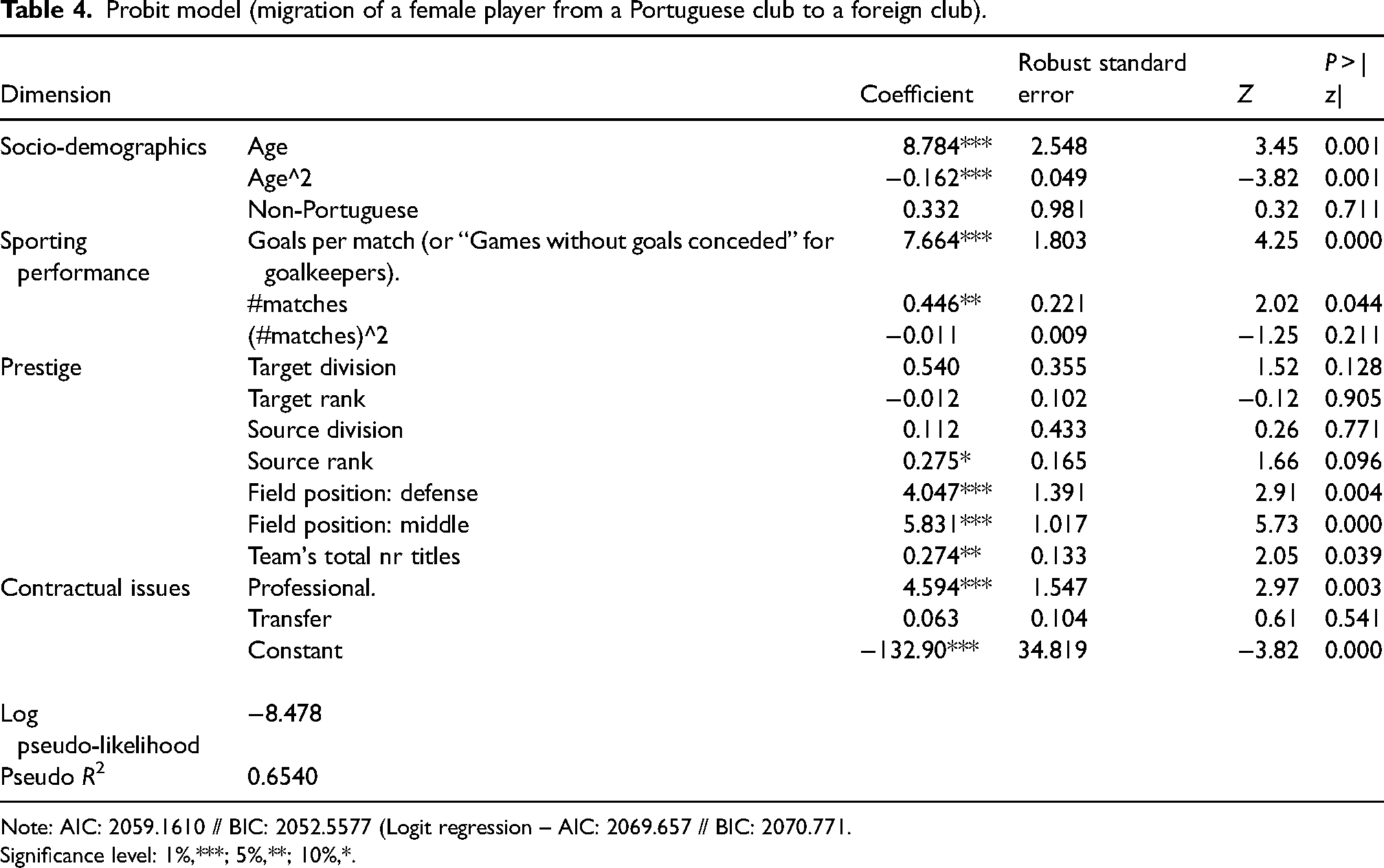
Note: AIC: 2059.1610 // BIC: 2052.5577 (Logit regression – AIC: 2069.657 // BIC: 2070.771.
Significance level: 1%,***; 5%,**; 10%,*.
Linear interpretations of these parameter estimates are not so obvious as for logit models, and so, if relevant, we can provide them upon request. The conventional interpretation is that the probit regression coefficients give the change in the z-score or probit index for a one-unit change in the predictor. Φ(Z) lies in the range [0,1], with Φ being the cumulative normal distribution. The column of P > |z| refers to the probability the z-test statistic would be observed under the null hypothesis that each predictor's regression coefficient is zero, given that the rest of the predictors are in the model.
We started by analyzing the set of variables related to the four dimensions by a probit model whose dependent variables identify whether the player migrates from a Portuguese club to a foreign club. Later on, we will also discuss the issue of endogeneity. Now, let us focus on the estimates in Table 4.
Considering the estimated coefficients for Sporting Performance, we observe that the significant estimates are those for “goals per match,” and for the “number of matches.” Higher values of these variables significantly increase the chances of a Portuguese female player migrating to a foreign club. 25 Considering socio-demographic variables, we found an inverted-U relationship between a player's age and her chances of moving to a foreign club. Actually, the inflection point is at the age of 27.11 years old; after this point, the chances of playing abroad for a player in the Portuguese Women League decrease. In the set of prestige dimensions, a lower rank of the sourcing team and a higher number of its titles increase the chances of a player migrating, similar to Garcia-del-Barrio and Pujol. 19 The estimates in Table 4 also proved that defenses and middle fields are positions with higher chances of moving toward a club abroad. Finally, considering contractual issues, being a professional player enhances the likelihood of playing abroad in the following season. 13
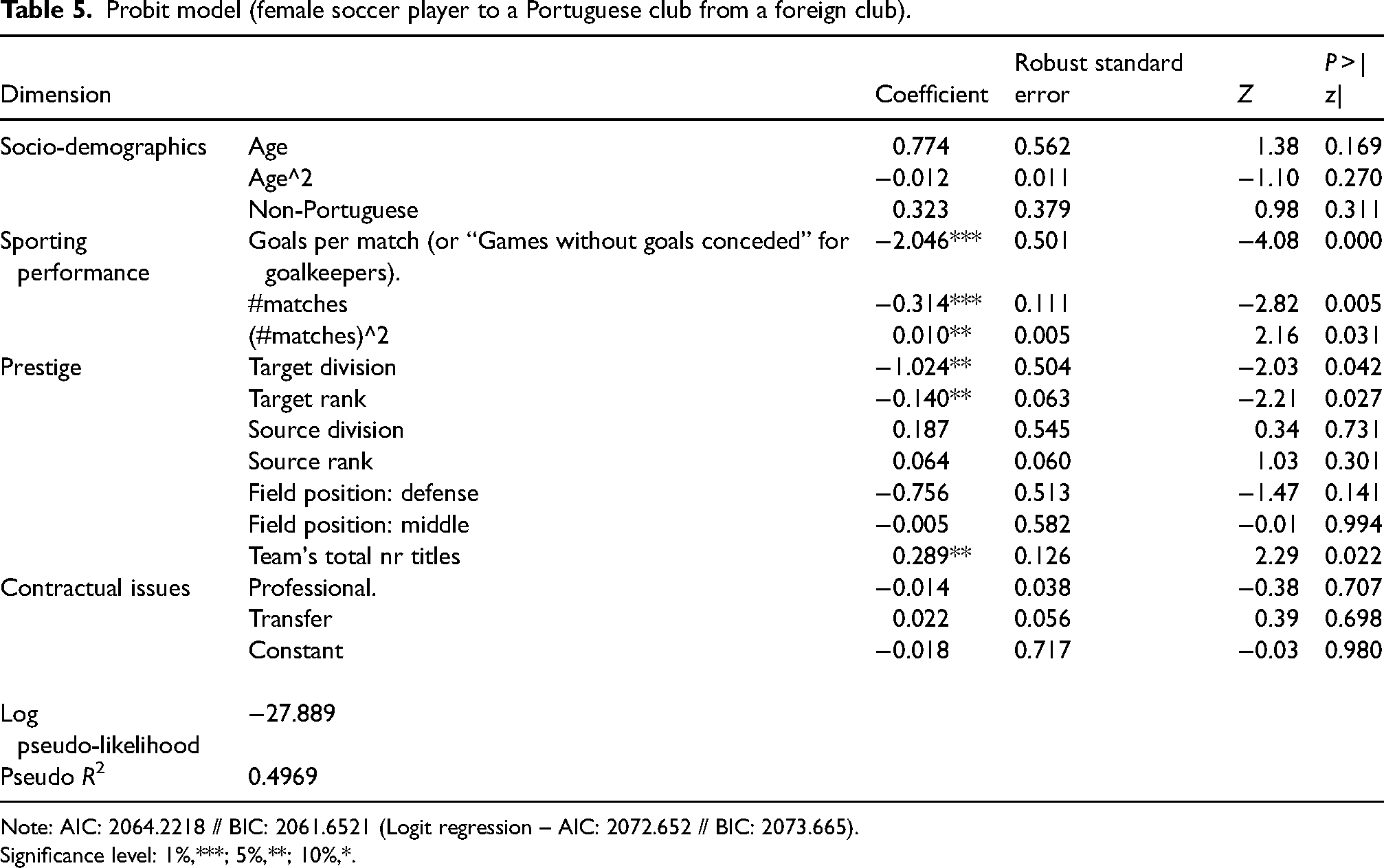
Table 5 shows the estimates for the probability of a Portuguese club hiring a female soccer player from a foreign club.
Probit model (female soccer player to a Portuguese club from a foreign club).
Note: AIC: 2064.2218 // BIC: 2061.6521 (Logit regression – AIC: 2072.652 // BIC: 2073.665).
Significance level: 1%,***; 5%,**; 10%,*.
Table 5 validates, in the case of the importation of players from foreign clubs, the importance of two dimensions: Sporting performance and Prestige. For sporting performance, we observe that a higher value of goals per match now decreases the chances of a female soccer player coming to the Portuguese Championship. Interestingly, the sign associated with the number of played matches and to its squared value shows there is an inflection point in the estimated relationship between the number of matches of a player and her probability of moving to a Portuguese team. In this case, the inflection point happens around 15 matches. After this value the chances of a player coming to Portugal significantly increase. 28 This shows that the Portuguese clubs are not yet offering competitive wages for foreign forward players. Considering prestige dimensions, Table 5 shows that these players tend to come to the first Portuguese league (we recall that the second league had the value of two while the first league had the value of one); these players also tend to come to the less competitive teams (positive coefficient estimated to “target rank”) and usually they come from clubs with high values for titles. 2
The remaining coefficients were not characterized by significance levels below 10%, so we cannot validate the associated hypotheses. Regarding the tests in the final lines of Table 5, they allow us to form a conclusion on the quality of the estimations.
Dealing with endogeneity and efficiency issues
Following the literature in the section “Literature review—from reviewing the facts to the four test dimensions,” we considered determinants for each player, including age, nationality, goals per match, and field positions. However, since the goals scored per match may depend on unobservable individual characteristics that also influence the outcome of interest, the respective coefficient β from equation (1.3) may still be biased. One solution to this problem is the use of instrumental variable (IV) regressions, where the idea is to isolate the goals per match of each observed transferred player that are uncorrelated with ε by finding an IV that predicts these goals but exerts no impact on the outcome variable. Other issues threatening the possibility of endogeneity relate to high levels of correlation among the explicative variables or the construction of some supposed exogenous variables by recurring to other exogenous variables.
As proposed tests, the empirical literature suggests the Wald test of exogeneity or the Smith-Blundell test of exogeneity. If these tests reject the null hypothesis of exogeneity, then following Kilic et al., 30 the strategy of using instrumental variables provides a consistent estimation of the β coefficient. We recall that our dependent variable is binary, that is, equal to 1 if there is a transfer involving a foreign club and 0 otherwise. Consequently, the OLS estimator must be discussed considering non-linear limited dependent variable specifications that could accommodate the treatment for the endogeneity of the endogenous variable (i.e. goals per match). Therefore, we will use selected instruments in the instrumental variables probit (IVProbit command in Stata) specification. Following Kilic et al., 30 “The IVProbit procedure in Stata attempts to fit models with dichotomous dependent variables and endogenous regressors, and jointly estimates two equations via maximum likelihood (…) The major difference between the IVProbit estimator and the instrumental variable estimator (as conceptualized in its traditional framework) is that the IVProbit estimates are maximum likelihood estimations of Amemiya's generalized least square estimator,31,32 where endogenous variables are treated as linear functions of their instruments as well as other exogenous variables.”
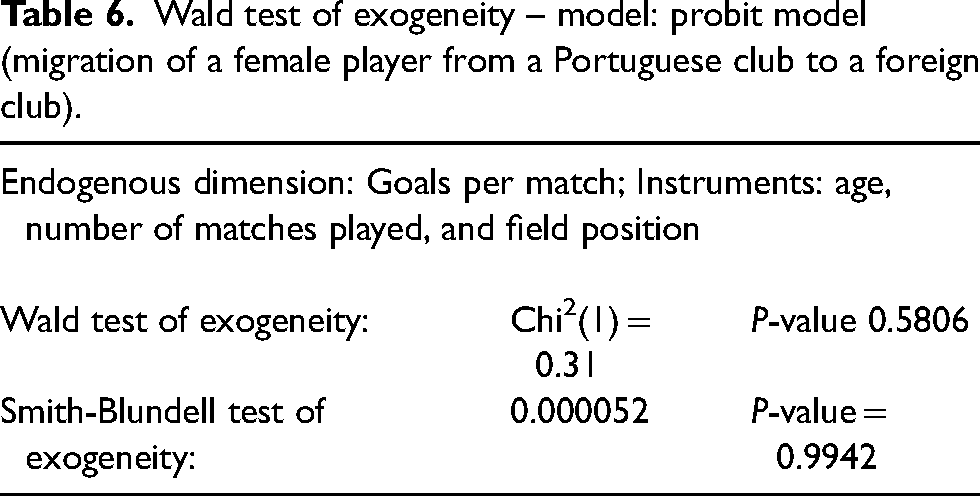
We have investigated the two most likely sources of endogeneity in our models: goals per match depending on age, a number of matches played and field position; and the square of matches depending on the number of matches played, the age of the player, and on the age squared. For the first source of endogeneity (goals per match depending on age, number of matches played, and field position), the respective values of these tests are in Table 6.
Wald test of exogeneity – model: probit model (migration of a female player from a Portuguese club to a foreign club).
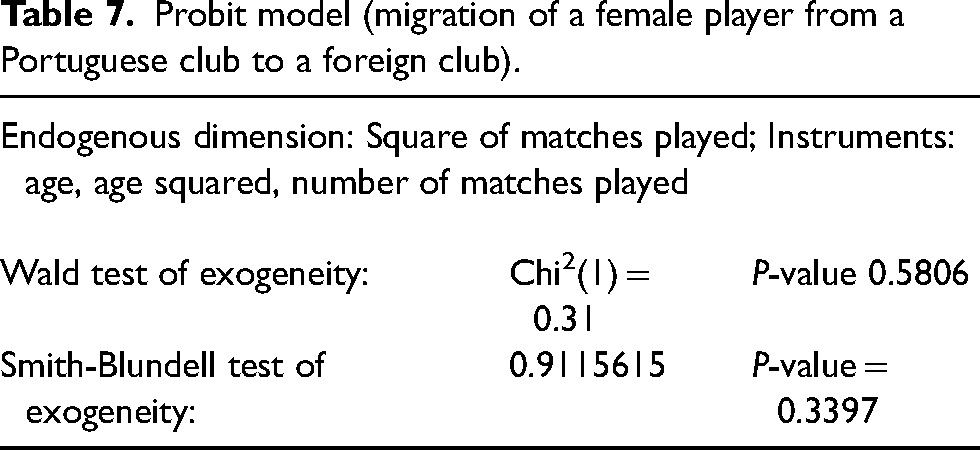
For the second source of endogeneity (the square of matches depending on the number of matches played, the age of the player, and on the age squared), the respective values are in Table 7.
Probit model (migration of a female player from a Portuguese club to a foreign club).
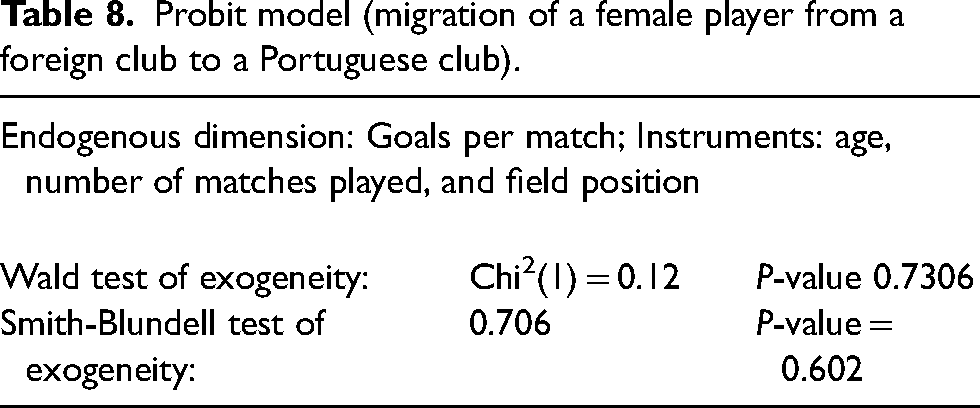
Tables 8 and 9 also study these sources of endogeneity but now consider the models of migration of a female player from a foreign club to a Portuguese club.
Probit model (migration of a female player from a foreign club to a Portuguese club).
Probit model (migration of a female player from a foreign club to a Portuguese club).
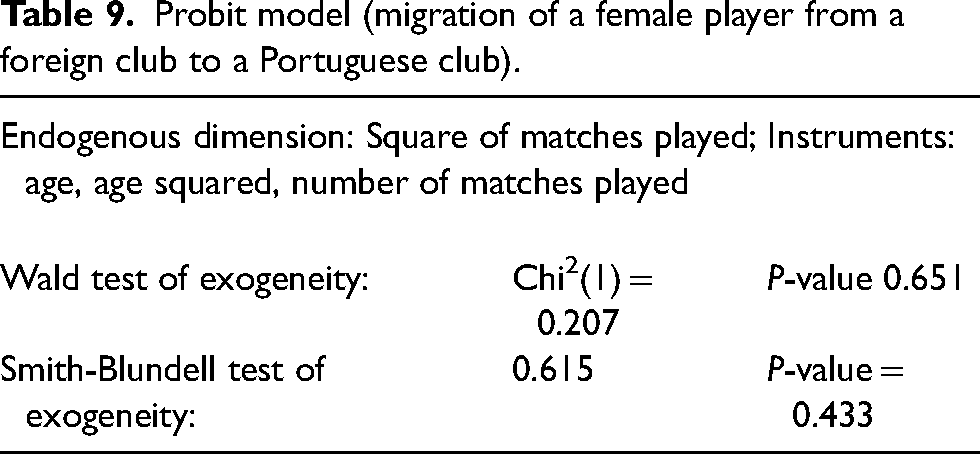
Considering the Wald test of exogeneity or the Smith-Blundell test of exogeneity, we confirm that using goals per match instrumented by a proper set of variables allows the rejection of the null hypothesis of a significant correlation between the estimated errors of the original model and the endogenous variable (goals per match). The same conclusion holds for the square of matches. As all the test statistics are insignificant, there is sufficient information in the sample to reject the null, so the regular probit regression is appropriate. In other words, because our Wald tests or Smith-Blundell tests are insignificant (p-levels higher than 10%), we cannot reject the null (of exogeneity or a non-significant correlation between the estimated errors and the endogenous relations). Therefore, we are better off using single probit equations, like those in Tables 4 and 5. In summary, there is no need for instrumental variables according to these test statistics because there is no endogeneity.
We also run a binomial probit model to combine our two dependent variables into a single model which has been found as more efficient. Table 10 shows the result, now exhibiting the marginal effects.
Biprobit estimation // marginal effects.
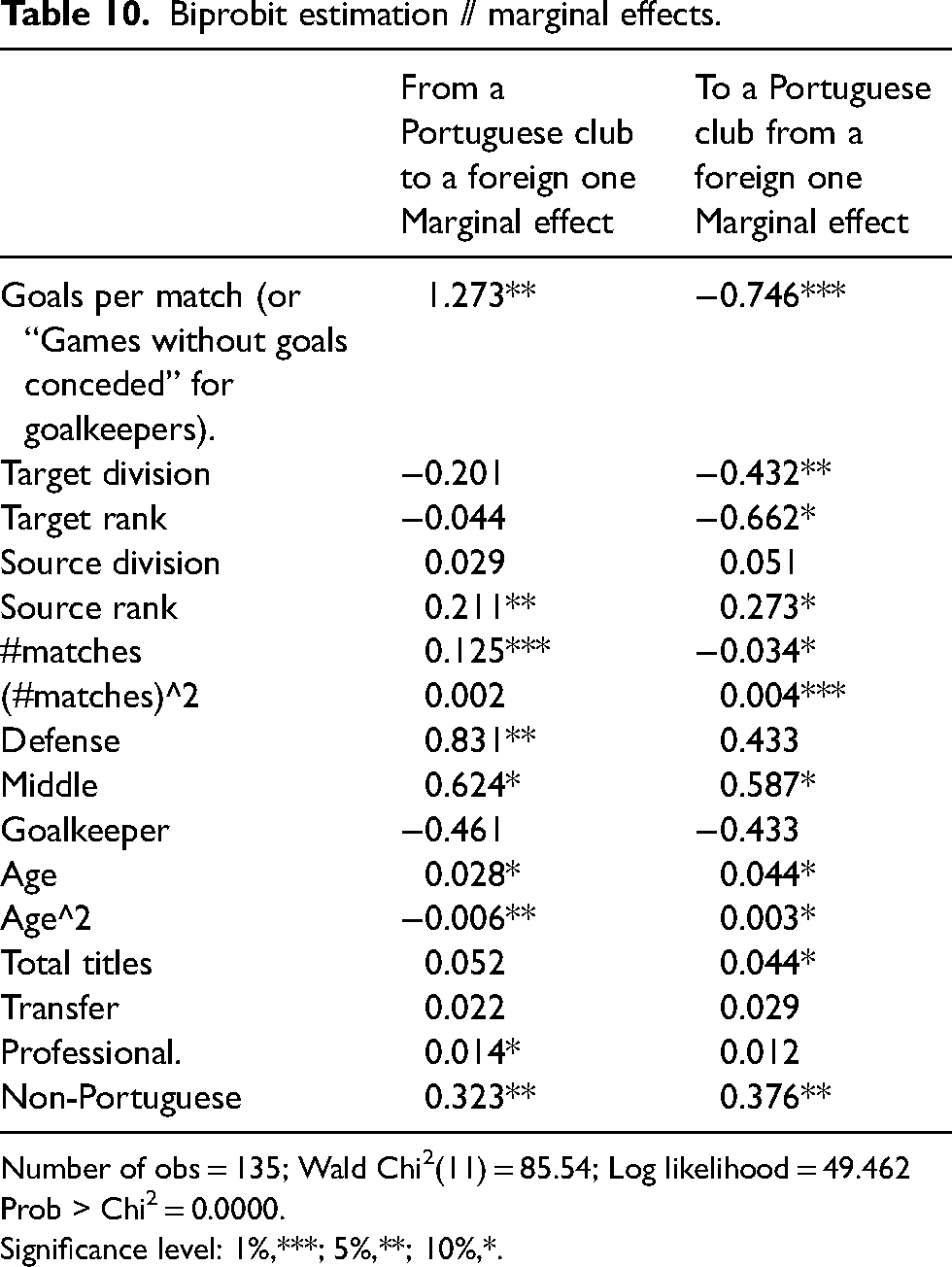
Number of obs = 135; Wald Chi2(11) = 85.54; Log likelihood = 49.462 Prob > Chi2 = 0.0000.
Significance level: 1%,***; 5%,**; 10%,*.
.
Table 10 follows the main results from Tables 4 and 5. We highlight again the role of goals per match, the importance of the sending club's rank and division as well as the age effect, especially for the export of players from Portuguese clubs.
Conclusion
This work reflected on the transfers of women soccer players involving Portuguese clubs in the 2019/2020 and 2020/2021 seasons. Although the COVID-19 pandemic took place in these sporting seasons, with serious repercussions on most transfers observed in men's football, these seasons coincided with the largest flow of movements in women's football worldwide.
One of the championships that best reflected the entry of foreign athletes was the Portuguese women's football championship, also a result of the development the sport has had in the country in the last decade. Even so, there is no study so far on transfers in women's football in Portugal or on transfers in women's football on an international scale. To counter this lapse in the investigation, this study applied probit methods to study the probability of a Portuguese club hiring a foreign athlete or a Portuguese club ceding an athlete to a foreign women's football club.
Using appropriate methods that considered the possibility of endogeneity in the original modeling, our main results identify the number of goals per game as the main dimension to increase the probability of an athlete switching between a Portuguese club and a foreign club. Further details were reached and discussed in the empirical section.
At a time when the value of transfers (fees) begins to increase significantly, as there is a trend toward professionalization of the leading national women's football championships, our results have two main lines of implications. Firstly, they show that although attention is focused on certain field positions in evolving championships such as the Portuguese championship, special attention is focused on players who bring a significant history of goals per game, an indicator of a promising scoring performance. Secondly, we observed that the transfers in question are characterized by a great diversity of values, whether in terms of age, nationality, or other dimensions such as the place of assigning clubs or contracting clubs. This evidence reveals that the transfer market is not yet specialized or focused on certain dimensions, which also proves the level of maturity of the Portuguese championship.
Finally, this work presents five challenges that further research teams can consider. The first challenge concerns the potential to extend this exercise to more transfers involving clubs from other women's football leagues. The second is related to the potential of involving network analysis in the analysis of the transfers in question, trying from now to perceive positions of the centrality of certain clubs in the international network. The possibility of studying internal transfers is our third relevant further challenge. The available data from official sources do not detail the existence of performance premia for the observed players. There are some media sources that detail such values but only for some players. However, as soon as available data contain these details for all players, we consider them deserving to be explained in further research (our fourth challenge). The fifth challenge concerns the possibility of exploring additional metrics beyond Goals or Goals per match (which clearly favors Forward players). Actually, the only available data source about the Portuguese women players does not provide information as the many sources for men around the world provide additional features like assists, completed passes, clearances, or blocks. I consider it a relevant challenge to revise these results as soon as new metrics appear as available.
Footnotes
Acknowledgements
The author acknowledges the suggestions provided by two reviewers of the journal. Additional limitations are author's exclusive ones.
Declaration of conflicting interests
The authors declared no potential conflicts of interest with respect to the research, authorship, and/or publication of this article.
Funding
The author(s) disclosed receipt of the following financial support for the research, authorship and/or publication of this article: This paper is financed by National Funds of the FCT – Portuguese Foundation for Science and Technology within the project (UIDB/03182/2020).
