



Abstract
Authentic leadership is a genuine form of leadership in which leaders demonstrate behaviours in line with their moral values. Research has started to examine this leadership style and its impact on a range of athlete outcomes. The aim of this study was to investigate whether coaches’ authentic leadership, as perceived by their athletes, is related to athletes’ commitment, positive affect and perceived teammate prosocial behaviour via trust and team culture. Participants were 366 (240 females, Mage = 21.07) athletes, participating mostly in team sports, who completed questionnaires assessing the aforementioned variables. Using multilevel path analysis, we found that authentic leadership was positively related to athletes' commitment and positive affect via trust and team culture, as well as to perceived teammate prosocial behaviour via trust. Our findings enhance our understanding of authentic leadership in sport and highlight its importance in predicting a range of outcomes. The findings suggest that authentic leadership in coaches could be key to creating more positive environments in sport.
Introduction
Given the social nature of sport, coaches are seen as highly influential within sports environments and can impact on athletes’ development, emotions and morality. 1 Recent leadership models focus on the relationships leaders develop and the interactions they have with their followers. 2 One such model of leadership, which is highly relevant to sport, is authentic leadership. 3 Research shows that authentic leadership is positively related to several desirable outcomes in athletes, such as commitment and enjoyment4,5. However, although some studies have examined authentic leadership in sport, the majority of authentic leadership research has been conducted in organizational contexts. Yet, authentic leadership is highly relevant to sport and could facilitate numerous positive athlete outcomes. This study aims to address gaps in the literature by investigating the relationship between authentic leadership and a range of athlete outcomes.
Authentic leadership
Authentic leadership is centred around the idea of authenticity which comes from ancient Greek philosophy, referring to ‘to thine oneself be true’. 6 It is considered a genuine form of leadership, whereby leaders’ behaviours are in line with their inner beliefs and moral values. 7 Many definitions of authentic leadership exist, however in this study, we use Walumbwa et al.'s 3 definition. They define authentic leadership as ‘a pattern of leader behaviour that draws upon and promotes both positive psychological capacities and a positive ethical climate, to foster greater self-awareness, an internalized moral perspective, balanced processing of information and relational transparency on the part of the leaders working with followers, fostering positive self-development’ (p. 94). Walumbwa et al. 3 integrated previous definitions8,9 and proposed that authentic leadership is a multidimensional construct, which incorporates four key components: self-awareness, relational transparency, internalized moral perspective, and balanced processing.
Self-awareness refers to showing an understanding of one's strengths and weaknesses and being aware of their impact on others. 3 One cannot be considered authentic unless one is aware of oneself and so self-awareness is key to authentic leadership. 9 Relational transparency pertains to authentic leaders being open with their followers through showing their true thoughts and feelings, while minimizing the expression of inappropriate emotions.10,3 Internalized moral perspective suggests authentic leaders have internal moral standards, which influence their behaviours, rather than being guided by group and societal pressures 11 and are able to express where they stand on controversial issues. 3 Finally, balanced processing (of information) means that authentic leaders take into account all available information, including their followers’ perspective, before coming to an objective decision. 3 These components are interconnected, forming a coherent model.
Authentic leadership shares similarities with other models, such as transformational leadership, which focuses on transforming and motivating followers, 12 and ethical leadership, which is concerned with demonstrating normatively appropriate conduct and promoting such conduct in followers. 13 However, it is conceptually distinct from these models as demonstrated by empirical studies. Specifically, studies examining authentic leadership, transformational leadership and ethical leadership have shown that authentic leadership explains variance in follower outcomes that is not explained by transformational and ethical leadership.3,5 Thus, there is merit in investigating authentic leadership as a separate leadership model within sport.
Authentic leadership is highly relevant to sport for several reasons. First, authentic leaders place importance on developing open and transparent relationships and are concerned with their followers’ development. This is expected to instil high levels of trust and result in positive outcomes in athletes. Indeed, it has been suggested that in order to be effective, coaches need to encourage caring and trusting coach-athlete relationships. 1 Second, the moral component of authentic leadership could help to establish moral team norms and thus may positively impact on followers’ ethical conduct. 3 This is vital given that sport is of a social nature and athletes’ behaviour could be influenced by the norms coaches create. 14 Finally, authentic leaders could create more positive sports environments, which may impact on athletes’ commitment, enjoyment and sports participation. 4 Thus, there is merit in investigating this form of leadership in sport.
Authentic leadership and athlete outcomes
In line with models of authentic leadership,8,9 this construct is expected to be related to numerous outcomes in followers. In this section, we start by discussing the potential relationships between authentic leadership and positive affect, commitment, and perceived teammate prosocial behaviour. We then outline how these relationships could be potentially explained by trust and team culture.
Based on Walumbwa et al’s. 3 definition, authentic leaders have heightened levels of positive emotions, which may influence followers’ commitment and positive affect. 9 In the sport context, sport commitment has been defined as a ‘psychological construct representing the desire and resolve to continue sport participation’ 15 (p. 6), while positive affect refers to the experience of pleasant emotions or moods 16 and is an indicator of well-being. Authentic leaders are expected to promote positive affect and commitment in followers by spreading their own positive emotions to their followers via emotional contagion processes.8,9 Support for the positive relationships between authentic leadership and athlete commitment and positive affect has been provided by several sport studies.4,5
Authentic leadership should also influence prosocial behaviour defined as ‘voluntary behaviour intended to help or benefit another individual’ 14 (p. 99). It is expected to be positively related to followers’ prosocial behaviour through authentic leaders acting as moral exemplars by demonstrating behaviours in line with their ethical standards and establishing moral team norms.8,17 Consequently, authentic leadership may increase the team's frequency of prosocial behaviour resulting in higher perceptions of teammates prosocial behaviours. Hannah et al. 17 found that authentic leadership was positively related to soldiers’ prosocial behaviours common in a military setting (e.g., demonstrating responsible behaviour, considering soldiers’ impact on others and putting the good of the group ahead of their own self-interest). In the sport context, Malloy and Kavussanu 18 found that athletes of coaches in an intervention group (which involved teaching coaches how to engage in authentic behaviours), reported significantly higher perceptions of their teammates' prosocial behaviours from pre- to post-intervention compared to the control group, whose coaches received no intervention.
According to models of authentic leadership, a key variable that authentic leadership may influence is trust. 11 Trust in one's leader is defined as being able to rely on the leader and believing that they have good intentions for the team. 19 Models of authentic leadership11,8,9 propose that authentic leaders are likely to instil trust in their followers by being genuine and acting as role models by demonstrating moral values, transparency and integrity. This should lead followers to identify with their leader which instils greater trust.8,9 The positive relationship between authentic leadership and trust has been reported in several studies in sport4,20.
Models of authentic leadership also suggest that authentic leaders may create a positive climate. 8 In this study we refer to climate as team culture, which is a concept similar to school culture as defined by Higgins-D’Alessandro and Sadh 21 as individuals’ perception of their team environment, consisting of normative expectations, leader/team relationships, follower relationships and educational opportunities. 21 Authentic leaders may create a positive team culture as they are transparent, create open relationships with followers and provide opportunities to the team; this over time may become the culture of the team. 8 Studies in organizational and nursing settings have found a positive relationship between authentic leadership and similar variables to team culture, such as team climate, defined as supportive and trusting social environments22,23. Although these studies measured team culture in slightly different ways, this construct is conceptually similar to Higgins-D’Alessandro and Sadh's 21 definition as they both focus on trusting leader–follower relationships and the perceived opportunities provided by the leader.
Trust and team culture may be directly related to athletes’ commitment and positive affect. This is because trust and positive team cultures influence followers’ beliefs about the honesty and integrity of the leader and the environment they have created.19,24,25 If followers feel they can trust their leaders and they experience a positive team environment, they are more likely to be committed and experience more positive emotions. 25 Conversely, if followers do not perceive their leader as trustworthy, they may consider quitting the team. 25 This has been supported by research which has found trust in leadership to be positively associated with followers’ satisfaction and commitment and negatively associated with the intention to quit. 24
Furthermore, trust and team culture may be directly related to athletes’ perceptions of their teammate's prosocial behaviours. Trusting relationships and positive team cultures may support followers and empower them to develop through encouraging the open sharing of information in positive sociomoral atmospheres, in turn leading to outcomes such as greater perceived teammate prosocial behaviours. 11 This may be because trusting relationships and positive climates are expected to be associated with followers’ positive attitudes, which in turn should lead to positive behaviours. 25 Such a positive sociomoral atmosphere created by trusting relationships and positive team cultures has been found to predict prosocial behaviours in sport.25–27
Trust and team culture may also explain the role of authentic leadership on athletes’ commitment and positive affect.11,8 According to models of authentic leadership 3 , authentic leaders are believed to influence followers’ commitment and positive affect as a result of followers identifying with their authentic leaders and through creating positive team cultures which promote high levels of trusting relationships that in turn positively impact on followers’ commitment and positive emotions.9,3 Thus, trust and team culture may explain the relationship between authentic leadership and commitment and positive emotions. The potential role of authentic leadership on commitment and positive emotions, via trust and team culture, has been supported by several studies in the business and nursing domains, with similar variables such as team climate.28,29,30 A study in sport also found that authentic leadership was indirectly related to athletes’ commitment via trust. 4
Trust and team culture may also explain the role of authentic leadership in promoting perceived teammate prosocial behaviour 8 . Authentic leaders are capable of influencing followers’ prosocial behaviour by creating trusting relationships and by establishing a team norm to act morally8,9,31. This in turn should lead followers of authentic leaders to show more prosocial behaviours and subsequently increase athletes’ perceptions of their teammates prosocial behaviour. Thus, trust and team culture may potentially explain the relationship between authentic leadership and perceived teammate prosocial behaviour. However, the indirect role of team culture in the relationship between authentic leadership and follower outcomes has received limited attention in sport.
Current investigation
In summary, authentic leaders may influence followers’ commitment, positive affect, and teammate prosocial behaviour by creating trusting relationships and a positive team culture28,17. Athletes’ perceptions of their teammates' prosocial behaviour and positive affect in relation to authentic leadership have received little attention in sport, while no sport study has examined the potential role of team culture in this relationship. These variables are important in promoting continued participation in sport, which is vital given the proposed 35% drop in sports participation from the age of 12 years. 32 This research will fill these gaps in the literature.
Based on the extant literature3,5,8, the purpose of this study was to investigate the role of authentic leadership on followers’ commitment, positive affect, and perceived teammate prosocial behaviour via trust and team culture. We hypothesized the authentic leadership of coaches would be positively and indirectly related to athletes’ commitment, positive affect, and perceived teammate prosocial behaviour23,28 via trust and team culture4,22,33.
Method
Participants
Athletes (N = 366; 240 females, 65.6%) from 22 sport teams that competed in university leagues or in external leagues at a regional level, from the UK, participated in the study. The sports were lacrosse (N = 120, 32.8%), field hockey (N = 80, 21.9%), football (N = 47, 12.8%), hockey (N = 30, 8.2%), netball (N = 25, 6.8%), basketball (N = 21, 5.7%), rugby union (N = 20, 5.5%), American football (N = 18, 4.9%) and athletics (N = 5, 1.4%); even though athletics is an individual sport, it was included in this study as the athletes trained and competed as a team. At the time of data collection, participants had an average age of 21.07 (SD = 5.16), had played their sport for an average of 7.74 years (SD = 5.97) and had been with their coaches for an average of 1.68 years (SD = 0.78). Participants were coached by a male (57.4%) or a female (42.6%) coach. The selection criteria for the participants were that they must train in a team sport environment and have been playing with their coach and team for a year or more so that the influence of the coach would be apparent. 34 The sample size was determined according to Schönbrodt and Perugini's 35 simulation study, who state that correlations stabilize at a sample of 250. Additionally, a review of adequate sample size and power consideration for structural equation modeling (SEM) and factor analysis suggested that a minimum sample size of 200 offers adequate statistical power of data analysis and accurate results. 36 Our sample was much larger than these suggestions.
Measures
Authentic leadership
Athletes’ perceptions of their coach's level of authentic leadership were measured using the Authentic Leadership Questionnaire (ALQ). 3 We adapted this questionnaire to be specific to sport, in line with previous studies 20 by replacing ‘my leader’ with ‘my coach’. The ALQ consists of 16 items, which measure the 4 components of authentic leadership using 4 subscales, including self-awareness (e.g. ‘my coach seeks feedback to improve interactions with others’), relational transparency (e.g. ‘my coach says exactly what he or she means’), internalized moral perspective (e.g. ‘my coach demonstrates actions that are consistent with his or her beliefs’) and balanced processing (e.g. ‘my coach listens carefully to different points of view before coming to conclusions’). Participants are asked to think about their experiences with their coach and respond on a 5-point Likert scale with 1 corresponding to ‘not at all’ and 5 corresponding to ‘frequently if not always’. This scale has been found to have very good reliability in sport (α = .85). 20
Trust
Athletes rated their perceived levels of trust using the Trust Questionnaire developed by Dirks. 19 This scale consists of nine items, and example items include ‘I trust and respect my coach’ and ‘other players consider my coach to be trustworthy’. Participants were asked to think about their experiences with their coach this season and circle the appropriate answer using a 7-point Likert scale, with 1 representing ‘strongly disagree’ and 7 ‘strongly agree’. This scale was found to be reliable (α = .96). 19
Team culture
Athletes’ perceptions of their team culture were measured using an adapted version of the School Culture Scale. 21 Team culture is a concept similar to school culture, defined as individuals’ perception of their team environment, consisting of normative expectations, leader/team relationships, follower relationships and educational opportunities. 21 The original scale consists of four subscales; however, for our study any items which could not be adapted to a sport environment were removed, leaving a 14-item questionnaire. The wording of the questionnaire was also changed so that ‘teacher’ became ‘coach’ and ‘students’ became ‘athletes’. The remaining subscales included in our study were: coach/team relationships (e.g. ‘athletes generally treat each other with respect and fairness’), athlete relationships (e.g. ‘the coach gives athletes a say in team decisions’) and educational opportunities (e.g. ‘athletes learn how to listen to other people's ideas better’). This scale has been found to be reliable (α = .85). 21
Sport commitment
Athletes’ ratings of their commitment were measured using a scale from the Sport Commitment Model. 15 This scale consists of four items (e.g. ‘How hard would it be for you to quit playing for this team’). Participants are asked to think about their experiences in their team and circle the most relevant number using a 5-point Likert scale, with 1 corresponding to ‘not at all dedicated’ and 5 corresponding to ‘very dedicated.’ This scale has been found to be reliable in sport (α = .85). 18
Positive affect
Positive affect was measured using the positive affect subscale of the Positive and Negative Affect Scale. 16 Participants were asked to read seven items describing affective states (i.e. ‘interested, excited, enthusiastic, inspired, determined, attentive and strong’) and rate the extent to which they had felt those emotions in the past few weeks, using a 5-point Likert scale with 1 meaning ‘very slightly or not at all’ and 5 meaning ‘very much.’ This scale has been found to be reliable (α = .89). 18
Perceived teammate prosocial behaviour
Athletes indicated their perception of the frequency of their teammates prosocial behaviour towards them using the adapted 37 respective subscale of the Prosocial and Antisocial Behaviour in Sport Scale. 14 In line with Al-Yaaribi et al., 37 the wording was changed so that the scale measured athletes’ perceptions of their teammate prosocial behaviour towards them. This was because authentic leaders are expected to change team norms and so an increase in the team's frequency of prosocial behaviours towards individual athletes was expected. However, as we assessed athletes’ perceptions of their teammate behaviour towards themselves, it should be noted that this measure does not assess team norms. The stem was changed to ‘this season, my teammates.’ This scale consists of five items (e.g. ‘Congratulated me for good play’) and uses a 5-point Likert scale with 1 corresponding to ‘never’ and 5 corresponding to ‘very often.’ A confirmatory factor analysis (CFA) showed the adapted scale to have a good model fit as shown by factor loadings which ranged from .60 to .85, as well as good reliability (α = .87). 37
Procedure
Before conducting the study, ethical approval was received from a university ethical committee. We then contacted the teams’ coaches, via email or phone, and asked whether their athletes could take part in the study, and informed consent was obtained. After a date and time for data collection was arranged, the questionnaires were administered to the athletes before or after a training session, in the same place as their normal training session. Data were collected towards the end of a regular university season, over 2 months (between February and March). The order of the measures in the questionnaire was counterbalanced to avoid order effects and the questionnaire took 10–15 minutes to complete. The researchers remained present at all times to answer any questions.
Data analysis
First, preliminary data analysis 1 was conducted to examine any missing data and to calculate the Cronbach’s alpha for the different scales, using SPSS, version 28. Second, a multilevel path analysis was conducted using Mplus, version 8.8, to test whether coach authentic leadership was positively related to athletes’ commitment, positive affect, and athletes’ perceptions of their teammates prosocial behaviour, both directly and indirectly via trust and team culture. A multilevel approach was used in order to capture the nested nature of the data (as a result of athletes being nested in teams), while simultaneously testing multiple direct and indirect relationships proposed in the theoretical model. Specifically, a random intercept multilevel model was specified using the latent variable covariates approach, which results in consistent (i.e. unbiased) estimates, 38 with between-level covariances. Thus, the multilevel approach was used primarily to obtain correct standard errors and the primary relationships among the variables were tested at the within (athlete) level. The model was tested using the Bayesian estimation because it does not have a distribution assumption and is an appropriate method for testing indirect relationships within a multilevel framework. 38 Results are presented using standardized estimates, which can be interpreted as effect sizes because they are expressed in standard deviation units, as well as 95% credibility intervals.
Results
Missing data on the individual items ranged from 0% to 0.8% and were assumed to be missing at random. Because only a small percentage of the data was missing, any missing data were replaced with the mean of the variable. 39 The Cronbach’s alpha scores ranged from .68 to .93 and were excellent to acceptable for all variables except for prosocial teammate behaviour as suggested by George and Mallery 40 (>.9 = Excellent; >.8 = Good; >.7 = Acceptable). Table 1 shows the reliabilities, descriptive statistics and correlations among the study variables. Correlations among the variables ranged from .16 to .68 and were all positive and significant.
Descriptive statistics, alpha coefficients and zero-order correlations, N = 366.
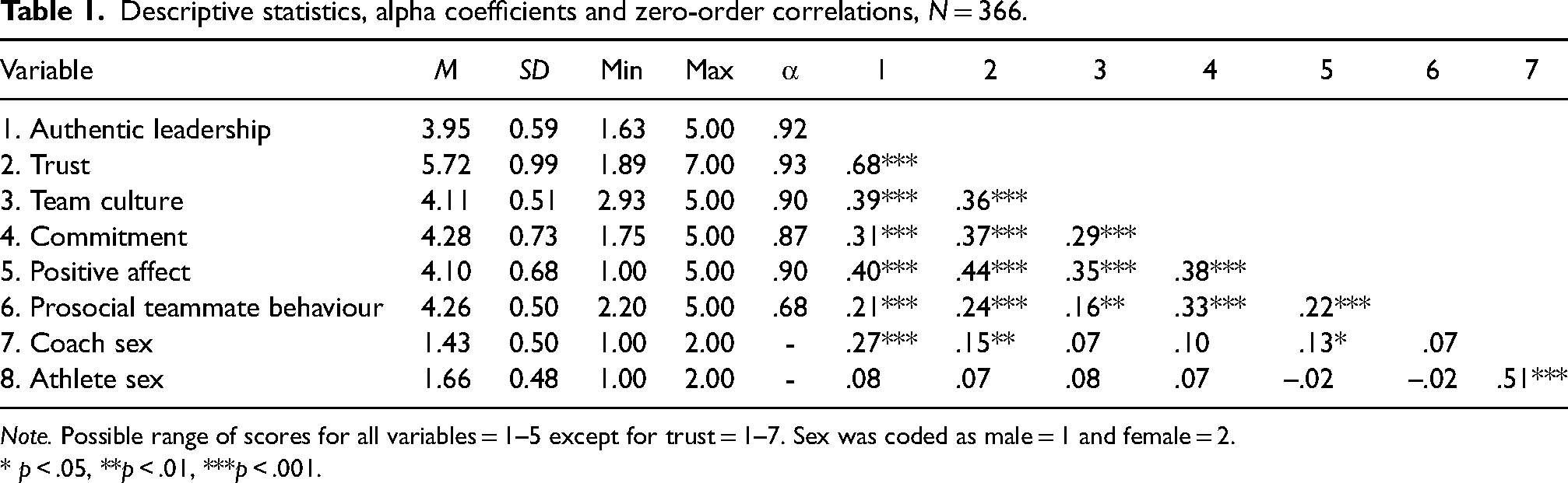
Note. Possible range of scores for all variables = 1–5 except for trust = 1–7. Sex was coded as male = 1 and female = 2.
* p < .05, **p < .01, ***p < .001.
Next, a null model was specified to calculate the intra-class correlations (ICCs), showing that the values of ICCs were: .17 for authentic leadership, .16 for trust, .10 for team culture, .20 for commitment, .13 for positive affect and .05 for perceived teammate prosocial behaviour. These results suggested that there were similarities across the athletes within each team and, therefore, multilevel modelling was an appropriate method to use to handle the non-independence of observations due to the team clustering, as indicated by the ICCs being above the acceptable level of .05.41,42,43
The full multilevel path model was tested, in which authentic leadership was specified as a predictor of trust and team culture, and authentic leadership, trust and team culture were specified as predictors of commitment, positive affect, and perceived teammate prosocial behaviour (outcomes) at the within (athlete) level. The results of the direct relationships are presentedin Table 2 and Figure 1. Overall, the model explained 41.5% of the variance in trust, 14.2% in team culture, 14.5% in commitment, 19.9% in positive affect and 7.1% in perceived teammate prosocial behaviour.
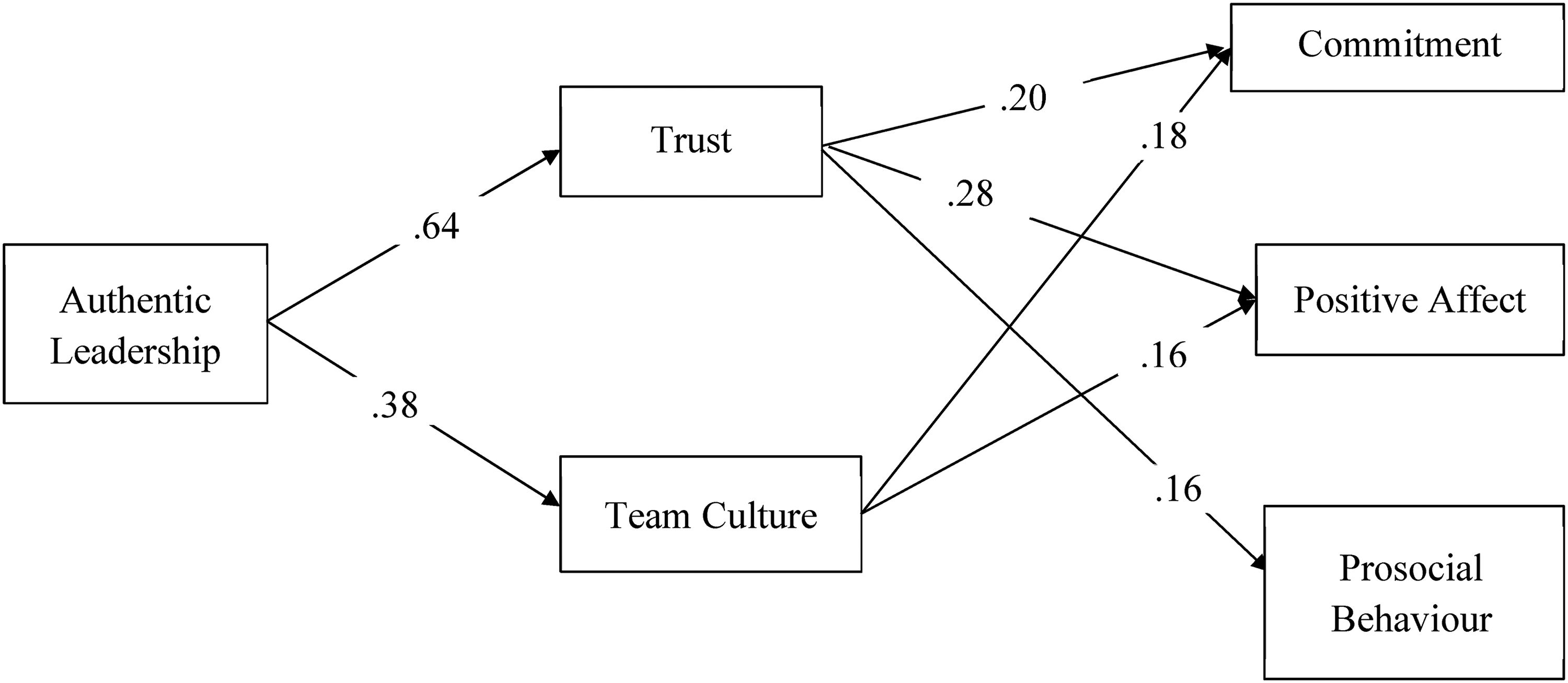
Standardized results for the direct effects of multilevel path model, N = 366. Only significant effects are presented.
Standardized results for the direct relationships among study measures, N = 366.
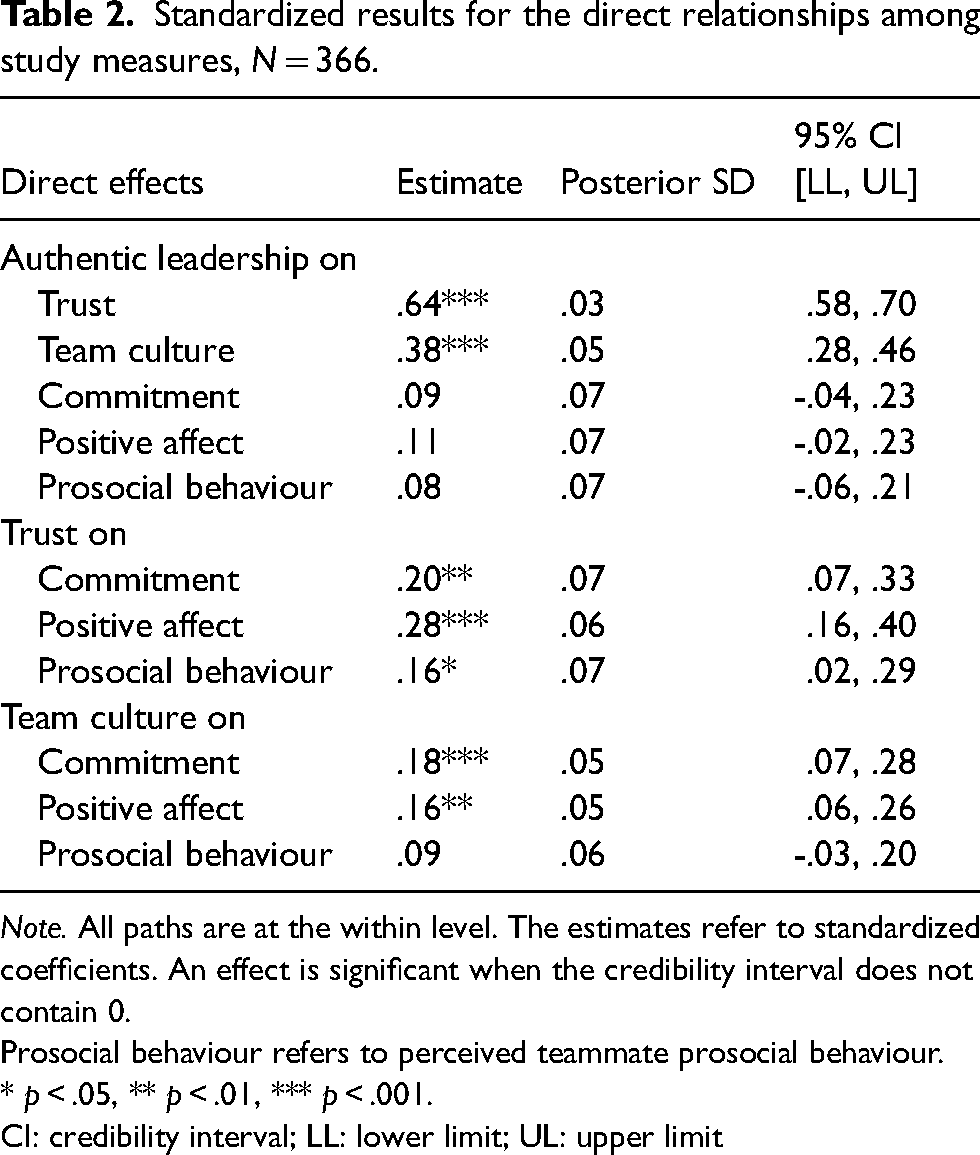
Note. All paths are at the within level. The estimates refer to standardized coefficients. An effect is significant when the credibility interval does not contain 0.
Prosocial behaviour refers to perceived teammate prosocial behaviour.
* p < .05, ** p < .01, *** p < .001.
CI: credibility interval; LL: lower limit; UL: upper limit
As shown in Figure 1 and Table 2, the multilevel path analysis revealed that authentic leadership was a positive predictor of both trust and team culture. In turn, trust was a positive, and significant predictor of commitment, positive affect, and perceived teammate prosocial behaviour. Team culture was a positive and significant predictor of commitment and positive affect but not of perceived teammate prosocial behaviour. In terms of authentic leadership results showed that it did not significantly and directly predict commitment, positive affect, or prosocial behaviour (Table 2). However, as shown in Table 3, authentic leadership was an indirect predictor of commitment and positive affect via both trust and team culture, and of perceived teammate prosocial behaviour via trust.
Standardized results for the indirect relationships, N = 366.
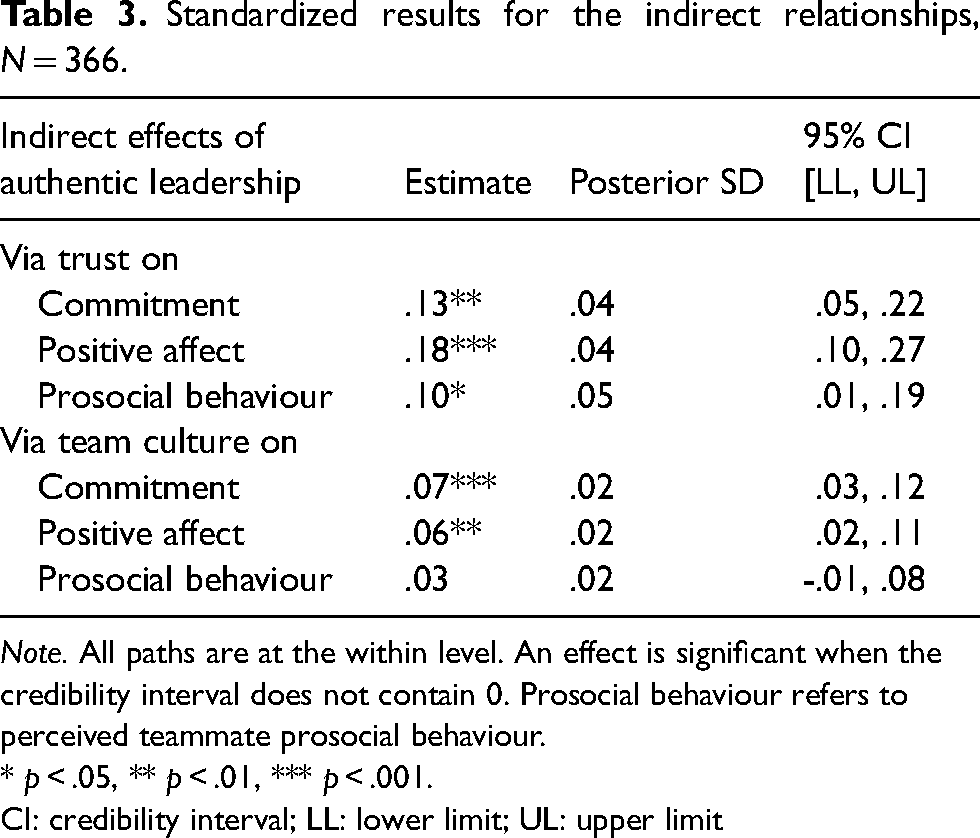
Note. All paths are at the within level. An effect is significant when the credibility interval does not contain 0. Prosocial behaviour refers to perceived teammate prosocial behaviour.
* p < .05, ** p < .01, *** p < .001.
CI: credibility interval; LL: lower limit; UL: upper limit
Discussion
Authentic leadership is believed to be highly relevant to sport, due to its focus on relationships and follower development and is expected to lead to positive outcomes in athletes20,4. Previous research has found authentic leadership to be positively related to athletes’ trust, commitment, and enjoyment. However, models of authentic leadership and studies conducted in non-sport domains,3,5,8 suggest authentic leadership may also influence variables such as positive affect, and perceived teammate prosocial behaviour, and that both trust and team culture may explain the relationship between authentic leadership and these outcomes. In the present study, we examined whether authentic leadership is related to athletes’ commitment, positive affect, and perceived teammate prosocial behaviour via trust and team culture.
In support of our hypothesis, authentic leadership was positively related to athletes’ commitment and positive affect via trust and team culture. These findings support research conducted in sport and other contexts showing that trust is positively related to followers’ commitment4,18,20, and extend previous research by examining positive affect. The positive relationship between authentic leadership and team culture is in line with studies conducted in the business domain with similar variables22,23. However, these studies measured team climate rather than team culture and so the results are not directly comparable. Our study extends these findings to the context of sport by demonstrating a positive relationship between coach authentic leadership and positive affect as well as the indirect role of team culture.
In line with our hypothesis, authentic leadership was also positively related to athletes’ perceived teammate prosocial behaviour via trust. This supports the literature which suggests that authentic leaders may promote prosocial behaviour in followers through creating trusting relationships which could lead them to show more prosocial behaviours8,9. Our study extends previous research by demonstrating the indirect role trust plays in the relationship between authentic leadership and perceived teammate prosocial behaviour.
Contrary to our hypothesis, authentic leadership was not related to athletes’ perceptions of their teammates prosocial behaviour via team culture. This finding is not in agreement with previous literature8,33, which suggests that authentic leadership could be related to followers’ prosocial behaviour, as a result of authentic leaders creating positive team cultures. This discrepancy could be due to Hannah et al. 17 measuring prosocial behaviours rather than perceptions of teammate prosocial behaviours towards individual participants. Furthermore, Hannah et al. 17 used a sample of soldiers rather than athletes, who may experience different types of team cultures and different perceptions of prosocial behaviours, and so the findings cannot be directly compared. Additionally, Hannah et al., 17 did not examine the indirect role of team culture on teammate prosocial behaviour. It is worth noting that team culture was positively correlated with prosocial behaviour, however, no indirect relationship was revealed in the multilevel model.
Taken together with previous research, our results suggest that when coaches exhibit authentic behaviours, such as being open, staying true to oneself, incorporating others’ opinions and displaying an internalized moral perspective, athletes may be more inclined to trust them; this in turn may lead athletes to be more committed, experience positive emotions, and perceive more prosocial behaviours from their teammates towards them.8,9 Therefore, coaches should be encouraged to display authentic behaviours, such as speaking honestly, taking into account others’ opinions and frequently displaying behaviours in line with their moral values. This may create more trusting relationships and team cultures and enhance positive affect and sport commitment. Thus, authentic leadership may lead to beneficial outcomes in sport.
Practical implications
The results of our study highlight the importance of authentic leadership within the context of sport and demonstrate its positive impact on a range of outcomes. Specifically, the findings suggest that coaches who demonstrate authentic behaviours are likely to create more committed athletes, who experience positive affect, and perceive their teammates to display prosocial behaviours towards them. Coaches can try to develop a greater understanding of their strengths and weaknesses, be open with their athletes, include them in decision making and display behaviours in line with their moral values. Finally, promoting authentic leadership among coaches may help to create more positive environments and trusting relationships.
Limitations and future directions
Our research has revealed some interesting findings but also has some limitations. First, the study was cross-sectional and so did not allow for cause-and-effect relationships to be established. Furthermore, due to the cross-sectional nature of the study, we are unable to test whether the outcome variables may also work as mediating variables and vice versa. Nonetheless, the study was needed to establish the relationships between authentic leadership and athlete outcomes as research on authentic leadership in sport is still in its early stages. Second, previous studies which have validated the team culture scale in sport were conducted on 12–18-year olds, and so this scale may not have been valid to use with the adult participants of this study. 44 However, we expect that an adult sample would not have had difficulty understanding the questions on the youth scale. It is worth noting that authentic leadership and the relationships leaders have with their followers are complex and develop over time. 45 A longitudinal study, with measures taken at three time points, would increase confidence in the causal nature of the relationships identified in this study. 46
Conclusion
Our findings extend the current literature by showing that authentic leadership was positively related to athletes' commitment and positive affect via trust and team culture as well as to perceptions of their teammates prosocial behaviours via trust. The study makes a significant contribution to sport leadership literature by revealing the value of authentic leadership in predicting these variables. Our results suggest that coaches should be encouraged to display authentic leadership behaviours to potentially create trusting relationships and positive team cultures, in order to increase athletes’ commitment, positive affect, and perceived teammate prosocial behaviours.
Footnotes
Acknowledgements
The authors would like to thank Yong Kai Tan who helped with recruitment and data collection, and the Economic and Social Research Council for supporting the study, via a scholarship to the first author. The study was conducted at the University of Birmingham.
Declaration of conflicting interests
The author(s) declared no potential conflicts of interest with respect to the research, authorship, and/or publication of this article.
Funding
The author(s) disclosed receipt of the following financial support for the research, authorship, and/or publication of this article: This work was supported by the Economic and Social Research Council.
