



Abstract
This article presents a comprehensive sociological conceptualisation of morality which can be used in empirical research, as a basis for further theorisation, and for dialogue with existing studies in sociology and other disciplines. It clarifies, systematises and extends Durkheim's incomplete works on morality, long misinterpreted and overlooked. Morality is conceptualised a system of interrelated concepts, including moral ideal, moral obligation, social attachment to the group, and individual autonomy. Grounded in Durkheim's notion of the social as a symbolic reality irreducible to the individual, ‘objective’, ‘social’ morality is shaped by ‘sacred’ moral ideals which exist in the symbolic domain of collective representations. Social morality is different from mores which are daily practices pertaining to the profane domain where moral rules are applied with ‘compromise’, and different from individual moralities. Extending Durkheim, moral obligation is elaborated through the subject, matter, addressee, and mechanisms of obligation, consistent with and indicative of the other elements of morality. The concepts of (a) morality produced by the collectivity/society/group (the morality of society) and (b) morality produced by social institutions like the state and media (the moral order) open pathways for analysing the roles of each and their juxtaposition, enabling new interpretations, empirically grounded critiques, and normativity. Together with the concepts of mores and individual moralities, these two types of moralities establish a multidimensional space open to empirical research.
Keywords
Introduction
Conceptualising morality has been challenging for all disciplines (Lukes, 2010), although morality is not unique in that respect (Abend, 2023). Morality is commonly understood as ideas about what is good and bad that pertain to various aspects of human life, include both individual and social dimensions, and differ across place and time (Keen, 2015; Lukes, 2025, 2008; Sayer, 2011). Broadly, these approaches can be divided into descriptive and normative notions of morality: what people do and what they ought to do (see Gert and Gert, 2020; Lukes, 2008; or the formal and substantive definitions in Hitlin and Vaisey, 2013).
Acknowledging the universal nature of morality, many disciplines have made significant efforts to narrow down these ideas of morality in order to develop a conceptualisation of morality through its functions, normativity, evaluations, linguistic means or neural basis (Dahl, 2023; Sinnott-Armstrong, 2016). For example see discussions in evolutionary studies and psychology (Dahl, 2023; Haidt, 2013; Krebs, 2020; Tomasello and Vaish, 2013; Turiel, 1983); in philosophy (Gert and Gert, 2020; Lukes, 2010; Sinnott-Armstrong, 2016; Stich, 2019); in anthropology (Curry et al., 2019; Fassin, 2012).
In contrast, sociological approaches to morality can be characterised as particularistic, or bound to specific context: what is moral is identified empirically within a particular setting (Abend 2014; Hitlin and Vaisey, 2013). Morality is often approached through one concept or a handful of concepts such as moral beliefs, values, norms, emotions, practices, behaviours, or ‘thick’ concepts like dignity or recognition (see Bargheer, 2018; Hitlin and Vaisey, 2013; Lembo et al., 2023; Lukes, 2010, 2024). These existing sociological approaches have developed our understanding of the moral domain but arguably have limitations.
First, the absence of a conceptualisation of morality impedes research on morality (also Bargheer and Wilson, 2018; Lembo et al., 2023; McCaffree, 2016); while many traditional concepts, including norms or values, are ‘distressingly vague’ as guides to empirical inquiry (Blumer, 1954). Second, identifying the moral empirically returns us to the original question of what is moral in the empirically found moral beliefs, norms, values or practices (also Lembo et al., 2023). Third, focusing on a single aspect of morality or a single concept hinders its complexity and omnipresence, which embraces the ethical, ‘evaluative’ dimension, constitutive of self and social life (Sayer, 2011; also Werneck, 2023). That can partly be explained by the decline of the concept of society in sociology (Outhwaite, 2006) and the break with the comprehensive agenda of classical sociology that treated the moral and the social as inseparable (Lukes, 2010; Vandenberghe, 2018). Fourth, the particularistic approach can lead to moral relativism, overlooking the culturally common dimensions which humans share with mammals including ‘desires for group belonging, care for infants, and fairness in the distribution of resources’ (McCaffree, 2019: 138; in contrast, see the search for universalism in anthropology Curry et al., 2019; Fassin, 2012; Keen, 2015). Fifth, the existing approaches might neglect moral dynamics, moral diversity, or over-emphasise either the individual or society (Abbott, 2019). Finally, the lack of conceptualisations prevents sociology from joining interdisciplinary discussion on morality.
Pathways to overcoming the existing limitations in the sociological approach to morality – such as defining morality as pertaining to universal human nature (Lukes, 2010), combining levels of morality (Abend, 2014; Kon, 1996; in anthropology Zigon, 2010 on ‘aspects of morality’), conceptualising morality as the combination of category/form with moral values as content (Bargheer and Wilson, 2018), working through relational sociology (Abbott, 2019) or constitutive practices (Rawls, 2010) – arguably face the same challenges of conceptualising the moral for the purposes of empirical research.
Remarkably, sociology has had a theorisation and conceptualisation of morality for a century but has largely overlooked it. It was Émile Durkheim who set to explain the nature of morality in clear terms for both academic and wider public (Durkheim, 1925/1961: 95) and developed a comprehensive theorisation of morality as a ‘system of interdefined concepts’ (Lukes, 1972: 410). Durkheim argued that the core of morality is the unity of duty and good, which was a major step in social theory and philosophy (Karsenti, 2012; Weiss, 2022). He approached good and duty through different interrelated concepts including the spirit of discipline, moral authority, attachment to the social groups, sacred ideals, and moral fact. Durkheim also pointed to the importance of individual autonomy which enables moral choice and thus makes morality different from religion.
Apart for the use of different concepts across the texts, there are other difficulties with Durkheim's work on morality. One is that his views on morality evolved over time (Cladis, 2024; Hall, 1987; Lukes, 1972, 2024; Pickering, 2005). The texts most often used in sociology – The Division of Labour, Suicide, and The Rules of Sociological Method – do not fully reflect his views on morality, while other texts directly addressing morality such as The Determination of Moral Facts (1906b/2010), Moral Education (1925/1961) or Professional Ethics and Civic Morals (1957/1992) are now largely unknown to mainstream sociology and social science. For example, in his later works, Durkheim did not use his earlier ‘mechanic’ and ‘organic solidarity’, reworking them into the ‘attachment to social groups’ (Paugam, 2024). Another difficulty is that Durkheim did not have the opportunity to complete his major book on morality (Durkheim, 1920/2005) and his archives were destroyed during the Nazi occupation of France (Lukes, 1972; Meštrović, 1993).
As a result, Durkheim's work on morality as good and duty, and his emphases on individual autonomy and moral diversity, remain under-recognised (see discussions in Carls, 2022; Lukes, 2024; Meštrović, 1993; Miller and Lukes 2020). Even in the sociology of morality Durkheim's perspective is not fully acknowledged (e.g. Lembo et al., 2023) or seen as an ‘old sociology of morality’ which rejects moral diversity within a society (Hitlin and Vaisey, 2013). Despite this there is helpful work which discusses Durkheim's understanding of morality (e.g. Carls, 2023; Gofman 2019; Hall, 1987; Karsenti, 2012; Lukes, 1972; Watts Miller, 1996; Weiss, 2012, 2022).
Nevertheless, the multiple ways Durkheim discusses morality and subsequent scholarly discussion of his work do not offer us a clear conceptual pathway to theorise and conduct research on morality. It is perhaps for this reason that his understanding of morality as the unity of good and duty continues to be overlooked and misinterpreted. This has not been a fully coherent theory with which to work. Notably, empirical work directly deploying and testing this approach to morality has been very rare. To my knowledge, in the English language literature, there are only the study of political conflict as a conflict of moral ideals of four political groups in contemporary Germany (Carls, 2023), scholarly analysis of religious conflicts as a conflict of moral ideals (Karsenti, 2017), and a short ‘exercise’ of analysis of the pandemic as a moral crisis demonstrating moral diversity (Weiss, 2022). These are helpful contributions, but they did not set themselves to the task of conceptual refinement and advance of the comprehensive sociological instruments to study morality.
The present article contributes new material in two ways. First, clarifying, systematising and extending Durkheim, it proposes a comprehensive conceptualisation of morality which can be used in empirical research in any social setting, as a basis for further theorisation and for dialogue with existing studies in sociology and other disciplines. Morality is conceptualised as a system of four interrelated concepts: moral ideal, moral obligation, social attachment to the group, and individual autonomy (Figure 1). This conceptualisation restates the core Durkheimian dual element of morality as the unity of ideal and obligation, makes explicit the element of belonging to the group (the collectivity which creates ideal and obligation), and also emphasises individual autonomy, which is necessary for the exercise of moral judgement in secular society. Individual autonomy can be safeguarded only collectively. Taken together, social attachment to the group and individual autonomy expose tensions between the individual and her (multiple) group membership(s). The article discusses each of these elements of morality and offers empirical ways to study them. Moral change is conceptualised as change in any of the elements of morality. Moral diversity is analysed by studying co-existing moralities.
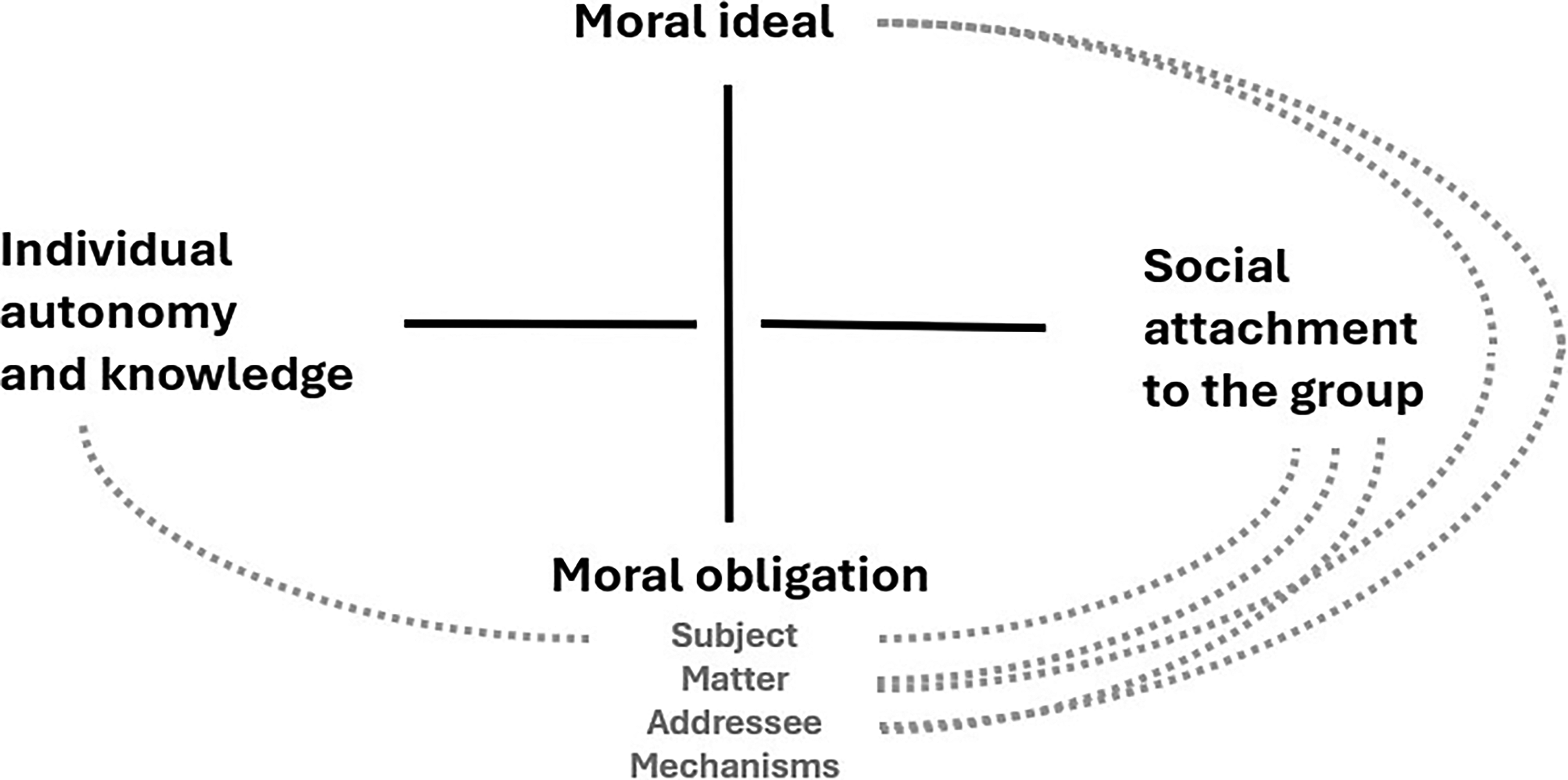
Sociological conceptualisation of morality.
Drawing on political philosophy and legal scholarship, the article extends Durkheim's work on moral obligation, a concept overlooked in sociology, proposing that moral obligation can be analysed empirically through its elements including the subject of obligation, the matter, the addressee, and the mechanisms, which in turn are consistent with, and indicative of, the other elements of morality (as shown by dotted lines on Figure 1; see the application in Smolentseva, 2024).
Second, for the purpose of studying complex, morally diverse societies, the article proposes that there are at least two types of moralities: morality produced by society/collectivity/group (the morality of society), and morality constructed by social institutions like the state, media or education (the moral order). The two types of moralities can be identified empirically using the proposed conceptualisation of morality. Recognising and analysing the role of each, and relating them to each other, helps in disentangling the complexity of the moral domain and opens possibilities for further research, interpretations, critique, and normativity that is grounded in empirical analysis. Together with mores as daily practices and individual/'subjective’ moralities, these two types of social moralities establish a multidimensional moral domain subject to empirical research.
The article starts with Durkheim's notion of the social and presents a comprehensive conceptualisation of morality. Then it discusses how we can approach the study of morality in complex, diverse societies, differentiating between the two types of moralities mentioned above: those produced by society/groups and those produced by social institutions. The conclusions highlight the heuristic power of the Durkheimian conceptualisation of morality as well as its limitations.
Morality as a product of collective life
A starting point for Durkheimian theorisation of morality is the nature of the social. The collectivity/group is not the sum of individuals or their views but a new, different, symbolic reality, ‘a complex of ideas and sentiments, of ways of seeing and of feeling, a certain intellectual and moral framework distinctive of the entire group’ (Durkheim, 1925/1961: 277; see more on this symbolic sui generis reality, e.g. Sawyer, 2002). Constituted in the symbolic domain, social life consists ‘essentially’ of representations, broadly meaning ‘ideas’ in French (Meštrović, 1993). Collective representations which include the external objects and frameworks for interpretation common to the group (Carls, 2023), ‘arise’ from the ‘network of interactions’, ‘relations’ between individuals or groups (Durkheim, 1897/2005: 276, 1898/2010: 10). To live in a society means to be ‘enveloped’ by collective representations and to exist in the exchange between one's own ideas and sentiments and those of the collective, which circulate among the people (Durkheim, 1925/1961: 71, 216). Those exchanges and interactions with society enable individuals to form and realise themselves, form the individuals as social and moral beings, and enable the collectivity to ‘realise’ itself through individuals (Durkheim, 1906b/2010: 29; Durkheim, 1925/1961; see more on the individual and social in Durkheim's work in Sawyer, 2002).
‘Objective’, social, ‘impersonal’ morality is shaped by ‘sacred’ moral ideals that exist in that symbolic domain of collective representations. Durkheim argues that the understanding of society as a symbolic reality is the only explanation for the fact that morality exists: the collectivity creates an impersonal force which can ‘bend’ the individual will to make a person act morally, which means acting towards other people, not oneself (Durkheim, 1925/1961). It is the society and not the individual that ‘commands’, and moral consciousness is necessarily directed towards others (ibid.). The similarities in meaning of the French language terms for ‘social’ and ‘moral’ (Hall, 1987) help to indicate the closeness of the two. Ultimately, for Durkheim, society is morality and morality is society: morality ‘is made for society’ and ‘by society’ (Durkheim, 1925/1961: 85–86, italics in the original). Morality is the product of society, rooted in society, created by people (Durkheim, 1905/2005: 79), not developed from an abstract principle as often suggested by philosophy (Durkheim, 1905/2005: 79). Importantly, society is understood broadly, as a group of any size: ‘the domain of the moral begins where the domain of the social begins’ (Durkheim, 1925/1961: 60).
As individual and society are different entities, ‘objective’ morality is different from individual, ‘subjective’ moralities: each person has her ‘own moral life’ and develops her ‘own morality’, which is not identical to social morality (Durkheim, 1906a/2010: 40). ‘Objective’ morality is also different from mores, which are daily practices in the profane domain where moral rules are not strictly followed (Durkheim, 1920/2005; Peristiany, 2010: xiv).
Impersonal morality ‘exists as an observable reality’ and can be studied (Durkheim, 1920/2005: 164). The task of sociology is the study of the ‘objective’ morality, ‘the morality of the social’, ‘that common and impersonal standard by which we evaluate action’ (Durkheim, 1906b/2010: 19), in its ‘purity and impersonality’ (Durkheim, 1920/2005: 168). ‘Objective’ morality pertains to a symbolic reality, which requires a new science – the science of morality, a special branch of sociology (Durkheim, 1920/2005) that should ‘understand’ the moral domain and ‘direct its changes’ (Durkheim, 1906a/2010: 33).
Morality as a system of interrelated concepts: Moral ideal, moral obligation, social attachment to the group, individual autonomy
Reconstituting and systematising Durkheim for the purposes of theoretical and empirical research, I propose a four-element conceptualisation of morality which can be employed for analysis in any social setting: moral ideal, moral obligation, social attachment to the group, and individual autonomy (Figure 1). The expansion of moral obligation into the subject, matter, addressee, and mechanisms is essentially post-Durkheimian.
The central element of morality for Durkheim is the unity of the ideal (good) and obligation (duty). Following Kant, Durkheim identifies duty as the central category of morality but departs from Kant by considering duty and good as connected to each other (Durkheim, 1906b/2010, 1925/1961; Karsenti, 2012; Weiss, 2022; on the commonality between Durkheim's and Hegel's views on morality see Honneth, 2021; Neuhouser, 2023). Also in contrast to Kant, Durkheim sees the origin of morality as social (Durkheim, 1906b/2010). Duty and ideal (good) are two ‘aspects of the same reality’: of a society which is ‘beyond’ individuals and also ‘part of’ individuals (Durkheim, 1925/1961: 98): Morality appears to us under a double aspect: on the one hand, as imperative law, which demands complete obedience of us; on the other hand, as a splendid ideal, to which we spontaneously aspire. (Durkheim, 1925/1961: 96)
Moral ideal (good)
Moral ideals can start as ideas (Weiss, 2012), emotionally loaded and dynamic, driven by collective forces (Durkheim, 1911/2010: 49). During gatherings, rituals or festivals, collective emotions elevate individuals beyond themselves, creating collective effervescence, which makes ideals sacred (Durkheim, 1911/2010, 1915b/2012; Shilling and Mellor, 1998; Weiss, 2012). The sacred is what is ‘separated’, ‘set apart’ from the profane and cannot be mixed with it. The sacred and profane exist at different levels of reality and are ‘incommensurable’ in their value (Durkheim, 1906b/2010: 36). The sacred ‘activates ideals’ (Stedman Jones, 2001: 190) and makes morality comparable to religion (Durkheim, 1906b/2010; also, e.g. Hall 1987; Watts Miller, 1996).
Moral ideals have a social, collective nature and have four key roles: they are constitutive (a) of morality, (b) of collectivity, (c) of value and value judgement and (d) of power.
Constitutive of morality, ideals specify the content of morality, set purposes and motivate actions (Durkheim, 1925/1961; Stedman Jones, 2001). They define what is good and what is bad. Being mutually defining (Alexander, 2014), both good and bad are sacred, comprising the pure and impure sacred respectively; and each is different from the profane (Durkheim, 1915b/2012; Kurakin, 2015; Riley, 2005). The good and bad are associated with affects of reverence and horror respectively but can be difficult to separate. In some situations, the pure sacred can transform into the impure sacred and vice versa (Riley, 2005).
Ideals are constitutive of the collectivity/society/group: ‘A society cannot be constituted without creating ideals. These ideals are simply the ideas in terms of which society sees itself and exists at a culminating point in its development’ (Durkheim, 1911/2010: 49). The special ‘mental life’ of society creates an ideal which is attractive for people and loved by people. Moral ideals are shaped by particular social contexts, cannot be disconnected from reality (Durkheim, 1909/2005: 231) and cannot be deduced from universal human qualities (Durkheim, 1920/2005: 152).
Contrary to one common misinterpretation of Durkheim, moral ideals are dynamic and plural, because individuals and society are always changing. ‘Alive, constantly changing and evolving’ (Durkheim, 1920/2005: 152), moral ideals are co-existing and emerging, and non-dominant ones may later prevail. Moral ideals reflect both the existing society and society ‘in becoming’ (Durkheim, 1906b/2010: 18) connecting three temporalities – past, present, and future (Peristiany, 2010: xx). Moralities which are not consistent with the present condition of society become outdated and should not be conserved (Durkheim, 1925/1961). The dynamic nature of morality means that public opinion might not correctly reflect morality: society might not precisely be ‘aware’ of itself and how it is changing. When moral ideals are not yet realised in practice, studying them can be the only way to identify them.
Ideals are also constitutive of value and value judgement: value emerges from the relation to the ideal (Durkheim, 1911/2010). Value is a social, collective outcome resulting from the ‘special mental life’ of the collectivity. It cannot be subjective. Understanding the ideal enables understanding of value and vice versa. Thus, moral judgement helps to reveal the ideal in relation to which a moral judgement is made; moral justification can indicate the ideal used to justify one's actions to other group members (Durkheim, 1906b/2010; Callegaro, 2017 following Lemieux, 2009; Karsenti, 2012). That opens opportunities for further research on justifications, judgements and evaluations, where the ideal can be identified empirically in a particular context.
Further, moral ideals working through their moral authority enables us to theorise moral power and legitimation (see also Carls, 2023; Corrigan and Sayer, 1985). Moral authority is ‘that influence which imposes upon us all the moral power that we acknowledge as superior to us’ (Durkheim, 1925/1961: 29). It can work (a) as the impersonal power of the collectivity which creates ideals and duties that make morality both obligatory and attractive to people, and (b) through a mediator: a prominent individual, a teacher or a social institution such as the state as ‘the highest form of organised society that exists’ (Durkheim, 1925/1961, 1957/1992: 74). ‘Actual or imaginary’, moral authority exists as real in peoples’ minds (Durkheim, 1925/1961: 88) and affects individual behaviour.
Today ‘moral ideal’ is rarely used as a sociological concept which could be studied empirically (but see Carls, 2023; Karsenti, 2017; Weiss, 2022). Yet research on ideals can draw on existing works using the concept of sacred (e.g. Mellor and Shilling, 2014; Rawls et al., 2016). It can also engage with studies based on the concept of values (see discussion and critique of values, e.g. Bargheer, 2018; Bykov and Nastina, 2024; Lembo et al., 2023; Martin and Lembo, 2020). In response to some criticisms of values (Martin and Lembo, 2020), Durkheim's unity of good and duty links ‘values’ and action, so that individuals aspire to realise that good in practice, as the main purpose of morality is ‘to direct action’. ‘The rules of morality cannot be dissociated from action’ (Durkheim, 1920/2005: 153). However, not all values are sacred.
Moral ideals are not easily subject to observation and analysis, but we can use Durkheim's work on how to identify moral ideals in empirical research: (a) through the good, highest value, or purposes, ‘all those things the group considers most valuable, incommensurable with anything else that cannot be quantified or equated with profane demands’ (Weiss, 2022: 149; see also Carls, 2023); (b) through moral/value judgement or justification, as discussed above; (c) through the impure sacred which can identify the pure sacred (Carls, 2023; Kurakin, 2015); (d) through transgression (Carls, 2023; Kurakin, 2015) or sanction (Durkheim, 1906b/2010) which imply violation of the ‘pre-established’ moral rule; (e) through moral emotions such as pride, shame or guilt that are indicative of the ideals behind them; (f) through the moral authority of a person, group or social institution, which could be indicative of the ideal; (g) through the events of collective effervescence indicative of collectivities and moralities (Durkheim, 1915b); (h) through symbols which constitute collectivities and moralities via creating sentiments (ibid.); (i) through the elements of the obligation. The last will now be discussed.
Moral obligation (duty)
Morality is a ‘system of obligations and duties’ (Durkheim, 1906b/2010: 25). Shaped by the moral ideal, duty ensures regularity of moral behaviour, or the ‘spirit of discipline’, and provides purposes (Durkheim, 1925/1961: 47). Duty is an imperative, which ‘commands because it does command’ over human passions and desires (Durkheim, 2013b: 209). It is action directed towards the ideal. As society and the individual are always changing, morality and the ‘content of discipline’ are also changing. Thus, duty requires rational thinking and cannot be reduced to obedience (Durkheim, 1925/1961: 52). Duty also relies on affect: the sense of duty, the pleasure of fulfilling a duty, the feeling of belonging to the group, the aspiration towards the ideal.
Duty is both a constraint and a liberation. As individual and society are driven by different ‘interests’, society needs to restrict individual will so that ‘the whole’ can ‘survive’ (Durkheim, 1957/1992: 14). Those limitations can only be supra-individual, social, to be able to ‘bend’ the individual will (Durkheim, 1957/1992: 15–16). The bigger the group, the harder it is for the individual to perceive and feel the needs of the social, so there is more need for rules. By ‘structuring’ individual will (Karsenti, 2018) these social constraints liberate individuals from pursuing unlimited desires, bringing them happiness within the existing limitations of the social and natural world, and self-realisation through social commitments (Durkheim, 1925/1961; but see Cladis 2008 for the account of suffering as inseparable from the ‘struggle’ to become a more social and moral being). The unlimited will leads to contempt for all moral rules and international law, as Durkheim (1915a) makes clear in his analysis of the causes of World War I.
There are certain key characteristics of moral obligation: it is habitual (Durkheim, 1925/1961; Stedman Jones, 2001), obligatory, binding, directed towards others, linking individuals (or groups or institutions) together, connecting ideal and action. Thus, as a sociological concept moral obligation pertains to a particular type of social relations constructed through social practices (Wolfe, 1989b) with varying empirical content. Moral obligation denotes daily (re)constitution of particular moralities and collectivities, and (re)production of social relations among individuals forming a building block of collectivities, groups, and societies. Yet, like the moral ideal, it has not received much sociological attention (but see Barbalet 2020; Bauman, 2000; Carls 2023; Fein, 1979; Marcucci, 2017, 2022; Wolfe, 1989a, 1989b; see Heimer and Staffen, 1998 on responsibility as meeting one's obligations to others).
The concept of obligation gives more precision to the sociological apparatus. For example, existing research show that mutual obligations establish group bonds and create group boundaries of inclusion and exclusion. Analysing the Holocaust, Fein (1979: 33) identifies the ‘sanctified universe of obligation’ which defines ‘the circle of persons toward whom obligations are owed, to whom the rules apply, and whose injuries call for expiation by the community’. Those reciprocal obligations create a basis for in-group solidarity and the boundary of exclusion (ibid.). Obligations to whom, and why they are maintained, are empirical questions.
As a core aspect of morality, the concept of obligation defines and illuminates other moral phenomena. Morality is obligations to others while amorality is the absence of them. Self-interest or the ‘egoistic cult of the self’, underpinning classical economics and liberalism and criticised by Durkheim (1973), means an absence of obligations to others. A century later Bauman (2000) defines indifference, a modern condition destroying human bonds, as exclusion from the ‘universe of obligation’. The concept of obligation highlights the limitations of the liberal notion of individual rights, conceived as an individualism with no obligations to others, while also being opposed to an understanding of collectivity which does not embrace individual rights (Wolfe, 1989b). Both positions were rejected by Durkheim (1973).
Identifying obligations which have a priority in a particular context can highlight the nature of that morality. Differentiating between universal and particular obligations – whether they should be practiced by everyone or only by specific groups, Durkheim (1957/1992) argued that universal obligations to others as our ‘human fellows’ based on ‘sympathy’ to the suffering of others should have a priority over civic/patriotic, professional, family, gender-based (gender roles have been declining over time to ‘mere shade of difference’), and other duties. The human being is a new sacred object, a new moral ideal of ‘our’ morality which we have not fully realised yet (Durkheim, 1973). Moreover, in secularised, increasingly differentiated societies where people have ‘nothing in common except their humanity’ (Durkheim, 1973: 52), it becomes the only moral ideal people can share (ibid., Durkheim, 1957/1992). That priority of obligations to other human fellows is an outcome of Durkheim's (1957/1992) socio-historical research on homicide and the evolution of contracts, not a normative statement.
How do we approach research into moral obligation? Working from political philosophy and law which analyse obligation as consisting from different elements (Darwall, 2013; Gilbert, 2006; Kish Bar-On, 2020; Law, 2022), I propose the following operationalisation of moral obligation: (1) the subject of the obligation, the one who is obligated to something or to do something; (2) the matter, an obligation to do what; (3) the addressee, to/towards whom or what an obligation is made; (4) the mechanisms of obligation, how the obligation is established. That enables us to identify and analyse the construction of moral obligation and its elements. These elements of moral obligation are consistent with and indicative of other elements of morality, as tested in empirical study (Figure 1; Smolentseva, 2024).
The mechanisms of moral obligation can be operationalised in different ways: as an obligation, duty, responsibility, the use of modal verbs (must, should, ought to, have to); the use of impersonal deontological forms (it is necessary); moral judgements (right, wrong, good, bad). Using cross-cultural anthropological studies, Keen (2015) provides a comprehensive list of the language of morality which can be employed in empirical research. In addition to the above that list includes moral emotions (e.g. shame, guilt, compassion), an imperative mood, references to conscience, exemplary patterns of behaviour, categories of moral character, virtues and vices, references to moral socialisation, religious beliefs, moral tales, and aphorisms. This list can be complemented by non-verbal, visual forms. There is a scope for further research into how obligation is established.
Social attachment to the group
‘Attachment to social groups’ is an important element of morality discussed in Moral Education (Durkheim, 1925/1961). As the social and the moral are close, the central question for Durkheim was ‘how can we attach ourselves to society?’ (Durkheim, 1920/2005) or ‘the nature of the social bond’ (Wilson, 1961). Intrinsic human sociality makes people seek social ties and group memberships for the purposes of protection and recognition (Paugam, 2023). As an element of the conceptualisation of morality, social attachment explicitly points to group boundaries, the role of the collectivity and the multiple group identities of individuals. It asks to which group is a particular morality applied?
Social attachment is constitutive of morality: moral ideals are created by collectivity and connect an individual with the group (Durkheim, 1925/1961). Social attachment means that people are attracted to the same moral ideal (Durkheim, 1925/1961: 92) and are attached to other people through the ideal, through the social, indirectly (Durkheim, 1906b/2010: 26). Social attachment is interrelated with duty and ideal (good): they represent one reality, the collectivity/society, which ‘commands’ individuals and indicates what is desirable. The collectivity can include family, professional group, union, business, club, political party, city, country, humanity (Durkheim, 1906b/2010: 26, 1925/1961: 80), but these may not be equally important for particular individuals. Belonging to various groups, feeling identified with groups, sharing ‘we’ with others, having ‘a pleasure’ in saying ‘we’, makes an individual ‘complete’ and makes morality ‘complete’ (Durkheim, 1925/1961: 240, 80).
The application of moral rules within the group, or moral boundaries as demarcating group boundaries has been studied in sociology (e.g. Alexander, 2014; Bykov, 2023; Fein, 1979; Lamont, 2023). Social attachments and group identities can be used by the state, for example, through the building of a unified national identity in the ‘totalising project’ of state formation, eliminating other group identities (Corrigan and Sayer, 1985), or used by other social groups in ‘moral regulation projects’ (Hunt, 2003). Group boundaries can be identified empirically through group identities, group assemblies, rituals, and symbols, areas in which sociology has rich research traditions. Group boundaries can also be outlined through the moral ideal, and the elements of the obligation (who in which role, is obligated towards whom/what, to do what), among other ways (also see Carls, 2023 for the analysis of different groups).
Individual autonomy and knowledge
The fourth element of morality is individual autonomy, or self-determination (Durkheim, 1925/1961). As morality is a daily duty which should be freely accepted and ‘desired’ without coercion, the individual, being able to exercise moral judgement, should understand what is right and why (Durkheim, 1925/1961). Individual autonomy differentiates secular morality from religion, which relies on persons following moral rules without scope for self-determination. That is increasingly important in ‘complex’ societies, where material conditions, societies, moralities, and individuals are changing (ibid.:52). The individual should be aware of the necessary restrictions and rationally accept them ‘with full knowledge of the facts’ (Durkheim, 1957/1992: 91). That liberates individual wills, helping individuals to realise themselves by establishing social bonds, following moral rules, and learning self-discipline (ibid.). Individual autonomy is always relative and socially defined, as individuals are never fully independent from others (ibid.: 68).
This fourth element of morality is fundamental for sociological conceptualisation of morality because it demonstrates the crucial role of the collectivity/society, including the state as expressing the collectivity, in creating conditions for moral behaviour (Durkheim, 1957/1992: 68–69). First, only the collectivity, not the individual, can ensure individual autonomy as a necessary pre-condition of moral conduct without coercion. Presently, the state is the only institutional form which expresses the society as a whole (Durkheim, 1915a). The state is ‘a social structure’ ‘necessary for morality’ (ibid.: 73). Without it, society is too differentiated and complex, a ‘mosaic’ of individuals and groups driven by their private interests towards different ends (ibid.). Such a society has no ‘common organ’ and no ‘unity of will’ (ibid.). Thus, the main role of the state is moral, not economic or military (Durkheim, 1957/1992: 71–72). Second, the collectivity defines the content of morality that guide individual behaviour: it creates and maintains moral ideals and obligations, moral authority and the spirit of discipline.
The Durkheimian conceptualisation of morality demonstrates that only the society/collectivity/group can ensure morally right behaviour at the individual level. It is not moral individuals who make moral societies, but the moral society that makes individuals moral (Alexander, 2014). While moral behaviour is an individual moral choice, it is enabled only socially. Without creating social conditions for a particular moral behaviour we cannot expect everyone to behave that way. In studying individual autonomy and knowledge, researchers can draw on existing approaches to moral self, moral agency, social structures and institutions which protect individual autonomy and also shape perceptions of the world, such as the family, education, professional groups, the state, media, social media, or algorithms.
Final remarks on morality as a system of concepts
Moral change can be analysed as a change in the elements of morality (Smolentseva, 2024). Morality as a system of concepts means that change in one element leads to change in the others (Durkheim, 1983: 97). Empirically, we can identify moral ideals, obligations, and the group within which these apply, as well as establish the degrees of individual autonomy and the knowledge provided socially. The elements of moral obligation are helpful in identifying the existing or missing obligations and pointing to other elements of morality.
The unity of ideal and duty means that they not only work together but also can compensate for each other (Durkheim, 1925/1961). Duty works in situations of established morality. During social and moral transformations, when the ‘spirit of discipline’ declines, morality can work through the ideal (ibid.). It is important to maintain people's commitment to the social ideal, engaging them in working for collective purposes so that they can later realise that ideal in practice (ibid.). Individuals’ creativity should be encouraged in order to develop new morality (ibid.: 102).
Morality embraces both reason and affect (Durkheim, 1925/1961). The rational is located in individual autonomy, awareness of one's duty, and regularity of conduct. The affect is found in the attractiveness of moral ideals, the pleasure of belonging to the group, and the sense of duty. Only the combination of reason and affect make morality work. Both reason and moral emotions can be used to identify morality empirically. Overall, the Durkheimian conceptualisation of morality as a system of interrelated concepts clarifies and refines our understanding of the nature of morality and offers us a way forward to further theorisation and empirical research.
Conceptualising the moral domain in complex, diverse societies
In contemporary complex societies there is a wide range of moralities, or collective representations, which circulates and mixes in the public space. These collective representations are produced by multiple sources, differing but not isolated from each other: various social groups, the state, law, media, social media, educational institutions, business, professional, and political organisations, and others. By empirically identifying moral ideals, obligations, group attachments, and the degrees of individual autonomy we can study moralities of different societies, social groups, social institutions, organisations or other settings (see Carls, 2023 for the study of political groups; Smolentseva, 2024 for the study of a national setting).
Among those multiple moralities it is important to separate at least two types: moralities produced by society/collectivity/group (morality of society) and moralities produced by social institutions (moral order).
The institutional moral order can be understood as morality(ies) constructed by particular social groups who control those social institutions and the circulation of collective representations in the public space. That includes the state (which shapes the law and ideologies among others), media, social media, education, business, and other institutions. Moral order can be illustrated, for example, by well-studied ideas of individual responsibility and individual success underpinning governmental policies in many countries, which in the Durkheimian perspective can be understood as a morality of self-interest based on obligations solely to oneself (Smolentseva, 2024).
In contrast, morality produced by society/groups points to the spontaneous, grass-root, organic origin of morality as arising from daily practices. Moralities produced by society/social groups might feed into political movements and even state ideologies, thereby becoming an institutional moral order (see Carls, 2023 for the analysis of moral ideals of four political streams in Germany and their interpretation as a moral conflict; for discussions of morality in social movements see Jacobsson, 2024; Sevelsted and Toubøl, 2023; but see Jayyusi, 1991; Rawls, 2010 for a different definition of ‘moral order’). On the other hand, moralities of society/groups, might not receive institutional support: for example marginalised voices, political dissidents or closed communities.
The distinction between these two types of moralities helps to clarify Durkheim's ideas and opens up opportunities for further theorisation. In Durkheim's work, the distinction between the two concepts is not made fully clear but the gap between the morality produced spontaneously by society and the morality expressed by existing social institutions runs through his texts. It can be interpreted as a gap between ‘society's instituted legal-moral framework’ and ‘society's division of labour and the way it generates moral expectations and aspirations for equality’ (Lemieux, 2021: 292); or as a gap between ‘is’ and ‘ought’: morality created by society is not realised in practice by social institutions and society is not aware of its own morality (Stedman Jones, 2001; Watts Miller, 1996). The boundaries between the two may not be strict, as collective representations circulate and mix. Social institutions enforce and sacralise particular moralities and individuals may or may not internalise them: for example, we need to understand the extent to which individuals internalise moralities imposed by institutions such as neoliberal morality of self-interest, ‘indifference’, and ‘ruthlessness’ (Bowring, 2016); it also might be a question of morality versus mores.
The proposed conceptualisation of morality and the distinction between the moral order and the morality of society enables us to consider the ‘legal-moral framework’, the ‘is’, on one hand, and the outcomes of the moral ‘division of labour’, the ‘ought’, on the other, as two different moralities which can be analysed empirically. Importantly, while social sciences have done much research on the roles of the social institutions, the suggested distinction helps to bring forward and research the morality produced by society/collectivity itself, which can be understood as the ethical, ‘evaluative’ dimension of social life (Sayer, 2011).
The juxtaposition of the moral order and the morality of society enables further interpretations of the moral condition of society: for example as ‘maladjustment’ (Lemieux, 2021) or déréglement, or anomie (Meštrović and Brown, 1985). The discrepancy between the two moralities – the ‘disarrangement of collective representations’ – means not normlessness but ‘derangement’, a ‘painful’, physiological, psychological, and social condition experienced by individuals and society (Meštrović and Brown, 1985) which helps to explain apathy, cynicism and nihilism (Smolentseva, 2024). That is what happens when people live in an institutional framework which they perceive as amoral: when sacred representations are treated as profane, what is bad becomes the good, and an ‘act of sacrilege’ can be institutionalised in the law (Meštrović and Romero, 2012 studying a prison which normalised tortures). The proposed distinction between the two types of moralities helps us to identify and analyse each, and their relations and implications. Further, the juxtaposition of two moralities might provide sociology with a grounding for normativity in empirical research, based on morality produced by society (on normativity also see Lemieux, 2021), without direct involvement of a researcher's judgement.
However, there are further questions such as how each type of morality is produced, especially the morality of society; how and to what extent different moralities are realised in daily practices or constituted by daily practices (Jayyusi, 1991; Rawls, 2010); and what are the relations among different moralities. One important question is whether Durkheim was right about the rising cult of the individual as the new morality of diverse secular societies (e.g. see Carls, 2023 on the cult of different kinds of individual).
To summarise, Durkheim identifies three types of social phenomena in the moral domain: (a) social, ‘objective’ moralities based on sacred moral ideals – discussed in this article; (b) mores as daily practices where moral rules are applied with compromise, and (c) individual, ‘subjective’ moralities which an individual forms for oneself (Durkheim, 1906a/2010, 1920/2005). This distinction conceptualises the whole moral domain and helps to categorise different types of moralities and daily practices of social groups, institutions, and individuals. For example, studies of everyday life in sociology and anthropology can be seen as working on mores and ‘subjective’ moralities while also contributing to the understanding of ‘objective’ morality. That impersonal morality is more difficult to study, as Durkheim argued, for it concerns ‘the unconscious, unclear ideal of collective thinking’ (Stedman Jones, 2001: 199), but this article has suggested the ways to approach it.
Conclusions
This article has argued that Durkheim's work provides a comprehensive conceptualisation of morality which can be used for further theorisation and empirical research. That conceptualisation consists of four elements: moral ideal, moral obligation, social attachment to the group, and individual autonomy. Moral obligation, in turn, can be further analysed through the subject, matter, addressee, and mechanisms of the obligation (Figure 1). Moral change can be analysed through change in the elements of morality(ies). We can use verbal, non-verbal, affective, rational, bodily, physical, visual, and other aspects of morality to identify and study it. We can also differentiate between morality(ies) produced by society/collectivity/group (morality of society/group), and morality(ies) produced by social institutions (moral order), and identify empirically the varieties of both. The juxtaposing of the two moralities provides new interpretations and an empirically grounded position for critique and normativity, without drawing on our own subjectivity. We can analytically separate both kinds of morality from daily mores, and individual moralities, and study the moral as multidimensional space. We can also consider the construction of moralities, based on empirical research, as Durkheim suggests (e.g. Cladis, 2024).
These strands of research can contribute to a comprehensive and empirically informed understanding of social life and its moral dimension, ‘the richest and most complex of realities’ (Durkheim, 1925/1961: 125). The Durkheimian framework is compatible with notions of the moral as a dimension of every social phenomenon linked to value judgement (Werneck, 2023), as a special domain of the social established empirically (Abend, 2014), and as pertaining to universal human nature, associated with mutual responsibility (Lukes, 2010). Durkheim's system of concepts is compatible with Kon's (1996) division into levels of morality and can be placed in conversation with Abend's (2014) division into moral background and actual beliefs/practices (see also Carls, 2023), as well as Lukes’ (2025) discussion of values and practices. By linking value and action, the Durkheimian perspective resonates with practices-oriented and pragmatist approaches to morality (e.g. Abbott, 2019; Bargheer, 2018; Gorski, 2022; Jayyusi, 1991; Morgan, 2014; Rawls, 2010). It also responds to the philosophical point that morality as a concept might have a complex structure (Sinnott-Armstrong, 2016) and aligns with normative and content-related criteria for the definition of morality (Wong, 2019). The Durkheimian approach connects with work in evolutionary studies and psychology (see Lukes, 2024), connections that can be further explored.
The comprehensive character of the Durkheimian approach brings new insights to other approaches. For example, ‘ordinary universalism’ as recognition of larger groups (Lamont, 2023) might be limited by group boundaries. Instead of expanding group boundaries to ‘recognise’ further groups, the Durkheimian perspective suggests that we need to develop other, wider identities, other kinds of group attachment, such a universal human identity associated with universal collectivity in which we see others as ‘our fellows’ in a global ‘cosmopolitan’ society (Durkheim, 1957/1992).
The Durkheimian approach brings back into sociological discussion the neglected concepts of ideals and obligations. The concept of ideal enables us to view society as ‘in becoming’, helping us to theorise the future: ‘The only question that a man can ask is not whether he can live outside society, but in what society he wishes to live’ (Durkheim, 2010: 59). Hope as orientation to the future, created collectively through emotions (Gokmenoglu and Manley, 2025), is consistent with Durkheim's notion of moral ideal and the role of affect. The concept of ideal reminds us that prioritising the profane economic domain – economic growth and economic self-interest – over the sacred moral which is the social, the common, people, societies, communities, social bonds, is not only a source of ‘derangement’, but, arguably, facilitates a path to extinction given the climate emergency and militarisation. The concept of ideal helps to clarify how power works and how moral judgements and justifications are made in relation to the ideal. The concept of obligation captures what connects individuals, the nature of the social, building social bonds.
The Durkheimian conceptualisation of morality is applicable beyond Western Europe. For Durkheim, morality is universal, as the word is found in various languages, and also special, pertaining to ‘phenomena which are distinguished from all other human phenomena by clearly defined and uniform characteristics’ (Durkheim, 1920/2005: 165). Durkheim's theorisation of morality is built on the study of ‘elementary’ societies, where the ideal is created in the collective effervescence of ritual practices, instilling a sense of duty towards the sacred totemic objects and establishing social attachment to the group (Durkheim, 1915b/2012; on effervescence in contemporary societies see McCaffree and Shults, 2022). Changes in morality are shaped by the long process of the division of labour (Neuhouser, 2023; Watts Miller, 2020).
Durkheim does not follow the path of many in trying to separate the moral from the social. On the contrary, it is Durkheim's work on the nature of the social that enables him to advance our understanding of the moral. It is the social – the orientation towards the others, the social bonds, the collective as symbolic reality, the sacredness created by the social, the impersonal power of the social – that constitutes and identifies morality. That understanding of the moral as social has broader implications for our conceptualisation not only of morality, but of political life and politics as a realisation of collective life (on the political see, e.g. Dawson, 2023; Durkheim, 1957/1992; Marcucci, 2022).
However, like any other theorisation or conceptualisation, the Durkheimian approach cannot explain everything. Focusing on the social and acknowledging the individual, it does not detail the individual dimension; but that can be approached through anthropological and other sociological perspectives. The more challenging problem, in my view, is to understand the constitution and reproduction of moralities of society, and to track the dynamics between those moralities, mores, and individual moralities.
The conceptualisation of morality in this article is just one sociological perspective on morality, inviting academic discussion, the building of empirical evidence and further development. Connecting social theory and empirical research, it can be used in a wider range of social sciences and humanities. In our daily life, working with Durkheimian concepts can help us to make moral decisions through identifying and reflecting on each element of morality and each element of the obligation – which moral ideals, which obligations of whom, to who, to what, which group attachments, and what degrees of individual autonomy and knowledge are entailed.
Footnotes
Acknowledgements
Papers based on this research were presented at the Theory stream of the British Sociological Association conferences in 2024 and 2025, the European Consortium of Political Research Joint Sessions Workshop ‘Moral politics’ in 2023, the British Association for the Slavonic and East European Studies conferences in 2023 and 2024. I would like to thank discussants Dr Adam Standring and Dr Ben Whitham, and the participants in those sessions for their comments and questions. I am also grateful to Prof David Lane, Prof William Outhwaite, Dr Olga Zeveleva and five anonymous reviewers of Acta Sociologica for their constructive feedback to the study.

Ethical approval
This article does not contain any studies with human or animal participants.
Funding
The author received no financial support for the research, authorship, and/or publication of this article.
Data availability
Not applicable.