



Abstract
Tennis players’ success relies on tennis skills, such as groundstrokes and serves, and physical attributes, such as strength, speed and endurance. This study aimed to determine if players’ tennis skills and physical attributes are influenced by time of day, chronotype or sleep–wake behaviour (SWB). Twelve male tennis players (age (years): 28.17 ± 7.85) competing in state-level competitions wore a wrist-worn activity monitor (GT3X, Actigraph) and completed a modified version of the Consensus Sleep Diary to measure SWB. The Chalder Fatigue Scale and Morningness and Eveningness Questionnaire were used to measure players’ fatigue and preferred chronotype. Mid-sleep with a sleep correction was used to determine players’ current chronotype. After the baseline period, players were tested at 8:00 am, 2:00 pm and 8:00 pm, with the order of testing sessions randomised for each player. Testing sessions were separated by at least 48 hours. Players’ groundstrokes, serve speed, agility, overhead medicine ball throw and Hit and Turn Test performance were measured in each session. General linear modelling revealed that backhand consistency was less in the evening compared to the morning by 17% (p = 0.020) and afternoon by 15% (p = 0.040). Maximal service velocity was less in the evening compared to the afternoon by 10.5 km/h (p = 0.041). Chronotype did not influence tennis skills or physical performance. Average and maximal backhand velocities were reduced for every hour that time at lights out, and sleep-onset time was postponed. Tennis skills, but not physical performance tests, were influenced by time of day and SWB.
Introduction
Tennis skills (forehands, backhands and serves) have been suggested to be the most influential factor on tennis performance when considering player rankings.1–3 Ball velocity for forehands and backhands has been identified as being significantly greater for higher, compared to lower, ranked players. 3 Furthermore, service velocity is a moderate predictor (r = −0.33 to −0.49) of tennis performance (lower ranking) in youth male tennis players. 4 Thus, identifying and optimising any factor influencing a player's skills is paramount for successful tennis performance.
Short maximal exercise, such as the tennis serve, soccer skills and aerobic performance, fluctuates during the day, with peak performance often occurring between 16:00 and 20:00, coinciding with peak core body temperature.5–7 However, this is not the case with all sports-specific skills; badminton serve accuracy peaks slightly earlier (2:00 pm). 8 This discrepancy may be due to the physical demands of these skills, with tennis and soccer skills requiring more gross motor functions than badminton serves. 7 Longer durations of wakefulness, which can produce fatigue, negatively affect mental performance.9,10 This may impair physical tasks that require a higher degree of motor control.
To date, only a handful of studies conducted on tennis players have investigated the influence of time of day on skill or physical performance.11,12 In particular, Atkinson and Speirs 12 showed increased velocity and decreased accuracy for first serves in the evening compared to the morning. López-Samanes et al. 11 showed a 2% to 4.5% decline in performance for serve accuracy/velocity, countermovement jump, agility and 10 m sprint time outcomes in the morning compared to the afternoon in male tennis players. While the results of this latter study are of interest, the afternoon time of day was 16:30, which may not be late enough for optimal performance in evening chronotypes.
Zeitgebers (time-givers), such as light, temperature, food and exercise, entrain ones internal body clock (circadian rhythms) around the external zeitraum (time-space) day.13,14 The phase in which the circadian rhythms are entrained is termed chronotype. An individual's chronotype can influence their sleep–wake behaviour (SWB), including sleep quality and duration and the timing of optimal physical performance.15,16 Players with differing chronotypes have been shown to have opposing responses to exercises performed at different times of the day.17–19 Players who are morning types have faster times in long-distance running, rowing and swimming events when performed in the morning, while evening types have been shown to have higher VO2max and torque values in the evening compared to the morning. 16 Additionally, exercise performed in the morning results in evening types having increased fatigue, perceived exertion, peak salivary cortisol and salivary cortisol post-exercise compared to morning types; the same outcomes are not observed for morning types during evening exercise.6,16,17,19
Sleep loss, particularly sleep deprivation, has a negative impact on sporting performance.20,21 The negative impact of sleep loss on tennis (skills) performance has also been demonstrated.22,23 Specifically, serving and groundstroke accuracy have been impaired when players experience acute sleep restriction; this may be due to increased levels of fatigue which can negatively affect physical and cognitive performance.22,23 Furthermore, exercise performance appears to be maintained if it is performed in the morning but not in the evening. 20 This finding indicates that increased time awake following sleep loss may be more influential on exercise performance than circadian variations, such as core body temperature. 20
The aim and hypothesis of this study are threefold. First, does the time of day influence male tennis players’ skills and physical performance? Given the increase in core body temperature later in the day, we hypothesise that groundstroke and serve velocities, overhead medicine ball throw and Hit and Turn Test will be worse in the morning compared to the afternoon and evening sessions. Second, does the chronotype influence male tennis players’ skills and physical performance? Based on previous literature from other sports, it is hypothesised that performance will be superior at the times of day that match players’ chronotype (e.g. morning types will perform better in the morning). Third, does the SWB influence male tennis players’ skills and physical performance? Longer sleep duration and better sleep quality are expected to affect the performance of tennis skills and physical tests positively.
Methods
Participants
Twelve (n = 12) state-level male tennis players agreed to participate in this study. Players were recruited through local tennis clubs and had to meet the following inclusion criteria; have an official Tennis Australia ranking attained through competition matches and be involved in at least one tennis training session per week. Exclusion criteria included, players diagnosed with a sleep disorder at the time of testing. All participants provided written informed consent prior to data collection. This study was approved by the Edith Cowan University Human Research Ethics Committee (ID: 01018).
Experimental design
The data presented in this manuscript is data from a larger observational study conducted on tennis players. 24 However, a washout period of at least 1 week was included prior to this study's initial testing session to remove any potential bias (see Figure 1). During the washout period, players were instructed to wear a wrist-worn activity monitor and complete an online sleep diary, which they would continue to do throughout the entire study period.
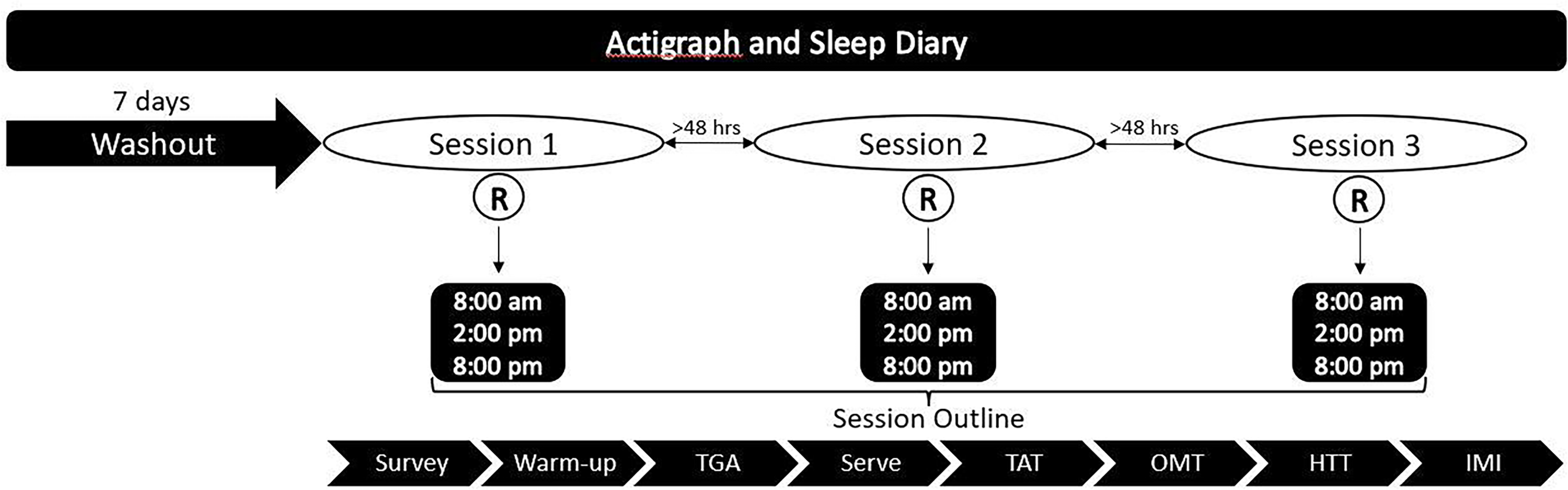
Experimental design, including testing session times, rest periods, assessments performed and session outline. HTT: Hit and Turn Test; IMI: Intrinsic Motivation Inventory; OMT: overhead medicine ball throw; R: randomisation; TAT: tennis agility test; TGA: tennis groundstroke assessment.
After the washout period, players attended the first of three testing sessions. All players completed testing in the morning (8:00 am), afternoon (2:00 pm) and night (8:00 pm); however, the order of these sessions was randomised for each player. Testing sessions were separated by a minimum of 48 hours to reduce the impact of residual fatigue from previous sessions.
The ambient temperature, measured in degrees Celsius, was taken at the start of each testing session. Immediately before the testing session, players complete an online survey consisting of validated sleep health, fatigue and chronotype questionnaires. Sleep health questionnaires were only administered if it had been longer than 1 week between testing sessions. Only the outcome of the chronotype questionnaire from the first session was used in the analysis.
After completing the survey, players performed a standardised warm-up before any data collection. The warm-up consisted of dynamic stretches of the lower and upper body, intensifying sprints, tennis-specific movements (e.g. sidestepping) and tennis strokes (groundstrokes and serves). Players then performed skills and physical tests in the following order: tennis groundstroke assessment, serve speed, tennis agility test, overhead medicine ball throw and Hit and Turn Test (Figure 1). Players were given a minimum of 2 minutes of recovery between tests, with longer rest times taken if required. Immediately following the testing, players completed the Intrinsic Motivation Inventory (IMI) effort/importance and pressure/tension scales.
Measures
SWB and chronotype
Chronotype was measured subjectively, via the Morningness and Eveningness Questionnaire (MEQ) and objectively via midsleep on free days with a sleep correction (MSFscn). The MEQ and the MSFscn were included as they indicate the player's preferred and current chronotype, respectively, which may differ due to social or environmental factors. 25 Players’ SWB was continuously monitored throughout the testing period, with at least the last seven recorded nights prior to each testing session being used for analysis. A wrist-worn activity monitor (GT3X, Actigraph, FL, USA) in conjunction with a modified sleep diary (see Figure S1), administered via Qualtrics software, was used to measure SWB. All sleep metrics recorded and a description of each can be seen in Table S1. A comprehensive overview of the chronotype and SWB measures have been described in a previous paper. 24
Fatigue
The Chalder Fatigue Scale (CFS) measured fatigue, including physical and mental fatigue. 26 The CFS is an eleven-item validated questionnaire designed to indicate the current physical and mental fatigue with total scores ranging from 0 to 33, with higher scores indicating greater fatigue levels.
Tennis groundstroke assessment
The tennis groundstroke assessment was used to assess the velocity, accuracy and consistency of forehand and backhand strokes. The tennis groundstroke assessment has shown good (intraclass correlation coefficient (ICC) = 0.88, standard error of measurement (SEM) = 2.35) test–retest reliability.
27
The assessment involves hitting 72 groundstrokes as hard and as accurately as possible into reference targets across three rounds. An experienced tennis coach fed ball to the players. Video recordings were analysed (Kinovea, version 0.8.15) to determine stroke accuracy (m) and consistency (%). Ball velocity (km/h) was quantified using a handheld radar system (Stalker ATS 2, Applied Concepts Inc, TX, USA). Velocity accuracy (VA) and velocity accuracy error (VAE) indices were calculated for each round of the assessment, with the overall score determined as the average of the rounds (1 and 2).


Serve speed
Players’ maximal service speed was measured using a handheld radar system (Stalker ATS 2, Applied Concepts Inc). Players were provided a sufficient number of practise serves before recording three serves. All serves were conducted from the ‘Deuce’ (right) side of the court. A testing team member was positioned behind the player and recorded every serve in kilometres per hour.
Tennis agility test
The tennis agility test was used to assess the player's tennis-specific movement speed. Decision time was calculated as the time between the tester's initial movement and the player's initial movement. Total time was measured as the total time taken from the testers’ initial movement to the player crossing the centre mark. The Tennis-specific agility test decision time has shown moderate test–retest reliability (ICC = 0.70; SEM = 0.08), while the total time has shown excellent test–retest reliability (ICC = 0.95; SEM = 0.11). 28 Each participant performed three trials per session, with the fastest trial of each session included for analysis.
Overhead medicine ball throw
Overhead medicine ball throw has previously been used to indicate tennis players’ upper body power. 4 Players used both hands to throw a 2-kg medicine ball overhead as far as possible. The players were required to stand with their feet behind a line and not move in front of the line during the throw; this reduced the influence of the lower body. 4 The distance from the line to where the medicine ball landed was measured and recorded to the nearest 5 cm. Players performed three trials per session, with the best trial of each session included for analysis.
Hit and Turn Tennis Test
The Hit and Turn Tennis Test was used to evaluate tennis-specific aerobic capacity. 29 The Hit and Turn Tennis Test has been shown to have high test–retest reliability (r = 0.835, p < 0.01) when conducted on the same surface. 29 The instructions for the test were provided to players on a pre-recorded soundtrack prior to the commencement of the test. The test ended when players could no longer reach the ball pendulum in the required time or voluntarily withdrew. Each session's highest completed level was included for analysis.
Intrinsic motivation inventory
Two subscales of the IMI were used to assess participant motivation. These included the effort/importance and pressure/tension subscales. Both subscales were completed upon the conclusion of testing. 30 The IMI and subscales of the IMI have been widely used within a variety of populations and tasks.31–33 Higher scores for the subscales indicate greater effort/importance and pressure/tension, respectively.
Statistical analysis
The influence of time of day, chronotype and SWB on tennis players’ tennis skills and physical performance were measured using general linear modelling. All models included age, height and body mass as covariates. False discovery rate corrections were applied to account for multiple comparisons and mitigate false-positive results. Repeated measures analysis of variance was conducted to identify any variation in SWB between the average baseline data and the night following each testing session. Analysis was conducted using R Studio software package, Version 1.1 (RStudio Team, 2020).
Results
Demographic information, including the age, height, body mass, SWB and chronotype of participants, is presented in Table 1. The SWB of the players did not significantly differ between baseline and testing sessions. Data on the temperature, fatigue, motivation, tennis skills and physical performance scores for the morning, afternoon and evening testing sessions are reported in Table 2.
Tennis players’ baseline demographic information and SWB metrics from the entire study period are presented as M ± SD (range).
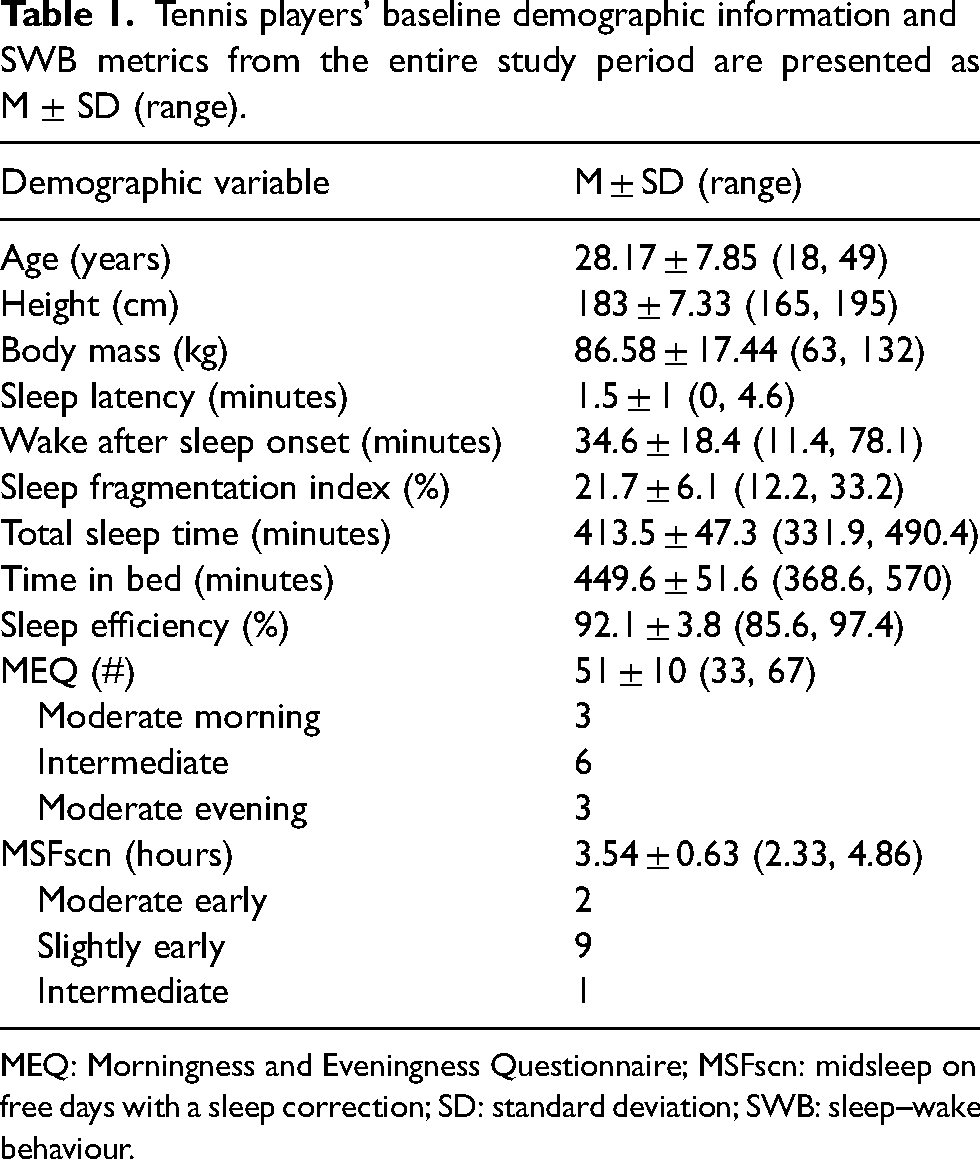
MEQ: Morningness and Eveningness Questionnaire; MSFscn: midsleep on free days with a sleep correction; SD: standard deviation; SWB: sleep–wake behaviour.
The estimated marginal means and standard error for the variables measured at the three time points.
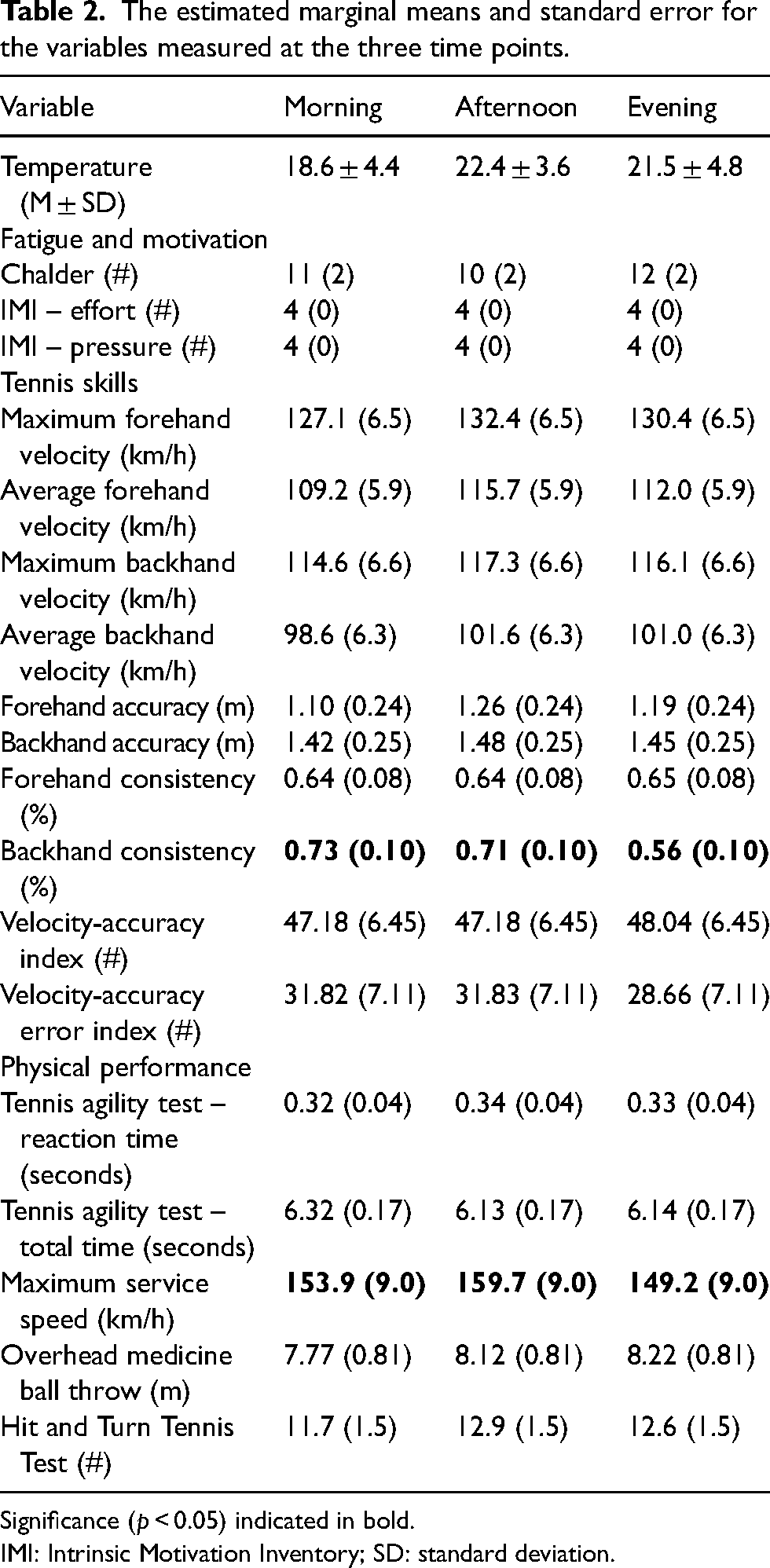
Significance (p < 0.05) indicated in bold.
IMI: Intrinsic Motivation Inventory; SD: standard deviation.
Players’ backhand consistency differed between the testing sessions. Specifically, backhand consistency was less in the evening compared to the morning by 17% (p = 0.020) and afternoon by 15% (p = 0.040, Figure 2). Maximal service velocity also differed between testing sessions, with maximal service velocity less in the evening compared to the afternoon by 10.5 km/h (p = 0.041, Figure 2). Tennis skills and physical performance were not significantly influenced by players’ preferred or current chronotype.
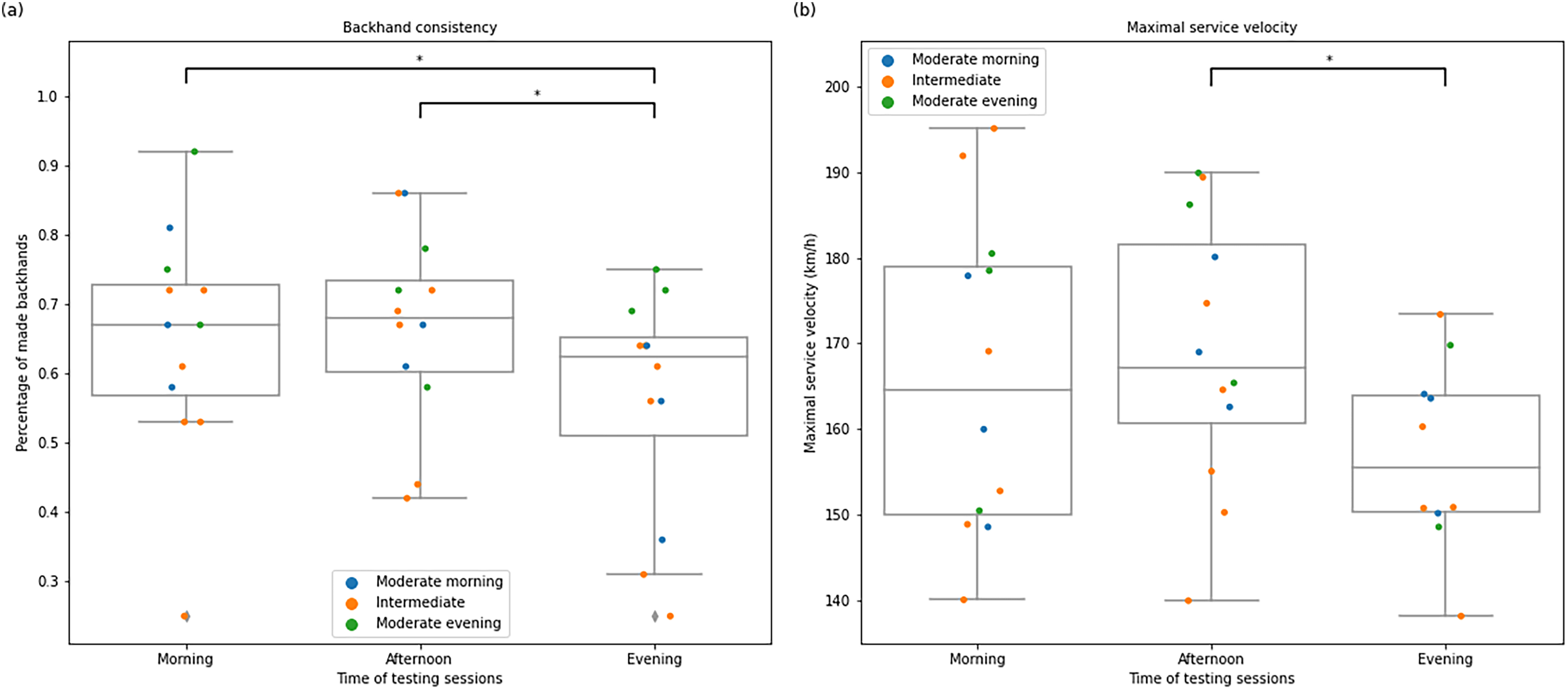
Boxplots with jittered data for (a) percentage of made backhands and (b) maximal serve velocity at the morning, afternoon and evening testing times. Colour-coded data points signify each player's chronotype, measured by the Morningness and Eveningness Questionnaire. *Significant (p < 0.05).
There was a 12.0 and 12.2 km/h reduction in maximal backhand velocity for every hour that time at lights out (p < 0.001), and sleep-onset time (p < 0.001) was postponed, respectively (Figure 3). An 11.6 km/h reduction in average backhand velocity was observed for every hour that time at lights out (p = 0.014), and sleep-onset time (p = 0.014) was postponed (Figure 3).
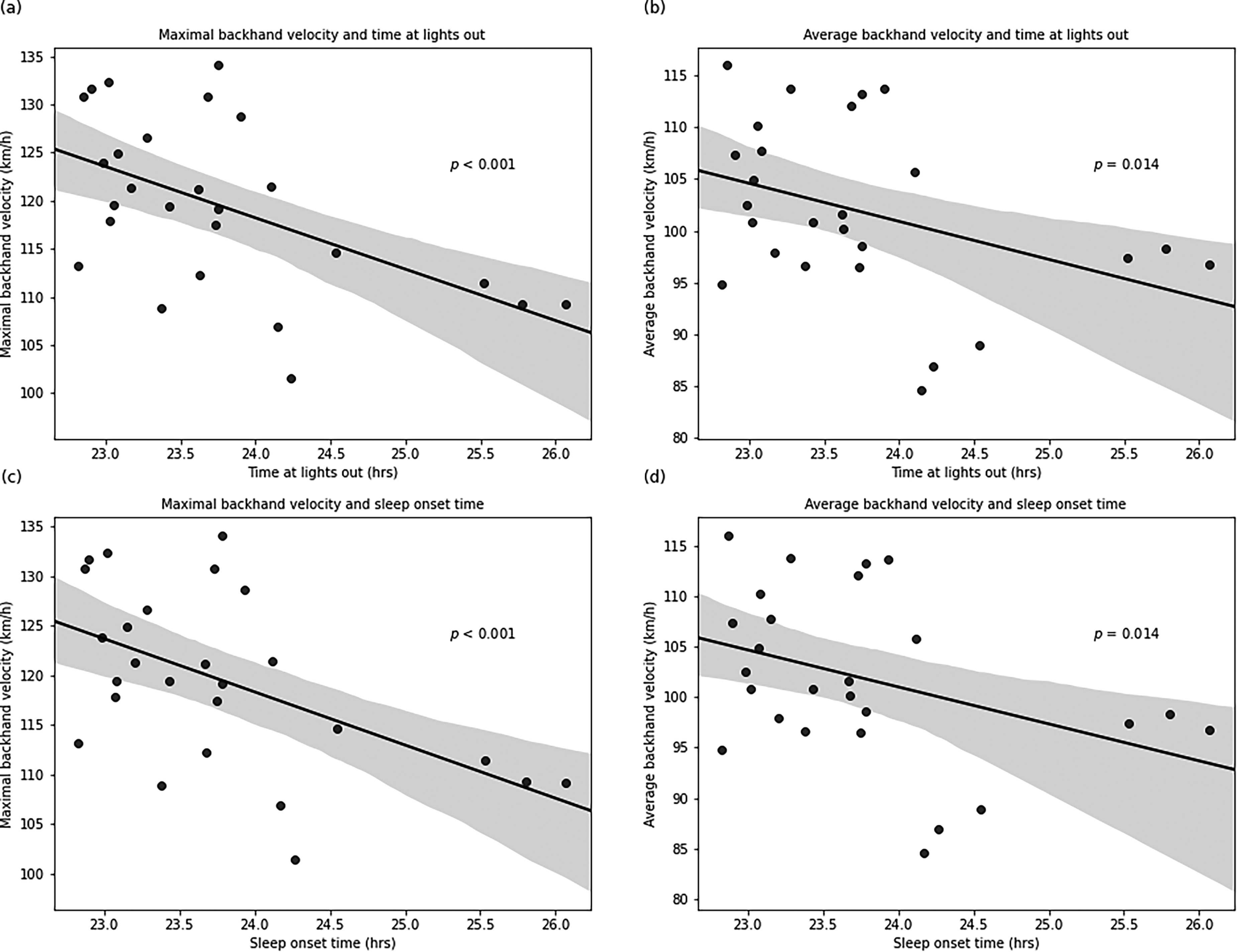
Scatter plots with regression model fit (solid black line) and 95% confidence intervals (grey-shaded area). Significance for each relationship is indicated within each subplot.
Discussion
This study aimed to determine if the skills of male tennis players were influenced by time of day, chronotype or SWB. It also sought to establish if physical performance was affected by the time of day, chronotype or SWB. Contrary to our hypothesis, players demonstrated a reduction in tennis skills in the evening compared to the morning and afternoon, irrespective of their chronotype. Later bedtimes and sleep-onset times were also found to negatively impact backhand velocity, regardless of the time of day. Physical performance did not appear to be influenced by the time of day, player's chronotype or SWB.
Previous studies have reported higher serve velocities later in the day.11,12 Atkinson and Speirs 12 observed higher serve velocities for adult males and females in the evening (6:00 pm) compared to the morning (9:00 am) and afternoon (2:00 pm). López-Samaneset al., 11 in another study, found serve velocities were 4% higher in the afternoon (4:30) compared to the morning (9:00 am) for adult males. The faster afternoon and evening serve velocities observed in these previous studies coincide with a known increase in core body temperature, occurring later in the day.5–7 Based on this literature, we hypothesised that tennis skills, including serve velocity, would be worse in the morning. Contrary to our hypothesis, we found that maximal serve velocities were lowest in the evening testing session. However, it is noteworthy that the evening time of day used in the present study was later than in previous studies (8:00 pm vs. 6:00 pm and 4:30 pm). This time difference is relevant as while an increased core body temperature will aid serve velocity, the increased fatigue that may be present later in the evening has been shown to be detrimental to physical performance.9,34
Interestingly, our study found that backhand consistency decreased in the evening compared to the morning and afternoon testing sessions. This result is also likely due to increased fatigue associated with extended periods of wakefulness.35,36 To our knowledge, this is the first study to investigate the influence of time of day and chronotype on tennis stroke consistency. This finding is of interest as most points are lost due to unforced errors; thus, improving a player's consistency will improve their tennis performance. 37 While unexpected, the player's chronotype did not influence their tennis skills or physical performance. Most participants in this study preferred an intermediate chronotype and were considered slightly early chronotypes based on their SWB. Thus, further studies are required to investigate the influence of definite morning or evening chronotypes.
Players’ sleep preceding tennis play has been shown to negatively affect their skill performance when restricted.22,23,38 Specifically, sleep-onset times have been delayed when sleep is restricted, resulting in decreased serve, backhand and forehand accuracy.22,23 Our study has evaluated the effect of regular SWB for the week before testing on tennis skills and physical performance, and contrary to the previous finding, we found no impact on forehand or backhand accuracy. The contrary results observed in this study may have been due to the SWB of players before testing, with mean sleep latency, total sleep time, wake after sleep onset and sleep efficiency metrics all being within the appropriate to uncertain ranges, as defined by the National Sleep Foundation. 39 This study did observe a reduction in backhand velocity with later time at lights out and sleep onset. This change in velocity may be due to players choosing to slow down their backhands to maintain accuracy. This is the first study to investigate the influence of SWB on tennis groundstroke velocities, and further research is required to support these preliminary findings.
Potential limitations
First, no power calculation was performed, and the study included a limited sample size (n = 12). However, it is worth noting that each player was tested at three time points and that their SWB was recorded throughout the entirety of the study. The present study's sample size is similar to previous studies in tennis players.11,22 Second, the modest playing level of the players may have impacted on the tennis skills test. While players were playing in regular competitive matches their frequency of training is considered low. Third, sleep latency, wake after sleep onset and sleep efficiency metrics need to be interpreted with caution, given that these metrics have only shown moderate concordance compared to Polysomnography (PSG). Nevertheless, actigraph devices are commonly used as they provide an ecological means of evaluating SWB in athletes and provide better longitudinal measures of sleep. Fourth, three service speed trials may not have been enough given the variability found. This variability is likely due to the player's ability level; higher-level players may be more consistent with their maximal serve speeds than the tested players. Additionally, using a tripod for the radar gun may have also reduced potential error. Fifth, the core body temperature of players was not measured during testing. Future studies should include core body temperature measurements when investigating variations in physical performance between times of day. Finally, this study was conducted on adult male players, and therefore the results of this study are not generalisable to junior or female players.
Practical applications
The findings from this study highlight variation in performance during the day and the influence of prior SWB on performance. Players and coaches should be mindful of a potential decline in tennis skills in the evening and acclimatise by conducting training sessions later in the evening leading up to late matches. Following recommended sleep health guidelines may assist players with going to bed and falling asleep earlier, which may also improve their tennis skill performance.
Conclusion
This study found that tennis skills, specifically backhand consistency and maximal service velocity, declined in the evening. Additionally, a decline in backhand velocity was observed the later that players went to bed. Players’ physical performance was not influenced by time of day, chronotype or SWB. Further longitudinal studies are required with players of various chronotypes to confirm the preliminary findings reported in this study.
Supplemental Material
sj-docx-1-spo-10.1177_17479541221136023 - Supplemental material for Does time of day and player chronotype impact tennis-specific skills and physical performance?
Supplemental material, sj-docx-1-spo-10.1177_17479541221136023 for Does time of day and player chronotype impact tennis-specific skills and physical performance? by Mitchell Turner, Philipp Beranek, Johnny Lo, Alexander Ferrauti, Ian C Dunican and Travis Cruickshank in International Journal of Sports Science & Coaching
Footnotes
Acknowledgements
The authors would like to thank all participants for their involvement in this study.
Declaration of conflicting interests
The author(s) declared no potential conflicts of interest with respect to the research, authorship, and/or publication of this article.
Funding
The author(s) received no financial support for the research, authorship, and/or publication of this article.

Supplemental material
Supplemental material for this article is available online.
References
Supplementary Material
Please find the following supplemental material available below.
For Open Access articles published under a Creative Commons License, all supplemental material carries the same license as the article it is associated with.
For non-Open Access articles published, all supplemental material carries a non-exclusive license, and permission requests for re-use of supplemental material or any part of supplemental material shall be sent directly to the copyright owner as specified in the copyright notice associated with the article.
