



Abstract
The aim of the present study was to examine whether full leg-length compression tights modify physiological and kinematic measures during treadmill running at a competitive race pace in moderately trained runners. Thirteen males and five females completed two 15-minute running tests at a speed corresponding to a recent race time wearing compression tights or loose-fitting running shorts. Running economy (RE) was determined by oxygen consumption and carbon dioxide expiration during the final 3 minutes of treadmill running. Muscle oxygenation, skin temperature, heart rate (HR), vertical oscillation, step frequency and ground contact time (GCT) were measured continuously. GCT was shorter with compression compared with control trials (p = 0.03), however, no differences in RE, muscle oxygenation, vertical oscillation, step frequency, HR or skin temperature were revealed. Despite a shorter GCT with compression tights, the findings suggest that moderately trained runners do not benefit nor limit physiological responses at a competitive race pace.
Introduction
Wearing compression garments during exercise has gained popularity within the past two decades. 1 World records have been set by athletes donning compression garments, reinforcing the link between compression clothing and elite performance. 2 Although the world records are undoubtedly the result of talent and training, athletes choose to wear these garments in the belief they will aid performance.
Despite the widespread use of compression garments among elite and moderately trained athletes, research has reported only small improvements in time to exhaustion tasks (Hedges g = 0.27 ± 0.33) 3 and during middle distance running (800–3000 m) (weighted mean improvement = 6.1 s). 4 Wearing compression garments during 5, 10 and 42.2 km flat outdoor running2,5,6 and 15 km trail running 7 had no ergogenic benefit. These time trial performance tests utilised either stockings or socks and did not consider full-length tights. When full-length tights elicit a garment pressure of ∼20 mmHg at the calf and 13–20 mmHg at the thigh,8,9 they were shown to improve variables related to running performance such as running economy (RE), 10 muscle oxygenation 8 and running kinematics. 9 This is in agreement with Watanuki and Murata's proposal of a ‘minimum pressure threshold’ to improve venous return of 17.3 mmHg at the calf and 15.1 mmHg at the thigh. 11 At, or above this pressure, compression may narrow superficial blood vessels and modulate haemodynamic factors, possibly explaining the reported improvement in physiological and biomechanical variables under these conditions.
RE, defined as the metabolic cost of travelling a given distance, is a useful indicator of endurance performance. RE is a multifactorial measure and is influenced by biomechanical, cardiopulmonary, metabolic and neuromuscular systems. 12 In heterogeneous populations with varying aerobic capacity (V˙O2max) values, a strong positive relationship exists between V˙O2max and running performance. However, RE is an important determinant of performance among runners who possess similar V˙O2max values. The benefit of possessing a good RE is evident for elite 13 and moderately trained individuals. 14 Marginal improvements in RE are directly associated with better distance running performance and therefore strategies to improve energy cost are of great interest to runners. 14
It is currently unknown whether full leg-length compression tights, applying an adequate level of pressure, alter cardiometabolic or kinematic variables at an individualised endurance race pace. The aim of the present study was to examine whether compression tights modulate physiological and kinematic variables associated with endurance running performance in moderately trained runners. Garment pressure was targeted to achieve the minimal pressure threshold suggested by Watanuki and Murata. 11 Assessments were completed at a speed that corresponded to an individual's most recent race time over either 10, 21.1 (half marathon) or 42.2 km (marathon) distance.
Methods
Participants
Ethical approval was received from the University of Essex ethical committee. An a priori sample size estimation was performed based on previously observed differences in RE with and without compression tights at 8 km·h−1.
8
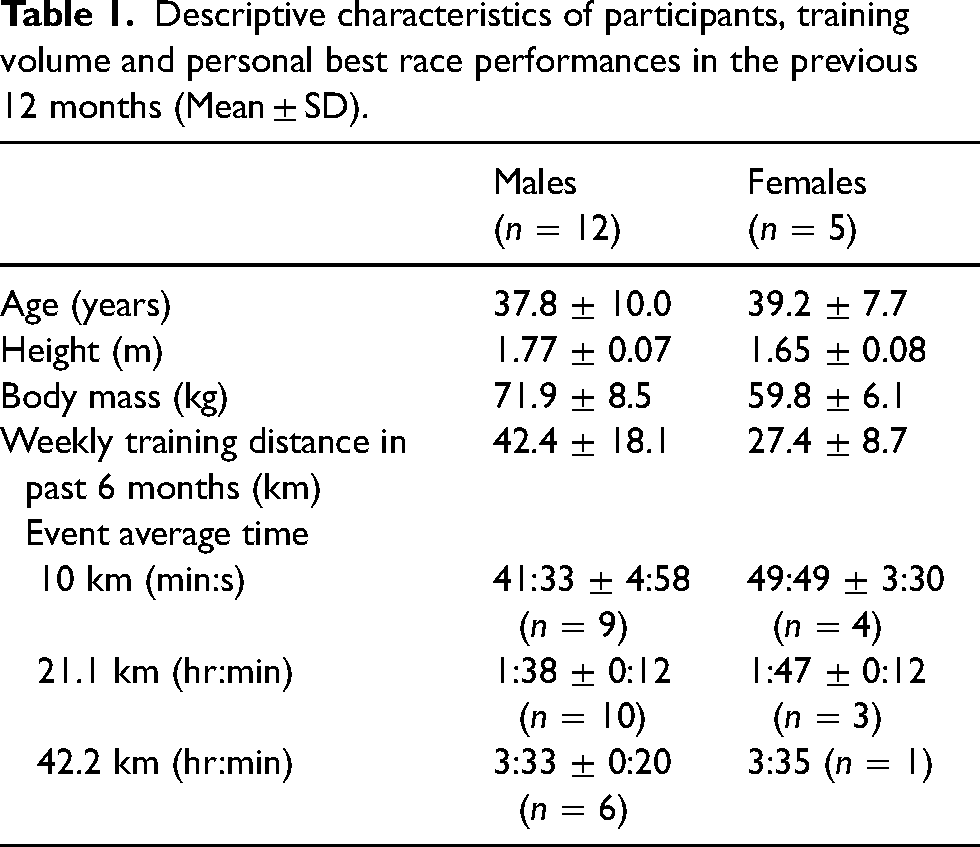
The effect size in this study was 0.76. With an alpha = .05 and power = 0.80, the estimated sample size needed to show a statistically significant effect is n = 16. Two additional participants were recruited to account for potential dropouts during the study. Therefore, a total of eighteen moderately endurance-trained individuals (male; n = 13; female; n = 5) provided written informed consent during the initial visit in accordance with the Declaration of Helsinki. During data collection, one male participant recorded a respiratory exchange ratio (RER) >1.00 during the final 3 minutes of the 15 minutes treadmill run, indicating an anaerobic contribution to energy expenditure. Therefore, all data acquired from that individual was removed prior to analysis. Table 1 provides descriptive data for the remaining 17 participants. All participants were moderately trained runners, familiar with treadmill running and had completed a 10, 21.1 or 42.2 km race within the previous 12 months. A moderately trained runner was defined as a runner who had engaged in a systematic training programme of endurance running for at least 1 year, completing between 10 and 45 km
Descriptive characteristics of participants, training volume and personal best race performances in the previous 12 months (Mean ± SD).
Compression garments
Full leg-length compression tights covering the body from ankle to waist were used in the investigation (SkinsTM A400, Riverwood, Australia). Participants were required to wear two compression tights on top of each other to achieve a target pressure of ∼20 and ∼15 mmHg at the calf and thigh, respectively. Garment size for both tights was selected in accordance with the manufacturer's sizing guide. The garments were made from warp-knitted fabrics, with the fibre reported as 76% nylon and 24% elastane, fabric thickness as 0.57 ± 0.01 mm and fabric weight 199.33 ± 0.57 g/m2. The pressure exerted by the compression tights were evaluated by the PicoPress® (Microlabs, Italy) pressure monitor. Pressure measures were recorded at two anatomical locations (posterior orientation of the maximal calf girth and anterior thigh at the midpoint between mid-trochanterion-tibiale laterale). The control condition consisted of loose-fitting running shorts, thereby providing a comparison between compression tights and garments typically worn by recreational runners. Participants did not wear compression socks during either condition.
Experimental design
Participants completed a single experimental session in a controlled laboratory environment (temperature: 18 ± 1.0°C; relative humidity: 65 ± 5.0%). In the 24 hours prior to testing, participants were asked to refrain from exercise, caffeine and alcohol intake. As participants could not be blinded to wearing compression tights, a questionnaire was completed defining their a priori beliefs and experiences regarding compression garments. 15 Two separate running tests took place during the session to assess the impact of compression tights on RE, muscle oxygenation, running kinematics, heart rate (HR) and skin temperature. Participants wore compression tights and control garments for each test in a counterbalanced, crossover design. At study entry, regardless of sex, garment order was based on non-randomised allocation by presentation, that is, participant 1 = control/compression, participant 2 = compression/control.
Body mass and stature were initially recorded using digital platform scales (SECA, Model 813, Birmingham, UK) and a stadiometer (SECA, Model 213, Birmingham, UK). Skinfold thickness was measured at the vastus lateralis and gastrocnemius of the dominant leg using skinfold callipers (Harpenden HSK-BI, British Indicators Ltd, UK). Participants were then fitted with a HR monitor, skin thermistors and two portable muscle oxygenation sensors. Participants performed 15 minutes supine rest on a medical examination bench prior to the exercise task. Each run test consisted of a 15 minutes run on a motorised treadmill (Quasar; HP Cosmos, Nussdorf, Germany) at a speed corresponding to the individuals most recent 10 (n = 5), 21.1 (n = 5) or 42.2 km race time (n = 7), determined by the most recent distance completed in a competitive event (mean [range] running speed; 11.9 [10.3–14.8] km·h−1). The calibrated treadmill gradient remained at 1% throughout. Convective airflow was provided throughout the running task by a fan (∼400 mm diameter, ∼2 m
Experimental procedures
Cardiovascular measures
Throughout each run test, participants wore a dead-space mask with an impeller turbine assembly (Hans Rudolph, Kansas, USA) and gas concentrations continuously sampled via a capillary line. Concentrations were determined by electrochemical (O2) and infrared (CO2) analyzers (Vyaire CPX, Mettawa, Illinois, USA). Prior to each test, the gas analyzers were calibrated with gases of known concentration (16% O2 and 5% CO2), and ambient air. The digital volume transducer was connected to the housing blower and calibrated automatically using both high and low flow parameters. Mean oxygen consumption (V˙O2) and carbon dioxide production (V˙CO2) were averaged from second-by-second data over an initial 1 min of stationery standing (resting) prior to and the final 3 min of each run test. Second-by-second V˙O2 and V˙CO2 data were used to determine RE as caloric unit cost (kcal·kg·km).
16
RE was adjusted for body size allometrically using a multiplicative method with allometric exponents for mass.
17
Using the general linear model with log outcome (RE) and log scaling factor (body mass) as a covariate enables the allometric scaling equation to be linearized according to the law of logarithms
18
The estimated allometric scaling exponent is shown in equation (1).
Near-infrared spectroscopy (NIRS)
Muscle oxygenation was assessed using NIRS. The Moxy monitor (Fortiori Design LLC, USA) measures changes in tissue oxygenation (SmO2) and total haemoglobin (tHb), providing insight into the balance between oxygen supply and consumption. 19 The Moxy employs four wavelengths of NIR light at 680, 720, 760 and 800 nm 20 and the sensor contains a single light-emitting diode (LED) and two detectors in placed 12.5 and 25.0 mm from the source.
One device was positioned on the belly of the vastus lateralis midway between the greater trochanter and the lateral epicondyle of the femur, the other at the maximal calf girth on the posterior aspect of the gastrocnemius. To ensure the optodes and detector did not move relative to the participants’ skin, the devices were fixed into position using a waterproof adhesive tape. In addition, bodily hair at or around the sensor placement area was removed from the skin and participants were asked not to moisturise the area on the day of testing. In the compression condition, 6 cm diagonal incisions were made in the garments to expose the NIRS devices. Black crepe bandage was wrapped around the leg to secure the NIRS devices and ensure that no external light would be received by the device detectors. A pressure monitor was used to ensure the pressure applied by the bandage was equal to the pressure initially applied under the compression tights (∼20 mmHg = thigh; 15 mmHg = calf), thereby maintaining a consistent external pressure to that of the compression garment. In the control condition, the bandage pressure applied to the NIRS devices was maintained at 8 mmHg, a sufficient pressure to hold the device in place during exercise, minimise movement artifact and prevent ischaemia-induced changes in SmO2 and tHb observed at higher pressures. 19 During all testing, the system was connected to a personal computer via a commercially available software program (Peripedal ©, peripedal.com) to provide a graphic display of the data. Data acquisition (2 Hz) was obtained from the sensors internal memory and data sets were smoothed by calculating the 3 seconds moving average. Due to potential differences in resting values between run tests, SmO2 was reported as a change from the baseline. Baseline SmO2 and tHb were established as the final 30 seconds of the 15-minute supine rest period prior to each run test. During each run test, the minimum SmO2 and tHb in the initial 1 minute was identified (10 seconds average) in addition to the final 1 minute average at the end of the 15 minutes treadmill run. These values were subtracted from the baseline to provide a delta (Δ) 1 minute and Δ15 minutes value. The difference between Δ1 minutes and Δ15 minutes value was calculated (Δdiff) to determine the muscle oxygenation response for the final 14 min of the run task. To ensure sufficient optical density penetrating the adipose layer, Feldmann et al. 21 recommend caution when using the Moxy monitor on participants with an adipose tissue thickness (ATT) > 15 mm. As such, participants with an ATT > 15 mm were excluded from the analysis. One female participant reported an ATT >15 mm at the thigh and calf. A further female participant reported an ATT >15 mm at the thigh and were therefore removed from NIRS analysis. ATT was calculated as 0.5 × mean skinfold thickness.
Running kinematics
Participants wore a HR strap equipped with a triaxial accelerometer (HRM-Run; Garmin Ltd, Schaffhausen, Switzerland). The strap was placed on the xiphoid process of the sternum. Output was sent wirelessly to a wristwatch (Forerunner 920XT, Garmin International Inc., Olathe, KS) via a 2.4 GHz ANT + system. Vertical oscillation, step frequency and GCT were calculated using the proprietary algorithms of the Garmin Connect software, previously reported as valid and reliable measures 22 compared with a motion-analysis system. Mean vertical oscillation (cm), step frequency (steps per minute (spm)) and GCT (milliseconds) were averaged from second-by-second data over the final 3 minutes of each run test
Temperature measurement
Skin temperature (Tsk) was recorded throughout the run test by taping temperature sensors (Libra Medical Ltd, Model ET402, Ascot, Berks, UK) adjacent to the NIRS devices at the gastrocnemius (calf) and vastus lateralis (thigh). Tsk was recorded each minute and 3 minutes averages were calculated and used for data analysis.
Subjective questionnaire
Participants were asked seven dichotomous questions and answers were summed to give an overall belief score. 15 Higher scores would indicate positive opinions on the effectiveness of compression garments.
Statistical analysis
Data are presented as mean and 95% confidence intervals (95% CIs) for all dependent variables. To evaluate if an order effect was present, results from the first and second treadmill sessions were analysed with a paired samples t-test. Paired differences between conditions for dependent variables were initially tested for normality using the Shapiro–Wilk test. Analysis of RE, HR, SmO2, tHb, vertical oscillation, step frequency and GCT was performed by a paired samples t-test to measure potential significant differences between two means. To assess differences in Tsk at different time intervals, a 2 × 5 repeated-measures ANOVA was conducted. Fisher’s least significant difference (LSD) test was used for post hoc pairwise comparisons. In addition, the magnitude of the differences between each condition was calculated using Cohen's d effect size with thresholds for small, moderate and large effects as 0.2, 0.5 and 0.8, respectively. Spearman's rank correlation coefficient analysis was performed to examine the association between belief score and differences between garment conditions in RE, vertical oscillation, step frequency and GCT. Differences between garment conditions are calculated as compression minus control. Statistical tests were processed using the statistical package SPSS (Version 18) and Microsoft Excel (Microsoft Corporation TM, Redmond, WA, USA). The level of statistical significance was identified by an alpha value of p < .05.
Results
The pressure applied by the compression tights was 17.8 [95% CI: 15.9–19.7] mmHg and 13.1 [95% CI: 11.8–14.3] mmHg at the calf and thigh, respectively. No significant order effect was observed for RE, RER, HR, vertical oscillation, step frequency or GCT (p = .40, .89, .80, .83, .78, .36). Furthermore, resting V˙O2 was not different between run tests (Run 1 = 499.9 [429.5–570.5] ml/min; Run 2 = 476.2 [413.0–539.4] ml/min, p = .39), indicating that either the 30 minutes rest between run trials negated any fatiguing effect, or the duration and intensity of the initial 15 minutes run test were insufficient to elicit a rise in excess post oxygen consumption ahead of the second run test. 23
A difference was observed between garment conditions for GCT (t (16) = 2.34, p = 0.03), indicating participants exhibited a shorter contact time with compression tights, however, vertical oscillation and step frequency remained unchanged.
No difference between the control and compression conditions was found for cardiovascular measures of RE, RER and HR (Table 2). However, compression produced heterogeneous responses in terms of RE (range: −5.6–3.8%). Figure 1 shows the change in RE for each participant as a violin plot. The violin plot shows the minimum, median and maximum values, while the width of the plot reflects the number of points for each value. Correlation analysis revealed no association between belief scores and changes in RE (r = .28; P = 0.27), vertical oscillation (r = .25; p = 0.33), step frequency (r = .35; p = 0.17) or GCT (r = .07; p = 0.79).
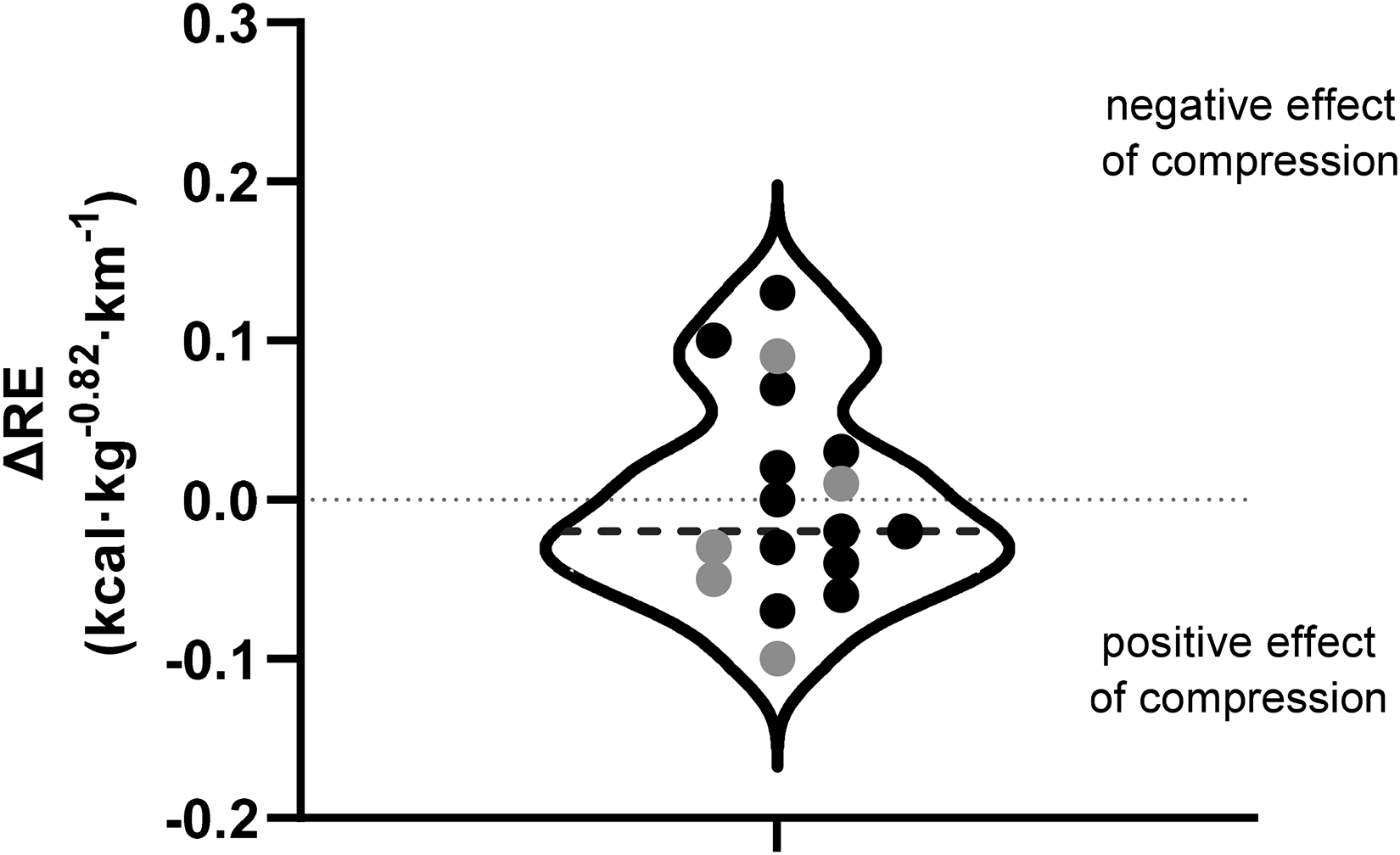
Violin plot showing the effects of compression tights on running economy (ΔRE).
Cardiovascular responses, running kinematics, SmO2 (%) and tHb (arbitrary units) data during 15 minutes run with and without compression tights (Mean [95% CI]).
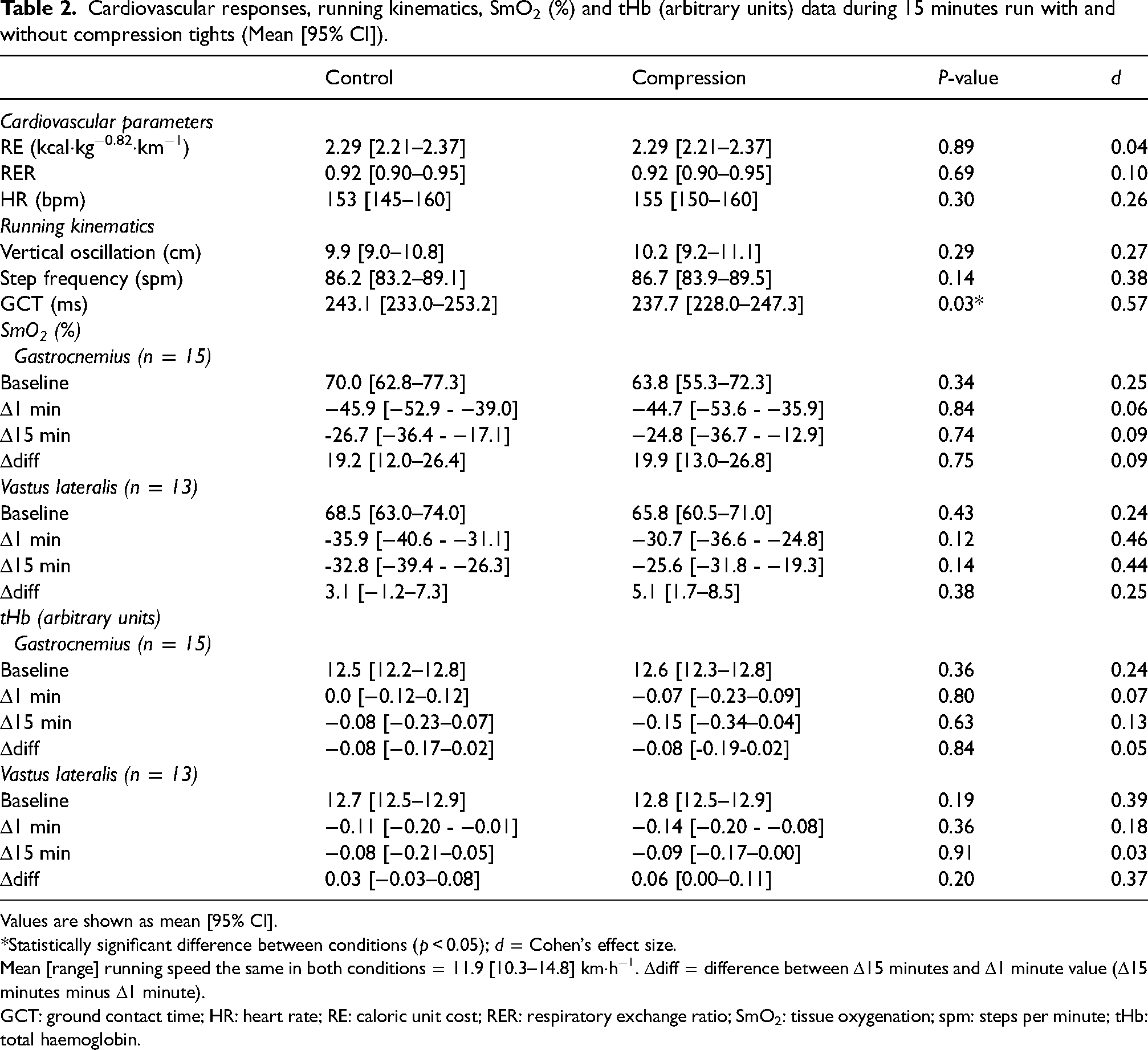
Values are shown as mean [95% CI].
*Statistically significant difference between conditions (p < 0.05); d = Cohen's effect size.
Mean [range] running speed the same in both conditions = 11.9 [10.3–14.8] km·h−1. Δdiff = difference between Δ15 minutes and Δ1 minute value (Δ15 minutes minus Δ1 minute).
GCT: ground contact time; HR: heart rate; RE: caloric unit cost; RER: respiratory exchange ratio; SmO2: tissue oxygenation; spm: steps per minute; tHb: total haemoglobin.
Due to data signal drop out, SmO2 and tHb data were unavailable for two participants at the vastus lateralis and one participant at the gastrocnemius. Therefore, accounting for the participants omitted due to an ATT > 15 mm and subsequent data signal drop out, a total of 13 participants were included in the analysis of the vastus lateralis and 15 participants for the gastrocnemius. There were no differences in SmO2 and tHb between garment conditions at any of the time points or the change (ΔDiff) between 1 and 15 minutes (Table 2).
For Tsk at the calf and thigh, there were significant main effects for time (P < 0.001) but not garment (p = 0.11 and p = 0.62) or their interaction (p = 0.47 and p = 0.80) (Figure 2a and b).
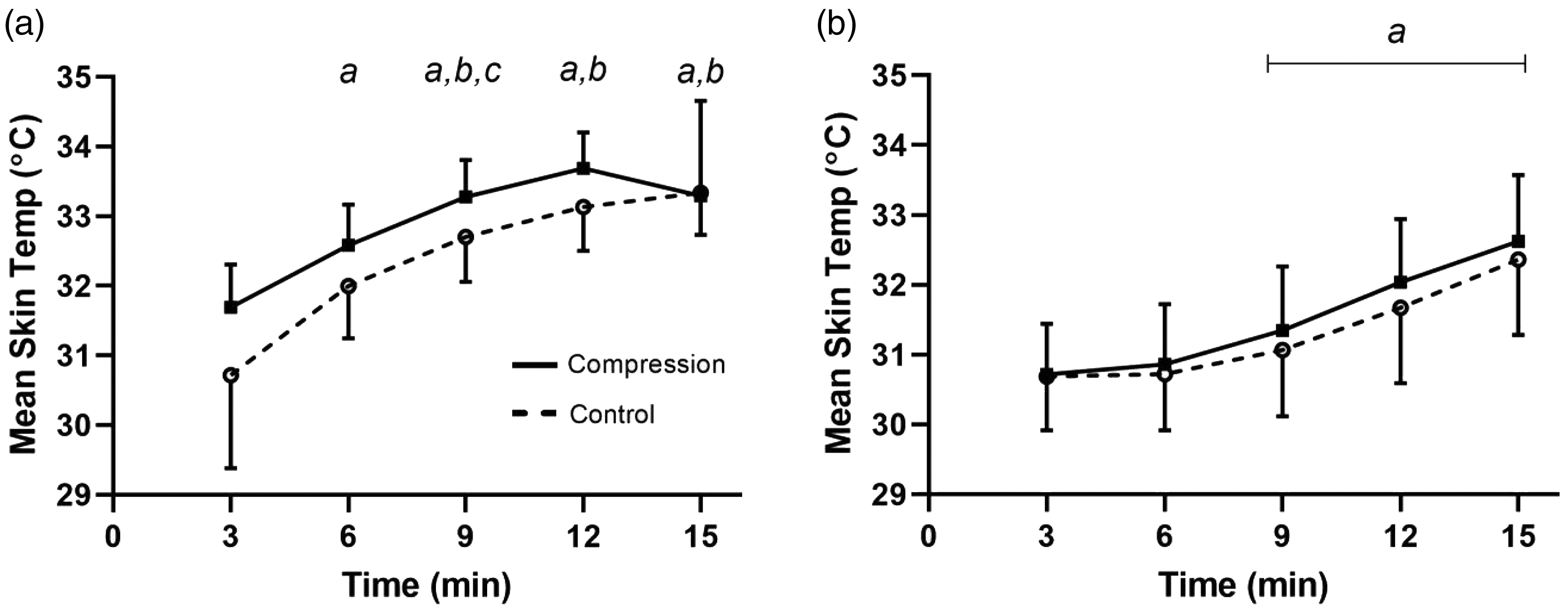
The effects of compression garments on skin temperature of the calf (a) and thigh (b) during 15 minutes race pace running.
Discussion
The current study investigated the influence of wearing compression tights on physiological parameters during submaximal running at long-distance race speed. No difference in any cardiovascular, NIRS or skin temperature measure was revealed between garment conditions. GCT was shorter with compression tights; however, vertical oscillation and step frequency remained unchanged.
The present study is the first to investigate the influence of compression tights on running kinematics. Previous studies have included compression stockings only15,24,25 or a combination of calf and thigh sleeves 26 and reported higher leg stiffness, lower contact time and lower stride length during constant rate running.25,26 The present study revealed no differences in vertical oscillation or step frequency, however, in support of Kerherve et al., 25 a shorter GCT was observed with compression. Some studies have reported a longer GCT is associated with a lower oxygen cost and therefore better RE, 27 whereas other report either no correlation between GCT and RE 28 or an inverse relationship whereby shorter GCT is associated with better RE. 29 In the present study, despite an apparent reduction in GCT among moderately trained runners wearing compression tights, RE remains unchanged. The observed difference in GCT between compression and loose clothing (∼5.4 ms) may simply be too small to transfer into any meaningful change in RE. Furthermore, because sample size was determined from previously observed differences in RE, and the number of variables included in the current study, caution is advised when interpreting this only significant finding between compression and loose clothing. It is plausible that the observed reduction in GCT is the result of a type 1 error and an adequately powered study focused on GCT is required to build upon these initial findings. If indeed the change in contact time is a result of donning compression tights, this may be a result of decreased range of motion (ROM) at the hip or knee joint, reducing stride length and contact time. Compression shorts decreased the ROM at the hip joint at rest, laying supine 30 and during a 60 m sprint. 31 Logically, decrease in ROM are only observed at the joints covered by the garment. By compression tights covering both the hip and knee joint, garments of this type offer the greatest opportunity to alter running gait. However, future research is required to explore whether decrease in ROM are observed at submaximal running speeds with compression tights and whether this is of benefit or detriment to performance.
Cardiovascular parameters during submaximal running are affected by various factors, including running kinematics such as vertical oscillation and GCT. 32 However, evidence appears equivocal regarding the association between GCT and RE, with several authors reporting either no relationship, 28 improved RE with longer GCT 33 or improved RE with shorter contact time. 34 In the current study, a shorter GCT with compression tights caused no measurable change in RE which was consistent with previous findings. Dascombe et al., 8 reported no change in RE or V˙O2 at speeds between 10 and 18 km·h−1 with well-trained middle-distance runners. The pressure reported at the calf (19 mmHg) and thigh (∼14 mmHg) appear comparable with the present study; however pressure assessment was conducted with the Kikuhime pressure monitor, a device shown to report higher pressures in comparison to the PicoPress and a medical reference standard. 35 It is therefore plausible that the pressure observed by Dascombe et al., 8 was below the desired pressure threshold previously postulated. 11 Similarly, in well-trained runners and triathletes, there was no effect of compression tights targeting a pressure of 20 mmHg on V˙O2 during a 15 min run at 70% V˙O2max. 36 However, in this instance, garment pressure was not directly measured so it remains unknown whether the targeted pressure of 20 mmHg was achieved. It is conceivable that treadmill running at a competitive race pace is a speed that participants regularly train at and therefore are already ‘most’ economical at this intensity. 15 In support of this, Varela-Sanz et al., 24 reported no change in V˙O2 at half-marathon pace with compression stockings, suggesting that athletes already select the most economical locomotion style at competition pace and deviating from this style will likely result in significant decrements in RE. Furthermore, McManus et al., 37 previously reported an improvement in RE with compression tights at a relative exercise intensity of 75–85% V˙O2max. It is plausible that the relative exercise intensity in the present study was below the purported range to respond positively to compression tights. Despite this, the current study confirms compression tights do not augment nor attenuate RE at speeds associated with long-distance races. Target garment pressures were selected in accordance with recommendations associated with improved venous return, 11 whereas garments pressures shown to influence running mechanics appear to be higher. Future investigations should assess the influence of compression tights on RE applying a pressure of ∼23–33 mmHg around the calf and ∼20 mmHg around the thigh.25,26
It is widely reported that compression garments can positively influence physiological parameters such as blood flow velocity 11 and proprioceptive capability. 1 However, an overlooked area associated with compression clothing is the additional mass of garments, thereby adding an increased metabolic cost The additional weight of a garment may negate any potential benefit caused by increased transmural pressure and stimulation of mechanoreceptors brought about by compression. Previous studies show an added shoe mass of ∼100 g per shoe increases metabolic rate by 1%. 38 It is conceivable that the total mass of the two garments (∼350 g) worn in the present study may have offset any physiological response that might benefit RE.
The participants’ perception of compression garments may influence the individual response. 39 In the present study, belief in sports compression did not influence ΔRE or kinematic variables. This is unsurprising given the majority of participants (n = 13) reported positive belief scores (score range: 3–7), with only one participant showing negative responses (score range: −7 – −3) and three exhibiting neutral responses (score range: −2–2). In contrast, Stickford et al.,, 15 reports an inverse correlation between belief scores and changes in V˙O2, revealing that highly trained distance runners reporting more positive feelings about compression garments produced greater decrements in submaximal V˙O2 when compression stockings were worn.
No significant garment effect on HR during submaximal exercise was observed in the present study. This observation is in agreement with previous investigations, who reported that HR is unaffected by compression tights when running at 110% V˙O2max , 40 or with compression stockings during a 10 km time trial. 2 Despite reported increases in venous flow velocity and venous return when compression is applied at rest, increased cardiac output due to exercise is likely to supersede minor changes to flow velocity caused by compression. This is perhaps indicative of the effectiveness of skeletal muscle pumps and venous valves during continuous dynamic exercise. 41
Skin temperature was not different between garment conditions at the gastrocnemius or vastus lateralis at any time point during the exercise task. This is of particular interest considering participants wore two compression tights and previous investigations reported higher skin temperatures under single-layer compression garments. 41 A noteworthy increase in skin temperature (∼1°C; d = 0.48) was observed at the gastrocnemius after three minutes of exercise; however, the between-garment difference diminished as the duration of exercise continued. In the present study, the skin thermistors were placed at an anterior (vastus lateralis) and posterior (gastrocnemius) orientation. The convective air flow delivered by the fan may explain the difference in skin temperature between measuring locations. It is suggested that thermal effects may be more pronounced during prolonged high-intensity or intermittent exercise, without constant air flow, however, further research is required to substantiate this theory. 41
This is the first study to investigate the influence of compression tights on muscle oxygen saturation at two anatomical locations simultaneously. The pattern of muscle oxygen desaturation and resaturation followed a similar pattern at both locations to those previously reported when running on moderately flat terrain. 25 A rapid decrease in muscle oxygenation was observed following the onset of exercise, followed by a slow linear increase. However, in agreement with earlier studies,8,42 no differences between clothing conditions were observed in muscle oxygen saturation during exercise. Other studies have reported positive effects of compression clothing on measures of muscle oxygen saturation;8,43 however, these studies include heel-raise exercise 43 or measures obtained at rest. 44
Measures of tHb obtained by NIRS reflect changes in local blood volume and hence, in some circumstances, can provide a surrogate measure of tissue blood flow. In the present study, compression tights did not alter tHb, indicating that muscle blood volume is unchanged during exercise between clothing conditions. However, obtaining NIRS measures during a venous occlusion of the leg would provide a greater insight into muscle blood flow. Future investigations should implement an arterial occlusion protocol during brief rest intervals throughout steady-state exercise to elucidate on flow and consumption changes with compression tights.
Conclusion
This study shows for the first time that wearing compression tights while running at speeds associated with competition pace reduces ground contact time. However, RE, skin temperature, muscle oxygen saturation, vertical oscillation and step frequency are not modified. There is evidence that the individual response to wearing compression tights varies greatly in moderately trained runners. In order to explore the relationship between changes in RE with compression tights and running gait parameters, future studies should select garments with pressures previously shown to alter running kinematics (∼20–33 mmHg) rather than pressure thresholds that may influence blood flow (15–17 mmHg).
Footnotes
Acknowledgements
The authors are grateful to the participants for volunteering their time and energy to this study. We would like to acknowledge SKINS International Trading AG for providing the compression garments free of charge. No external funding was received for this study or potential conflicts of interest reported by the authors.
Declaration of conflicting interests
The author(s) declared the following potential conflicts of interest with respect to the research, authorship, and/or publication of this article: None of the authors have any ownership of stocks, employment or board membership at SKINS International Trading AG or other companies with competing interests in relation to data presented here, neither financial, professional nor personal.
Funding
The author(s) disclosed receipt of the following financial support for the research, authorship, and/or publication of this article: SKINS International Trading AG provided the compression garments free of charge. SKINS International Trading AG had no role in study design (other than garment provision), data collection and analysis, decision to publish or preparation of the manuscript. No external funding was received for this study. The results of the current study do not constitute an endorsement of the product by the authors or the journal.
