



Abstract
High divorce and remarriage rates have expanded nontraditional family forms, as some family members leave and others join during the process of repartnering. A less explored consequence of the growth in step-families is the proliferation of step-grandparenthood. This paper focuses on emotional closeness and frequency of contact between step-grandparents and their step-grandchildren in childhood and adulthood. Based on 4,992 biological grandparents and step-grandparents participating in the 2014 wave of the German Ageing Survey, we compared 7,710 biological grandparent–grandchild relations to 465 step-grandparent–step-grandchild relations. Step-relations were differentiated by whether repartnering occurred in the grandparent or parent generation. Hierarchical linear regression results provided support for the hypothesis that step-grandparents feel less emotionally close to their step-grandchildren than biological grandparents feel to their biological grandchildren. In contrast, the observed lower frequency of contact in step-grandparent–step-grandchild relations was mostly explained by their weaker emotional ties.
Keywords
Introduction
Family scholars have studied grandparenthood as a unique life-stage governed by implicit and explicit rules of engagement among grandparents, parents, and grandchildren (e.g., Arber & Timonen, 2012). In part, this interest derives from growth in the prevalence of three-generation families, enabled by increased life expectancy that has extended the amount of shared lifetimes between generations (Leopold & Skopek, 2015; Margolis, 2016). The percentage of adults having at least one grandparent alive at age 30 has risen nearly four-fold over the twentieth century to about 20 percent today (Uhlenberg, 2004). Research has also identified positive consequences of active grandparenting in the form of contact, support, and emotional connection, for the well-being of both grandparents and grandchildren (e.g., Attar-Schwartz, Tan, Buchanan, Flouri, & Griggs, 2009; Drew & Silverstein, 2007; Mahne & Huxhold, 2015; Ruiz & Silverstein, 2007).
Given profound changes in family structure over the last several decades due to increased divorce and remarriage rates, it is understandable that recent attention has been drawn to the topic of stepfamily relations in later life. Interest in later-life step-parenting has also surged with the growth of older step-families (Ganong & Coleman, 2012; Lin, Brown, & Cupka, 2018; Steinbach & Hank, 2016). Research shows that relationships with adult stepchildren tend to be characterized by weaker emotional attachment, less contact, and lower financial transfers than relationships with biological children (e.g., Henretta, van Voorhis, & Soldo, 2014; King & Lindstrom, 2016; Steinbach, 2013). The proliferation of step-families combined with renewed interest in grandparenting has sparked interest in the role of step-grandparents in contemporary families.
Only recently have scholars considered step-grandparenthood as a family role worthy of study. Rich descriptive qualitative studies on step-grandparenting have predominated (for an overview, see Chapman, Ganong, & Coleman, 2016). Several quantitative studies have been performed with small convenience samples (e.g., Block, 2002; Christensen & Smith, 2002; Henry, Ceglian, & Matthews, 1992; Soliz, 2007), with recent studies focusing on care provided to (step-)grandchildren by (step-)grandparents (Coall, Hilbrand, & Hertwig, 2014; Danielsbacka & Tanskanen, 2018; Žilinčíková & Kreidl, 2018). We are aware of only one study that used nationally representative data to study step-grandparents; however, that investigation (Yahirun, Park, & Seltzer, 2018) focused on demographic characteristics of step-grandparents, and neither considered the quality of step-relationships, nor distinguished whether that came about by the repartnering of biological grandparents or the repartnering of biological parents.
In the current study, we focus on step-grandparent–step-grandchild relationships, relying on data from a representative national sample of older adults in Germany with detailed measures that allowed consideration of how those step-relations were acquired. Germany represents—in several ways—an average nation on most dimensions of family life. For example, rates of divorce, remarriage, single-parenting, and step-family formation in Germany lies between the extremes of Northern and Southern Europe (Steinbach, Kuhnt, & Knüll, 2016; Toulemon, 2016). This also holds true for the demography of grandparenthood (Leopold & Skopek, 2015) and intergenerational family relationships more generally (e.g., Saraceno, 2008).
The purpose of our investigation was to examine emotional closeness and frequency of contact between grandparents and grandchildren based on their bio-step status, distinguishing step-relations by the generation in which repartnering occurred. Further, we differentiated relationships with minor grandchildren and relationships with adult grandchildren in order to isolate the critical developmental period in which grandparents are most involved with their grandchildren.
Background
Although grandparent–grandchild relationships have extensively been studied in the context of martial disruption in the middle or parent generation (e.g., Attar-Schwartz et al., 2009; Bridges, Roe, Dunn, & O’Connor, 2007; Drew & Silverstein, 2007; Westphal, Poortman, & van der Lippe, 2015), few studies have differentiated biological grandparents from step-grandparents as an analytic focus (for an overview, see Chapman, Ganong, & Coleman, 2016). For the purpose of our investigation, we define a step-grandparent as someone who achieved a grandparent-like status within a family by virtue of repartnering in either the grandparent or the parent generation (Chapman, Ganong, & Coleman, 2016). We present in Figure 1 the two pathways by which step-grandparent status is achieved using labels developed by Ganong and Coleman (2004). In the first pathway, a step-grandchild is acquired when a step-child becomes a parent, a type we label as “skipped generation.” In the second pathway, a step-grandchild is acquired when a biological child becomes a step-parent, a type we label as “inherited.” (Although Ganong and Coleman (2004) divided the skipped generation type into later-life, and long-term step-grandparents—depending on when in the lifecycle of the step-grandchild the step-grandparent was aquired—we consider all step-grandparents aquired through repartnering in the grandparent generation as “skipped generation” due to data limitations.) While it is possible that the two pathways (skipped generation and inherited) operate together, in the case where a step-child becomes a step-parent, this is a rare occurrence in our analytic sample. We also note that the step-grandparent role can be acquired due to repartnering following either divorce or widowhood, each with unique implications for step-families (Chapman, Kang, Ganong, Sanner, & Coleman, 2018). However, we are not able to differentiate these antecedent marital conditions in our data, recognizing that widowhood is likely more prevalent prior to the repartnering of grandparents than the repartnering of parents.
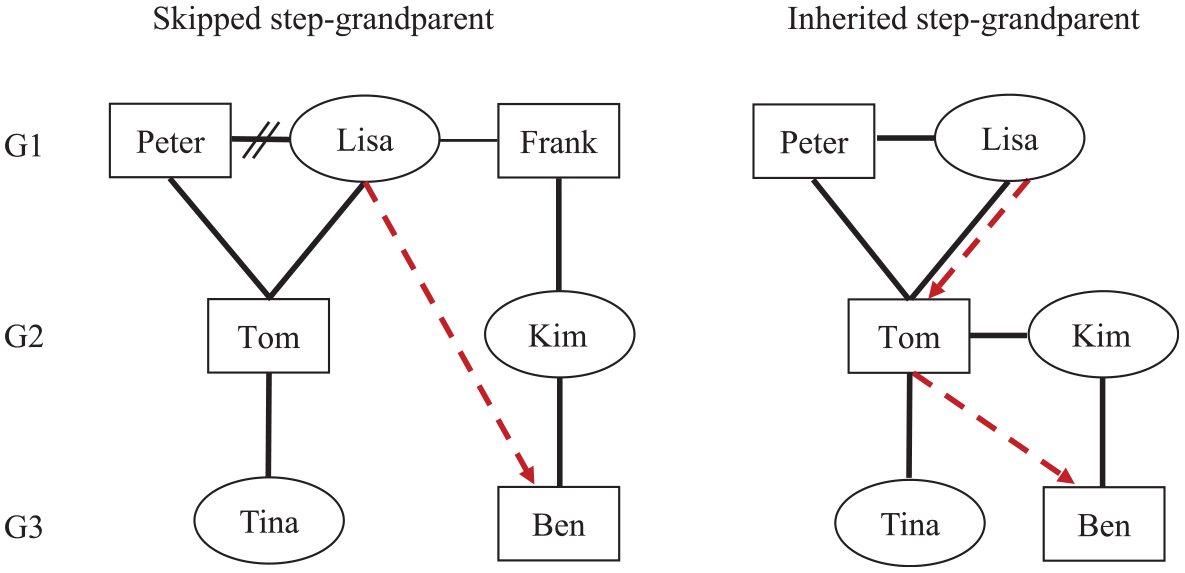
Genogram of Skipped and Inherited Step-Grandparent Constellations.
Age of grandchildren represents an important characteristic when examining grandparent–grandchild relationships. In general, biological grandparents are emotionally closer and have more frequent interaction with younger than older grandchildren (e.g., Bridges et al., 2007; Lussier, Deater-Deckard, Dunn, & Davies, 2002; Silverstein & Marenco, 2001). In general, the strength of relationships between biological grandparents and grandchildren declines with the transition of grandchildren to adulthood (Geurts, Poortman, van Tilburg, & Dykstra, 2009; Silverstein & Marenco, 2001). However, a recent study of step-families revealed that step-relations of longer duration were stronger than shorter-term step-relations (Chapman, Ganong et al., 2016).
Timing of family disruption and step-role acquisition also has consequences for step-grand relationships. The age of the step-grandchild at the outset of the step-relationship is typically important in how step-grandparents are integrated into the family. Research has demonstrated that step-grandchildren who acquired the role in early childhood evaluated their relationships with step-grandparents as more important and emotionally closer than those who acquired the role as adolescents or adults (e.g., Chapman, Sanner et al., 2016; Christensen & Smith, 2002). Additionally, step-grandchildren are at high risk of experiencing the dissolution of their relationship with step-grandparents because remarriages are more prone to divorce than first marriages. For instance, Sanner, Coleman, and Ganong (2019) found that step-grandchildren had difficulty maintaining relationships with their former step-grandparents and found losing ties with them distressing.
Gender also plays a key role in shaping grand relations (e.g., Christensen & Smith 2002). Research demonstrates that biological grandmothers typically have stronger relations with their grandchildren than do biological grandfathers (Arránz Becker & Steinbach, 2012). In general, women tend to serve as kin-keepers in families, maintaining contact with and connecting family members. In addition, lineage is also important to consider since maternal grandparents generally invest more in their grandchildren than do paternal grandparents. Both gender and lineage differences in intergenerational family relations have been explained from evolutionary perspectives (e.g., genetic relatedness) and social perspectives (e.g., socialization to gender roles and cultural norms) (Danielsbacka, Tanskanen, & Rotkirch, 2015). In addition, same-gender relations tend to be closer than mixed gender relations, with biological grandmother–granddaughter relationships being the strongest (Chapman, Ganong, & Coleman, 2016). These gender and lineage differences likely apply to step-grandparents as well, with the caveat that step-grandparents are not genetically related to their step-grandchildren, nor do they have as long a history of social exposure to them, possibly dampening gender differences among them.
A key challenge faced by step-grandparents is much the same as that facing step-parents: the lack of clear social norms for their role responsibilities (Cherlin, 1978; Ganong & Coleman, 1997). Roles in step-families tend to be idiosyncratically negotiated, which may raise conflicts and increase social distance when expectations across generations are not in agreement (Chapman, Sanner et al., 2016; Suanet, van der Pas, & van Tilburg, 2013). Even though some step-grandparents are excited about their new extended family, others may resist engaging with newly acquired step-grandchildren (Henry, Ceglian, & Ostrander, 1993). Whether and how quickly step-grandparents adjust to their new family role depends on the length of time since entry into the stepfamily, feelings of loyalty or guilt toward other (biological) members of their family-of-origin, and pressure exerted by children and/or step-children to “normalize” their new family arrangements (Chapman, Ganong, & Coleman, 2016; Ganong & Coleman, 2004). Consequently, there is much variation in the quality of the step-grand relationship, ranging from virtually having no connection at all to having relationship that is fully kin-like in quality (Chapman, Sanner et al., 2016; Christensen & Smith, 2002).
We note that the two pathways to step-grandparenting involve nodes in the family network that may inhibit relations with step-grandchildren. The literature on grandparenting clearly shows that the linking function of the middle generation is instrumental to the quality of relationships maintained with grandchildren (Mueller & Elder, 2003). In the case of the inherited type of step-grandparenting, the relationship with the newly acquired child-in-law may create barriers due to incomplete integration of the repartnered child’s spouse into the family. In the case of the skipped type, the barrier might come with the incomplete integration of the new grandparent into the family. There is little theory to guide a prediction as to which type of barrier would be stronger.
Explanations for weaker relationships maintained by step-grandparents with their step-grandchildren derive from sociological theories related to exchange, opportunity, and normative factors over the family life course (see Szydlik, 2012) and evolutionary theories that put primacy on promoting the fitness of genetically related family members (see Tanskanen & Danielsbacka, 2019). Because step-grandparents lack clear behavioral norms and are not genetically related to their step-grandchildren, both social and evolutionary explanations are plausible (e.g., Chapman, Sanner et al., 2016; Danielsbacka & Tanskanen, 2018). However, in the case of the inherited step-grandchildren, there is a biological relationship involved (with the step-parent of the step-grandchild) such that there may be motivation to be more involved with the grandfamily.
Relations between grandparents and grandchildren, both biological and step, can be described along multiple dimensions of the intergenerational solidarity paradigm (Silverstein, Giarrusso, & Bengtson, 1998). In this paper, we focus on emotional closeness and frequency of contact between (step-)grandparents and (step-)grandchildren because they represent the two most important and inclusive dimensions within the solidarity paradigm (Lawton, Silverstein, & Bengtson, 1994; Szydlik, 2012). Emotional closeness reflects a subjective aspect of relationships, conveying the degree of intimacy and warmth, whereas frequency of contact is a more objective, behavioral dimension, which has geographic propinquity and exchange of support between the generations among its correlates (Silverstein, Bengtson, & Lawton, 1997; Steinbach, 2013). However, emotional closeness and contact are highly interrelated dimensions of intergenerational relationships (Hogerbrugge & Komter, 2012; Silverstein, Parrott, & Bengtson, 1995; Szydlik, 2012). Research has demonstrated a reciprocal mutually reinforcing relationship between emotional closeness and social contact between adult children and their parents (Lawton, Silverstein, & Bengtson, 1994), and we assume the same would hold in grandparent–grandchild relationships. Thus, in our models we control one for the other in order to isolate the unique effects of grandparents’ step-relationship status on each dimension.
In summary, previous qualitative research and research based on convenience samples have provided evidence that emotional closeness is weaker and frequency of contact is lower with step-grandchildren than with biological grandchildren. The aim of the current study was to provide population-based evidence for these differences, taking into account several pathways to step-grandparenting, and applying a rich set of control variables to represent potential explanations for them. First, we hypothesized that emotional closeness is weaker and frequency of contact is lower in step-grandparent–step-grandchild relations than in corresponding biological relations. Second, we hypothesized that emotional closeness and social interaction are independently associated with the step-biological distinction in grandparent–grandchild relationships. Third, we hypothesized that the step-grand gap will be rendered less consequential for step-grandparents whose step-grandchildren are adults than those whose step-grandchildren are minor children, under the assumption that many older step-grandchildren have had long-term relationships with their step-grandparents. Finally, we hypothesized that the inherited step-grandparent relationship type would demonstrate a greater step-gap than the skipped type, based on where in the lineage repartnering occurred and genetic relatedness to the grandfamily.
Method
Sample
Data used for this study were from the German Ageing Survey (DEAS) (https://www.dza.de/en/research/deas.html) provided by the Research Data Centre of the German Centre of Gerontology or FDZ-DZA (https://www.dza.de/en/fdz.html). The DEAS is a nationwide representative survey of the population aged 40 years and older in Germany (for details, see Mahne, Wolff, Simonson, & Tesch-Römer, 2017). Our analysis was based on the most recently available DEAS wave in 2014 (doi:10.5156/DEAS.2014.M.001) that consists of 10,324 respondents (Klaus & Engstler, 2017). The overall response rate of the survey was about 30 percent, which is in line with a general trend of decreasing response rates in social surveys in most Western societies, and particularly in Germany (Aust & Schröder, 2009; Brick & Williams, 2013; de Leeuw & de Heer, 2002; Stoop, Billiet, Koch, & Fitzgerald, 2010). However, selectivity of participation in the survey does not appear to be an issue of concern in the DEAS 2014 data, as sociodemographic characteristics of the sample have been shown to match well with similar characteristics of the population (Klaus & Engstler, 2017). The survey took place using face-to-face CAPI interviews (Mahne & Huxhold, 2015).
Out of 10,324 study participants, 5,511were grandparents. Grandchildren and step-grandchildren were identified using a roster method in which respondents identified all their biological, adopted, foster, and step-children, and then identified the biological, adopted, foster, and step-children of those children. Respondents provided detailed information about relationships with up to eight adult children and up to four grandchildren. In cases where the number of grandchildren exceeded four, the interviewer randomly selected four for detailed relational questions. Although this selection method systematically excluded relationships in larger families, it captured 99 percent of all grandparent–grandchild relations.
The data set was transformed into long format resulting in 9,070 grandparent–grandchild dyads. We excluded 30 grandparent–grandchild relations with missing information on the type of relationship (bio or step), 103 with adoptive or foster relations, and 397 who did not know the year of birth of their grandchild. Another source of missing data was the question on frequency of contact to which 365 grandparents did not respond. Additional analysis assigning these relations as having “no contact” did not alter the results. After making the aforementioned exclusions, the final analytic sample consisted of 8,175 grandparent–grandchild dyads nested within 4,992 grand-families. We estimated two-level random intercept hierarchical linear models (Gelman & Hill, 2006: Part 2A) with grandparent–grandchild dyads clustered within grandparents.
Dependent Variables
To assess emotional closeness, respondents were asked to indicate “how close” their relationship is to each grandchild using the following response categories: 1 = “not close at all,” 2 = “not very close,” 3 = “moderately close,” 4 = “close,” and 5 = “very close.” Frequency of contact with each grandchild was measured by the question: “How often are you in contact, including visits, letters, phone calls, SMS or e-mail,” with the following response categories: 1 = “never,” 2 = “less often than several times a year,” 3 = “several times a year,” 4 = “one to three times a month,” 5 = “once a week,” 6 = “several times a week,” and 7 = “daily.” The question about contact was asked only if the grandchild was 16 years or older and did not live in the same household as the child of the grandparent. For grandchildren 15 years or younger who lived in the same household as their parents, we used frequency of contact with parents as a proxy measure of contact (Chapman, Sanner et al., 2016; King, 2003).
Types of Step-Grandparent–Step-Grandchild Relationships
We delineated grandparent type by using information about the nature of the relationship between the grandparent and the adult child and the nature of the relationship between the adult child and the grandchild. Three lineage types were identified: (a) Biological grandparent: The adult child and the grandchild were both biologically related to the grandparent. (b) Inherited step-grandparent: The step-grandchild was the step-child of the grandparent’s biological child (i.e., repartnering took place in the parent generation). (c) Skipped step-grandparent: The step-grandchild was a biological child of the grandparent’s step-child (i.e., repartnering took place in the grandparent generation). Since there were only eight cases where both the child and grandchild were step-children, we categorized this combination as inherited.
Independent Variables
We controlled for a set of variables which previous research found to be associated with grandparent–grandchild relations (e.g., Danielsbacka & Tanskanen, 2018; Mahne & Huxhold, 2012). To account for opportunity factors and intergenerational strain, we controlled for geographic distance from grandchildren and frequency of conflict with them. Geographic distance from each grandchild was measured using the following categories: 1 = “in the same house or household,” 2 = “in the neighborhood,” 3 = “in the same town,” 4 = “in another town, but it can be reached within two hours,” 5 = “farther away, in Germany,” and 6 = “farther away, abroad”). If the grandchild lived together in the same household as the adult child of the grandparent, geographic distance to that child was used as a proxy. Frequency of conflict with each grandchild was measured by how often they felt “annoyed or angry with each other” with response categories: 1 = “never,” 2 “seldom,” 3 “sometimes,” 4 “often,” or 5 “very often (constantly).” To assess gender of the grandparent and grandchild, we included three dummy variables for the gender composition of the grandparent–grandchild dyad: grandmother–grandson, grandfather–granddaughter, and grandfather–grandson (grandmother–granddaughter as the reference group).
In order to isolate emotional and behavioral components of the relationships studied, we controlled for emotional closeness when predicting frequency of contact, and frequency of contact when predicting emotional closeness, following the example of Steinbach and Hank (2016).
Grandparents’ characteristics considered were age (in years), number of grandchildren, partnership status (having a partner vs. none), level of education as indicated by two dummy variables using the International Standard Classification of Education (ISCED) which ranges from 0 = “less than primary education” to 8 = “doctoral degree or equivalent” (ISCED medium (level 3–4) and ISCED high (level 5–8), with ISCED low (level 0–2) as the reference group), work status (works for pay vs. does not work for pay), self-rated health (1 = “very poor,” 2= “poor,” 3 = “average,” 4 = “good,” or 5 = “very good”), and region ( respondent lives in western vs. eastern Germany). In order to gain leverage over the general valuation of grandparenting, we included a measure of the assessed importance of the grandparent role (1 = “completely unimportant,” 2 “not so important,” 3 “important,” and 4 “very important”).
Grandchildren’s characteristics considered were age (in years) and gender of the lineage as indicated by the adult child who is parent of the grandchild (daughter vs. son).
Detailed descriptive sample statistics are found in Table 1.
Descriptive Sample Statistics.
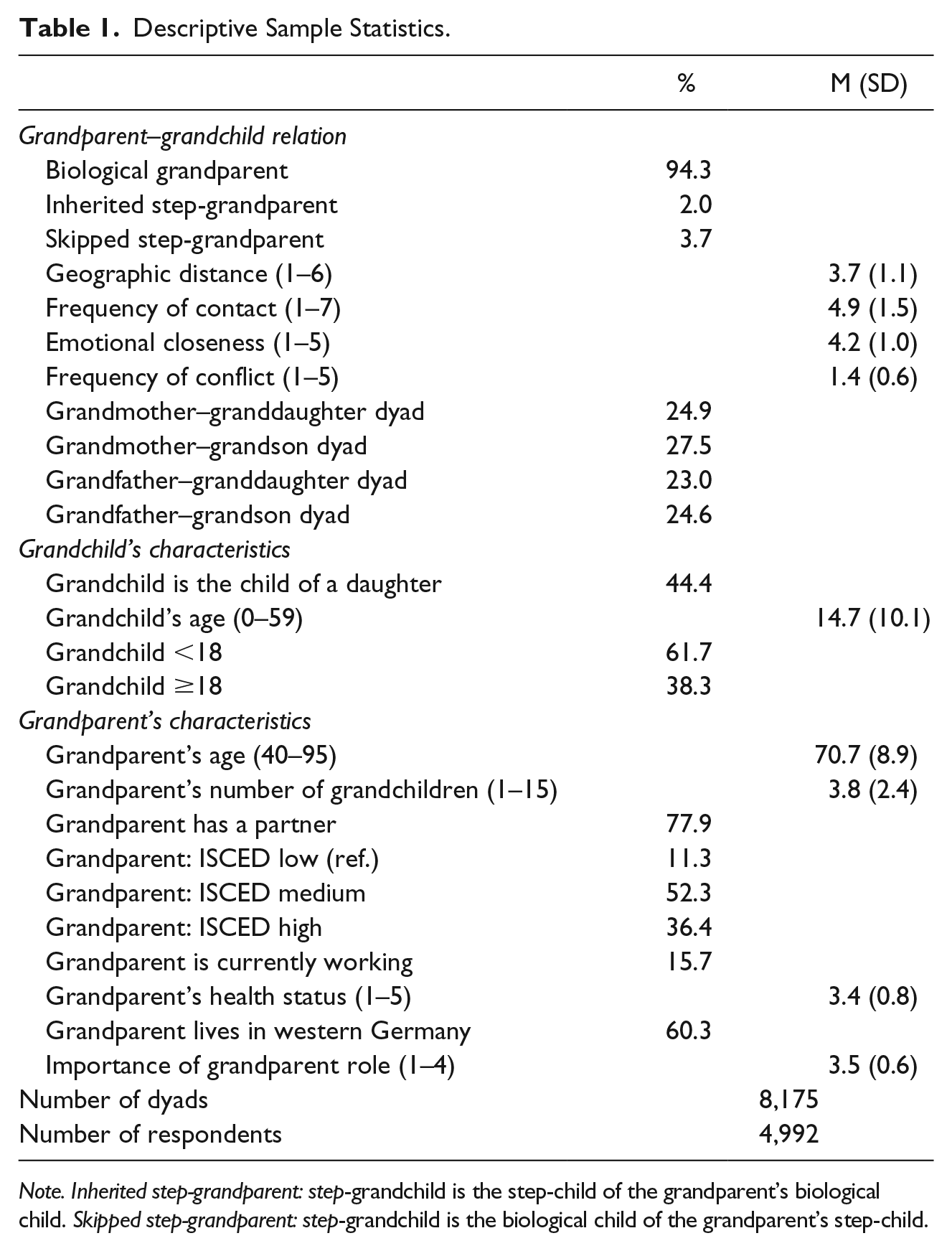
Note. Inherited step-grandparent: step-grandchild is the step-child of the grandparent’s biological child. Skipped step-grandparent: step-grandchild is the biological child of the grandparent’s step-child.
As the data set in the current study does not have information about when in the family lifecycle the step-grandparent entered that role, we must infer this from the current age of the step-grandchild. We assume that older step-grandchildren will have both long-term and short-term relationships, so, on average, will have known their step-grandparents longer than younger step-grandchildren. However, age of grandchildren carries life-cycle influences, such that older step and biological grandchildren are more likely to be independently connected to their (step)grandparents, outside the influence of their parents, than are younger grandchildren, thereby weakening grandparental ties (Silverstein & Marenco, 2001). Since it is difficult to predict the impact of age on the step-gap, we stratify our analyses by whether the (step)grandchild in each relationship was a minor (under 18 years old) or an adult (18 years of age or older).
Results
Bivariate results (mean values shown in Table 2) suggest that relations between step-grandparents and their step-grandchildren are emotionally weaker than relations between grandparents and their biological grandchildren—both in childhood and adulthood. Both, skipped and inherited step-grandparents, felt less emotionally close to their minor and adult step-grandchildren than grandparents felt to their comparably aged biological grandchildren. There are no observable differences in the step-gap between the two types of step-grandparents. As hypothesized, the strength of emotional closeness with adult grandchildren is generally weaker than with minor grandchildren, both in step- and biological relationships. However, it is important to note that assessments of emotional closeness to all types of grandchildren was quite high, averaging at least 4 on the 5-point scale.
Grandparents’ and Step-Grandparents’ Emotional Closeness and Frequency of Contact with Grandchildren and Step-Grandchildren in Childhood and Adulthood.
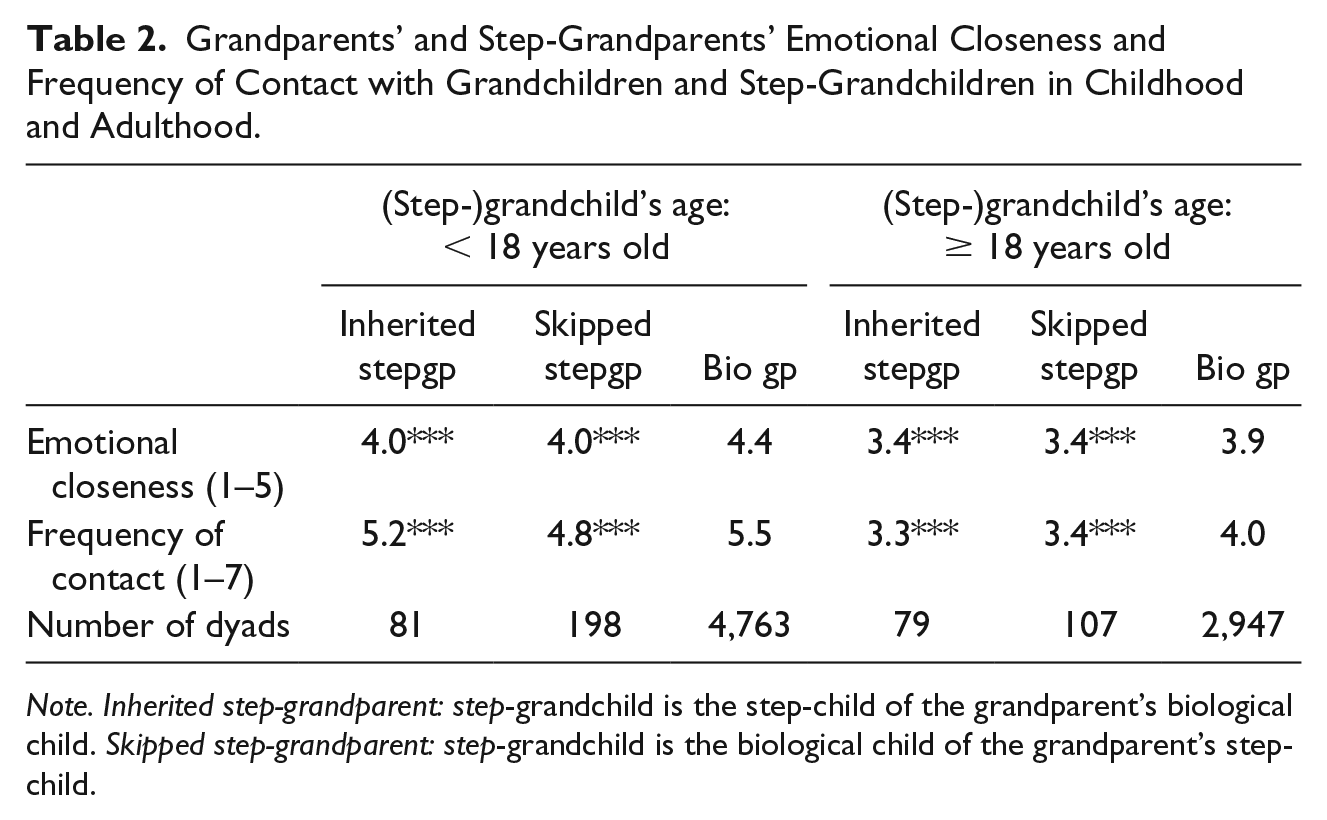
Note. Inherited step-grandparent: step-grandchild is the step-child of the grandparent’s biological child. Skipped step-grandparent: step-grandchild is the biological child of the grandparent’s step-child.
Frequency of Contact
Bivariate results for frequency of contact, also shown in Table 2, demonstrate a somewhat different pattern than that for emotional closeness. With respect to minor step- and biological grandchildren, contact with skipped step-grandchildren was lower than contact with biological grandchildren. However, contact with inherited minor step-grandchildren did not significantly differ from contact with minor biological grandchildren. With respect to frequency of contact with adult step- and biological grandchildren, contact with step-grandchildren of both types was significantly lower than contact with biological grandchildren.
Multivariate Results
We present estimates from the multilevel model for emotional closeness to minor and adult grandchildren in the first two equations of Table 3. Mirroring the bivariate results, step-grandparents of both types felt significantly less close to their step-grandchildren, than grandparents felt to their biological grandchildren. These results hold for relationships with both minor and adult grandchildren.
Hierarchical Linear Regression Predicting Emotional Closeness and Frequency of Contact between (Step)Grandparents and (Step)Grandchildren.
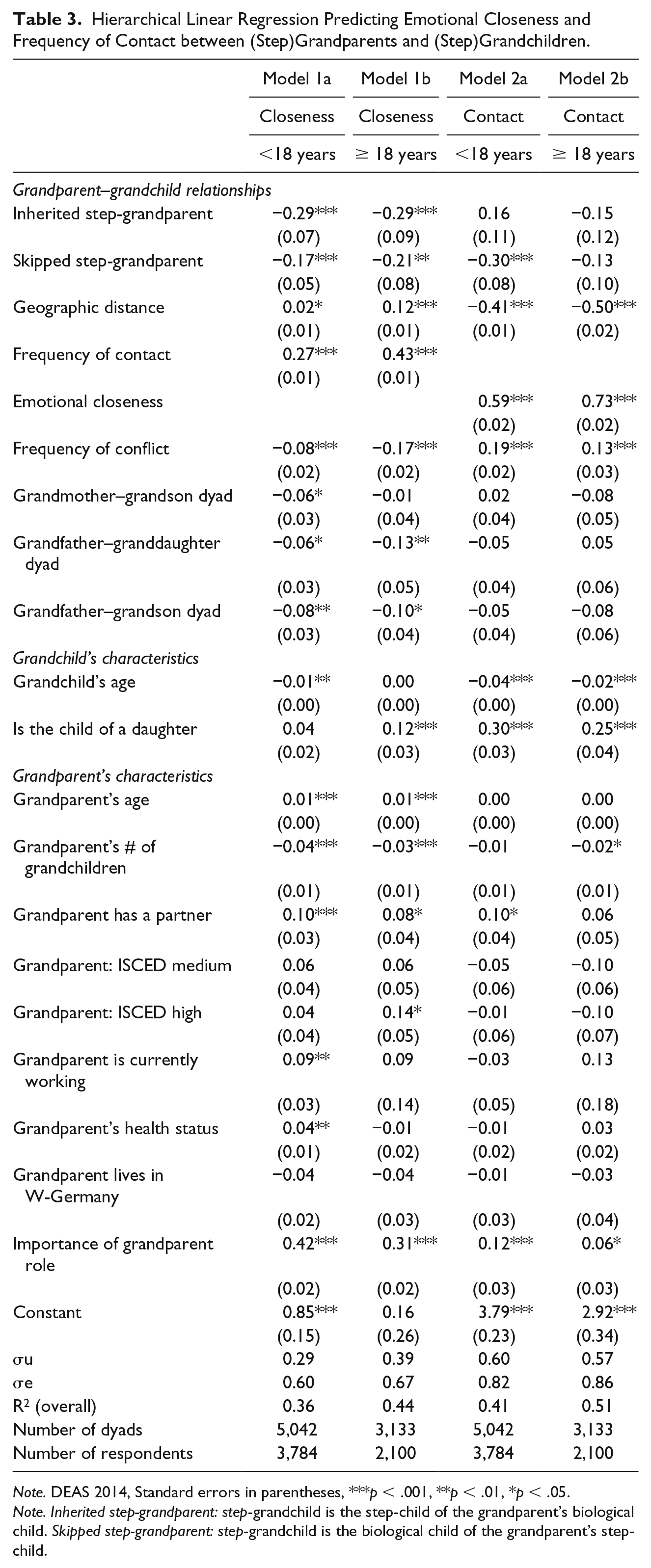
Note. DEAS 2014, Standard errors in parentheses, ***p < .001, **p < .01, *p < .05.
Note. Inherited step-grandparent: step-grandchild is the step-child of the grandparent’s biological child. Skipped step-grandparent: step-grandchild is the biological child of the grandparent’s step-child.
Geographic distance and frequency of contact each had a positive association with emotional closeness, while frequency of conflict had a negative association with it. Regarding the sex composition of the dyads, grandmother–granddaughter pairs were emotionally closer than other pairings. Only among adult grandchildren were grandparents closer to grandchildren in their daughters’ families compared to those in their sons’ families. The results also revealed age effects. Grandchild’s age was negatively associated with emotional closeness among minor grandchildren, and grandparents’ age was positively associated with emotional closeness with both minor and adult grandchildren.
The total number of grandchildren was negatively related to emotional closeness, with a greater number of grandchildren reducing emotional closeness to any one grandchild. Having a partner had a positive association with emotional closeness. Education played a minor role with only highly educated grandparents feeling closer to adult grandchildren in comparison to less educated grandparents. Working grandparents and those in better health felt closer to minor grandchildren when compared to their counterparts. No differences were found by east–west region. Finally, those who considered the grandparent role more important felt closer to their grandchildren than those who felt the grandparent role to be less important.
Frequency of Contact
A more complex and sparser pattern of associations emerged with respect to the step-bio gap in frequency of contact with grandchildren, shown in the final two equations in Table 3. Only among minor grandchildren was contact lower with skipped step-grandchildren compared to biological grandchildren. No similar effect was found with respect to inherited step-grandchildren. With control variables included in the multivariate model, no step-bio differences in contact were found with respect to adult grandchildren.
Greater frequency of contact between grandparents and their grandchildren was associated with greater emotional closeness, closer geographic distance, and greater frequency of conflict between them. No differences were found with respect to the gender composition of dyads. Contact was greater with younger minor grandchildren and younger adult grandchildren when compared to their older counterparts. Gender of the lineage predicted contact with greater contact observed with grandchildren derived from daughters compared to grandchildren derived from sons.
Neither age of the grandparent, nor number of grandchildren was associated with frequency of contact. Having a partner was associated with greater contact—but only with minor grandchildren. Educational level of grandparents, as well as their work status, self-rated health, and regional location did not predict frequency of contact. Those who endorsed the importance of the grandparent role tended to have more contact with grandchildren.
Discussion
In this investigation, we examined whether relationships maintained with step-grandchildren differed from those maintained with biological grandchildren, focusing on two focal dimensions of intergenerational solidarity: emotional closeness (a subjective dimension, conveying the degree of intimacy and warmth) and frequency of contact (an objective, behavioral dimension). Relying on theoretical arguments from sociology as well as from evolutionary science, we predicted that step-grand-relations would be weaker than biological grand-relations. Step-relations were proposed to be disadvantage, because of a lack of social norms, the absence of support expectations in these newly established relationships, and genetic dissimilarity that makes investments in the fitness of grandchildren less likely. Relying on a representative sample of biological and step-grandparents in Germany, we examined two types of step-grand relationships based on the generation in which repartnering occurred.
Regarding emotional closeness, we found significant differences between relations with grandchildren based on the step-bio distinction. Relationships with step-grandchildren, both minor and adult, were emotionally weaker than those with biological grandchildren. These results were consistent even after controlling for sociodemographic characteristics of grandparents and their biological and step-grandchildren, as well as frequency of contact, degree of conflict, and geographic distance between them. Regarding frequency of contact, the results were somewhat different. The bivariate analysis detected the same pattern as found for emotional closeness. However, after controlling for sociodemographic characteristics and emotional closeness, we found only one bio-step difference with regard to contact: grandparents had less contact with minor skipped step-grandchildren than with minor biological grandchildren. This result may be a consequence of competition between the step-grandparent and previously existing biological grandparents for the attention of young step-grandchildren, or blocked access to the step-grandchild by the biological parent of the step-grandchild. On balance, findings of a grand step-gap were weaker for contact than for emotional closeness. As contact requires effort in the commitment of time and energy, it might be the case that mediating forces such as emotional distance from step-grandchildren suppresses contact, whereas weak feelings of closeness to them are based on early structural facts and therefore insensitive to current levels of contact. However, that the step-gap in contact was found only for the skipped type of step-grandparents but not the inherited type, partially confirms our hypothesis about relationship type.
With regard to emotional closeness, we did not find meaningful differences in relationships based on the pathway taken to step-grandparenthood. Relationships with step-grandchildren were more weakly connected regardless of whether repartnering occurred in the grandparent or the adult child generation. Gaining this knowledge is important as it suggests the primacy of biological grand-families over several alternatives, an area that has not previously been examined with a sufficient sample size. Further, our models control for several confounding factors such as the general salience of the grandparent role which may lead to differential involvement with grandchildren based on step-bio status. The fact that we cross-controlled for emotional and behavioral aspects of each relationship in our predictive models suggests that contemporaneous exposure to step-grandchildren does not explain weaker emotional ties with them.
Our results can also be viewed from a “strength-based” perspective. We appreciate the possibility that close relations between step-grandchildren and their step-grandparents can develop based on the emotional connection to parents and step-parents and conceptions of family inclusion (Sanner, Ganong, Coleman, Chapman, & Kang, 2019)—emerging from complex negotiations based on personal, family, and cultural expectations (Chapman, Ganong, Coleman, Kang et al., 2016). Supporting this perspective are the null step-bio differences in contact we found among inherited step-grandparents when emotional closeness, geographic distance, and conflict are controlled. This suggests that when emotional closeness, distance, and conflict are maintained at equivalent levels, contact with inherited step-grandchildren can be maintained at an average level no different than contact with biological grandchildren. We hope that future research examines whether the step grand-gap closes at increasingly higher levels of intergenerational solidarity. Such a model is beyond the mission of the current investigation, requiring the introduction of interaction terms, but would go far toward understanding the conditions under which close step-grand relationships can be maintained.
The development of family bonds can be challenging for step-family members because neither legal regulations nor social norms are uniform or clear in resolving ambiguity in these intergenerational roles (King, Boyd, & Thorsen, 2015). Step-relationships are often negotiated on the basis of idiosyncratic guidelines as to what makes someone family (Schmeeckle, Giarrusso, Feng, & Bengtson, 2006). Loyalty conflicts may easily occur. These challenges usually attributed to relations between step-parents and their step-children naturally extend to relations between step-grandparents and their step-grandchildren, with the added complexity that the middle generation performs a gatekeeper function in moderating access to step-grandchildren (Arránz Becker & Steinbach, 2012; Mueller & Elder, 2003). Exploring these nuances and how they may lead to feelings of ambivalence in step-grandparent–grandchild relationships would be a welcome avenue for future research (Connidis, 2015).
On the other hand, some step-grandparents may be viewed as a “bonus” family member within the kinship matrix and serve as an additional filial resource. Literature demonstrates that biological grandparents are important sources of love and support for descending generations. The question arises, whether step-grandparents can be as functionally important to their step-families. The few existing findings on this topic point in this direction (e.g., Chapman, Coleman, & Ganong, 2016; Chapman, Ganong, Coleman, Kang et al., 2016; Christensen & Smith, 2002; Soliz, 2007). Identifying, which step-relationships result in estrangement, and which result in full incorporation of the step-grandparent into the step-family will be an important topic for future research.
Our analysis has important limitations that deserve mentioning. A key limitation of our analysis is the lack of information in the data about the timing of step-family formation. Length of relationship is likely a mediator of the effects of a step-grand gap on closeness and contact. We are not able to discern the direction of omitted variable bias in our analyses. More refined models that take timing into account and differentiate longer-term and shorter-term step-relationships will require information about both how and when step-grandparents enter the family of their step-grandchildren.
Although age of step-grandchild is an imperfect indicator of duration, it is likely that relationships with older step-grandchildren are more heterogeneous with respect to time-in-role than relationships with younger step-grandchildren. On the other hand, younger step-grandchildren are more likely to have known their step-grandparents for their entire lives.
We were not able to examine the development of relations between step-grandparents and step-grandchildren as they progress from early childhood to adolescence and then adulthood. We compared two age groups as a first step, but future studies that use longitudinal data may detect patterns of change that vary by step-grandparent status. This would allow consideration of stable and episodic aspects of step-grandparent–step-grandchild relationships.
Due to the survey design we used the frequency of contact between the grandparent and the parent generation as a proxy for the frequency of contact between grandparents and grandchildren under age 15. While this is an imperfect measure, on balance, it is likely a reliable indicator for this age group because parents act as important mediators of early grandparent–grandchild relationships (Arránz Becker & Steinbach, 2012; Attar-Schwarz & Fuller-Thomson, 2017).
We also note that our findings are based on the perspective of only one generation. Thus, we do not know if step-grandchildren, as well as biological grandchildren, differ in their evaluations from those of their (step-)grandparents. However, since most studies of step-grand-relations have relied on the reports of step-grandchildren (Chapman, Sanner et al., 2016), our analysis contributes to the literature by considering the perspective of the grandparental generation concerning their relationships with step and biological grandchildren.
Finally, we were not able to compare relations with biological grandchildren and step-grandchildren within the same families due to sample size limitations. It would be informative to apply within-family analytic approaches to control for family effects, particularly if step-grandparents are systematically different in unobserved ways than grandparents who have only biological grandchildren.
However, our investigation makes a distinct contribution to the literature on grand-family relationships. The ability to use an unusually large representative sample of step-grandparents allowed us to control for important grandparent and grandchild characteristics that differentiate step-grand from bio-grand relationships. In addition to these characteristics, we consider perceived importance of the grandparent role, geographic distance from, and conflict with, bio and step grandchildren. Thus, any differences in emotional closeness and contact observed between step and bio-grandchildren can more confidently be attributed to the type of relational arrangement itself and its (unobserved) history, rather than contemporary differences in access to grandchildren and experienced difficulties and salience of the role.
We place this study in the context of the current historical period in which step-grandparents represent a burgeoning population given the growth in complex families. Nevertheless, step-grandparenthood remains an understudied topic, largely due to the lack of relevant data. Estimates are that as many as 15 percent of all families with minor children in the United States and Germany are step-families (Steinbach, Kuhnt, & Knüll, 2016; Teachman & Tedrow, 2008), but not all of them include step-grandparents and step-grandchildren. A national study of step-grandparents in the United States shows that grandparents will spend 15 percent of their remaining years after age 65 as a step-grandparent (Yahirun et al., 2018). While this is more than twice the 6-percent prevalence rate found in Germany, this difference is not surprising because divorce and remarriage are about half as common in Germany as in the United States (Steinbach, Kuhnt, & Knüll, 2016), and the percent reported in Germany is based on relationships and not person-years of individuals.
In conclusion, our research contributes to the nascent literature on the topic of step-grandparenthood by providing a comprehensive portrayal of this family role at the relationship level and within a population-based study. Overall, we observed a step-bio gap that points to weaker step-relationships among step-grandparents. However, additional research is needed to explore the conditions under which step-grandparents operate as de facto grandparents, who add to the number of functional grandparents available for the benefit of grandchildren. We hope that our research has broadened consideration of the consequences of step-family formation to include the entry of step-grandparents into the family system. Acknowledging the complexity of these relationships and demonstrating their basic characteristics are the first steps toward strengthening our efforts to understand them.
Footnotes
Declaration of Conflicting Interests
The author(s) declared no potential conflicts of interest with respect to the research, authorship, and/or publication of this article.
Funding
The author(s) received no financial support for the research, authorship, and/or publication of this article.
