



Abstract
The ruck area is responsible for the second-highest number of rugby union injuries, therefore it is necessary to investigate and understand the ruck better for improved player safety. The study aimed to investigate and compare incidents of legal and illegal ruck cleanouts in non-professional youth rugby. Using Nacpsort Scout Plus software, 118 South African Rugby Union under 18 Youth Week tournament matches were coded between 2015 and 2019. In total, 35,545 ruck cleanouts were coded, of which 32,641 (91.8%) were legal and 2904 (8.2%) were illegal. Of the 2904 illegal cleanouts, 2676 (92.2%) were deemed ‘not dangerous’ and 228 (7.8%) were considered ‘dangerous’. The ‘dangerous’ ruck cleanouts represented 0.6% of the total ruck cleanouts. Of the most common illegal ruck cleanouts, ‘not supporting own body weight’ were mostly ‘not dangerous’ (2498; 99.4%, p = 0.01); and all ‘neck rolls’ were considered ‘dangerous’ (147; 100.0%, p = 0.02). The findings of the study suggest player behaviour can still be improved, with regular participation in regular safe and effective technique training drills. The risk of injury during the ruck can further be influenced positively by coaches, through regular coaching and training on safe and effective ruck techniques.
Introduction
In rugby union (hereafter referred to as rugby), the tackle and ruck events are the most common events of the play, with the ruck occurring ∼116 times during an 80-min match. 1 The second highest proportion of injuries (6 to 17%) at the professional level occurs during the ruck.2–5 During the 2019 injury surveillance report of four youth week tournaments, most injuries occurred during the tackle (29% for both the tackler and ball carrier) followed by the ruck (25%) for all youth tournaments combined. 6 The same report found the mechanisms causing the most injuries in the ruck were being kicked (33%), being cleaned (22% of injuries), and cleaning out (11%). 6 The high frequency of exposure to rucks and its associated injury risk raises concerns regarding player safety.
A cleanout during a ruck is when the players contesting in the ruck, make contact, drive with the legs, and clear the opposition off or away from the ball to either gain or maintain possession of the ball. 7 To date, only one study has investigated the legality of ruck cleanouts in rugby. 7 Specifically, this study identified and analysed a total of 22,281 ruck cleanouts during the 2018 Super Rugby competition. Of the 22,281 ruck cleanouts, 2111 (9%) were deemed illegal according to the World Rugby (WR) laws of the game, with an average of 16 illegal ruck cleanouts occurring per match. Of the 2111 illegal ruck cleanouts, 1087 (51%) were considered dangerous, at an average of 10 per match. 7 The physical, mental and emotional fatigue associated with the ruck can impair players’ decision-making abilities8–10 and can result in poor techniques. 11 This can subsequently increase injury risk because players become more vulnerable to making errors in a fatigued state.8,9
The injury risks need to be investigated further and the first step in injury prevention is surveillance. 12 Injury surveillance research published on the ruck is limited,7,13–15 especially at school level rugby. Having surveillance data on illegal and dangerous ruck cleanouts, could help BokSmart, the South African Rugby Union (SARU), WR and other international rugby unions that implement injury prevention initiatives. According to Viljoen and Patricios 16 ; Carter 17 ; and Archbold et al. 18 data from the current study can provide information to improve their current programmes, by using this data to improve player, coach and referee behaviour. Coaches need to monitor all risk factors and must ensure that their players are technically and tactically prepared, by teaching safe techniques and contact skills during practise. Coaches also have a duty of care and responsibility to teach players to play and adhere to the laws of the game.19,20 With a focus on injury prevention, very little research has been done on player behaviour in ruck cleanouts, as most research has focused on tackles.11,21 Therefore, the aim of this study was to investigate technical execution and player behaviour during ruck cleanouts during the Under 18 Craven Week rugby tournaments. The study analysed tournaments between 2015 and 2019 to determine whether there were trends in behaviour of both legal and illegal ruck cleanouts.
Methodology
Sample
One hundred and eighteen matches from the SARU Under 18 Craven Week tournaments between 2015 and 2019 (N = 118 matches) were analysed by a single coder using Nacsport software (Version: Scout Plus, Spain: 2008). The video recordings were supplied by SARU's technical department. All were analysed. Ethical approval was obtained from the Research Ethics Committee: Human Research, Stellenbosch University (REC-2019-10416).
Data collection procedure
Prior to coding, a ‘gold standard’ was set by an international referee, using the 2019 WR Laws of the Game definitions, and by analysing a match in conjunction with the coder. Thereafter, each ruck cleanout was coded according to the performance indicators (PIs) and operational definitions (Table 1). The initial PIs were developed based on published peer-reviewed studies in this field,7,22–24 and by consulting an expert panel (N = 7). The panel consisted of: (1) a rugby injury prevention specialist; (2) a rugby coach; (3) a rugby player; (4) a rugby referee; (5) a rugby referee coach; and (6) two BokSmart representatives. After deciding on the PIs, the panel was consulted to review the validity and relevance of the proposed PIs and the lucidity of the operational definitions. The panel agreed that the PIs for the study were appropriate and clear, and no further changes were required. Prior to coding, a ‘gold standard’ was set by an international referee, using the 2019 WR Laws of the Game definitions, and by analysing a match in conjunction with the coders.
Performance indicators (PI) and operational definitions.
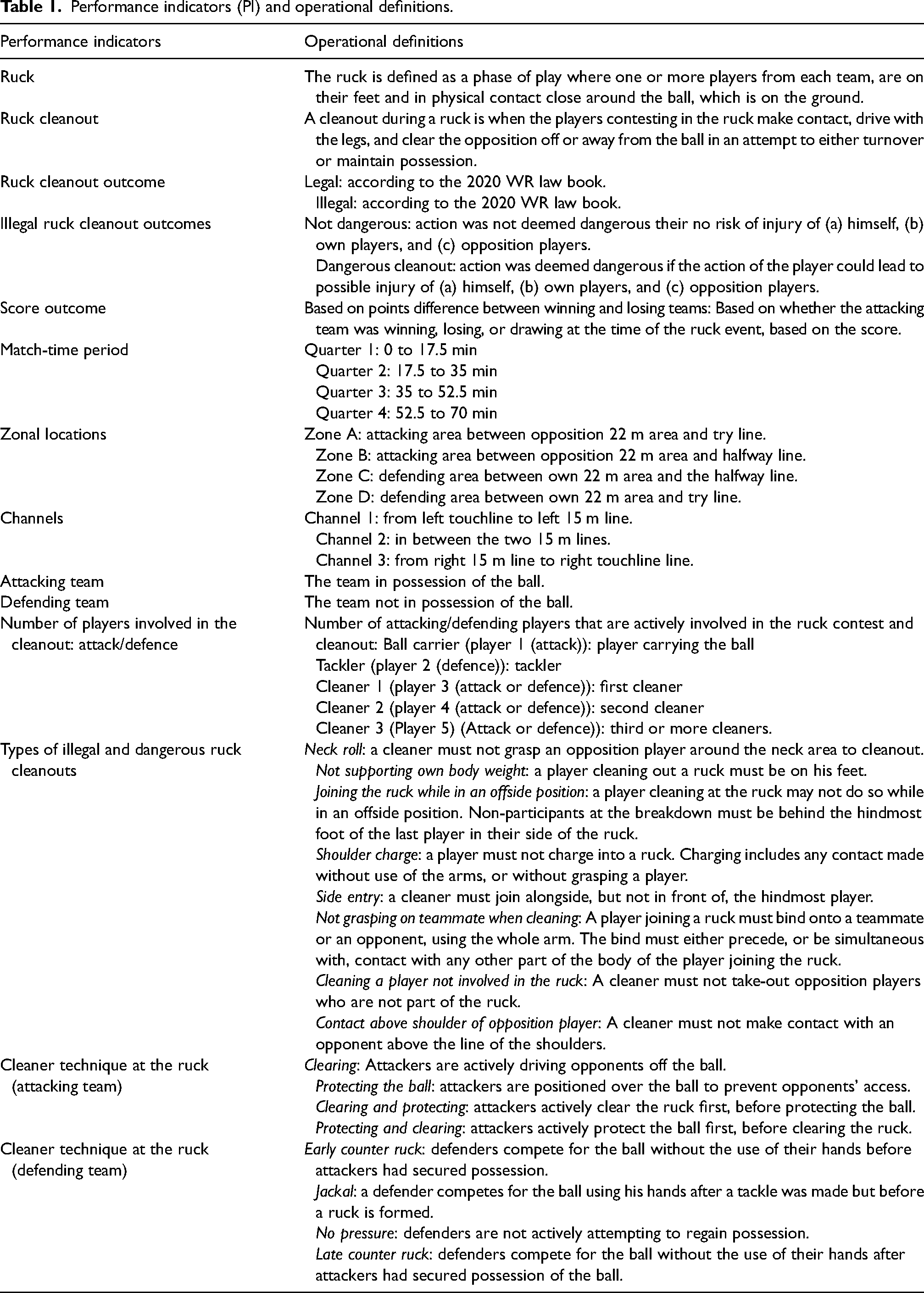
The reliability of the coded ruck cleanouts was tested using Cohen's kappa coefficient (κ) for intra- and inter-rater reliability. Before data collection for the study started, the primary researcher coded a full match and re-coded the same match seven days later (intra-rater reliability). An external coder also coded the same match and recoded the match seven days later (used for inter-rater reliability). After the initial coding, the primary researcher, and an external coder re-coded 20 matches that were randomly selected by the statistician for intra- and inter-rater reliability. The intra and inter-rater reliability revealed a ‘very good agreement’ (κ = 0.81–0.99) for both before and after coding.
Statistical analysis
All statistical analyses were performed using Statistica software (version 13.3.721.1). Descriptive data of the PIs were reported as frequencies (number of observations) and percentages, with a significance level of 5% applied (p < 0.05). Association between ruck cleanout outcomes (legal, illegal ‘not dangerous’ and illegal ‘dangerous’) and PIs were determined using Chi-Squared analyses. Four a priori proportions were decided upon as proxies of player behaviour. Player behaviour was measured by: (1) legal ruck cleanouts as a percentage of all ruck cleanouts (i.e., legal, illegal ‘not dangerous’ and illegal ‘dangerous’ combined); (2) illegal ruck cleanouts as a percentage of all ruck cleanouts; (3) illegal ‘not dangerous’ ruck cleanouts as a percentage of all illegal ruck cleanouts (i.e., illegal ‘not dangerous’ and illegal ‘dangerous’ combined); and (4) illegal ‘dangerous’ ruck cleanouts as a percentage of all illegal ruck cleanouts. A Classification and Regression Tree (CART) model was established with the dependable variable, namely ruck cleanout outcome, and the independent variables being the PIs. This model classified the best group of predictors for the ruck cleanout outcome and to establish the cut-off point values for each of the PIs.
Results
A total of 35,545 ruck cleanouts were recorded over the five years, at an average of 301 ruck cleanouts per match. Most ruck cleanouts (32,641; 91.8%) were legal, and the proportions of legal, illegal, illegal ‘not dangerous’, and illegal ‘dangerous’ ruck cleanouts were similar for all factors including years, quarters, zonal locations, channels and match outcomes (Table 2). When comparing the ruck cleanout outcomes per year the results showed a significant (p = 0.01) decrease in the number of legal and illegal ‘dangerous’ ruck cleanouts, and an increase in illegal ‘not dangerous’ cleanouts in 2018 and 2019 compared to the earlier years. The quarters, zonal locations, and channels did not indicate any significant differences when comparing ruck outcomes.
The number of ruck cleanouts presented as both frequency (n) and percentage (%) for legal and illegal (including ‘dangerous’ and ‘not dangerous’) ruck cleanouts and various performance indicators.
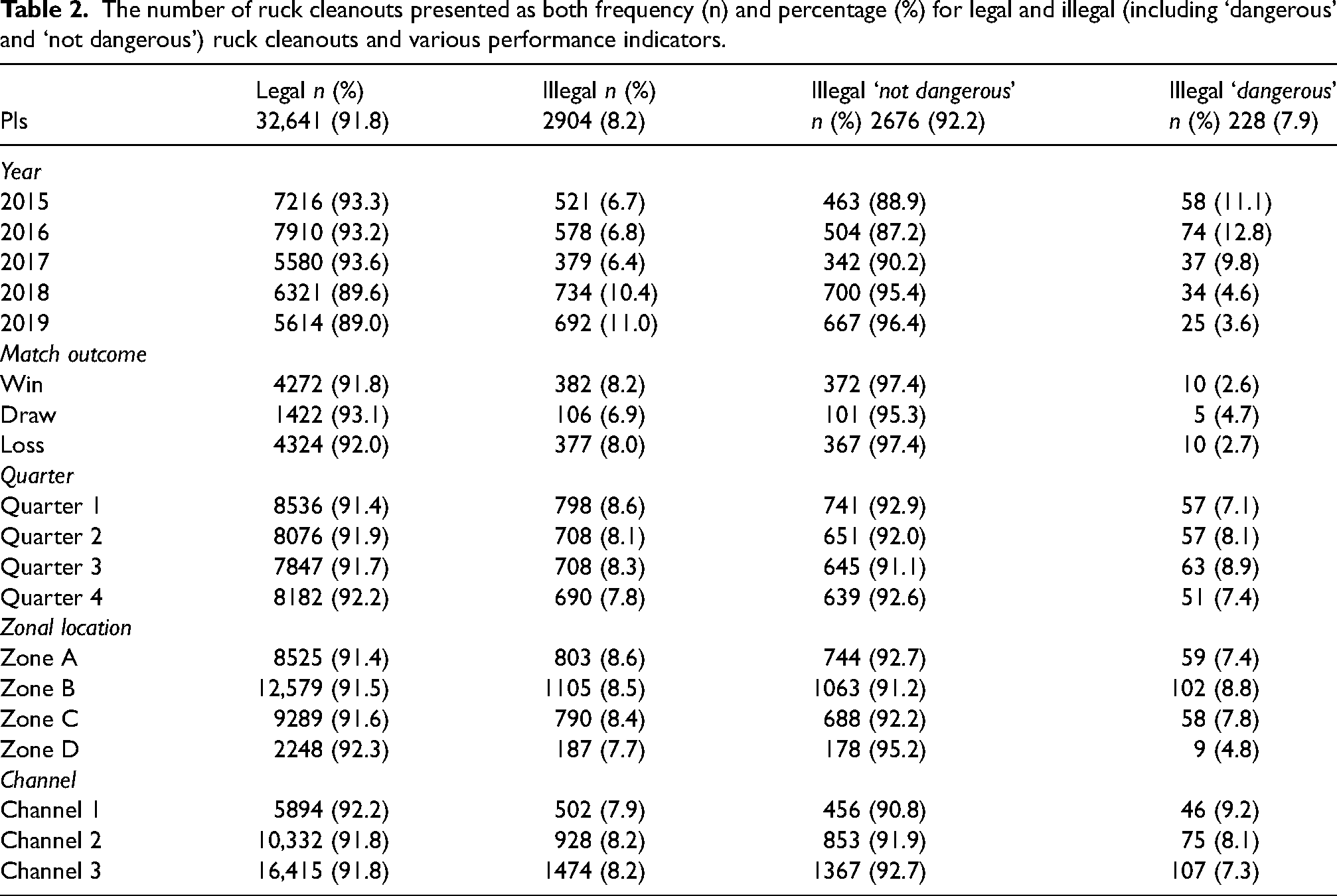
Table 2 shows the legal and illegal ruck cleanouts as a percentage of all ruck cleanouts. The percentages ranged from 89% (5614 out of 6306) in 2019 to 94% (5580 out of 5959) in 2017. When observing all illegal ruck cleanouts, regardless of whether ‘not dangerous’ or ‘dangerous’, this ranged from 6% (578 out of 8488) in 2016 to 11% (692 out of 6306) in 2019. We explored the impact of illegal ‘dangerous’ and illegal ‘not dangerous’ percentages further on overall illegal player behaviour and represented this information as a percentage of all illegal ruck cleanouts (Table 2). The illegal ‘not dangerous’ ruck cleanouts, percentage ranged between 89% (504 out of 578) in 2016 and 96% (667 out of 692) in 2019. The illegal ‘dangerous’ cleanouts, the percentage ranged between 4% (25 out of 692) in 2019 and 13% (74 out of 578) in 2016.
When analysing ‘Cleaner’ arrival at the ruck for both attacking and defending teams, the results indicate that ‘Cleaner 2’ for the attacking team performed significantly more total cleanouts (p = 0.02), legal cleanouts, and illegal cleanouts (both ‘dangerous’ and ‘not dangerous’) when compared to the other attacking team ‘Cleaner’ roles (Table 3). When looking at the defending team, ‘Cleaner 1’ (p = 0.01) was responsible for executing significantly more total cleanouts, legal cleanouts and illegal ‘not dangerous’ cleanouts, when compared to the other defending team ‘Cleaners’. When analysing the ruck cleanout techniques used by both attacking and defending teams, the attacking team's adopted the ‘Protection’ strategy significantly more (p = 0.02) during legal ruck cleanouts. However, for illegal ruck cleanouts, both ‘dangerous’ and ‘not dangerous’, the ‘Clearing and protecting’ strategy was utilised significantly more (p = 0.04) during match-play. When looking at defending teams, the ‘Jackal’ technique was applied significantly more (p ≤ 0.01) during legal cleanouts and in illegal ‘not dangerous’ cleanouts, when compared to the other defensive rucking techniques. The ‘Early counter ruck’ was responsible for significantly more (p = 0.02) illegal, illegal ‘not dangerous’, and illegal ‘dangerous’ ruck cleanouts (Table 3).
The number of coded legal and illegal ruck cleanouts, presented as both frequency (n) and percentage (%) illegal ‘dangerous’ and illegal ‘not dangerous’ ruck cleanouts, and various other performance indicators.
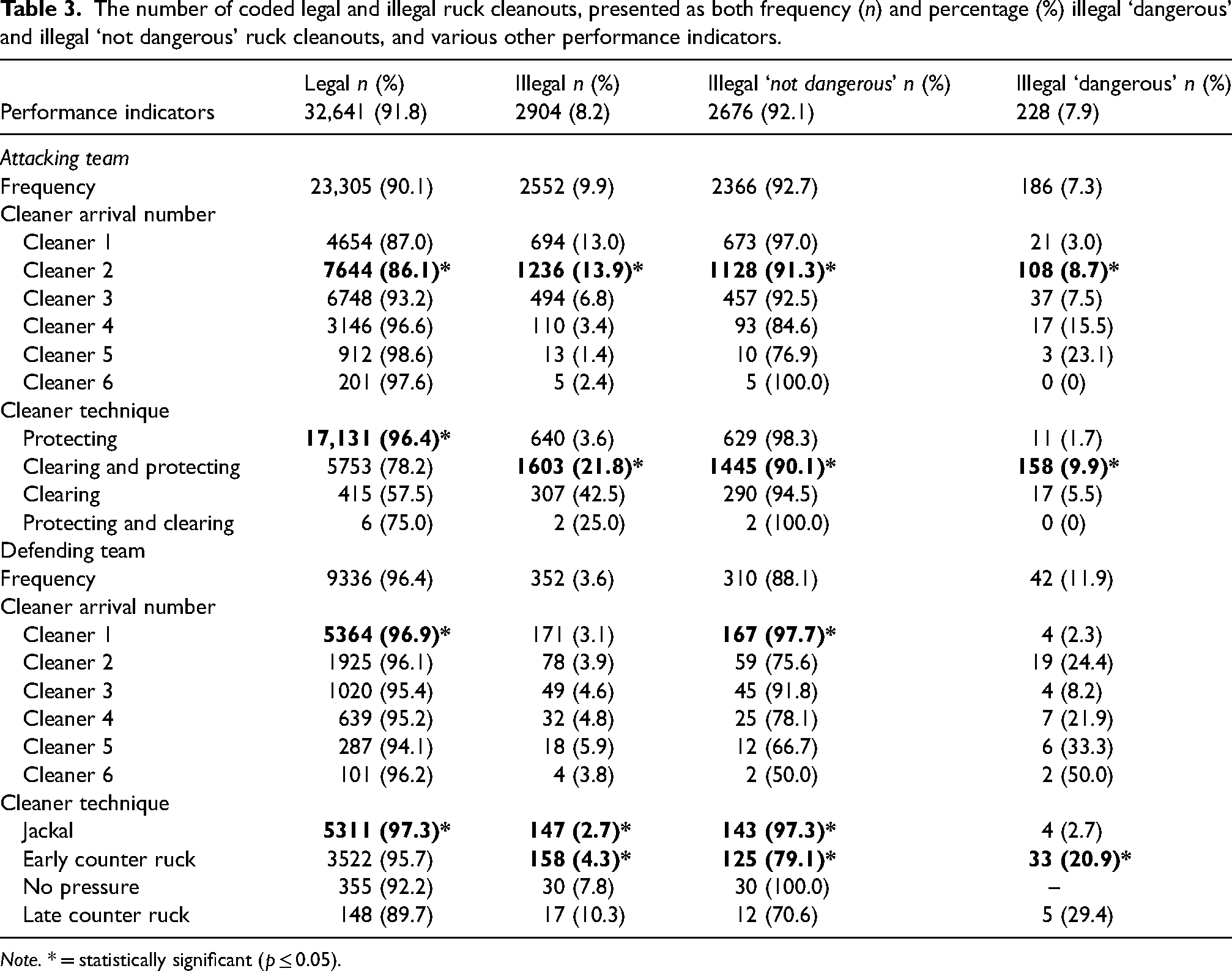
Note. * = statistically significant (p ≤ 0.05).
Out of the 2904 illegal ruck cleanouts, most of the ‘not dangerous’ types were ‘not supporting own body weight’ (f = 2498; 99. 4%), which was performed significantly more (p = 0.01) than the other types of illegal ‘not dangerous’ cleanouts. The remaining types of illegal ‘not dangerous’ infringements were: ‘joining the ruck from an offside position’ (f = 68; 100.0%); and ‘side entry’ (f = 53; 100.0%). For the illegal ‘dangerous’ types of ruck cleanouts, the majority were ‘neck roll’ (f = 147; 100.0%), which was significantly (p = 0.02) greater than the other illegal ‘dangerous’ ruck cleanouts. The remaining illegal ‘dangerous’ types were: ‘contact above the shoulder’ (f = 34; 65.4%) and ‘shoulder charge’ (f = 30; 62.5%) (Table 4).
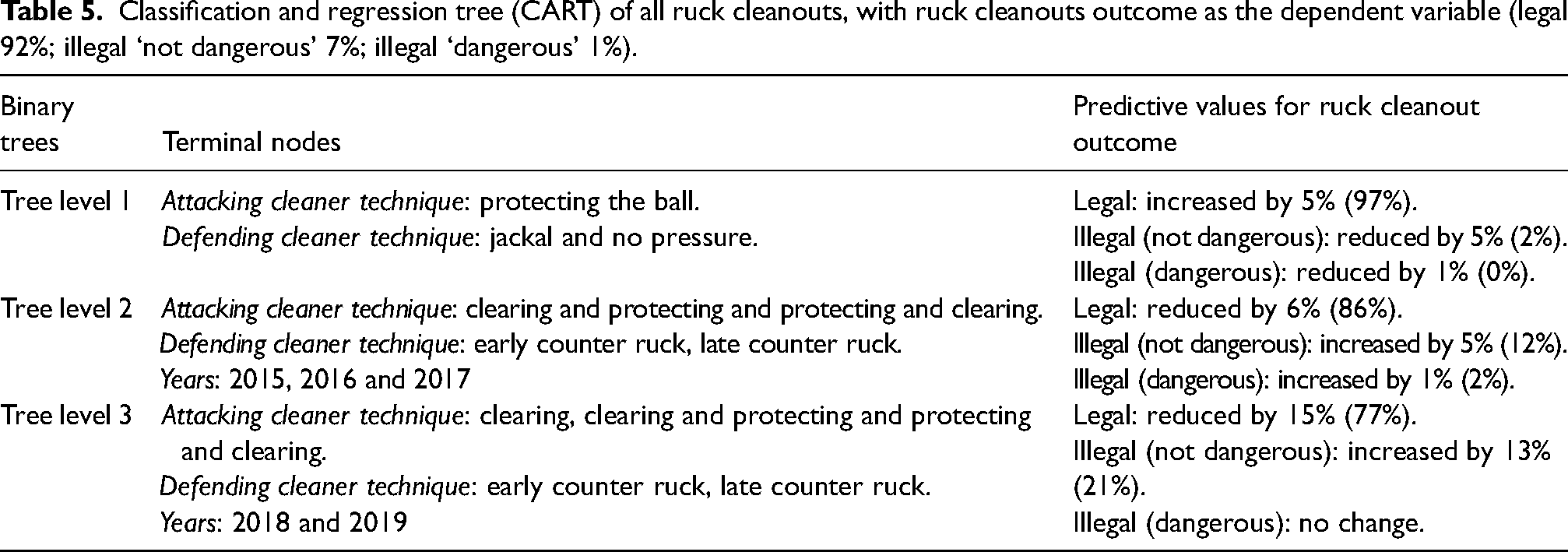
The importance plot showed that the Cleaner technique (1.0) and year (0.3) were the best predictors of outcome using the current CART model. The results in Table 5 predict a 5% increase in legal ruck cleanout outcomes when the attacking cleaner technique ‘Protecting the ball’ and the defending cleaner techniques, ‘Jackals’ or applies ‘No pressure’, were used. However, the largest reduction (from 92% to 77%) in legal ruck cleanouts, and an increase (7% to 21%) in illegal ‘not dangerous’ ruck cleanouts were evident in 2018 and 2019, and when the attacking cleaner executed the following techniques: ‘Clearing’, ‘Clearing and protecting’, and ‘Protecting and clearing’, and the defending cleaner executed the following techniques, the ‘Early counter ruck’ and ‘Late counter ruck’ (Table 5).
The number of illegal ruck cleanout types presented both as frequency (n) and percentage (%) for illegal ‘dangerous’ and illegal ‘not dangerous’ ruck cleanouts.
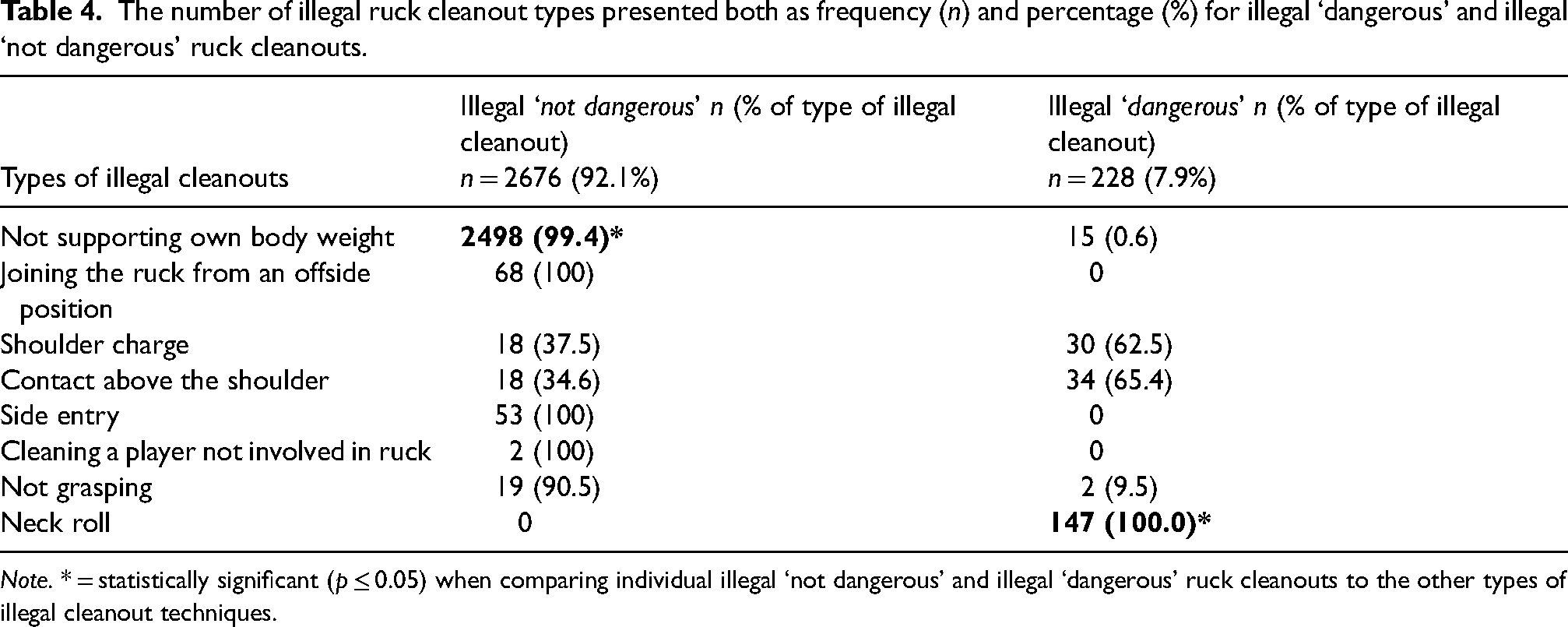
Note. * = statistically significant (p ≤ 0.05) when comparing individual illegal ‘not dangerous’ and illegal ‘dangerous’ ruck cleanouts to the other types of illegal cleanout techniques.
Classification and regression tree (CART) of all ruck cleanouts, with ruck cleanouts outcome as the dependent variable (legal 92%; illegal ‘not dangerous’ 7%; illegal ‘dangerous’ 1%).
Discussion
The major findings were that: (1) the majority of the ruck cleanouts were deemed legal and out of all the illegal cleanouts the majority were not dangerous, (2) the attacking team was responsible for more legal ruck cleanouts when compared to the defending team; (3) for the attacking team, of the illegal ‘Clearing and protecting’ techniques, the majority were ‘not dangerous’, compared with the defending teams, where the majority of the illegal ‘Jackal’ techniques were also considered ‘not dangerous’; and (4) the majority of the illegal ‘not dangerous’ ruck cleanouts were ‘not supporting own body weight’ and for illegal ‘dangerous’ cleanouts were the ‘neck roll’. To our knowledge, this is the second study that has focused on legal and illegal (both ‘dangerous’ and ‘not dangerous’) cleanouts at the ruck to assess player behaviour during match-play and is the first study on the ruck at the youth rugby level. The study by Kraak et al. 7 investigated the non-sanctioning of illegal ‘dangerous’ and ‘not dangerous’ ruck cleanouts in Super Rugby.
The proportions of legal and illegal ruck cleanouts can be viewed as a metric for player behaviour. The majority (91.8%) of all ruck cleanouts over the period studied were legal, which is a strong indication of positive on-field player behaviour. The percentage of illegal ruck cleanouts compared to all ruck cleanouts, however, was 8.2%. Albeit largely due to ‘not dangerous’ illegal ruck cleanouts, the current study indicated that player behaviour worsened during the 2018 and 2019 rugby seasons; ‘dangerous’ illegal ruck cleanouts, on the other hand, improved. Although one could argue that the results are not direct ‘metrics’ of player behaviour, they were chosen because they have practical relevance to rugby stakeholders, to whom this study's results must be disseminated. The findings of the current study are still concerning from an injury prevention perspective because 2676 not dangerous illegal ruck cleanouts pose an unnecessary injury risk to the players involved in the breakdown contest Although representing less than 1% of all ruck cleanouts, 228 illegal cleanouts were deemed ‘dangerous’, and any one of these cleanouts could have led to severe injury. This reasoning is also consistent with BokSmart's adopted long-term goal of ‘#VisionZero’ – eliminating all serious injuries from the game. 25 Players are required to follow the laws of the game as determined by WR, during training and match-play, to allow players to participate within the spirit of the game and more importantly, to protect them from injury and unreasonable risk. 26
Securing and retaining possession of the ball is a fundamental component of attack in rugby, with the main aim to score points and subsequently win matches. 10 Because of the large increase in the number of rucks and breakdown contests in match-play, it has become an important facet of play for both attacking and defending teams in the modern game. 27 A study by Mitchell and Tierney 15 analysed 7393 collisions in the Rugby Championship and Six Nations competitions and found determined that 65% of collisions resulted in a ruck in professional rugby. The current study showed that the predominant techniques used by the attacking cleaners were ‘Protecting’ and ‘Clearing and protecting’. When the first attacking player arrives at the tackle, and the ball carrier is on the ground, the player must rapidly assess the situation and decide. 23 ‘Protecting’ is when the ‘cleaner’ arrives at the tackle and there is no pressure from the defending team. The player then goes into a strong position over the ball, to prevent oncoming defensive players from gaining access to the ball. However, this could also cause a high number of players going off their feet or ‘not supporting own body weight’ to protect the ball, as found in the current study. The second most used technique by the attacking team player in the current study, was when the ‘cleaner’ first clears the defending threat from the ruck, and then goes into a strong body position to protect the ball.
The ruck techniques most frequently used by the defending teams were the ‘Jackal’ and ‘Early counter ruck’. Wheeler et al. 10 found a similar trend. The 2011 Super Rugby study demonstrated, respectively, that the ‘Jackal’ and ‘Early counter ruck’ techniques were used 39% and 60% of the time by defensive teams, to win turnovers at the ruck. ‘Early counter rucks’ were effective at turning over possession when the ruck contests occurred in the wide attacking channels (18% of turnovers), whilst the ‘Jackal’ technique was effective in the central field areas (13% of turnovers). Wheeler et al. 10 2013, however, also found that the ‘Early counter rucks’ led to 17%, and the ‘Jackal’ technique to 7% of infringements. Players are more susceptible to concussive impacts when they are in a defensive role. 28 It may, therefore, be useful to incorporate a coaching emphasis on ‘maintaining awareness’ for players, engaging during a ruck from an attacking and defensive perspective. 28 The amount of time spent training correct contact techniques is however associated with positive player behaviour that reduces injury risk. 29 According to Hendricks et al. 29 verbal instruction and demonstration of correct and safe techniques are the most effective coaching methods for contact events. Therefore, coaching the ruck should follow the same principle as the tackle because they are both contact events. The same key factors that are applied to a tackle can also be applied to the ruck. To make a legal and safe ruck cleanout, players must have correct timing, momentum coming into the ruck, and a safe and strong body and head position. 30
The current study found that attacking teams engaged in more illegal ruck cleanouts (87.9%) when compared to the defending teams. A similar pattern was found by Kraak et al.7 and Mitchell and Tierney. 15 Kraak et al. 7 demonstrated that attacking teams accounted for 90% (1895 of 2111) of all illegal ruck cleanouts, at an average of 16 per match. In the latter study, the attacking team contributed to 70% (340 of 486) of all infringements. A typical game situation on attack could be as follows: after the initial tackle made by the defender, and ball placement by the ball carrier, the first arriving player on attack must clear the first arriving defender away from the ball carrier, with the second arriving player on the attack having to secure the possession and engage any additional defenders, as they arrive to contest for the ball or support the first defender. 23 Possible reasons for the high infringement rate by attacking teams are the following: (a) The ball carrier does not dominate the collision and does not present the ball effectively to his teammates. 24 Therefore, the first arriving player on attack uses an illegal technique to try and retain possession. (b) The support players on attack react poorly to the tackle situation and arrive late at the ruck. 7 (c) Poor decision-making and assessment of the situation by the players involved in the contest. (d) Poor ruck cleaning techniques were used in the latter stages of the match due to fatigue. 31 (e) The defending team might already be infringing, and the attacking team then also uses illegal techniques to try and retain possession. 7 Studies by Wheeler et al. 32 and Kraak and Welman 23 identified that players must execute specific actions and techniques to retain (attacking team) or turnover (defending team) possession of the ball at the ruck.
‘Not supporting own body weight’ was the type of ‘not dangerous’ illegal ruck cleanouts that occurred the most in the current study. This finding agrees with Kraak et al., 7 who also found that ‘not supporting own body weight’ occurred the most out of all illegal ‘not dangerous’ ruck cleanouts during the 2018 Super Rugby tournament. However, this pattern was not evident during the 2019 Rugby World Cup. 15 In this study ‘head and shoulders below hips’ was the infringement that occurred most.
A possible reason why players might not support their body weight properly can be two-fold: (1) The first attacking cleaner arrives late, and the defending team might already have protection over the ball. Therefore, the cleaner decides to perform an illegal action to try and get to the ball and regain possession. (2) The first arriving player might execute an illegal action and be off their feet, and therefore, the second arriving player tries to clear the player off the ball illegally. To clear the player, the cleaner then uses the ‘neck roll’, or grabs onto the head or neck, and twists or forces it to the side of the ruck, 33 which is considered the most ‘dangerous’ ruck cleanout. ‘Not supporting own body weight’ and ‘neck rolls’ can lead to major injuries at all levels, but especially because of the size and height of the players that participate in the Craven Week tournament. 34
Limitations and future research directions
The available camera angles, at times, could be seen as a limitation as it was difficult to see all of the players' actions during a ruck. Another limitation was that the current study only analysed one youth week competition, and therefore, the findings of the study cannot be generalised across all youth rugby levels. Future studies should investigate the ruck cleanouts in other elite competitions and at community level rugby, and should also include other potential factors, such as log position and nationality of teams.
Conclusion
The study found that 91.8% of ruck cleanouts were legal cleanouts, which reflect positive player behaviour, and 92.1% of illegal ruck cleanouts were ‘not dangerous’. Although contributing to less than 1% of all cleanouts recorded, the illegal ‘dangerous’ ruck cleanouts remain a concern for stakeholders from an injury prevention perspective. This equates to approximately 2 dangerous ruck cleanouts per match, every ‘dangerous’ illegal act is an opportunity for catastrophic injury. Due to the evolving nature of the game, the number of ruck cleanouts in rugby matches are unlikely to decrease. Therefore, the focus must be placed on how cleanouts are taught and then carried out. To aid injury prevention efforts, future studies should explore why players perform illegal ruck cleanouts in contravention with the laws of the game. Additional educational and operational interventions need to be targeted at coaches, referees, and players to improve these shortcomings. If players are not playing within the laws, and coaches are not implementing the prevention strategies, the effectiveness of injury prevention programmes will be limited. The data from the current study reinforces the importance of coaching correct techniques, correcting player behaviour and continued strict action against illegal ‘not dangerous’ and illegal ‘dangerous’ cleanouts during training and matches. Because of limited research on investigating the legal, illegal ‘not dangerous’ and illegal ‘dangerous’ cleanouts during match-play, and to assist in lowering injury incidence, it is important to expand the area of research so that the game is continually made safer for all involved.
Practical applications
Albeit that less than 1% of cleanouts were deemed to be dangerous, there are methods to improve the illegal activities of player behaviours. These include participating in regular and effective technique training drills, changing on-field player behaviours and improved decision-making on match days. The risk of injury can be influenced positively by coaches, through regular coaching and training of only safe and effective ruck techniques with their players. The on-field referee on match days can also reduce the risk of injury, by dealing appropriately with the players who go off their feet, who perform ‘neck rolls’, who fly into the ruck leading with the shoulder, and who make contact above the shoulder line. A special focus must be applied to those events with the potential to cause serious life-threatening or debilitating injuries, such as ‘neck rolls’ and ‘shoulder charges’.
Effective execution of contact techniques depends on players’ physical conditioning, skill level, and tactical awareness.4,11,35 Coaches can improve player technique by designing technical training sessions that both assess and develop the technical skill level of the players. 24 This can be done by using a simple two-on-two contact drill, as proposed by den Hollander et al. 36 Using the technical assessments of this drill, senior-level players scored higher in contact technique proficiency than academy players. The authors also highlighted that players need to develop proper ruck technique to progress safely through the levels of competition, that better technique leads to better player and team performance, and that it also lowers injury risk. 36 This cultivates a better attitude towards injury prevention and management, which coaches must encourage and implement. 37 However, these attitudes are also dependent on how compliant the players are with these interventions. 38
Senior professional players with elite training and more competitive international games are stronger in all neck strength measures than players at any other age or level of competition. 39 Because of access to higher quality coaching, the players will be more experienced and have a better understanding of injury mechanisms. 30 Training schedules must be customised and adapted to suit the specific team's level of play, age, skill level, experience, and different positions. 11
Subsequently, a call for the development of a contact-skill programme was made. 28 The results of the current study provide evidence to contribute to the design of such a programme and highlights the need for specific techniques that need to be emphasised during training. Furthermore, the contact technique elements associated with success in the current study are useful to consider for other levels of play. Ruck sessions should include the initial tackle, fight for dominance, correct ball placement, and safe and effective clearing techniques in the same drills. By including all these events, players will develop decision-making skills during practise, which can be transferred better into match situations. 7 Performance analysis could also be beneficial and should, where possible, be included in training sessions and matches. Players should be able to have access to these videos and after every training session or match, do self-reflection on their individual and team's performance. Self-reflection is an effective way for players to recognise their mistakes, identify poor behaviour and illegal actions, and to reflect on what an ideal situation should look like. Looking at the team's performance, will help each player realise how the team can progress, by improving performance and player safety at the same time. According to Hendricks et al. 28 more work is required to improve the understanding of the relationships between technique, fatigue, tactics and performance, and coaches must consider these factors when designing and developing contact-technique training sessions.
Footnotes
Acknowledgements
The authors would like to thank the international referee who assisted with developing the gold standard, the external coder who assisted with inter-rater reliability, Professor Martin Kidd for conducting the statistical analysis and the SARU technical department for providing the video footage.
Declaration of conflicting interests
The author(s) declared no potential conflicts of interest with respect to the research, authorship, and/or publication of this article.
Funding
The author(s) received no financial support for the research, authorship, and/or publication of this article.
