




Abstract
World Rugby’s law application guideline for the breakdown was developed to make the breakdown safer, fairer, and simpler to understand. The aim of this study was to use video analysis to assess the impact of these guidelines by comparing player adherence from the 2019 Rugby World Cup (pre-guidelines) to the 2020 Autumn Nations Cup (post-guidelines) as well as the rate of sanctioning by match officials. Contested breakdowns (n = 1444) were individually analysed by coding any infringement that occurred as well as the sanctioning outcome. The chi-square and probability (p) values were calculated to compare proportions before (pre) and after (post) the law application guidelines. No change in the rate of infringements was observed (p = 0.207), though the rate of infringements penalised increased (p = 0.001). Reductions in the rate of infringements of two of the five offences targeted by the guidelines were observed; “offside” (p = 0.008) and “remains on feet” (p <0.001). All dangerous play infringements reduced; “charged in” (p <0.001), “contact above shoulder” (p <0.001), “intentional collapse” (p = 0.023). There are early indications that the guidelines have had a marginal influence on overall player adherence to the breakdown rules but a considerable positive influence on adhering to the rules surrounding dangerous play.
Introduction
Contacts event are integral to rugby union which can increase the risk of injury. 1 Williams et al. 2 reports the tackle and ruck to be the first and second most likely causes of injury, respectively. The rapid evolution of the sport since turning professional makes it essential World Rugby (WR), the international governing body for rugby union, have a complete understanding of the incidence, nature, severity and causes of injuries to aid in their prevention strategies which may come in the form of law amendments. 3 Players are required to act within the laws of the game set by WR, which are put in place to promote safe play within the spirit of the game. Match officials interpret and apply these laws to protect players. 4
McCormick 5 explains how the heightened physical capabilities of modern-day players can impact a match. One of the most significant changes identified is the increase in ‘ball in play time’ which increased from 25 min 45 s at the 1995 Rugby World Cup (RWC) to 34 min 21 s at the 2019 RWC. This has led to an increased number of breakdown events in a game. In 2019, teams averaged 82 rucks per game compared to 25 in 1987. 5 Whilst the increased physical capacity of players allows for higher intensity games, making the game a better spectacle for fans, it can also produce larger collisions and a higher injury rate. 6
A breakdown is a term used for the short period of play after a tackle and before a ruck has formed. 7 A ruck is formed when one or more players from opposing teams are in contact, on their feet, and competing over the ball which is on the ground, in order to retain (attacking team) or regain (defending team) possession. 8 A 2018 study analysed 7393 physical interaction events in the Championship and Six Nations competitions and determined that 65% of collisions resulted in a ruck. 9 The importance of retaining possession at a breakdown and turning the ball over has been found to be a key performance indicator associated with team success.10,11 The breakdown is one of the most technical aspects of rugby union, accounting for 47% of all penalties committed during the 2015 Super Rugby season. 7 The refereeing of the breakdown can therefore have a significant impact on the outcome of a match, making it is essential that referee decision-making is accurate and uniform.
The findings of Mitchell and Tierney, 8 suggest this may not be the case, at the elite level of the game. The analysis of 898 breakdowns from the knockout stages of the 2019 RWC revealed that 37.7% of breakdowns involved illegal play, and that 79.9% of these illegal breakdowns were not sanctioned appropriately by the on-field officials. Furthermore, only 5.6% of “dangerous play” offences were penalised, raising concerns for player welfare. Kraak et al. 12 examined the rate of sanctioning of illegal and dangerous ruck cleanouts throughout the 2018 Super Rugby competition. Eight separate illegal ruck cleanout techniques were identified and coded, revealing that 9% of all ruck cleanouts were illegal, 93% of which were not sanctioned by the match referee. Similar findings have also been observed surrounding refereeing of the tackle area. Analysis from the 2011-2015 Craven Week, a schoolboy rugby tournament used by referees to improve their refereeing skills and status, reported 59% of illegal tackles, predominantly high tackles (65%) and dangerous charging tackles (67%) were not sanctioned. 13 This is concerning as illegal tackles have the highest propensity for injury in comparison to any other contact event. 13 Failure to penalise such incidents in a youth setting may increase the risk of players continuing to carry out the same techniques into senior rugby where collisions are much greater, and risk of injury may increase. 14
Nazarudin et al. 15 believes refereeing a professional rugby match is a substantial challenge. A breakdown may occur up to 200 times in a single match, 8 where the referee must interpret and apply the laws of the game instantaneously. A single misjudgement could affect the outcome of the match. 15 Governing bodies place focus on the physiological and fitness training of their referee’s meaning structured training in decision-making is rare. 15 Mascarenhas et al. 16 found implementing a video-based training program combined with informed knowledge from experts to improve the accuracy of on-field decision-making by 17%. They concluded that shared mental model training is an appropriate means for improving refereeing performance and may have significant implications for consistent and accurate refereeing.
In 2020, WR’s breakdown law application guidelines became operational following recommendations by a specialist breakdown working group comprising of players, coaches, referee’s and medical staff.
17
It aims to give referees a clearer picture on a complex facet of the game, which should lead to more uniform decision-making. Despite considering law changes, the group decided to strictly reinforce the existing laws focussing specifically on laws 14 and 15, comprising of 5 key elements:
Tackler – greater emphasis on rolling away from the contact zone immediately after completing the tackle, allowing for the ball to be played. Infringement targeted: “rolled away”. Ball carrier – Once the ball carrier is brought to ground, they are allowed one dynamic movement before presenting the ball. This is to stop the ball carrier buying seconds on the ground before support arrives. Infringement targeted: “holding on”. Jackaler – The jackaler must be on their feet and in control of their own body weight. Players elbows must be off the ground and must show the referee they are trying to turn over the ball by getting their fingers under the ball and lifting immediately. Infringement targeted: “off feet”. Arriving players – Must stay on their feet, not sealing off the ball by diving on top of the ball carrier. Emphasis on staying on feet and “drive not dive” into rucks. Infringement targeted: “off feet” and “remains on feet”. Entry – Players must join the ruck from behind their offside line and enter “through the tunnel”. Infringement targeted: “offside”.
The law application guidelines have been developed to make the breakdown safer, fairer, and simpler to understand.
18
They aim to reduce the risk of injury, while promoting a fair contest for the ball at the breakdown. The aim of this study is to use video analysis to assess the impact of these guidelines by comparing player adherence from the 2019 RWC (pre-guidelines) to the 2020 Autumn Nations Cup (ANC) (post-guidelines) as well as the rate of sanctioning by match officials.
Methods
Televised video recordings (n = 13) of each game from the 2020 ANC were analysed in this study. Kinovea video software was used to analyse the match footage, allowing frame-by-frame viewing by a rugby video analyst with three years’ experience. The video had a minimum frame rate of 25 fps and could be watched as many times as necessary. Similar to Mitchell and Tierney, 8 contested breakdowns from the knockout stages of the 2019 RWC were individually analysed and coded into a Microsoft excel database to provide information on each infringement being committed (Table 1), as well as the breakdown outcome (turnovers and penalties) for both the attacking and defending team. A binary coding system was employed to identify the specific breakdown infringements that had been committed during each breakdown. A ‘0’ was used to indicate no infringement whilst a ‘1’ indicated an infringement had been observed. Given that the video data was in the public domain, ethical approval was not required, similar to previous rugby union video analysis studies.19–21
Breakdown laws from WR’s 2021 laws of the game.
4
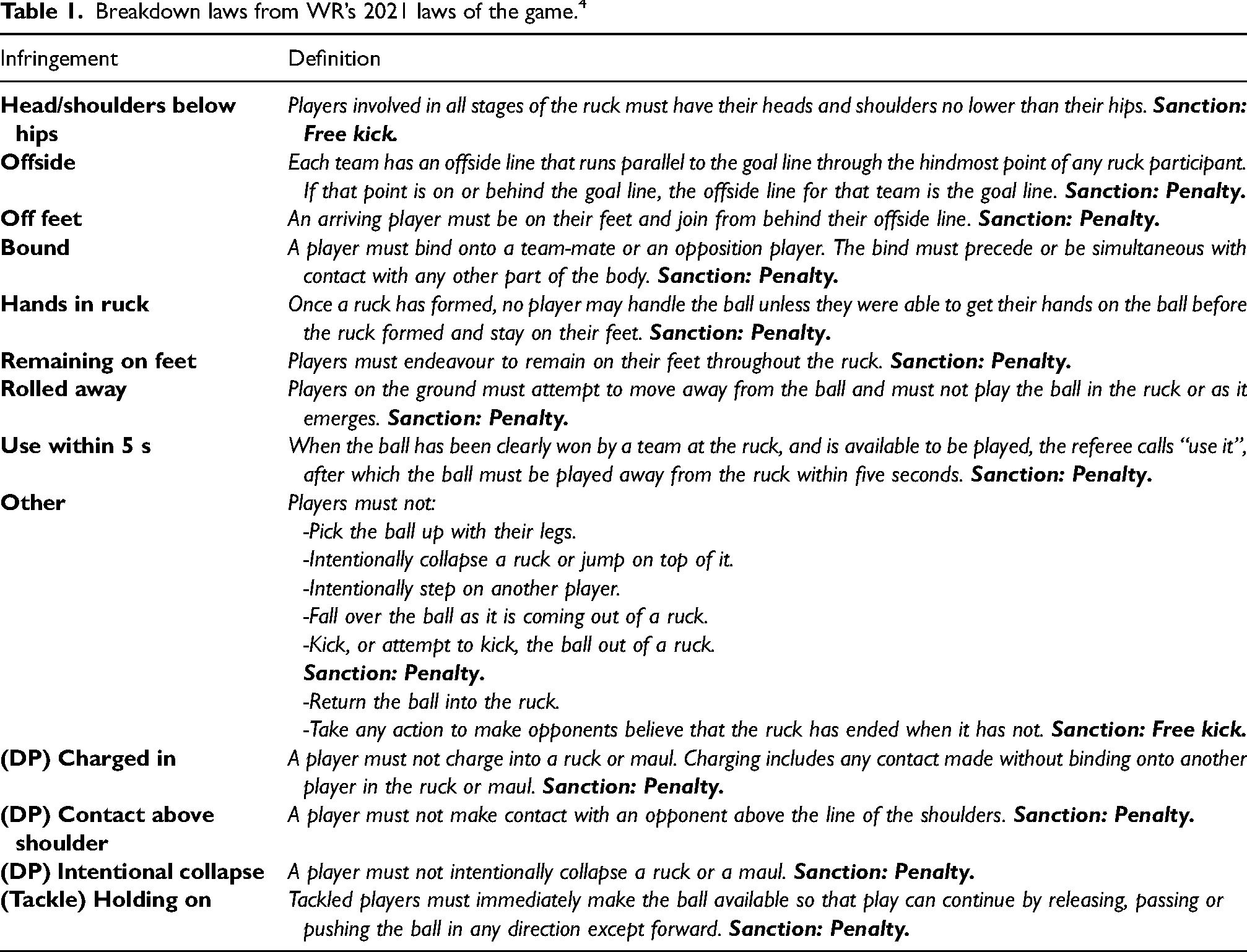
Breakdown laws from WR’s 2021 laws of the game. 4
Statistic providers MatchStats 22 were used to cross-reference the total breakdowns in each fixture and illustrated consistency though certain breakdowns were excluded from the current analysis where the defending team were not on their feet and actively engaged, trying to regain possession of the ball. World Rugby state ‘a ruck is formed when at least one player from each team are in contact, on their feet and over the ball which is on the ground.’ 4 Breakdowns included in this study had to be contested and adhere to this definition. Table 1 shows the ruling and sanction for each infringement, aligned with WR’s laws of the game. 4 To assess inter-rater reliability, both authors conducted analysis on the same 25 cases. Intra-rater reliability was assessed using Cohen’s κ following the main reviewer’s reanalysis of the original 25 cases one month after the initial review. Cohen’s κ values of 0.823 and 0.841 were calculated for inter-rater and intra-rater reliability, respectively. 8 A Cohen’s κ value greater than 0.8 indicates a near perfect agreement. 23
For infringement and penalty variables, chi-square (x 2 ) were calculated from the pre and post guideline data. 24 The x 2 values were calculated by comparing the frequency of occurrence for the various breakdown variables (legality, penalties, turnovers) collected before (pre) and after (post) the application guidelines becoming operational. Differences were considered to be significant if the p value was <0.05. All statistics were calculated using SPSS (IBM SPSS Statistics for Windows, Version 22.0. Armonk, NY: IBM Corp.)
Table 2 shows a total of 1444 contested breakdowns were analysed from the ANC, of which 65.0% were deemed legal compared to 62.2% observed in 2019 (p = 0.184). No change in the rate of breakdowns leading to a turnover was observed (p = 0.420).
Comparison of infringements from pre to post law application guidelines with p-value.
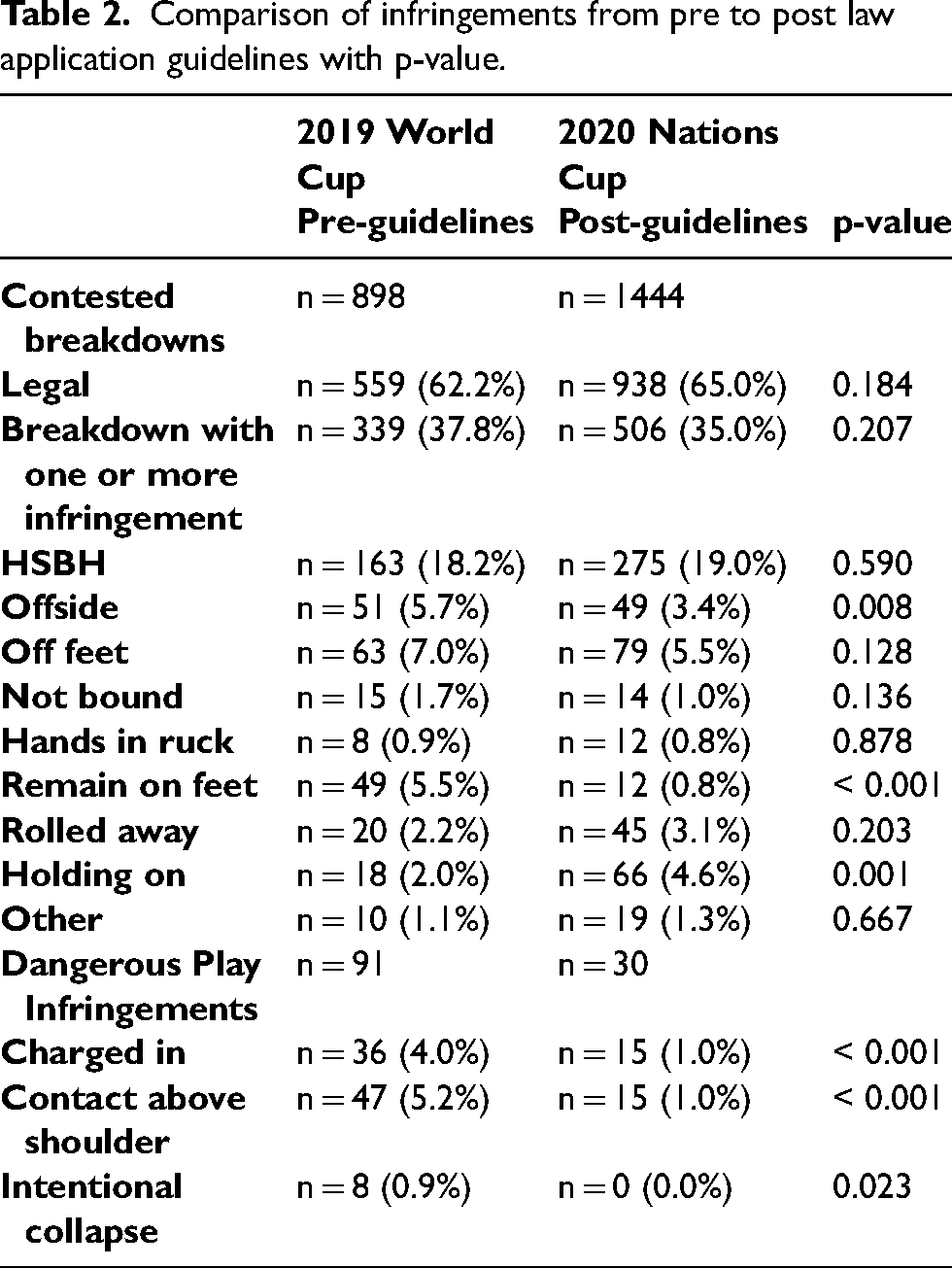
Comparison of infringements from pre to post law application guidelines with p-value.
“Head and shoulders below hips” (HSBH) accounts for the largest proportion of infringements pre and post-guidelines, totalling 18.2% and 19.0% respectively (Table 2). “Offside”, a particular target of the amendment guidelines, had a lower rate of 3.4% from 5.7% in 2019 (p = 0.008), as well as “remain on feet” (p <0.001). “Holding on” was the only offence that had a higher rate of 4.6% from 2.0% (p = 0.001). All dangerous play infringements reduced in the ANC in comparison to the RWC. No change in rate of infringements for “off feet” (p = 0.128) or “rolled away” (p = 0.203) were observed. The contribution of infringements made by the attacking team was similar in both tournaments, 73.3% at the ANC compared to 70.0% at the RWC.
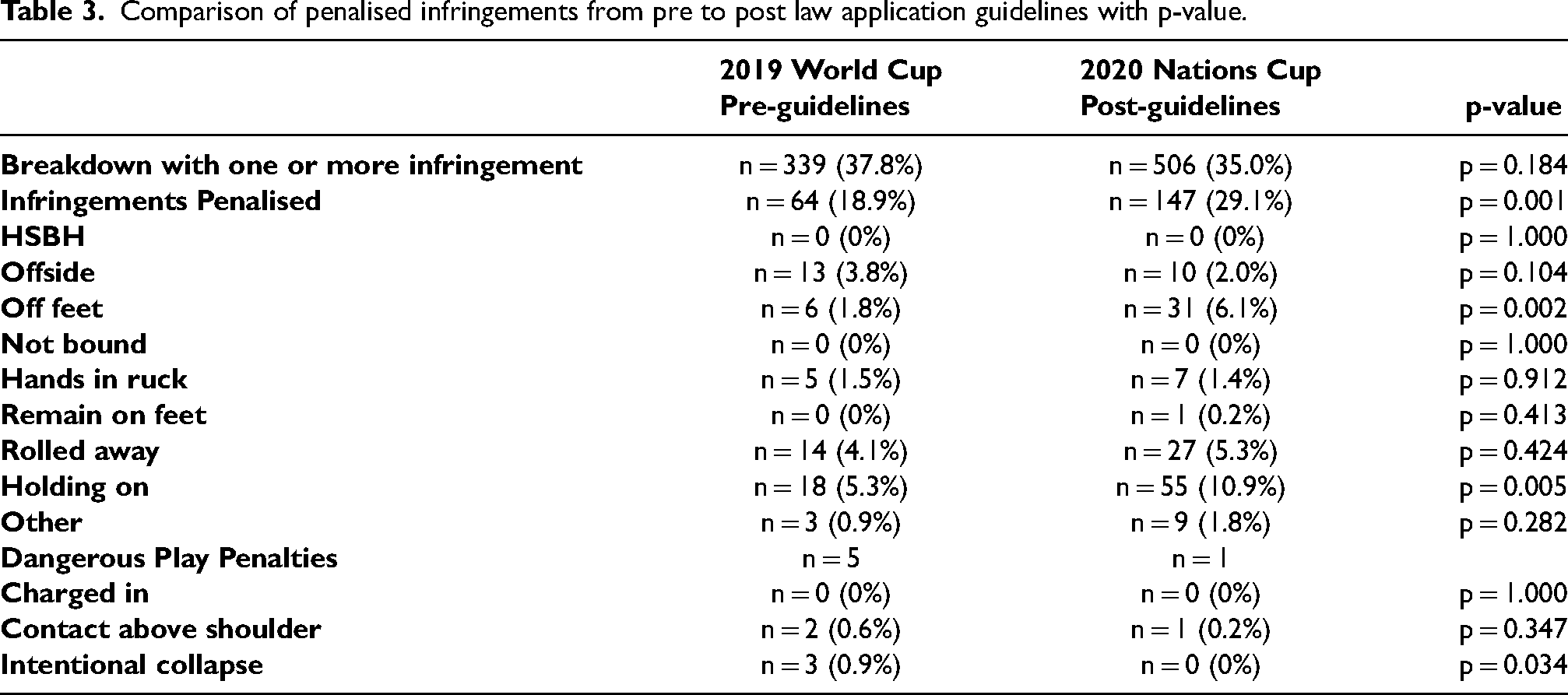
Table 3 shows an increase in the rate of infringements penalised from 18.9% to 29.1% (p = 0.001). The rate of penalties awarded for the “off feet” infringement increased from 1.8% to 6.1% (p = 0.002) as well as “holding on” from 5.3% to 10.9% (p = 0.005). No change in the rate of penalties awarded for infringements “offside” (p = 0.104) or “rolled away” (p = 0.424) were observed.
Comparison of penalised infringements from pre to post law application guidelines with p-value.
Early indications reveal the breakdown law application guidelines have had a marginal influence on overall player adherence to the breakdown rules but a considerable positive influence on adhering to the rules surrounding dangerous play. The reduction in the rate of “dangerous play” infringements may be due to growing emphasis on player safety as well as refereeing guidelines on head collisions during contact events. The guidelines indicate that a referee is entitled to issue yellow or red cards for any contact made to an opponent’s head. 25
The emphasis on entry angle into the ruck was to eliminate players contacting jackalers from the side. Knee injuries are one of the most common and severe injuries in rugby union and can often occur when a player gets their entry angle wrong, placing considerable force through their opponents exposed, planted leg. 26 By entering the ruck ‘through the tunnel’ which has been reinforced in the new guidelines, impacts are more likely to occur front-on rather than side-on. The current study found a reduction in the rate of “offside” infringements from 5.7% to 3.4% suggesting a potential shift in player behaviour. This is supported in that the Super Rugby Aotearoa’s (New Zealand) penalty count dropped from 31 to 22 per match, across nine rounds of matches which is consistent with the data from Australia, revealing penalties awarded at the breakdown reduced from 20 to 13 in the opening nine rounds. 18 This reduction in penalty count across both competitions shows early signs of behaviour change from players, coaches, and referees in the southern hemisphere. However, without post-match reviews of these matches, it remains unclear whether the reduction in penalties was due to improvements in player compliance or referee’s failing to penalise infringements. Furthermore, research has shown reductions in average time spent at a ruck (3.1 to 2.7 s) since the guidelines came into effect, with evidence that shorter breakdowns lead to fewer injuries. 18 Previously, jackalers were in vulnerable bent over positions with their necks exposed, bracing for impact or being cleared out. Following the amendments, if a jackaler is first to the ball and is showing positive signs to lift the ball, the referee should reward the jackaler. This is demonstrated in the rate of penalties that were awarded for “holding on”, which more than doubled from 5.3% to 10.9%, rewarding the jackalers positive intent.
WR has reported further research from New Zealand suggesting that the guidelines have also had an impact on the split of ruck penalties between attack and defence. 18 WR’s data from previous seasons of Super Rugby had shown the attacking side to be penalised less at the breakdown, responsible for 44% of total penalties. After 9 rounds of the 2020 season, this figure has risen to 51%, perhaps evidencing a fairer competition for the ball at the breakdown. 18 This is consistent with the findings of Mitchell and Tierney 8 who reported that despite committing a larger number of breakdown infringements, the attacking team was penalised less (43.8%) than the attacking team (56.2%), pre-guidelines. The current research has also observed a shift in the distribution of penalties, showing that 48.9% of penalties were awarded against the attacking team during the ANC, although the rate of infringement for the attacking team is still higher than for the defending team, contributing to 73.3% of all infringements.
The final aim of the guidelines was to make the game easier to referee and simpler to understand. In order to achieve this, WR provided a comprehensive visual guide, including video explanations on the laws. 4 The specialist breakdown group recommend short phrases such as ‘entry through tunnel’, ‘drive not dive’, ‘one dynamic movement’ which are simple, effective messages that can provide a clear cue for what a referee is looking for in these situations. Cue simplicity ensures applicability at all levels of the game. However, the current study has shown that 35.0% of all contested breakdowns post-guidelines involved at least one infringement, 70.9% of which were not sanctioned appropriately by match officials. Whilst this percentage seems high, “head and shoulders below hips” accounted for 19.0% of all infringements and may need further exploration by WR. It is important to consider that although these amendment guidelines have provided clarity towards certain aspects of the breakdown, the on-field officials still have many fundamental breakdown and ruck laws to interpret and apply within a matter of seconds, in a highly pressurised situation. Some studies have suggested psychological skill training to improve the decision-making of officials, however it is unclear how beneficial these methods can be within a match setting. 27 Due to the high degrees of freedom during a breakdown, Mascarenhas and Collins, 16 suggest a decision-making accuracy of around 50% may be appropriate. However, this may not be appropriate for tightly contested matches with small winning margins. A potential way to eliminate these errors from happening could come in the form of a “captains challenge” allowing each team the chance to make the television match official (TMO) review certain incidents they feel the referee may have got wrong. The captain’s challenge has potential to ensure the right outcomes are achieved more often, and was trialled in the Pro 14 Rainbow Cup, running from April to June 2021 as an end-of-season cup competition.28,29
Despite providing an insight into how the guidelines have impacted the breakdown in elite international rugby, this is not representative of breakdown sanctioning within the game as a whole. The dynamics of the game and quality of refereeing is likely to be different in lower-level competition or in a youth setting. Therefore, a larger scale study assessing sanctioning across multiple seasons and levels would be more beneficial. Analysis was also limited to television match camera angles. In future studies, access to multiple camera views would be beneficial to mitigate the risk of missing vital breakdown information. Access to audio would have allowed the infringement “use within 5 s” to be included in the analysis.
Conclusion
When comparing player adherence and sanctioning of breakdown infringements after the issuing of law application guidelines, the findings indicate that the guidelines have had a marginal influence on overall player adherence to the breakdown rules but a considerable positive influence on adhering to the rules surrounding dangerous play. A total of 35.0% of all contested breakdowns post-guidelines involved at least one infringement, 70.9% of which were not sanctioned appropriately by match officials. “Head and shoulders below hips” accounted for 19.0% of all infringements and may need further exploration by WR. All dangerous play infringements reduced in the ANC in comparison to the RWC which may be due to growing emphasis on player safety as well as refereeing guidelines on head collisions during contact events. The law application guidelines aimed to reinforce and provide clarity on five particular infringements. Results show a reduction in the rate of “offside” and “remain on feet” offences, however the rate of “holding on” offences increased. The rate of “off feet” and “holding on” offences penalised by on-field referee increased, perhaps due to the simplification of the existing laws. The current study provides an early indication on the influence of the law application guideline for the breakdown from the first international tournament since becoming operational. There is still a need to improve player adherence and sanctioning of infringements at the breakdown, such that they protect players, ensure fair play and are in keeping with the dynamics of the modern game.
