



Abstract
Training for both sporting and military performance is common practice within army trainee populations, although it is currently unknown what effect this combination of training methods may have on the physical attributes required for overall physical preparedness. This study examined the effects of sport-specific training on general fitness in a professional military population. Four hundred and twenty-three Greek male army cadets completed a 12-week training regimen involving standard physical training (callisthenics, strength and endurance running exercises) and either general military training (GMT) or sport military training (SMT). A series of physical tests took place before and after the training period: a mile run, pull-ups, 50 m swim and an obstacle course run. Both the GMT and SMT groups showed significant (p < 0.001) improvements in all physical tests. However, the SMT group produced significantly greater improvements in all four tests (pull-ups [p < 0.001], 50 m swim [p < 0.05], obstacle course [p < 0.01] and mile run [p < 0.01]) compared to the GMT group. Furthermore, different types of SMT (e.g. rock climbing and track sprinting) achieved greater improvements (p < 0.001–0.01) in certain physical tests when compared to other forms of SMT (e.g. Pankration, Fencing). These results indicate that cadets undertaking concurrent participation in general and sport military training are overall better prepared for physical performance than their counterparts who undertake only general military training. Military conditioning personnel should be aware of the positive interplay between general and sports specific training in forming a preparation strategy designed for physical performance.
Introduction
The physical and mental preparation of army cadets for military readiness is paramount for their success within future training and deployed environments. Army infantry cadets are primarily destined to be war fighters and must therefore engage in many physically demanding activities, both near and on the battlefield, such as carrying heavy backpacks over long distances and rough terrain, as well as shorter, more intense activities, such as sprinting across the battlefield and traversing obstacles in rural and urban terrain.1,2 Traditional military physical preparation strategies have focused on the usage of calisthenics, aerobic activities (e.g. marching, running and swimming) and variations of obstacle course and load carrying, as well as combat simulations.3,4 Developments within the area of tactical conditioning for military and service personnel (e.g. fire and police) have highlighted the potential benefits of integrating structured resistance training within their training practice. 4 Furthermore, military personnel often undertake additional sporting activities or play competitive sport, and little is known what effect this may have on the components of fitness required for successful military performance.
In military recruits, sport participation, apart from contributing to physical fitness, could benefit individuals and groups by supporting the development of desirable military characters and socially healthy units. Sport participation in team sports (e.g. soccer, rugby, cricket and athletics) encourages discipline, promotes regimental pride, and facilitates the growth of esprit de corps through the creation of healthy rivalries.5,6 The development of common interests among a unit or regimental sized group through sporting activities and aerobic exercise has also been shown to increase self-esteem, self-confidence, and morale. 7 Sports that promote practice, repetition, training, and support in a structured environment reduces stress, facilitate experiences of familiarity, order, consistency, and control, 8 and may provide the physiological stimulus for maintaining the required operational physical conditioning levels.
Within a military environment sports participation may comprise sport-specific practice activities and additional training aimed to develop the necessary physical qualities required for the intended sport (e.g. repeated sprint training). Therefore, sporting activities undertaken by cadets may not always closely relate to the intended military activities from either a mechanical or physiological perspective (e.g. movements in tennis differ from common military occupational tasks such as lifting-carrying loads, digging and marching). The implementation of contrasting training strategies to optimise sporting success raises the question as to whether cadets who undergo concurrent participation in military and sport-specific activities can be as well prepared for military performance as their non-sporting counterparts. In terms of civilian populations, a large body of evidence exists exploring the extent to which concurrent training can lead to sub-optimal adaptations,9,10 although these investigations have primarily focused on the inter-play between endurance and resistance exercise programmes without considering additional activities, such as sports participation.
Since the potential interplay between military and sporting activities poses important challenges for physical training personnel tasked with preparing cadets for the battlefield, there is a need to understand this area further before military training can be optimised. As such, the primary purpose of this study was to evaluate the effects of sports specific military training on the performance of army cadets in a series of physical tests used as indicators of physical preparedness. A secondary purpose was to examine the links between different types of sport specific training and the magnitude of training-induced changes observed within the physical test battery.
Methods
Participants and procedures
Four hundred and twenty-three male army cadets of the Hellenic Army Academy participated in the study. The participants were recruited from either third- or fourth-year cohorts and as such, they can be considered as well-trained due to high level of experience at both the training and testing undertaken within this study. All participants took part voluntarily and gave their written-informed consent as part of procedures that complied fully with relevant laws and with standards of ethical conduct in human research as regulated by the Committee of the Institute.
Training: To evaluate the effects of sport participation on physical military conditioning the study recorded the performance of participants before and after a 13-week training period (four days a week). Two-hundred and eleven cadets formed the General Military Training (GMT) group (Age = 21.7 ± 2.0 years, Height = 175.7 ± 5.7 cm, Mass = 66.4 ± 7.2 kg, Body Fat = 16.9 ± 3.8%), and 212 cadets formed the Sport Military Training (SMT) group (Age = 21.4 ± 1.7 years, Height = 175.9 ± 7.8 cm, Mass = 67.2 ± 7.9 kg, Body Fat = 15.4 ± 5.0%).
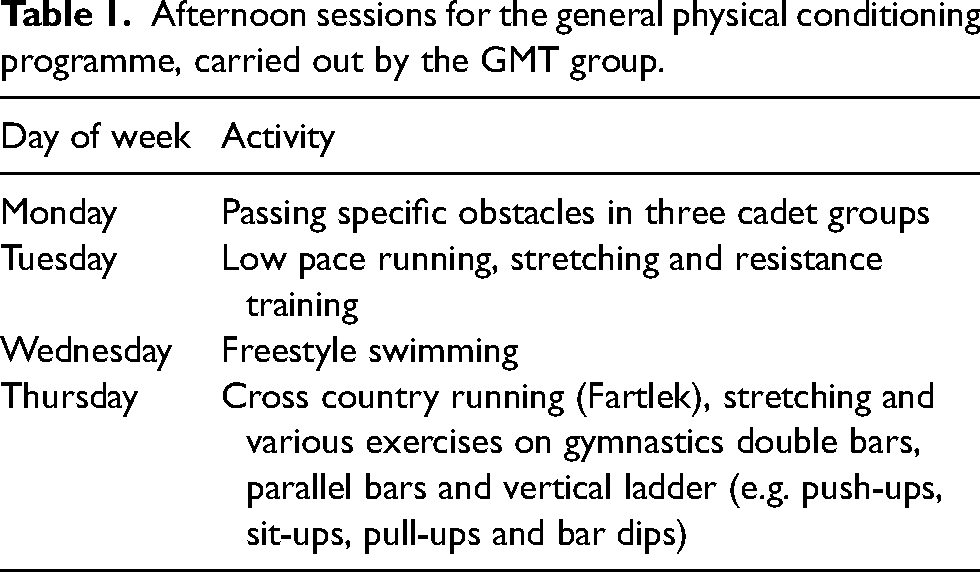
Analytically, the standardised morning training session was identical for the GMT and SMT groups and included: a) 10 min of stretching in ballistic form (4 sets of 12 repetitions around shoulder, chest, groin, thighs, and calves), b) 25 min of low pace running (3–5 km distance) and 20 min of callisthenic exercises (4 sets of 12 repetitions in various forms of push-ups, sit-ups, pull-ups, inverted crawls, hops, high jumps, supine bicycles and lunges). The afternoon training session for participants in the GMT group included a 90-min general physical conditioning programme (Table 1) which consisted of running, swimming, weight training, obstacle running, and callisthenics carried out in five classes (n = 40–45). All participants performed their respective programmes with no time to exercise outside the training schedule and followed the same obligatory dietary programme which involved four meals per day administered in a mess hall, with water and herbal tea consumed ad-libitum. A quartermaster officer monitored the cadets’ diet and ensured 100% compliance with all dietary protocols (arrival time, eating period, number of portions, departure time).
Afternoon sessions for the general physical conditioning programme, carried out by the GMT group.
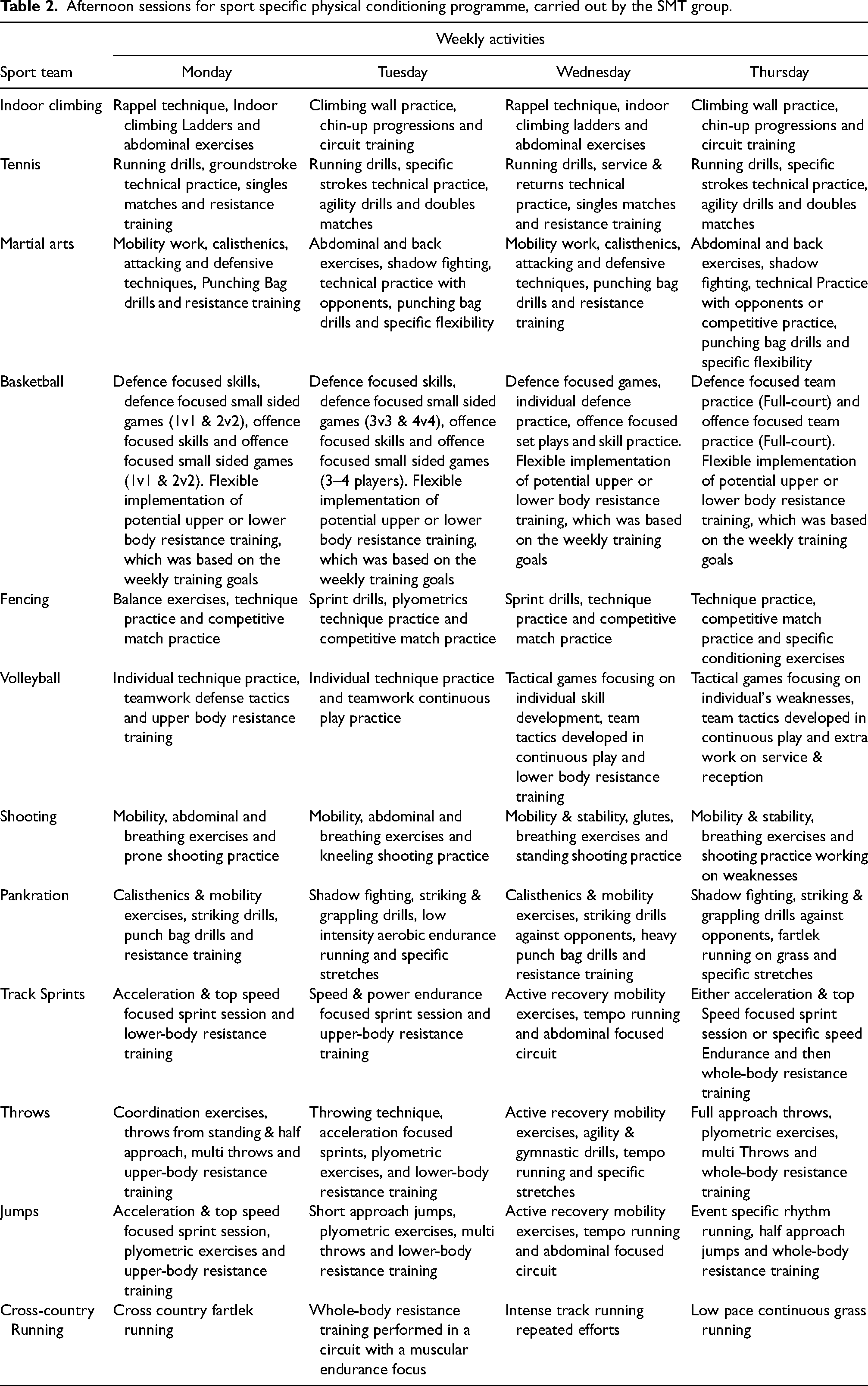
In contrast, the afternoon session for participants in the SMT group comprised a 90-min Specialised sport-specific programme for each one of the following sport teams: Indoor climbing, Tennis, Martial arts (judo/kickboxing), Basketball, Fencing, Pankration (a form of Greek mixed martial arts), Volleyball, Shooting, Jumps (high/triple/long jump), Cross-country running (6 km/10 km), Throws (discus/javelin/shot put) and Track Sprints (100 m/200 m/400 m). Each participant in the SMT group joined only one team for the whole duration of the 13-week period and team selection was based on self-selection. The specialised sport-specific programme followed by each sporting team, shown in Table 2, was based on undulating periodization model which involves changes in intensity and volume on a weekly or/and daily basis. 11
Afternoon sessions for sport specific physical conditioning programme, carried out by the SMT group.
Testing: To assess the effects of the 13-week training period on physical conditioning, participants underwent a series of field tests, such as pull-ups, obstacle course run, 50 m freestyle swimming and one-mile run which are quite common and convenient in military testing. 12 These tests were employed immediately before and after the 13-week training period. Prior to the physical tests, height, body mass and body fat assessed with skinfold callipers according to Durnin and Womersley's method 13 were measured. All physical tests were performed at a specific time period (13:00 − 19:00) and were spread over two days. Pull-ups and obstacle course were performed on day 1 whilst 50 m swim and one-mile run were performed on day 2 as the intention was to place the more fatiguing tests last. All participants were allowed thirty minutes to recover between each test and performance was recorded for each participant separately for each of the tests apart from the one-mile run.
Analytically, the one-mile run took place in a outdoor 400 m synthetic track and was performed by ten participants each time. The obstacle course had a length of 500 m and consisted of the following obstacles: 1. Rope ladder, 2. Double beam, 3. Trip wire, 4. Network of wires, 5. Ford, 6. Espalier, 7. Balance beam, 8. Sloping wall with rope, 9. Horizontal Beams (over-under), 10. Irish table, 11. Tunnel and twin beams, 12. Four steps of beams, 13. Banquette and pit, 14. Assault wall, 15. Pit, 16. Vertical ladder, 17. Assault wall II, 18. Balance beam (Zigzag), 19. Chicane, 20. Assault walls in succession. Information regarding obstacle characteristics and passing are analytically reported in International Military Sports Council. 14
The participant started the pull-ups in a hanging position with arms straight and hands in an overhand position. Then body was pulled upward until the chin was over the bar and after each pull-up the participant turned to a fully extended position. 15 Swimming was performed in a 50 m indoor pool where participant started the trial from a diving block and swam freestyle as fast as possible. Starting timing was commenced after a sound signal and terminated when participant's hand touch was observed on the wall. All participants used the same lane between April and May where water average temperature was measured at 27.2°C.
During the obstacle course, mile-run and 50 m swim time each trial was recorded with the use of handheld digital stopwatches (Accusplit 625, Linemore, USA). In an effort to minimize errors during measurements, time was simulataneously recorded by three head examiners with 25 years experience in physical testing. All head examiners were certified coaches by the national track and field or swimming associations. Despite the fact that handheld compared to electronic timing produces an error of 0.04 s during 2–3 s durations, 16 for the time span used in the present measurements (45–385 s) that difference was considered to be negligible.
The reliability of these regularly performed field measurements was assessed by repeated trials on successive days in a random subsample (n = 14) of cadets (intraclass correlation coefficients ranged from 0.93 to 0.99; 0.99 for mile run, 0.99 for 50 m swim and 0.93 for obstacle course).
Data analysis
Means and standard deviations (SD) for all participant characteristics and physical conditioning tests were computed. Independent t-tests and one-way analysis of variance (ANOVA) were used to detect any pre-training differences between groups. A two-way mixed analysis ANOVA with repeated measures was used to test the effect of time (pre vs. post), group (GMT vs. SMT) on each physical conditioning test and any interaction effects for each variable. Follow-up analyses included pairwise Bonferroni-corrected comparisons. Furthermore, to detect differences within the SMT group, a two-way mixed repeated measures ANOVA was used to test the effect of time (pre vs. post), sport (12 different athletic teams) and any interaction effects on the depended variables. In the event of significant main effects or interactions, pairwise Bonferroni-corrected comparisons were employed. For determining ANOVA related effect size, partial eta squared (η2 p ) values for each dependent variable were calculated whilst power estimations were also included. In addition, for differences between means, Cohen's d (effect sizes defined as “small, d = 0.2,” “medium, d = 0.5,” “large, d = 0.8”, very large, d = 1.2”, “huge, d = 2.0”), the magnitude of the mean ± SD differences between testing sessions (MΔ) and the 95% confidence limits (95% CL) were used for data interpretation. All statistical analyses were conducted using the Statistical Package for Social Sciences (SPSS; SPSS, Chicago, Illinois, USA) version 25.0. The significance level for all tests was set at p < 0.05.
Results
GMT versus SMT training
There were no significant differences between groups for any of the cadets’ characteristics nor any time effect on the same attributes. The independent t-tests showed no significant differences (t = 0.065–1.867, p = 0.630 – 0.948) between the groups for all pre-training tests. The two-way mixed ANOVA showed that there was a significant main effect of time (pre vs. post) on pull-ups (F = 764.318, p < 0.001, η2 p = 0.645, power = 1.000), 50 m swim (F = 433.382, p < 0.001, η2 p = 0.507, power = 1.000), obstacle course run (F = 208.954, p < 0.001, η2 p = 0.332, power = 1.000) and mile run (F = 159.626, p < 0.001, η2 p = 0.275, power = 1.000) performances overall. Similarly, a main effect of group (GMT vs. SMT) was observed for pull-ups (F = 5.159, p < 0.05, η2 p = 0.012, power = 0.620), 50 m swim (F = 4.226, p < 0.05, η2 p = 0.010, power = 0.536), obstacle course run (F = 6.836, p < 0.01, η2 p = 0.016, power = 0.742), and mile run (F = 6.039, p < 0.05, η2 p = 0.014, power = 0.689). Furthermore, significant interaction effects were observed for the same four variables respectively (F = 363.628, p < 0.001, η2 p = 0.463, power = 1.000; F = 69.699, p < 0.001, η2 p = 0.142, power = 1.000; F = 40.869, p < 0.001, η2 p = 0.088, power = 1.000; F = 28.756, p < 0.001, η2 p = 0.064, power = 1.000).
Based on the above statistical outcomes both groups improved their performance post-training (p < 0.001), however the pre-post training differences for the SMT group were significantly greater compared to the GMT group for all tested variables (p < 0.001 – 0.05) (Table 3).
Mean ± sd for pre- and post-training physical test performance for GMT and SMT groups.
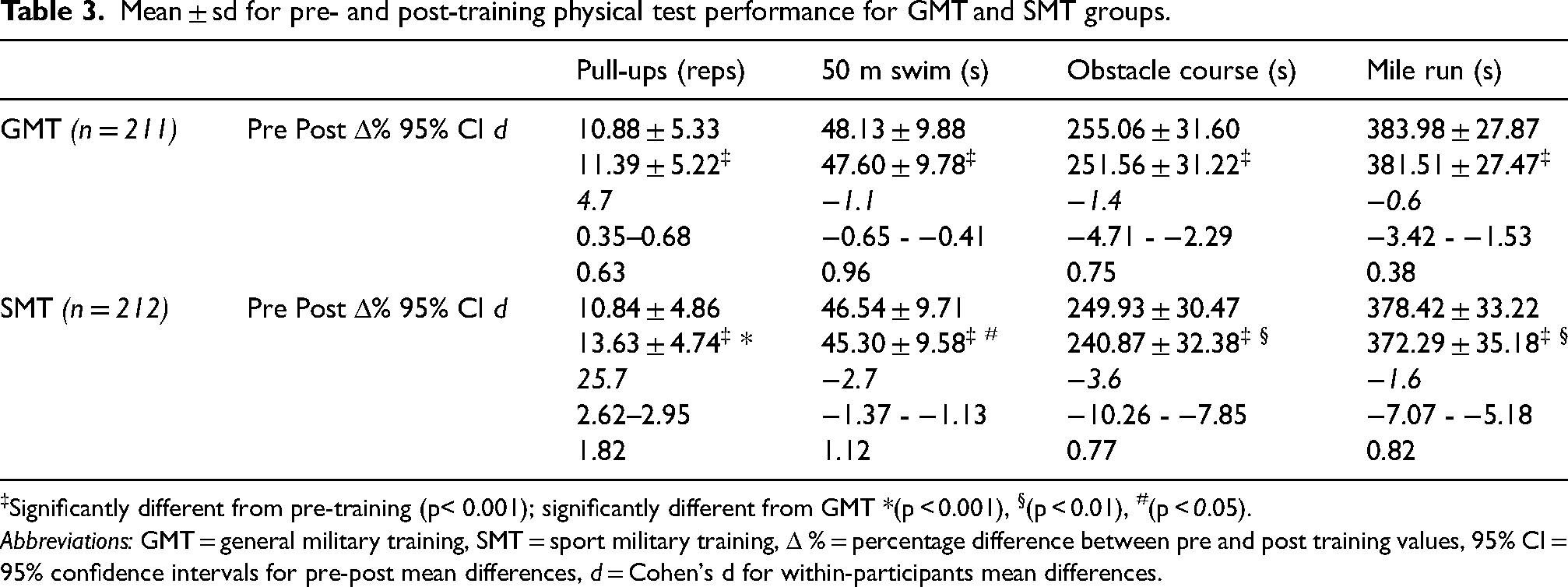
Significantly different from pre-training (p< 0.001); significantly different from GMT *(p < 0.001), §(p < 0.01), #(p < 0.05).
Abbreviations: GMT = general military training, SMT = sport military training, Δ % = percentage difference between pre and post training values, 95% CI = 95% confidence intervals for pre-post mean differences, d = Cohen's d for within-participants mean differences.
SMT groups
Regarding the analysis of the SMT groups, the one-way ANOVA revealed that there were some pre-training differences between certain groups. For pull-ups, the martial arts, cross-country running, and track sprints groups exhibited better performance than fencing (p < 0.05). For 50 m swim, the indoor climbing group showed better performance than the basketball and cross-country running (p < 0.01), and shooting (p < 0.001) groups; also, the shooting group had lower times than the tennis (p < 0.001) and the pankration and volleyball (p < 0.05) groups. For the obstacle course, the indoor climbing and track sprints group performed better than the martial arts (p < 0.001, 0.01) and the fencing, pankration, and shooting (p < 0.001) groups. Additionally, the pankration group showed inferior performances to the tennis and jumps (p < 0.01), and cross-country running and throws (p < 0.05) group. Likewise, the fencing and the shooting groups compared in a similar direction to the jumps (p < 0.05) groups with fencing also outperformed by the tennis (p < 0.05) group too. Finally, for the mile run the cross-country running group performed better than all other 11 groups (p < 0.001–0.01) with the jumps group achieving better times against the fencing group (p < 0.05).
The mixed ANOVA yielded a main time effect (all p < 0.001) for pull-ups (F = 1208.858, η2 p = 0.858, power = 1.000), 50 m swim (F = 277.546, η2 p = 0.581, power = 1.000), obstacle course (F = 158.897, η2 p = 0.443, power = 1.000) and mile run performances (F = 310.472, η2 p = 0.608, power = 1.000), indicating that all groups improved their performance in all tests following the training period. Significant main effects (all p < 0.001) were also detected for the group factor for each dependent variable (η2 p = 0.162, power = 0.995; η2 p = 0.179, power = 0.998; η2 p = 0.396, power = 1.000; η2 p = 0.323, power = 1.000). Finally, significant time × group interactions (all p < 0.001) were identified for pull-ups (F = 16.200, η2 p = 0.471, power = 1.000), obstacle course (F = 7.586, η2 p = 0.294, power = 1.000) and mile run (F = 21.326, η2 p = 0.540, power = 1.000), but not for the 50 m swim.
Post-hoc analysis using Bonferroni corrections revealed interesting trends between pre-post training group differences. For instance, the cadets in the teams of indoor climbing, cross-country and sprints improved significantly more (p < 0.001 – 0.05) in pull-ups than those in the teams of basketball and fencing, with the fencing team improving significantly less than the teams of indoor climbing, martial arts, jumps, cross-country and sprints (p < 0.001 – 0.05) (Figure 1). Cadets in the sport teams of pankration, martial arts, fencing and shooting improved significantly less (p < 0.001 – 0.05) in obstacle course than those in other sport teams with indoor climbing, sprints and jumps exhibiting most of the improvements amongst the 12 teams. No significant differences existed in 50 m swim improvements amongst teams whilst in the mile run all teams improved at similar rates except for the cross-country running team whose improvements were significantly higher than those of all other teams (p < 0.001 – 0.01).
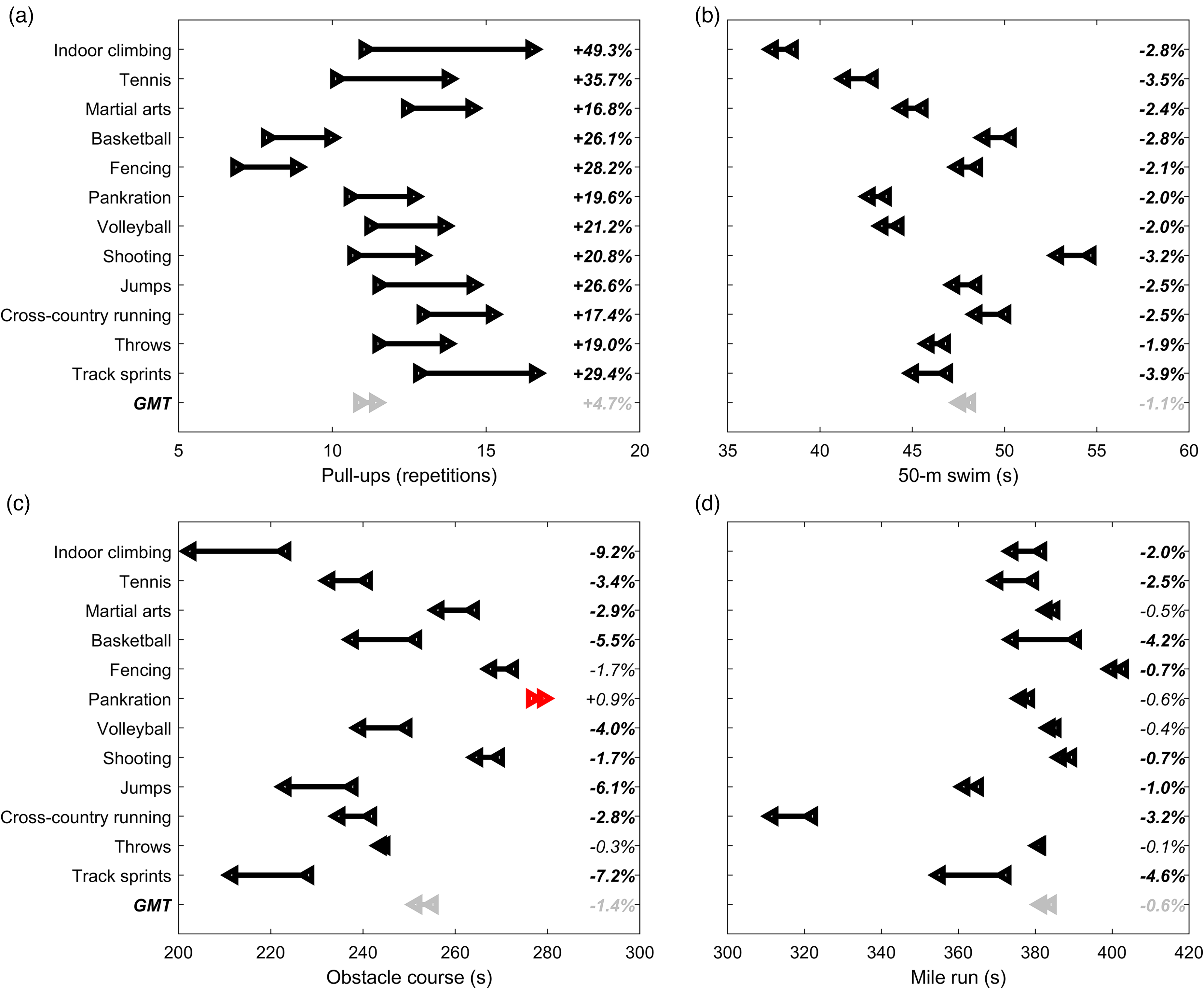
Pre-post training changes for each SMT subgroup for pull-ups (a), the 50 m swim (b), obstacle course (c), and the mile run (d). Percentage changes for each subgroup are displayed on the right-hand-side of each subplot, where bold values denote a significant pre-post difference (p < 0.05). GMT group data have also been presented for comparison. Only one subgroup showed a “reduction” in performance for one of the physical tests (Pankration for the obstacle course) and this has been highlighted in red.
Discussion
The present study set out to evaluate the effects of sports specific training on the performance of army cadets in a series of physical tests used by their army academy. Secondly, the study aimed to examine the links between different types of sport specific training and the magnitude of training-induced changes observed within the physical test battery. Both the general (GMT) and sport military (SMT) training groups showed statistically significant improvements in the physical performance tests following the 13-week training intervention (Table 3). However, the SMT group produced significantly greater improvements in all four tests (pull-ups [p < 0.001], 50 m swim [p < 0.05], obstacle course [p < 0.01] and mile run [p < 0.01]) compared to the GMT group. Furthermore, different types of SMT provided greater improvements in specific physical tests when compared to other forms of SMT (e.g. indoor climbing vs. pankration). As such, the findings initially highlight that the implementation of sport specific military training provides superior physical development in comparison to the general military conditioning. Therefore, it becomes evident that army cadets who undergo concurrent participation in both general and self-selected sport specific training are better physically prepared than their counterparts who specialise in only general military conditioning, beyond the superior improvements in their physical conditioning such participation is expected to promote a range of non-physical benefits of sporting participation (e.g. psychological and emotional wellbeing, leadership, stress reduction).7,8
From a pure military conditioning perspective, the findings highlight that the GMT programme produced suboptimal improvements in the physical performance of benchmark military physical tests despite being a military-centric programme, developed specifically with these tests in mind. It was noteworthy that the SMT group delivered significantly greater improvements in all four physical tests despite their sport training involving activities that were not always closely related to the selected physical tests from either a mechanical or physiological perspective. Previous studies exploring the combination of structured resistance and endurance training within military environments have likewise observed greater physical adaptations in comparison to standard military training.2,3,17 Therefore, the findings underscore the need for military commanders to be aware of the positive interplay between military and sports training. In particular the potential benefits of a holistic training approach in which training stimuli are varied and optimised may be particularly important when aiming to enhance physical and combat performance. For instance, this is demonstrated through the observed changes in the pull-up test, in which the relative improvements of the SMT group were five times greater than the GMT group (25.7% vs. 4.7%) (Table 3). Interestingly, the GMT group undertook calisthenic training 4 times a week, however this training stimulus provided comparatively smaller improvements compared to SMT interventions. This suboptimal success of the calisthenic training could be reasonably explained due to the lack of progressive overload and the application of a routine programme with unvarying stimuli to a group of men already possessing good levels of physical capacity. Kotarsky et al. 18 demonstrated the effectiveness of calisthenic training when the exercise intensity was progressed whilst maintaining a low number of repetitions, whereas other studies implementing a more traditional approach of increasing the repetitions for the same exercise have shown limited improvements in strength.4,19 The cadets assessed in this study were experienced at all these training methods as they were military students in third and fourth year, which would suggest that the calisthenic exercises selected for this period of their development were not sufficiently intense for already well-trained cadets.
On the other hand, the climbing group within SMT completed sport related climbing movements that closely resemble the kinetic pattern of the pull-up multiple times per week, as well as a weekly session that included a special focus on pull-up variations (e.g. wide grip pull-ups and isometric holds). Unsurprisingly, the climbing group achieved the greatest pull-up improvement of 49.3%, highlighting the potential adaptation that cadets can achieve when the training includes appropriate volume, exercise progression and similarity of the movement patterns. It is also clear, that a number of the other SMT groups (e.g. track sprints, tennis) undertook targeted upper body resistance activities, whilst frequently utilising progressive overload within these sessions, something that contrasts the approach taken within the GMT regimen. As such, the strength improvements observed within these SMT sub-groups can be attributed to the inclusion of additional upper body resistance training.2,3,17 Therefore, providing similar upper body stimuli to cadets who do not take part in additional sports training would be highly recommended.
The superiority of the SMT training in capitalising on the fundamental principles of specificity, progressive overload and variation extends beyond the improvements seen in the pull-up test. Indeed, the fact that the SMT regimen induced significantly greater improvements in the obstacle course and mile run likely reflects this fact, considering that the standardised morning training sessions completed by both GMT and SMT was identical and provided a baseline aerobic endurance and callisthenic strength stimulus for all cadets. It was the afternoon specialised training which enabled the SMT subgroups to optimise their performances. This was evident in all SMT subgroups regardless of the philosophy and direction of their training programme. Notably, the SMT groups who produced the greatest relative improvements in the mile run performance were the sprinters (4.6%) and basketball players (4.2%), although fundamentally the training approaches used within these two groups were not intended to target this physical quality. However, the inclusion of sustained high intensity running over a range of distances (total sessional distance: 600 – 1000 m) and activities (e.g. small sided games) within these groups can be attributed to the enhanced performance through a potential increased running economy and cardiovascular adaptations.20,21 In contrast, only small improvements in performance (0.1 – 0.7%) were observed within the martial arts, fencing, pankration, volleyball, throws and shooting groups, which is not surprising when reviewing their individual programmes and unlike the aforementioned groups there was limited exposure to either high intensity endurance activity or a substantial volume of lower intensity endurance activity.
Overall similar SMT group trends can be observed within the obstacle course, although there were some notable exceptions, such as the indoor climbing group who improved by 2% and 9.2% in the mile run and obstacle course, respectively. The obstacle course required completing 12 obstacles in the fastest time, in which nine were atypical pull-up movements and as such upper body strength and muscular endurance would be key physical qualities in the completion of this test. Therefore, the additional climbing training provided an ideal stimulus to further improve the necessary strength and muscular endurance qualities required to complete the obstacle course.22,23 Whereas the transference of the climbing training to the mile run performance was less successful due to the lack of similarity between the running and climbing movements. Interestingly, a non-significant worsening in obstacle course performance (0.9%) was observed in the pankration group, which could be attributed to the unrelated movements undertaken within the performance of this sport, thus the sports specific movement patterns of striking and grappling require the coordination of different muscle groups when compared to the movements undertaken within the obstacle course.24–26 Hence, the present findings underline the need to consider a range of biomechanical and physiological factors when constructing an effective programme for military personal, these include the movement pattern, type of muscle action(s) (e.g. concentric), velocity of movement, postural factors (e.g. range of motion) and energy system contribution.27,28 Military training requires careful planning when considering these factors in the context of military combat and military commanders should seek to apply the fundamental principles of progressive overload and structured variation 29 within their programmes, otherwise reduced or negative adaptations may occur.
Significant improvements in 50 metre swim performance were observed in both GMT (1.1%) and SMT (2.7%) groups with the SMT group showing larger improvements by their GMT counterparts (Table 3). The analysis of the individual SMT sub-groups did not show any significant difference between training groups, with improvements ranging between 1.9% to 3.9% (Figure 1). Interestingly, the GMT group undertook a weekly freestyle swimming session on Wednesday afternoons, whereas the SMT groups did not undertake any swimming training due to taking part in the sport specific elements of their programme. Therefore, the SMT groups were able to outperform the GMT group without specific practice at the task, which highlights that the swimming stimulus implemented within the GMT programme was perhaps insufficient at developing optimal training adaptations. One of possible explanations for the superior improvements observed in the SMT groups could be attributed to the additional strength and power drills they undertook as part of their training schemes, as strong relationships exist between measures of upper body pulling strength and sprint swim velocity. 30 Furthermore, cadets self-selecting the GMT regimen may have not been as skilled swimmers as SMT cadets before joining the academy (their pre-training scores support this assumption) and whilst the swimming trainings stimulus helped them to improve their performance, it may have not been rigorous enough to condition them to the same level as their SMT counterparts. Therefore, it is vital for military commanders to review the frequency of the swimming sessions within GMT groups, accompanied by targeted upper body conditioning as well as considering the introduction of repeated sprint swimming in order to provide a stimulus that replicates the physiological demands of the intended test.31,32
This study is affected by several limitations. Most notably, the investigation compared several training regimens (which differed their intensity, volume and training modality) with regards to their effect on common military physical performance tests. Likewise, allowing participants to decide which training intervention they wish to participate increases the accidental bias of the study. Clearly, the self-selection process allowed cadets to play to their strengths and this was evident from the differences in performance between various SMT groups before training. Whilst the above two limitations to randomise the participants and equate these key training parameters generate challenges in identifying the relative contribution of different training stimuli to the observed adaptations, the large-scale nature of this study, controlled training and testing environments and ecologically valid physical training, alongside a real-world sport selection process provides important information on commonly used military training interventions. Such information is fundamental to military commanders and conditioning personnel when aiming to optimise physical preparation and readiness for combat. Although, it must be noted that the four tests represent the benchmark physical qualities deemed as essential within the Hellenic national army with the obstacle course considered as the most specific to military tasks, other more battlefield specific tests exist, such as the 30 m and 400 m sprint with fighting load or the simulated casualty rescue with fighting load. 33 The present study highlights that experienced army cadets who undergo concurrent participation in general and sport military training can be as prepared for military performance as their counterparts who specialise in general military conditioning. More importantly, the findings demonstrate that sport military training provides greater improvements in military physical performance than a more generalised approach, although the specific characteristics of the sport military training may impact on the magnitude of any improvements.
Conclusion
A mandatory general military training programme focusing on traditional military physical conditioning is inferior to a combination of basic military and sports specific training, as it was evidenced in well-trained army cadets executing three general fitness tests and one combat-related related fitness test. Moreover, certain sport specific training programmes (e.g. climbing, track sprinting, jumping, basketball) seemed to provide better adaptations in military performance, perhaps due to their differentiating strength and power training components. Therefore, general military training should include a combination of high intensity upper and lower body exercises in combination with weight training. Furthermore, as sprint swimming is a key test, additional training should be focused on developing the assisted qualities utilised within this task. Finally, certain sports (e.g. fencing and pankration) provide suboptimal adaptations to key physical qualities and hence, military conditioning personnel should consider reviewing sport specific programmes that do not include high intensity exercise and/or weight-based training.
Footnotes
Authors' note
Theodoros M Bampouras is also affiliated at School of Sport and Exercise Sciences, Liverpool John Moores University, Liverpool, UK.
Declaration of conflicting interests
The author(s) declared no potential conflicts of interest with respect to the research, authorship, and/or publication of this article.
Funding
The author(s) received no financial support for the research, authorship, and/or publication of this article.
