



Abstract
Soccer heading may be problematic for neurocognitive function. The English Football Association (FA) recently introduced guidelines in order to limit the number of headers within training for youth soccer. However, it remains to be seen what the influence of these guidelines has been on the leaders of soccer teams that are primarily responsible for implementing the guidelines. Thus, we aimed to explore grassroot youth coaches’ knowledge of, views on, and adherence to the heading guidelines. An online survey was distributed to team representatives across Local County FAs. The survey comprised of three sections: (1) background information, (2) heading practices including details on heading activities and views on heading safety, and (3) heading guidelines including levels of awareness, knowledge, and compliance. 240 coaches responded by stating they rarely (21%) or never (73%) practiced heading, although they mostly perceived heading as being somewhat safe (36%). While respondents indicated being only somewhat aware of the guidelines (43%), they scored very high on their perceived (92%) and actual (based on retrospective accounts of heading) (87%) compliance with the guidelines. There was a mixed perceived change within practice following the introduction of the guidelines (disagree = 26% vs. agree = 22%), and they were perceived as safe (86%) and appropriate (81%). Factors that were identified as being potential barriers were only marginally agreed upon (<30%) and tended to be related to in-game rules. While there is scope to successfully implement heading guidelines, there is some discrepancy between the requirements for heading safety and coaches’ knowledge.
Introduction
Soccer is perhaps the most popular sport in the world, played in over 200 countries by approximately 265 million players. 1 It is the only sport in which players are required to purposely use their head in order to execute game-specific skills for performance. Previous research has shown former professional soccer players are at an increased risk of mortality caused by neurodegenerative disease (hazard ratio = 3.53; 95% CI, 2.72–4.57)—particularly relating to dementia—when compared to matched controls. 2 Whilst physical contact between players may contribute to such issues, it has been suggested that soccer heading itself may be related to a decline in neurocognitive function.3–8 This detrimental effect becomes somewhat more disconcerting when we consider the number of times a player may head the ball. That is, depending on the position of play, soccer players can head the ball approximately 1–15 times during a single competitive match. 9 With some players competing in excess of 50–60 matches per season, and a career spanning 15–20 years, this may accumulate to thousands of headers across the lifespan. 6 In addition, a recent study in youth soccer players revealed that teams averaged up to 45 headers per training session; independent of competitive match-play. 10
With this in mind, there are a small number of countries that have introduced heading guidelines for grassroots soccer coaches to independently implement. Namely, The English Football Association (FA) introduced the following heading guidelines for youth soccer teams
11
(see Footnote
1
):
Heading should not be introduced in training sessions for U7-U11 One session per month with a maximum of 5 headers for U12 One session per week with a maximum of 5 headers for U13 One session per week with a maximum of 10 headers for U14-U16 Heading drills should be reduced and take into consideration the heading exposure in matches for U18
At this juncture, it is relevant to evaluate how well-received the heading guidelines have been within the game. Along these lines, Kaminski et al.
12
recently conducted an evaluation of the adherence to a separate set of heading guidelines from U.S. Soccer, which revealed widespread adoption. However, separate guidelines that may be established by national governing bodies across the world face a unique set of challenges in terms of being able to develop, communicate and impose such guidelines. Having an appreciation of these issues is particularly important if we are to promote behaviour change within coaches,13–15 which can have direct consequences for athletes’ behaviours and their well-being.
16
Thus, further insights may inform heading guidelines that can work to uphold the safety of players. The aim of the present study was to explore the general awareness, views and implementation of the FA heading guidelines by holding a cross-sectional survey within youth soccer coaches.
Methods
Data collection
The study was approved by the lead institution research ethics committee, and followed the principles of the Declaration of Helsinki (ref.: 21/SPS/008). Local County FAs were initially contacted by the FA to notify them of the research and forward any recruitment material to the teams that they had on record. The recruitment material informed potential respondents about the study including its anonymity and featured a hyper-link in order to consent to and access the survey online. The survey was set up and controlled by a web-based software programme; Joint Information Systems Committee (JISC). This platform is GDPR-compliant and ISO 27001-certified, which allows respondents to securely access and respond to the survey via their own personal electronic devices.
The survey ran between 8th March and 4th July, 2021. The initial start date coincided with the lifting of UK restrictions that resulted from the COVID-19 pandemic. The final date coincided with the end of the season for nearly all grassroots soccer, which was an extension to help combat the loss of time caused by the earlier lockdown and allowed respondents to re-enter back into their normal training practices. While much time had been spent within lockdown, respondents were instructed to only take part if they had undertaken practice with their respective teams since the FA heading guidelines were introduced (February 2020). A penultimate and last reminder to complete the survey was sent on the 29th March and 14th June, respectively.
Survey
In line with previous soccer-based surveys,12,17 and to ensure complete transparency and accuracy in the portrayal of the heading guidelines, the research team initially discussed the content validity with associates of the FA. The content of the final online survey can be observed in full via the supplementary material. There were three distinct sections including background information, heading practices, and heading guidelines.
The background information section broadly collated descriptive details from the respondents regarding their own personal role, highest coaching qualification (if any), and team age group and gender. The heading practices section involved items surrounding the regularity of training sessions, heading-specific drills and indirect set pieces (i.e. corners, free-kicks without shooting), and views on the safety of heading. The heading guidelines section initially questioned respondents about their awareness and knowledge of the guidelines. Therein, they were provided with a copy of the actual guidelines, which they could refer to throughout the remainder of the survey. Subsequent items questioned respondents on the potential violation, safety and appropriateness of the guidelines, as well as any observed changes to their training activities. Finally, respondents had to select any factors that they thought could prevent them from fully implementing the guidelines.
Data handling
Data were exported to Microsoft Excel (Microsoft Corp, Redmond, WA). The frequency and percentages of responses for individual items were calculated. Because the key aspect of the heading guidelines relates to age, we further brokered the frequency and percentages for some of the key items as a function age. In order to remain consistent with the age ranges that were specified by the guidelines (see Introduction), and for the sake of brevity, we did not separately evaluate each age group but broadly discriminated them as U7-U11, U12-U13, U14-U16 and U17-U18.
As a further matter of interest, we attempted to indirectly assess the potential differences in coach education by brokering the frequency and percentages on the awareness of guidelines as a function of coaching level or qualification. To more directly examine compliance with the guidelines, we categorised responses as compliant when the estimated number of headers within reported drills was under or on the recommended number for that age group (e.g. U8 performing no headers). However, they were considered to be in violation of the guidelines if they were above this stated number (e.g. U8 performing an estimated 5 headers). The U17-U18 age group was not considered in this instance because it does not feature an explicit or concrete limit within the guidelines.
While presenting non-parametric categorical data, it was not entirely viable to statistically analyse given the violation in some key assumptions (i.e. Pearson's chi-square test requires expected frequencies to be >5 in ≥80% and ≥1 in 100% of cells or categories). 18 Meanwhile, due to the cross-sectional and descriptive nature of this study, we opted to directly observe the data and report in a descriptive manner.
Results
Background information
There was a total of 240 respondents (see Footnote 2 ). These comprised of 227 coaches (95%) and 13 other personnel (5%) (e.g. assistant, club secretary, club welfare officer) that were directly involved in player training. Coaching qualifications included 29 (12%) no formal FA qualification, 134 FA Level 1 (56%), 51 FA Level 2 (21%), 15 FA Level 3 (UEFA B) (6%), 3 FA Level 4 (UEFA A) (1%) and 2 other (1%) (e.g. SFA badges) (5 prefer not to say (2%)). There were 183 male-only (77%), 21 female-only (9%) and 35 (15%) mixed gender teams involved. Team age groups were relatively well distributed across the available range, while the number of training sessions per month suggested there was an adequate sample for potential exposure to heading (Figure 1).
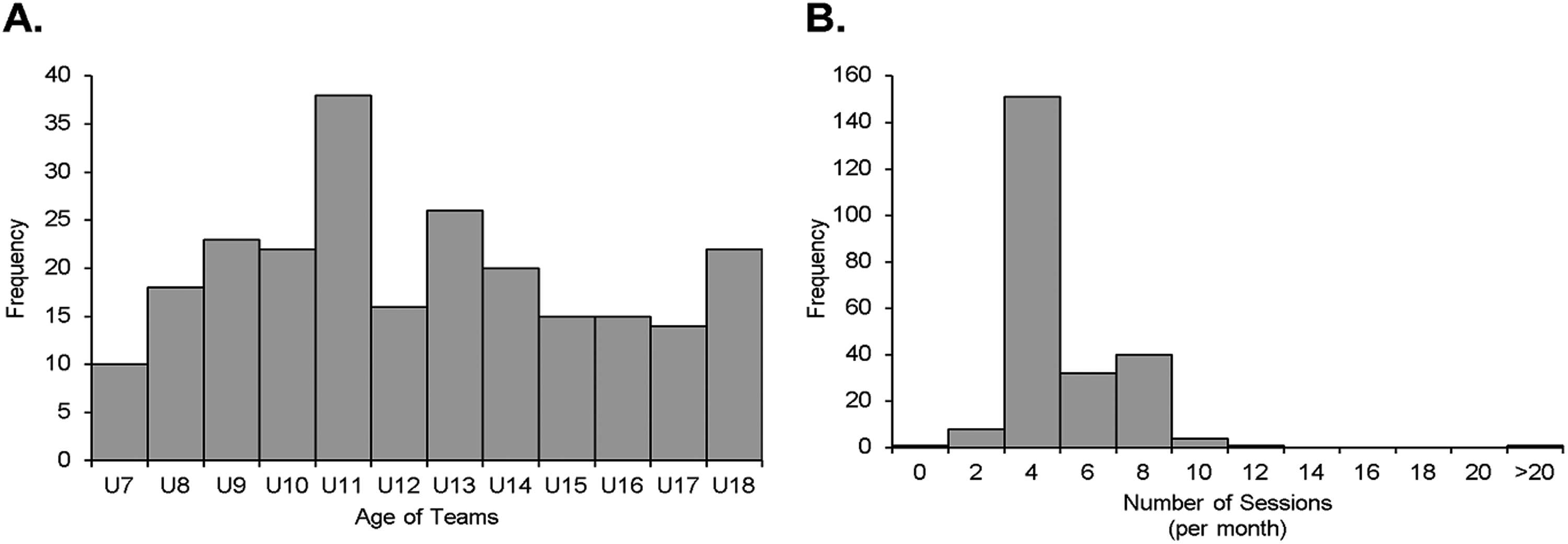
Histograms illustrating the frequency distribution of the team age groups (A), and number of training sessions per month (B) (N.B., present solitary anomaly (>20) likely indicates a response error or misinterpretation of the related item).
Heading practices
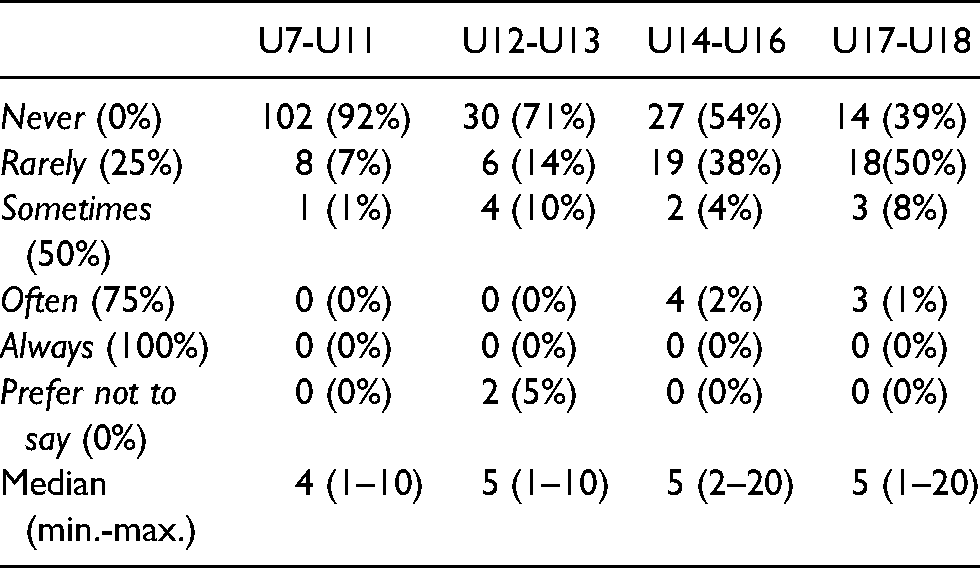
There were mostly no or rare instances of heading-specific drills, while indirect set-pieces appeared somewhat more regularly (Figure 2). However, the potential for heading within training appeared to grow slightly more with age (Table 1). The views on how safe heading is ranged from 16 not at all (7%), 46 very little (19%), 87 somewhat (36%), 36 very much (15%), 14 completely (6%) and 36 don’t know (15%) (4 prefer not to say (2%)).
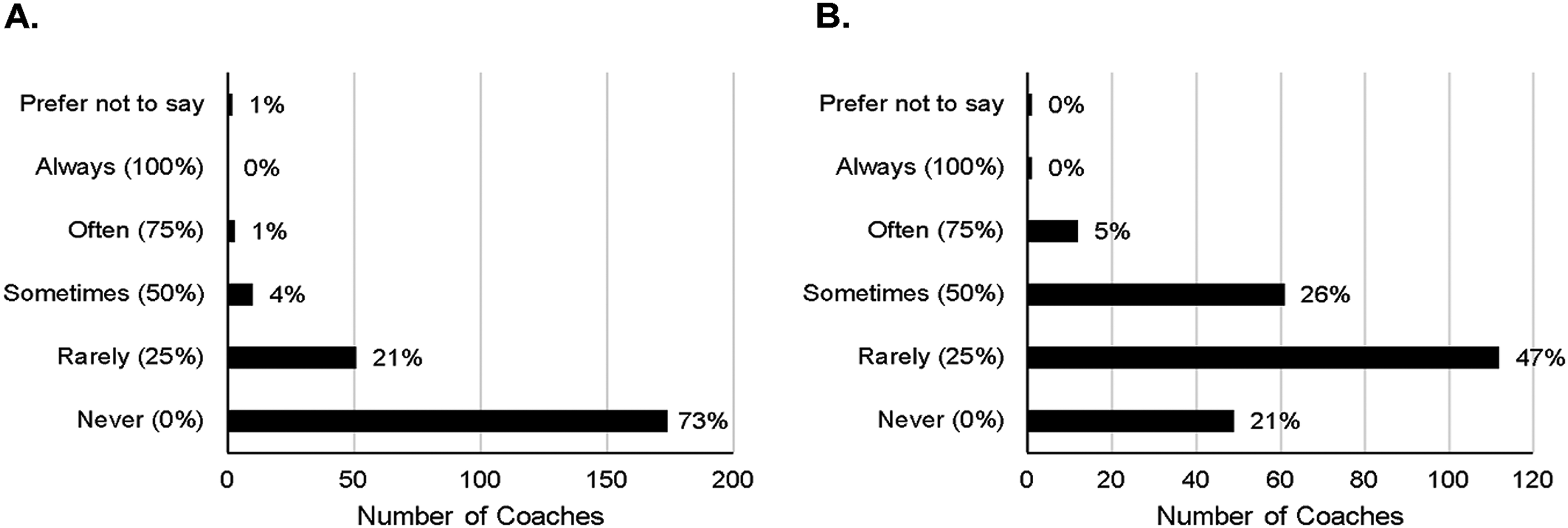
Number of responses to the regularity of heading-specific drills (A) and indirect set pieces (B) within training.
Breakdown of the responses to heading-specific drills, and median (min.-max.) number of headers within a drill as a function of age group.
Heading guidelines
The level of awareness of the heading guidelines featured 8 not at all (3%), 33 very little (14%), 102 somewhat (43%), 62 very much (26%) and 33 completely (14%) (1 prefer not to say (<1%)). This distribution remained relatively unaffected by coaching qualification (Table 2).
Breakdown of responses to the awareness of heading guidelines as a function of coaching qualification.

Most tended to agree that they did not violate the heading guidelines (Figure 3). This perception was consistent with actual compliance based on the number of headers that were retrospectively reported in training (compliant n = 177 (87%), non-compliant n = 20 (10%), prefer not to say n = 7 (3%)). However, from those few that appeared to violate the guidelines, there was a greater distribution toward the younger age groups with 19 from U7-U11 (17%), 1 from U12-U13 (2%) and 0 from U14-U16 (0%).
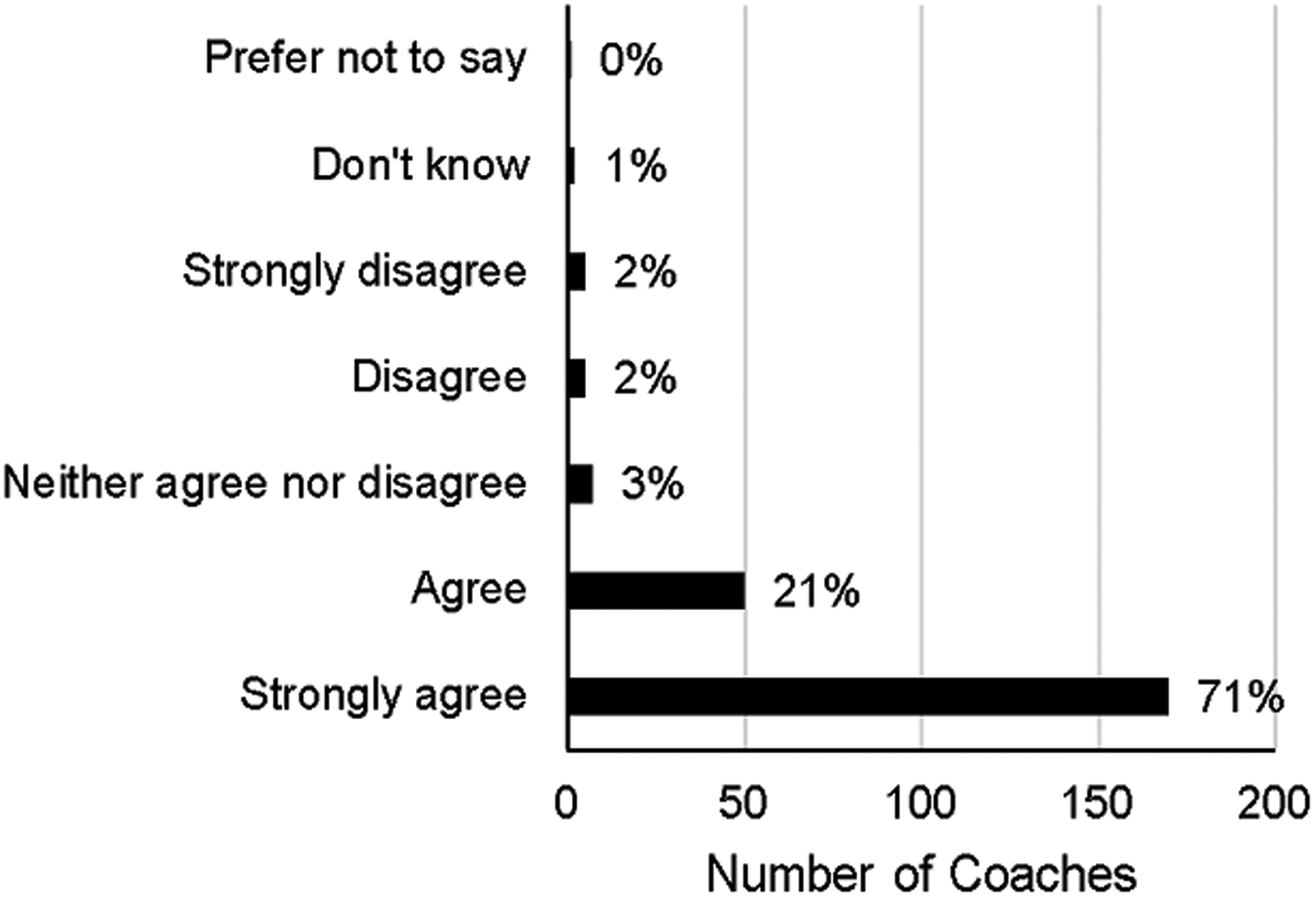
Number of responses to reports of not violating the guidelines.
The views on any changes to training activities as a result of the guidelines appeared to be somewhat mixed, although there was a tendency to agree that the guidelines were safe and appropriate (Figure 4).
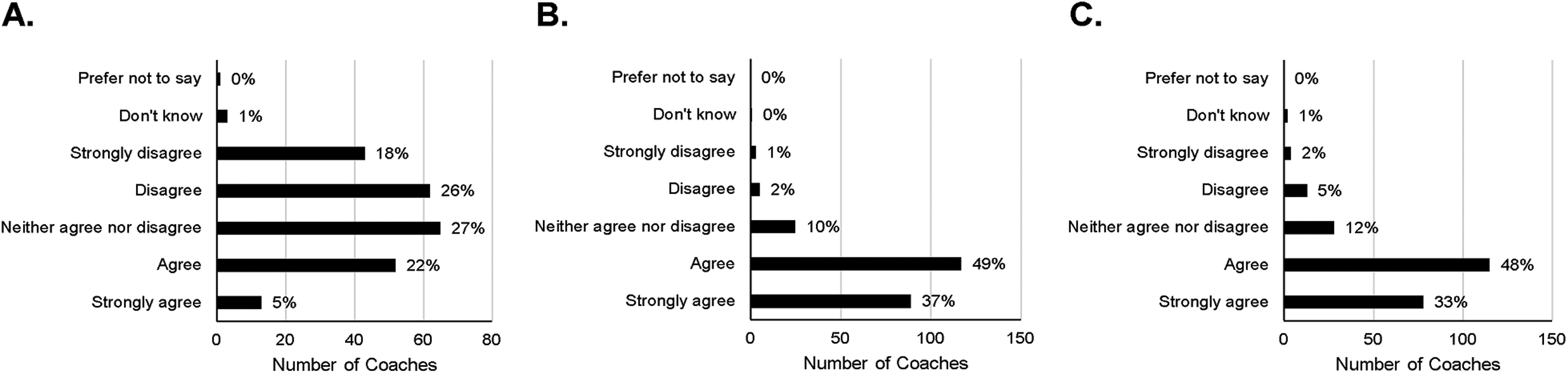
Number of responses to perceived changes in training (A), and safety (B) and appropriateness (C) of the guidelines.
Potential perceived barriers to the guidelines that tended to be agreed (agree/strongly agree) upon the most were lack of knowledge of the guidelines (n = 66 (29%)), lack of research being done (n = 52 (23%)) or communicated (n = 65 (29%)) to support the guidelines, playing preference/tactics involving potential heading (n = 64 (28%)) and competitive match rules that permit unlimited heading (n = 55 (25%)). Meanwhile, there was a tendency to disagree (disagree/strongly disagree) most for factors involving separate personnel such as own players (n = 139 (62%)), coaching colleagues (n = 146 (65%)), opposition coaches (n = 126 (56%)), own players’ parents (n = 136 (60%)), and opposition players’ parents (n = 119 (53%)).
Discussion
In light of the growing calls to action on the safety of heading and the subsequent introduction of heading guidelines, 11 the present survey aimed to explore the general awareness, views and implementation of the FA heading guidelines in youth soccer coaches. The main findings to be discussed broadly highlight the potential lack of leadership and guidance for developing coaches, although it appears the implementation of heading guidelines can be achieved with relative ease.
Further leadership and guidance
A majority of 60% of respondents tended to lack the appropriate knowledge of the guidelines (3% not at all, 14% very little, 43% somewhat), which could not necessarily be attributed to the level of coaching qualification. This limited knowledge was also highlighted by the degree of ambiguity or uncertainty surrounding views on heading safety because most of the respondents reported it being somewhat safe (36%), while the remainder were relatively distributed between not at all and completely safe. The failure to fully recognise the potential dangers of heading appears at odds with emerging empirical evidence, which indicates a negative influence on neurocognitive function including memory and executive control.3–8 Thus, there appears to be some need to more greatly communicate such guidelines, as well as broadening the understanding on the effects of heading. Specifically, the FA and other national governing bodies may consider more clearly directing coaches and other team representatives on issues of heading including ways to adapt coach education programmes.
General scope for heading guidelines
Generally speaking, respondents seemed to comply with the heading guidelines; whether deliberately or inadvertently. That is, 92% of respondents tended to agree (agree/strongly agree) that their practices were consistent with the guidelines (for similar findings, see. 12 ) This perception was vindicated by the 87% of respondents whose retrospective account of the number of headers within practice was under or equal to the number of headers permitted by the guidelines. However, those that appeared to violate the guidelines were mostly involved with younger teams (U7-U11), which may have merely unfolded because of the much tighter restrictions that are imposed upon these particular age groups (i.e. no headers). While only a minority, this violation may warrant further consideration given that it relates to the most vulnerable of age groups consisting of unique rates of biological maturation and ongoing development of the skeletal and nervous systems.19,20
On reflection, respondents appeared to indicate minimal concerns surrounding the viability of the guidelines. That is, over 80% of respondents tended to agree that the guidelines were safe and appropriate for their respective teams, while more than 60% failed to agree that any of the proposed factors prevented them from implementing the guidelines. While comparatively minor, the most prominent factors that were identified as potential barriers included issues related to heading safety (e.g. lack of knowledge of the guidelines, lack of heading research) or operated within the confines of the game itself (e.g. playing preference/tactics that could involve heading, competitive match rules that permit heading). On the other hand, there were next to no factors identified that may otherwise be considered as operating outside of the game (e.g. opposition, parents, etc) (for parental views on coach adherence to heading guidelines, see. 21 ) In this regard, there seems to be very little in the way of preventing the FA and other member associations from implementing heading guidelines that could be realistically and successfully adhered to.
Limitations
While the present findings may highlight key issues with a view to informing future guidelines, there are several limitations of the present study that should be noted. Firstly, there was a relatively modest cross-sectional sample (n = 240), which may not represent the full scale of possible insights from coaches. That said, it is important to recognise that reasonable attempts were made to recruit the most representative sample because the survey was distributed multiple times across several months via the FA communications to each of its regional county members, which comprise of all registered teams.
Secondly, the respondents were asked to retrospectively report the number of headers within their training, which presents potential risks associated with misreported, fabricated and/or biased accounts of heading. This limitation highlights a continuing struggle within heading-related research, where attempts to capture the chronic effects of prolonged heading typically entail retrospective reports of heading7,22 or categorical distinctions between soccer players and matched controls that are usually from non-contact sports.2,23–27 In this regard, we may seek to balance this research trend by adopting more observational studies that can objectively quantify the number of headers alongside neurocognitive measures within grassroots soccer.
Conclusion
The present study provides novel insights on heading practices and guidelines. Specifically, we identified a potential gap in knowledge surrounding the guidelines themselves and general safety of heading. However, coaches appeared to coincidentally comply with the existing heading guidelines, while they also demonstrated a generally positive attitude with only limited perceived barriers for implementing the guidelines.
While heading guidelines have been issued for coaches to access, the gap in knowledge suggests a potential issue surrounding coach education. Thus, there is a need to more appropriately deliver such information including concentrated efforts within coach education programmes. An obvious candidate would be to more clearly incorporate heading safety into the mandatory child safeguarding component of introductory coaching courses. However, in line with the fore mentioned perceived barriers involving competitive match rules, it may be that while heading continues to be permitted during matches within youth soccer (e.g. U7-U11), then there will always be some aversion toward any guidelines surrounding mere practice; particularly, as it is not officiated.
Supplemental Material
sj-pdf-1-spo-10.1177_17479541221075213 - Supplemental material for A survey on the English FA heading guidelines for youth soccer: Evidence of compliance, but with limited knowledge of safety
Supplemental material, sj-pdf-1-spo-10.1177_17479541221075213 for A survey on the English FA heading guidelines for youth soccer: Evidence of compliance, but with limited knowledge of safety by James W Roberts, Christopher P Towlson and James J Malone in International Journal of Sports Science & Coaching
Footnotes
Acknowledgements
We would like to thank the FA and local county FAs that were responsible for distributing the survey, as well as all respondents.
Data availability
Data are available upon reasonable request from the corresponding author.
Declaration of conflicting interests
The author(s) declared no potential conflicts of interest with respect to the research, authorship, and/or publication of this article.
Funding
The author(s) received no financial support for the research, authorship and/or publication of this article.

Supplemental material
Supplemental material for this article is available online.
Notes
References
Supplementary Material
Please find the following supplemental material available below.
For Open Access articles published under a Creative Commons License, all supplemental material carries the same license as the article it is associated with.
For non-Open Access articles published, all supplemental material carries a non-exclusive license, and permission requests for re-use of supplemental material or any part of supplemental material shall be sent directly to the copyright owner as specified in the copyright notice associated with the article.
