




Abstract
This study investigated the differences in external and internal load during pre-season training sessions carried out with different SSGs and a friendly match in top-class professional football players. The study was conducted over a full pre-season. Participants were 9 male top-class professional football players (25 ± 5 years; 74 ± 8 kg; 177 ± 8 cm). The following variables were measured: training session duration (min), average heart rate (bpm), total distance (m), distance covered per minute (m/min), the total number of accelerations > 2.5 m/s2, number of accelerations > 2.5 m/s2 per minute, average distance of accelerations (m), the average value of acceleration (m/s2). One-way ANOVA was performed to analyze the variance of all evaluated variables. No differences were found in the average accelerations (m/s2) (0.128) among all the training formats. Moderate differences were found in number of accelerations > 2.5 m/s2 per minute (η2 = 0.396, moderate effect) and average distance of accelerations (η2 = 0.545). Strong differences were found in HR (η2 = 0.788, large effect), total distance (η2 = 0.797, strong effect), distance per minute (η2 = 0.775 strong effect), total number of accelerations > 2.5 m/s2 (η2 = 0.699 strong effect). Significant correlations were found just for the number of accelerations > 2.5 m/s2 and the number of accelerations > 2.5 m/s2 per minute with the 4v4, 8v8 and the FM (r = 0.828–0.890, r2 = 69% – 79%; p < 0.01). External and internal loads differ across different SSGs and a FM during the pre-season training sessions.
Introduction
Training methods in football have evolved over the years. 1 Different training formats that claim to simultaneously improve physical capacities along with technical and tactical skills, under the demands of professional football settings have been used. 2 The different small-sided games are an efficient option for football players to simulate real match play situations and a proper tool to improve the physical fitness of players.3–5
Small-sided games (SSG´s) are one of the most used training tasks in football training methodology by coaches and are widely studied by sports scientists.4,6–8 Modified games played on reduced field areas and often using adapted rules involving a smaller number of players compared with traditional games or high-intensity interval training are attractive exercise modalities to simultaneously develop endurance capacity, tactical and technical football skills.9–11 Internal load (e.g. perceived exertion, heart rate, and blood lactate concentration) and skill requirements can be modified during SSG by altering certain factors, such as the number of players (e.g. 1vs1 to 3vs3, 4vs4 to 5vs5 or even 5vs5 to 5vs3), 4 the pitch size (e.g. small to large), 12 the rules of the game (e.g. offside) 13 and coach encouragement.4,12
Sided games are not a one size fits all training methodology when it comes to player loading. 14 Although the external and internal loads of different SSG conditions are one of the most studied performance parameters, some limitations remain in the international literature.6,15 The heterogeneity that exists among designs causes a lack of consistency about the design of SSG, 3 the level of ability of the players, the coach encouragement, and the rules (e.g. number and type of goals, number of touches in the ball) used by researchers.9,13 Such inconsistencies make it difficult to compare studies. Additionally, the main body of research in this area is conducted with young players3,6 while studies conducted with senior players and especially with top-level professional players are less known. 15
Despite the availability of evidence about training load within SSG-based programmes is large,3,14,16 few studies compared different SSG formats and competitive friendly matches.17–20 Giménez et al. 17 investigated, in professional football, the relationships among external loads (e.g. running, acceleration) and perception of exertion of friendly matches. The authors used three task training sessions (SSG/LSG: small or large-sided game, mini-goals - MG, ball circuit training- CT), in different design combinations (Design 1: SSG + MG + LSG; Design 2: SSG + CT + LSG, and Design 3: MG + CT + LSG). Those authors found that the training tasks did not replicate the main set of high-intensity efforts experienced in competitive conditions. Casamichana et al. 18 examined the impact of developing SSG´s training sessions compared to conducting friendly matches in semiprofessional players, and the results indicated that during friendly matches more sprints per hour of play were performed, with greater mean durations and distances, greater maximum durations and distances, and a greater frequency per hour of play for sprints, compared to the SSG´s. Dellal et al. 19 suggested that 4 versus 4 SSGs with specific conditions imposed (1 or 2 ball touch rules) induced a high proportion of high-intensity running, significant loading of the aerobic system (HR response). Castellano & Casamichana 20 analyzed the differences in the number of accelerations between small-sided games and friendly matches also in semiprofessional players. Those authors showed that the number of accelerations was higher during SSG used as part of training than it was during friendly matches. This finding might be related to greater neuromuscular fatigue and increased metabolic cost during matches, although in that study the players’ heart rate was not monitored. 20
Previous studies have compared the training load in various training tasks with friendly matches.17,18,20–22 However, to the best of our knowledge, no studies compared the internal and external training load of different pre-season activities (e.g. small-sided games and a friendly match) in top elite football players. Coaches commonly plan friendly matches during the preseason to prepare the players for the dynamic effort usually demanded by official matches. 21 Monitoring post-match fatigue-related markers and planning effective training loads are among the key issues in sports preparation. 23 The preparatory period, commonly referred to as pre-season, is designed to develop players’ physical capacities and prepare them for the various demands of match-play in the whole season. 24 Small-sided games are widely used as a training tool in football preparation, and the physical demands of different SSG conditions are the among most studied performance parameters.6,25 Given its importance in planning effective training loads, especially during the pre-season, more research is needed to clarify whether the manipulation of different SSG formats causes similar responses to competitive scenarios in elite football. Understanding the possible differences between SSGs and friendly matches would be useful for coaches and practitioners dealing with training prescription in elite football, assisting with preseason programming, to better cope with training load management and prevent muscular injuries. 23 Therefore, the aim of this pilot study is to investigate the differences in external and internal load during pre-season training sessions carried out with different SSGs and a friendly match in top-class professional football players.
Materials and Methods
Sample
An initial sample of 23 professional football players (who were already champions of the main competitions in Brazil, South America, Europe, as well as the FIFA World Cup) was monitored in a competitive season across the national championship (38 matches). In an attempt to provide a representative profile for this study, we elected to only include players who were regular starters with ≥ 60% participation in the total matches of the season and who not absent for more than 21 days due to injuries. The final sample, therefore, was composed of 9 male professional football players (25.11 ± 4.59 years, body mass 74.33 ± 8.3 kg, height 176.56 ± 7.94 cm). The group was composed of defenders, midfielders, and forwards. Goalkeepers (GK) were excluded from the analysis. These individuals were part of a first division team of Brazilian football, with professional experience in training and competitions of national and international level, recognized by the Brazilian Football Confederation (CBF) and South American Football Confederation (CONMEBOL). All players were submitted to medical evaluations by the club's medical staff and presented adequate health status for the practice of professional football.
All participants signed the Free and Informed Consent Term. The anonymity of the participants was preserved throughout the process. The data were only involved in this study after the agreement of the participants. It was obtained a consent letter from the club agreeing with the procedures. All research procedures were conducted according to the norms established by the National Health Council Resolution (466/2012) and the Declaration of Helsinki for research with humans. The project was approved by the Human Research Ethics Committee (485/10).
Experimental design: training games formats
A descriptive comparative design was used to investigate possible differences between several pre-season sessions, including SSG formats and friendly match. The study was conducted over a full pre-season and lasted three weeks. Various studies had used similar weekly training frequency. 8 The following game formats: 4v4, 6v6, 7v7, 8v8, 10v10, and 14v14 were compared with 1 friendly match (FM) in terms of the activity profiles of the players. The different SSGs used in this study were similar to previous studies.3–5,7,15 The pre-season training session's formats carried out with different SSGs are described in table 1.
Description of the SSG´s.
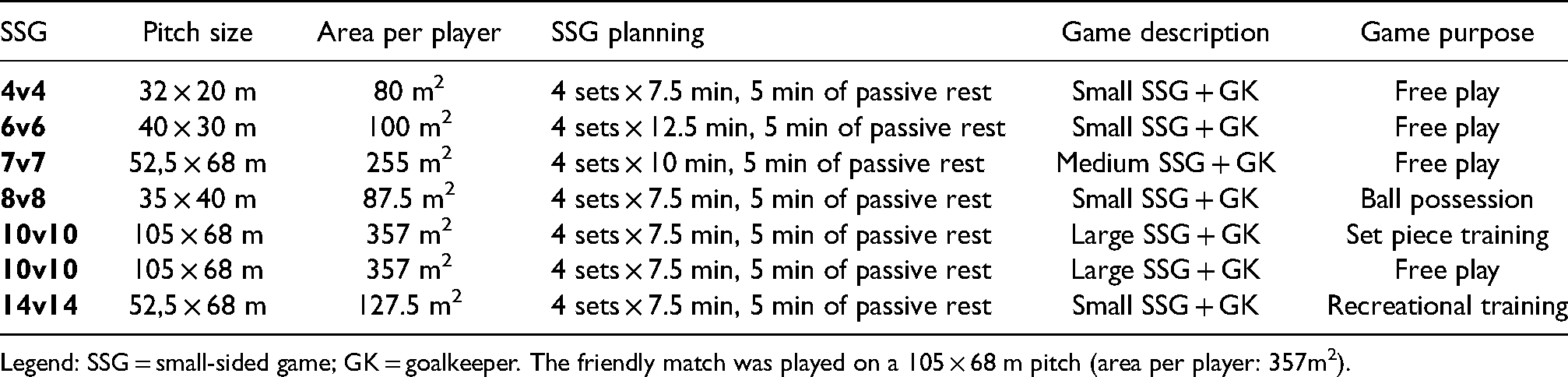
Legend: SSG = small-sided game; GK = goalkeeper. The friendly match was played on a 105 × 68 m pitch (area per player: 357m2).
The pre-season sessions were performed in three consecutive weeks and were part of a regular training session. The 4v4 and 6v6 SSGs were performed on Tuesday and Thursday of the first week, respectively. The 7v7, 8v8 and 10v10 SSGs were performed on Tuesday, Thursday, and Saturday of the second week, respectively. The 10v10, 14v14 SSGs and FM were performed on Tuesday, Thursday, and Saturday of the third week, respectively. We chose the same weekdays to minimize the influence of the distribution of training loads over the weeks on player's physical responses; therefore, the recovery time was standardized. In the FM, the opponent was a professional football team, which competes in championships at a national level.
The players were familiarized with the use of these devices and with the SSG formats used. Coaches gave verbal encouragement to players during the training formats. Each team was composed of at least one defender, midfielder, and forward, to allow teams to explore the physical and technical-tactical specificities of each playing position during the different SSGs. 13 Considering that all players are part of a top-class professional team, we assumed that the homogeneity of the sample would not require an intentional team creation and opponent composition by the researchers. The decision, therefore, creating SSG´s teams and defining opponents was coach-driven.
All SSGs were implemented immediately after a warm-up (15–30 min) containing preparatory activities such as moderate running, dynamic stretching, balance and agility exercises, and accelerations. This process helped to ensure similar conditions across all SSGs. The ball was always available by prompt replacement when out to maximize effective playing time, except in the 4v4 format, which was played in a special arena surrounded by walls that kept the ball in play continuously. The number of touches to the ball was free for each player. Official FIFA-approved goals (7.32 × 2.44 m) were used. The offside rule was applied in all training formats, as well as in the match. On the rest periods, players were allowed to drink liquids ad libitum.
Data collection
The external load variables were obtained from portable GPS devices (GPSports SPI Pro X). According to the manufacturer, the GPS device has a sampling frequency of 15 Hz and includes a 100-Hz triaxial accelerometer. The manufacturer supplemented the GPS frequency to provide a sampling rate of 15 Hz. 25 Each player used a special vest which enabled the device to be fitted to the upper part of his back. The use of the special GPS vest and the heart rate (HR) monitor has not influenced the player's performance, as the club uses these devices in training sessions and official matches. The GPS devices were activated 15 min before the beginning of each training session, following the manufacturer's instructions. The data were transferred to a computer and analyzed in the software Team AMS (R1 2016, Australia). These devices have been previously used in elite football. 26 The registered variables were training session duration (min), average heart rate (bpm), total distance (m), distance covered per minute (m/min), the total number of accelerations >2.5 m/s2, number of accelerations >2.5 m/s2 per minute, average distance of accelerations (m), the average value of acceleration (m/s2).
The monitored training sessions occurred in the morning, between 9:00 am and 11:00 am, with sunny weather conditions and similar temperatures (24.3 ± 3.3°C), separated by an interval of 24 h between them. The majority of the training formats were performed on the same field with natural grass. Only the 4v4 sided game was played on artificial grass. The official match was played in home condition, between 4:00 and 6:00 pm on natural grass with sunny conditions and similar temperatures (26.3 ± 2.7°C). Pauses in the training game formats were excluded from the analysis. In order to ensure the ecological validity of the data collected, the planning and execution of the training did not suffer interference from the researchers.26,27 During the study period, the athletes performed 2–3 strength training sessions per week. These sessions took place in the gym under the supervision of the club.
Statistical analysis
G*Power 3.1 software was used for the sample calculation. The hypothesized effect size assumed was 50%. A sample generalization power of up to 44% was achieved. A descriptive analysis of the data was performed, presenting the results in mean and standard deviation. Shapiro Wilk test was performed to verify data normality. As data presented normal distribution, parametric tests were performed. One-way ANOVA was performed to analyze the variance of all evaluated variables. The partial eta squared (η2) has tested the effect size (ES) of ANOVA. The Ferguson's classification for the ES was used 27 : no effect (ES < 0.04); minimum effect (0.04 < ES < 0.25); moderate effect (0.25 < ES < 0.64); and strong effect (ES > 0.64). The pairwise comparisons were tested with Cohen's d to analyze the effect size. The following classification to measure the magnitude of ES was used 28 : no effect (d < 0.41), minimum effect (0.41 < d < 1.15), moderate effect (1.15 < d < 2.70) and strong effect (d > 2.70). The level of statistical significance adopted was α = 0.05. All data were analyzed using JASP software (Team, 2020; JASP Version 0.14; Computer software).
Results
Descriptive statistics of duration, heart rate, total distance (m), distance per minute (m/min), the total number of accelerations >2.5 m/s2, number of accelerations >2.5 m/s2 per minute, average distance of accelerations (m) and average accelerations (m/s2) are shown in Figure 1.
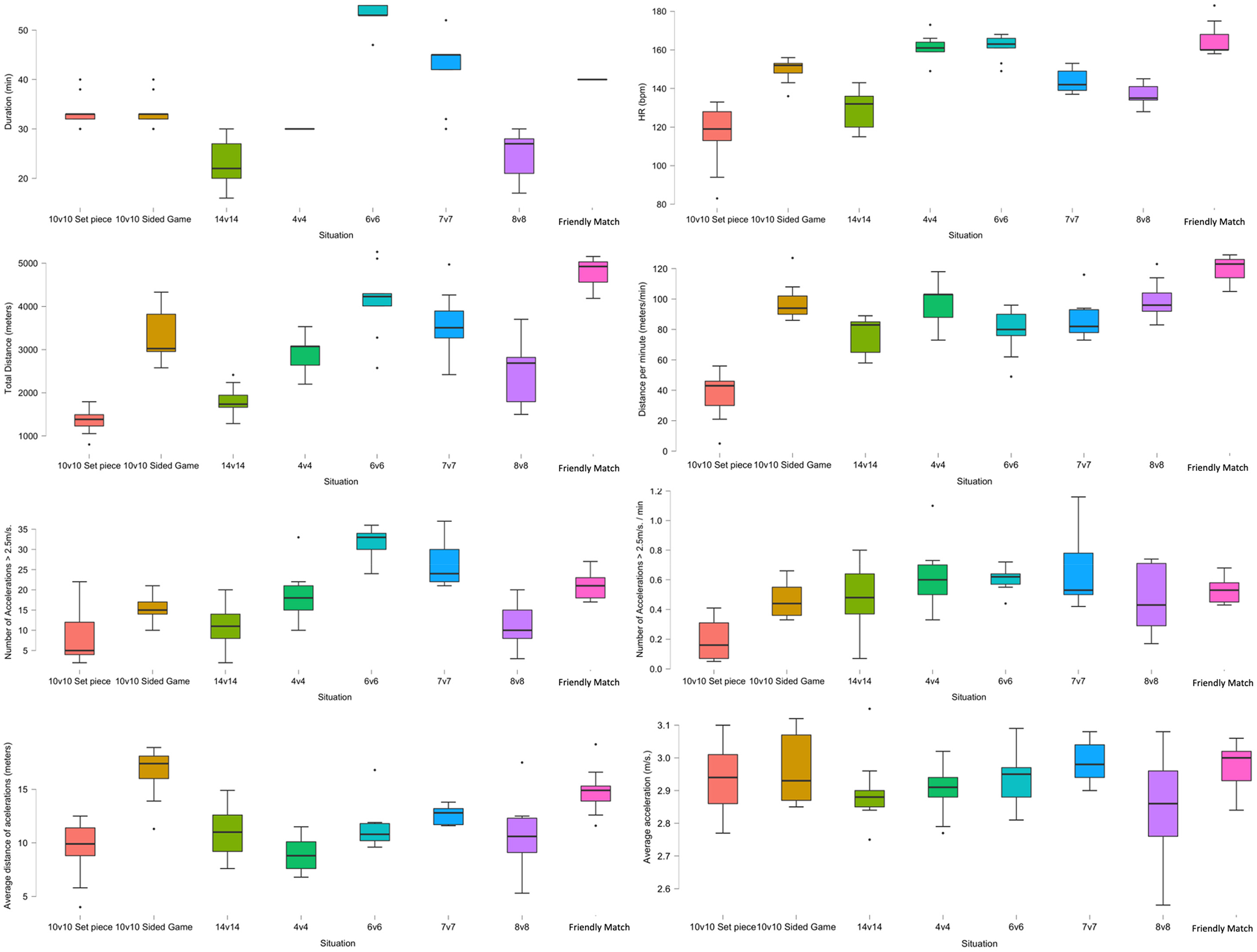
Descriptive boxplots.
There was no difference in the training session duration (p = 0.995) across all training formats. Comparing all the pre-season training tasks, no differences were found just in the average accelerations (m/s2) (p = 0.128). Moderate differences were found in number of accelerations >2.5 m/s2 per minute (η2 = 0.396, moderate effect; p < 0.001) and average distance of accelerations (η2 = 0.545 moderate effect; p < 0.001). Strong differences were found in HR (η2 = 0.788, large effect; p < 0.001), total distance (η2 = 0.797, strong effect; p < 0.001), distance per minute (η2 = 0.775 strong effect; p < 0.001), total number of accelerations >2.5 m/s2 (η2 = 0.699, strong effect; p < 0.001).
Tukey post hoc analysis revealed that the total number of accelerations >2.5 m/s2 in the FM was higher than the 10v10 set piece (d = 2.409), 14v14 (d = 2.229) and 8v8 (d = 2.049). No difference was found comparing the match with the 10v10 sided game (p = 0.265), 4v4 (p = 0.997) and 7v7 (p = 0.440). Lower values were found comparing the FM with 6v6 (d = 2.979). The number of accelerations >2.5 m/s2 per minute in the FM was higher than the 10v10 set piece (d = 2.926, strong effect). No differences were found comparing the FM with the 10v10 sided game (p = 0.988), the 14v14 (p = 0.975), the 4v4 (p = 0.955), the 6v6 (p = 0.993), the 7v7 (p = 0.828) and the 8v8 (p = 0.998). Average distance of accelerations in the FM was higher than the 10v10 set piece (d = 2.188), 14v14 (d = 1.670), 4v4 (d = 3.046) and 8v8 (d = 1.443). No difference was found comparing the FM with the 10v10 sided game (p = 0.842), the 6v6 (p = 0.063) and 7v7 (p = 0.472). HR in the FM was higher than the 10v10 set piece (d = 3.734), 10v10 sided game (d = 2.071), 14v14 (d = 3.773), 7v7 (d = 2.853) and the 8v8 (d = 4.070). No difference was found comparing the FM with the 4v4 (p = 0.984) and the 6v6 (p = 0.985). Total distance in the FM was higher than the 10v10 set piece (d = 10.967), 10v10 sided game (d = 3.255), 14v14 (d = 8.839), 4v4 (d = 5.385), 7v7 (d = 2.116) and the 8v8 (d = 3.889). No difference was found comparing the FM with the 6v6 (p = 0.233). Distance per minute in the FM was higher than the 10v10 set piece (d = 8.680), 10v10 sided game (d = 2.090),14v14 (d = 4.390), 4v4 (d = 2.162), 6v6 (d = 3.521), 7v7 (d = 3.104) and the 8v8 (d = 1.998). Further tables providing comparisons between the FM and the SSG´s are available as supplementary material.
Discussion
The purpose of the present pilot study was to investigate the differences in external and internal load during pre-season training sessions carried out with different SSGs and a friendly match in top-class professional football players. Our main findings showed no differences only in the average value of accelerations (m/s2), across different SSGs and the FM. However, there were differences in the total number of accelerations > 2.5 m/s2 and number of accelerations > 2.5 m/s2 per minute, average distance of accelerations (m), HR (bpm), total distance (m) and distance per minute (m/min). The present findings are in accordance with an extensive literature supporting the hypothesis that different game formats demand particular external and internal loads, provoking a specific response in players and having acute effects on physical condition.4,7 In addition, current results shows that the external and internal loads differ across different SSGs in relation to the FM during the pre-season training sessions, corroborating with previous research. 17 Therefore, further studies with a representative sample are encouraged to investigate if the SSGs can fully simulate the demands of a competitive match-play.
In elite football, the number and value of accelerations performed by players are important parameters due to their relevance in the competitive performance, 20 as well as the impact on the recovery time of this type of action. Although it has been shown that greater accelerations are required in game formats with larger pitch areas than in small ones, 3 our study showed an absence of differences in the mean value of accelerations. These findings indicate that the intensity of the actions was statistically similar in all training formats and the FM. Our findings are in accordance with Rago et al., 2 showing that SSG seems to replicate well the acceleration demands observed during full-sized games. One explanation in the present study could be because only a range of intensity was analyzed, as the analysis of different intensity ranges previously showed differences. 20
Nevertheless, the absolute frequency of the accelerations >2.5 m/s2 showed differences, indicating that the mechanical load may vary among the investigated training tasks. The FM elicited a greater number of accelerations >2.5 m/s2 than the 10v10 (set-piece game purpose), the 14v14 and the 8v8, which can be partially explained by the game purpose, such as recreational or ball possession. When comparing the FM with the 10v10 sided game, 4v4 and 7v7, no difference was found. The 6v6 game elicited a greater number of accelerations >2.5 m/s2 than the FM. Conversely with the literature, when both variables (dimensions and players) are lower, more demand is placed on acceleration and deceleration variables. 20 However, normalizing this analysis per minute, the relative frequency of the accelerations >2.5 m/s2 was greater only than the 10v10 (set-piece game purpose). No differences were found comparing the FM with all other training formats. The very large correlation found among the number of accelerations > 2.5 m/s2 in the 4v4, 8v8 and the FM corroborates previous findings from Rago et al.. 2 Those authors have found a moderate correlation between acceleration and full-sized games. However, in that study, only 7v7 format was used, which could compromise the full analysis of the SSG´s impacts on acceleration.
Short-sprint (≤ 20 m) performance is an important quality for success in football. 29 In the present study, the FM elicited a higher average distance of accelerations than the 10v10 (set-piece game purpose), 14v14, 8v8 (all with moderate effect size), and 4v4 (strong effect size) formats. Even though the 8v8, 10v10, and 14v14 formats were played in medium, large and full-size pitches, it was expected that the distance from the accelerations would be shorter, due to the specific tactical objective of this games (i.e. ball possession, recreational). However, the very strong effect size (d = 3.046) found in relation to 4v4 indicates that the average distance of the accelerations in the FM was substantially larger. This finding leads to the hypothesis that the exponential increase in the use of SSG´s in football training,4,6 which does not entirely fulfil the complete match demand itself, 17 might be related to increased hamstring injuries in recent years.
No difference was found comparing the match with the 10v10 (free play), 6v6 and 7v7. The absence of difference with 10v10 is somehow obvious given the same area, number of players used and specific tactical purposes of the training format. Whether the objective of the training is to perform sprints similar to those made in a match,3,4 playing situations with larger spatial dimensions or finishing situations involving few players and a large space, may be effective options in this process of optimizing the players’ state of physical conditioning.
Heart rate is commonly used to monitor training intensity in elite football. 26 In the present study, the FM elicited greater HR than the 10v10 (set-piece game purpose), 10v10 (free play), 14v14, 7v7 and the 8v8. A systematic review showed that players obtained higher %HR when playing in a smaller format compared to other higher format of SSG´s, 3 however our present findings indicated that no difference comparing the FM with the 4v4 and the 6v6 pre-season training tasks. In this way, 4v4 and 6v6 formats could promote similar levels of HR as in the FM. Our results could be explained by the dynamic movement pattern in such game formats, especially in the 4v4 format, which was played in a special pitch surrounded by walls that kept the ball in play continuously. These findings are in accordance with the literature, showing that SSG´s may be effective in maintaining aerobic fitness. 4
Our results showed that the FM elicited a higher total distance than the 10v10 (set-piece game purpose), 10v10 (free play), 14v14, 4v4, 7v7 and 8v8. This data corroborates past findings that indicate higher external load (i.e. distance covered) in SSGs played on medium and large pitches than on small pitches, for both amateur and professional level players. 3 Still, no difference was found comparing the FM with the 6v6. Tactical rules applied in SSG protocols could lead to a significant increase in total distance,3,4 which might explain the statistically similar behaviour in the total distance in the 6v6 format. However, normalizing the analysis per time was possible to observe that the FM elicited greater distance per minute than all evaluated training formats. As has been indicated previously, the lack of similarity between the demands various groups of training formats could suggest the need to use the whole range of training game formats (e.g. from 1 vs. 1 to 10 vs. 10) when coaches want to overstimulate or replicate the demands of the game.
The limitation of this study was to have a small sample size. However, even with such a sample size, a sample generalization of the data of up to 44% was achievable. Therefore, future studies are encouraged to analyze a larger number of players. Another limitation was to not evaluate other constructs, such as perceived exertion, muscle soreness and tactical demands. These measures can complement the analysis of the SSG and the FM to understand better the differences. Despite this, the present study brings reflections and practical findings of external and internal load of various pre-season training tasks carried out with different SSG formats and FM, to further develop our understanding of the training stimulus provided by football specific training sessions during pre-season in professional football.
Before finalizing, we would like to do some reflections regarding the widespread use of the SSGs in elite football practices and its practical implications. Despite technological developments in sports training settings,30,31 a longitudinal analysis between 2001 and 2013 found that hamstring injuries had annually increased by 4% in professional football. 24 Football matches' demands have also increased over the years. Yet, notwithstanding the popularity of SSG's and their tactical benefits, 11 it is unclear whether the common widely used SSG´s actually reproduce the demands of competitive matches, regarding physical performance 18 or if it may be effective to reduce the likelihood of muscular injuries. 23 Evidence has emerged in recent years supporting the need to include sprint stimuli in player's preparation with the objective of minimizing injury risk, in addition to the SSG practices. Furthermore, if players do not accumulate high chronic sprinting loads, they are more prone to “peaks” in acute sprinting loads during matches, which will ultimately lead them to increased likelihood of muscular injury, especially hamstrings injuries. 23 Although hamstrings injuries have been related to strength deficits, the current evidence is insufficient to recommend it. 30 Because there is inconsistency regarding the association between eccentric hamstrings strength and injury risk using different field devices. 30 Therefore, playeŕs physical preparation with similar demands to those of the match is necessary (i.e. similar acceleration distances), as an inadequate exposure to specific training loads could lead to muscular injury.
SSGs have been shown to be extremely relevant to enable football players to enhance their tactical and technical skills. 11 Nevertheless, it is important to mention that, although modulating SSG rules and pitch area could enable greater acceleration distances, the stimulus of SSG alone might not be enough to simulate mechanical demands of match-play regarding the distance of accelerations. Perhaps the most important element of preventing injuries in elite football lies in optimally managing player load. 23 SSGs typically mimics the physical intensity and movement patterns of match play, but can often result in limited exposure to sprinting distances due to the use of smaller areas. Match-play represents the largest stimulus in terms of high-speed running (HSR) and thus balancing training to reflect match play HSR load is important. 23 SSG´s should be used preferably for the development of greater technical-tactical skills and for aerobic-fitness development. 18 The inclusion of additional specific speed drills to SGG to prepare players for competition demands, with a suitable stimulus of acceleration distance, is necessary.
Conclusion
Pre-season training tasks carried out with different SSG formats elicit different demands on elite professional football players, regarding running, acceleration, and cardiovascular responses. Caution should be taken when selecting different SSGs, to improve the players’ performance during the pre-season. This pilot study may help coaches to learn whether proposed tasks underload, replicate or overload the requirements of friendly match-play, something which might be considered when scheduling training sessions.
Supplemental Material
sj-docx-1-spo-10.1177_17479541211069935 - Supplemental material for Small-sided games do not replicate all external and internal loads of a football match-play during pre-season: A case study
Supplemental material, sj-docx-1-spo-10.1177_17479541211069935 for Small-sided games do not replicate all external and internal loads of a football match-play during pre-season: A case study by Guilherme de Sousa Pinheiro, Roberto Chiari Quintão, Vitor Bertoli Nascimento, João Gustavo Claudino, Adriano Lima Alves, Israrel Teoldo da Costa and Varley Teoldo da Costa in International Journal of Sports Science & Coaching
Footnotes
Declaration of conflicting interests
The author(s) declared no potential conflicts of interest with respect to the research, authorship, and/or publication of this article.

Supplemental material
Supplemental material for this article is available online.
References
Supplementary Material
Please find the following supplemental material available below.
For Open Access articles published under a Creative Commons License, all supplemental material carries the same license as the article it is associated with.
For non-Open Access articles published, all supplemental material carries a non-exclusive license, and permission requests for re-use of supplemental material or any part of supplemental material shall be sent directly to the copyright owner as specified in the copyright notice associated with the article.
