




Abstract
Small/er soccer nations rely strongly on developing youth athletes into experts in adulthood due to financial, logistical, and coach education constraints. One factor that contributes to this expertise is activities engaged in during childhood. Researchers have described these activities by focusing on larger, well-developed countries that often have larger participation rates and higher competition levels than their smaller counterparts. Therefore, to provide more specific information to support talent development in smaller soccer nations, a survey of the youth development system of a small soccer nation was conducted, alongside recording the developmental activities of skilled and less-skilled soccer players within this system. Key stakeholders (e.g., technical director) completed a youth development system survey. Skilled soccer players (n = 12) who were representing their country at U17 level and less-skilled players (n = 13) that had never played for their country completed a Participation History Questionnaire. Skilled players engaged in significantly higher amounts of individual practice in both childhood and early adolescence compared to less-skilled players. Survey data indicated that the greater amounts of individual practice for the skilled players stemmed from a lack of finances, playing facilities, and a formal coach education program. Results from this study may inform future practices and processes in the youth development systems of small/er soccer nations and their national associations.
Introduction
Professional soccer clubs and nations identify and recruit talented youth players with the intention to develop them into experts in adulthood 1 . More recently, an increase in the emphasis on youth development has come from national football associations through the application of quotas and/or incentives to increase the opportunities for domestically developed players to excel, in place of clubs merely procuring the most skilled players intercontinentally (e.g., Homegrown Player Rule 2 ). Furthermore, talent identification and development in soccer continues to interest researchers3–6, providing practical implications for key stakeholders involved in designing talent development programs (e.g., coaches/scouts) (for a review, see 4). For instance, sociological predictors of talent are associated with being the younger sibling 7 , relative age 8 , place of birth 9 , and socio-economic status 10 . Another factor is the amount and type of sporting activities athletes engage in across their formative years 11 . Soccer nations differ in population, player participation rates, financial resources, and number of qualified coaches 3 . Most of the research has focused on large/r, well-developed soccer nations 12 , yet less is known about small/er, less-developed nations 3 . In the present study we address this issue by assessing the youth development processes of a small soccer nation in relation to the amount and type of sporting activities players within this system engage in. Findings may provide implications to support the design of talent development practices in smaller soccer nations.
Deliberate practice theory 13 and early research 14 has influenced theory and understanding of expert athletes and their development. It can be characterised as effortful, coach-led, individualised activities that are aimed at improving a key aspect of performance that is near or beyond the current ability of the individual, also consisting of repetition and individualised feedback 13 . Ericsson et al. 13 suggested that deliberate practice was not inherently enjoyable, although recent empirical work shows this may not be the case, at least for coach-led practice in sport, which may not share all the characteristics of deliberate practice 15 . Ericsson‘s deliberate practice theory proposed that the level of performance attainment is monotonically correlated with the accumulated time in deliberate practice, where those that engage earlier and practice at higher amounts will have higher performance levels throughout development than those that engage later 16 . This has in part led to the belief that deliberate practice should occur early in childhood and those children should ‘specialize’ in a specific sport to maximise the amount of time spent in this activity.
An alternative to childhood ‘specialisation’ is for athletes to diversify and sample multiple sports through peer-led play rather than deliberate practice, with specialisation occurring later in adolescence17–19. Deliberate play is characterised as informal activities, created and led by the participants themselves (e.g., street soccer) and are supposed to be inherently fun and enjoyable20,21. Extensive childhood sampling of sports through deliberate play has been postulated22,23 to lead to long-term development of expert performance, greater levels of intrinsic motivation, reduced overuse injuries, prolonged engagement [see24–26 for dissenting observations]. More recently, reviews of the literature have suggested that multi-sport coach-led practice, but not peer-led play, during youth participation was an activity that differentiated long-term senior performers across various sports. However, sport-specific peer-led play was cited as having no relation to senior performance in these reviews, and effects of sport-specific and other-sport deliberate play on junior performance were considered mixed and inconsistent15,27.
The early specialisation/ diversification pathways are two dichotomous patterns and do not fully explain the complexities of the developmental activities of expert athletes27,28. Childhood participation patterns can be defined by several continuous variables that may vary independently from one another including start age, amounts of sport-specific and other-sport deliberate practice, deliberate play, and competition 29 . Multiple researchers have used retrospective recall methods to collect these variables via interviews and questionnaires4,26,30. One of the strongest forms of current evidence is from studies involving athletes performing at the highest levels are separated into groups similar career attainment such as international vs. national players [for examples in soccer,12,31].
The most comprehensive description of skilled youth soccer players developmental activities across countries was published by Ford et al. 32 . Participants were 328 skilled soccer players from seven countries (Brazil, England, France, Ghana, Mexico, Portugal, and Sweden) who completed a participant history questionnaire. The players began engaging in soccer around 5 years of age, with equal amounts of soccer-specific coach-led practice and peer-led play (≈180 hrs/yr) and relatively low engagement in other sports. They engaged in an elite training academy between 11 and 12 years of age, whereby they significantly increased the amount of time in soccer-specific coach-led practice (≈400 hrs/yr) 32 . Although there were many similarities between the skilled players in the study by Ford et al. 32 , there were also between-country differences. For instance, during childhood, players from Brazil engaged in lower amounts of soccer-specific coach-led practice, which was replaced by more hours in peer-led deliberate play (≈4-5 hrs/wk) and futsal. During adolescence, players in Mexico engaged in significantly more hours of soccer-specific coach-led practice compared to the combined data, whereas athletes from England engaged in significantly less 32 . These between country differences in amounts of practice and play observed by Ford et al. 32 were suggested to be reflected by the differences in the youth development systems of the respective countries5,33–36.
The youth development systems in large/r soccer nations are characterised by large participation rates and considerable financial and logistical resources3,5. Players are identified and recruited from an early age into training academies leading to earlier and greater exposure to technical, tactical, and physical soccer practice compared to small/er soccer nations32,37, with the intention to gain competitive and financial gains38,39. Many other soccer nations are characterised by smaller participation rates and substantially fewer financial resources (e.g., player/coach/staff salary 3 ), but relatively little is known about how this may impact on the developmental activities engaged in by their players. Moreover, no researchers have assessed the relationship between the youth development system in a country and the developmental activities engaged in by their players, even though a link between the two has been hypothesised [e.g., 28 ]. In the current study, we assessed the perceptions of the youth talent development system from key stakeholders of a small/er soccer nation currently playing under the Confederation of North, Central America and Caribbean Association Football (CONCACAF) governing body. Furthermore, we examined the developmental activities engaged in by youth soccer players currently playing/had played within this youth development system to identify links between the youth development system and their developmental activities. Given the specific demographics of the soccer nation compared to previously examined 32 , the contrasting findings surrounding sporting milestones (e.g., start age in soccer) and type and amount of sport-specific and other sport activities15,27, we have forgone formulating any a priori directed hypotheses.
Method
Study design
To assess the developmental activities of players, quantitative data was collected using the same retrospective recall methods as several recent studies examining player development in youth soccer32,40 and is regarded as one of the best available methods for attaining such data 41 . To examine the perceptions of key stakeholders of the development system in their country, qualitative data was collected in the form of a survey. It was anticipated that the qualitative approach would help to provide a deeper understanding of some of the key issues surrounding player development in this small/er soccer nation beyond that found from quantitative methods 42 .
Participants
A total of eight male stakeholders volunteered to participate and comprised of all staff within the player development system in the country. All stakeholders were aged 30 years or older and had been in their current role for 5 years or over. Stakeholders included members of the national Football Association (FA) (n = 4) whose positions were: Technical Director, Grassroots Coordinator, Projects Officer, Head of Finance. There were also owners of private soccer academies (n = 2) who both held CONCACAF ‘D' coaching licenses; and members of the Ministry of Youth Development and Sports (n = 2) which included the Director of Youth Development and Sports, and the Coaching Coordinator.
For the examination of developmental activities, 28 participants were initially approached, and of those 25 male soccer players with a mean chronological age of 16.6 (SD = 0.2) years volunteered to participate and were assigned to a group based on skill level. The skilled group comprised of 12 soccer players aged 16.8 (SD = 0.2) years who were representing a small CONCACAF soccer association in the U17 national team. The less-skilled group comprised of 13 soccer players aged 16.5 (SD = 0.3) years who had played grassroots level soccer in their country (e.g., inter-school, inter-district level) but had never represented their country at youth or senior national level.
Soccer nation
The country has a relatively small population size and is characterised by a relatively low gross domestic product (GDP), as well as a pronounced variation of wealth across the population. Approximately 40,000 children attend primary (5-11 years of age) or high school (12-16 years of age). The soccer association is governed by CONCACAF. At the time of data collection, the male senior national team was ranked in the bottom quartile of the FIFA/Coca-Cola male world rankings, albeit studies involving regression analysis across worldwide soccer nations suggest that the ranking of the national team is substantially higher than would be expected based on their population size and low GDP43,44. However, the current adult national team comprises of many players who were not born, and/or were not developed in the country, rather they qualified for selection based upon some other factors such as the ‘grandparent rule‘. In the current study, we are examining the developmental activities of indigenous players. The domestic male soccer leagues consist of a first and second division that are non-professional level (i.e., recreational) and each league has nine teams. Boys aged 5-11 years engage in grassroots level soccer in teams/clubs that mainly compete via friendly matches. Child teams have a relatively large annual turnover of being created and folded, so the number of teams is difficult to provide. Players can join private soccer academies at any age and are run on a ‘pay-to-play’ basis. As per youth teams/clubs, there is a large turnover of private academies, with players often moving from one academy to another. From age of 10 years onwards, players are free to join recreational youth soccer clubs. Annual national competitions for players are organised at the U11 (37 teams), U13, U15 and U17 (32 teams each) age groups involving a ‘round-robin’ format. In terms of coaching, at the time of data collection approximately 38 coaches held the CONCACAF ‘D‘ coaching license.
All participants provided written informed consent and the study was conducted following ethical approval from the lead researcher university ethics committee. Stakeholders and soccer players were recruited and selected through convenience sampling from the network of contacts of the research team based on previous links with the association.
Procedure
Development system survey
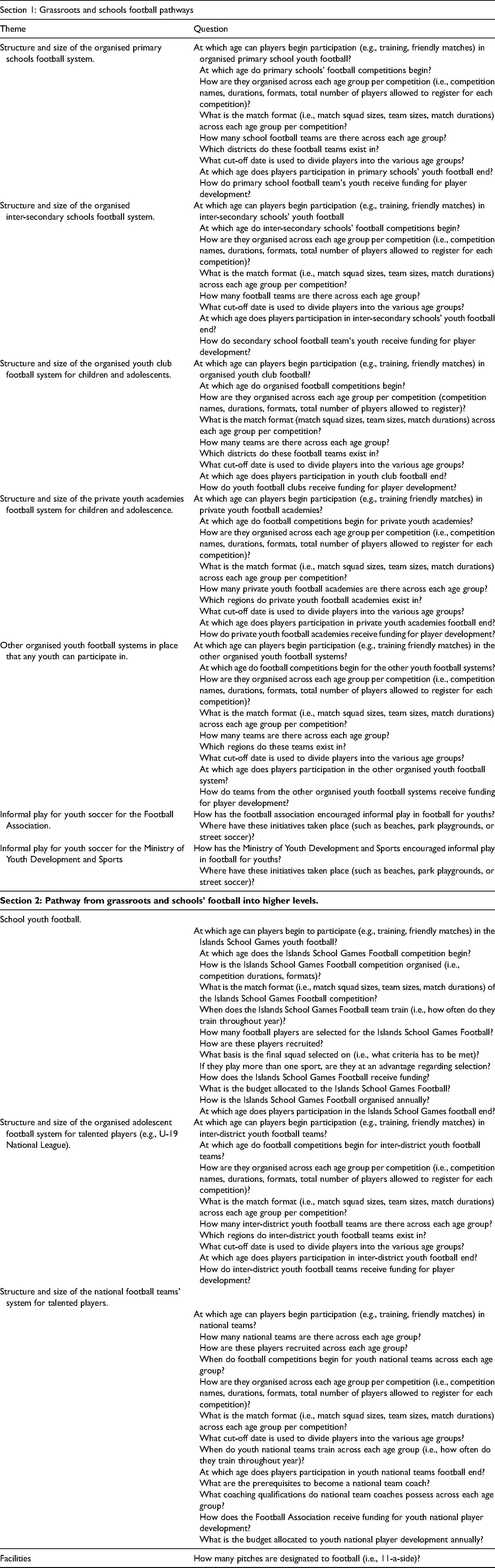
A bespoke paper-based survey was created for key stakeholder participants to complete. The survey was completed in English to correspond with the native language in the country. All questions were open-ended requiring a written response from the stakeholders and to encourage them to provide full meaningful answers based on their knowledge and/or feelings relating to: (1) grassroots and school soccer to provide an understanding of factors associated with developmental pathways during childhood; (2) the pathway from grassroots and schools soccer into higher levels which provided an understanding of factors associated with developmental pathways during adolescence. Some open-ended questions were targeted more to specific stakeholders‘ area of expertise (e.g., finance), though most questions were targeted at all stakeholders, regardless of position, to allow comparison. Questions were developed by a member of the research team and were based on experience and relevant literature45,46. The survey was reviewed for content validity via three rounds of group discussions with members of the research team. Two rounds of pilot testing were performed with two key stakeholders (excluded from final data collection). These stakeholders were former head coaches (one first team and one development team) of the national FA under investigation. One of the coaches was previously employed as the Technical Director and the other was a former member of the technical committee. Their involvement ensured the wording and context of the questions was appropriate and contextualised to the national FA. This required the modification of wording to several questions to improve readability/understanding. The final survey questions were approved by both stakeholders. For all questions provided to stakeholders, see Table A1.
Verbal instructions were provided to participants regarding the purpose of the survey and how to complete each question before commencing. Participants did not complete the next question until they completed the previous. Members of the FA completed the survey together, so did the members of the Ministry of Youth Development and Sports, whereas owners of the private academies completed the survey separately. All participants completed the survey in a quiet room under the supervision of a member of the research team who could provide explanation and aid if needed. Participants completed the survey in no longer than 90 minutes.
Developmental activities
The Participation History Questionnaire (PHQ) was used to elicit information relating to activities that players had engaged in during their development. The PHQ has been used in previous studies examining developmental activities of soccer players5,32,35 and is based on Côté, Ericsson and Law's 40 recommendations. The reliability and validity of retrospective primary/main sport hours-per-week in the PHQ were shown in Ford et al. 47 , with a large interclass correlation coefficient (ICC) of 0.9 for a three-month test re-test and 0.8 for parent/player validity. Questionnaires that have used similar and/or identical questions as the PHQ have shown a large ICC of 0.9 for a three-month test re-test and 0.7 for parent/player validity of the yearly total practice hours 34 , as well as a high-test re-test recall correlations for hours of practice (r = 0.9-1.0 48 ). As with the survey, the PHQ was completed in English. The questionnaire contained three sections. The first section was designed to elicit information on soccer-specific milestones. These milestones included the age at which the participants first took part in soccer (i.e., start age), and their start ages in supervised (i.e., coach-led) soccer practice, soccer competition, and participation in a higher level training academy. The second section of the questionnaire was designed to elicit information on their engagement in soccer activities. Altogether, four soccer activities were listed: competition (organised competition usually between two teams supervised by adults/coaches); coach-led practice (organised group practice supervised by coaches, e.g., team practice); individual practice (practice alone supervised by themselves, e.g., practicing shooting alone); play (games with rules supervised by yourself/peers, e.g., small-sided-games with friends/teammates). These activities were chosen based on previous research in which retrospective questionnaires were used36,49 and to match the recommendations proposed by Côté et al. 40 . Participants were required to report the hours per week and months per year for each of the soccer activities, as well as weeks when they were injured per year. Information was recorded each year from the current season back to the age group at which they began playing soccer. Prior to the start of each year, to aid recall, the participants were required to report the team and coach they played for. The third section of the PHQ was designed to elicit information on engagement in other sport activities. It contained a list of sports (plus space to add sports) from which participants were required to indicate those in which they had participated in regularly for at least a total minimum period of three months. Additionally, they were required to record the hours per week, months per year and start and end age of engagement for each sport. Participants were not required to include other sport activities engaged in during physical education classes at school, though those engaged in after school were included.
Verbal instructions were provided to participants regarding the purpose of the questionnaire and how to complete each section before commencing. Participants did not complete the next section until they completed the previous. Participants completed the paper-based questionnaire in small groups in a quiet room under the supervision of a member of the research team so they could provide explanation and aid if needed. Participants completed the questionnaire in no longer than 60 minutes.
Data analyses
Development system survey
The lead researcher initially read line-by-line extracts of the free text statements presented in the completed surveys. Descriptive nouns, phrases or statements of interest were coded, and analytic memos were compiled to provide a deeper, richer understanding, and for the lead researcher to engage in what Bogan and Biklen 50 describe as analytic reflection. At this stage, the study was interested in stakeholder beliefs and attitudes, provisional ‘value coding‘ (i.e., values, attitudes, beliefs) was applied during a full coding of the data 51 . Coded units were then categorised into themes and subthemes, and subject to qualitative content analysis. The frequency of stakeholders‘ value codes was then organised into higher order themes and subthemes. Example quotes were provided to illustrate the categories and subcategories within each theme 52 .
Developmental activities
For the milestone data, we calculated the mean year of age achieved for each group. For other sports engaged in, we calculated the mean total number of other sports for each group during childhood (6-12 years of age) and early adolescence (13-16 years of age). For the soccer-specific activity data, we calculated the hours accumulated for competition, coach-led practice, individual practice, play and total during childhood and adolescence for both groups. An independent sample t-test was used to examine milestone data, as well as other sports engaged and soccer-specific activity data for both childhood and adolescence. Although analysis involved multiple analysis among related variables, we decided not to adjust for potential alpha accumulation (e.g., Bonferroni adjustment) 15 . Alpha was set at p < 0.05 and Cohens d expressed effect size.
Results
Development system survey
Below we present the most frequently occurring themes from the key stakeholder perceptions and attitudes towards the youth development system and how it may influence player development.
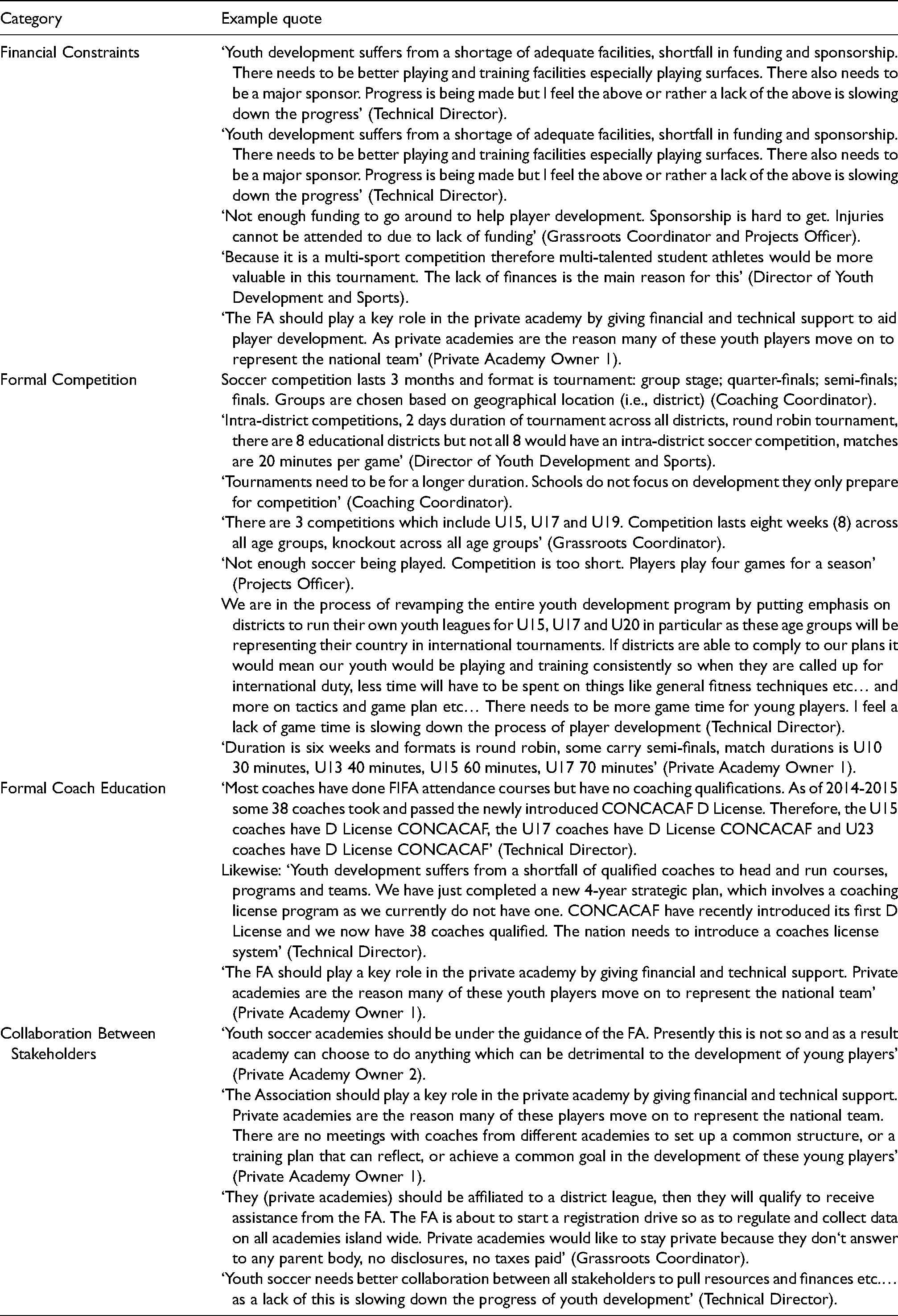
Financial constraints
Stakeholders often alluded to financial constraints as impeding the development of youth soccer players. For instance, the Grassroots Coordinator and Projects Officer highlighted that there was ‘Not enough funding to go around to help player development. Sponsorship is hard to get. Injuries cannot be attended to due to lack of funding’. The country holds an ‘island games‘ in which student athletes from the small islands in the area compete against each other over multiple sports. The Director of Youth Development and Sports linked the lack of funding for soccer to these youth games by stating: ‘Because it is a multi-sport competition, therefore, multi-talented student athletes would be more valuable in this tournament. The lack of finances is the main reason for this’. Moreover, owners of private youth academies suggested that academy soccer players development is deprived of financial support.
Lack of formal competition
Similarly, key stakeholders frequently suggested lack of formal game-time as a factor impacting soccer player development. When questioned on competition/match duration and format of primary schools’ youth soccer competition, the Director of Youth Development and Sports replied: ‘Intra-district competitions, 2 days duration of tournament across all districts, round-robin tournament, there are 8 educational districts but not all 8 would have an intra-district soccer competition, matches are 20 minutes per game’. Moreover, when discussing the structure and size of the organised inter-secondary school soccer system the Coaching Coordinator commented: ‘Tournaments need to be for a longer duration. Schools do not focus on development they only prepare for competition’. Stakeholders provided comments on the structure and size of organised youth soccer system for children. They stated they needed: ‘Players to be playing in leagues and not knockout tournaments so that they get more game time to develop their game’ (Technical Director). Owners of private youth academies also suggested lack of game-time impacted youth soccer player development. For instance, when discussing competition and match durations and formats of private youth academy soccer they replied: ‘Duration is six weeks and formats is round-robin, some carry semi-finals, match durations is U10 30 minutes, U13 40 minutes, U15 60 minutes, U17 70 minutes’.
Lack of formal coach education
Stakeholders frequently proposed a lack of formal coach education as a factor impacting soccer player development, providing responses regarding the coaching qualifications of national team coaches across age groups, such as: ‘Most coaches have done FIFA attendance courses but have no coaching qualifications. As of 2014-2015 some 38 coaches took and passed the newly introduced CONCACAF D License. Therefore, the U15 coaches have D License CONCACAF, the U17 coaches have D License CONCACAF and U23 coaches have D License CONCACAF’ (Technical Director). Moreover, private academy owners suggested that a lack of formal coach education impacts soccer player development. They commented: ‘The FA should play a key role in the private academy by giving financial and technical support. Private academies are the reason many of these youth players move on to represent the national team’ (Private Academy Owner 1).
Lack of collaboration between stakeholders
Stakeholders frequently alluded to a lack of collaboration between each other as a factor impacting player development. For example, both owners of private youth academies were asked to give general comments on the structure and size of the private youth academy soccer system for children. One commented: ‘Youth soccer academies should be under the guidance of the FA. Presently this is not so and as a result an academy can choose to do anything which can be detrimental to the development of young players’ (Private Academy Owner 2). However, members of the FA were asked for general comments on the structure and size of the private youth academy soccer system for children and adolescence, they stated: ‘They (private academies) should be affiliated to a district league, then they will qualify to receive assistance from the FA. The FA is about to start a registration drive to regulate and collect data on all academies island wide. Private academies would like to stay private because they don‘t answer to any parent body, no disclosures, no taxes paid’ (Grassroots Coordinator).
Categories and example quotes from the youth development system survey.
Developmental activities
Milestones
Table 2 contains milestone data. Independent t-tests revealed that the start age in soccer was significantly [t(23) = −2.23, p = 0.04, d = 0.90] earlier for the skilled (M = 6.6 yrs, SD = 2.4 yrs) compared to the less-skilled (M = 9.0 yrs, SD = 2.9 yrs) players. There was no significant differences between skilled and less-skilled players in age of start in supervised practice, [t(23) = −1.79, p = 0.09, d = 0.69], competition [t(23) = −1.69, p = 0.10, d = 0.71], or entering a private training academy [t(23) = 0.93, p = 0.36, d = 0.11]. The 25 players from both groups began supervised training with an adult/coach at the mean age of 9.8 years (SD = 3.1), participated in league/tournament competition at a mean age of 11.7 years (SD = 2.5) and entered a private training academy at a mean age of 10.8 years (SD = 2.7).
Milestones in years (SD) of age achieved by each group.

Soccer-specific activities
For childhood (Figure 1a), the independent t-tests revealed no significant differences between-groups in total hours accumulated in soccer activities [t(23) = 1.01, p = 0.33, d = 0.42], competition [t(23) = −0.69, p = 0.52, d = 0.97], coach-led practice [t(23) = 0.93, p = 0.36, d = 1.37], and play [t(23) = 0.27, p = 0.79, d = 0.37]. However, there was a significant difference in soccer-specific individual practice [t(23) = 2.19, p = 0.04, d = 3.21] indicating that skilled players (M = 701.8 hrs, SD = 203.5 hrs) engaged in significantly more hours of this activity when compared to the less-skilled players (M = 449.0, SD = 163.0 hrs). Figure 1a shows that hours accumulated in soccer-specific individual practice during childhood were descriptively lower when compared to coach-led practice and play but were higher than competition.
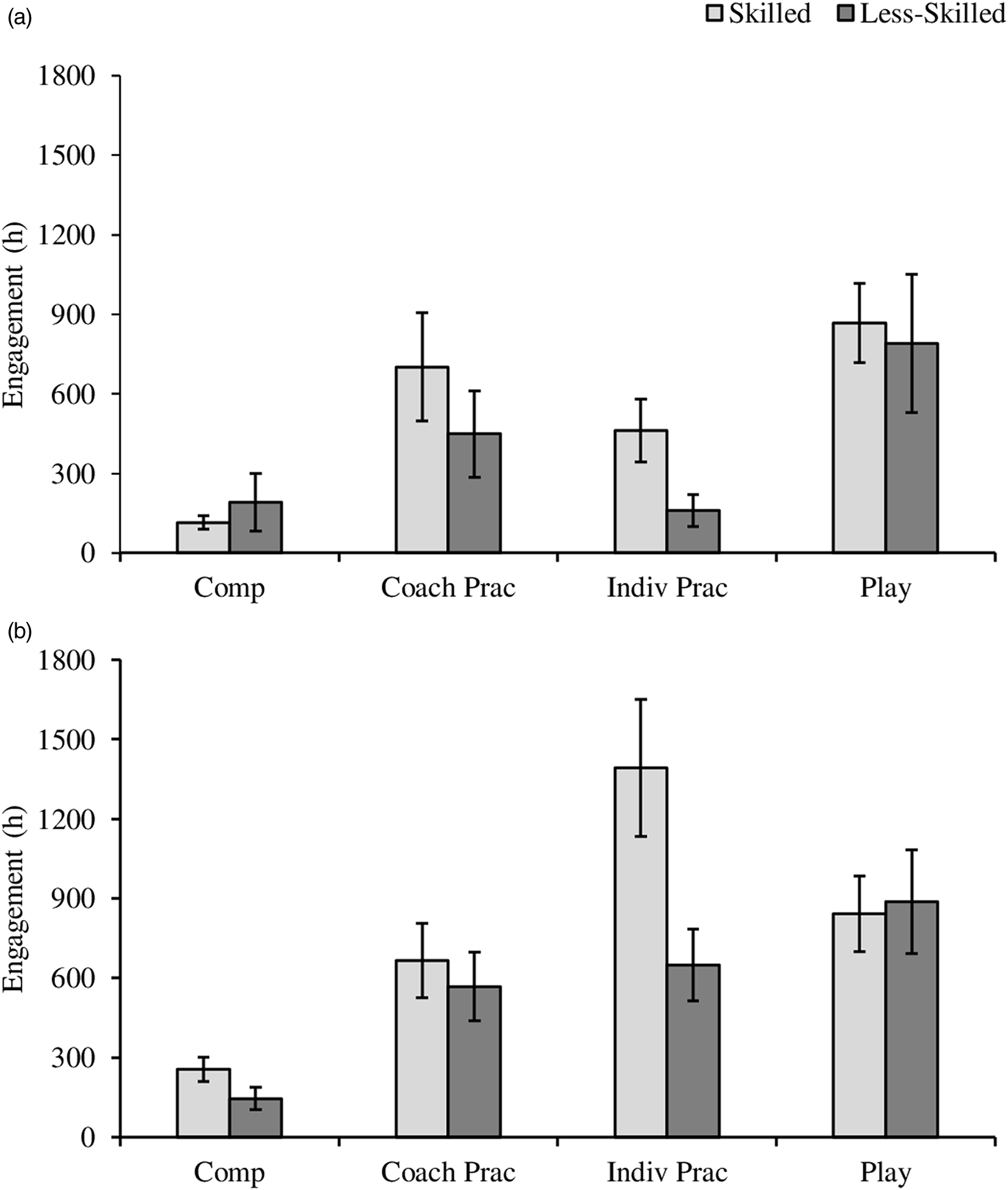
Hours accumulated (error bars represent standard error of mean) during (a) childhood (6-12 years of age) and (b) adolescence (13-16 years of age) in competition, coach-led practice, individual practice, and play for the skilled (light-grey bars) and less-skilled (dark-grey bars) soccer players.
In early adolescence (Figure 1b), there was a significant difference between groups in total hours accumulated in soccer activities [t(23) = 2.12, p = 0.04, d = 0.83] indicating that skilled players (M = 2,532.3 hrs, SD = 1,245.5 hrs) engaged in significantly more hours when compared to the less-skilled players (M = 1,690.3 hrs, SD = 727.4 hrs) (Table 2). Independent t-tests revealed no significant differences in hours for competition [t(23) = −1.76, p = 0.09, d = 2.51], coach-led practice [t(23) = 0.51, p = 0.61, d = 0.72] and play [t(23) = −0.19, p = 0.85, d = 0.27]. However, there was a significant between-group difference in individual practice [t(23) = 2.60, p = 0.02, d = 3.60] indicating that skilled players (M = 1,392.1 hrs, SD = 258.9 hrs) accumulated significantly greater hours in this activity when compared to the less-skilled players (m = 649.3 hrs, SD = 135.0 hrs). Figure 1b shows that the hours engaged in each soccer activity were descriptively greater in early adolescence when compared to childhood (Figure 1a). Moreover, individual practice by skilled players was descriptively higher when compared to the other three activities in early adolescence.
Engagement in other sports
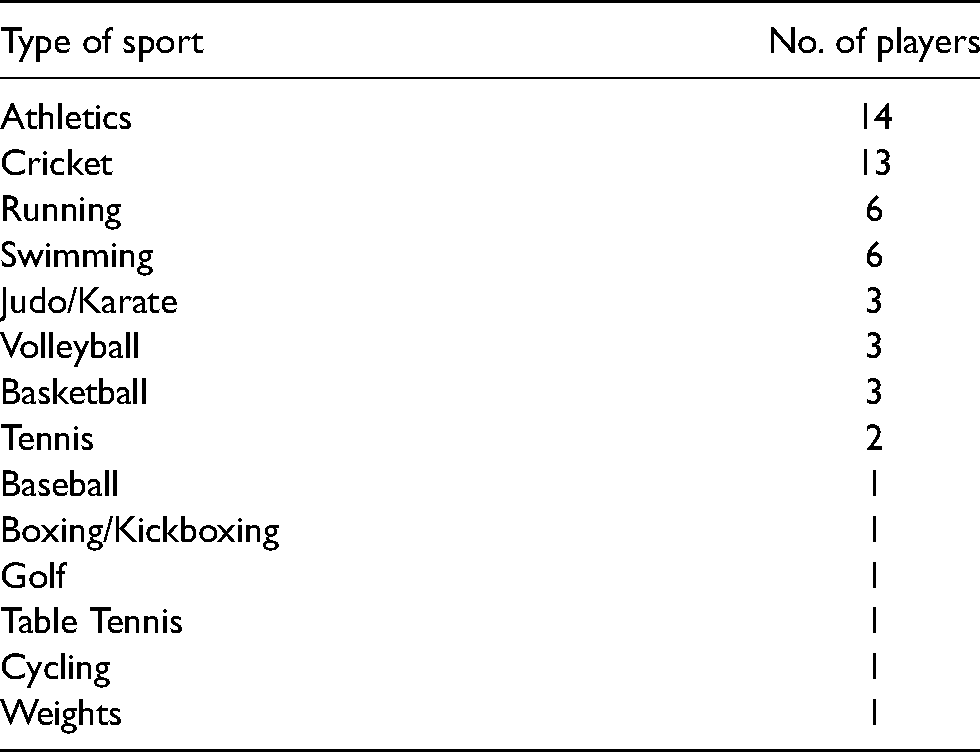
Table 3 contains the number of other sports and the total hours of engagement during childhood and adolescence for players in each group. For childhood, an independent t-test revealed no significant difference between skilled and less-skilled players for the number of sports [t(19) = −1.15, p = 0.27, d = 0.28], or total hours engagement [t(19) = −0.08, p = 0.94, d = 0.04]. From the 25 participants from both groups, 21 engaged in a mean of 1.8 (SD = 0.8) other sports sometime during childhood and had accumulated 705.0 hrs (SD = 795.0). For early adolescence, another independent t-test revealed no significant difference between skilled and less-skilled players for the number of sports [t(18) = 0.51, p = 0.62, d = 0.23], or total hours engagement [t(18) = −0.57, p = 0.58, d = 0.26]. The 19 participants engaged in a mean of 2.0 (SD = 0.9) other sports sometime during adolescence and had accumulated 621.6 hrs (SD = 627.0). Players engaged in 14 different additional other sports overall. Table 4 indicates the type of sports the players engaged in across their development.
Mean (SD) number of other sports engaged in, number of players who engaged in them, and total accumulated hours during childhood (6-12 years of age) and adolescence (13-16 years of age) by each group.

The type of other sports engaged in and the number of players that engaged in them.
Survey questions provided to all key stakeholders.
Discussion
This study assessed the youth development system of a small/er soccer nation playing under the CONCACAF governing body from the perspective of key stakeholders in relation to the developmental activities of the youth players within this system. Findings indicated links between the youth soccer system in a country and the developmental activities engaged in by their players 28 . Key stakeholders perceived there to be a lack of finances for the sport in the national association and country which they believed caused less formal youth soccer activities and coach education. Consequently, youth players in the country accumulated relatively low hours in the formal soccer activities of match-play and coach-led practice by the end of childhood, but relatively high individual soccer practice without a coach. In early adolescence, they continued to accumulate similar hours in coach-led soccer practice, match-play, and peer-led play, but increased the hours in individual soccer practice without a coach. Overall, the total hours accumulated in soccer activities between starting the sport in early childhood and mid-adolescence was around 4,500 hrs, with the proportion of activities being greater in informal activities compared to formal.
Skilled players in this study started soccer at around six years of age, which is similar but slightly later than reported for British soccer players 37 and players in Ford et al. (5 years of age 32 ), but earlier compared with the less-skilled players. Their mean start age in supervised training was later at 8-9 years of age when compared to British soccer players 37 and players in Ford et al. (6-7 years of age 32 ), but again earlier than the less-skilled players. The amount of coach-led soccer practice and peer-led soccer play per year in childhood was similar for the skilled players when compared to the players in Ford et al. 32 , but the total accumulated hours across childhood in these activities were less because of the later start age in this activity. In early adolescence, hours per year and accumulated in coach-led soccer practice were significantly lower for the skilled players when compared to the players in Ford et al. 32 . In addition, the number of qualified coaches in the country (n = 38) and their qualification level was relatively low when compared to some other countries, such as Germany who in 2017 had nearly 4,000 coaches qualified at Union of European Football Association (UEFA) Level ‘A’ (Tier 6) level 53 . In soccer, it is well established that the role of the coach is significant for player and team development54–56, thus, a lack of coaches and well-qualified coaches would likely attenuate this development and likely caused less coach-led practice to occur at the key adolescent phase, which was exacerbated by a low number of training facilities because of the lack of finances.
Both skilled and less-skilled players were first recruited to private academies at around 10 years of age which is similar to the age English skilled soccer players were recruited to club-based youth academies32,57. Unlike club-based academies in Europe, players entered private academies that are financed by the player/their family (i.e., pay-to-play). Survey data identified these private coaching academies as one of the main contributing factors towards these youth players moving on to represent their national team. However, this model of operating is exclusive in nature, and only those with the means to pay can attend, such that individuals of equal or greater ability from lower socio-economic backgrounds are disadvantaged because they cannot attend these academies. The European academy system does not require players or their families to pay to participate, but there have been suggestions of players coming from more affluent backgrounds 58 because of the costs associated to travel etc., though this has not been explored in sufficient detail. Moreover, in the current study the lack of collaboration between key stakeholders (i.e., private academies and the FA) was perceived to be prohibitive. It was identified that player development may be more effective with oversight, governance, and financial support from the FA, including the private academies who are not currently governed by the national association.
Consistent with previous literature31,32,49,59, skilled players accumulated more hours in soccer-specific activities across their youth when compared to less-skilled players, particularly in early adolescence where this difference was statistically significant. Hours accumulated in individual soccer practice without a coach were statistically higher for skilled compared to less-skilled players in both childhood and adolescence. Across early adolescence, skilled players were engaging in this activity for around an hour a day, every day, making individual soccer practice their largest accumulation of the four soccer activities in this phase. In contrast, researchers examining developmental activities in professional team sports 32 have reported relatively low levels of individual soccer practice. The difference in individual practice in childhood between the groups is likely the consequence of there being limited amounts of formal, coach-led team soccer practice and/or few peers for them to play the game with, perhaps because of the smaller population in this country.
Both skilled, and less-skilled soccer players from a small/er nation engaged in relatively high amounts of soccer-specific peer-led play during childhood (≈125 hrs/yr) and adolescence (≈210 hrs/yr). Data support previous research in skilled youth soccer players in large/r soccer nations48,49 and small/er 32 soccer nations who also engaged in relatively high amounts of soccer peer-led play during their youth. For example, Ford et al. 32 reported that players engaged in relatively high amounts of peer-led soccer play during childhood (≈185 hrs/yr), that slightly decreased during adolescence (≈160 hrs/yr). Survey data from the present study indicated that lower amounts of coach-led practice and higher peer-led soccer play was attributed to a perceived lack of facilities, coaches, and restricted finances. All stakeholders cited a shortage of adequate facilities, such as playing and training facilities, playing surfaces, and shortfall in finances and sponsorship as the main contributing factors in limiting youth development across the country. These data indicate that a lack of adequate playing and training facilities, coupled with the lack of qualified coaches meant that the system must rely somewhat on informal activities to develop youth soccer players.
Players engaged in a relatively low number of other sports, supporting data from youth soccer players in other countries 32 and contradicting the idea that diversification into multiple sports precedes the development of expertise in soccer [e.g.,28,60]. However, data from present study were collected from skilled youth soccer players and it remains feasible that none of these players may become professionals (i.e., experts) in adulthood. Future studies may wish to pursue professional adult athletes from other small/er soccer nations who may demonstrate a different pattern of activities when compared to the current study. Moreover, a relatively small sample was used from one small nation and the possibility exist the development of these players does not fully reflect all small/er soccer nations, as well as from other players within this country. However, to our knowledge, the present study is one of the first to examine the perceptions and attitudes of key stakeholders of youth players development from a small/er less established soccer nation, and their links to the developmental activities engaged in by youth soccer players who were currently playing/had played for the youth national team within this same nation.
The findings of the present study may also provide practical implications for the identification and development of players in small/er soccer nations. All key stakeholders generally support the notion that the lack of coaches and coach education restricts the development of soccer players in this smaller nation. Therefore, it could be recommended that the focus of the national association is to prioritise coach education. The education of coaches is the main priority of many sports organisations and governing bodies in well-developed countries 5 , for example, there was over 1.25 million coaches working in the United Kingdom in 2011 61 . Furthermore, findings from the present study indicate that soccer players engaged in relatively small amounts of coach-led practice, and thus, it is important for these coaches to maximise the activities their players engage in during practice and schedule more in adolescence. Further study is required on the practice activities used by coaches in small/er nations, perhaps by adopting the systematic observation methodology to assess the microstructure of practice activities. This technique has proved very effective in understanding coach behaviours in large/r nations55,62,63 and how coaches may adopt evidenced-based practice activities that are optimal for skill acquisition in soccer 64 . Moreover, previous studies examining the developmental activities of soccer players from different countries have shown variability in type and amount of activities across development32,36, coupled with the lack of examination of developmental activities in small/er less established soccer nations, so these practical implications may not be applicable to all small/er and/or less established soccer nations.
Conclusion
In the current study we found support for the hypothesised 28 link between the youth soccer system in a country and the developmental activities engaged in by their players. Total accumulated hours in soccer activities by mid-adolescence was very similar between players in this study and others 32 at around 4,500 hrs. However, key stakeholders perceived there to be a lack of finances for the sport in the national association and country which they believed caused less formal youth soccer activities, qualified coaches and coach education when compared to other countries5,32. Consequently, the amount of coach-led soccer practice was lower when compared to that found in other studies on soccer players 32 , but the amount of individual soccer practice without a coach was greater, whilst the amount of peer-led soccer play without a coach and number of other sports were very similar.
Footnotes
Declaration of conflicting interests
The author(s) declared no potential conflicts of interest with respect to the research, authorship, and/or publication of this article.
Funding
The author(s) received no financial support for the research, authorship, and/or publication of this article.
