




Abstract
The intent to improve a youth athlete’s ability is developed through structured focused training in the competencies within their sport. To date there is little evidence around how multi-discipline youth athletes organise their training load (TL) outlook in a multitude of sports. The aim of this study was to analyse the daily TL, distribution and wellness in aspiring 10-15yr old pentathletes (n = 31) over 152 ± 35 days. Athletes completed daily reports documenting sport mode, session duration, session rate of perceived exertion (sRPE) and wellness (sleep, stress, mood, fatigue, muscle soreness). Parental understanding of training periodisation was used to contextualise the athletes training patterns (n = 15) through semi-structured interviews. Weekly training duration was 5 h 59 min ± 3 h 38 min. The swimming discipline dominates the overall time spent training (50.5%). Pentathlon specific TL was significantly higher in the 14–15 yrs (3000 ± 1207 AUT) in comparison to 10–11 yrs (1837 ± 874 AUT). Weekly micro TL fluctuations showed significant peaks on the weekend compared to Tuesday and Friday (p < 0.05). Wellness scores were significantly worse on Monday to Wednesdays (p < 0.05), compared to Fridays. Parent interviews suggest a multitude of coach input from solo disciplines over a typical week, with little inter-coach discussions. In conclusion there is little structure on a micro or macro level in youth pentathletes training showing multiple-coach input with little coach crossover. Implications for the training/competition is based around convenience/holidays/availability of resources rather than overall individual development, which suggests the potential need for an early specialisation approach to support athletes within this style of multi-discipline sport.
Introduction
Aspiring youth athletes are frequently exposed to sport participation in both a school and structured club setting. The variety of sports participation can provide wide ranging benefits from physical fitness, social development, and mental wellbeing as well as developing a readiness for sport through physiological, psycho-social, technical and tactical skill attributes.1,2 Out of approximately 7.09 million 4 to 16 years olds in the UK, 78.8% participate in outside of school organised sporting activities. 3 Modern pentathlon is a multi discipline sport that has five distinct disciplines; epee fencing, 200 m pool swim, show jumping on an unfamiliar horse, running and shooting (combined as laser-run, 4 times through a 5 successful 10 m shots into 800 m run). This requires large amounts of physical training alongside developing technical aspects.4,5 Modern Pentathlon boasts a family of alternative formats to attract developing athletes from age nine up to masters. 6 In 2018 the talent development pathway of Modern Pentathlon contained just over 100 athletes aged 13–17 year olds, and the flagship grassroots National Biathlon (run swim) event attracts around 600 entries per year. 7 Training for a multitude of sporting disciplines with coaching input, in conjunction with school team commitments, may accumulate fatigue, overtraining, increase chances of injury and illness or potentially maladaptation. In addition the physiological and psychological demands of a large range of sports may lead to detrimental effects on sporting ability, or desire to participate and managing maturity status alongside training load is paramount to a positive wellbeing experience in sport.2,8–15
It has been suggested that youth athletes should not spend more than their age in hours training per week, with at least one rest day, 12 although this advice has no context to the level of athlete (recreational or elite). However, literature has shown that this statement has not been fulfilled in many sports.16–18 Managing training load (TL) appropriately and understanding the application of a progressive overload, especially in a young cohort, can assist in retaining larger talent pools. 19 Using measures of internal (physiological and psychological) and external (objective measures) TL can allow for efficient and effective training strategies to be implemented, which optimise adaptation. 20 The use of a periodised plan has been documented widely in elite sports performers21–23 and has been shown to minimise ‘burnout’ and injuries, 11 , 15 however data on periodisation in elite or sub-elite multidisciplinary youth athletes is scarce. 24 The costs and benefits of early specialisation is summarised by Waldron and colleagues 25 and that the purpose of youth sport must have continual progression to assist long term sporting experiences and sporting excellence pathways. There is no evidence to suggest that it is necessary for intense TL within youth sport to achieve ‘elite’ status.4,26
Within youth sport it is also important to consider wider social influencers to a child’s sporting development with parents being key facilitators and influencers to their child’s development. 27 From a positive perspective parents have been found to facilitate a child’s enjoyment 28 and physical self-worth. 29 Whereas negative effects stem from more threatening behaviours, which can cause the child to become discontent with the sport and experience performance anxiety.9,30–32 Harwood and Knight 33 have highlighted key areas of successful parenting in youth sports, this includes parents' past expertise in sport, capacity to manage multiple relationships and having excellent organizational skills. Parental involvement in sport is fundamental to provide developmentally appropriate opportunities and support navigating training and competition across multiple sports; therefore insight into parental management is important to consider. 34
This current paper aims to present the landscape of training in youth athletes aspiring to become pentathletes over a five month period capturing internal (session rating of perceived exertion (sRPE), wellness) and external (time, training frequency, training mode) TL factors for each session completed. 35 Alongside the youth athlete data collection, parental interviews will provide information of how the training weeks are developed and what challenges are associated with training for a multi-discipline sport. This research aims to contribute to the sport-specific and athletic development stage-specific data available to Modern Pentathletes. In addition it aims to add insight into the current training landscape of this youth population and presents a summary of how coaches and practitioners could use this data to shape future practice. 36
Methods
Experimental approach to the problem
A concurrent mixed-methods approach, where the athletes’ quantitative numeric data were collected in conjunction with the qualitative interviews of the parents, was used in the study design and subsequent analysis. A prospective observational, longitudinal research design assessed a period of uninterrupted training (152 ± 35 days) during five months (December 2018 to May 2019), of the athletes (n = 31). Daily subjective (sRPE) and objective (time) data were collected for each of the athletes’ training sessions (excluding school time physical education sessions). In addition the athletes’ daily wellness scores (perceived mood, stress, fatigue, muscle soreness and incidence of injury) were recorded. Qualitative interviews of the athletes’ parents (n = 15) were performed to understand the complexities, structure and management of the athletes’ training schedule. By adopting a mixed methods approach the aim was to draw from the strengths of both elements, and as a result to take a pragmatic position. 37
Participants
Thirty one a (aged 12.1 ± 1.7 years, months), youth Modern Pentathlon development athletes were recruited from the National Biathlon Championships (November 2018) competition (Table 1). Inclusion criteria stated that the athlete must have at least 24 months experience in both running and swimming disciplines with the intention of completing the full modern pentathlon. Athletes were aged between 10–15 years old as of the 31st December 2018.
Anthropometric data from all n = 31 athletes and in the three, 2 year age bands.
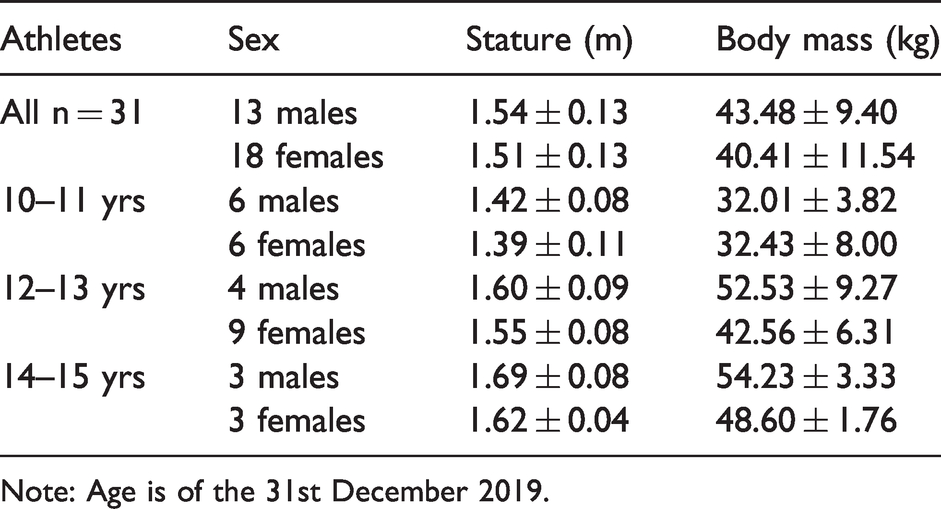
Note: Age is of the 31st December 2019.
Out of the youth athletes who were part of the study, 15 parents opted to be involved with semi-structured interview data collection. Out of the 15 parents, 9 were female and 6 male, 3 parents had two children completing the study. Ethical approval was granted by the Institutional Research Ethics Committee and assent and consent was collected from the youth athletes and their parents/guardians.
Procedures
The athletes training diary
Daily subjective and objective training data was asked for after each training session, excluding in school physical education lessons (PE). The exclusion of PE from the calculated TL total was due to the compulsory inclusion across the age groups studied being part of the school curriculum. Key Stage 3 receives 124 minutes of PE per week and Key Stage 4 receives an average of 98 minutes of PE each week 38 any optional extra lunch or after school sports activities was recorded by the athletes. The self-reporting mechanism was through an interactive bespoke Google Form (Google Forms, Google, CA, USA) with a unique log in code given for each athlete. Prior to starting the study a familiarisation session was carried out with each athlete.39,40 Saw and colleagues 39 state that self-reported questionnaires account for a high proportion of high-performance athletes training reporting mechanisms, and in terms of application to be sent out UK wide provided the best option to collect the subjective data. It has been demonstrated that children as young as 10 years old can provide reliable, valid, and meaningful reports of health when developmentally appropriate assessment methods are applied.41,42 The athlete log included any training performed on their own, with an organised club/coach or in a school club outside of school hours (extracurricular activities). The athletes were asked to complete the report immediately after each training session. The athlete submission was omitted if more than 72 hours after the session timestamp to ensure that athlete was able to appropriately recall the training session. 43
Athletes reported sRPE for an intensity measure and the session duration in minutes after every training or competition which was used to calculate TL.44–47 The use of TL provides a simple and responsive way for the athletes to report on both physiological and psychological stress which can be applied to multiple disciplines easily and has been used in junior athletes previously.
Wellness (their perceived mood level, perceived stress level, fatigue level, muscle soreness, any injury) and sleep hygiene (duration and their perceived quality) on an adaptation of the basic 1–5 Likert scale was reported on a daily basis. The Likert scale is an assessment tool commonly used to assess perceptual subjective readiness within athletic populations48,49 and is based on the recommendations of Hooper & Mackinnon 50 with the former showing good agreement between the scale and objective neuromuscular and endocrine measures.
The parent interviews
A dictaphone (Sony Dictaphone ICDPX333) was used to capture the parent semi-structured telephone interview data which was then downloaded and transcribed for later analysis through NVIVO (NVivo 12 v. 12.3.0.599). Parents were invited to take part in the research interview via a pre National Biathlon event email notification sent via the gatekeeper and also by information provided at the event. Interviews were conducted over the phone within the 4 weeks preceding the competition. Although the questions were not informed by the quantitative data, they were designed to supplement our understanding of parents’ knowledge of how they support their children whilst they engage in their sport of pentathlon and other sporting commitments outside of school. The semi-structured interview questions targeted the composition and operation of the weekly training schedule for their children. The questions further examined how much input they have into the process, and who else may have an input to their child’s training with questions including; “What does your child's weekly training consist of? and “Who determines this weekly training make up”
Analysis
Quantitative training load data
The youth athletes training diaries of both wellness and training were analyzed using descriptive statistics assessing hours, minutes trained per week, TL and subjective wellness measures. Analysis of TL between age categories (sub divided into two-year bands, 10–11 yrs, 12–13 yrs and 14–15 yrs) was analysed using a Two Way ANOVA. Significance was set at p < 0.05. Residual analysis was performed to test for the assumptions of the two-way ANOVA. Outliers were assessed by inspection of a boxplot, normality was assessed using Shapiro-Wilk's normality test for each cell of the design and homogeneity of variances was assessed by Levene's test.
Qualitative parent interviews
All audio recordings lasted between 13 and 24 minutes and were transcribed verbatim to produce between 2054 words and 5024 words of transcript. A reflexive thematic analysis was used 51 to explore parent’s perceptions of their experience of having a child or children compete within a multi-discipline sport. Therefore, prior to analyzing the data it was important to be transparent and acknowledge that the first author, who led the analysis, was heavily involved in pentathlon coaching and therefore, had an ‘insider’ knowledge and understanding of pentathlon and current coaching provisions. Further independent analysis of the data was performed by a researcher with little sport specific knowledge of pentathlon, who therefore acted as a ‘critical friend’. 52 The reflective thematic process involved both of these authors reading and rereading the transcripts to increase familiarity with the data through the process of ‘indwelling’. 53 Next, each author independently examined the data to generate codes, which reflected the most basic unit of the analysis. At this stage 49 codes were identified. The codes were then reviewed and similar codes were combined to create high-order themes. The process was then repeated to generate more expansive themes, which represent the broadest level of the analysis (e.g. the higher order themes coaching conflict and influence, and weekly and seasonal training and competition periodisation).
Trustworthiness
To enhance the quality of this qualitative enquiry, a flexible process was applied comprising several quality markers that align with contemporary perspectives on rigor. 54 As the first researcher is immersed within the culture of pentathlon, in order to enhance the quality of the first researcher’s interpretations of the data, the marker of critical friend was selected. The last author, who works outside of this sport and therefore an outsider, acted as a critical friend and provided a critical viewpoint by scrutinizing the methodological processes, reviewing and discussing the first researcher’s interpretation and encouraged reflexivity throughout.54,55 An example of the critical friend’s actions were reminding the first researcher of the research question within phase 3 and 4. This resulted in a reduction and refinement of quotations and codes selected, grouping of these codes and themes brought forward to the results. The outcome of which ensured a more aligned analysis and presentation of the findings to the purpose of the study. Furthermore, there was an attempt to engage in member reflections, 55 where participants were provided with a presentation of the findings, however, during this process participants agreed with the themes generated and no further changes were made.
Results
Athlete data
The mean (SD) weekly training hours for all 31 athletes were 5 h 59 min ± 3 h 38 min. The total training can be separated into pentathlon specific (running, swimming, shooting, fencing and riding) (4 h 41 min ± 3 h 31 min) and non-specific (1 h 17 min ± 2 h 5 min) sports. Overall training accounted for 72% of entered counts (coached 56%, uncoached 16%) then competitions were 9% and rest days 18%. Rest days accounted for 0.9 ± 0.7 days per week. Over the duration of the data collection, the minutes reported on a training week fluctuated, especially decreasing at Christmas break and the week before the February half term, (Figure 1).
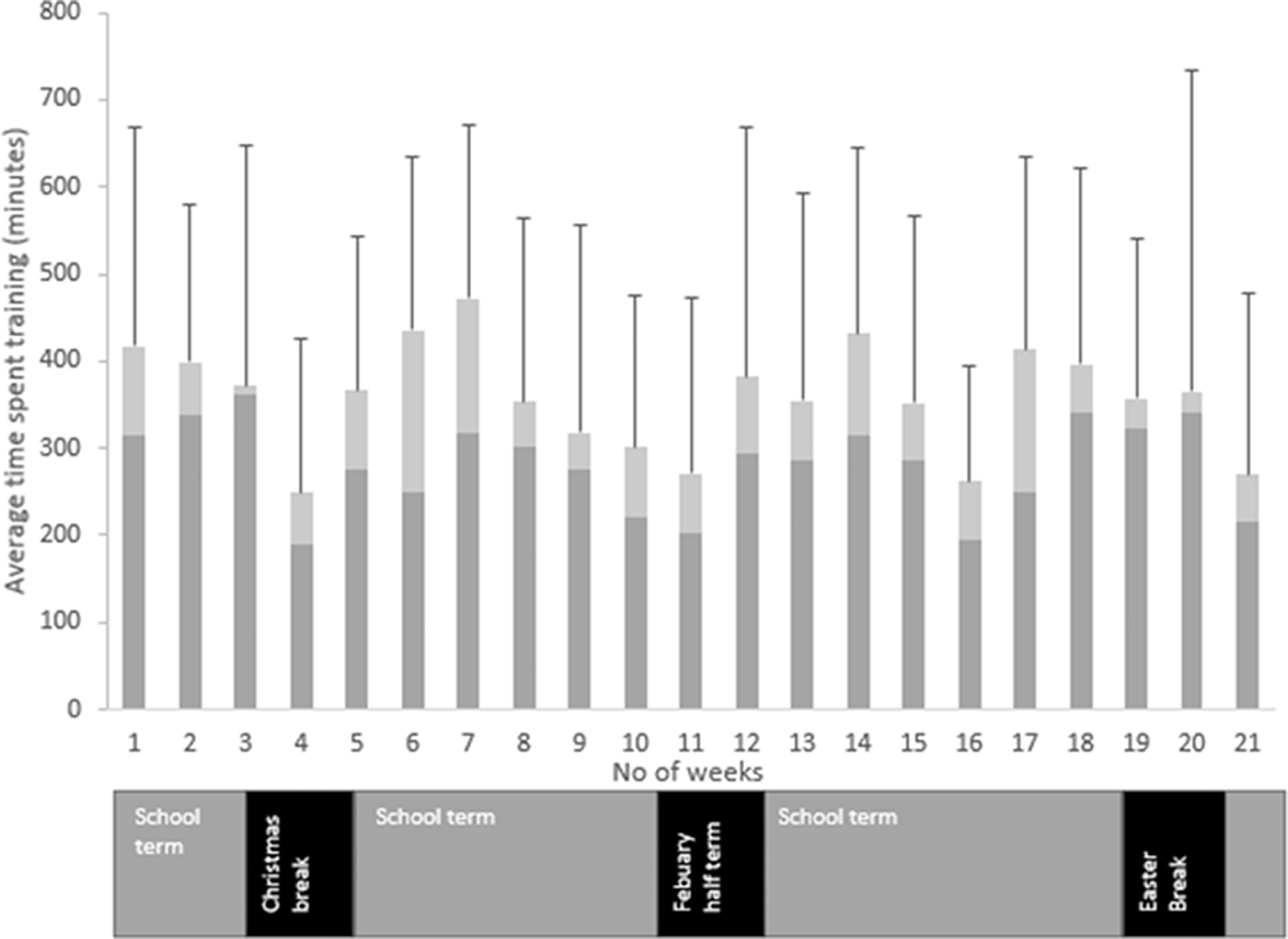
The mean ± standard deviation (SD) weekly training completed in minutes (n = 31). Dark grey bars represent the specific disciplines and sports to modern pentathlon, the lighter bars represent non-specific disciplines recorded. SD bars show standard deviation of total time spent training.
There was no significant difference between the total weekly TL with age amongst the 10–11yrs = 2401 + 819 arbitrary units [AU]; 12-13yrs = 2431 + 1039 AU; 14–15yrs = 3272 + 1160 AU, (F(2,30) = 1.84, p = 0.18), (Table 2). Overall TL in the pentathlon specific sports was not significantly different across the three age bands (F(2,30) = 2.86, p = 0.07), although there was a significant difference between TL reported in 10-11 yrs and 14–15 yrs, (p = 0.03). Furthermore there was no significant difference, reported through changes in TL, between the non-specific sports and modern pentathlon sports (F(2,30) = 0.66, p = 0.52).
Training load mean ± SD of the whole group and in age bands over the 21 weeks for a standard week, total load, specific pentathlon load and non-specific pentathlon sports.
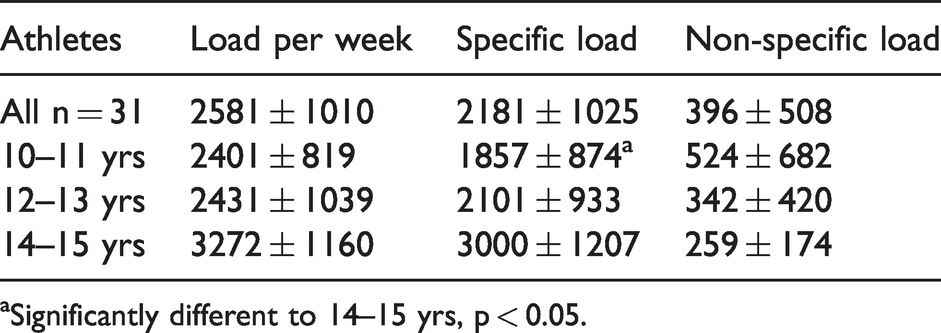
aSignificantly different to 14–15 yrs, p < 0.05.
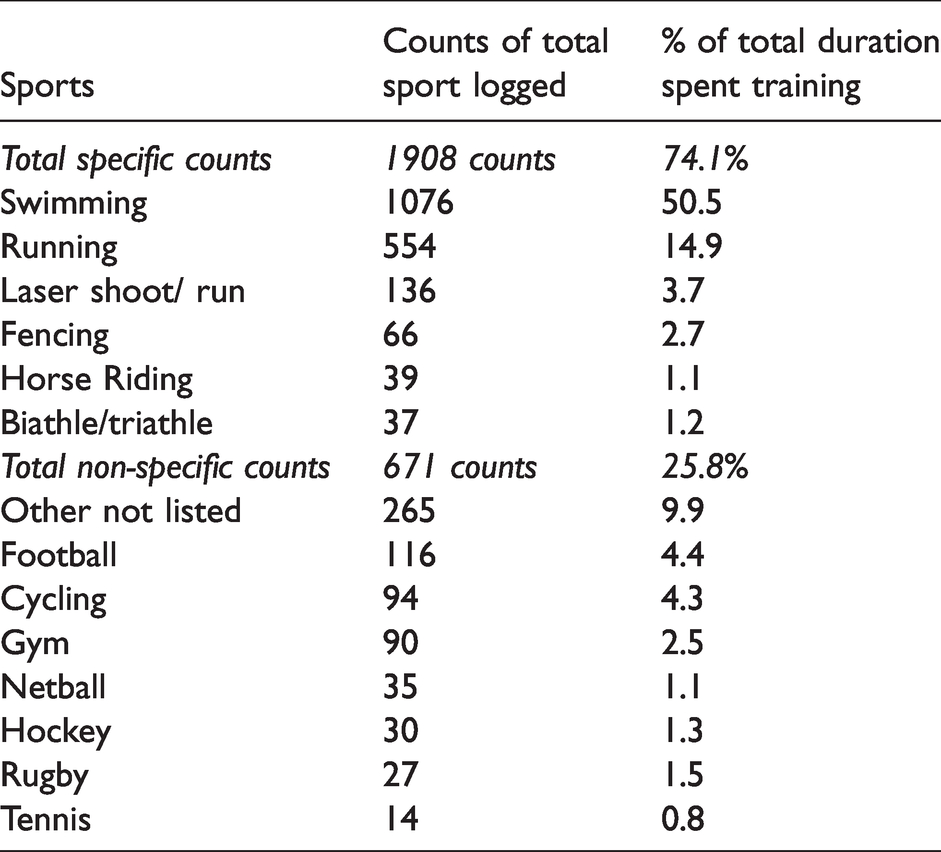
In terms of distribution of time spent in each sport the swimming discipline accounted for the most entries and 50.5% of the entire time spent training with the next most frequent training being running (14.9%), (Table 3).
Number of training entries logged in each sport and the % of the total time spent training logged in minutes by each athlete (n = 31).
On a micro weekly level the mean of subjective TL over a week was significantly different, (F(6, 120) = 12.41, p < 0.001). The lowest TL day was Friday (440 ± 34 AU), which was a significantly lower load than Monday, Wednesday and the weekend (Table 2). The three highest TL days were Saturday (720 ± 55 AU), Sunday (758 ± 38 AU) and Monday (645 ± 31 AU), which were significantly greater than Tuesday and Friday. Sunday (758 ± 38 AU), was the highest TL reported day, which also was significantly higher than Tuesday, Wednesday, Thursday and Friday, (Figure 2). Wellness reported scores (highest scores represent feeling fresh, good amount of sleep and excellent quality, no soreness and great mood) were significantly lower (p < 0.05) on Monday, Tuesday and Wednesday compared to the highest score reported on Friday, which also has the lowest TL value. Having a designated rest day did not seem to influence any wellness parameters the day after.
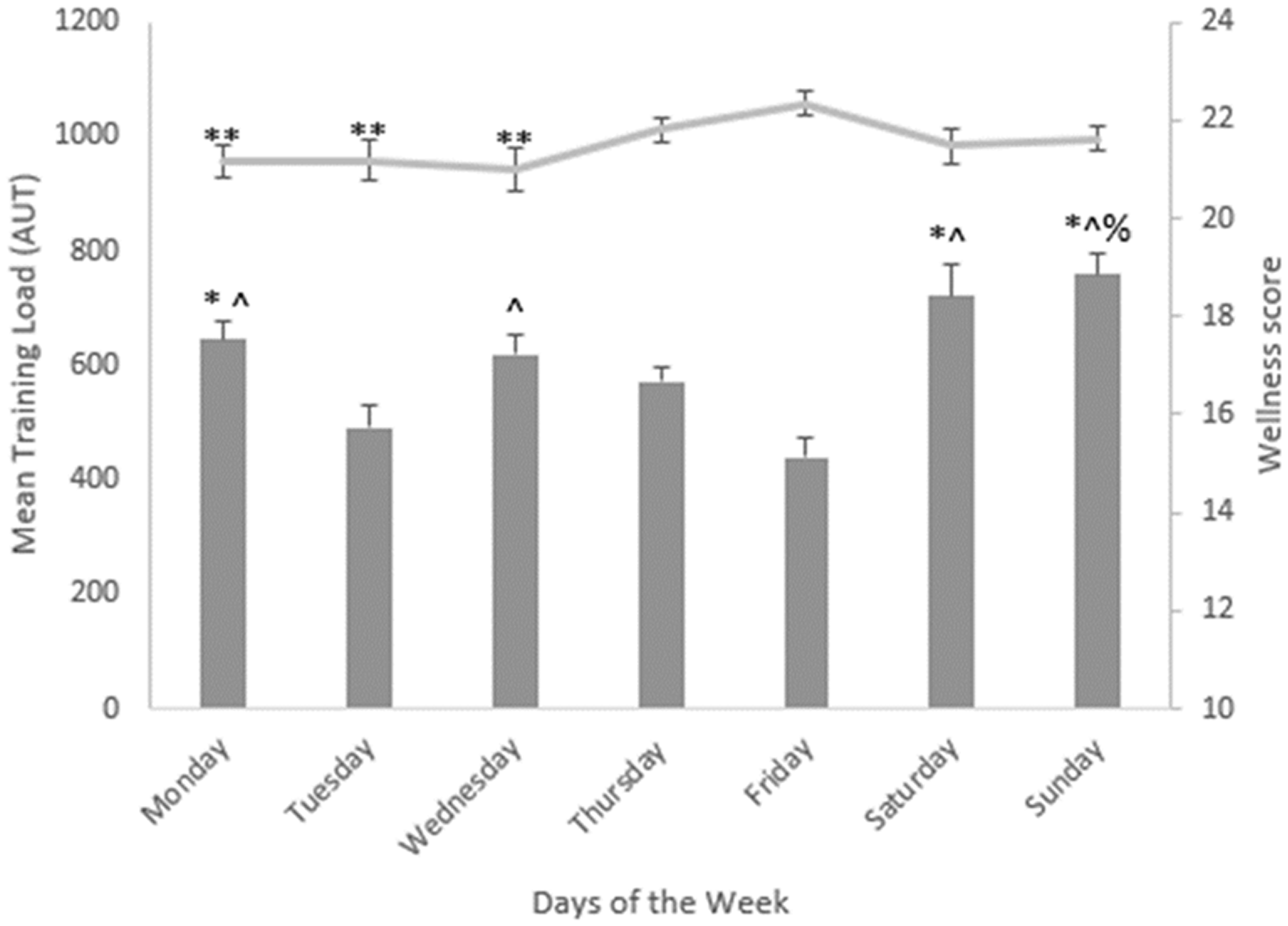
Daily TL averages n = 31 (represented in grey bars) as mean and SD, * significantly higher than Tuesday, ^ significantly higher than Friday, % significantly higher than Wednesday and Thursday p < 0.05, overlaid with overall Wellness score (sleep duration, sleep quality, muscle soreness, fatigue and mood) (represented by grey line as mean and SD, ** significantly lower values reported than Friday p < 0.05.
Solely focusing on the average reported muscle soreness showed a weak positive relationship with the average subjective TL (R2 = 0.11, P = 0.069). Overall the highest reported muscle soreness areas were the gastrocnemius (170 counts), followed by hamstring (140 counts), then quadriceps (125 counts) and the shoulder (109 counts) across all athletes.
On a macro level there was a fluctuation in the sum of subjective TL over the 21 weeks of data collection (Figure 4). High levels of TL were seen in weeks 6 and 13, which occur at the start of the school terms, (Figure 4). The lowest TL week was during Christmas, week 4, and this was significantly different, p < 0.05, to all other weeks apart from week 10. Week 10, for the majority of athletes, corresponded to the week before the start of half term.
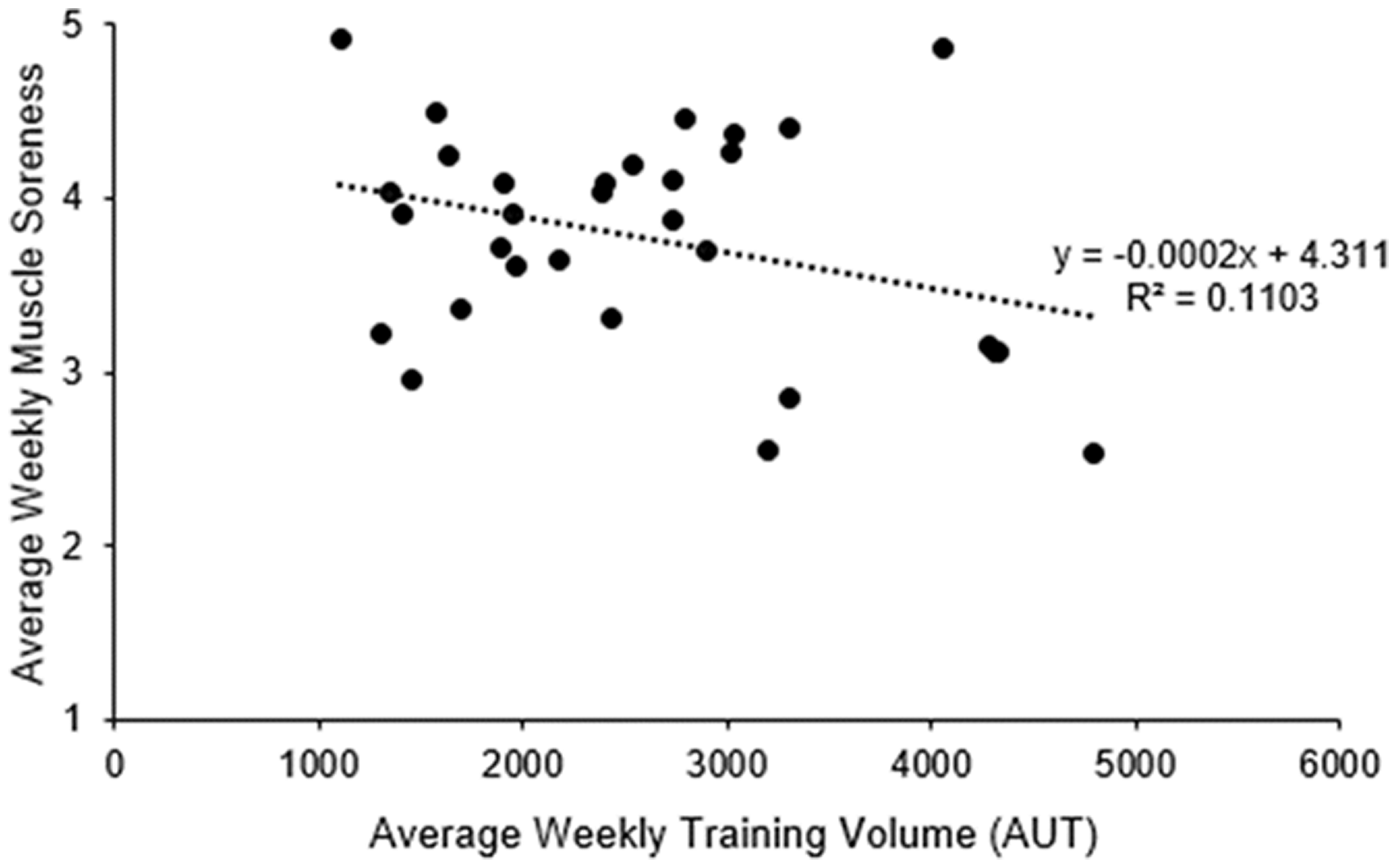
The relationship between average weekly reported muscle soreness (1 high muscle soreness to 5 felling very refreshed) and average weekly reported subjective training load (AU), (n = 31).
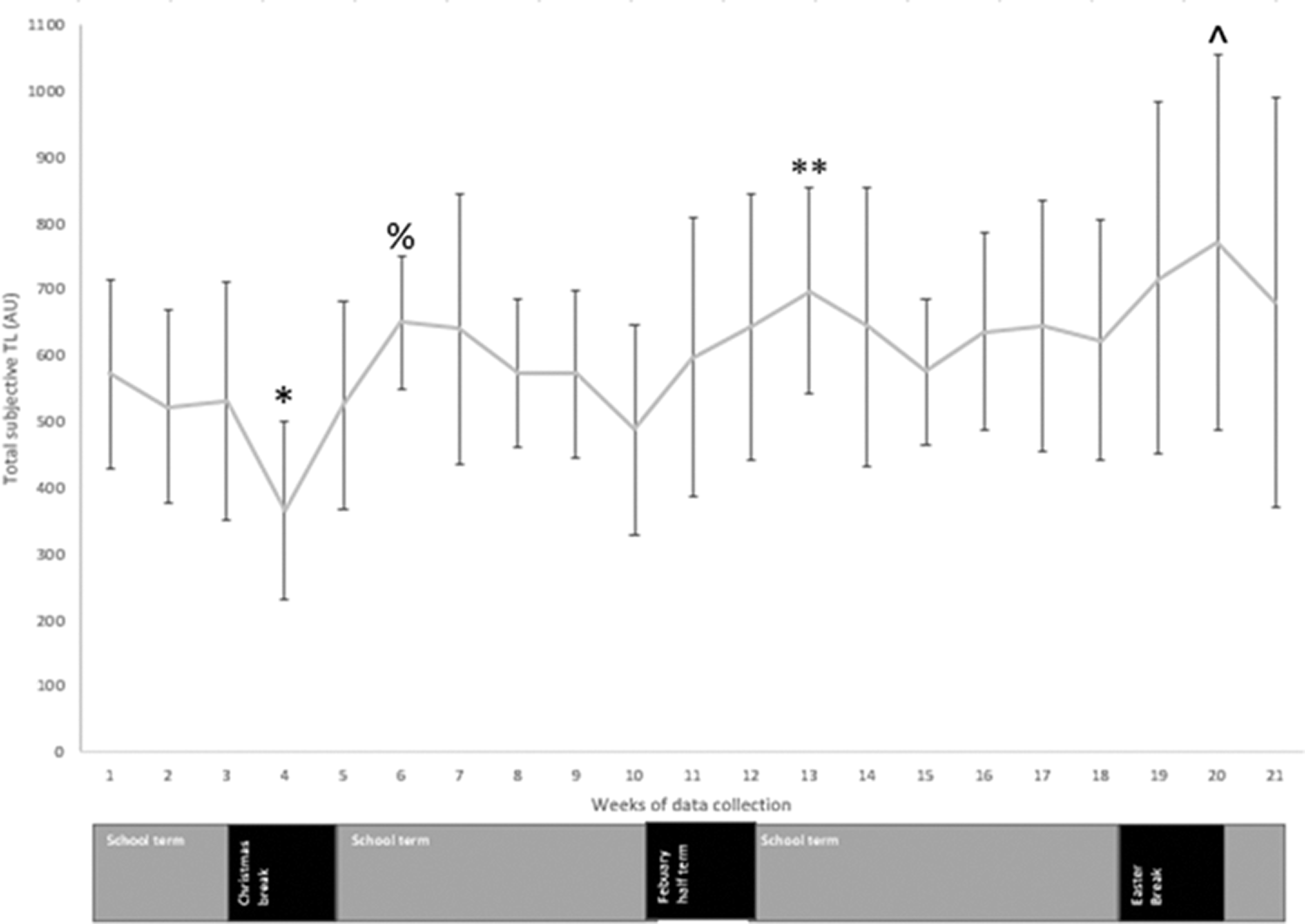
Mean and SD of the weekly TL from n-31 for each week over the 21 weeks of data collection presented alongside the school term holidays. Repeated measures ANOVA pairwise comparisons showed; * indicates a significant lower TL than all other weeks apart from week 10. ^ indicates significantly higher training loads to weeks 2,4,8,10,15, % significantly greater TL to weeks 3,4,8,9,10,15. **Significantly higher TL than weeks 2,3,4,8,9,10.
Parent interviews data
The parent interviews revealed two main higher order themes that were centred on the parents’ perceptions of the coach and the perceived conflicting messages as a result of this disparate coaching and sport engagement. Secondly, parents’ knowledge of the weekly and seasonal training and competition periodization was presented as a higher order theme, with sub themes relating to the varied knowledge and input that the parents reported providing.
Higher order theme 1. Coach conflict and influence
Throughout the interviews it became evident the athletes had multiple coaches which resulted in a number of issues. These issues included, the different pressures associated with various sports, a lack of communication between coaches, an over emphasis on swimming and a need for further guidance from NGBs for the parents. These sub-themes are presented below.
Sub-theme: Multiple coaches and individual discipline pressure
Parents were asked how many coaches prescribed training to their child/children on a weekly basis. It was highlighted that athletes had at least three coaches, with 10 of the 15 parents reported having 4–6 coaches per week. Parent 4 stated, “So athletics we have the same coach, she’s very good, so he has two different swimming coaches. Then obviously there’s the biathle coach and >name< removed< for the shooting, then after-school coaches”.
Sub-theme: Lack of communication between coaches
Parents identified a lack of communication between the multiple coaches which led to a lack of awareness of the athlete’s total TL and competition schedule. Parent 7 explains, “so they do not have any interaction between, like the swimming coach doesn’t talk to the running coach”. Furthermore, Parent 14 explains, “nobody, erm, will ask >name removed< about the intensity of his training or, like, what you’ve asked me, on a typical week no-one’s asked me any of those questions around his other training”.
Swimming coaches were identified as the dominant influencer in training and competition schedules. Seven of the 15 parents reported how the swim coach did not take an interest in, or discuss any other sporting engagement;
“At swimming, they say they want their athletes to be all-rounder’s but the reality is it’s swimming, swimming and swimming which I don’t think is very different from any other swim clubs really, from what I can hear” (Parent 5)
Sub-theme: over emphasis on swimming
A common reported theme within the parent interviews was linked to an over emphasis on swimming and that a lot of their child’s training was focused on this one discipline:
“I don’t know why that they just focus it solely, particularly our club I think, don’t particularly go down the multisport route, it’s looked down upon. You’re a swimmer and you swim…. for me, actually being a bit more confident in my own mind how much to let her do in terms of the other things, rather than just having to go for the unilateral side of the swimming coaches.” (Parent 3)
‘the swimming is very structured and we don’t tend to be able to alter that at all, so as a parent I guess I feel I just try and ensure that she does get to do the things that she enjoys and try to get her there but also, if I feel she is too tired, just try and guide her and advise what to do and what not to do, and particularly things, like, on a morning where she has swum for an hour and a half and then goes to school and does a cross country for school, erm, that we sort of, you know, decide whether she’s gonna do that or not and school are very good about not, erm, forcing her, knowing that she’s swum. So if she runs it’s great but she, she, erm, you know, there’s a bit of flexibility and I try and guide on that. (Parent 15)
Sub-theme: Need for further guidance
The parents and athletes found it difficult to fit all their coaches’ expectations of training and competitions given their multiple and conflicting approaches to training. The consequences of these difficulties resulted in the parents having to manage and prioritise their child’s training and competition schedule at different points in the season. For example, Parent 5 reported, “the triathle is the main thing that she’s working hard at and laser running is the next one down in the pecking order and after that it’s the running events” (Parent 5)
When asked about what support would be beneficial to help them with their child’s training nine parents reported that having support in this emerging parent-manager role would be helpful, such as guidance around training structure, and frequency and competition recommendations.
“Possibly to look at his training schedule and because I’m not a professional athlete and go ‘is this right? Is this where he needs to be? Are we doing the right things?’ and hopefully get a bit of guidance that way. I’m hoping I’ve got the balance of running and swimming and his football right, erm, but it would be nice maybe if someone looked at that and went ‘actually if you did it like this, you know, that could work out a lot more beneficial for him” (Parent 1).
“It’s having a bit more of a prescribed running programme, a prescribed swimming programme that isn’t gonna require hours and hours of time to do, and has steps within a process” (Parent 2)
Higher order theme 2. Weekly and seasonal training and competition periodisation
Throughout the interviews, it became evident that there were varied levels of knowledge and understanding of training, competition and periodization. This perceived knowledge meant that some parents provided a lot of input, whereas others looked for coach guidance. These themes are explored further below.
Sub theme – Parental input
When asked who had the most input into their child’s general weekly training programme 12 out of the 15 parents stated themselves or a family member. These family members provided an overriding approach to organise what the child did each week, in an effort to ensure they did not over commit to training or competition;
“as a parent I guess I feel I just try and ensure that she does get to do the things that she enjoys and try to get her there but also, if I feel she is too tired, just try and guide her and advise what to do and what not to do.” (Parent 3)
Sub-theme: Parents varied level of knowledge
Throughout the interviews, it was evident that parents had a mixed level of knowledge around training, recovery and periodization. Rest days and using effective ways to recover was limited and time off was given more on a ‘feel’ basis rather than a prescribed rest day. The majority did report a rest day per week, “Saturday was always a day when she didn’t swim, over the last year or so I think she’s given herself that more as a recovery day.”(Parent 3) although with further questions around this rest day in principle it did not happen very often due to school, competition or other less physically demanding training commitments. Parent 5, indicates a rest day may still include technical training, “Fridays is rest….although he’s doing 20 minutes shooting, probably, being realistic”. With Parent 9 showing that the less specialised sport acts as a physical recovery day option“…the school lacrosse training, I don’t think it’s a particularly heavy load compared to an hour in the pool or, you know, an hour running or whatever, it’s quite light in comparison’ (Parent 9). Or a half a day was considered enough in the week for a recovery day, “they try not to do anything on the Saturday afternoon and Monday evenings” (Parent 13). And “sometimes we finish training on the Saturday and we don’t do anything till Sunday tea time. So again, that’s a decent rest break in there so that his body can recover.” (Parent 4).
Although some parents protected at least a full day for recovery. The understanding for appropriate recovery was in some part formed from past overtraining experiences.
“we always try to make sure there’s two rest days in a week or at least a decent period of rest in there. <the hospital> were saying for his growth to develop him that he has that rest away from everything and their recommendation as well is that he probably needed more recovery time than the average person’’ (Parent 4).
Sub-theme: Knowledge of future training plans
All the parents interviewed had a knowledge of the training and competition plan over the next 12 months. However, the knowledge was consistent with logistical organisations rather than an understanding of a periodisation. The plan was constructed around the competition schedule set out by the NGB or the individual discipline sports or clubs. For example, “[In summer] it’s competition after competition and then in the winter months it’s probably similar, he runs cross country twice a month and then his swimming galas and biathlons start then in the winter” (Parent 1). The training design and competition choice is more about logistics than the development of the athlete as seen in this following quote;
“There’s no design to the plan. It’s a combination of trying to fit in doing the various elements of the sports and because there is no club per-se that covers what she wants to do, we’re dipping in and out of different clubs and it’s trying to balance the what >athletes name< wants to get out of it with meeting the pressures and commitments of being an athlete in those different clubs.” (Parent 5)
“trying to track all the competitions on excel and virtually every week there’s a competition, there’s kind of a bunch of events that the Pentathlon club recommend, there’s a bunch of competitions that the athletics club recommend and then there’s a bunch of things from the swimming”. (Parent 14)
They do acknowledge it is a balancing act between sports and coaches expectations. For example, Parent 3 explained, “so for cross countries which she has always enjoyed, she’s only managed a couple of those, because of clashing, with swimming dates”.
A few parents had an active role in coaching their child, or had a sport science or PE teacher background. The past experience meant that the parent took more ownership of their child’s overall programme and acted as a ‘performance manager’ liaising with the individual coaches. For example, Parent 8 reported that they have been involved in their child’s planning stating she had ‘become involved in his training schedule plan in the last 2-3 years,’
Discussion
With the interest of sports participation in youth athletes rapidly expanding, this is the first study to focus on applying, quantifying and understanding TL in the younger generation of multi-discipline athletes. The youth athletes included trained in a range of sports predominantly focusing on the multi-discipline sport of Modern Pentathlon. The aim of this study was to have insight into their weekly TL, frequency, sport distribution and wellness data over five months. In addition, parental interviews gave context to this training organisation.
The training reported
Youth recommendations from Brenner 12 suggest children should not be training ‘more than their age’ in hours, in their sport. Weekly time spent training was 5.59 ± 3.38 h/wk which was lower than the cohort's ages studied, which is similar to other youth athlete studies.16,18,56 For example youth track and field multi-eventers aged 13–14 reported 5.69 ± 2.53 h/wk, 16 which is considerably less than youth gymnastics of 20–30 h/wk. 17 However it is important to note the considerable large standard deviation reported across these and the current study with athletes reporting some weeks average being over 11 hours of training.
Focusing on the athletes reported TL there was a significant difference in both total and specific sports between the 10–11 years olds athletes compared to the 14–15 year olds although not overall across all the age groups. This findings deviates from previous research within university athletes in full time education, who recorded almost half the amount of TL. 57 The long term athlete development (LTAD) model 58 would suggest the youngest athletes should be in the ‘learn to train’ and older ones in ‘train to train’ phase or as Côté 59 describes it as the sampling years through to 13–15 years which is classed as specialising years, which supports the current data set. However, all the athlete groups were subjected to higher TL than those of the more advanced LTAD groups described by Cote et al. 59
The three highest TL weeks occur at the start of each school term which may suggest athletes potentially getting ‘back to a routine’ with training and school commitments, and not in relation to competition periodisation. The description of training and competition strategies gathered from the parent interviews, substantiate these assertions and indicate that training is mainly structured around availability of the sub-sports and the overemphasis of training from ‘sole’ discipline coaches focused on competition output rather than training progression.
Weekends provided the largest TL with parent interviews suggesting this is due to more time availability compared to week days. Rest days were evident (0.9 ± 0.7 days per week), but seemed to be easily compromised by other less specific sporting activities, technical training or taken due to a consequence of acute fatigue rather than a planned recovery day. Wellness scores show significantly lower values (poorer) on the three days preceding the weekend, which could relate to an accumulative fatigue from the high weekend TL. This could potentially disallow or limit for an adaptive response contradicting information around youth physical development models that training should be moderately structured for this age group. 60 If there is no clear training stress within the micro or macro cycles or time allowed for an adequate recovery period, a maladaptation could occur with a potential increased risk in overtraining, injury or drop out due to similar training stimuluses.8,9 There was no clear periodisation structure seen, which is also evident in average weekly TL having little correlation with muscle soreness and rest days not resulting in higher wellness scores the day after.
It is recommended that specialisation in a sport should not occur until early adolescence yet or even teenage years; 61 this is unclear in regards to a multi-discipline sport where so many competencies are needed to be developed to be successful but also to balance TL effectively. Modern Pentathlon is seen to be a late specialisation sport with age of peak performance at the Olympic games in 2012 showed the top 20 pentathletes age as 26.9 ± 3.6 years (men) and 25.1 ± 4.1 years (women) 62 . However, in the sub-disciplines, swimming (men, 24.6 ± 3.3, women, 22.7 ± 3.4) and middle distance running (men 25.0 ± 3.6, women 25.8 ± 4.8) peaked at a younger age. Although compared to fencing (men 27.2 ± 4, women 26.7 ± 4.6) and shooting (men = 32.6 ± 7.7, women = 28.4 ± 5.3) this was slightly higher. Longo et al., 62 concluded sports with an increased physical demand seem to have an early peak as opposed to more tactical skilled sports. This highlights the importance of a robust pathway development within such a multi factorial performing sport to sustain youth interest and not burn out at an early age, potentially within sub disciplines. With the swimming discipline being the dominant sport in the present study and that it is classed as an early specialisation sport, this may account for the increased pressure around training and competition in this discipline.
With inconclusive research around whether there is a ‘window of opportunity’ for accelerating children’s physical potential due to an increased sensitivity of training or not, the current data suggests an unstructured view of periodisation with little integration for any individualisation support needs potentially brought on by poor coach to coach interaction on a weekly basis. 58 Having this unstructured approach of ‘let’s see what fits’ could indicate that this youth population may have a ‘training load error’ which may restrict athletic development if training is not managed correctly. 63 The themes from the athlete parent interviews highlighted that many coaches were involved in the construction of the weekly training programme which were mostly coach driven in individual disciplines suggesting an uncoordinated nature to the athlete’s micro and macro cycles. Parents seemed to show high organisational skills to get their children to sessions and competitions but seeked more knowledge and understanding around training principles and expectations on how to manage relationships between coaches and schools, which is fundamental in successful sport parenting. 33 Where multiple coaches are involved in training the main voice seems to be heavily driven by the swimming coach. Of all the individual disciplines swimming seems to have limited capacity for non-specialised young performers. Parents with multi-event children are pressured into complying with the training and competition schedule of the swimming coach rather than a structured schedule to incorporate all the disciplines over the week.
Interestingly within the Modern Pentathlons scoring system, the swimming element of the sport rates quite low in how you accumulated more points (250 points award to a 2 min 30 sec time with a 1 point ± per 0.5 sec), especially compared to the fencing (70% of bouts won correspond to 250 points), with additional victories, depending on the athlete numbers, could be greater than 5 points per hit. 64 Therefore, the athlete would have to swim two seconds quicker over 200 m to score 4 points, as opposed to making one hit in the fence. This poses the question whether the 50.5% time spent overall training is focused on swimming is correct for the development model for youth athletes who are focusing on Modern Pentathlon, or whether this focus on the physical development in this discipline is necessary, although running accounts for only 15% of total time training.
The parents identified that having a developmental programme to refer to, and having development camps in their areas with good quality clubs which understand the multidisciplinary nature of pentathlon and its sub sports assist their child’s development in the sport, which supports research recommendations by Harwood and Knight. 33 This awareness of growth and development from a parental view has been successful in other sports.34,65 The complexity of multi-discipline sports training and the multiple pressures of discipline coaches makes the education and support of parents a recommendation moving forwards.
Conclusion
Youth talented athletes have a range of sporting opportunities to engage in and this paper has shown that in most cases their weekly training is very single sport oriented with blinkered sports coaches vying for athlete attention. Parents then manage decisions around training and competitions which could result in poor long term development. Findings within this study could influence how to optimize training strategies in youth athletes who engage in multi-sports and raise awareness to how sports can structure a better approach into and to retain within the talent pathway system in an effort to conserve and maximise talent as well as through parental education opportunities and coach development. In this sample size this could apply to recommending standards of training hours, load and recovery set out for youth development pentathletes. As summarised in Lloyd and Oliver’s 60 paper there are many factors to be considered when coaching youth athletes and this current paper highlights potential problems in training organisation, competition and knowledge when there are multiple coaches throughout a training week to support a multi-discipline athlete. The large implication of multiple coached sessions and minimal crossover awareness layered on top of the self-reported training data may suggest bad practice in developing a young “elite” athlete, as crossover of sporting demands may be detrimental to overall adaptation and result in accumulative fatigue. This is further reflected in the parent’s time management duty of balancing and fitting in all the training demands seemed an incredible challenge. Moesch et al., 66 and more recently Feeley and colleagues 67 highlight that the age band of 10–15 years is critical in terms of branding whether a youth athlete becomes specialise or not from an early age in their sport to determine future medal success and due to the mixture of physical and technical 68 elements . In a multi-discipline sport like Modern Pentathlon the youth training pathway needs to be considered with clear guidance to help support these developing athletes and their parents in the journey especially if their coaches are not interacting with each other around intensity, load and competitions. This agrees with research by Emie and colleagues 61 around utilizing sporting policy to better resource the focus on grassroots participation in sport to assist with retention alongside talent development.
Limitations and future research
It is acknowledged that the study involved young athletes and that some days were missed in terms of logging training and wellness, however there were several controls implemented to maximise the reliability of the data collection. Any response rate of longer than 72 h from the activity stamp was removed (12% of entries) from the data set.
Longitudinal studies into the effects of a multi-discipline specialisation to sport, or retrospective accounts and how the balance of disciplines in the developmental stages affects the potential trajectory would help this body of literature. Exploring interventions as the parent/coach support on an athlete's biological age and training expectations may also give insight into developing and preserving talent in the Pentathlon system.
Footnotes
Acknowledgements
The authors would like to thank the athletes and parents involved with the data collection across the UK for their time and understanding for the research to be carried out.
Declaration of Conflicting Interests
The author(s) declared no potential conflicts of interest with respect to the research, authorship, and/or publication of this article.
Funding
The author(s) received no financial support for the research, authorship, and/or publication of this article.
