




Abstract
Highlight videos accompanied by inspiring music can help in enhancing an athlete’s motivational state and self-efficacy (SE). The addition of verbal priming techniques could provide a further boost, but this combination of audiovisual stimuli has yet to be examined in a sport context. A repeated-measures, crossover design was used. The study entailed a pretraining intervention administered to American football players (N = 32). Measures included the Situational Motivation Scale and an SE scale. Participants were exposed to control, music, video, video-music, video-priming, and video-music-priming conditions. Repeated-measures MANOVA indicated that the video-music condition elicited the strongest response in terms of increasing intrinsic forms of motivation (p = .010) and decreasing amotivation (p = .019). Three of eight SE components (Perceptions of Effort, Consistency, and Concentration), and an overall global SE score were significantly enhanced by the experimental stimuli, with video-music-priming eliciting the most positive response, followed by video-music. The present findings indicate the utility of audiovisual interventions combined with verbal primes immediately prior to sporting performance. Practitioners working with athletes might consider the preperformance use of motivational music and videos along with embedded subliminal verbal primes.
Introduction
Motivation might be considered one of the keystones of athletic achievement. Enhancing motivation can improve an athlete’s sense of wellbeing and even performance levels. 1 Research has shown how motivation can be heightened temporarily through the use of motivational videos, 2 verbal priming techniques, 3 and music. 4 The combination of these stimuli could enhance these effects further still but has yet to be examined in a sport context.5,6
Ryan and Deci7,8 theorized that motivation can be categorized into three main motivational constructs. These lie along a continuum from amotivation, through extrinsic motivation, and then to intrinsic motivation. Of these primary forms of motivation, amotivation can be characterized as a lack of motivation to engage in an activity. There are then four subcategorizations of extrinsic motivation. Specifically, external regulation refers to processes associated with the salience of rewards and punishments. Introjected regulation entails the internalization of previously external reasons for engaging in a behavior. Nonetheless, this behavior is not authentically self-selected, given that the individual has imposed pressure on her/himself to engage in it. Identified regulation involves the conscious attachment of value to a given activity and goals associated with it. Integrated regulation refers to when a behavior has become not only valued, but also integrated within and in harmony with other aspects of an individual’s sense of self. 8 As we move toward more intrinsic forms of motivation, participation in the activity becomes more focused on the pleasure and satisfaction that one derives from it.
From the perspective of an athlete or coach, perhaps the most desirable of the three main constructs is intrinsic motivation, given its potentially positive effects on sport performance, resilience, learning, and self-efficacy.9–12 According to Ryan and Deci, intrinsic motivation becomes a dominant force when the underlying psychological needs of competence, autonomy, and relatedness are satisfied. Preperformance imagery interventions, for example, have been found to enhance athletes’ sport-related self-confidence and competence, thereby serving to bolster their intrinsic motivation.13,14 Thus, the present study aims to examine a combination of motivational video, priming techniques, and music on motivation and self-efficacy in a sport context.
Self-efficacy in sport
Self-efficacy pertains to an individual’s belief in her or his capabilities to perform and produce a designated outcome.15,16 There is a strong corpus of evidence to suggest that high self- and collective efficacy leads to enhanced effort and performance across a range of sports,16,17 with a potential reciprocal relationship between self-efficacy and motivation. 18 Bandura 15 identified four main factors that influence self-efficacy. The most salient of these is past experience, such as the previous success enjoyed in a given activity. Next, vicarious experience is a factor that pertains to observing the success or failures of others in a given activity. Thereafter, social persuasion is when positive encouragement from others increases self-belief in our capabilities to succeed in a given activity. Lastly, there are physiological factors such as fatigue and nausea, the interpretation of which can alter self-efficacy. Given the aforementioned benefits of self-efficacy in sport, preperformance interventions targeting factors such as vicarious experience and social persuasion can be relatively easy to implement via the medium of motivational videos. Research also demonstrates that implicit motivational techniques, such as priming, can enhance the perceived competence component of motivation in a training context, 19 and although understudied, priming could positively influence self-efficacy if delivered as part of a preperformance intervention. 20
Priming techniques
An intervention that has been used to influence an athlete’s motivation and behavior at a subconscious level is priming. 5 Priming refers to the passive, subtle, and unobtrusive activation of relevant mental representations by external stimuli, without an individual being consciously aware of its influence. 3 Priming effects can take either subliminal or supraliminal forms. In the case of the former, the primes are presented below the threshold of conscious awareness and are typically masked in some way, to reduce or eliminate conscious perception.21,22 An example of a subliminal prime entails the presentation of momentary flashes of meaningful words that are edited into a video.5,6 In the case of supraliminal primes, an individual is aware of an environmental cue, albeit not of its influence on her/him; an example being a scrambled sentence task.23,24
In a sport and exercise context, few studies have examined priming; nonetheless, the technique has been shown to have a positive effect on motor performance over a limited timeframe.24,25 Ashford and Jackson 24 employed a scrambled sentence task as a pretask supraliminal priming intervention for a hockey-dribbling test. Compared with having no primes and when priming words were negative or neutral, participants performed the hockey-dribble faster and with fewer errors, with positive priming words (e.g., immersed) that promoted automacity. The authors suggested that priming may have directed internal attention away from controlling the step-by-step movement mechanics of a skill. This ameliorated performance pressure by enabling participants to focus on the outcome of the movement, rather than associated processes.
In a subsequent, replication-type study, Winter and Collins 26 disputed Ashford and Jackson’s findings. The supraliminal priming intervention elicited no significant performance benefits. However, the participants were older, more experienced, and competed at international level, in contrast to the national-level athletes recruited by Ashford and Jackson. Adams et al. 25 employed a soccer-dribbling test following the same sentence-scrambling task and found that priming phrases associated with fluent execution, such as “movements seemed to flow”, elicited shorter task completion times.
A general limitation of these studies is that they hold little ecological validity, as they were conducted in a controlled, laboratory environment. While a dribbling task might be considered representative of drills that are typically conducted in training, it is questionable whether the reported effects would emerge in a field setting or during competitive sport performances. Priming techniques delivered in subliminal form could be used in the locker room and embedded into motivational videos that are shown to athletes. 6 In summary, priming has the potential to elicit positive responses in athletes but needs to be examined in a real-life context, similar to programs of work conducted for other forms of stimuli such as videos and music.2,4
Music and video interventions in sport
Motivational music and videos are often used in interventions to elicit positive psychological effects.2,4 Music can be a relatively simple, background stimulus that is effortlessly absorbed by the listener. Music-related interventions have been found to enhance motivation, task engagement, emotional arousal, and enjoyment, particularly in sport and exercise contexts. 27 Juslin 28 highlighted how people use music in a diverse range of settings and purposes; the most common purpose being to regulate emotions. Within a sport context, athletes often use music as a pre-event preparation, warm-up, and training tool. Typically, this is done to increase motivation, enjoyment, and induce positive emotions such as happiness, confidence, and relaxation. 29
Video-related interventions have been used to heighten motivation and prompt positive changes in behavior. 30 In Jenkins, Morgan, and O’Donoghue’s 31 qualitative study in collegiate netball, participants indicated that motivational videos improved both confidence and motivation, but should not be allowed to interfere with preperformance preparation. Accordingly, video interventions should be relatively brief (i.e., 2.5–5.0 min in length). The combination of a motivational video with subliminal verbal primes and music has the potential to elicit stronger effects on outcomes such as self-reported motivation and affective arousal.5,6
Interactive effects of video, priming, and music in sport
Few studies have examined a combination of the three stimuli of video, priming, and music. Such a combination would be relatively easy to administer, given that most sport centers and gymnasia have the required equipment. Video and music are already oft-used, such as motivational music-videos playing on gymnasium screens. 32 Barwood et al. 30 found that the combination of music and video has the potential to increase self-efficacy and stimulate greater emotional engagement. Similarly, Hutchinson et al. 32 found that the combination of video and music had the most potent effect on state motivation and in reducing perceptions of exertion, when compared with presentation of these stimuli in singular form.
Employing a laboratory setting, Loizou et al. 5 investigated how a combination of video, subliminal priming, and music influenced satisfaction of the needs underlying intrinsic motivation as well as on emotional states. They used a sample that was heterogeneous in regard to the type/level of sport played and showed their participants video footage of sport performances with and without subliminal primes (words) and music. Intrinsic motivation was reported to be most strongly influenced when the stimuli were presented in unison. Interestingly, there was a significant reduction in these effects in the absence of music. A study limitation, however, was that conditions were presented to participants on the same day, with the potential for participant fatigue, boredom, and crossover effects. In addition, without actually having a sport-related task to immediately follow the intervention, these findings cannot be readily applied to the realm of sport.
Loizou and Karageorghis 6 extended this study through examining video, subliminal priming, and music as a precursor to the Wingate Anaerobic Test among a similarly heterogeneous sample. They found the combination of video, priming, and music to be the most effective in terms of modulating participants’ pretask affect and subsequent anaerobic performance; this was followed by the music-only condition. Nonetheless, a limitation acknowledged by the authors, was that the audiovisual stimuli employed could have engendered subtly different effects across levels of sports participation and beyond the confines of a laboratory setting. In summary, video, priming, and music stimuli could elicit synergistic positive effects in athletes, but have yet to be examined in a real-life sport context and among a more homogenous sample.
Rationale, purpose, and hypotheses
Motivational music and videos have been found to have a positive effect on state motivation. 32 Nonetheless, most previous studies have only examined controlled exercise tasks, thus limiting their applicability to other forms of exercise or the sports arena. Additionally, the psychological outcomes associated with the use of priming techniques remain largely unexamined. Using a sentence scrambling task, Adams et al. 25 examined supraliminal priming effects on serial motor skills, but the authors also recognize that a faster, simpler method to introduce verbal primes (e.g., subliminal and via video) could be more practical in a sport context.
Loizou et al. 5 found that the synergistic effects of video, priming, and music elicited the highest scores in intrinsic motivation. Loizou and Karageorghis 6 extended the study to an examination of the Wingate Anaerobic Test under laboratory conditions. A way of addressing the latter study’s limitations would be to assign separate days for each condition to potentially reduce participant fatigue, and test participants in a naturalistic setting. Although Loizou and Karageorghis’ study did not involve sport, researchers have suggested that sport in an outdoor environment could elicit stronger positive effects on self-efficacy and motivation when compared to laboratory settings, owing to positive associations with nature and connectivity.33,34 There is, therefore, a need to examine the effects of the three stimuli in a field experiment using an athletic population in the pretraining phase. This is particularly pertinent, given that athletes likely have fewer opportunities for listening to music during competition, and many governing bodies of sport have banned the in-competition use of music. 29
The purpose of the present study was to examine the psychological effects of video, subliminal priming, and music when used as a pretraining intervention in a sport context (club-level American football). In accord with previous findings, it was expected that all experimental conditions would also have significant positive effects in a sport environment on state motivation and self-efficacy when compared with a no-stimulus control.5,6 More specifically, the three research hypotheses tested were: H1 All experimental conditions would have significant beneficial effects on state motivation and self-efficacy when compared with control. H2 Video with priming and music would elicit the greatest beneficial effects on state motivation and self-efficacy. H3 Video-music would elicit the second most beneficial effects on state motivation and self-efficacy, followed by music-only, video-priming, video, and then control. 5
Method
Power analysis
A power analysis (G*Power 3) 35 was conducted using the effect size derived from the condition main effect pertaining to motivation variables in a similar study addressing video, priming, and music (ηp 2 = .08). 5 With power set at 0.90, a minimum of 22 participants was required to detect an effect in a repeated-measures design. To ensure a sufficient number of cases in each cell of the analysis relative to the number of dependent variables, an additional 10 participants were recruited. 36
Participants
Following institutional ethics approval, a convenience sample of 32 male participants was recruited from an American football team in Northwest London, UK. The sample had an age range of 19–30 years (Mage = 25.4 years, SD = 3.0 years). Their experience in the sport ranged from 0 years (beginners) to 12 years (Mexperience = 2.6 years, SD = 2.6 years), and thus were a relatively heterogeneous sample in terms of experience.
Experimental conditions
Experimental conditions comprised video footage of the American football team’s peak performances during recent games and practices. These were edited down into a 3.5-min montage and combined with music and/or verbal primes. 31 Primes consisted of the three words (in isolation) of the Olympic motto, “faster”, “higher”, “stronger”, as used by Loizou et al. 5 and were edited into the video for 40-ms flashes, appearing once each at ∼1-min intervals. The primes were chosen for their relevance to motivating physical performance, at a general level, and to take into account the varying roles of players in the American football squad. A 19-track motivational music playlist that the coaches often used during practice was employed, given its familiarity to squad members. It was played in the background at approximately 70 dBA (via a nearby speaker) during the warm-up while data were collected from participants as they arrived. Conditions comprised of video-only, music-only, video-music combined, video-priming, and video-music-priming, and a control with no extraneous auditory or visual stimuli.
Measures
The Situational Motivation Scale (SIMS) was used to assess state intrinsic motivation. 37 It is comprised of 16 items that address why participants engage in a given activity with responses provided on a 7-point Likert scale anchored by 1 (corresponds not at all) and 7 (corresponds exactly). The items relate to four subscales representing different types of motivation, with four items that fall into each attached to a “Why are you currently engaged in this activity?” response set. Sample items for each of the four subscales are as follows: Amotivation – “I don’t see what this activity brings me”; External Regulation – “Because I am supposed to do it”; Identified Regulation – “Because I am doing it for my own good”; and Intrinsic Motivation – “Because the activity is fun”. Guay et al. 37 provided reliable alpha values (.83–.90) across four studies of college students, and a confirmatory factor analysis indicated good model fit. 38 Tenenbaum, Eklund, and Kamata 39 conducted a review of studies that had employed the SIMS, concluding there was strong support for the reliability, factorial, and construct validity of the scale.
To assess self-efficacy, an 8-item scale was created by the present authors in accord with Bandura’s guidelines for the development of measures of self-efficacy for a particular domain of interest. 40 The measure consisted of a confidence rating scale of 0–100 anchored by 0 (No confidence) and 100 (Absolute certainty) across eight hypothetical qualities. These were chosen with the coach and two American football players from another club, which was at the same level competitively as the club under investigation. In addition, we followed a procedure similar to that employed by Conmy, Tenenbaum, Eklund, Roehrig, and Filho to create qualities/items specific to American football. 41 A question stem was used of “essential qualities to American football performance” referring to individual athletes’ perceived competence and confidence in their football abilities, with the outcomes being: Effort, Control, Persistence, Decision Making, Coping with Pressure, Consistency, Concentration, and Composure. These were presented as items and participants then rated their perceived capability with reference to each quality. 40 The qualities were conglomerated into a mean score that is referred to hereafter as Global Self-Efficacy. The associated items were tested for internal reliability.
Procedure
Participants were asked to engage in a study on “psychological techniques in sport”, given an information sheet, and asked to provide written informed consent/demographic details. In consecutive weeks over a 6-week period, ∼30 min prior to commencement of a training session, participants were administered one of the six conditions. The order of conditions was randomized across the 6 weeks but every participant was administered the same condition in each week, owing to the field-based nature of the study. The playlist was delivered using a SoundCore Bluetooth portable speaker system (Anker; Shenzhen, China) and multiple laptop computers (Thinkpad; Lenovo, Beijing, China) were used to deliver the highlight videos simultaneously to participants, either with or without the inclusion of verbal primes. This area was separated from the nonparticipating players’ preparation area. Verbal primes were inserted into the video using Movie Maker (Windows, Version 2012) and each of the three prime words appeared for 40 ms at 1-min intervals throughout the video. 5 Accordingly, all priming conditions also involved video footage.
In accord with the experimental condition, each participant was administered the SIMS and self-efficacy scale immediately after watching the video, following their arrival at the playing field and prior to individual warm-up. In conditions involving musical stimuli, the playlist was initiated as the first players arrived and continued until the data were collected (i.e., just before the players began their regular training session). In the control condition, the participant engaged in the regular pretraining phase but without music or video.
Manipulation check
Following participants’ final training session within the present study, three participants were asked some short, open-ended questions as a form of manipulation check. The questions served to evaluate their awareness of the study’s general aims, use of subliminal priming words, and general purpose underlying the use of the audiovisual stimuli.
Data analysis
Data were screened for univariate outliers using standardized scores (–3.29 ≤ z ≥ 3.29) and for multivariate outliers using the Mahalanobis distance test (p < .001). 36 Following checks for normality in each cell of the analysis, two single-factor, repeated-measures MANOVAs were used to examine differences across conditions; one for the SIMS subscales and another for the eight self-efficacy items. A repeated-measures ANOVA was used to examine differences across conditions in global self-efficacy. Mauchly’s test was used to check the assumption of sphericity and Greenhouse–Geisser adjustments were made to F tests where necessary. Significant F tests were followed-up with Bonferroni-adjusted pairwise comparisons to identify where differences lay.
Results
Data screening and diagnostics
One participant was excluded from further analysis owing to multiple univariate outliers (k = 10). Outlier checks indicated that there were 38 other univariate outliers (z > ± 2.58) and the associated raw scores were duly altered in order that standardized scores fell within the accepted range as a precursor to parametric analysis. 42 Tests of the distributional properties of the data revealed that seven data cells demonstrated significant negative skewness (Std. Skewness > ± 2.58) for SIMS scores across the six conditions, and nine cells demonstrated negative skewness for the self-efficacy items and global score. This is, however, to be expected in an athlete population.43–45 MANOVA and ANOVA are sufficiently robust to withstand such minor violations of normality 46 and logarithmic transformation of scores from self-report Likert scales would potentially distort the dataset 47 and was thus not implemented. Accordingly, the analyses that follow should be interpreted with due caution.
Analysis of SIMS scores
There was a main effect of condition, Pillai’s Trace = .39, F(20, 600) = 3.22, p < .001, ηp 2 = .10. This is a medium effect and indicates that approximately 10% of the variance can be attributed to the independent variable manipulation. Univariate tests indicated a significant difference across conditions for Intrinsic Motivation (p = .001) associated with a medium-to-large effect size (ηp 2 = .13), Identified Regulation (p = .002) with a large effect (ηp 2 = .14), and for Amotivation (p = .001) with a large effect (ηp 2 = .16).
Follow-up pairwise comparisons (see Figure 1) indicated that for the Amotivation subscale, there were significantly lower scores for video-music (p = .019) and video-priming conditions (p = .042) over control (Mdiffs of .56 and .53, respectively). There were no significant differences for External Regulation. For Identified Regulation, the video-music condition was scored significantly higher than control (Mdiff = .40, p = .003), and music (Mdiff = .33, p = .003); video-music-priming was nonsignificant albeit with higher scores than control (Mdiff = .31, p = .053). For Intrinsic Motivation, only the video-music condition showed a significantly higher score when compared to control (Mdiff = .32, p = .010), and video-priming (Mdiff = .32, p = .024); however, video-music-priming was scored significantly higher than video-priming (Mdiff = .26, p = .045).
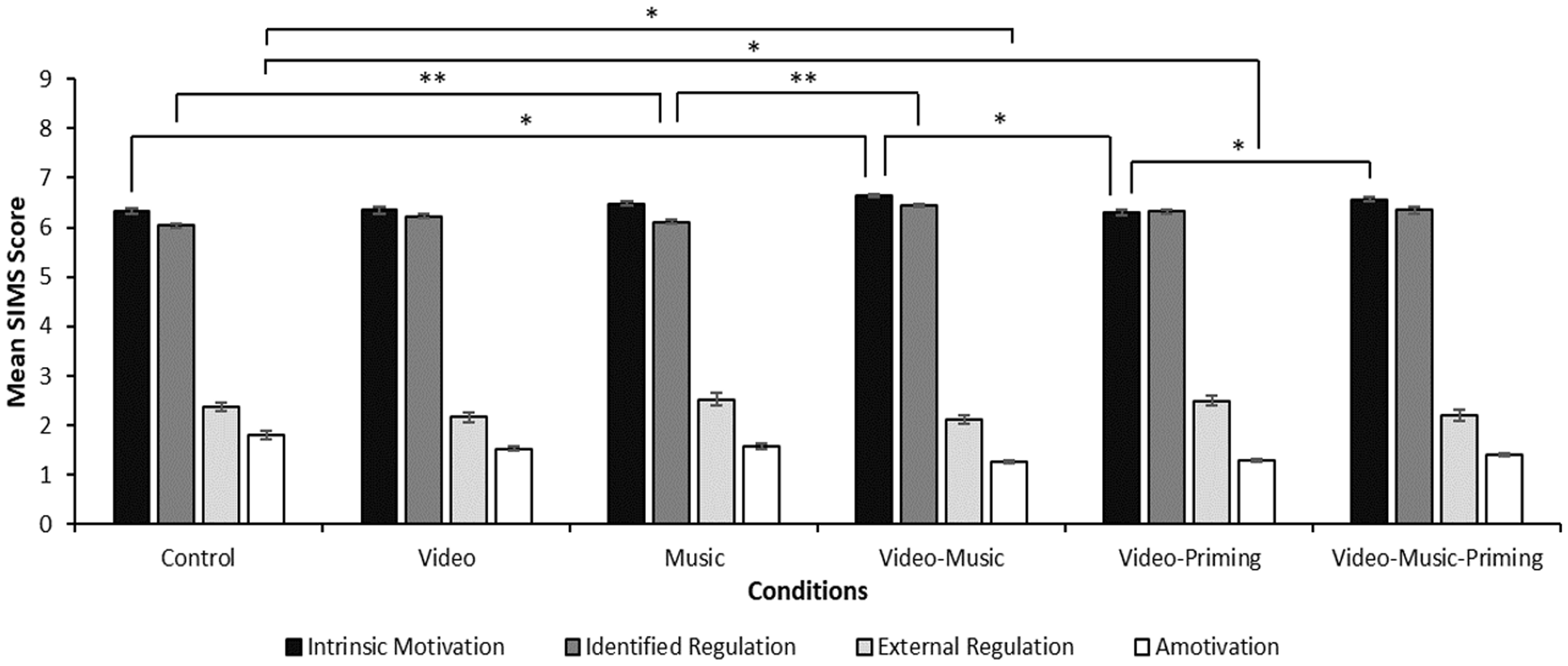
Mean SIMS scores, standard errors, and significant differences across the six conditions. *p < .05; **p < .01.
Analysis of self-efficacy
There was a main effect of condition, Pillai’s Trace = .51, F(40, 735) = 2.08, p < .001, ηp 2 = .10, which is medium in size and indicates that approximately 10% of the variance can be attributed to the independent variable manipulation. Univariate tests indicated a significant difference across conditions for Effort (p = .007) with a medium effect (ηp 2 = .11), Control (p = .012) with a medium effect (ηp 2 = .11), Decision Making (p = .044) with a medium effect (ηp 2 = .07), Coping with Pressure (p = .019) with a medium effect (ηp 2 = .11), Consistency (p < .001) with a large effect (ηp 2 = .16), Concentration (p < .001) with a large effect (ηp 2 = .16), and Composure (p = .038) with a medium effect (ηp 2 = .09). Follow-up pairwise comparisons indicated that for Effort, video-music-priming elicited significantly higher scores than control (Mdiff = 6.06, p = .001), video (Mdiff = 4.87, p = .031), and video-priming (Mdiff = 4.58, p = .019; see Figure 2). For Coping with Pressure, video-music-priming elicited a higher score than control that did not reach significance (Mdiff = 7.56, p = .063). For Consistency, video-music was significantly higher than control (Mdiff = 7.97, p = .005); video-music-priming was significantly higher than both control (Mdiff = 9.32, p = .002) and video (Mdiff = 6.77, p = .045). For Concentration, significantly higher than control were video-music (Mdiff = 8.03, p = .003), video-priming (Mdiff = 7.07, p = .013), and video-music-priming (Mdiff = 8.55, p = .009).
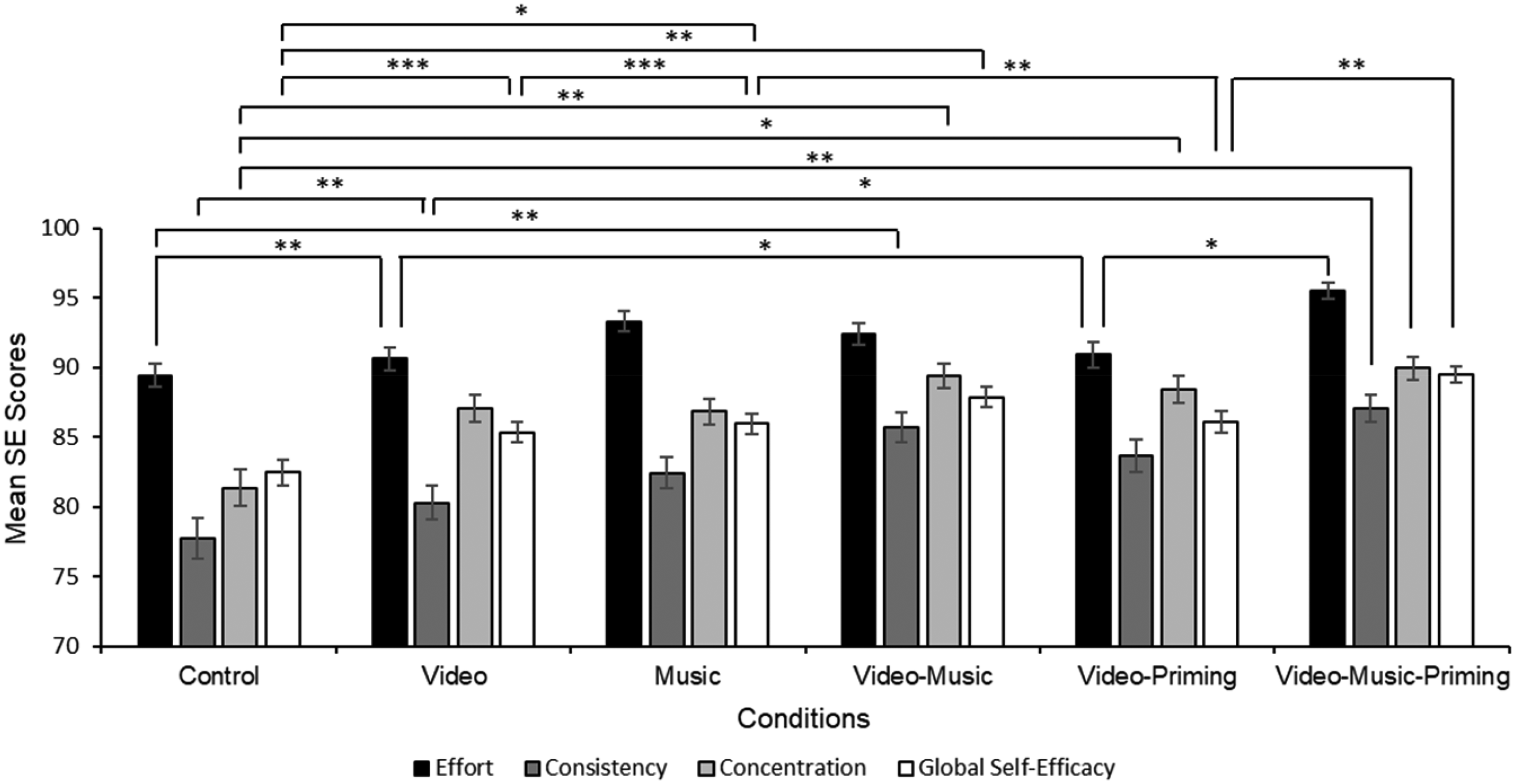
Mean significant self-efficacy (SE) scores and standard errors across the six conditions. *p < .05; **p < .01; ***p < .001.
The repeated-measures ANOVA also indicated that there was a main effect of Global Self-Efficacy, Pillai’s Trace = .55, F(5, 26) = 6.43, p = .001, associated with a large effect (ηp 2 = .55). Pairwise comparisons indicated that video-music-priming was significantly higher than control (Mdiff = 7.04, p < .001), video (Mdiff = 4.14, p < .001), music (Mdiff = 3.55, p = .001), and video-priming (Mdiff = 3.43, p = .006). Video-priming elicited a higher score than control that did not reach significance (Mdiff = 3.61, p = .058). Moreover, video-music elicited significantly higher scores than control (Mdiff = 5.40, p = .002) as did music (Mdiff = 3.49, p = .031). In addition, Cronbach’s alpha coefficient for Global Self-Efficacy was .97, indicating high internal reliability.
The manipulation check indicated that no participant was aware of the experimental stimuli (i.e., the primes were not identified and the music was just part of their normal training environment) or aims of the study.
Discussion
The aim of the present study was to investigate the effects of video, priming, and music on state motivation and self-efficacy prior to American football training sessions. H1 was partially supported, as some of the experimental conditions elicited significant positive effects on more intrinsic forms of motivation, and higher global self-efficacy scores when compared to control. H2 was not accepted, as video with priming and music did not elicit the most positive outcomes compared to the other experimental conditions. Accordingly, H3 received partial support; video with music generally elicited the strongest positive responses, followed by video with priming and music. The order of next strongest responses varied depending on the outcome variable under investigation.
Effects of experimental conditions on motivation
As expected for an athlete population, participants reported a relatively high level of intrinsic motivation, regardless of condition.43–45 Nonetheless, the combination of video, priming, and music elicited a positive effect on the intrinsic forms of motivation, with a corresponding decrease in amotivation (see Figure 1). SIMS results indicated that for Amotivation, there were reported decreases across all experimental conditions when compared to control. This partially supports H1, as video-music (Mdiff = .55, p = .019) and video-priming (Mdiff = .52, p = .042) reached significance.
With regard to External Regulation, Identified Regulation, and Intrinsic Motivation, video-music tended to exhibit the highest scores, followed by video-music-priming. This does not support predictions that priming techniques would elicit greater enhancement in motivation when embedded in a video, even without the addition of musical stimuli, 25 but are indicative of the facilitative role that music can play 5 with regard to more intrinsic forms of motivation. Winter and Collins 26 suggested that supraliminally primed participants might exert their effort differently and hence the prime may automatically and subconsciously lead participants to concentrate on a given task more intently. However, the assumption could be made that when priming stimuli are presented as words to be read such as in subliminal priming, the working memory might be involved to some degree, 48 particularly in tasks that are more complex than the field hockey-dribble task that Winter and Collins used. This conflicts somewhat with the theoretical premise of priming; that automaticity and only a subconscious level of awareness facilitates its effects. Engagement of the working memory might, in part, explain the lack of effect associated with the priming stimuli used in the present study. Ostensibly, the activation of working memory can be to the detriment of cognitions oriented toward performance outcomes and motivation. 49
Although the effects of singular video and music conditions were nonsignificant, the increase in Intrinsic Motivation and decrease in Amotivation when the two stimuli were combined (see Figure 1) illustrates how potent these stimuli can be when used synergistically. This lends support to previous findings that illustrate the efficacy of video when combined with music stimuli.30,32 We found partial support for the results of Loizou et al. 5 ; specifically with the positive effects of video-music on motivation (see Figure 1). However, when combined with video and musical stimuli, the priming stimuli did not elicit the expected responses in motivation constructs in terms of enhancing intrinsic motivation.
The lack of more significant positive effects for priming may have been due to the field-experiment nature of the present study. Participants were exposed to the video stimuli outdoors and so there were various visual distractions that were not present in Loizou et al.’s 5 laboratory-based study. These distractions could have emanated from other team members as they prepared, the coach as well as coaching staff/spectators who may have restricted participants’ absorption of the priming words. An alternative approach would be to administer the intervention in a controlled, indoor environment prior to a training session. A further salient factor is the lyrical content of music: song lyrics could have elicited an emotional response and prompted extramusical associations. 50 When music and verbal primes are presented isochronously, it is conceivable that the response elicited by the music can mask or interfere with the motivational effects of the primes (e.g., motivational phrases among the lyrical content).
Effects on self-efficacy
Three of the eight self-efficacy components were significantly enhanced by the experimental stimuli, providing partial support for H1 and H2 (see Figure 2). For Effort, video-music-priming elicited the highest score (M = 95.52), particularly when compared with any condition that did not include musical stimuli. This finding reinforces the notion that music, as an ambient stimulus that is absorbed effortlessly, can elicit meaningful effects on self-efficacy. 27 The finding also suggests that music can serve as a useful distraction from the priming process, when primes are delivered visually in a video, thus firmly keeping the effects at a subconscious level. We observed similar findings with Consistency, Concentration, and Global Self-Efficacy (see Figure 2). With regard to the former two SE components, we speculate that the primes “faster”, “higher”, “stronger” were more strongly associated, at a subconscious level, with schemata pertaining to effort, consistency, and concentration when compared with the other components that we measured. 6
With reference to the effects of music, psychomusicologists North and Hargreaves 51 proposed that individuals select musical works with stimulative or sedative properties, as appropriate to the listening context. The music was chosen by the coaches with participants’ preferences in mind. Moreover, the tracks were chosen to motivate the players/make them feel more confident prior to training. Such musical choices were thus likely to promote more intrinsic forms of motivation and higher SE. However, some of the music may have had a negligible or even negative effect that might explain the lack of significant findings in some of the SE components. Songs containing rap, distracting lyrics, or characterized by a slow tempo may have elicited a neutral or negative response. This could have undermined task-relevant focus as well as the components of Composure, Coping with Pressure, and Decision Making if participants felt compelled to listen to music they did not favor. 50 Other research suggests that more experienced athletes have a higher level of self-efficacy, 52 and thus changes in this variable are more difficult to detect in the present sample. Nevertheless, the significant enhancement of Global Self-efficacy through the combined stimuli of video, priming, and music represents a novel effect in the sport psychology literature. This finding supports H1 and H2 and the notion that these stimuli can have a synergistic effect when used prior to training.5,6
Limitations of the present study
A limitation associated with the measurement of intrinsic motivation is that the players recruited for the present study were highly intrinsically motivated (M = 6.42). This is illustrated by the fact that they attended practice twice weekly on a voluntarily basis and even paid a fee to do so. The potential ceiling effect in terms of intrinsic motivation means that positive changes are hard to elicit with either acute or chronic psychological interventions. Similarly, the SIMS only examines four of the six forms of motivation and so capturing the earlier explained constructs of introjected and integrated regulation may have facilitated a more nuanced appraisal of the present intervention. Using a more sensitive motivational measure might go some way toward mitigating both of the aforementioned limitations.
The lack of validity testing of the bespoke self-efficacy scale created for American football also represents a limitation of this applied study. We did not have a sufficient volume of data to run confirmatory factor analysis in order to examine factorial validity; this potentially limits the degree to which the items that we generated accurately represent the construct of self-efficacy. However, the scale was created with reference to Bandura’s 40 guidelines, with support from an American football coach and two other players to ensure a degree of content validity. Moreover, Cronbach’s alpha internal consistency estimates were used to check for scale reliability. Nonetheless, future researchers are encouraged to adopt a more rigorous approach in establishing the validity of such psychometric instruments. 39
A further potential limitation concerned the competitive season of the sport under investigation. The data collection period coincided with upcoming games of varying expected difficulty for participants. This may have influenced players’ self-efficacy as they may, for example, have felt anxious about an upcoming opponent that they deemed to be particularly aggressive or better skilled.15,53 Over the course of the data collection period, the participants’ team won all five matches they contested. Although data were not collected on match days, the training sessions were in close proximity to these matches. A good performance would likely have enhanced players’ self-efficacy due to the salient influence of past experience, and equally, could have enhanced the perceived competence component of motivation. 15 Thus, participants could have reported levels of self-efficacy and intrinsic motivation that were not directly attributable to experimental conditions. A means by which to reduce this effect would be to administer experimental stimuli outside of the competitive season.
Lastly, given the field-based nature of the study, there was potential for order effects to manifest, as the order of conditions could not be counterbalanced. A future study could adopt a counterbalanced design, albeit in an applied context, this presents significant challenges. In a similar context, counterbalancing could be achieved if every athlete had a dedicated laptop and headphones.
Conclusions and recommendations
The current findings have implications for practitioners and sports coaches given that they illustrate the potential benefits of using video, priming, and music as a preperformance tool. Video combined with music elicited higher levels of intrinsic motivation. Video with music, as well as the video-music-priming combination, were found to enhance self-efficacy. The findings support those of previous studies, which indicate that the combination of video with music can enhance state motivation. 5 The inclusion of verbal primes did not elicit an additive effect for either motivation or self-efficacy (i.e., beyond the combination of video and music). The present findings have utility given the relative ease with which a priming-related intervention can be implemented for athletes using technology such as Movie Maker. The expected enhancements in athletes’ motivation and self-efficacy should manifest in performance-related benefits. 54
Further studies might address some of the previously mentioned methodological issues pertaining to extraneous variables, such as the equipment used and environmental influences on participants. A longitudinal approach to the investigation of motivational outcomes might reveal more nuanced changes in an athlete population. It would also elucidate the degree to which competitive outcomes moderate the efficacy of priming-related interventions. Moreover, researchers might consider investigating video, priming, and music on psychophysiological outcomes such as heart rate variability 6 and galvanic skin response in a sport context. 55 These findings would provide a more objective means by which to assess the efficacy of video, priming, and music interventions.
The main contribution of this work has been to provide an initial investigation into video, priming, and music in a real-life sport context. It is one of very few investigations into American football outside of a North American context. 56 The findings show that in a preperformance application, the video-music condition elicited the most positive effects on motivation, while the video-music-priming condition elicited the most pronounced enhancement in self-efficacy. In the sport context, priming effects have been conspicuously understudied. Future research should investigate these techniques in other sports/performance environments and by use of different priming modalities, such as imagery 24 or sentence-scrambling tasks. 25 In conclusion, it appears the use of video, priming, and music might be a valuable tool for sport psychology practitioners in enhancing the motivational state and self-efficacy of an athlete.
Footnotes
Acknowledgements
This study was undertaken at the Wembley Stallions’ training ground. The authors thank the head coach, team manager, and players for their contribution to the research.
Declaration of conflicting interests
The author(s) declared no potential conflicts of interest with respect to the research, authorship, and/or publication of this article.
Funding
The author(s) received no financial support for the research, authorship, and/or publication of this article.
