




Abstract
The aim of the study was to investigate whether performance of children can be improved by training with modified equipment that challenges movement execution. For that purpose, young field hockey players practiced with a modified and a regular hockey ball. The modified hockey ball enforces more variable movement execution during practice by rolling less predictably than a regular hockey ball and, thus, challenges the players’ stick–ball control. Two groups of 7- to 9-year old children, with 0 to 4 years of experience, participated in a crossover-design, in which they either received four training sessions with the modified ball followed by four training sessions with the regular ball or vice versa. In a pretest, intermediate test (i.e. following the first four training sessions) and a posttest, the participants dribbled an obstacle parcours with a regular ball. Results show that practice with the modified ball led to greater performance improvement than the intervention with the regular hockey ball. This performance improvement, however, was not predicted by experience and/or initial skill (i.e. pretest score). The findings indicate that by using modified equipment, sport trainers and physical education teachers can, presumably through enhancement of movement variability during practice, stimulate skill acquisition in young children.
Introduction
According to the constraint-led approach,1–3 motor skill learning can be conceptualized as emerging from a change in the interaction of performer, task and environmental constraints. Consequently, skill learning is not uniquely determined by changes within the performer, but encompasses an improvement in the relationship between performer and environment.1,4 Hence, interventions to promote learning need not be solely confined to the performer, but must also involve the manipulation of environment and task constraints.
A key aspect to be achieved with the manipulation of task constraints is to inject noise into the movement system. By doing so, movement variability is increased. In fact, since the well-known kinematic recordings of Bernstein 5 demonstrating that a skilled blacksmith’s spatiotemporal trajectory of the wrist holding the hammer repeats itself without being identical while end point precision is maintained, researchers have considered movement execution variability as a pertinent characteristic of expertise. 6 Within the constraint-led approach, this movement variability is considered as functional because it aids the search for movement solutions that satisfy the ever-changing interaction of constraints. It stands to reason therefore that practice interventions that promote movement variability also facilitate learning, or does it? 7
Recent theoretical and empirical contributions have indeed suggested that increasing movement variability during practice interventions can benefit motor skill learning (for an overview, see Ranganathan and Newell 7 ). In this respect, Ranganathan and Newell 7 distinguish two levels of movement variability for executing the same skill: variability in the task goal and variability in execution redundancy. When varying the task goal, constraints are manipulated to elicit different outcomes of the task. In the basketball throw, this would be exemplified by throwing the ball from different distances to the target, requiring ball trajectories of different lengths. By contrast, varying execution redundancy implies that constraint manipulations are intended to achieve the same task outcome in various ways (i.e. Bernstein’s repetition without repetition). For example, throwing the ball at the same distance, but varying the speed, timing and/or height of release. With regard to variability in execution redundancy, Ranganathan and Newell 7 provide two hypotheses why execution redundancy would have a positive effect on motor learning: first, it results in the learner to explore different movement patterns to achieve the same task goal (i.e. degeneracy), bringing personalized optimal solutions; second, it allows the learner to better adapt to different situations.
In sports, one way to achieve increased movement or execution redundancy through constraint manipulation is by using modified equipment. 8 The modification of equipment can challenge the performer to vary the habitual movement execution patterns. This promotes skill learning, because an increased movement variability results in a degenerate movement repertoire, that is, achieving the same task goal in different ways.7,9
In a study on acquisition of the forehand stroke in novice tennis players, the effectiveness of manipulating the tennis ball, net height and court size was examined. 10 The manipulations were intended to induce increased movement variation during practice. The authors showed that in comparison to a traditional learning intervention, which prescribed the same ideal movement pattern to all players, the task constraint manipulations did indeed increase the number of movement patterns immediately after practice (i.e. post-test). However, the increased movement redundancy induced by the constraint manipulations was not associated with better task outcomes compared to the traditional learning intervention.
In a different study, the effect of different balls on learning passing skills in novice adult soccer players was compared. 11 The participants practiced either with a regular soccer ball or with a futsal ball. A futsal ball is smaller, lighter and has smaller coefficient of restitution, making it less bouncy. It stands to reason, therefore, that the futsal ball would induce less variable movement execution during learning, and thus, following predictions by Ranganathan and Newell, 7 slows down learning. However, the participants’ passing skills with the regular soccer ball showed a greater improvement from pre- to post-test in the group that trained with the futsal ball than in the group that trained with the regular ball.
In sum, these studies10,11 do not provide convincing evidence that increased execution redundancy promotes motor skill acquisition as far as performance is concerned, although there were some indications for adaptive changes in coordination. 10 However, these studies only involved novices or beginner athletes. Possibly, novices first need to learn to achieve the task goal; and only then can an increase in execution redundancy by increasing task complexity benefit (further) performance improvements. This would be reminiscent of Bernstein’s conjecture that learners first reduce the degrees of freedom, and only after they have gained rudimentary control over the task they can start incorporating additional degrees of freedom to increase flexibility of control and movement variability (see also Vereijken et al. 12 ). Accordingly, it has been reported 13 that for elite springboard divers increased movement variability in practice did result in improved performance consistency.
The aim of the present study is to investigate if increased execution redundancy during practice increases the improvement of motor skills in young field hockey players with different levels of experience. To this end, we use a modified hockey ball that rolls less predictably than regular balls, thereby inducing a greater movement execution redundancy. We hypothesized that practice with this modified hockey ball would lead to enhanced improvement on technical hockey skills compared to practice with a traditional hockey ball. In addition, we expected that this improvement would be greater the more experience the field hockey players had accrued.
Method
Participants
The sample included 129 girls aged between 7.10 and 9.40 years (mean ± SD: 8.54 ± 0.45 years). In total, there were 15 teams participating, each team containing eight or nine girls. A priori power analysis for an ANOVA with repeated measures indicated a minimal sample size of 44 participants (α = 0.05, 1–β = 0.95, f = 0.25). Participants were recruited from a local Dutch hockey club. On average, participants’ experience ranged from 1 week to 4 years with an average of 1.84 years playing hockey (SD = 1.02 years), according to the clubs’ membership administration. Prior to the start of the study, written parental informed consent was obtained. Ethics approval was granted by the Ethical Committee of the Vrije Universiteit (VCWE-2018-031R1).
Equipment and apparatus
In this study a regular field hockey ball and a modified hockey ball were used. Both were smooth, 23 cm circumference field hockey balls with a weight of 155 g. The modified hockey ball was developed by the Athletic Skills Model (ASM14,15) and has a slight disbalance due to asymmetrical mass distribution; therefore, it has a more variable motion pattern than regular balls. This increased variability was verified by letting both the regular and the modified hockey balls roll off a 3-m slope for 15 times (Figure 1). This was filmed using an iPad Air. For each ball, the deviation from the midpoint (in cm) was measured. The measurement confirmed that the path and the end point of the modified hockey ball were less consistent and predictable. Mean deviations from the midpoint were 50.9 cm (SD = 29.5; maximum deviation = 88.0 cm) and 3.1 cm (SD = 3.6; maximum deviation = 10 cm) for the modified and regular ball, respectively. There was a significant difference in mean deviation from the midpoint between the balls: t(28) = –6.23, p < 0.001.
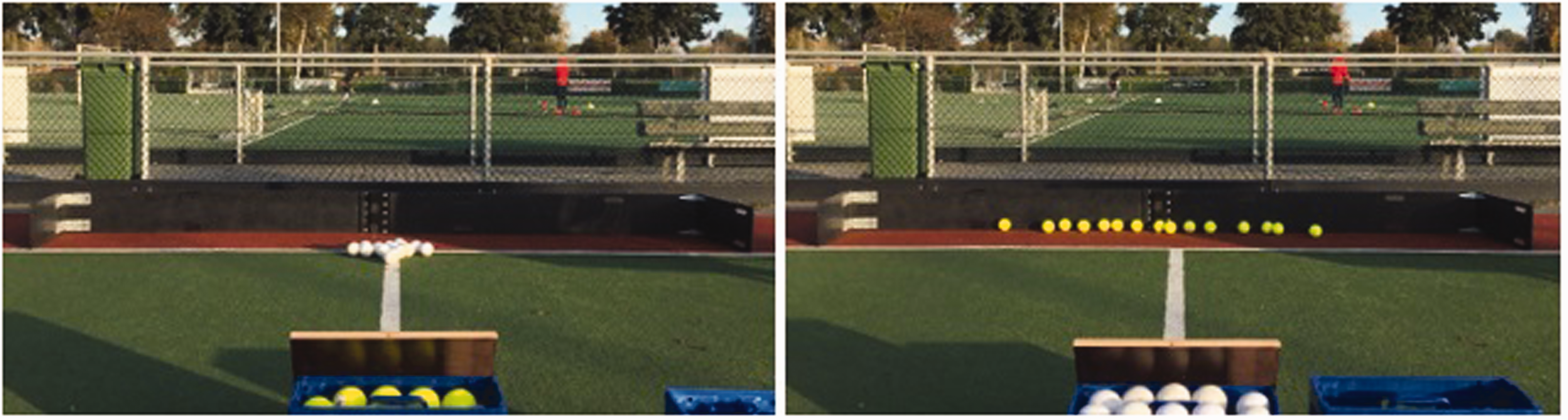
End position of the ball. Left picture: regular ball; right picture: modified ball. The regular ball rolled straight resulting in small dispersion of the end point, while the modified ball path was less predictable resulting in large dispersion of the end point.
A field hockey skill test, consisting of items for ball control and shooting skills was used (Figure 2). Time was recorded when the ball passed the goal line. If the participant did not score, the time stopped when the participant crossed the goal line. This was done because running over the goal line was thought to be more representative of the performance than adding a pre-determined time penalty.
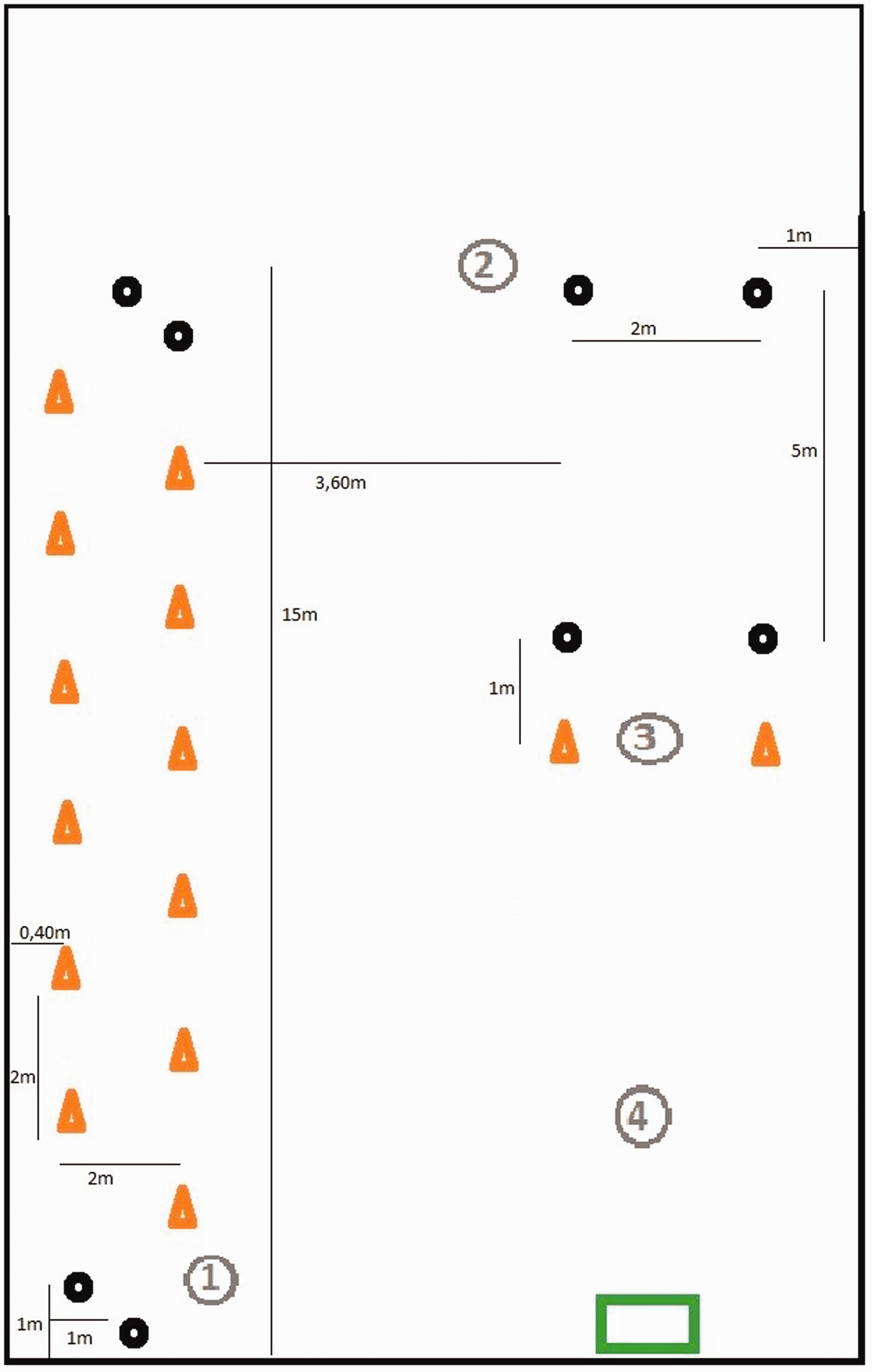
The field hockey skill test. The child starts behind the black cones. When the child runs through the black cones, the time recording is initiated. First, a large slalom is performed (1). The child runs to the second part of the track (2), where they run backwards with the ball. At (3), the child performs a figure 8 around the cones. Lastly, the child tries to score a goal at (4). Note that the orange cones represent cones 35 cm high and solid circles represent cones 8 cm high. The green rectangle is a 100 cm wide goal.
Part 1 (i.e. slaloming) has adequate reliability (ICC = 0.78). 16 Test reliability was shown to be medium high between on the one hand, part 1 (i.e. slaloming) and on the other hand part 2 (i.e. moving backwards with ball), part 3 (i.e. performing a figure 8) and part 4 (i.e. shooting) (r = 0.762, p < 0.001). 17 Test–retest reliability was high: r = 0.87, p < 0.001 for part 1 and r = 0.63, p < 0.001 for parts 2–4. 17 Also, it was shown that the total scores on the field hockey test were significantly different between young players who played field hockey and non-players, attesting for criterion validity of the test. 17
Procedure and design
A crossover-design with two groups was used. Because the participants in a crossover-design serve as their own controls, this reduces the influence of confounding covariates. In addition, this design was considered fairer, since every participant got the opportunity to practice with the modified hockey ball and thus profit from its advantages, if any. The two groups were formed by assigning the players of the 15 participating teams to them on the basis of the players’ average amount of hockey experience per team. That is, after determining the average amount of hockey experience per team, the teams were ranked. Next, the team with the highest rank was assigned to group A, the second and third ranked teams to group B, the fourth and fifth ranked teams to group A, and so on. As a result, seven teams were placed in group A and eight teams were placed in group B. Group A trained with the modified hockey ball in the first intervention period and group B in the second intervention period (Figure 3).
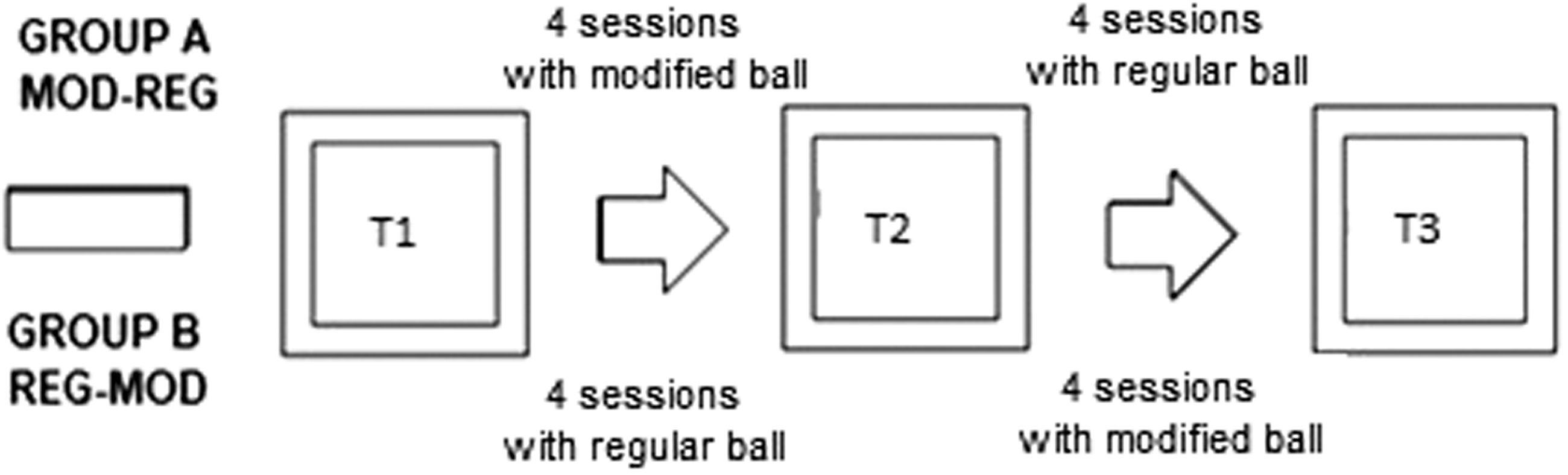
Experimental design for both groups (T1: pretest, T2: intermediate test, T3: posttest).
The investigation extended over a period of 7 weeks. In the first, fourth and seventh weeks, children performed the field hockey skill test as pre-test, intermediate test and post-test, respectively. The field hockey skill tests were performed with a regular hockey ball. They were performed during a regular training session. First, a research assistant showed how to perform the hockey skill test. The participants were subsequently allowed to practice the test once. After this, the participants had to perform one test trial. Total test time (i.e. the combined time for parts 1 to 4) was recorded with a hand-held stopwatch. To increase standardization of measurement, the handheld stopwatch was always operated by the same experimenter.
In the second, third, fifth and sixth weeks, the intervention took place. Participants trained either with the modified hockey ball or with a regular hockey ball, depending on group condition (Figure 3). Training sessions took place two times a week for 60 min on each day on an artificial hockey pitch in a circuit style (4 exercises of 15 min, of which 45 min were exercises with stick and hockey ball). The training sessions were performed by the team trainer and consisted of basic technical exercises, with themes like controlling the ball, dribbling the ball, passing the ball and playing a small sided game (see Table 1). Both groups performed the same exercises, only the balls differed. Estimated ball contact time per player per training was 20–30 min. To ascertain that each group performed the exercises as similar as possible, the main researcher explained the planned exercises comprehensively to the trainers before the training, and trainers could ask questions. The trainers were told to adhere to these exercises, but were not informed about the purpose of the study and also not that the hockey balls were modified.
The study design: scheduling of sessions, study phase and exercise themes.
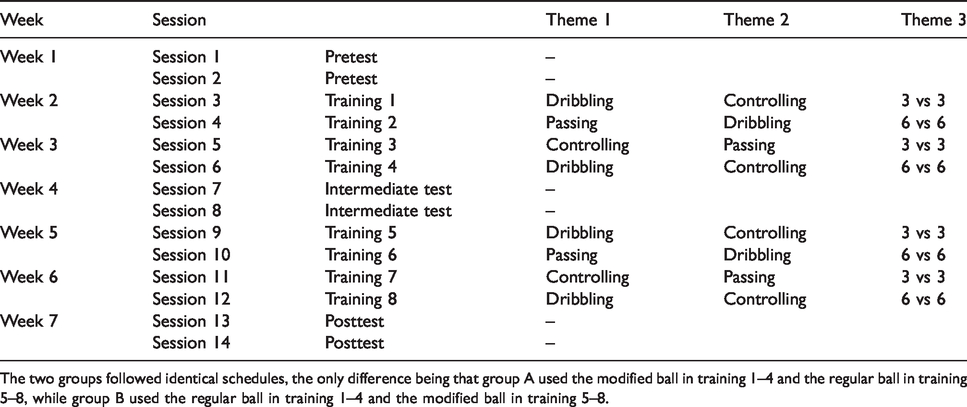
The two groups followed identical schedules, the only difference being that group A used the modified ball in training 1–4 and the regular ball in training 5–8, while group B used the regular ball in training 1–4 and the modified ball in training 5–8.
Data analysis and statistics
All statistical tests were performed using SPSS 25.0. The total time was submitted to a 2 (group: A, B) × 3 (time: pre-test, intermediate test, post-test) analysis of variance with repeated measures on the last factor. In the case the assumption of sphericity was violated, we report the results of Greenhouse–Geisser correction. Post-hoc comparisons were carried out using t-tests with Bonferonni corrections. Effect sizes were expressed as ηp2 with ηp2 < 0.01 being interpreted as small, ηp2 < 0.06 as medium and ηp2 < 0.14 as large. 18 The level of significance for all tests was set a priori to 0.05.
Additionally, for each participant, we calculated the difference between learning with the modified ball (i.e. the difference between the total times on the tests before and after practice with the modified ball) and learning with the regular ball (i.e. the difference between the total times on the tests before and after practice with the regular ball). This difference score indicates the degree the participants showed extra learning benefits from practice with the modified ball relative to practice with the regular ball. Pearson product correlation was performed to assess the relationship between hockey experience and this difference score.
Results
Starting with 129 participants, 27 were excluded from analyses because they either did not complete enough practice sessions (i.e. at least 3 out of 4 in each period, N = 11) or did not complete all the test sessions (N = 16). Of the excluded participants, 12 belonged to group A and 15 belonged to group B. Consequently, the final analyses included 51 participants for both groups.
Total times to complete the field hockey skill test are shown in Figure 4. The analysis of variance showed a significant main effect of time (F(1.68, 168.10) = 91.34, p < 0.001, ηp2 = 0.477) and a significant interaction effect between time and group (F(1.68,168.10) = 18.69, p < 0.001, ηp2 = 0.157). Post hoc tests indicated that there were no differences between groups at the pre- and post-test. However, group A performed significantly better in the intermediate test (t(100) = –3.21, p = 0.002). In addition, significant improvements in performance between the pre-test and intermediate test were found for both group A (practicing with modified ball; t(50) = 8.24, p < 0.001) and group B (practicing with regular ball, group B: t(50) = 2.84, p = 0.007). Between the intermediate- and post-test only group B (practicing with modified ball) showed significant performance improvements, t(50) = 7.44, p < 0.001). Group A (practicing with regular ball), however, did not show further improvement from the intermediate test to the post tests (t(50) = 0.48, p = 0.632).
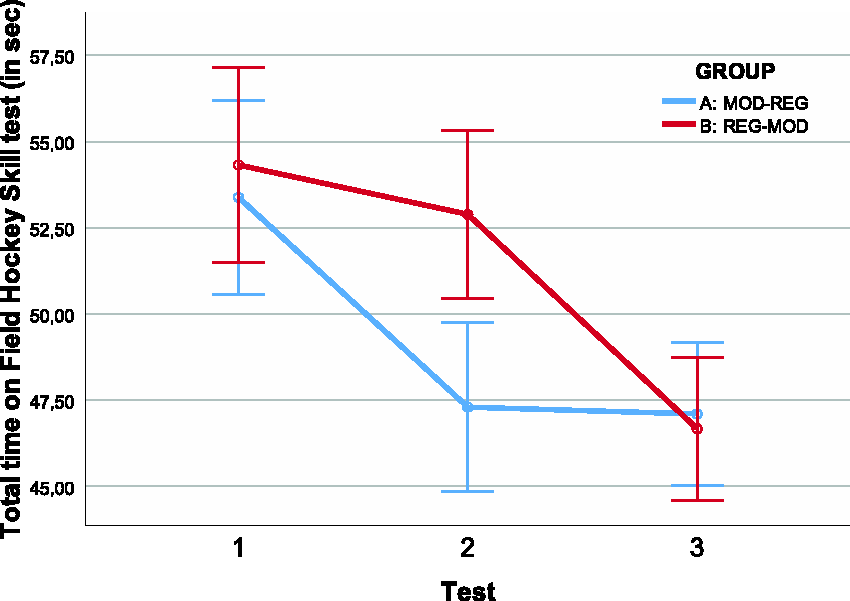
Total times on the hockey track for both groups.
The participants in Group A (who started practicing with the modified ball) had an average hockey experience of 1.89 years (SD = 0.94, range 0.06–4.06 years) and the participants in Group B (who started practicing with the regular ball) had an average hockey experience of 1.91 years (SD = 1.16, range 0.06–4.06 years). An independent samples t-test showed that there was no difference in amount of hockey experience between the two groups, t(100) = –0.087, p = 0.931. Analysis showed that hockey experience was a significant predictor for the pre-test: r(102) = –0.388, p < 0.001. Finally, hockey experience and the learning effect with the modified ball (i.e. the difference score for learning with the two balls) did not correlate significantly (r(102) = –0.119, p = 0.232, Figure 5).
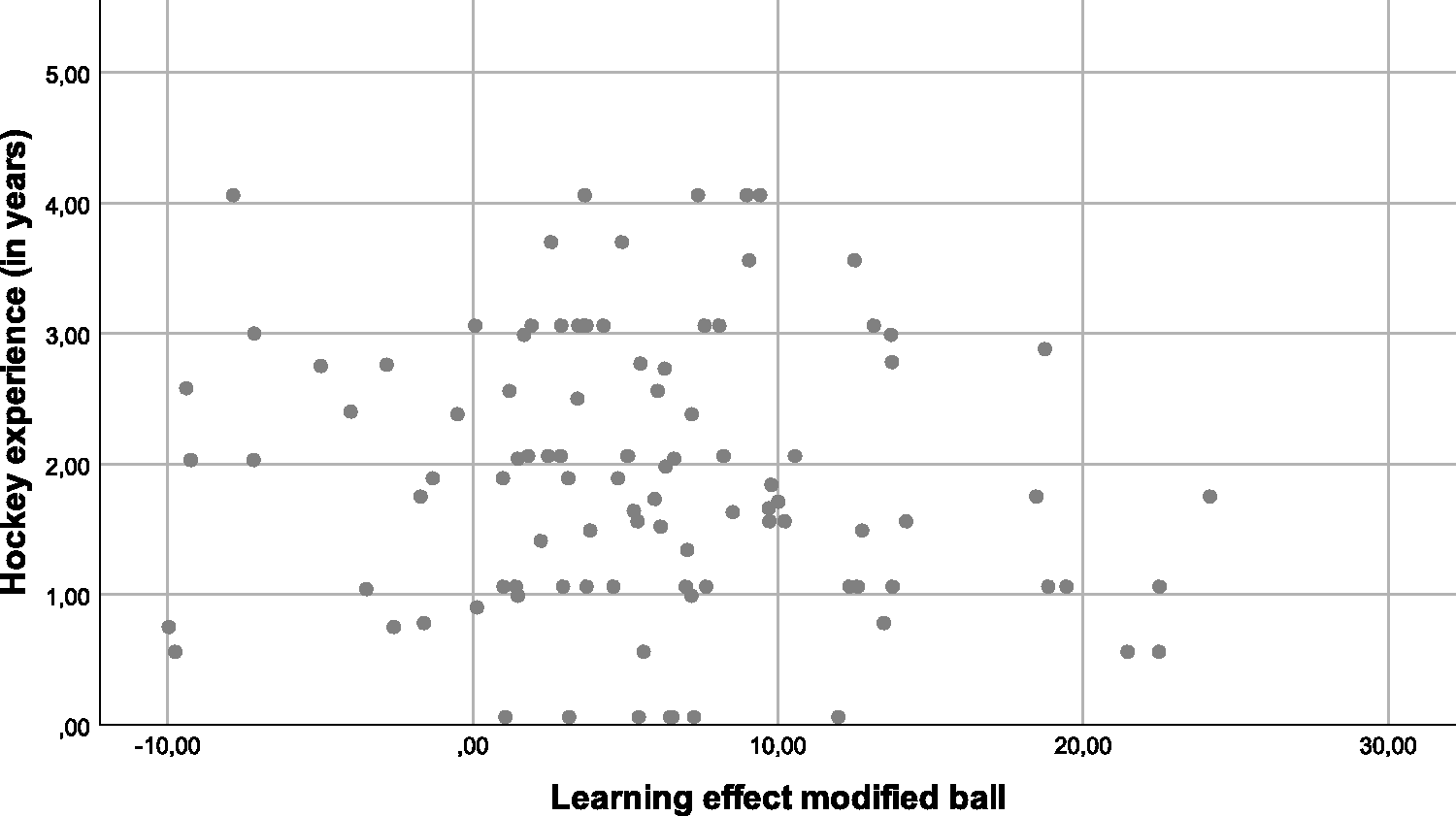
Scatterplot of the correlation between learning effect of the modified ball and hockey experience.
Discussion
The aim of the present study was to investigate whether motor skill learning is promoted by increasing movement execution redundancy. To this end, a group of young field hockey players with fairly large range of hockey experience trained with both a regular and a modified hockey ball. The distribution of mass in the modified hockey ball was such that it resulted in more variable, less predictable rolling trajectories. Presumably, this increased variability enforced the players to make more adjustments in stick handling while dribbling, passing and shooting the ball, thereby increasing execution redundancy. Following Ranganathan and Newell 7 (see also Lee et al. 10 ), it was hypothesized that the increased execution redundancy during training with the modified ball would lead to increased improvement on field hockey motor skills compared to training with the regular, traditional hockey ball. We also anticipated, based on earlier observations,10,11,13 that this beneficial effect of the modified ball would be more pronounced for the more experienced players compared to the beginner players. The results confirm our main hypothesis: improvement of field hockey skills was significantly enhanced with the modified hockey ball compared to the regular hockey ball conditions. This effect, however, was not mediated by experience, and thus failed to support our secondary hypothesis.
This is one of the first studies to show the positive effects of movement execution redundancy on complex sport motor skills in a realistic setting, namely during the regular group training. Two earlier studies10,11 did not show fully convincing evidence that increased execution redundancy promotes relatively permanent improvements in motor skill performance, although there were suggestive adaptations in movement patterns. Indeed, many studies have manipulated sports equipment, for instance, by reducing the size of the tennis racket, by designing lighter balls and by shortening pitch length (for an overview, see Buszard et al. 19 ), the underlying rationale being that this equipment scaling allows children to adapt more quickly to their use, while requiring less cognitive resources. The current study shows that the equipment manipulation does not only promote improvement because it is easier to use, but that equipment modification can also enhance improvement by increasing movement execution redundancy.
Traditional approaches typically assume that for each task a single ideal movement pattern exists, which all learners should strive to acquire.20,21 This has resulted in a prescriptive pedagogy. By contrast, the constraint-led approach conceptualizes motor skill and learning as emerging from the interaction between the performer, the task and the environment. Rather than prescribing movement patterns to learners, this approach advocates the manipulation of task constraints to encourage learners’ exploration of movement variability in order to achieve functional movement solutions. This so-called nonlinear pedagogy approach10,22 sits well with the current manipulation of equipment. The inherently less predictable rolling of the modified hockey ball in this study presumably creates a constantly changing challenge, forcing the player to control the action by coupling to the momentary unfolding information. In addition, the more erratic rolling of the ball is thought to induce a more active exploration, creating a larger movement repertoire (i.e. degeneracy), which allows a learner to achieve the same task goal in different ways and to better adapt to different situations. It must be noticed that presently it is still an assumption – a well-founded one we think – that the more erratic rolling of the ball did indeed induce increased movement variability. It is important for future research to verify this assumption by evaluating movement execution during the practice exercises in more detail. In this respect, the movement clustering analysis performed by Lee et al. 10 to identify distinct movement patterns in children learning to hit a tennis stroke may be implemented. Such an approach, however, would require high-dimensional kinematic recordings, which would be difficult to achieve in-situ as per current study.
In many studies, the manipulation of equipment is clearly noticeable to the learner (again, see Buszard et al. 19 ), which likely results in deliberate and conscious efforts to adjust to the modified equipment. By contrast, in the current study, the modified and regular balls had an identical appearance; both the regular and the modified hockey balls had exactly the same size and weight, and participants and their trainers were not informed that modified balls were used. After the study had finished, the main researcher did ask 30 participants informally (i.e. without sitting down and/or using standard questionnaires) whether they had noticed any differences between the regular hockey ball and the modified hockey ball. Most children responded that they had sensed ‘something peculiar’ about the modified ball, but were unable to articulate what was different, except for the colour of the ball (i.e. the modified balls were yellow, while the regular ball was white). None of the children reported that the modified ball rolled differently. This may suggest that the modified ball induced an implicit learning process, in which learning occurred without the usual accumulation of declarative knowledge. 23 This would be interesting to assess in further research. It has been argued that implicit learning is advantageous, especially for learners with relatively low motor skills and/or weak working memory.24,25 However, not all studies confirm this. 26 In addition, implicit learning has been shown to result in enhanced resistance against the adverse effect of stress. It is important to assess to what degree the present advantages of increased execution redundancy remain in more explicit and/or stressful environments. Finally, it also important to explore the long-term learning effects using a delayed retention test.
It was also hypothesized that the learning advantage of increased movement redundancy would be greater the more experience the field hockey players had accrued. Although experience logically predicted performance on the pre-test, it did not predict the magnitude of the improvement advantage of the modified ball. Accordingly, independent of the degree of hockey experience, participants, both beginners and more experienced players, improved their skills more when training with the modified ball than when training with the regular ball. We had hypothesized that novices might need to learn to achieve the task goal first and only then increased execution redundancy would benefit further performance improvements. Our results do not support this hypothesis, as both the novices and the more experienced players improved more while training with the modified ball. We might speculate that this relates to the novice and more experienced players having trained together and performing the same exercises, possibly reducing the relative training challenge for the more experienced players. However, as this result diverges from other studies, more research is needed to verify the relationship between movement redundancy and experience in sport.
One limitation in this study is the use of a handheld stopwatch to measure the time for the field hockey skill test. To minimize measurement errors, subsequent work should use a digital, automatic measurement system (see e.g. Stöckel et al. 27 ). More importantly, however, although the time needed to complete the test was previously shown to have good validity for discriminating players of different skill level, 17 it neither gauges the coordination and control parameters that underpin these skills, nor does it address a player’s adaptivity in more dynamic, game-like situations. For future work, it would be pertinent to include kinematic measures to assess the degree to which the modified ball indeed results in the purported increase in degeneracy or larger repertoire of movement solutions. 10
We conclude that increased movement variability during practice by using a modified ball leads to a significant improvement in field hockey skills. An advantage for the application of the modified ball is that the manipulation of the hockey ball does not require specific training of coaches or very strict instructions, this in contrast to for instance many studies on implicit learning (for instance, see Brocken et al. 26 ). Therefore, hockey trainers are encouraged to use this modified hockey ball in their regular training sessions to fast-track learning.
Footnotes
Acknowledgements
We would like to thank all children and trainers who participated in the present study for their time and cooperation. Also, we would like to thank the reviewers for their useful feedback.
Declaration of conflicting interest
The author(s) declared the following potential conflicts of interest with respect to the research, authorship, and/or publication of this article: Geert Savelsbergh has been involved in the design of the adaptaball (the modified ball). The study is not funded by the manufacturer of the adaptaball.
Funding
The author(s) received no financial support for the research, authorship, and/or publication of this article.
