




Abstract
A constraints-led approach (CLA), based on an ecological dynamics rationale for athlete learning and development has been applied to analyses of individual and team sports. To date, such an approach has yet to be applied to the learning of coaches. Here, we propose how applying a CLA in education and professional development programmes can shape emerging behaviours of coaches as they interact with constraints of representative environments to adapt their practice. A core concept within ecological dynamics for coach education is the conceptual differentiation between knowledge of (direct perception) and knowledge about (indirect perception) the environment. Current coach education and development practices focus primarily on the acquisition and transmission of knowledge about, which over-relies on provision of (abstract) verbal and visual augmented corrective information found in manuals. Reconsidering coaches’ behaviours as emerging under constraints provides a coach developer opportunities to identify and manipulate key individual, environmental and task constraints. This approach guides attention to relevant and alternative affordances (opportunities for action) when coaching, and promotes continuous self-regulation of coach learning, supported by an experienced mentor. Learning to coach through a CLA could result in an extensive appreciation of multiple sources of knowledge, resulting in a continuously deepening fit between the coach and their performance environment. An ecological perspective of a coach learning to adapt to the constraints of a performance environment offers an alternative to current formalised coach development practice.
Introduction
Professional education and development of sports coaches remains an important issue for both national governing bodies and academics, with current evidence for coach learning suggesting that expert coaches continually seek to learn and refine their practice. 1 The development of coaches’ skills and capacities for interacting with athletes and teams has been identified as an important challenge for coach education, 2 yet many coaches struggle to achieve the continuous learning that characterises professional development. 3 A major issue is that, allied with the complexity of the task, the coach learning process is little understood at the ecological scale of individual-environment, tending to focus on discrete skills or sport specific content. 4 This deficit has led to calls for a theory of coach learning to be identified and developed. 5 Also, the changing nature of sports and physical activities at all levels, due to continuous modifications of equipment, rules, sports formats, emergence of new technologies, as well as theoretical and professional developments, emphasises the need for coaches to continually develop their pedagogical skills and knowledge. 6 In other words, coaches need to learn to continuously adapt to the dynamic landscape of sports performance and athlete development.
Despite coach learning being proposed as an idiosyncratic process, 7 existing research has focused on retrospective, descriptive accounts of the development and methods of elite and successful coaches. 8 Similar to professional concerns about how athletes and teams learn to enhance performance, there is a need to better understand how coaches become more skilled in their work. 9 There have been few attempts to conceptualise learning and development of coaches: (i) across domains, 10 (ii) through studying experiences of novice or emerging coaches making the initial steps into coaching from diverse beginnings, 11 and (iii), by examining trajectories of former or current athletes, parents, graduates, or enthusiasts. Where efforts have been made to propose guidelines for learning, and consistent routes to successful coaching, there have been attempts to standardise and quality-assure coaches through formal qualification pathways and the sharing of best practice. 12 This asymmetry, focused on the acquisition of pedagogical knowledge and skills supposedly relevant to the coaching process, 12 neglects the important role that the constraints of the environment and task of coaching may play within the embedded learning of a coach as they practice in-situ.
Research has tended to focus on the categorisation of coach learning experiences as formal, informal and non-formal opportunities.13,14 Research has also evaluated and directed attention to the passing on of theoretical knowledge about processes and methods of learning and coaching from a social lens: via mentoring, communities of practice and programmes of formal education.4,15,16 However, it is well documented that coaches value informal learning above formal opportunities, 17 and that understanding of coaching is more effectively developed in relevant context-specific environments for a coach. 18 Aligned with criticisms of current pedagogical approaches to athlete skill acquisition, a major concern is the over-emphasis in coach education on technical knowledge about how and what to coach.19,20 Coach education steeped in a constraints-led approach (CLA) could help trainee coaches to develop requisite understanding and knowledge of contemporary theories of motor learning and talent development required to help them comprehend the range of dynamic constraints that impinge on the learning process. In other words, traditionally educated coaches risk attending to the operational procedures of coaching, rather than to its actual practice.
Experiential learning has been identified in the literature as a significant element of the progression to expertise. 21 Research has been concerned with engaging coaches in reflective practice as a mechanism of learning.5,22 Whilst the value of reflection is evident for established coaches, there remains a shortage of research addressing how novice and developing coaches find their way through practice dilemmas, given their limited practical and theoretical understanding. 11 Further problems emerge from relying on practice experience as the source of learning for novice coaches as this may result in unchallenged beliefs about learning and coaching that reinforce outdated and less than suitable pedagogies.20,23 A path dependency of learning may be established as novice coaches’ experiential knowledge is limited by what they already know (from coaches who coached them or from over exposure to traditional manuals in coach education programmes). This convention in coach education over-emphasises what the ecological psychologist James Gibson 24 referred to as knowledge about the environment: second-hand information with an operational emphasis. Rather than encouraging the learning coach to adapt to the dynamic constraints of different coaching contexts, settings and cultures.25,26
In this paper, we explore an ecological perspective of coach learning, based on a trainee coach continually adapting in direct interaction with the task constraints 27 of coaching, and the social, cultural and historical constraints of a sport performance environment. 28 We discuss how coach education practice has the potential to be enhanced through continuous contact with these intertwined constraints, enriching the experience of both the learning coach and athletes. Specifically, we consider how key concepts from ecological dynamics provides a suitable framework to underpin a CLA to the learning, education and development of coaches.20,25
Coach learning under constraints
A recent survey of UK coaches highlighted that a significant portion (34%) of respondents failed to engage in any informal learning or continued professional development beyond qualification (UK Coach Survey 29 ). A key question for coach education is, therefore: Does the current approach to skill development challenge coaches enough to promote their continual learning and development? 30 At present, coach learning relies on the assumption that ‘handed on’, descriptive knowledge about the coaching process is a rather static entity which can be seamlessly integrated into a coach's practice. The danger of such an approach to conceptualising knowledge of coaching is that it may reify a path-dependent future, whereby a trainee coach may be encouraged to regurgitate formalised coaching content from manuals and programmes to which they are exposed.20,31 Subsequently, socialisation via powerful sociocultural constraints of an environment could lock-in operational methods and processes of how to coach 25 (i.e. focused on reproduction of mechanical, reductive, coach-centred and comparative methods of coaching). The outcome of current coach education methods is the creation of a seemingly adapted workforce (i.e. without the intention to continue searching and exploring the environment), reproducing the ideas of more experienced coaches, incapable of informally enhancing and developing their practice as they encounter contemporary pedagogical theories and are exposed to the dynamic constraints of different coaching contexts.20,32
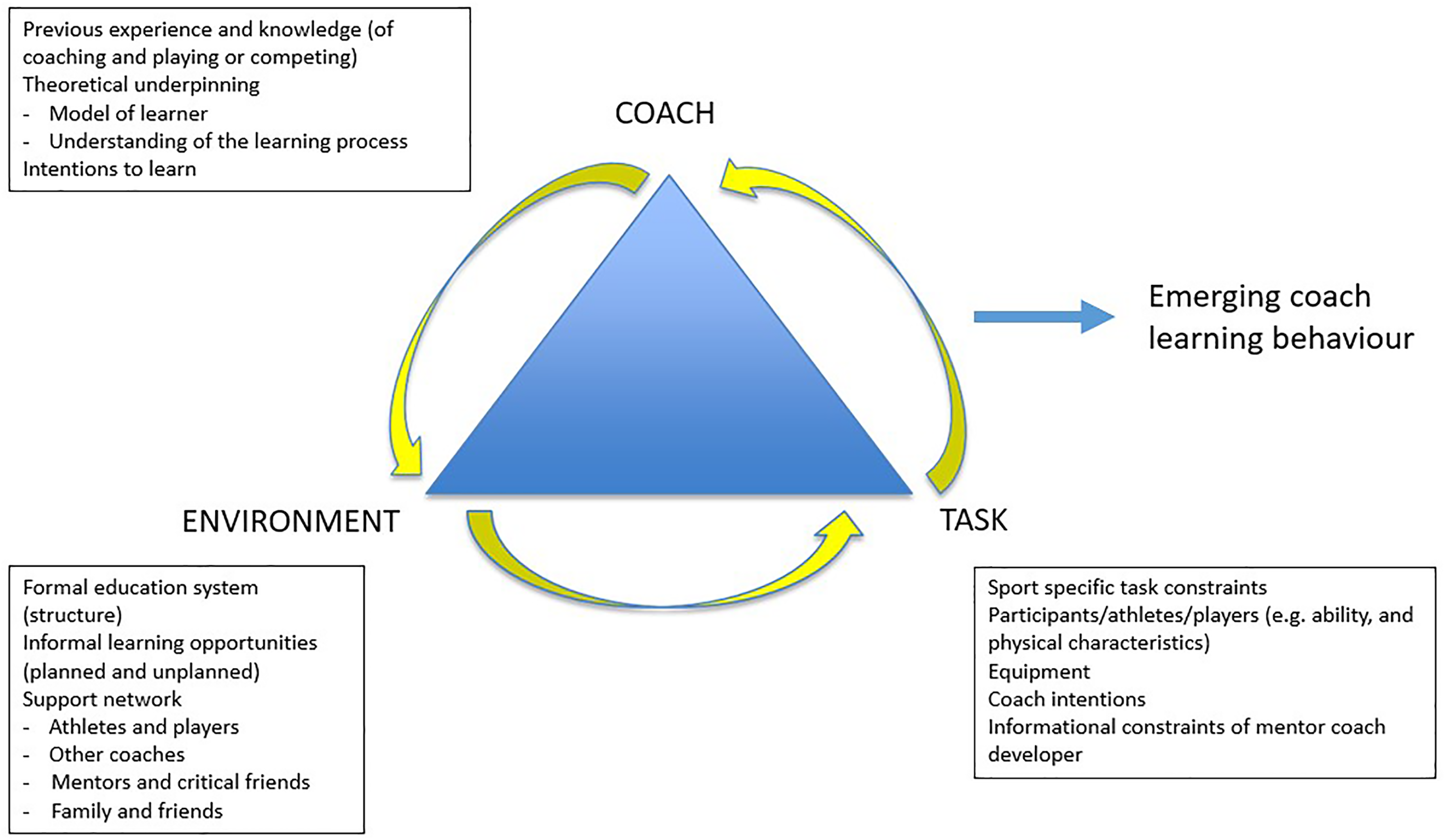
Ecological dynamics 35 is a contemporary applied scientific framework which brings together concepts from ecological psychology,24,36 complexity science 37 and constraints on dynamical systems 33 to explain relevant behaviours including performance, development and learning. 38 In an ecological dynamics rational, sport performance behaviours have been shown to emerge under surrounding individual, task and environmental constraints, 33 and in the same way, coach behaviours could also continuously emerge under such interacting constraints (Figure 1). An ecological dynamics analysis reminds us that it is important to consider that a coaching context is continually ‘in formation’ and is never ‘fully formed’. This key concept in ecological dynamics signifies that the skills, knowledge, expertise and experiences of coaches at all levels are continually developing under interacting personal, task and environmental constraints of a coaching context. The constraints acting on each coach differ, which is an important consideration for coach developers, since these constraints act as information that continuously shape and guide emerging behaviours whilst coaching. Understanding which of these constraints may support development, or which may act as ‘rate limiters’ (factors potentially restricting or blocking a potential change in a system), on learning is a requisite insight for coach developers. The continuous exploration and discovery of specifying information (regulatory information which highlights affordances (opportunities or invitations 39 ) for successful coaching behaviours) attunes the perception-action system of the coach. Over time, increased attunement (heightened sensitivity) to specifying information in a coaching environment supports a transition to a new state of knowing how to coach better, represented by an enhanced knowledge of the environment. 40 To summarise thus far, ecological dynamics explains coach learning as a process of searching for (exploring) and then exploiting (attuning to) the information that specifies relevant affordances of an environment for more effective coaching. Successfully following this process will help a coach to express their agency by continuously self-regulating (adapting in the moment, and refining long term) their coaching behaviours. 41
Knowledge about: a traditional, indirect approach to coach learning
Gibson 24 identified two forms of knowledge needed for individuals to navigate their environments: external representation or knowledge about, and cognition informed by affordances or knowledge of the environment. Knowledge about an environment can be considered as indirect, description of a phenomena created by a mediator as a way of having access to facts about an environment. For example, a graphic of a tennis court showing frequency data on technical actions performed. The map mediates the perception of an actual tennis court, and even the perception of the phases of play when a coach uses appropriate signs and symbols to externally represent technical actions. The implication of Gibsonian ideas for coach education is that the knowledge about the environment is valuable in supporting someone in verbally describing what to perceive or even what could be done, but is rather limited in guiding them to directly interact with their surrounds. Unfortunately, this sort of knowledge about the environment is over used in tuition programmes supported by verbal instructions, pictures, images and graphics. 6 This type of second-hand knowledge may not encourage coaches to challenge their current thinking, explore and discover pedagogical methods beyond what is formally reinforced or culturally acceptable.42,43 In coach education programmes, an overemphasis on knowledge about the environment may result in coaches who are highly adapted to or enculturated into adopting specific traditional prescriptive methods of practicing.
A contemporary, direct approach to coach learning
In contrast to knowledge about, Gibson's 24 conceptualisation of knowledge of the performance environment supports individuals in their continuous direct interactions with their task and environmental constraints. This type of knowledge is useful in different types of performance: organising actions, making decisions, detecting relevant information to regulate behaviour and solving problems directly (when performing and coaching in sport), rather than describing how to perform (i.e. commentate) and coach. Such an epistemological view of knowledge influences the way in which we understand the learning process of athletes and coaches as they undertake routine tasks of preparing for performance and when coaching. Like athletes, coaches use environmental information (knowledge of: i.e. sight, sound, feel and touch) to directly regulate continuous interactions with performers and stakeholders, rather than write plans or verbally explain how they should interact with performers and a performance environment (rather like a ‘how to’ manual of coaching).
Gibson's 36 insights on different types of knowledge contribute significantly to an ecological perspective on learning and development that has been applied to the design of practice activities for individual athletes and sports teams over the past three decades.35,44,45 The application of an ecological dynamics approach to coach education is also important as it emphasises that behaviour and skills emerge under different constraints over timescales of performance, learning and development, through constant interactions of the individual, task and environment 34 (Figure 2). With respect to coaching, adopting an ecological perspective requires an understanding of the coach in continuous interaction with their specific performance environment. In this way, it avoids the problematic asymmetry of previous approaches applied solely to analysing the coach (or their relevant behavioural subsystems) or a specific method of delivery in professional practice. 46 An ecological perspective on learning to coach can be considered as the continual process of developing an improving, more refined, functional fit between a coach and their coaching environment. With learning and experience, the ongoing self-organised and growing sensitivity to knowledge of a performance (i.e. coaching) environment47,48 helps coaches to functionally support athletes in their preparation for performance and development.
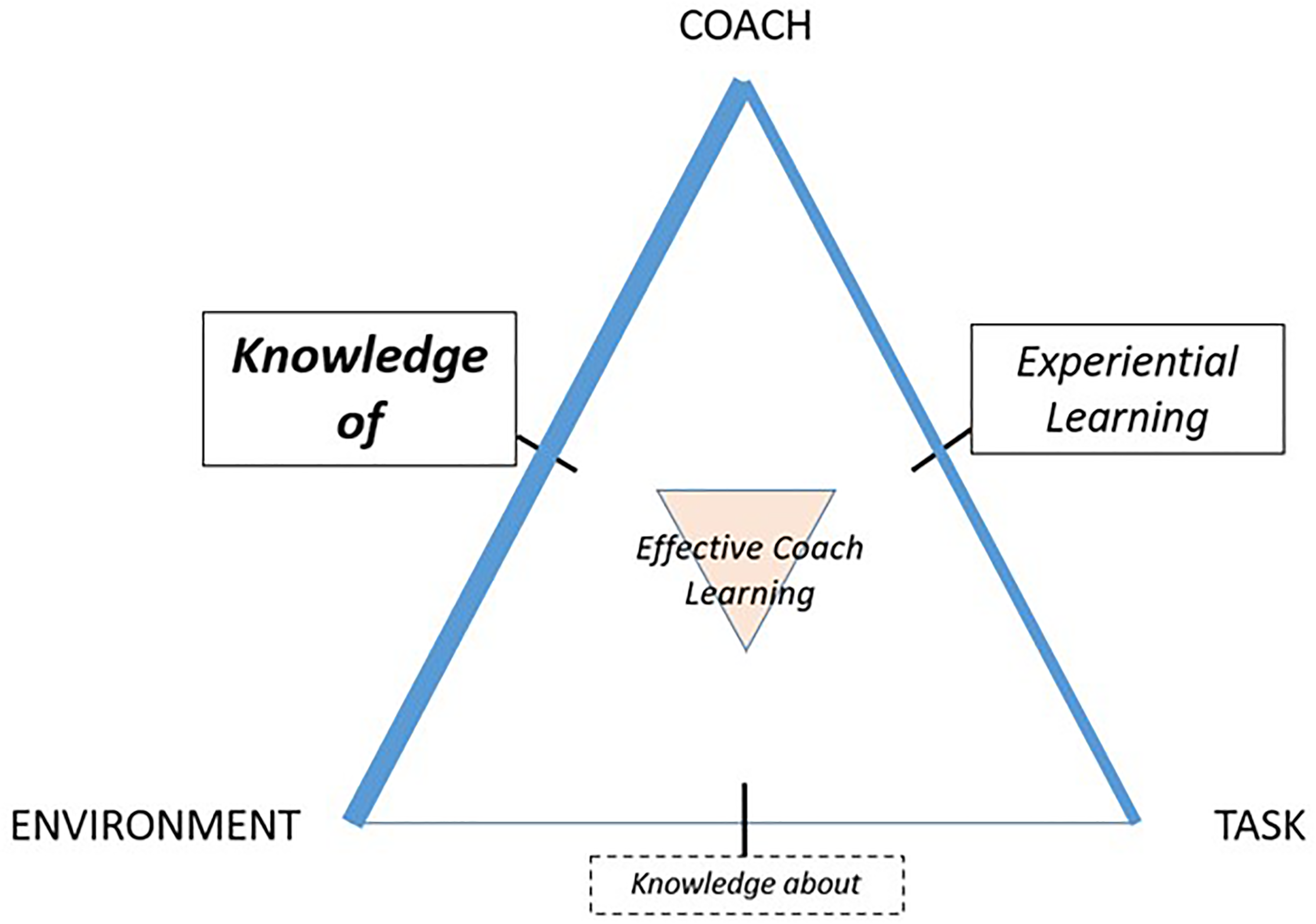
How interacting categories of constraints influences coach learning and development. Extensive experiential learning and understanding provides knowledge of the environment, combined with just enough knowledge about the coaching process, to create a most effective coach learning environment. Developing coaches who emerge from the simultaneous interaction of these sources of constraints have the potential to continually inform and reshape their behaviours, in a dynamic process of co-adaptation with the environment.
In ecological dynamics, it is imprecise to think of the process of learning as being predictable and linear, rather it can be considered as a phase-like, nonlinear process. 34 Ecological dynamics advocates a three-phase model of learning: search and exploration, discovery and attunement and calibration. 49 This model proposes that exploration is not only a feature of novice behaviour in a task, but also remains an important feature of expert learning behaviours.50,51 Aligned with these ideas, an ecological dynamics approach applied to coaching emphasises that novice coaches explore to learn, developing coaches learn to explore and experts explore efficiently. 34
Here, we argue that the various overlapping and proximate phases proposed for motor learning can also enhance our understanding of how coaches learn to coach. All coaches can benefit from a theoretical model of the performer and learning process to guide their decision-making and interactions with athletes at all levels of performance. 52 Coaches’ intentions to explore their practice effectively can be shaped by an ecological conceptual model of the performer and the learning process that underpins their approach.
Explore, discover, exploit: an ecological framework for coach learning
An ecological explanation of learning notes that context means everything. 53 Context-dependent constraints (highly contextualised information and experiences, guiding knowledge of the environment) continually shape the learning designs coaches use with individual athletes and teams. Designing specific contexts in sport requires coaches, like athletes, to become attuned to specifying information in a performance preparation environment to achieve intended aims and objectives. 54 Initial stages of learning to coach involve the coach exploring the environment, searching for relevant perceptual information sources which may be coupled to their actions (e.g. activity design, use of different modes of communication including verbal, visual and non-verbal, individualised approaches) in a specific learning context. At the next stages, coaches can learn to become increasingly sensitive to available affordances of the coaching environment, learning how to regulate their pedagogical behaviours to achieve coaching goals. These ideas emphasise the need to reconceptualise pedagogical agency in educational practice addressed by Aspbury-Miyanshi. 55
Context-dependent constraints emphasise that a single coupling of perception and action cannot be generalised to all similar situations, as behaviour is dynamic and needs to be understood as ‘becoming’ and stable only in that moment. 49 In this way coaching behaviours can be understood as highly contextualised, emergent and adaptable. In other words, coaching needs to be uniquely balanced between stability and flexibility, with the capacity to change and flow with the dynamics of task and environmental constraints, which vary on different occasions. Over time, learning – as an adaptable process of exploration and discovery – results in a calibration 56 between the behaviours of the coach, the task and environmental constraints (what is directly perceived).
Captured in such an ecological perspective, learning to coach needs to be considered and encouraged as an embedded and embodied process of navigating through a performance environment comprised of an abundance of constraints and entangled tasks. 57 This process is predicated on Gibsonian ideas 36 that conceptualise an individual's environment as being rich in information, which specifies affordances, or opportunities for action. What an environment affords an individual depends upon the individual's intentions, perceptions and action capabilities. 36 For example, a coaching environment in team games may offer the opportunity for coaches to explore the use of small-sided and conditioned games, if there is a variety of playing areas differing in dimensions and shapes specific to performance contexts in sports like basketball, rugby and football codes. If such an affordance is not available to coaches, then it is possible that a coach developer may constrain the coaching task to encourage coach exploration using markers and cones to simulate the affordances available in varied phases of play.
Further, coaching athletes to pole vault can be undertaken via the presence of necessary equipment and space for athletes to perform a pole vault. However, if the environment surrounding the coach does not have enough equipment for vaulting or lacks an available safe pole vault area, it may be challenging for the coach to perceive some of the affordances for coaching pole vaulting. Similarly, the coach may have preferences and intentions to coach hurdling or high jump, therefore not utilising affordances for pole vaulting. These examples illustrate how an affordance for coaching should be understood at the ecological scale of the individual-environment relationship, through the interaction of personal, task and environmental constraints in practice. According to Gibson, affordances are ubiquitous in the environment and continuously available, but they may not be used by an individual due to the lack of effectivities (relevant skills, and capacities). Regardless, trainee coaches can be encouraged to use available affordances designed into a performance environment. Affordances were defined by James Gibson as not causing behaviour, but rather constraining and guiding its emergence. An affordance is a solicitation from a performance environment, which reveals value when perceived and meaning when acted upon by an individual. 36 The key idea for coaches learning to coach is that affordances solicit or invite behaviours based upon the current intentions and abilities of an individual, capturing the nonlinear nature of learning. 39 Athletes and coaches considered as nonlinear dynamical systems do not develop in a predictable, linear way, but rather may display progressions, instabilities, regressions, stabilities or plateaux, making it challenging to predict performance trajectories. This perspective poses a challenge to athletes, coaches and coach developers. The later may attempt to engage coaches in standardised training programmes and practice environments in a ‘one-size-fits-all’ approach. There are clear possibilities of limiting the chances of creating a suitably matched environment and experiences with each individual coach learner. These ideas suggest that coach developers could consider adopting an ecological dynamics approach in order to capture the vast complexity of the learning process as it emerges for each individual coach, depending on context, needs and potential barriers to change.
To summarise so far, reconceptualising coach learning through an ecological lens requires consideration of the representativeness of coach learning environments. Ecological dynamics defines representative learning activities as those that faithfully simulate the information and contexts encountered in a specific environment.58,59 To support self-regulation of learning, coaches must be exposed to a variety of representative coaching tasks, predicated on differences in quality of available practice space and technical equipment, for example. Regardless, the role of a coach developer is to guide and educate the attention of trainee coaches to relevant coaching affordances in developing an extensive knowledge of the learning environment. 24 This ecological dynamics approach in coach education would address the problem of coaches, like athletes, becoming adapted to a specific environment, rather than developing adaptiveness needed for engaging in continuous exploration in enhancing their knowledge of performance environments. 34
A learning system approach has previously been applied to the study of coach and athlete relations, 60 and to conceptualise the behaviours of an athlete as a learner. Until now, such an approach has not been applied to the coach as a learner embedded within a performance environment, despite its relevance (Figure 3). Adopting an ecological dynamics approach to coach learning offers positive outcomes in the form of a coach's adaptiveness to changing contexts of performance and practice, which maintains their value to an athlete or group as they progress along the developmental pathway. Additionally, the coach's value to a sport is enhanced more generally as they continue learning within their coaching form of life. 25 As the constraints of the task and environment change, along with athlete learning and development, so to do the task dynamics of coaching. For example, during the early period of learning, a track and field coach may include a variety of throwing experiences that help support exploration and discovery of how the body moves and generates forces as a fundamental basis for performance. With greater athlete experience, learning and performance, coaches need to understand how to design more representative throwing tasks which may be increasingly tailored to specific individual needs linked to specific competitive goals in a target sport. Therefore, coach education programmes need to adopt an adaptive (openness to multiple possibilities), rather than an adapted (tried and tested, best practice) outlook for coach development. What is essential is a focus on skill adaptation at the level of the athlete and of coaches and their educators. The latter groups can remain in synergy with the athlete and dynamics of the performance environment through being continually sensitized to a process of explore, discover, and exploit when working with learners (Figure 3). A coach's attentive responsiveness to change describes the complexity of the coaching task, which coach educators are challenged to help coaches embrace. This challenge can be summarised as the coach's ongoing ability to learn, or adapt, in representative coaching tasks (learning in context).
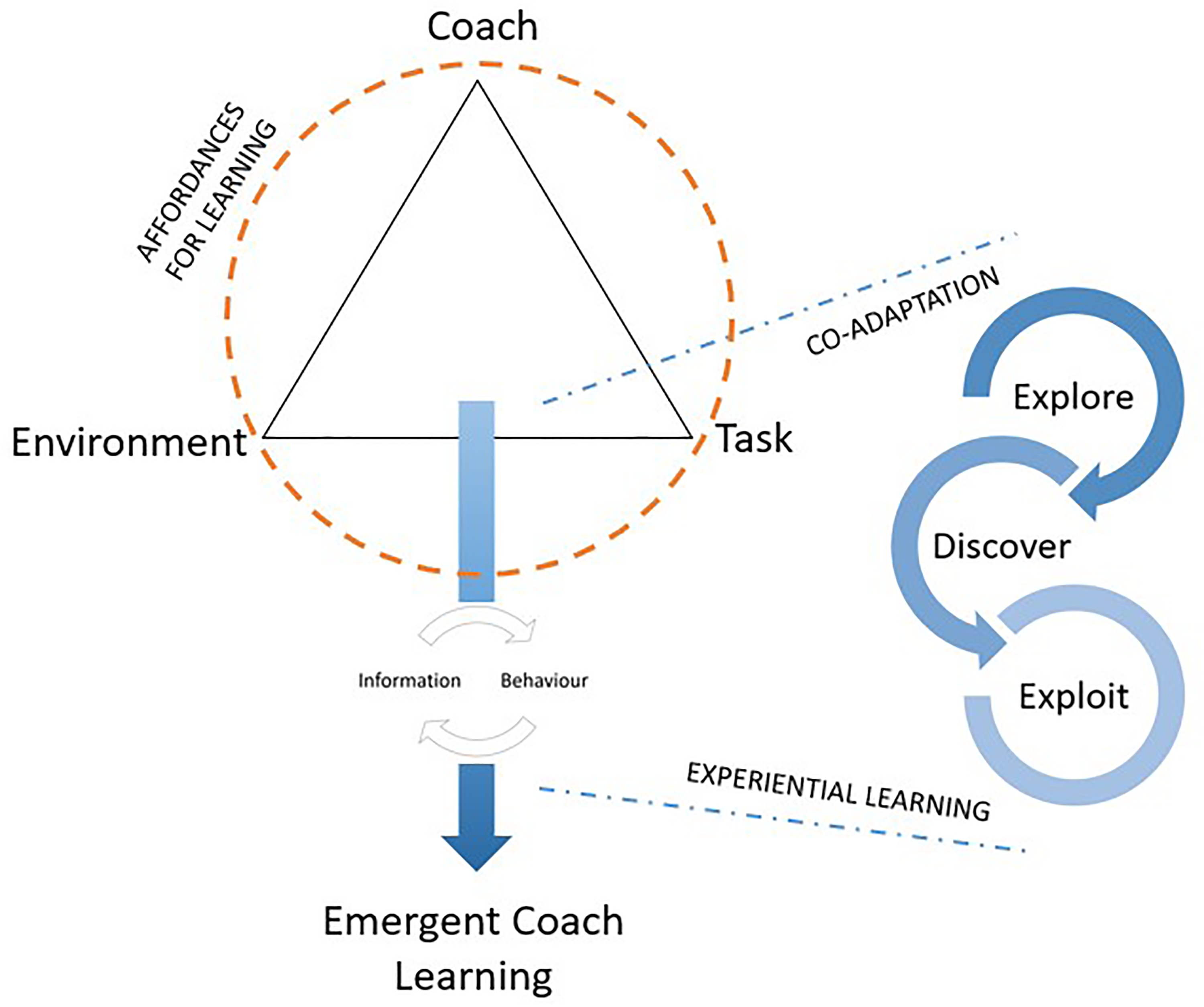
Coach-environment system applied to the coaching process, based upon Orth et al. 60 emerging coach behaviour results from an experiential learning process defined as: explore, discover and exploit, resulting in a deepening knowledge of the changing environmental and task constraints of coaching.
Implications for practice: a CLA to coach learning
An issue in coach development is the idea that coach learning from an ecological perspective does not follow a predetermined path as stipulated in highly structured formal coach education programmes. To confront this challenge, we propose that coach development adopts a CLA to coach learning in much the same way as applied to the learning process in athletes and teams. 61 In a CLA, individual constraints of intentions, previous history, knowledge and current behaviours continually interact with the physical, technological and sociocultural constraints of the environment. 62 The main implication for coach developers here is the need to appreciate the complexity of a coach involved in a learner-environment system, exemplified in Figure 3. Viewed through an ecological dynamics lens, the role of a coach developer is to facilitate and support an effective, emerging relationship between the coach, and the environment. 45
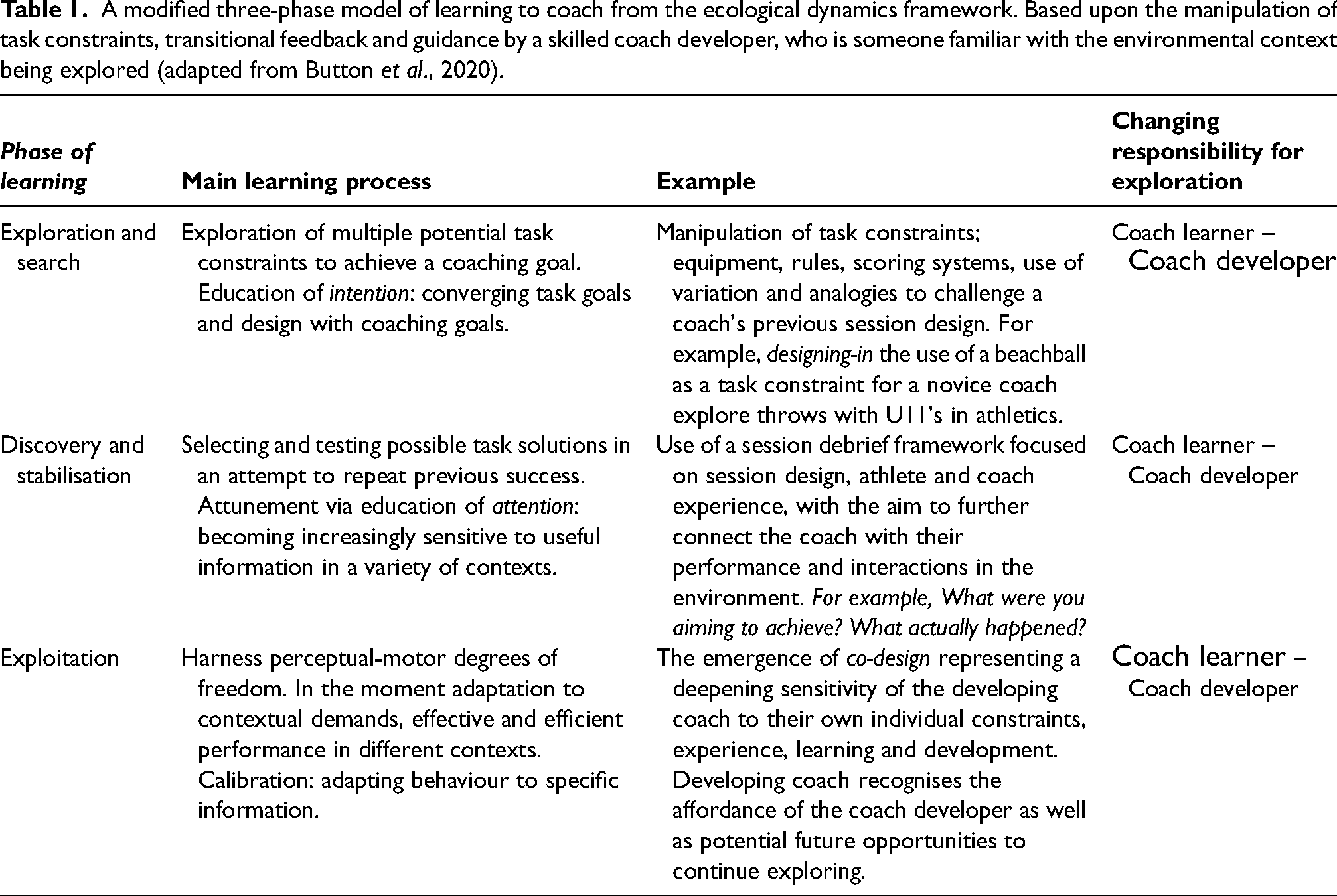
In meeting this challenge, coach developers need to conceptualise emerging ideas of how a CLA to coach learning may be applied in practice to support coaches to explore, discover and exploit the dynamic constraints of the coaching environment (see Table 1 for further insight). This change to a more systemic and contextualised perspective is not without its challenges. Here, we present a potential approach that a coach developer may follow to encourage coach exploration and learning: (i) careful manipulation of task constraints to challenge and destabilise current practice; (ii) guiding a coach's attention to critical features and information in the environment; and (iii), co-designing learning opportunities based upon a coach's developing awareness of their current abilities and intentions to learn.
A modified three-phase model of learning to coach from the ecological dynamics framework. Based upon the manipulation of task constraints, transitional feedback and guidance by a skilled coach developer, who is someone familiar with the environmental context being explored (adapted from Button et al., 2020).
Manipulating task constraints: destabilise current practice
Moving from a coach-centred to a coach-environment scale for understanding learning, changes the role of a coach developer to a designer of representative coaching tasks, facilitating coach-environment interactions. This idea clearly implies that the main task for coach development is to provide long-term, mentored experience of coaching, guided by a substantive theoretical framework for athlete learning and development. During the mentoring process, just as in coach-athlete relationships, a primary aim of coach developers is to guide the attention of coaches to pick up relevant information specifying available affordances in the coaching environment. 54 Over time, coaches become increasingly attuned to information in their environment, resulting in an improved fit with their specific ecological niche. 47
Adopting a constraints-led model of coach support during the mentoring process implies that the coach developer needs to understand: (i) the nature of the interacting constraints on each individual coach; and (ii), how manipulation of key task constraints can support exploration and discovery, resulting in emergence of functional behaviour. For example, at the microlevel of practice, coaches utilise some knowledge about their chosen sport to make decisions in preparation to coach (planning), during coaching (adapting), and post session as reflection. The problem with knowledge about the environment, is that it is an example of a context-independent constraint (composed of universal categories, kinds and types of knowledge). This type of knowledge does not require coaches to make observations beyond a simplistic descriptive comparison between a plan and current performance. The certainty implied by such an approach reduces the likelihood that a coach will engage in exploratory behaviours. This can lead to context-specific adapted behaviours, as the coach relies on standardised, predetermined responses to shape their ongoing behaviour (e.g. the reproduction of recognised best practice drills or activities). To avoid path-dependent, enculturation of a trainee coach, it is necessary to challenge a coach's pre-existing knowledge about learning that constrains the coach to be adapted in their current practice.
A key individual constraint that shapes the coaching intention (or goal) is the model of the learner-in-context and understanding of the learning process adopted by a practitioner. The introduction of an alternative model of learning as espoused from an ecological perspective, for example, captured in principles of nonlinear pedagogy (NLP), 63 emphasises the role of specific task constraints designed to destabilise a coach's current practice. Perturbing a coach to reconsider the learning process as being emergent from the continuous interactions of an athlete exploring a learning environment, requires them to explore their coaching environment in new ways typically not mandated of them. Once a coach demonstrates an intention to explore their own practice, an experienced coach developer has the potential to guide them to directly perceive 36 and use different coaching affordances that may have been previously masked and supressed by traditional formalised coaching practices. Successful manipulation of task constraints perturbs a coach to explore and utilise different available affordances in their environment by making them more soliciting. These solicitations can lead to the perception and utilisation of affordances which can help a coach adapt their practice in the absence of a prescriptive approach. 64 A coach developer, therefore, has the potential to create representative learning opportunities, relevant to an individual coach, through the careful manipulation of task constraints to make available affordances more soliciting to a specific learner.
In contrast to traditional, in-direct models of learning, a CLA bridges the gap between knowledge about and knowledge of in such a way that planning activity becomes less adapted and more adaptive through the application of practice design principles (e.g. manipulation of task constraints, variation, affordance utilisation, representative design and learner intentions). These design principles for learning enable a coach and coach educator to make ‘in the moment’ revisions to an emerging practice design. The emphasis on interacting constraints on each learner constrains a coach and developer's observations and ongoing behaviours. This approach highlights the next principle of exploring to learn and educating a coach's attention to the relevant affordances of their coaching environment.
Guiding exploration and discovery
Exploratory behaviour is evident at all levels of experience. 34 However, the degree of exploration and the intention to explore are typically different for novice and experienced coaches. Therefore, the role of a coach developer is to mentor and guide coaches to develop exploratory behaviours throughout their career. In ecological dynamics, self-organised coach learning refers to the ongoing relationship that emerges between the coach, their actions, perceptions and the coaching environment. 65 Recent research has exemplified the learning process of athletes as an embedded process of navigating an environment, becoming increasingly skilful in the search and discovery process for information that helps regulate functional behaviour. 48 In the context of coach learning, the idea of a self-regulating journey, resulting in developing knowledge of the coaching environment has powerful implications for professional practice in coach development. 48 In this respect, the aim of coach development, from an embedded ecological perspective, is to encourage coaches to self-organise their own learning through a process of attuning to specifying environmental information, and calibrating their performance beahviours. 65 Multiple layers of interacting constraints on the coach, coach developer and coaching environment offer a rich landscape inviting personal development and learning. The following principles provide examples of how this aim could be achieved through the interaction of a coach developer who uses an ecological dynamics rationale of learning.
Task constraints have a powerful influence over other interacting constraints. 66 As previously introduced, when the coaching task is skilfully manipulated by a coach developer, the new task and environmental information available to a coach promotes exploratory behaviour, which in turn results in the discovery of further knowledge of the environment. It is, therefore, important that a coach developer can create a safe environment for coaches to explore methods in their work. This aim could be achieved using a planning task to include NLP 63 design principles to replace a coach's current instruction-led approach. It is important to emphasise that it should not be the intention of the coach developer to prescribe how to coach (with knowledge about the environment), but to offer learners a platform to begin exploring their coaching journey.57,67 For example, guiding a coach to complete a detailed task analysis (identifying and considering individual, environmental and task constraints) affords them the opportunity to be more attentive and responsive to new coaching possibilities, and what behaviours may be emerging in their coaching environment. Such an attentiveness, achieved through exploration of task constraints, contrasts with a traditional approach that imposes methods of practice (fused with knowledge about the environment) that ultimately may result in the socialisation of a trainee coach toward a specific, adapted way of practising.
For a coach to discover new knowledge of their environment, they must spend time practising the skill of searching for new ways of supporting athlete exploration and discovery. This exploratory activity by a coach requires the patience to continue the search process sufficiently long enough to discover relevant new affordances to facilitate new learning. 68 A coach developer must recognise the specific configuration of interacting constraints on each coach as they are in development, 69 emerging in their own timeframe of exploration and discovery, so they can responsively support their learning. Over time, a coach becomes more responsive to the dynamic affordances of the coaching environment, becoming ever more adaptive in their behaviour. For example, this adaptation could involve recognising opportunities to dial up (or down) the level of variation in a task to maintain and support athlete exploration and learning. Indeed, adaptive behaviour extends beyond the coaching session utilising both knowledge of and about in order to move forward with a new path based upon current information, therefore initiating the next set of coaching intentions and plans, guiding future action. 41 Therefore, an important individual constraint on coach learning is an individual's ability to use their current effectivities embodied in the perception of affordances of a coaching environment. Learning to be attentive to information and affordances takes time, with the coach, and coach developer, needing to dwell within the performance environment to progressively resonate with its rhythms. 43 In contrast, a coach who does not learn to pay attention in this way risks attempting to shortcut the learning and development of learners due to being insensitive to their needs and current capabilities. For example, a coach who spends time intentionally getting to know athletes may progressively learn to attend to the subtle changes in athlete demeanour. What this presents, is an affordance for the coach to act upon, for instance, engaging in a conversation that explores what it is that is influencing a change in demeanour. Often, this level of attentiveness is not established through the enactment of knowledge about found in coaching manuals, but is forged relationally, as coaches and athletes learn to directly attend and respond to each other. Moreover, as the coach develops their experiential knowledge, they become increasingly capable of sharing their experience with a coach developer. The dynamic relationship of a coach in interaction with the task of coaching, alongside a coach developer, offers the opportunity for the co-design of learning experience to emerge from practice.
Recognising the value of representative co-design in the mentoring process
A potential problem for coach developers who prefer control and predictability, 70 is how to individualise the learning design of a coach. Faced with this challenge, a coach developer may revert to tried and tested linear approaches to simplify the task. Previously, coaches’ experiential knowledge has been recognised as a valuable source of information in the design of practice tasks for athletes and teams. 71 Here, we attempt to illustrate how the primary experience 72 of the coach can be harnessed by a coach developer to alleviate the burden of individualising a coach's learning through a shared process of representative co-design. 72 An embedded view of the coach within a performance environment recognises the coach's ability to identify critical coaching affordances as they emerge from practice. In line with a representative co-design approach, the coach developer can initiate a discussion to guide and support the exploration process, revealing further layers of information and possibilities for action. As the coach becomes more aware of a deepening knowledge of their environment, the coach developer can challenge the coach using targeted questioning to identify different affordances that support alternative actions. For example, how many different ways can you encourage athletes to explore the height of their take-off in long jump? Or, how could you change the way you phrase questions posed to athletes to promote further exploration of the task? Such questions encourage the coach to generate as many coaching opportunities as they can (explore) to achieve the task. Next, in collaboration with the coach developer, the coach is able to co-design their own learning by selecting a coaching opportunity to trial (e.g. using an analogy), deepening their knowledge of the environment as they observe, and interact with the constraints of the emerging coaching task. The education of intention is key in this instance as a positive outcome attributed to a specific perception-action coupling may result in an attractor state (a stable pattern of behaviour) drawing the coach toward reproducing the same response again. However, as each practice context is uniquely different, careful consideration must be based upon perception of available affordances. A coach developer, can therefore, design-in task constraints that guide the coach's intentions to explore an appropriate level of variability in the coaching environment. For example, coaching throwing by utilising a range of alternative equipment (scaled by properties such as mass and size) with different sub-groups of athletes in a session. 73 This approach aims to utilise the principle of repetition-without-repetition, challenging the coach to repeat the exploration and discovery process to find a relevant, innovative solution, rather than the naïve selection and reproduction of a previously-known solution.
Access to an experienced coach developer for mentorship is a critical environmental constraint on a coach's learning. A key feature of a coach developer's work is to support the coach to recognise emerging affordances in their environment, leading to an ongoing development of the coach-environment fit. Over time, the coach is encouraged to take greater responsibility as their deepening relationship with their coaching environment develops. The skill of the coach developer, then, is to support the immersion of the coach in their own learning process. In this way, learning emerges through exploration and discovery alongside a coach developer. 57 In a discovery learning approach, questioning offers an important pedagogical interaction used to guide a coach's search for knowledge of the environment. For example, a coach developer could ask: What did you notice about how the athletes interacted with the performance environment when you used less verbal instruction? How could you manipulate task constraints to make the task more or less challenging for the athletes? Carefully targeted questions, such as these, could reveal where to search for information, but importantly do not prescribe universal coaching solutions. Moreover, responses do not have to be verbalised, acting instead as a basis to be answered in the coaches ongoing actions with the environment. What this means, is that such questioning does not intend to have a ‘right or wrong answer’, but to rather guide the search of a coach in regions of the performance environment that may have otherwise remained unexplored.
Conclusion
A rationale for coach learning and development, based on a CLA, offers significant potential to influence and shape the future of professional practice in coach development. Similar to how coaches have increasingly become recognised as learning designers, 34 so to could a coach developer be reconsidered as a designer of learning experiences and opportunities for and with coaches. This paper has explored the adoption of an ecological dynamics approach of the learning process, based upon a continuous exploration, discovery, and exploitation of a deepening knowledge of the coaching environment, providing an enhanced relationship between a developing coach and their environment. A constraints-led model of coach learning has the potential to harness traditional knowledge about the coaching process and sport-specific content with a developing knowledge of the coaching environment; a blend that could result in the emergence of effective coach learning.
Knowledge of coaching is continually emerging (daily, weekly, monthly) through the coach's interaction with the tasks of coaching under the guidance of a coach developer. Therefore, a key constraint of coach learning is to learn how to interact and utilise the affordance of a coach developer present in the environment. Consequently, for a coach developer to successfully add value to a coach's learning process they need to have a sound theoretical model of the learner and the learning process to support their practice. It has been argued that successful sports organisations should adopt a unified theoretical framework to coordinate and communicate shared ideas about learning and development through a Department of Methodology. 74 Coach developers could form an integral part of such a department, supporting the ongoing learning of both themselves and the coaches they work alongside. This is an issue for future research on coach development from an ecological perspective.
Footnotes
Declaration of conflicting interests
The authors declared no potential conflicts of interest with respect to the research, authorship and/or publication of this article.
Funding
The authors received no financial support for the research, authorship and/or publication of this article.
