



Abstract
It has often been shown that performance and learning in movement tasks may be improved by focusing on the effect of the movement in the environment (external focus of attention) instead of the movement itself (internal focus of attention). Nevertheless, most coaching instructions and feedback information given in sports seem to favor an internal focus of attention over an external one. In the present study, we investigated coaches’ instructions and feedback in an instrumental sports action, viz. baseball pitching, in which external targets are readily identifiable, such as the strike area or the catcher’s glove. To this end, we recorded and analyzed the pitching instructions and feedback statements of six baseball coaches given to 70 elite youth baseball pitchers (mean age 15.3 (SD 1.67) years) during regular pitching training sessions over a training period of four weeks. All instructions and feedback statements were classified according to the type of focus of attention invoked (i.e. internal or external), and a rest category of all other statements. Of the statements promoting a specific focus of attention (717/1699), only 31% (224/717) were classified as external focus of attention statements. Correspondingly, the responses on a questionnaire filled out by the pitchers indicated that they used an internal focus of attention during practice and preferred to receive internally oriented over externally oriented instructions and feedback. The present results show that, even in sports involving clear external targets such as baseball pitching, the internal focus of attention instructions prevails, the experimental evidence in favor of external focus of attention instructions notwithstanding.
Keywords
Introduction
Baseball pitching is a complex action in which the entire body is involved in generating a very high throwing velocity. The fastest pitch ever recorded was clocked at 105.1 mph (169.1 km/h). Thus far, research on baseball pitching served two aims, namely to understand how to generate high throwing velocities and how to minimize musculoskeletal injuries by optimizing the throwing technique. In general, great strength and explosive power are needed to generate high throwing velocities. 1 In addition, a delicate task-specific coordination of body parts is required for optimal pitching performance.2,3 Previous research has focused on prominent features of the pitching action, such as the extension of the front leg and the time separation between pelvis and trunk rotation. 4 However, many aspects of the task-specific coordination required for optimal pitching performance are still not fully understood. Apart from gaining a better understanding of the pitching action, elucidating these aspects may help to identify and support young talented pitchers through training. An important question in this context is what types of instruction and feedback should be given to young talented pitchers in order to improve their pitching technique and thus their throwing velocity.
Previous research has suggested that instruction and feedback determine the focus of attention adopted by actors, which in turn affects both performance and learning. 5 In particular, a distinction has been made between instructions with an external focus of attention, in which attention is focused on the effects of the movement in the environment, and an internal focus of attention, in which attention is focused on the movement itself. 6 Importantly, several studies on a variety of tasks, including far-aiming tasks, jumping tasks7–9 and agility tasks, 10 have shown that an external focus of attention may improve performance and learning more than an internal focus of attention.5,11,12 Although the advantages of external focus of attention instructions for both performance and learning have been amply demonstrated,5,10,12,13 most coaching instructions in sports still tend to promote an internal rather than an external focus of attention. Evidence for this was found in a study in which 13 track-and-field athletes from 10 disciplines (8 running disciplines, javelin and triple jump) were interviewed about the instructions they received from their coaches. 14 The coaches in this study predominantly provided instructions and feedback about movement characteristics (85%), which, in all likelihood, led the athletes to adopt an internal focus of attention. However, in view of the results of studies comparing the effects of external and internal focus of attention instructions on performance and learning, this might not have led to the best possible performance and learning outcomes.
Although the main finding of the Porter et al. 14 study is interesting in that it raises questions about the relationship between sports science and sports practice, it suffers from three limitations that preclude generalization of this finding to other sports. First of all, as recognized by the authors themselves, the sample size of 13 athletes is (much) too small to warrant generalization. A second limitation, also acknowledged by the authors, is that the reliability of their finding depends on the recall capabilities of the interviewed athletes rather than direct recordings of the instructions given by the coaches in authentic practice situations. A third limitation, not noted by the authors, is that the 10 track-and-field disciplines cannot be seen (at least not a priori) as fully representative for, or equivalent with, other sports disciplines with regard to the topic under investigation (i.e. internal versus external focus of attention instructions). It may be, for instance, that internal focus of attention instructions prevailed in the track-and-field disciplines of interest simply because external focus of attention instructions are less readily identifiable in these disciplines than in other sports. For example, running is a cyclic activity with little external reference points, giving the coaches less opportunity to provide instructions and feedback pertaining to the external effect of the movement in the environment. In contrast, instrumental sports actions, such as hitting a tennis ball or shooting a basketball, involve a clear environmental goal and thus provide a direct opportunity for giving external focus of attention instructions. Also, baseball pitching is a discrete aiming task with a clear environmental goal, namely to throw the ball through the strike area of the batsman into the glove of the catcher, which can be readily translated into external focus of attention instructions, for instance by having the pitcher focus on the batsman’s strike area or the catcher’s glove. In light of this difference between tasks, it could be that coaches are more inclined to use instructions and feedback in baseball pitching training that invoke an external focus of attention than track-and-field coaches and that such instructions and feedback are experienced as more common by the pitchers themselves. The main aim of the present study was to examine to what extent baseball coaches invoke an external focus of attention when instructing elite youth players in baseball pitching training, i.e. a discrete aiming task with a clear environmental goal. In doing so, we sought to avoid the two other limitations of the study by Porter et al. as much as possible.
To this end, we recorded all the instructions and feedback given by coaches during actual training sessions for youth baseball pitchers (i.e. in authentic practice situations) and then classified these instructions according to the type of focus of attention invoked by them (i.e. internal or external), or none at all. Given previous research, we expected a prominent role for instructions and feedback with an internal focus of attention but relatively speaking, a greater percentage of instructions and feedback with an external focus of attention than have been observed in track and field, given the aforementioned task difference.
In addition, we were interested in exploring the (potential) associations between the instructions given by the coaches and the goal of the training sessions, i.e. to improve pitching performance, as well as the players’ disposition towards those instructions. As regards the former objective, we measured how the throwing velocity evolved over the training sessions. The instructions given by the coaches were intended to improve pitching performance, and it was hypothesized that differences in the type of instruction provided by the coaches led to statistically different changes of the improvement of performance. As regards the latter objective, we measured the propensity of players to reinvest via the MSRS, as well as how they focused their attention during training (as measured with the BSQ) and the type of instruction they preferred (as measured by open-ended questions).
Method
Participants
Seventy male pitchers and six male coaches, each connected to one of the six baseball academies in The Netherlands, were recruited for the present study. The baseball academies in question deliver teams that compete in the Dutch youth elite leagues. All pitchers (n = 70, mean age 15.3 years (SD 1.7)) were experienced and skilled players within their age category (playing experience = 9.6 years (SD 2.8)), with dedicated pitching experience (mean 6.9 years (SD 2.8)). Before each training session, an attendance and injury check was performed in order to exclude any participants who were not sufficiently fit to participate in the present study. Coaches (n = 6, age 42.5 years (SD 13.1)) had a minimum of 6 up to 30 years of baseball experience, as player (in the Dutch major league up to the MLB minor leagues) and as coach. Both players and coaches were informed about the project in very general terms without explaining the specific goal of the study or mentioning the variables of interest besides throwing velocity. Given that the present study was an observational study, neither pitchers nor coaches received any form of instruction or feedback from the researchers during the study. All participants and their legal representatives signed an informed consent form before the study was initiated.
Procedures
The study was conducted in February 2015 during the final four weeks of winter training, before the start of outdoors practice. The intention was to visit all six coaches once per week for four weeks. All practice sessions were indoors. Due to holidays, ‘coach 1’ cancelled two training sessions and ‘coach 3’ cancelled one training session, while ‘coach 4’ was absent for one week due to illness.
In order to record all instructions from the pitching coaches, each coach was equipped with a voice recorder (Olympus Memo recorder VN-7600) during each training session. The voice recorder was active during the entire training session. In addition, each training session was filmed with a camera (Casio XLZR 1000) in order to record which specific practices were performed.
Depending on their age and team, the players threw a minimum of 10 and a maximum of 45 balls from the pitching mound during each training session. The throwing velocity of all throws from the pitching mound was measured using a Stalker Pro II Sport radar gun (Applied Concepts Inc., Plano, TX) and the mean throwing velocity for each player and each (weekly) session was calculated.
After the first and last practice, the players filled out the Dutch version of the movement specific reinvestment scale (MSRS), 15 which measures a person’s propensity to consciously monitor and control movements (i.e. to ‘reinvest’ conscious control in automatized movement execution). The MSRS questionnaire consists of 10 items, 5 of which relate to movement self-consciousness and 5 of which relate to conscious motor control. The latter five items (see Table 2, left column) indicate if one tends to adopt an internal or an external focus of attention during physical activities. The MSRS was originally developed by Masters et al. 16 in the English language and translated into Dutch by Kleynen et al. 17 Kleynen et al. and subsequently Kal et al. 15 found the Dutch version of the MRMS to be a reliable tool to assess the propensity for movement-specific reinvestment, with intra-class coefficients of 0.81 and 0.91, respectively. Furthermore, after each practice sessions, the players had to fill out a baseball specific questionnaire (BSQ) with no established validity and reliability. This questionnaire was developed in order to obtain more information about the focus of attention used by the players during practice. The BSQ questionnaire was derived from studies by Maurer and Munzert 18 and Porter et al. 14 who used similar questionnaires to investigate the focus of attention used. The BSQ was designed as a “fake” motivational questionnaire with 10 focus-related questions hidden throughout the 32 questions posed. The focus-related questions were hidden such that the participants remained blind to the main goal of the questionnaire. These focus-related questions consisted of five external and five internal-related statements (see Table 2, right column). Each BSQ had to be filled out in relation to the practice session that the participants just completed, so as to obtain information about their focus (or motivation) during the training session in question. Players had to indicate how much they agreed or disagreed with each statement by putting a cross on a 9-cm long line (resulting in a score of 1–10 with a score of 1 corresponding to 0 cm and a score of 10 corresponding to 9 cm).
After the last practice session only, and after having filled out the two previously mentioned questionnaires, pitchers also had to answer two open-ended questions. In particular, they were asked to write down the three instructions they perceived as most useful and the three instructions they perceived as least useful to accomplish a higher throwing velocity.
Data analysis
Examples of recorded examples assigned to category 1 (internal focus) and to category 2 (external focus).
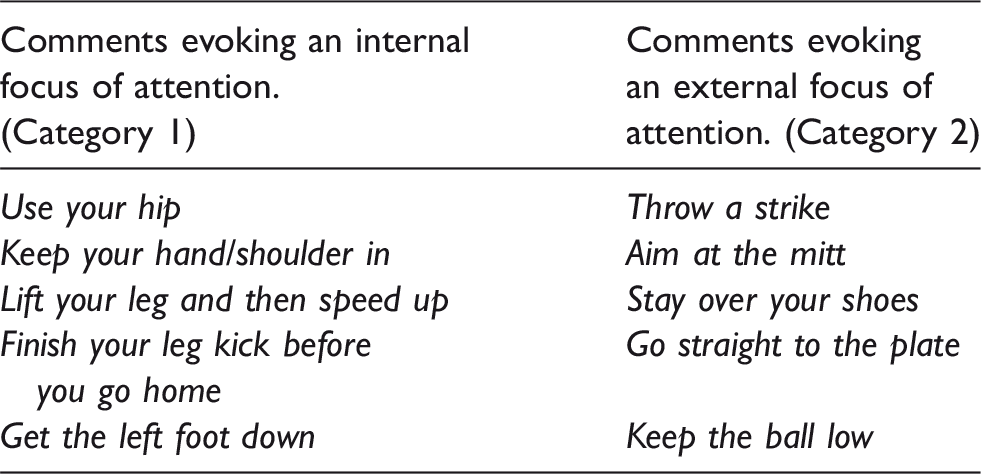
The MSRS score was calculated by adding up the scores of the five focus-related statements of the questionnaire. Each statement was rated on a scale of 1 to 6 ranging from “strongly disagree”(1) to “strongly agree”(6). A low score, i.e. in the range 5–17, indicated a greater preference for an external focus of attention, while a higher score, i.e. in the range 18–30, indicated a greater preference for an internal focus of attention. The difference in MSRS score between the first and fourth week was analyzed using a paired samples t-test.
The 10 questions of the BSQ were given a score between 1 and 10, with a score of 1 indicating a preference for instructions that promoted an internal focus of attention and a score of 10 indicating a preference for instructions that promoted an external focus of attention. The overall score could thus be calculated on a scale from 10 to 100. Whether the BSQ score was dependent on coach and week was analyzed by means of a one-way ANOVA with repeated measures. The same analysis was performed for throwing velocity. Both the paired t-test and the ANOVA were performed in SPSS v 23.0.0.3, (IBM Corporation, Armonk, NY, USA) with significance set at p < .05. The between-subjects factor coach was added to determine if the coaches players differed in BSQ score and throwing velocity, thus indicating a possible association between instruction style, which potentially differs between coaches, and BSQ score or throwing velocity. The within-subjects factor week was added to examine if there were systematic week-to-week variations.
Results
Coaches’ instructions
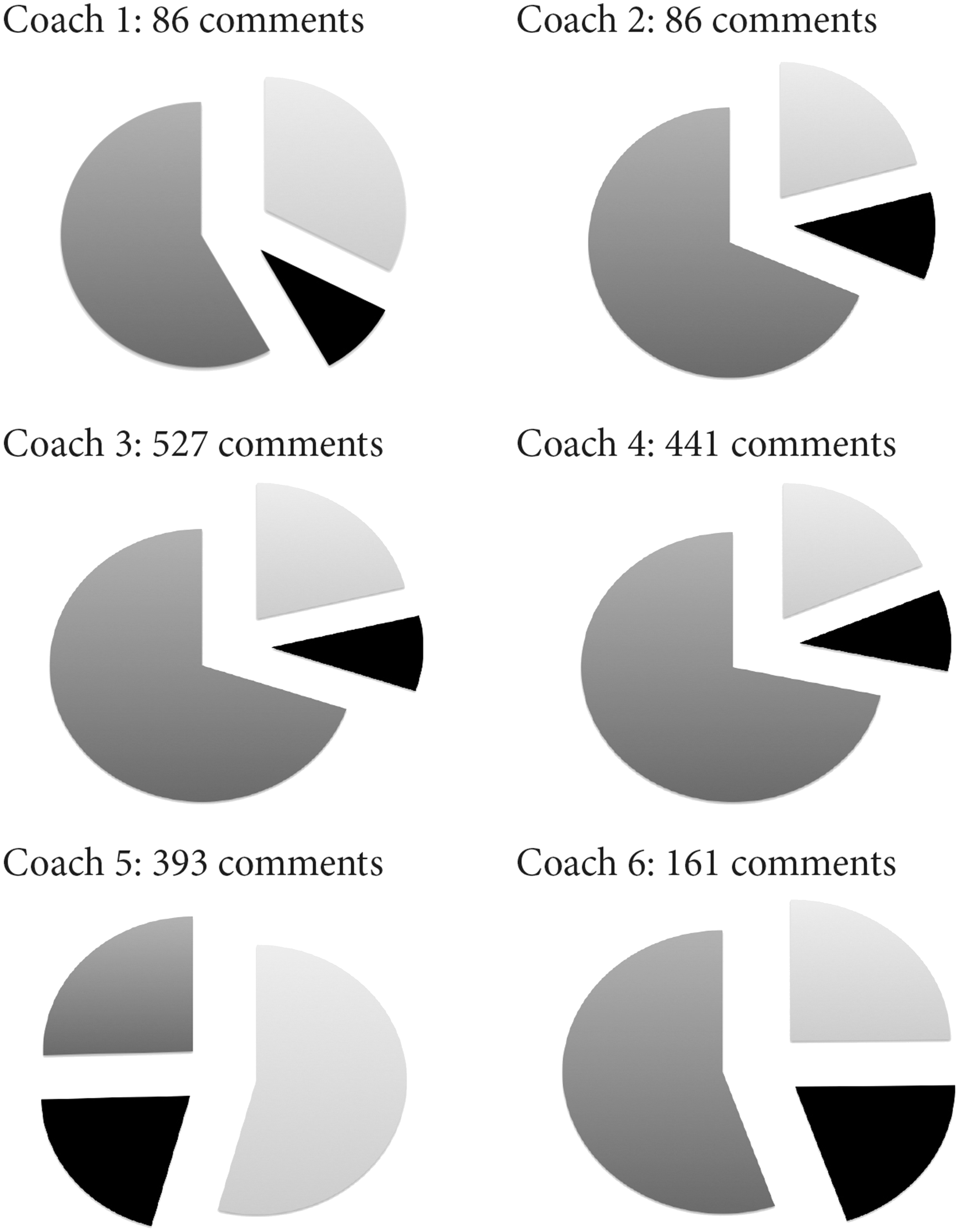
Over 37 h of recorded training sessions with 1699 individual statements were written out and subsequently categorized independently by two raters. Of all statements, 42% (717/1699) invoked either an internal or an external focus of attention. Only 31% (224/717) of these statements invoked an external focus of attention (Figure 1). Although there were differences in the type and number of statements given among coaches, all coaches used more statements that invoked an internal focus of attention rather than an external focus of attention (Figure 2). The inter-rater reliability (Cohen’s kappa) was 0.76 (87.6% agreement), indicating substantial (defined as 0.61–0.80) agreement between raters.
20
All statements categorized. Category 1 (gray): internal focus. Category 2 (black): external focus. Category 3 (lined): other comments. Categorized statements of the six coaches individually. Category 1 (light gray); internal focus. Category 2 (black); external focus. Category 3 (dark gray); other comments.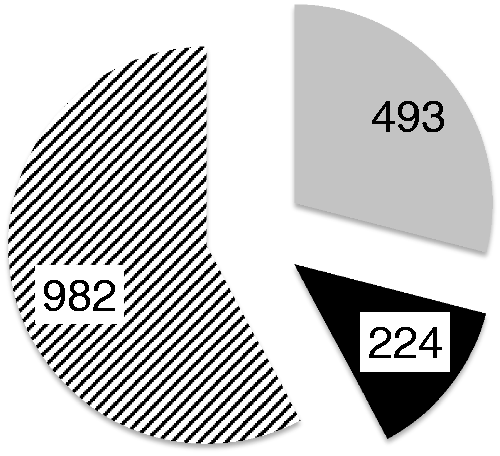
MSRS
The score on the MSRS after week 1 was significantly higher than the MSRS score after the training period, t = 2.247, p = .029 (mean 22.65 (SD 4.07) vs. mean 21.31 (SD 4.41)), indicating that participants were somewhat less internally focussed in their attention after the training period. Only two of the participants scored both times lower than 17 on the MSRS, indicating a propensity for an external focus of attention. Hence, the MSRS questionnaire scores showed that participants generally tended toward an internal focus of attention.
BSQ
The overall mean of the BSQ in week 1 was 56.0 (SD = 6.7). Neither a significant effect of week (F(3,112) = .437, p = .727) nor of coach (F(5,112) =1.006, p = .418) was found. Hence, the mean BSQ scores for the six coaches and for the four weeks of the training period can be considered equal.
Open-ended questions
In response to the open-ended questions regarding the best and worst instructions, 44 players provided 117 instructions in total. Only four of the instructions that were deemed helpful by the players in increasing their throwing velocity were instructions invoking an external focus of attention; 16 players reported a statement that they did not find useful, 13 of which were instructions invoking an internal focus of attention. The explicit knowledge of the players mainly consisted of instructions invoking an internal focus of attention.
Throwing velocity
The overall mean of the throwing velocity in week 1 was 67.0 mph (SD 6.6 mph). There was a significant effect of coach (F(5,143) = 1.006, p = .006) but not of week (F(3,143) = .119, p = .994). Bonferroni post hoc testing of the significant effect of coach showed that the players of ‘coach 5’ had a higher throwing velocity than players of ‘coach 3’ with a difference of 5.0 mph (SE 1.5 mph, p = .016) and ‘coach 6’ with a difference of 6.80 mph (SE 2.3 mph, p = .048).
Discussion
The aim of the present observational study was to examine to what extent the main finding of the study by Porter et al. 14 applies to an instrumental sports action, i.e., baseball pitching, that, by its nature, gives more opportunities for giving external focus of attention instructions instead of internal focus of attention instructions than non or less instrumental sports actions like running. In doing so, we attempted to enhance reliability and validity of the study’s findings by including a substantial number of participants (6 coaches and 70 pitchers) and by recording the instructions that were given in the actual training situation itself.
In the present study, almost 1700 coaching instructions and feedback statements were recorded during 37 h of indoor elite youth pitcher training, and subsequently categorized according to the type of focus of attention they invoked. More than two-thirds (69%) of these statements invoked an internal as opposed to an external focus of attention, implying that most instructions were directed at the movement of the pitchers themselves. The observed predilection in baseball pitching training to provide instructions and feedback on the pitching movement themselves rather than on their effects is congruent with the finding in the study of Porter et al. 14 that 85% of the instructions given by track-and-field coaches invoked an internal focus of attention. This correspondence in results is interesting because the study by Porter et al. 14 was focused predominantly on running, whereas the present study was focused on baseball pitching. Since baseball pitching, unlike running, provides ample opportunities to give pitchers instructions and feedback resulting in an external focus of attention, we hypothesized that external focus of attention instructions would figure more prominently in baseball pitching than in the track-and-field by Porter et al. 14 This was indeed the case (31% vs. 15%), although in both sports such instructions still formed the minority of all focus of attention instructions given. Importantly, this was also found to be the case in a recent study by Halperin et al. 19 on the ringside feedback provided during boxing matches.
To obtain more insight into the focus of attention of the players during practice besides the instructions given by the coaches, the pitchers filled out multiple questionnaires. The verified MSRS questionnaire indicated that players used an internal focus of attention during practice. However, our self-developed BSQ did not indicate any preference; perhaps this was due to the fact that players tended to respond positively to all instructions of the BSQ, regardless of type (i.e. internal or external focus). In this context, it should be noted that as of yet, no psychometric characteristics of this questionnaire are available. The answers to the open-ended questions indicated, however, that the majority of the instructions reported by the players themselves were instructions and feedback statements about movement characteristics, reflecting an internal focus of attention.
In sum, internal focus of attention instructions prevailed in both the recorded coaching instructions and the instructions reported by the pitchers themselves. Apart from the nuance that external focus of attention instructions figured somewhat more prominently in baseball pitching training, this result is consistent with the main result of Porter et al. 14 for an instrumental sports action, and thus contributes to its generalizability. The apparent generality of this finding is remarkable in light of the strong evidence for the superiority of an external focus of attention over an internal focus of attention in motor performance and learning in different laboratory tasks and sport domains21,22 that requires further consideration and analysis. In our view, the most plausible explanation for our main finding and that of Porter et al. 14 is that a gap still exists between sports practice and sports science in that results obtained in scientific research are not (yet) implemented in practice. Because coaches still give instructions invoking an internal focus of attention, players prefer such instructions since they are used to them and assume that they are effective. 18 This being said, there remains a need for field experiments in which the effects of instructions invoking either an internal or an external focus of attention are examined in real sport contexts and ideally over longer episodes than have typically been studied in previous research.
Conclusion
The 5 questions of the MSRS related to conscious motor control and all 10 BSQ questions.
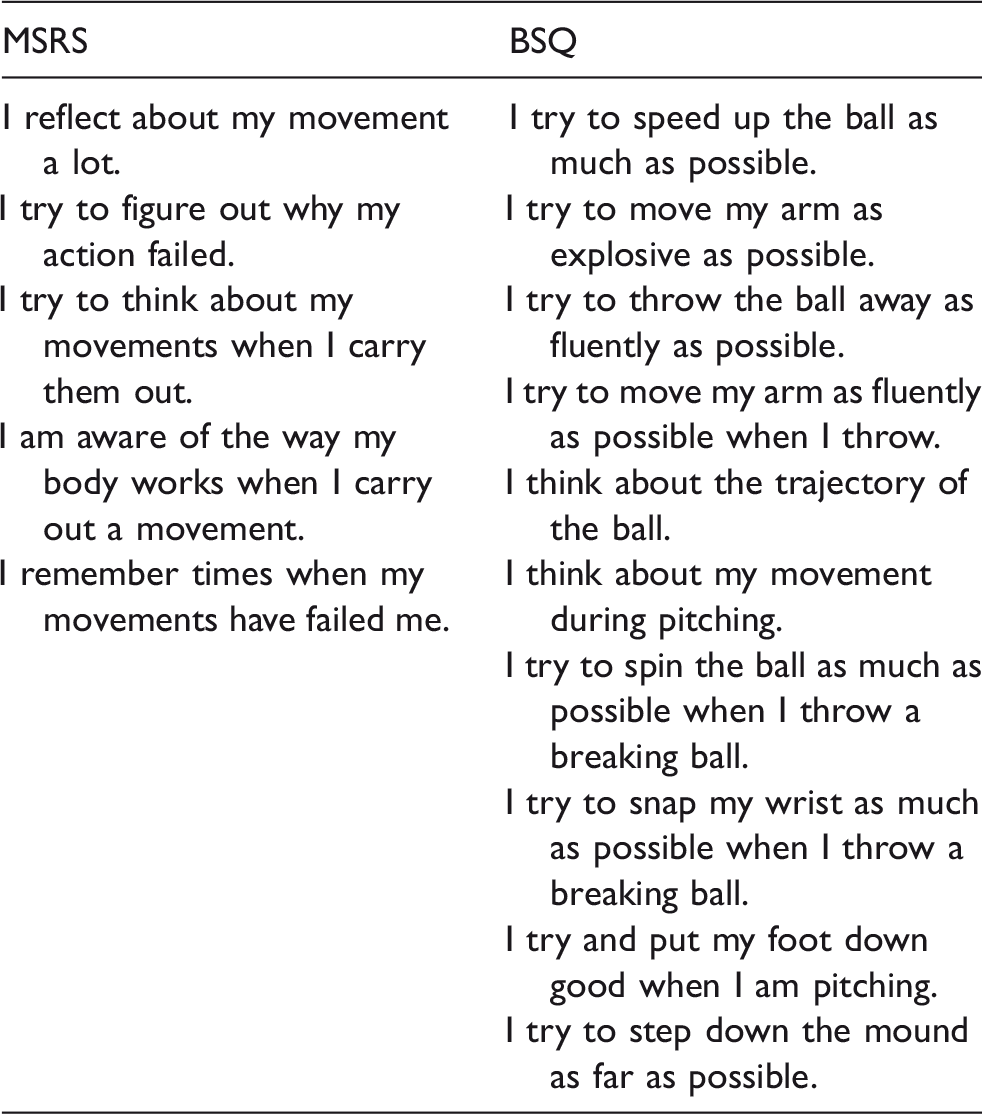
MSRS: movement specific reinvestment scale; BSQ: baseball specific questionnaire.
Footnotes
Acknowledgements
We are grateful to Martijn Nijhoff and the Royal Dutch Baseball Association (KNBSB) for facilitating the present study.
Declaration of Conflicting Interests
The author(s) declared no potential conflicts of interest with respect to the research, authorship, and/or publication of this article.
Funding
The author(s) disclosed receipt of the following financial support for the research, authorship, and/or publication of this article: This research is part of a STW-funded project, named ‘project FASTBALL’, a collaboration between the Dutch baseball federation and the Vrije Universiteit Amsterdam, Delft University of Technology, Motekforce Link, the Bergman clinic and the physical therapy practices ManualFysion and Medicort.