




Abstract
In this paper, the functionalized nanosilica was prepared via covalent modification and used as effective nanofillers to reinforce silicone rubber matrix. The influence of functionalized nanosilica on the mechanical property of PVMQ was examined. The microstructures of the nanocomposites were characterized by Fourier-transform infrared spectroscopy, scanning electron microscopy, and X-ray diffraction. As the nanosilica loading reaches up to 90 wt%, the tensile strength of functionalized nanosilica/PVMQ rubber nanocomposites can reach the maximum values (3.67 MPa). It was noteworthy that the functionalized nanosilica not only could be homogeneously dispersed and incorporated into the polymeric matrix as fillers but also could be effectively improved the mechanical property of the silicone rubber.
Introduction
Silicone rubbers have received intensive attention because of their super properties and widely applications.1–4 As a new type of special silicone rubber, methyl-phenyl-vinyl silicone rubber (PVMQ) has many excellent properties, such as high damping, radiation resistance, ablation resistance, and super high and low temperature resistance and was widely used in the fields of machine tools, shipbuilding, automobile, and aerospace equipment.5–8 However, the deficiency of mechanical property has hindered their wide applications.9–11 The most effective method to solve this problem is adding fillers, such as nanosilica, halloysite nanotubes, graphene, and carbon nanotubes.12–15 Compared to conventional fillers, nanofillers are effective owing to their low cost, large surface area, and uniform dispersion in the polymer matrix, which enhance properties of polymer nanocomposites.16–20 However, the high surface energy and Van der Waals forces cause these nanofillers easily agglomerate and poorly disperse in polymer. Agglomeration is a critical factor that affects nanofillers enhanced properties of nanocomposites frequently reported in the literature.21–23 The uniform dispersion and interaction between polymeric matrix and nanofillers are compulsory to prepare rubber nanocomposites with excellent properties.24–28
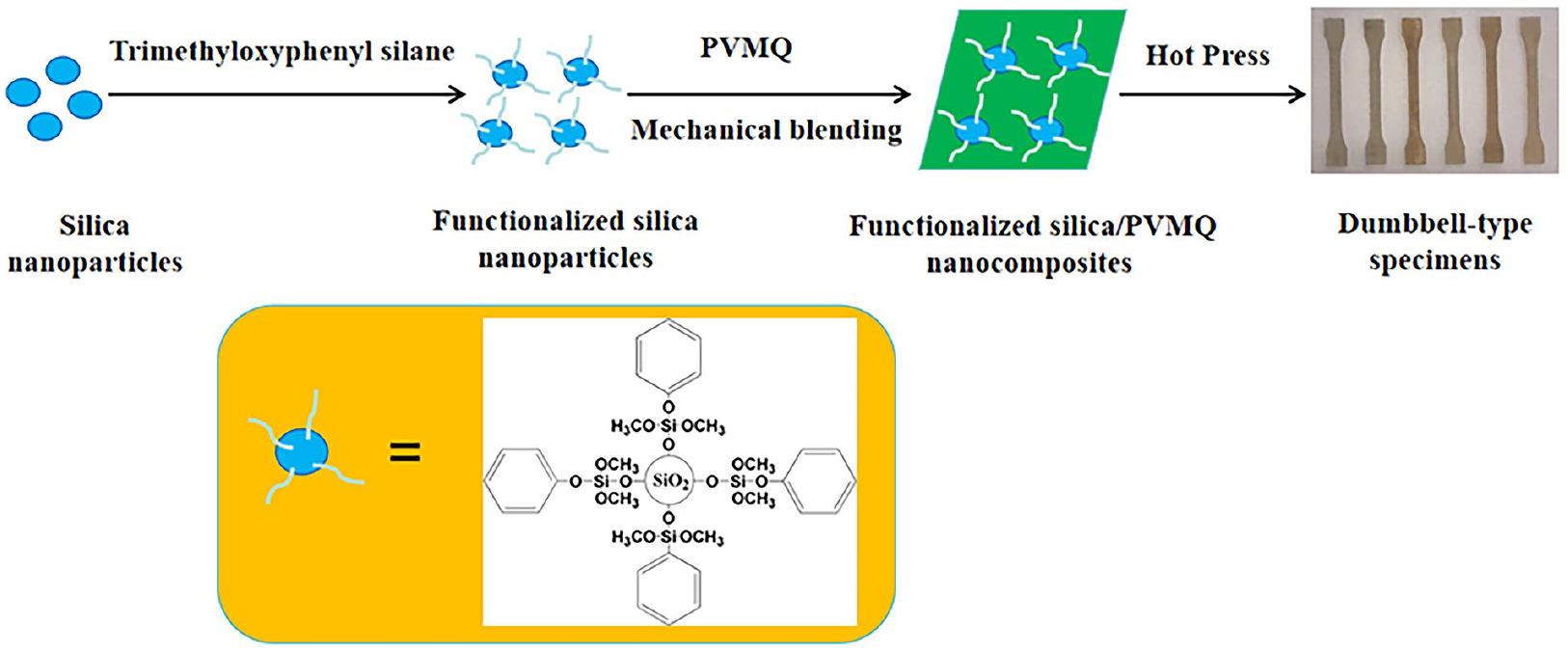
Herein, we report a facile method for preparation of the functionalized nanosilica/methyl-phenyl-vinyl silicone rubber nanocomposites with homogeneously dispersed functionalized nanosilica fillers. The functionalized nanosilica was synthesized via covalent modification and used as fillers to reinforce silicone rubber matrix (Scheme 1). The microstructures of nanocomposites were characterized by Fourier-transform infrared spectroscopy (FTIR), scanning electron microscopy (SEM), and X-ray diffraction (XRD). Furthermore, the effect of interaction between the nanosilica and polymer matrix on mechanical property of the prepared nanocomposites was investigated in detail.

Preparation of the functionalized nanosilica/methyl-phenyl-vinyl silicone rubber nanocomposites.
Experimental
Materials
Methyl-phenyl-vinyl silicone rubber (PVMQ, commercial grade) was purchased from Mingyi Silicone Co., Ltd. The fumed nanosilica (SiO2, commercial grade) was purchased from Hubei Huifu nanomaterials Co., Ltd. The trimethoxyphenyl silane (C9H14O3Si, analytical grade) was obtained Shanghai Macklin Biochemical Co., Ltd. The ethanol (C2H5OH, analytical grade) was supplied by Sinopharm Chemical Reagent Co., Ltd. All reagents were used as received without further purification.
Preparation of functionalized nanosilica
First, in a typical procedure, the nanosilica (6.0 g) was soluble in 100 mL C2H5OH with stirring continuously. Adjust pH to 5 with HCl. Then, 3.0 mL of the trimethoxyphenyl silane (C9H14O3Si) was added drop wise at 75 °C for 2.5 h and washed with C2H5OH three times. Finally, the functionalized, chemically modified nanosilica was obtained and stored in vacuum oven.
Preparation of functionalized nanosilica/PVMQ nanocomposites
Nanocomposites of functionalized nanosilica/PVMQ were produced by mechanical blending method. First, the PVMQ (10 g) was put into a two-roll miller for plasticization. Then, functionalized nanosilica with different weights of 1, 3, 5, 7, 9, and 11 g and 2,4-dichlorobenzoyl peroxide (0.2 g) were added gradually. The series of rubber compounds were molded at 170 °C under 15 MPa for 20 min. Then, the functionalized nanosilica/PVMQ nanocomposites at different loadings of functionalized nanosilica (10, 30, 50, 70, 90, and 110 wt%) were prepared.
The preparation of samples for tensile testing
For the tensile testing, samples were prepared by hot-pressed technique. First, the functionalized nanosilica/PVMQ nanocomposites were placed into dumbbell-type mold. When the temperature of hydraulic hot press reached up to 170 °C, the nanocomposites with different amounts of functionalized nanosilica were hot-pressed under 15 MPa for 20 min. After that, the dumbbell-type functionalized nanosilica/PVMQ rubber samples with different loadings of functionalized nanosilica (10, 30, 50, 70, 90, and 110 wt%) were prepared.
Characterization
The scanning electron microscopy (SEM, Sirion 200) was used to observe the morphologies of functionalized nanosilica and nanocomposites. The functionalized nanosilica constituent components were investigated by FTIR (Perkin Elmer Spectrum 100). The crystal structures were characterized using X-ray diffraction (XRD) on a D/Max-rB diffractometer.
Results and discussion
Infrared spectrum analysis
Figure 1 shows the FTIR spectrum of nanosilica (Figure 1(a)) and functionalized nanosilica (Figure 1(b)). In Figure 1(a), the peaks 3430.6 and 802 cm−1 are respected for the Si–OH stretching vibration and asymmetric stretching vibration. The peak 475 cm−1 is confirmed to be the Si–O–Si symmetric stretching vibration. 29 In Figure 1(b), the peak 1112.7 cm−1 corresponding to asymmetrical stretching vibration of Si–O–Si increases. 30 The peaks 3070.4 and 946.2 cm−1 confirm the presence of phenyl group, and the peak 2931.7 cm−1 is confirmed to asymmetric stretching of −CH3 group. The appearance of peak 3430.6 cm−1 shows that –OH group on the surface of functionalized nanosilica has not reacted with trimethyloxyphenyl silane (TMPS) completely. 31 These results suggest that the functional groups of TMPS were grafted onto the nanosilica surface successfully.

FTIR spectra of (a) nanosilica and (b) functionalized nanosilica.
XRD analysis
The crystal structures of functionalized nanosilica and functionalized nanosilica/PVMQ nanocomposites were characterized using XRD. XRD patterns of functionalized nanosilica and functionalized nanosilica/PVMQ nanocomposites are depicted in Figure 2. As can be seen, the broad peak around 21.9° is observed (Figure 2(a)), which is a typical peak of amorphous silica correspond to the amorphous silica. 32 The large diffraction dispersion peak at 25° is a typical amorphous polymer diffraction peak (Figure 2(b)).

XRD diffraction patterns of (a) functionalized nanosilica and (b) the functionalized nanosilica/PVMQ nanocomposites.
Morphology analysis
To investigate the dispersion of functionalized nanosilica in PVMQ, the morphologies of functionalized nanosilica and functionalized nanosilica/PVMQ nanocomposites were identified by SEM (Figure 3). As shown in Figure 3(a) and (b), the nanosilica particles (with the average diameter of ~10 nm) presented spherical and dispersive morphology. Compared to images of Figure 3(a) and (b), the functionalized nanosilica particles are homogeneously dispersed in the PVMQ matrix (Figure 3(c) and (d)). These results are due to the fact that both PVMQ and functionalized nanosilica have unsaturated structure. After mechanical blending, the homogeneously dispersed functionalized nanosilica/PVMQ nanocomposites were formed via π–π stacking interactions between the functional phenyl groups on nanosilica surface and phenyl, vinyl groups in PVMQ repeat unit.

SEM images of functionalized nanosilica (a, b) and the functionalized nanosilica/PVMQ nanocomposites (c, d) at different magnifications.
Mechanical behavior analysis
To investigate the effect of functionalized nanosilica on mechanical property of PVMQ, the tensile tests were carried out, and the results are shown in Table 1. It was noteworthy that the tensile strength (σ) of the functionalized nanosilica/PVMQ nanocomposites increased steeply with an increase in the amount of functionalized nanosilica. When the amount of nanosilica reaches up to 90 wt%, the tensile strength (σ) of nanocomposites can reach the maximum values (3.67 MPa). The improvement of mechanical performance is attributed to homogeneous dispersion and interaction between the functionalized nanosilica and polymeric matrix.
Mechanical properties of neat PVMQ and functionalized nanosilica/PVMQ nanocomposites.

Conclusion
The functionalized nanosilica was prepared via covalent modification, and it was found that the modified nanosilica can be used as effective nanofillers to reinforce silicone rubber matrix. The microstructures of functionalized nanosilica and the nanocomposites were characterized by SEM, FTIR, and XRD. The influence of functionalized nanosilica on the mechanical property of PVMQ was examined. As the nanosilica loading reaches up to 90 wt%, the tensile strength of functionalized nanosilica/PVMQ rubber nanocomposites can reach the maximum values (3.67 MPa), which is much higher than that of the neat PVMQ rubber. It is attributed to the uniform dispersion and interaction between the nanosilica fillers and PVMQ rubber matrix.
Footnotes
Declaration of conflicting interests
The author(s) declared no potential conflicts of interest with respect to the research, authorship, and/or publication of this article.
Funding
The author(s) disclosed receipt of the following financial support for the research, authorship, and/or publication of this article: This work was supported by the Natural Science Foundation of Anhui Province’s Higher Education of China (KJ2021ZD0140), the University Synergy Innovation Program of Anhui Program of Anhui Province (GXXT-2023-096), and Anhui Province’s Quality Engineering “Four New” Research and Reform Practice Project of China (2021SX095).
