



Abstract
The whitefly Bemisia tabaci is a destructive insect pest that infects many plants. Finding solutions to reduce the damage associated with whiteflies and their widespread use is of great interest. Therefore, the current research aims to synthesize four polyesters containing a curcumin ring system and investigate their effects against B. tabaci. The synthesized polyesters killed whitefly eggs and their nymphs. Polyester containing a methoxy group (P3) showed the best performance (80.3%) toward the mortality of insect eggs among all the tested polymers. Polyester containing a 4-hydroxybenzaldehyde moiety (P2) showed the lowest mortality efficiency (50.9%) against whitefly eggs after 72 h of treatment. The effect of polyester concentration on the mortality of insect nymphs varied during the treatment period. The mortality rate of nymphs after P3 treatment was the highest (78.0%), whereas that after P2 treatment was the lowest (46.9%). The polyester type, concentration, and treatment duration significantly affected the insect nymph mortality rate. Polyester containing a methoxy group for 72 h resulted in the highest mortality rate (90.0%) against whitefly nymphs.

Introduction
The whitefly Bemisia tabaci (B. tabaci; Homoptera: Aleyrodidae) is a destructive insect pest that infects many plants such as eggplants, cucumbers, and cotton, for example.1 –4 Yellow spots on the leaves are formed due to nymphs and adults sucking the juice from the plants’ vegetative parts. The developed sites can unify to produce irregular yellow areas due to chlorophyll deficiency.5 –8 In addition, the insect saliva secreted during the feeding process causes the cessation of leaf growth. As a result, the leaves shrink in size, die, and eventually fall.9 –12 The feeding process causes dust and fungi to accumulate on the respiratory stomata on the damaged surface of plant leaves, which negatively affects the photosynthesize and transpiration processes. 11 Whiteflies also facilitate the transition of plant viral diseases from infected plants to healthy ones and have caused a global decrease in the production of crops and vegetables in many parts of the world. Finding solutions to reduce the damage associated with whiteflies and their widespread use is of great interest; in particular, research has been directed toward finding an alternative to pesticides because of their ability to gain rapid resistance to them.13 –16
Polyesters containing different functional groups and aromatic moieties have various applications. 17 Efficient antioxidants can be derived from hydroxyl and carbonyl groups present in them. The aromatic moieties within polymeric chains increase their stability. 18 In addition, the presence of heteroatoms (e.g. nitrogen and oxygen) containing asymmetric electron pairs can significantly increase their biological effectiveness. Polyesters resemble curcumins, which have lower toxicity than many pesticides.19 –25 Therefore, this study aimed to evaluate the in vitro effect of polyesters containing curcumin moieties on whitefly eggs and nymphs.
Results and discussion
Synthesis of polyesters P1–P4
Bis-phenols

Structures of bis-phenols
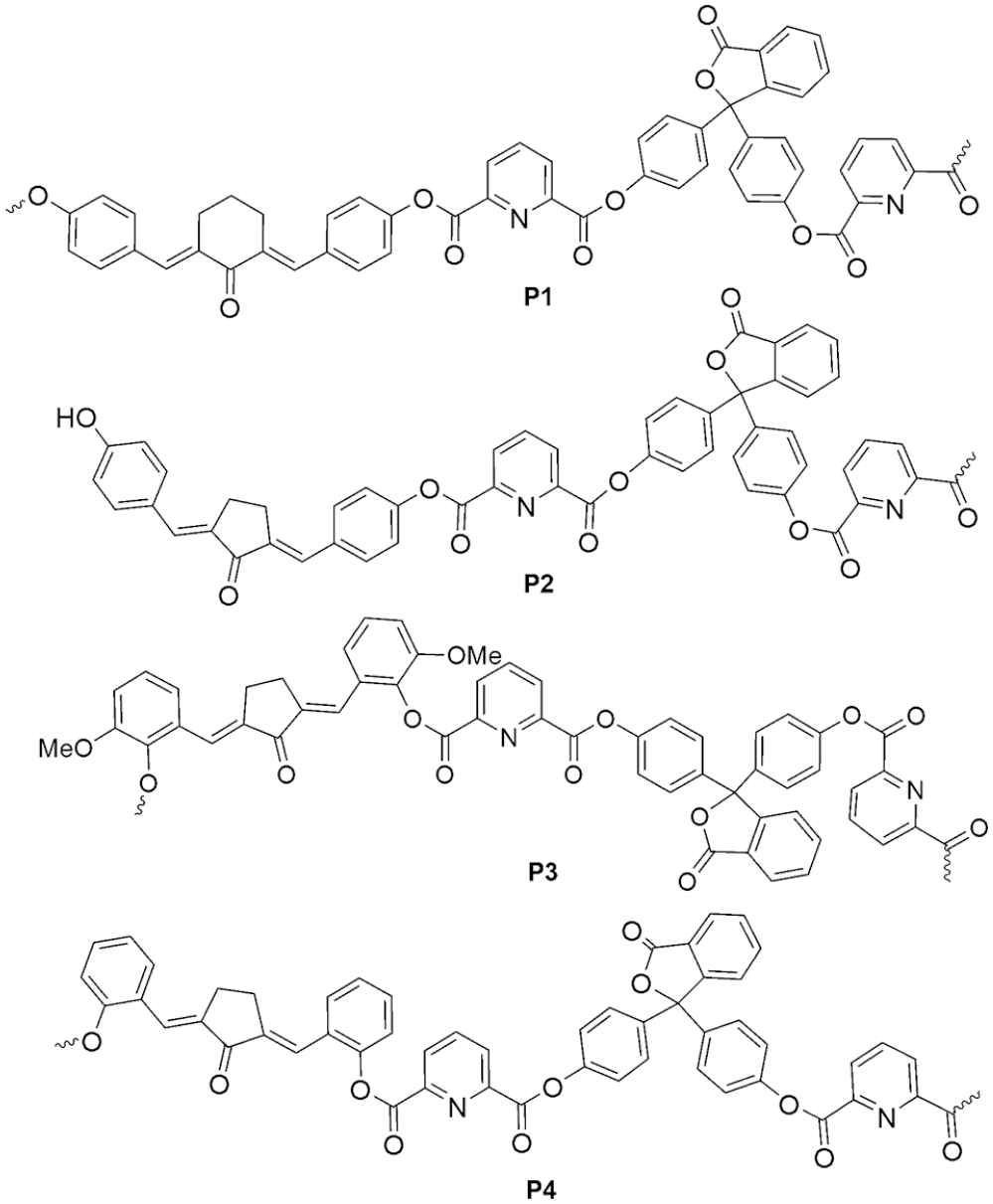
Structures of synthesized polyesters P1–P4.
The structures shown for polymers P1–P4 in Figure 2 are only representative, as a 1:1 mixture of appropriate bis-phenol
Effect of polyesters P1–P4 on whitefly eggs
The synthesized polyesters P1–P4 were evaluated to assess their mortality rates in whitefly eggs (Table 1). P3 had a significantly higher mortality rate against whitefly eggs than the others, with an average of 80.3%. The methoxy group in P3 may be responsible for its high efficiency. In contrast, P2, which contained 4-hydroxybenzaldehyde, showed the lowest (50.9%) mortality rate against whitefly eggs, even after a long duration of treatment (up to 72 h). Polyesters P1 and P4 led to similar mortality rates of 61.9% and 66.3%, respectively, owing to the similarity of their structures. The mortality rate of whitefly eggs increases as the polyester concentration increases. For example, the mortality rate of whitefly eggs was 90.0% when P3 was used at a concentration of 15%, compared with 83.5% at 10% and 67.4% at 5%. The whitefly egg mortality rate increased as the number of active ingredients within the polyesters increased. However, no significant difference was observed between the average mortality rates obtained at 10% and 15% concentrations.
Effect of polyesters P1–P4 on the mortality rate of whitefly eggs.

Effect of polyester, LSD (0.01) = 9.25. The effect of polyester concentration, LSD (0.01) = 8.01. The interaction between the type of chemical compound and concentration, LSD (0.01) = 16.03. LSD: least significant difference.
Effect of polyesters P1–P4 on whitefly nymphs
Next, we investigated the impact of polyesters P1–P4 on the mortality rate of whitefly nymphs (Table 2). Using different polyesters resulted in a significant variation in the mortality rates of whitefly nymphs. P3 led to the highest mortality rate, with an average of 78.0%. In contrast, P2 had the lowest mortality rate, averaging 46.9%. The concentration of polyesters plays a vital role in determining the mortality rate. For example, the mortality rates of whitefly nymphs after P3 treatment were 80.4% and 83.0% at concentrations of 10% and 15%, respectively. However, there was no significant difference in the average mortality rate of polyesters when 10% (58.7%) or 15% (62.5%) concentrations were used. The results presented in Table 2 are following those recorded in Table 1.
Effect of polyesters P1–P4 on the mortality rate of whitefly nymphs.
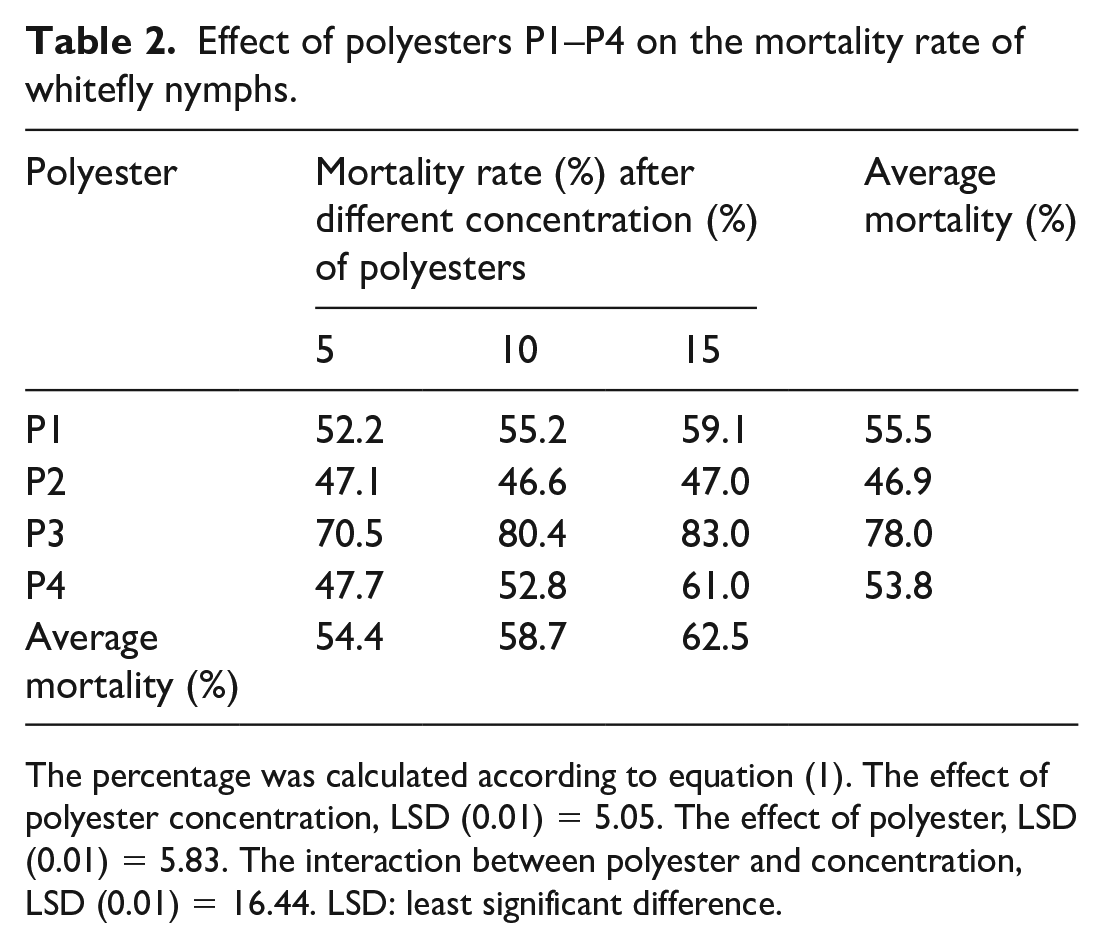
The percentage was calculated according to equation (1). The effect of polyester concentration, LSD (0.01) = 5.05. The effect of polyester, LSD (0.01) = 5.83. The interaction between polyester and concentration, LSD (0.01) = 16.44. LSD: least significant difference.
Effect of duration of treatment on whitefly nymphs using polyesters P1–P4
The time of treatment (24–72 h) of whitefly nymphs with polyesters P1–P4 was investigated (Table 3). The average mortality rate was 69.0% after 72 h of treatment, significantly higher than that obtained at 24 or 48 h. The concentration of polyesters and the duration of treatment affected the mortality rate of whitefly nymphs. P3 showed the highest mortality rate (90.0%) after 72 h of treatment, which was significantly higher than that observed in the presence of other polymers. P2 had the lowest mortality rate (36.6%) after 24 h of treatment.
Effect of duration of treatment on the mortality rate of whitefly nymphs using polyesters P1–P4.

The effect of polyester concentration, LSD (0.01) = 5.89. The effect of time, LSD (0.01) = 5.10. The interaction between polyester concentration and time, LSD (0.01) = 10.21. LSD: least significant difference.
Effect of the average concentration of polyesters P1–P4 and duration of treatment on whitefly nymphs
There was no significant difference in the mortality rate of whitefly nymphs (67.3%, 69.4%, and 70.4%, respectively) at different concentrations (5%, 10%, and 15%, respectively) of polyesters P1–P4 used for 72 h (Table 4). After 24 h of treatment, using the 5% concentration led to the lowest mortality rate (36.5%).
Effect of the interaction between the concentration of polyesters and time on the mortality rate of whitefly nymphs.
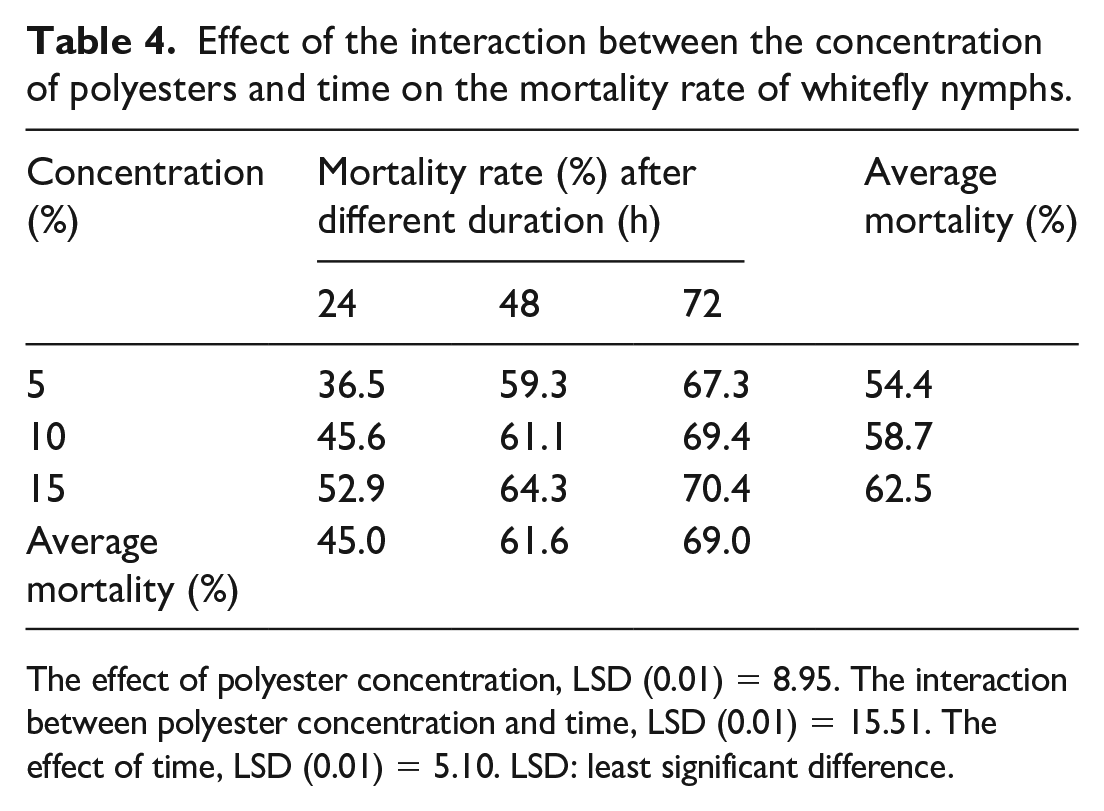
The effect of polyester concentration, LSD (0.01) = 8.95. The interaction between polyester concentration and time, LSD (0.01) = 15.51. The effect of time, LSD (0.01) = 5.10. LSD: least significant difference.
Finally, the effects of each polyester’s type, concentration, and treatment duration on the whitefly nymph mortality rate were investigated (Table 5). No significant difference was found in the mortality rate when different concentrations (5%, 10%, and 15%) of P3 were used. The highest mortality rate (92.0%) was achieved when P3 was used at a concentration of 5% after 72 h of treatment. P4 at concentrations of 5% and 10% after 24 h of treatment resulted in the lowest mortality rates, at 31.0% and 39.2%, respectively.
Effect of the interaction of polyester type, concentration, and treatment time on the mortality rate of whitefly nymphs.
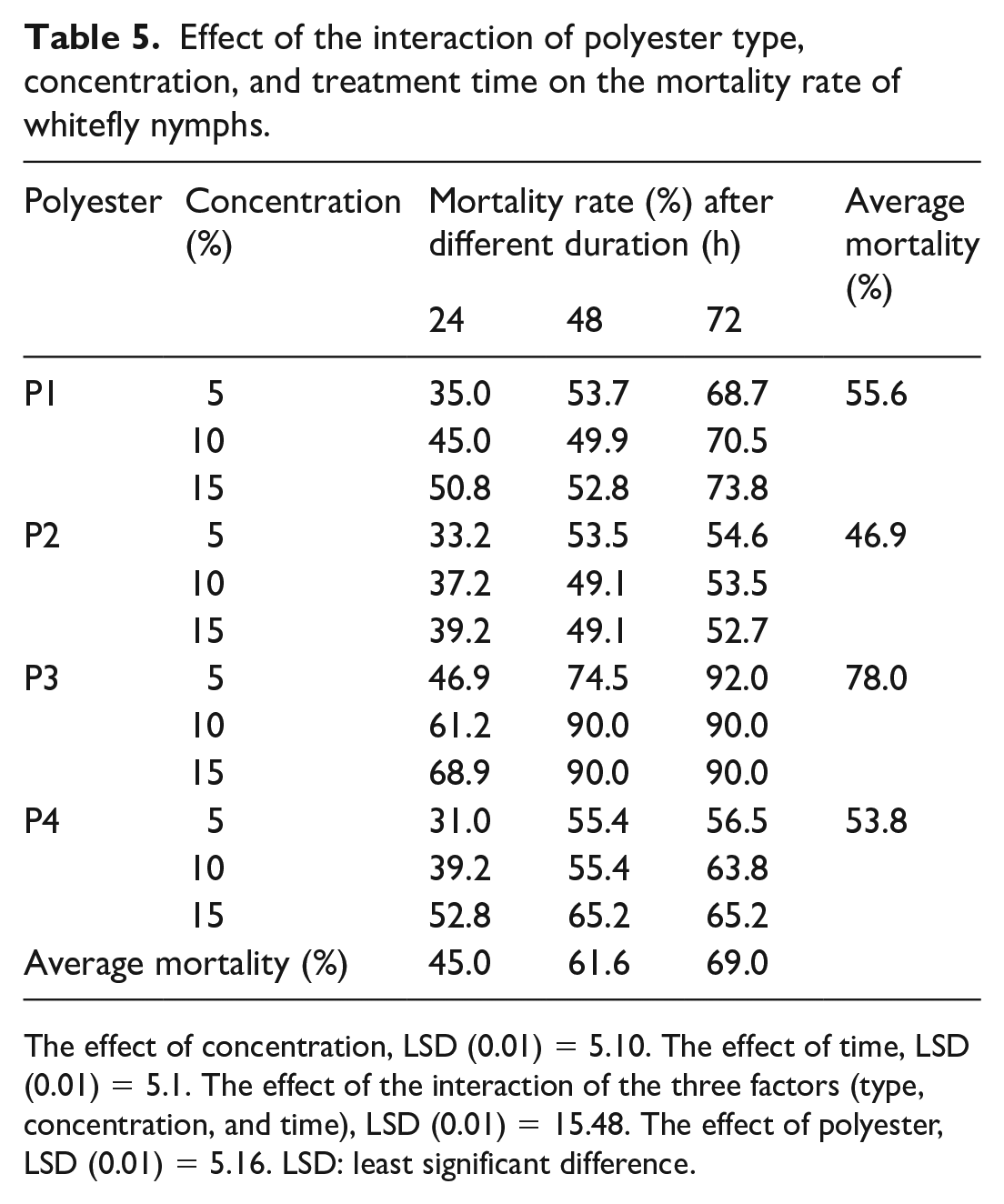
The effect of concentration, LSD (0.01) = 5.10. The effect of time, LSD (0.01) = 5.1. The effect of the interaction of the three factors (type, concentration, and time), LSD (0.01) = 15.48. The effect of polyester, LSD (0.01) = 5.16. LSD: least significant difference.
The current study is the first to investigate the effect of modified polyester on B. tabaci. Polyesters containing a curcumin ring system significantly affect the mortality rate of whitefly eggs and nymphs. The mortality rate of whitefly eggs and nymphs increased as the concentration of polyesters increased. Among the tested polyesters, the polymer containing a methoxy group led to the highest mortality rate of whitefly nymphs. In addition, its effectiveness increased as the concentration and duration of treatment increased, owing to the presence of the methoxy group. 27 The interaction between polyester concentration and the treatment time also affected the mortality rate of whitefly nymphs. The highest mortality rate was observed at a concentration of 5% after 72 h of treatment.
Polyesters are environmentally friendly insecticides.28,29 They are biodegradable and do not leave any harmful residues. Polyesters can be combined with other insecticides to achieve a synergistic effect. Polyesters can be used as a foliar spray or applied to the soil. The mechanism of the mode of action of polyesters against whiteflies is not fully understood. However, polyesters may disrupt the feeding or reproductive behavior of whiteflies. However, more research is still needed to be able to confirm. In addition, the effectiveness of polyesters against whiteflies in different field conditions needs to be performed. Moreover, using polyesters combined with other insecticides to achieve a synergistic effect must be investigated.
Conclusions
Four polyesters were synthesized, and their effectiveness against B. tabaci was evaluated. The polyester containing a methoxy group was the most effective for killing whitefly eggs and nymphs. At a 10% or 15% concentration, such polyester caused a whitefly egg and nymph mortality rate of 90%. The methoxy group (electron donor) may explain the high efficiency of this polyester. Polyesters containing a curcumin ring system can be used as effective and environmentally friendly insecticides against whiteflies.
Materials and methods
General
Chemicals and reagents (analytical grade) were purchased from Merck (Gillingham, UK) and used without further purification. Infrared (IR) spectra were recorded on a Shimadzu FTIR-8400 Affinity spectrometer (Shimadzu, Kyoto, Japan). The experiments were conducted at the Department of Plant Protection, College of Agriculture, and the Department of Chemistry, College of Science, University of Basrah, from January to June 2022. Eggplant leaves infected with whiteflies were obtained from the greenhouses of the College of Agriculture. Phenols
Preparation of polyesters P1–P4
Triethylamine (1.1 mL, 8.0 mmol) was added to a stirred solution of phenols
Effect of polyesters on whitefly eggs
Sterile plastic Petri dishes (9 cm diameter) were used. A layer of sterile medical cotton moistened with water was added to each Petri dish and covered with an eggplant leaf (5 cm), which was washed with water to remove any impurities and traces of infection caused by whiteflies. Five pairs of whitefly adults (male and female) were transferred and left inside the cages for 24 h to lay eggs. The whitefly eggs (10 eggs) were left on each plate over eggplant leaves and sprayed with different concentrations (5%, 10%, and 15%) of polyesters (P1, P2, P3, and P4) at an average of 1 mL/dish using a sterile syringe. The control experiment involved dimethylformamide (1 mL per dish), and all experiments were performed in triplicate. The mortality rate of the whitefly eggs was calculated using the Orell and Schneider Equation (equation (1))

We studied the mortality rate of whitefly eggs and performed statistical analyses to assess the effect of polyesters on their mortality rate.
Effect of polyesters on whitefly nymphs
Five pairs of adults (male and female) were allowed to mate in cages. The eggs laid were left to let the nymphs come out. Ten nymphs were placed in sterilized Petri dishes and sprayed with different concentrations (5%, 10%, and 15%) of P1–P4 (1 mL/dish). Dimethylformamide (1 mL/dish) was used as the control. The experiments were performed in triplicate. The mortality rate of whitefly nymphs was evaluated after various treatment durations (24, 48, and 72 h) using equation (1). Statistical data were examined to assess how polyesters affect the mortality rate among the nymph population.
Statistical analysis
The GenStat Software Package was utilized for performing the statistical analyses. 30 To analyze the impact of polyesters on whitefly eggs, a two-factor analysis of variance (ANOVA) was conducted, which involved examining the type and concentration of the polyester. An analysis was conducted on the impact of polyester type, its concentration, and treatment duration on whitefly nymphs using a three-factor ANOVA. A significance level of 0.01 was utilized to assess any noteworthy differences between the treatments. To compare the mean differences between different treatments, the least significant difference (LSD) test was employed. This type of statistical analysis is typical in agricultural research.31,32
Footnotes
Author contributions
Conceptualization: HMRM, HAA, BAA, and BAS; methodology: HMRM, HAA, BAA, and BAS; formal analysis: HMRM, HAA, BAA, BAS, NLH, and GAE-H; investigation: HMRM, HAA, BAA, and BAS; data curation: HMRM, HAA, BAA, BAS, NLH, and GAE-H; writing: HMRM, HAA, BAA, BAS, and GAE-H. All authors have read and agreed to the published version of the manuscript.
Declaration of conflicting interests
The author(s) declared no potential conflicts of interest with respect to the research, authorship, and/or publication of this article.
Funding
The author(s) disclosed receipt of the following financial support for the research, authorship, and/or publication of this article: We thank the University of Basrah for the technical support. GAE-H acknowledges the support from the Researchers Supporting Project (number RSP2023R404), King Saud University, Riyadh, Saudi Arabia.
