



Abstract
In order to increase its solubility in water and improve β-cyclodextrin combination with guest molecules, chemical modification of β-cyclodextrin is a feasible and effective method. A variety of β-cyclodextrin derivatives are designed and introduced for pharmaceutical complexation and analytical chemistry application. In this study, a series of β-cyclodextrin derivatives containing unsaturated bonds is designed and synthesized. The products are characterized by MS, FTIR, 1H NMR, and 13C NMR. Some of the functional monomers may be used in the preparation of molecularly imprinted polymers, and preliminary studies have shown excellent molecular recognition ability. The prepared β-cyclodextrin functional monomers have potential application value in molecular recognition materials based on polymers.

Introduction
β-Cyclodextrin (β-CD) is a cyclic oligosaccharide composed of seven glucopyranose units attached by α-1,4 glucosidic bonds and has an interesting structure with a conical cavity.1,2 β-CD can achieve supramolecular assemblies with small lipophilic molecules because of its inherent properties, the outer region is hydrophilic while the inner is hydrophobic. Hence, β-CD can be applied in many areas, such as molecular recognition, catalysis, chromatographic separation, solubilization, drug release, and biotechnology.3–5 However, the solubility of β-CD in water is relatively low, it cannot be dissolved in most organic solvents, and its molecular recognition ability is also poor. Modified β-CDs have functional groups on their surfaces, and their molecular recognition ability can be increased by introducing various groups.6–8 For example, some hydrophobic drugs with appropriate size and shape can enter into the cavity to form noncovalent supramolecular complexes. The formation of these complexes not only enhances their aqueous solubility but also improves their general stability in some cases.
In the past few decades, the synthesis of modified β-CD derivatives has attracted wide attention due to their unique properties. 2 On the one hand, β-CD derivatives have been used as functional monomers in the synthesis of molecularly imprinted polymers in order to improve the recognition ability of the imprinted derivatives and increase their solubility in water.7–11 On the other hand, β-CD derivatives have been used as chiral solid phases to separate chiral compounds,12–17 for example, Armstrong and Tex 18 reported a β-CD-based chiral solid phase for the separation of various optical isomers. At present, it is easy to obtain randomly modified derivatives, such as methylated ones, but little attention has been paid to monofunctional derivatives, especially those containing unsaturated double bonds.19–21 In this paper, the 12 β-CD derivatives shown in Figure 1 were designed and synthesized. Mono-(6-O-p-tolylsulfonyl)-β-CD was used as an important intermediate in this study and was synthesized by the reaction of β-CD with toluene p-sulfonyl chloride in NaOH solution.22,23 In addition, this intermediate also could be obtained by using toluene p-sulfonyl anhydride reacting with β-CD in NaOH solution24,25 or by toluene p-sulfonyl chloride reacting with β-CD in dry pyridine. 26 The products are characterized by MS, IR, 1H NMR, and 13C NMR. Partially synthetic novel β-CD derivatives have been used as monomers to prepare interesting molecularly imprinted polymers.27–29
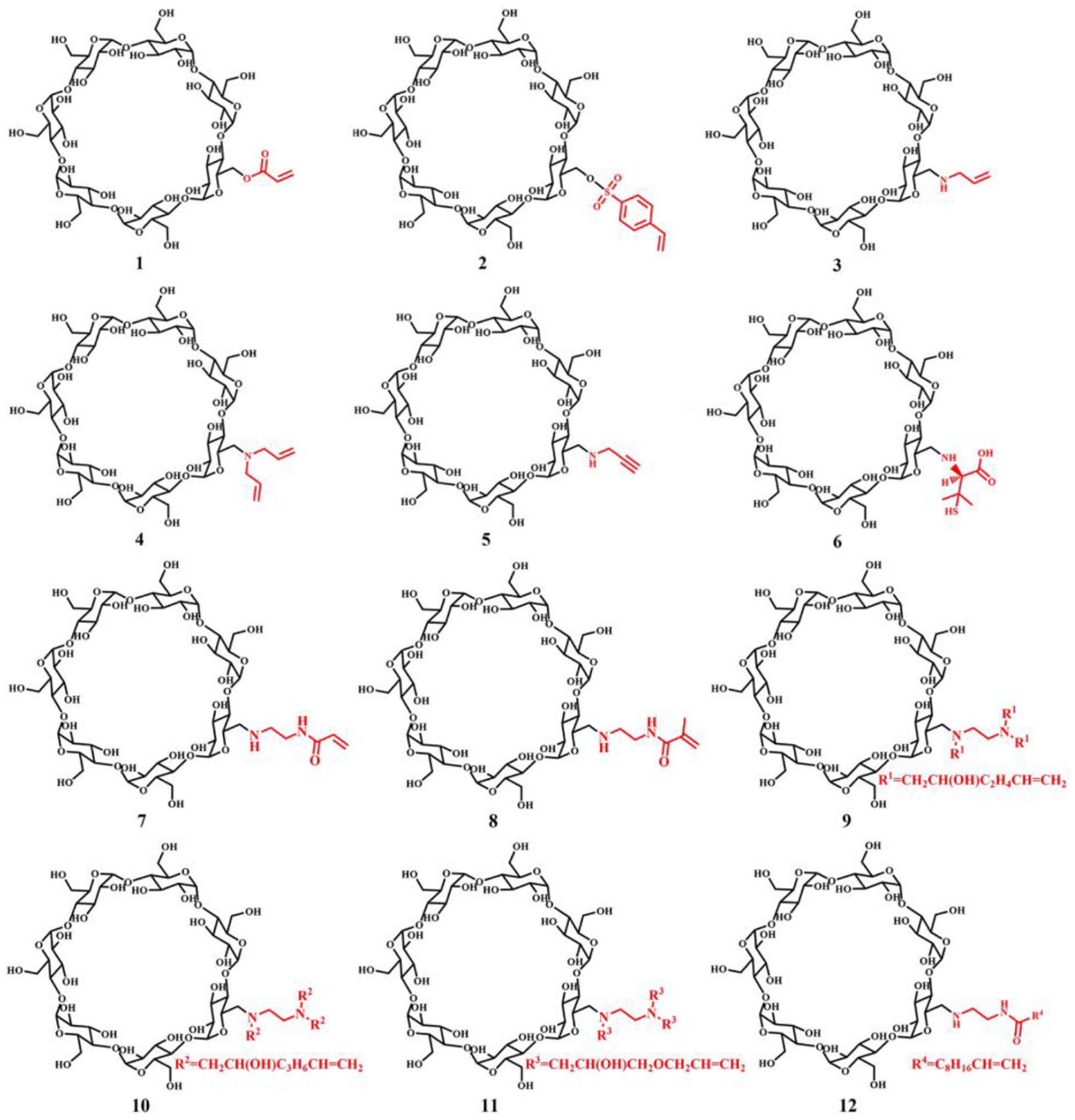
The structures of the 12 target compounds.
Results and discussion
These interesting functional monomers may be utilized to construct unique molecularly imprinted polymers easily. Compounds
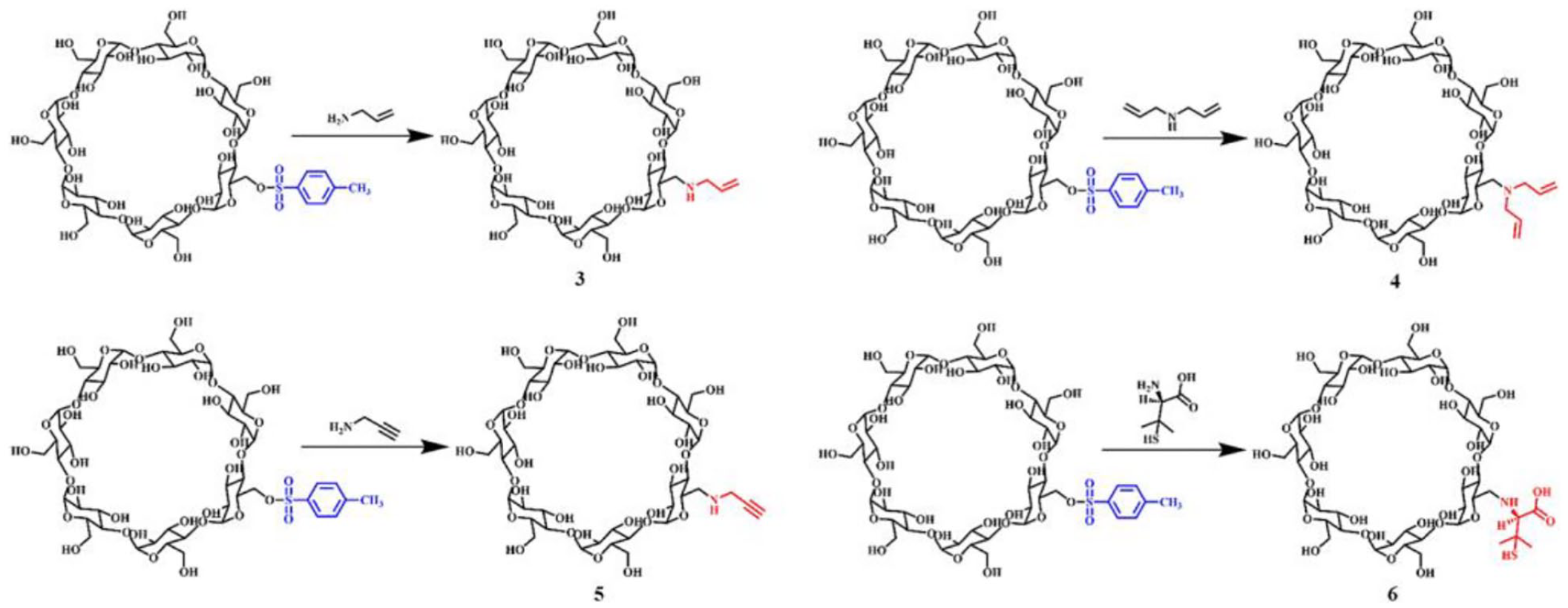
Synthetic reactions of products

Synthesis of products
Optimization of the synthesis of product
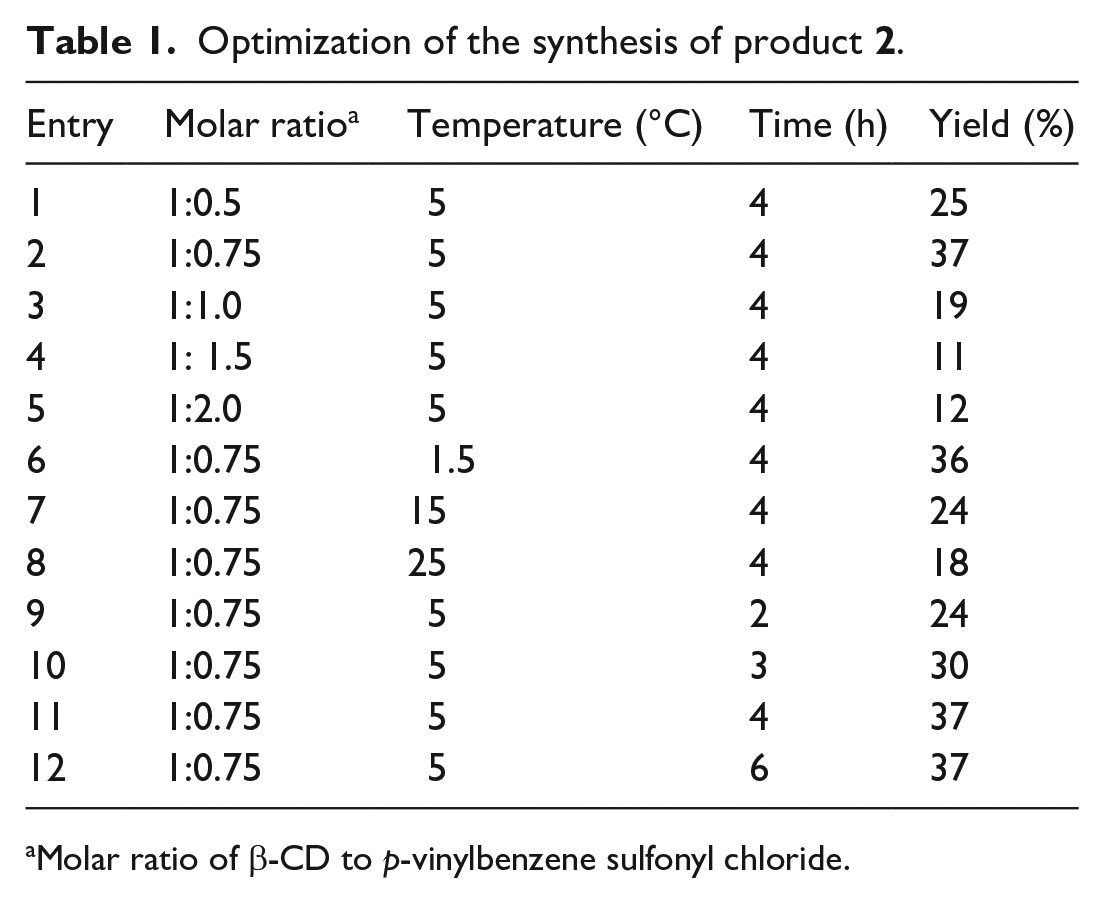
Molar ratio of β-CD to p-vinylbenzene sulfonyl chloride.
Conclusion
A series of novel β-CD derivatives has been designed and synthesized, members of which contain unsaturated double bonds, with some products having three unsaturated double bonds. The products have different functional groups and should be more active toward polymerization. The structures of all products were confirmed by MS, IR, 1H NMR, and 13C NMR analysis. These β-CD derivatives are useful and interesting monomers for the preparation of molecularly imprinted polymers and other functional materials.
Experimental section
Reagents and instruments
Allylamine (99%), diallylamine (98%), acryloyl chloride (98%), mono-propargylamine (98%), D-penicillamine (99%), allyl glycidyl ether (99%), 10-undecylenoyl chloride (99%), and methacryloyl chloride (99%) were purchased from Xiya Reagent Co. Ltd. (Shan Dong, China). 1,2-Epoxy-5-hexene (>96.0) was purchased from Tokyo Chemical Industry Co., Ltd. and 1, 2-hydroxy-7-octene (97%) was purchased from Thermo Fisher Scientific Co., Ltd. (China). β-Cyclodextrin (β-CD) was purchased from Shandong Binzhou Zhiyuan Bio-Technology Co., Ltd. (Binzhou, China). A FA2004 type electronic balance (Shanghai Hengping Scientific Instrument Ltd.) and XMTD-204 digital thermostat water bath equipment (Jiangsu Jintan Huacheng Kaiyuan Experimental Instrument Factory) were used in the experiments. An EQUINOX 55 Fourier transform infrared spectrometer (German Bruker Optics Company) and an Agilent Technologies 6540 UHD Accurate-Mass Q-TOF LC/MS (Agilent Technologies Inc) were used for product characterization. NMR spectra were obtained on a Bruker AV-600 MHz nuclear magnetic resonance spectroscopy, using DMSO-d6 or D2O as solvents. The chemical shifts (δ) are given in ppm relative to the TMS signal at 0.00 ppm as an internal reference, coupling constants (J) are given in Hertz (Hz).
Synthesis of mono-(6-O-acryloyl-6-deoxy)-β-CD (1 )
β-CD (7.9 g, 7.0 mmol) was added to a 500 mL round-bottomed flask. Next, NaOH (4.3 g, 0.11 mol) and distilled water 250 mL were added. After the solids had dissolved, the flask was placed in an ice-water bath (1.5 °C). Acryloyl chloride 10 mL was added to the flask by using a constant-voltage funnel. After stirring for 30 min, the solution was filtered and dried under reduced pressure at 40 °C. Then crude product was dissolved in N,N-dimethylformamide 20 mL, and the solution filtered to remove sodium chloride. Acetone 200 mL was added and the product precipitated and was collected. It was dissolved in methanol 20 mL and acetone 200 mL was added and the precipitate collected. The resulting product was dried under reduced pressure at 40 °C for 5 h.
Off white powder (yield 63%); m.p. 280–283 °C. The molecular weight of compound
Synthesis of mono-(6-O-p-vinylbenzene sulfonyl-6-deoxy)-β-CD (2 )
β-CD (22.7 g, 20 mmol) was added to a 250 mL three-necked flask. Next, NaOH (4 g, 0.1 mol) and distilled water 200 mL were added. After the solids had dissolved, the flask was placed in an ice-water bath (1.5 °C). Then p-vinylbenzene sulfonyl chloride (2.9 g, 15 mmol) was dissolved in acetonitrile 8 mL and added to the flask by a constant-voltage funnel. After stirring for 4 h, the pH of solution was adjusted to 1.5 with 1 mol/L HCl and the flask was placed in a refrigerator at 4 °C for overnight. Then the solution was filtered and recrystallized. The obtained product was dried under reduced pressure for 5 h at 55 °C.
White powder (yield 37%); m.p. 230–233 °C. The molecular weight of compound
Synthesis of mono-(6-N-allylamino-6-deoxy)-β-CD (3 )
The mono-(6-N-allylamino-6-deoxy)-β-CD (
White powder (yield 84%); m.p. 222–224 °C. The molecular weight is 1174.4204, with the found mass-charge ratio of 1174.4245 corresponding to [M + H]+. The FTIR spectrum of the compound revealed vibration bands at νmax cm–1 3385, 2926, 1645, 1557, 1417, 1298, 1157, 1155, 1079, and 1031; 1H NMR (600 MHz, DMSO-d6): δ 5.91 – 5.56 (m, 2H), 5.89 – 5.57 (m, 2H), 4.75 (s, 1H, -CH=C
Synthesis of mono-(6-N-diallylamine-6-deoxy)-β-CD (4 )
Compound
White powder (yield 79%); m.p. 212–215 °C. The molecular weight of compound
Synthesis of mono-(6-N-propargyl-6-deoxy)-β-CD (5 )
Compound
White powder (yield 84%); m.p. 290–291 °C. The molecular weight of compound
Synthesis of mono-(6-N-D-penicillamine-6-deoxy)-β-CD (6 )
Mono-(6-toluenesulfonyl)-β-CD (1.3 g, 1.0 mmol) and penicillamine (0.45 g, 3.0 mmol) were added to a 250 mL three-necked flask. Then 20 mL triethanolamine and distilled water 30 mL were added. After the solids had dissolved, the flask was fitted with a reflux condenser and was placed in a water bath at 94 °C. After 10 h, the pH of the solution was adjusted to 2 with 1 mol/L HCl. The solution was dried under reduced pressure at 45 °C. Then it was dissolved in water 20 mL and filtered. The solution was collected and placed in a refrigerator at 4 °C for overnight; the solution was filtered and collected. The purification process was repeated 3 times. Then the pH was adjusted to 9 with 1 mol/L sodium bicarbonate and dried under reduced pressure at 45 °C. Then the crude product was dissolved in N,N-dimethylformamide 5 mL. The solution was filtered to remove sodium chloride. After that, the product was dissolved in methanol 10 mL. Acetone 100 mL was added and the product precipitated and was collected. The purification process was repeated twice. The product was dissolved in water 3 mL and methanol 10 mL was added. Finally, acetone 100 mL was added and the precipitate was collected. The obtained product was dried at 45 °C for 5 h.
White powder (yield 84%); m.p. 242–245 °C. The molecular weight of compound
Synthesis of mono-(6-ethylenediamine-(N-acryloyl)-6-deoxy)-β-CD (7 ) and mono-(6-ethylenediamine-(N-methylacryloyl)-6-deoxy)-β-CD (8 )
Compounds
Compound
Compound
Synthesis of mono-(6-N-ethylenediamine (N-(2-bis(2-hydroxy-5-hexene))) (N-(2-hydroxy-5-hexene))-6-deoxy)-β-CD (9 ) and mono-(6-N-ethylenediamine (N-(2-bis(2-hydroxy-7-octene))) (N-(2-hydroxy-7-octene))-6-deoxy)-β-CD (10 )
Compounds
Compound
Compound
Synthesis of mono-(6-ethylenediamine-(N-(2-bis(3-allyloxy-2-hydroxy-propyl)-(N-(3-allyloxy-2-hydroxy-propyl)-6-deoxy-β-cyclodextrin) (11 )
Compound
White powder (yield 50%); m.p. 209–212 °C. The molecular weight of compound
Synthesis of mono-(6-ethylenediamine-(N-undecylenyl)-6-deoxy)-β-CD (12 )
Compound
Off white powder (yield 70%); m.p. 243–247 °C. The molecular weight of compound
Supplemental Material
sj-docx-1-chl-10.1177_17475198211073281 – Supplemental material for Design, synthesis, and characterization of a series of novel β-cyclodextrin functional monomers
Supplemental material, sj-docx-1-chl-10.1177_17475198211073281 for Design, synthesis, and characterization of a series of novel β-cyclodextrin functional monomers by Zhimin Liu, Zhigang Xu and Liping Ma in Journal of Chemical Research
Footnotes
Acknowledgements
The corresponding author thanks the Professor Yubo Jiang of Kunming University of Science and Technology for his help and support.
Declaration of conflicting interests
The author(s) declared no potential conflicts of interest with respect to the research, authorship, and/or publication of this article.
Funding
The author(s) disclosed receipt of the following financial support for the research, authorship, and/or publication of this article: This work was supported by the Natural Science Foundation of China (21565018 and 21666016).

Supplemental material
Supplemental material for this article is available online.
References
Supplementary Material
Please find the following supplemental material available below.
For Open Access articles published under a Creative Commons License, all supplemental material carries the same license as the article it is associated with.
For non-Open Access articles published, all supplemental material carries a non-exclusive license, and permission requests for re-use of supplemental material or any part of supplemental material shall be sent directly to the copyright owner as specified in the copyright notice associated with the article.
