A novel steroid-derived Schiff base chemosensor, N′-(2-hydroxybenzylidene)-3α-hydroxy-cholanhydrazide (LA), has been designed and prepared via microwave irradiation. The sensor LA showed highly selective fluorescent sensing for Al3+ with a low detection limit of 34 nM in the pH range from 6.05 to 9.32 in ethanol/water (1:2, v/v) solution. The binding stoichiometry between LA and Al3+ was determined as 1:1 by Job’s plot and further verified with 1H NMR studies. Under a UV lamp, the fluorescence color changes could be easily detected by the naked eye. In addition, the sensor LA has been applied in detection of Al3+ in real water samples.
Aluminum is the most abundant metal in the earth’s crust, forms approximately 8% of earth mass. Aluminum has been widely used in modern life, such as water treatment plants, food additives, textiles, and pharmaceuticals. However, with the rapid development of aluminum industry, the content of aluminum in natural water and soil is gradually increasing.1 As we all know, aluminum is not a biologically essential element, and excessive accumulation of Al3+ would be toxic and cause many serious diseases, such as neuronal disorder,2 loss of memory, listlessness, and Alzheimer’s disease.3,4 Therefore, the design and synthesis of chemosensors with high selectivity and excellent sensitivity in detecting aluminum is of great significance.
Schiff bases are good ligands for metal ions, with which they can form strong coordinate bonds. This characteristic has resulted in their extensive use in the design and synthesis of chemosensors.5–9 Two possible mechanisms that have been reported, the C=N isomerization and the suppression of this isomerization, are responsible for fluorescence emission behavior of the Schiff bases.10–12 Binding with metal ions, the C=N isomerization would be inhibited and provides a significant change in the fluorescence emission, which is a crucial advantage in practical applications.13
“Green chemistry” is the frontier of international chemical science research today and has received widespread concern and attention from governments, business, and chemical circles around the world. As a new technology in line with the concept of “green chemistry,” microwave irradiation has attracted considerable interest in recent years.14,15 Microwave-assisted organic synthesis is a valuable technology that helps reduce reaction times, increase yields, achieve cleaner reactions, simplify workups, and design energy-saving protocols.16–18
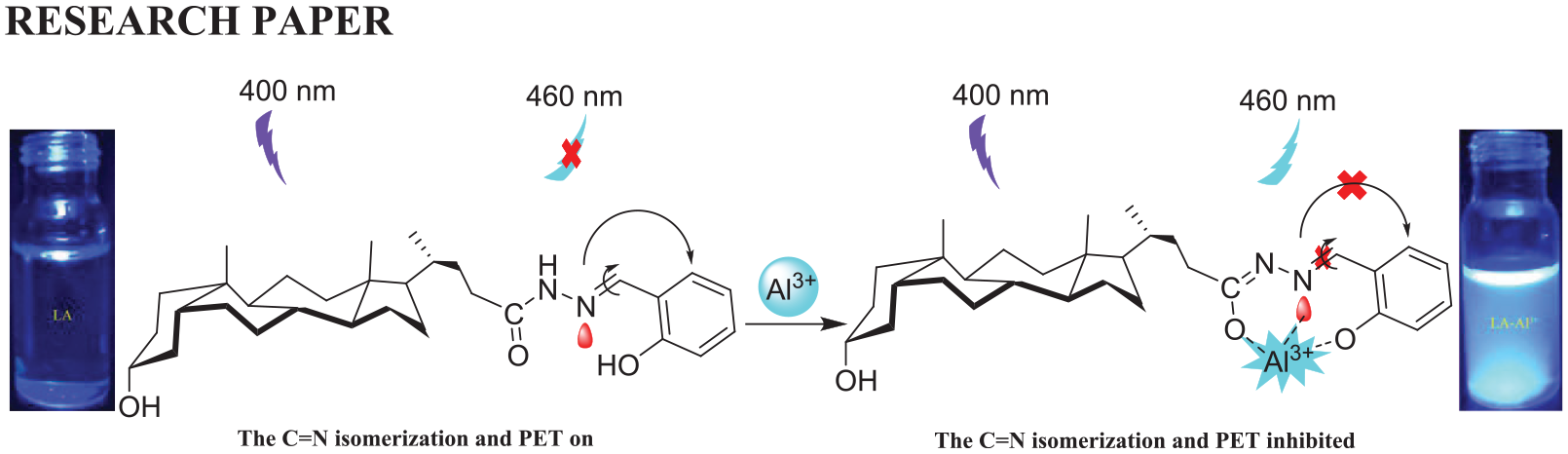
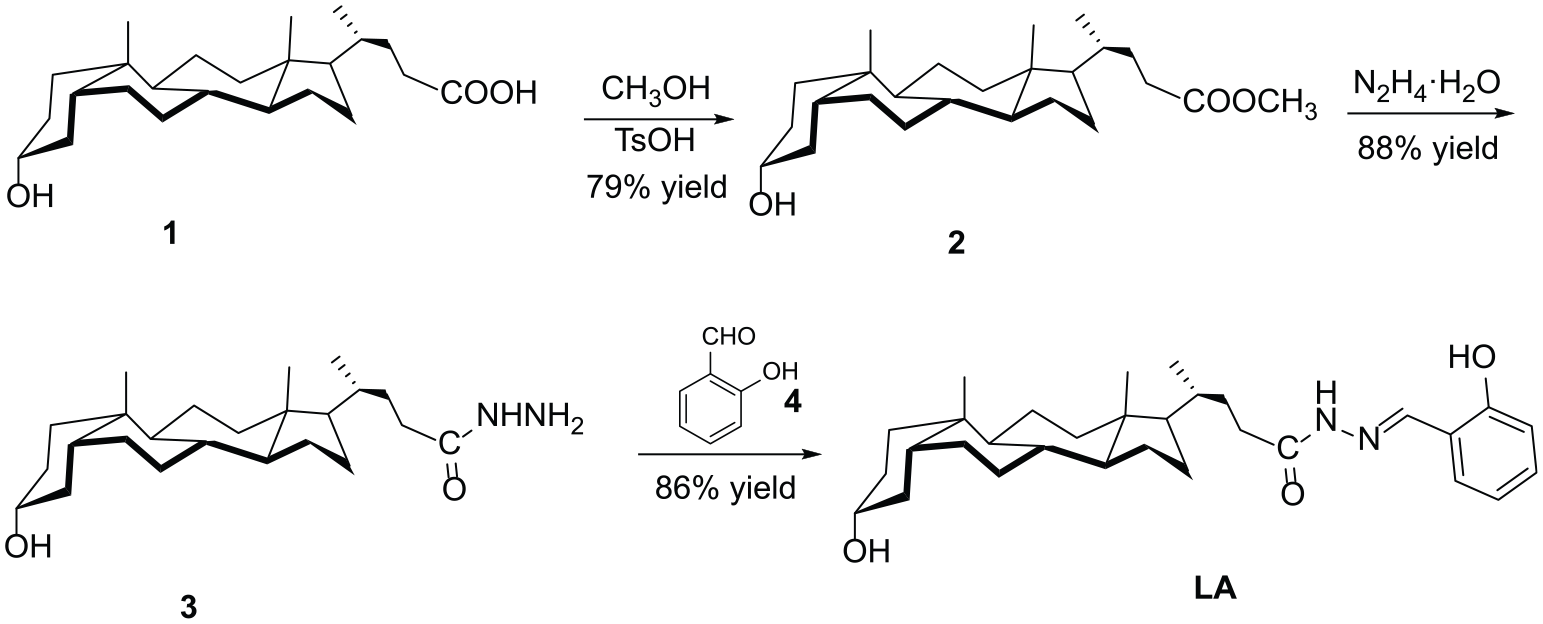
Although various Schiff base chemosensors have been designed and synthesized,19–23 to the best of our knowledge and according to the literature survey that few efforts have been made in the efficient synthesis of chemosensors with “green chemistry” strategy. Besides, steroids are rarely used as a skeleton for fluorescent sensor. In previous studies,24–27 we reported a microwave mediated, efficient, high yield, and environmentally friendly synthesis of Schiff base derivatives. Herein, a novel steroidal Schiff base fluorescent sensor, N′-(2-hydroxybenzylidene)-3α-hydroxy-cholanhydrazide (LA), was designed and prepared via microwave irradiation (Scheme 1), and Al3+ detection capability of LA has been investigated. The free LA exhibited almost no detectable fluorescence emission due to the C=N isomerization and the photo-induced electron transfer (PET) phenomena; when coordinating with Al3+, the C=N isomerization and PET effects were inhibited and the molecular structure changed from flexible to rigid, which dramatically increased the fluorescence intensity.12,28–30
Synthetic protocol for sensor LA.
Results and discussion
To develop an optimal reaction condition, 3α-hydrox-ycholan-24-hydrazide (3) and salicylaldehyde (4) were employed in conventional and microwave-assisted procedures. The reaction was monitored with or without additives, such as acetic acid, Sulfuric acid (H2SO4), or hydrochloride (HCl) under refluxing in Tetrahydrofuran (THF), Dimethyl Sulfoxide (DMSO), N,N-Dimethyl-formamide (DMF), ethanol, methanol, or acetic acid. The result demonstrated that the yield of sensor LA was in the range of 12%–73%, while longer reaction time was required. With better catalytic property, HCl was used in the synthesis of sensor LA under microwave irradiation. Fortunately, it showed a dramatic improvement of the yield and remarkable reduction in reaction time (0.17 h) when we employed a microwave-assisted method. Compared with conventional thermal heating, microwave irradiation technique decreased the reaction time from 5 to 0.17 h and enhanced the yield from 73% to 86%. The study data were given in Table 1.
Optimization of the reaction conditions synthesis sensor LA.
The UV-Vis titration spectra of LA upon addition of various concentrations of Al3+ were carried out in ethanol and water (1:2, v/v) at room temperature. As shown in Figure 1, the absorption spectra of receptor LA have three absorption maxima, centered at 254, 264, and 294 nm. Upon addition of increasing concentrations of Al3+ (0–1.0 equiv.) to the solution of sensor LA (50 μM), those three absorption bands were enhanced gradually, which clearly suggests that LA participates in a coordination with Al3+.
Absorption spectra of sensor LA (50 μM) in ethanol and water (1:2, v/v) solution obtained by adding aliquots of [Al3+] (0, 0.1, 0.2, 0.3, 0.4, 0.5, 0.6, 0.7, 0.8, 0.9, and 1.0 equiv.).
The fluorescence emissions of sensor LA (50 μM) on adding different metal ions (1.0 equiv. of LA) including Ag+, Al3+, Ba2+, Ca2+, Co2+, Cr3+, Cu2+, Fe3+, Hg2+, Mg2+, Mn2+, Ni2+, Pb2+, and Zn2+ were determined in ethanol/water (1:2, v/v). After excitation at 400 nm, the sensor LA exhibited very week fluorescence emission. Upon addition of Al3+ (50 μM), a remarkable fluorescence emission peak at 460 nm was observed (Figure 2). In contrast, no significant fluorescence change was detected after addition of other metal ions under the same conditions. These results indicate that LA exhibits high selectivity for Al3+ over other metal ions. Under the 365-nm UV lamp, the remarkable light-blue fluorescence emission associated with the reactions between LA and Al3+ was observed by the naked eye, but no significant fluorescence change was detected for LA solution with other metal ions.
Fluorescent spectra of sensor LA (50 μM) with 1.0 equiv. of various metal ions in ethanol and water (1:2, v/v). Inset: The colors of sensor LA and LA-Al3+ as viewed by the naked eye under a 365-nm UV lamp.
The quantitative sensing abilities of LA (50 μM) toward Al3+ were studied, and a working curve was obtained (Figure 3). With addition of increasing concentrations of Al3+ ions (0, 10, 20, 30, 40, 50, 60, and 70 μM), the fluorescence intensity of LA-Al3+ enhanced remarkably and showed a maximum fluorescence emission at 460 nm. Besides, a good linear correlation (R2 = 0.99078) between the emission intensity of LA and the concentration ratio of [Al3+]/[LA] was observed on addition of 0–1.4 equiv. of Al3+ ions. According to the titration profile (Figure 4), the binding constant of LA for Al3+ could be calculated as 4.13 × 10³ M−1 based on the modified Benesi–Hildebrand equation (equation (1)),31 in where F, Fmin, and Fmax represents the fluorescence intensities of LA-Al3+ complex, free LA, and the maximum fluorescence intensity of LA-Al3+ complex, respectively.
Fluorescence titrations of 50-μM LA (λex = 400 nm) in ethanol and water (1:2, v/v) in the presence of different equivalents of Al3+ ions (0, 0.2, 0.4, 0.6, 0.8, 1.0, 1.2, and 1.4 equiv.). Inset: Graph of the fluorescence intensity at 460 nm as a function of the concentration ratio of Al3+ and LA.
Benesi–Hildebrand analysis of the emission changes for the complexation between LA and Al3+ in ethanol and water (1:2, v/v). (λex = 400 nm, λem = 460 nm).
According to the 3σ method (limit of detection (LOD) = 3σ/K, σ represents the standard deviation of a blank solution and K represents the slope of the calibration curve in Supplemental Figure S1), the LOD of sensor LA for Al3+ reached 34 nM, which is low for the detection of Al3+ comparing with other published Al3+ binding sensors and much lower than World Health Organization (WHO) recommended 3.7–7.4 μM Al3+ standard drinking water.32,33 These results demonstrate that sensor LA could be potentially used for selective detection of Al3+ in analytical chemistry, especially in water quality monitoring.
To determine the utility of sensor LA as an Al3+-selective receptor in the complex background of competing species, the fluorescence emissions of LA-Al3+ were examined in the presence of different metal ions (Figure 5). Upon addition of different metal ions (1 equiv. of Al3+), the fluorescence emissions of LA-Al3+ were almost not interfered, except for Cu2+ and Fe3+. The obvious reduction of fluorescence intensities caused by Cu2+ and Fe3+ might due to an energy or electron transfer.34 As reported in literatures,35,36 it was possibly because the newly formed complex LA-Fe3+ or LA-Cu2+ was too stable to be replaced by Al3+.
Relative fluorescence intensity ratio of LA-Al3+ (50 μM) in the absence and presence of different metal ions (1.0 equiv.). (λex = 400 nm, λem = 460 nm).
To investigate the applicability of sensor LA for detecting Al3+ in different environments, the pH effects were studied (see Supplemental Figure S2). The fluorescence emissions of LA (50 μM) and LA-Al3+ complex (50 μM, 1:1, M/M) were detected in various buffer solutions (see Supplemental Table S1). The free sensor LA exhibited very week fluorescence emissions in the pH range of 3.92–9.84. Upon addition of Al3+, a remarkable fluorescence enhancement of LA was observed and the pH value increased from 6.05 to 9.32. On the contrary, in acidic solutions (pH < 6.05), the fluorescence intensities significantly decreased, which might due to the protonation of Schiff base group. Moreover, the fluorescence intensities of LA-Al3+ were sharply reduced in strong alkaline solutions (pH > 9.32), which mainly result from the decomposition of Schiff base group. Besides, the formation of aluminum hydroxide in strong alkaline solutions could possibly be another reason for this significant inactivation of probing process. These results demonstrate that sensor LA is highly selective toward Al3+ in a relatively wide pH range (6.05–9.32).
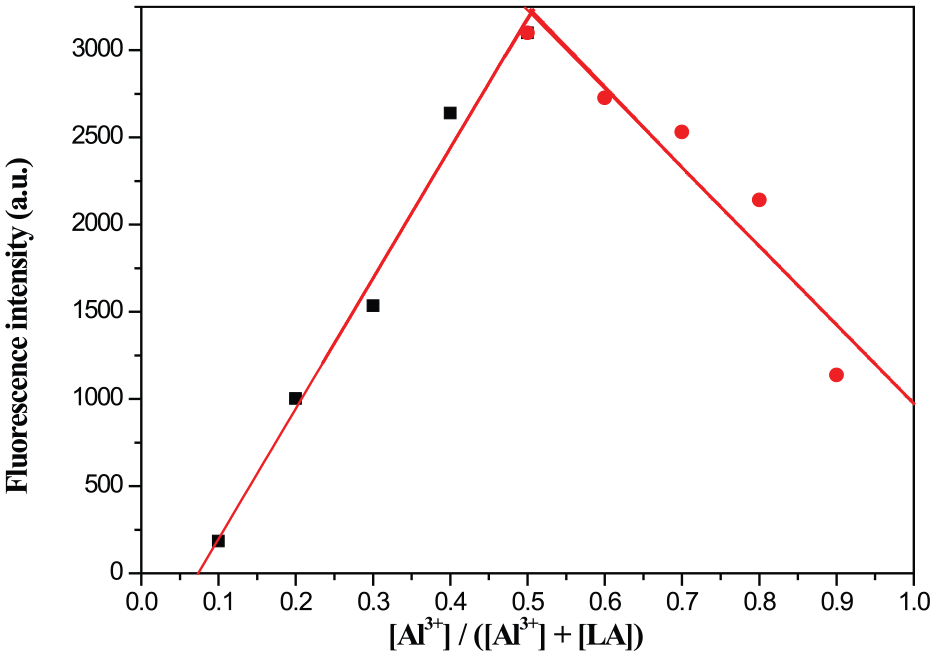
The binding stoichiometry between sensor LA and Al3+ (Figure 6) was studied by the method of continuous variation (Job’s plot). In the Job’s plot, the total concentration of LA and Al3+ was 50 μM, with a continuous variable molar fraction of guest [Al3+]/([LA+Al3+]). The maximum fluorescence emission intensity at 460 nm was observed at the molar ratio of 0.51, establishing a 1:1 binding stoichiometry between sensor LA and Al3+.
Job’s plot for the complexation of LA with Al3+ (λex = 400 nm, λem = 460 nm).
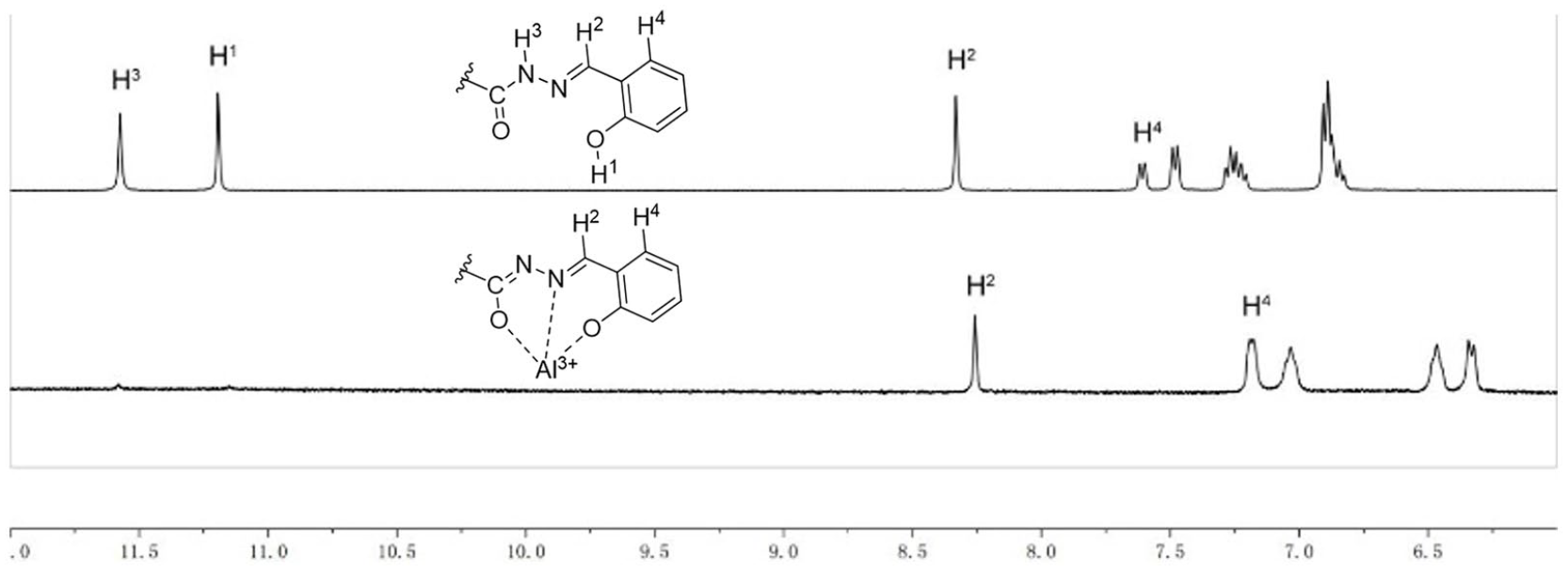
Additional evidence was given by NMR (nuclear magnetic resonance) studies of sensor LA and LA-Al3+ complex. The 1H NMR spectra of LA in the absence and presence of Al3+ were recorded in DMSO-d6. Significant spectral changes were observed (Figure 7). Signals for the protons of –NH– (H3) at 11.57 ppm and –OH (H1) at 11.19 ppm disappeared, which indicates the enolization and deprotonation of LA in the presence of Al3+.37,38 Besides, the signals of H2 and H4 were downfield shifted 0.08 and 0.3 respectively. These phenomena indicate that the hydroxyl group, carbonyl group, and C=N group of sensor LA participate in a coordination with Al3+, which in return changes the electron distribution in the chemosensor.
1H NMR spectra of sensor LA and LA-Al3+ in DMSO-d6.
Based on the above results, a binding mechanism for the fluorescence response of LA toward Al3+ is proposed. As shown in Scheme 2, the fluorescence emission of free LA is nearly quenched, which may due to the PET phenomenon causing by lone pair electron from Schiff-base nitrogen atom to the phenol moiety and C=N isomerization process. However, upon addition of Al3+ ions (2.0 equiv.), two nitrogen atoms of the azomethine groups and the hydroxyl group on the phenol participate in the coordination with Al3+, forming a 1:1 complex and resulting in a remarkable fluorescence enhancement of LA.
Proposed sensing mechanism between sensor LA and Al3+.
By utilizing a previously reported method,39,40 sensor LA was used to measure the Al3+ content in actual water samples, including tap water (from our laboratory), domestic sewage (from student residences at our college), and industrial sewage (from industrial areas in Pingdingshan City). All the water samples were filtered through a 0.2-mm filter membrane to remove large particular impurities, followed by removal of remaining organics by extraction processes. The resulting samples were diluted with ethanol and water (1:2, v/v) in a 10.0-mL volumetric flask. Table 2 shows the results acquired using sensor LA with the appropriate concentration gradient of Al3+ added. The results indicate that sensor LA had good recovery and demonstrated high accuracy in the analysis of Al3+. Therefore, sensor LA can measure the concentration of Al3+ in real water samples and has practical value in environmental analysis.
Determination of Al3+ in real water samples with sensor LA.
Determined with a pH meter before treating with Al3+.
Results are based on three measurements.
Conclusion
In summary, a highly selective and sensitive Schiff base chemosensor, N′-(2-hydroxybenzylidene)-3α-hydroxy-cholanhydrazide (LA), has been designed and synthesized under microwave irradiation. LA shows significant “turn-on” fluorescence behavior with Al3+ in ethanol/water (1:2, v/v) solution, giving strong light-blue emission. The detection limit was calculated to be 3.4 × 10⁻⁸ mol L-1 and remained stable, detecting Al3+ in the pH range of 6.05–9.32. In addition, the sensor LA exhibits satisfactory results for Al3+ detection in the analysis of real water samples and can be further used in potential applications for the detection of nanomolar concentrations of Al3+ in chemical and environmental systems.
Experimental
All chemicals and solvents were obtained from commercial sources and used without further purification, except when specified. Solvents used in fluorescent experiments were of spectroscopic grade. The 1H NMR and 13C NMR spectra of the ligand were recorded on an Agilent 400-NMR DDR2 spectrometer. The chemical shifts (δ) are recorded in ppm, relative to tetramethylsilane (SiMe4). The Fourier transform infrared spectrum was recorded on a Perkin-Elmer 1700 FTIR spectrophotometer. Mass spectra were obtained using a Finnigan LCQ DECA mass spectrometer in electrospray ionization (ESI) positive mode. A Mapada UV-6100 UV-Vis spectrophotometer was used for recording the UV-Vis spectra. Fluorescence emission spectra were recorded on a Dual-FL fluorescence spectrophotometer. Elemental analysis (C, H, and N) was performed with an Elementar Vario MICRO cube, and the results are within ±0.4% of the calculated values. All the reactions were performed in a commercial microwave apparatus (XH-100A, 100–1000W; Beijing Xianghu Science and Technology Development Co. Ltd, Beijing, China). All the solvents were purified before use. Compounds 2 and 3 (Scheme 1) were prepared starting from lithocholic acid according to a literature procedure.41
Preparation of N′-(2-hydroxybenzylidene)-3α-hydroxy-cholanhydrazide (sensor LA)
To a solution of compound 3 (1 mmol) in methanol (5 mL), salicylaldehyde (0.95 mmol) and acetic acid (2 drops) were added successively. The mixture was heated to reflux in the microwave oven at 300 W for 10 min. After completion, the mixture was cooled and filtered to afford crude product. The crude product was recrystallized from ethanol to give the desired product LA (428 mg) as yellow solid. Yield 86%; m.p. 254.5–254.9 oC (EtOH). IR (KBr, cm)−1: 3453, 3221, 3070, 2941, 2872, 1687, 1624, 855, 750, 627. 1H NMR (400 MHz, DMSO-d6): δ 11.57 (s, 1H, NH), 11.19 (s, 1H, Ar-OH), 8.33 (s, 1H, =CH), 7.48 (d, J = 8.0 Hz, 1H, ArH), 7.25–7.29 (m, 1H, ArH), 6.87–6.91 (m, 2H, ArH), 4.45 (d, J = 1.2 Hz, 1H, 3α-OH), 0.92 (t, J = 8.0 Hz, 3H, 21-CH3), 0.87 (s, 3H, 19-CH3), 0.61 (s, 3H, 18-CH3). 13C NMR (100 MHz, DMSO-d6): δ 173.98, 162.46, 151.48, 134.61, 131.73, 125.24, 123.78, 121.45, 75.04, 61.26, 60.71, 60.54, 47.46, 46.70, 41.48, 40.56, 40.33, 40.13, 39.39, 36.34, 36.08, 35.56, 34.18, 32.92, 32.07, 31.34, 29.03, 28.46, 25.59, 23.45, 17.07. ESI-MS, m/z: 495.86 [M+1]+. Anal. calcd for C31H46N2O3: C, 75.26; H, 9.37; N, 5.66; found: C, 75.06; H, 9.34; N, 5.68%.
Supplemental Material
SI-CHL-19-0441 – Supplemental material for Microwave-assisted synthesis of a novel steroid-derived Schiff base chemosensor for detection of Al3+ in aqueous media
Supplemental material, SI-CHL-19-0441 for Microwave-assisted synthesis of a novel steroid-derived Schiff base chemosensor for detection of Al3+ in aqueous media by Yu Chen in Journal of Chemical Research
Footnotes
Declaration of conflicting interests
The author(s) declared no potential conflicts of interest with respect to the research, authorship, and/or publication of this article.
Funding
The author(s) received no financial support for the research, authorship, and/or publication of this article.
ORCID iD
Yu Chen
Supplemental material
Supplemental material for this article is available online.
References
1.
HeTXinQZhenLZ, et al. Spectro Chim Acta A2019; 207: 31.
2.
CampbellABecariaALahiriDK, et al. J Neurosci Res2004; 75: 565.
3.
FlatenTP. Brain Res Bull2001; 55: 187.
4.
GoodPFOlanowCWPerlDP. Brain Res1992; 593: 343.
5.
WangRJiangGQLiXH. Inorg Chim Acta2017; 455: 247.
6.
SupritiSTitasMBasabC, et al. Analyst2012; 137: 3975.
7.
UpadhyayKKAjitK. Org Biomol Chem2010; 8: 4892.
8.
WeiHDDanWXiangJZ, et al. Sens Actuators B2015; 209: 359.
9.
OnderASerkanE. Sens Actuators B2015; 208: 159.
10.
ZhaoCXJuYYDavidRS. Chem Soc Rev2010; 39: 1996.
11.
LeiLYongQDHongWL, et al. Tetrahedron Lett2010; 51: 618.
12.
JunYLongFJingCQ, et al. Tetrahedron Lett2016; 57: 2910.
KalyaniRAmitKMMemanS, et al. Inorg Chim Acta2019; 492: 156.
21.
XinSYaWWYuP. Org Lett2012; 14: 3420.
22.
ZohrehSMehdiASoraiaM. J Lumin2019; 207: 78.
23.
DasBJanaAMahapatraAD, et al. Spectrochim Acta A2019; 212: 222.
24.
ShiZCZhaoZGLiuM, et al. C R Chim2013; 16: 977.
25.
ShiZCZhaoZGLiuXL, et al. Chin Chem Lett2011; 22: 405.
26.
ShiZCZhaoZGLiuXL, et al. J Chem Res2011; 35: 198.
27.
LiGHShiZCLiXR, et al. J Chem Res2011; 35: 278.
28.
TangKCChangMJLinTY, et al. J Am Chem Soc2011; 133: 17738.
29.
WuJSLiuWMZhuangXQ, et al. Org Lett2007; 9: 33.
30.
FujikawaYUranoYKomatsuT, et al. J Am Chem Soc2008; 130: 14533.
31.
LiuSRWuSP. Sens Actuators B2012; 171: 1110.
32.
SinhaSKonerRRKumarS, et al. RSC Adv2013; 3: 345.
33.
SenBMukherjeeMBanerjeeS, et al. Dalton Trans2015; 44: 8708.
34.
MartınezRMolinaP. Org Lett2005; 7: 5869.
35.
BurdetteSCFredericksonCJBuW, et al. J Am Chem Soc2003; 125: 1778.
36.
LiuWXuLShengR, et al. Org Lett2007; 9: 3829.
37.
MonfaredHHFalakianHBikasR, et al. Inorg Chim Acta2013; 394: 526.
38.
XiaoWLuZLWangXJ, et al. Polyhedron2000; 19: 1295.
39.
QuSZZhengCHLiaoGM, et al. RSC Adv2017; 7: 9833.
40.
WuXChenJZhaoJX. Analyst2013; 138: 5281.
41.
ZhouCEZhaoZGTangXL. Chin J Org Chem2007; 27: 513.
Supplementary Material
Please find the following supplemental material available below.
For Open Access articles published under a Creative Commons License, all supplemental material carries the same license as the article it is associated with.
For non-Open Access articles published, all supplemental material carries a non-exclusive license, and permission requests for re-use of supplemental material or any part of supplemental material shall be sent directly to the copyright owner as specified in the copyright notice associated with the article.