



Abstract
A molybdenum carbide-carbon composite (β-Mo2C/C) is prepared by carbonization of an anionic resin with molybdate. The β-Mo2C/C is characterized by X-ray diffraction, N2 physisorption, scanning electron microscopy, and transmission electron microscopy. Characterization indicates that the sample shows a hierarchically microporous, mesoporous, and macroporous structure, and has a large surface area. The nanosized β-Mo2C crystals are highly dispersed in the carbon-based sample. The β-Mo2C/C composite shows high catalytic activity in the hydrogenation of naphthalene to tetralin.
Keywords
A molybdenum carbide-carbon composite is prepared by carbonization of the anion resin with molybdate. Characterization indicates that the sample shows a hierarchically porous structure. The nanosized β-Mo2C crystals are highly dispersed in the carbon-based sample. The β-Mo2C/C shows high catalytic activity in the hydrogenation of naphthalene.

Introduction
Tetralin, which is widely used in pharmaceuticals and in paint, is a very useful high boiling point solvent, and is usually obtained from the hydrogenation of naphthalene. 1 Although precious metals show high activity and selectivity in the hydrogenation of naphthalene, the widespread application of precious metals in a commercial system is severely restricted because of the high cost and the low abundance. Transition metals of carbides, nitrides, and phosphides of group 4–6 metals exhibit similar catalytic performance to precious metals and have received considerable attention. 2 Among them, molybdenum carbide (Mo2C) is an effective catalyst in the hydrogenation, 3 dehydrogenation, 4 and other reactions. 5 Due to its much lower price, Mo2C has shown several characteristics as a promising alternative to precious metals. During the past few decades, many efforts to synthesize Mo2C have been reported.3–6 The catalytic activity of Mo2C is attributed to the permeation of carbon atoms into the lattice of the transition metal, which lengthens the metal–metal distance and then increases the d-band electron density at the Fermi level of molybdenum. 6
The surface of molybdenum carbide is generally small, so it needs to be attached to a support to have stability and catalytic activity, for example, activated carbon (AC),7,8 carbon nanotubes,9–12 and ordered mesoporous carbon. 13 Liang and colleagues 8 reported the preparation of Mo2C/AC through pyrolysis of a suitable precursor under microwave irradiation using AC as the support. Lou and colleagues 10 reported that nanostructured Mo2C supported on carbon nanotubes (Mo2C/CNTs) with different loadings could be prepared by a carbothermal hydrogen reduction method. These materials showed high activity in some reactions. However, the methods to synthesize these materials are still complicated.
Resins are relatively low-cost and easily obtainable commercial products, and have been used to prepare porous carbons,14,15 silicon carbide, 14 and magnetically motive porous spheres. 16 Carbon materials stand out as possible catalytic supports due to their favorable proprieties such as high surface area and porosity.17–19 The carbonization of resins can easily be used to prepare porous carbon which has hierarchical porous and high surface areas. Mo2C is easily dispersed on this support. In the present study, we demonstrate a facile and one-step route for the synthesis of composites consisting of molybdenum carbide and carbon (β-Mo2C/C), which combine the advantages of large spheres, high surface areas, hierarchical pores, good stability, and high catalytic activity.
Results and discussion
Catalyst synthesis
Anion-exchange resin was mixed with an aqueous solution of ammonium molybdate to obtain the corresponding resin derivative. The resin derivative was washed, dried, and carbonized under a N2 atmosphere at 850 °C for 5 h to obtain the catalyst.
Catalyst characterization
X-ray diffraction (XRD) (Figure 1) of the sample indicated that β-Mo2C formed without any impurities. The obtained sample clearly exhibits typical diffraction peaks at 2θ of 34.4°, 37.9°, 39.5°, 52.2°, 61.7°, 69.6°, 74.5°, and 75.7°, which are exclusively due to β-Mo2C.7,20 First, the anion resin was carbonized to carbon at 850 °C under a nitrogen atmosphere, and then the carbon was reacted with the molybdenum species which was already ion-exchanged into the resin to produce molybdenum carbide. Notably, the starting materials are the anionic resin and ammonium molybdate, and the final products are β-Mo2C and carbon. Possibly, the anion resin may be transformed into carbon by dehydration and carbonation, followed by the interaction of molybdenum species (e.g. molybdenum oxide) with the carbon species, resulting in the formation of the β-Mo2C phases.

XRD pattern of β-Mo2C/C.
Figure 2 shows the nitrogen adsorption and desorption isotherm of the sample. The isotherms of the sample show a steep increase in the curve at a relative pressure of P/P0 < 0.02, which is due to filling of the micropores. 21 The micropore size distribution gives a narrow uniform pore of 0.62 nm (Figure S4a). A hysteresis loop in the range of 0.5 < P/P0 < 1.0 is characteristic of H4-type adsorption, according to de Boer’s classification, which may show the presence of mesoporous structures. The Barrett, Joyner, and Halenda (BJH) pore size distribution indicates mesoporosity and macroporosity with an average size distribution of 20–80 nm (Figure S4b). Another step can be identified in the adsorption curve at a relative pressure of P/P0 > 0.90, which may be assigned to the presence of macroporous structures. This phenomenon may be attributed to the fact that the sample contains interconnected micropores, mesopores, and macropores. 22 The presence of microporosity, mesoprosity, and macroporosity in the sample may result from the expansion of gases such as H2O that are formed through the interaction between the carbon and molybdenum oxide in the sample under a nitrogen atmosphere. 23 The sample has a high Brunauer–Emmett–Teller (BET) surface area (328 m2 g−1) and large pore volume (0.21 cm3 g−1) (micropore volume 0.06 cm3 g−1) which is very useful for adsorption and catalysis.

N2 isotherm of β-Mo2C/C.
The N2 adsorption isotherm of the Mo-free sample synthesized without molybdate (Figure S2) shows microporosity, but this Mo-free sample has a surface area (101 m2 g−1) and pore volume (0.05 cm3 g−1) which is much lower than β-Mo2C/C.
Scanning electron microscopy (SEM) images (Figure 3) show that β-Mo2C/C exhibits sphere morphology (Figure 3(a)) inherited from the original resin (Figure S1) during the preparation process and that the sample contains numerous mesopores and macropores ranging from 40 to 80 nm (Figure 3(b)), in agreement with the results of nitrogen adsorption (Figure S4). Hierarchical mesopores and macropores can be clearly identified in the β-Mo2C/C sample, indicating that the high porosity of the parent resin is well conserved.
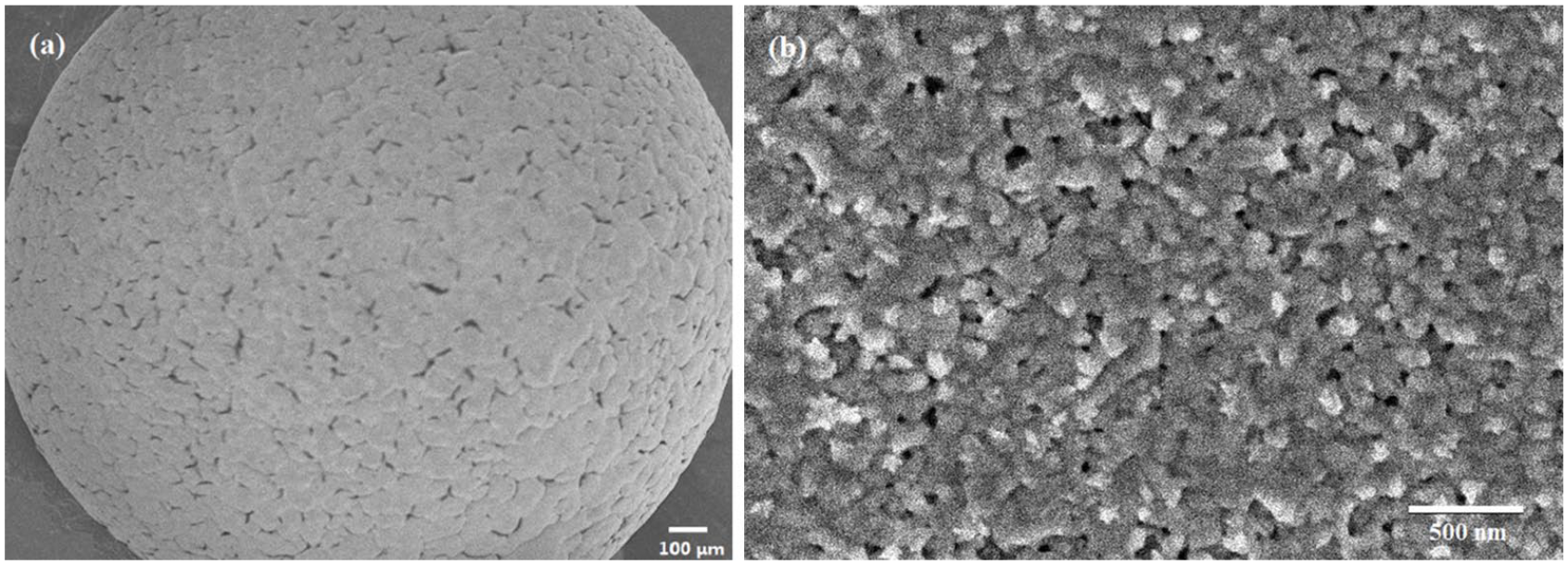
SEM images of β-Mo2C/C at different resolutions: (a) 100 μm, and (b) 500 nm.
Transmission electron microscopy (TEM) images give a direct insight into the structure properties and distribution of the β-Mo2C/C catalyst. It can be seen in Figure 4 that the β-Mo2C nanoparticles (black dots in the TEM image) are highly dispersed on carbon with diameters of 20–40 nm (Figure S3). The TEM image also shows that the sample contains a number of mesopores and macropores ranging from 40 to 80 nm (white in the TEM image), in agreement with the results of nitrogen adsorption and SEM. The pore structure can accelerate the reaction mass transfer rate and increase the shape selectivity.

TEM image of β-Mo2C/C.
The β-Mo2C/C catalyst might be an effective alternative to precious metals catalyst due to the high dispersion of β-Mo2C and the use of hierarchical porous carbon as the support.
Catalytic activity
Naphthalene hydrogenation is a type of consecutive reaction, with tetralin as the half-hydrogenated product and decalin as the fully hydrogenated product. 8 Precious metal catalysts usually show high selectivity for tetralin; however, they are very sensitivity to catalyst poisons.
The catalytic activity of the molybdenum carbide-carbon composite (β-Mo2C/C) toward naphthalene hydrogenation was investigated. Figure 5 illustrates the time-dependence of naphthalene conversion over the β-Mo2C/C catalyst. Notably, the activity of β-Mo2C/C was good: after reacting for 3 h, the conversion of naphthalene was 89% (Figure 5(a)) and the selectivity toward tetralin was 85% (Figure 5(b)). The conversion of naphthalene was almost maintained above 86% within 24 h (Figure S5), which meant that the stability of β-Mo2C/C catalyst was high.

(a) Conversion of naphthalene and (b) selectivity toward tetralin.
The hierarchical porous structure and large surface area of this composite was good for mass transformation in this reaction. The results indicate that β-Mo2C/C had high hydrogenation activity in the hydrogenation of naphthalene, showing high activity and selectivity toward tetralin, which we suppose is not only due to the high dispersion of β-Mo2C, but also the support of the hierarchical porous carbon.
In summary, a molybdenum carbide-carbon composite (β-Mo2C/C) has been prepared rapidly in one step by carbonization of the anion resin which is simple and cheap. This sample has a hierarchical microporous, mesoporous, and macroporous structure, and a large surface area. The nanosized β-Mo2C crystals are highly dispersed in the carbon. β-Mo2C/C has a high efficiency in the selective hydrogenation of naphthalene to tetralin. We hope that β-Mo2C/C will find use as a low-cost catalyst for the production of tetralin.
Experimental
Materials synthesis
For the facile one-step synthesis of the composite, 3 g of a basic anion-exchange resin (D201, Bengbu Tianxing Ion-Resin Co., Ltd, China) was mixed with 40 mL of an aqueous solution of 0.5 g of ammonium molybdate ((NH4)6Mo7O24·4H2O, Sinopharm Chemical Reagent Co., Ltd, China) to obtain the corresponding resin derivative. The resin derivative was washed with deionized water, dried at 80 °C for 12 h, and carbonized under a N2 atmosphere at 850 °C for 5 h in steps of 3 °C min−1.
Catalyst characterization
XRD patterns were obtained with a Rigaku D/Max-2550 diffractometer using CuKα radiation. The nitrogen adsorption isotherms of the samples were measured using a Micromeritics ASAP 2010 system. The samples were outgassed for 10 h at 300 °C before the measurements. The pore size distribution was calculated using the BJH and Horvath–Kawazoe (HK) model. SEM experiments were performed on a Hitachi S-4000 electron microscope. The TEM experiment was performed on a JEM 3010 electron microscope (JEOL) with an acceleration voltage of 300 kV.
Catalytic reaction measurements
The β-Mo2C/C (200 mg) catalyst was added to a high-pressure reactor (Parr Instrument Company, United States), and the reactor was heated to 350 °C at a rate of 10 °C min−1 under 1 MPa H2 and kept for 1 h to ensure that the catalyst has been activated. After the reactor was cooled to 250 °C, the desired amount of n-dodecane (80 mL) as the solvent with the appropriate quantity of naphthalene (3 g) was introduced into the reactor. The total pressure was 4.5 MPa (hydrogen pressure of about 4.2 MPa), and the stirring rate was 800 r min−1. Hydrogen was continually supplied to make up for the consumption of hydrogen and to maintain the same total pressure. A steady state was achieved after reacting for 3 h. A small amount of the liquid product from the hydrogenation of naphthalene was removed from the reactor and allowed to cool. The products of the hydrogenation of naphthalene were analyzed with an Agilent 6890N gas chromatograph equipped with a flame ionization detector (FID) detector.
Supplemental Material
Supporting_Information – Supplemental material for A facile one-step synthesis of molybdenum carbide-carbon composites for the hydrogenation of naphthalene
Supplemental material, Supporting_Information for A facile one-step synthesis of molybdenum carbide-carbon composites for the hydrogenation of naphthalene by Chengyang Yin, Jing He and Shuang Liu in Journal of Chemical Research
Footnotes
Declaration of conflicting interests
The author(s) declared no potential conflicts of interest with respect to the research, authorship, and/or publication of this article.
Funding
The author(s) disclosed receipt of the following financial support for the research, authorship, and/or publication of this article: This work was supported by the Special Fund of Liaoning Provincial Universities’ Fundamental Scientific Research Projects (LQN201709), the Natural Science Foundation of Liaoning Province (20180550890), the Scientific Research Project of Shenyang Normal University (BS201812), and the Open Project of State Key Laboratory of Supramolecular Structure and Materials (SKLSSM201829).

Supplemental material
Supplemental material for this article is available online.
References
Supplementary Material
Please find the following supplemental material available below.
For Open Access articles published under a Creative Commons License, all supplemental material carries the same license as the article it is associated with.
For non-Open Access articles published, all supplemental material carries a non-exclusive license, and permission requests for re-use of supplemental material or any part of supplemental material shall be sent directly to the copyright owner as specified in the copyright notice associated with the article.
