




Abstract
Two coumarin-benzimidazole hybrids and two coumarin-phenanthroimidazole conjugates were conveniently synthesized and characterized. The UV–vis absorption, emission spectra, absolute quantum yields, and fluorescence lifetimes of these compounds in diluted dichloromethane solutions were measured.
Coumarins have been widely studied not only for their various biological activities such as antibacterial, anti-HIV, and anticancer activities but also for their superior thermal stability and outstanding optical properties including high quantum yields, large Stokes shifts, and superior photostability. Thus, coumarin derivatives are extensively used as fluorescent whiteners, nonlinear optical chromophores, fluorescent probes, laser dyes, and solar energy collectors. Since their spectroscopic and photophysical properties can be easily modified by introducing substituents on the coumarin ring, the synthesis and application of coumarin derivatives have been attracting great interest.1–3
Benzimidazole and phenanthroimidazole derivatives have also been extensively studied because of their synthetic utility and their variety of applications.4,5 To our knowledge, coumarin-benzimidazole hybrids have been well studied due to their diversified properties. They are reported to exhibit various biological activities such as antitumor, antioxidant, and antihepatitis. 6 They are also well-known laser dyes and have been investigated in many optical studies. 7 However, studies on the optical properties and applications of coumarin-phenanthroimidazole conjugates in the literature are limited. 8 Recently, we have synthesized coumarin-7, coumarin-30, and their 4-substituted regioisomers and found the UV–vis absorption and fluorescence emission properties of the isomers are different.9,10 As a part of the foregoing research in our group, we present herein the concise synthesis and fluorescent properties of regioisomeric coumarin-benzimidazole and coumarin-phenanthroimidazole hybrids. As for the reported analogs, 7 these synthesized compounds could be potentially used as laser dyes, environment-sensitive fluorescent probes, or dopants for organic light-emitting diodes.
Results and discussion
The synthesis of the target molecules was carried out as outlined in Scheme 1. As we have demonstrated previously in the synthesis of coumarin-7 and coumarin-30,9,10 4-(diethylamino)salicylaldehyde (

Synthesis of coumarin-benzimidazole and coumarin-phenanthroimidazole hybrids. Regents and conditions: (a) Ph3P=CHCO2Et, ethanol, reflux, 5 h, 72%; (b) DMF, POCl3, 60°C, 7 h, 81%; (c) ethyl acetoacetate, ZnCl2, ethanol, reflux, 5 h, 82%; (d) SeO2, xylene, reflux, 10 h, 58%; (e) 2-aminodiphenylamine, ammonium acetate, ethanol, reflux,
Fortunately, a single crystal of compound

The molecular structure of compound

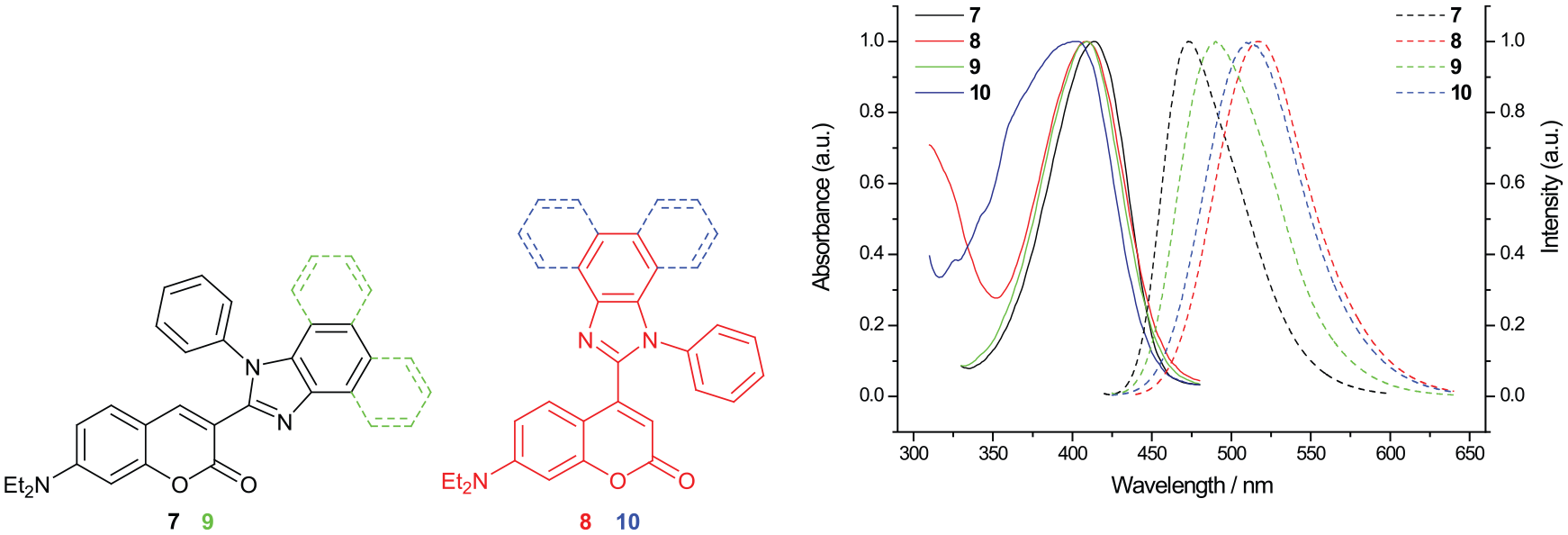
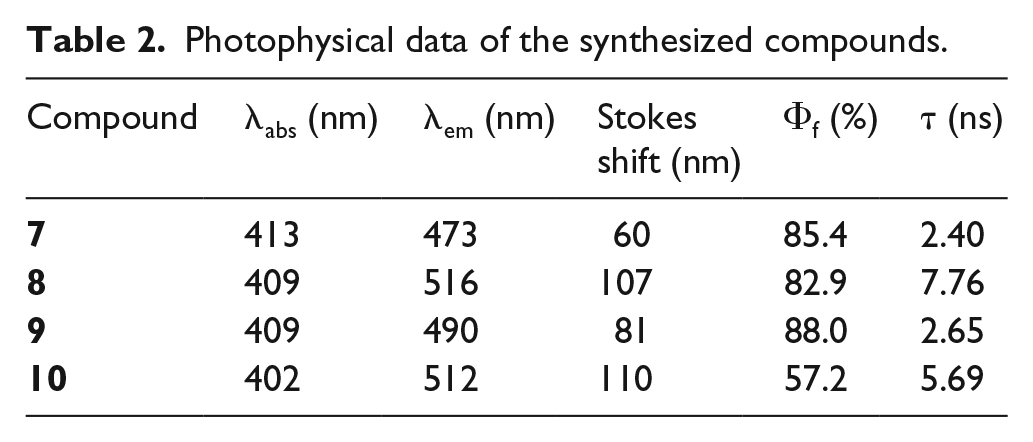
The UV–vis absorption and fluorescence spectra of the synthesized compounds

Normalized absorption and emission spectra of compounds

Fluorescence life time measurements of compounds
Photophysical data of the synthesized compounds.
In conclusion, the facile synthesis of two coumarin-benzimidazole regioisomeric hybrids and two coumarin-phenanthroimidazole regioisomeric hybrids has been described. The UV–vis absorption, emission spectra, absolute quantum yields, and fluorescence lifetimes in diluted dichloromethane solutions of these compounds were determined. The results revealed that the photophysical properties of the 3-substituted hybrids are obviously different from those of the corresponding 4-substituted analogs. Applicability of these coumarin-benzimidazole and coumarin-phenanthroimidazole conjugates is yet to be established.
Experimental
Reagents and solvents were all from commercial sources and used without further purification. IR spectra were performed on a Digilab FTS-3000 FTIR spectrophotometer. 1H NMR and 13C NMR spectra were recorded on either an Agilent Technologies DDZ 600 MHz or a Bruker Avance III 500 MHz spectrometer. Melting points were determined using a microscope apparatus and are uncorrected. High-resolution mass spectra (HRMS) were determined on a Bruker Daltonics APEX II 47e spectrometer. Single crystal X-ray diffraction measurements were made on a Bruker X8 APEX diffractometer working with graphite monochromated Mo Kα radiation. UV–vis absorption and fluorescence spectra were recorded on a Hitachi U-3900H spectrometer and on a Hitachi F7000 FL spectrophotometer, respectively. Fluorescent lifetimes and absolute quantum yields were recorded on a FLS920 type steady-state/transient fluorescence spectrometer (Edinburgh Instruments Ltd).
7-(Diethylamino)coumarin (
Synthesis of 7-(Diethylamino)-3-(1-phenyl-1H-benzo[d]imidazol-2-yl)coumarin (7 )
7-(Diethylamino)-3-formylcoumarin (0.23 g, 0.94 mmol), ammonium acetate (0.45 g, 5.84 mmol), and N-phenyl-o-phenylenediamine (0.19 g, 1.03 mmol) were dissolved in ethanol (20 mL). The reaction mixture was stirred under reflux conditions for 5 h. After the completion of reaction, the solvent was evaporated under reduced pressure and the resulting mixture was dissolved in ethyl acetate (50 mL). The organic phase was washed with water (3 × 50 mL), dried over Na2SO4, and evaporated under vacuum. The resulting residue was purified by column chromatography over silica gel using petroleum ether/acetone (v/v = 6:1) as eluent to afford yellow solid product. Yield 0.21 g (54%), m.p. 220°C–221°C (lit. 11 m.p. 198°C–200°C). IR (KBr) cm−1: 3059, 2978, 1710, 1525, 1452, 1384, 729. 1H NMR (600 MHz, CDCl3): δ/ppm 8.14 (s, 1H), 7.86 (d, J = 7.8 Hz, 1H), 7.48–7.27 (m, 9H), 6.59 (dd, J = 9.0 and 2.4 Hz, 1H), 6.41 (d, J = 2.4 Hz, 1H), 3.41 (q, J = 7.2 Hz, 4H), 1.20 (t, J = 7.2 Hz, 6H). 13C NMR (150 MHz, CDCl3): δ/ppm 159.1, 157.3, 151.5, 149.1, 146.2, 142.7, 136.9, 136.6, 129.8, 129.4, 128.2, 126.3, 123.4, 122.8, 119.7, 111.1, 110.4, 109.1, 108.1, 97.1, 44.9, 12.4.
Synthesis of 7-(Diethylamino)-4-(1-phenyl-1H-benzo[d]imidazol-2-yl)coumarin (8 )
Compound
Synthesis of 7-(Diethylamino)-3-(1-phenyl-1H-phenanthro[9,10-d]imidazol-2-yl)coumarin (9 )
7-(Diethylamino)-3-formylcoumarin (0.21 g, 0.86 mmol), 9, 10-phenanthrenequinone (0.22 g, 1.05 mmol), aniline (0.12 g, 1.30 mmol), and ammonium acetate (0.20 g, 2.60 mmol) were dissolved in acetic acid (20 mL). The reaction mixture was refluxed under nitrogen for 12 h. After completion, the reaction mixture was cooled to room temperature and was poured into water (100 mL) and extracted with dichloromethane (3 × 100 mL). The combined organic phase was dried over Na2SO4. After filtering, the filtrate was evaporated under reduced pressure. The resulting residue was purified by chromatography on silica gel using petroleum ether/ethyl acetate/dichloromethane (v/v/v = 3:1:1) as the eluent to afford yellow solid product. Yield 0.25 g (58%), m.p. 261°C–263°C. IR (KBr) cm−1: 2987, 1718, 1608, 1519, 1355, 1136, 754. 1H NMR (500 MHz, DMSO-d6): δ 8.94 (d, J = 8.5 Hz, 1H), 8.89 (d, J = 8.0 Hz, 1H), 8.64 (dd, J = 8.0 and 1.5 Hz, 1H), 8.24 (s, 1H), 7.79–7.34. (m, 10H), 7.16 (dd, J = 8.0 and 1.5 Hz, 1H), 6.73 (dd, J = 8.5 and 2.5 Hz, 1H), 6.51 (d, J = 2.5 Hz, 1H), 3.43 (q, J = 7.0 Hz, 4H), 1.12 (t, J = 7.0 Hz, 6H). 13C NMR (125 MHz, DMSO-d6): δ 159.3, 156.7, 151.4, 147.6, 147.2, 137.3, 136.4, 130.2, 129.8, 129.7, 128.7, 128.5, 127.6, 127.5, 127.2, 126.7, 125.7, 125.4, 124.5, 123.7, 122.3, 121.9, 120.2, 109.9, 109.4, 107.0, 96.3, 44.2, 12.3. HRMS Calculated for C34H28N3O2 [M+H]+: 510.2176, Found: 510.2189.
Synthesis of 7-(Diethylamino)-4-(1-phenyl-1H-phenanthro[9,10-d]imidazol-2-yl)coumarin (10 )
Compound
Footnotes
Acknowledgements
We thank the Instrument Analysis Center of Lanzhou Jiaotong University.
Declaration of conflicting interests
The author(s) declared no potential conflicts of interest with respect to the research, authorship, and/or publication of this article.
Funding
The author(s) received no financial support for the research, authorship, and/or publication of this article.
