



Abstract
Background:
Climate change is reshaping environmental exposures, which in turn influence cerebrovascular diseases. Brazil’s continental dimensions and climate diversity offer a unique opportunity to examine climate-stroke associations within a unified healthcare system. Such regional analyses may inform adaptation strategies for other low-and middle-income countries facing similar environmental challenges.
Methods:
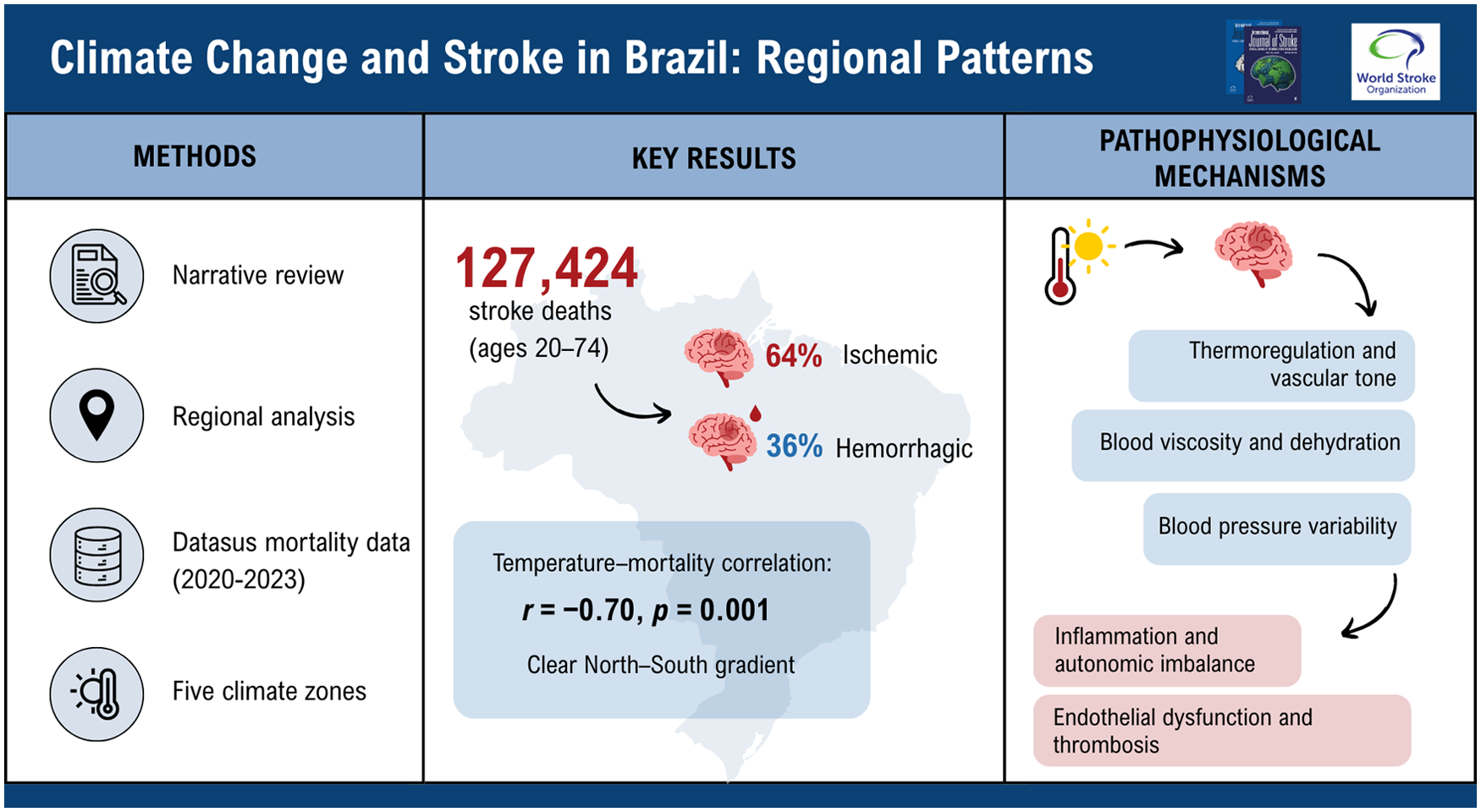
A literature search was conducted across the PubMed, Scopus, and Web of Science databases, covering publications from January 2000 through August 2025 linking climate exposures to cerebrovascular outcomes. To examine climate-stroke associations, we analyzed national mortality data (DATASUS, 2020–2023) for Brazil’s five geographic regions, yielding 127,424 stroke deaths (I61–I62, I63 + I65–I66).
Findings:
Global evidence consistently demonstrates nonlinear, asymmetric associations between temperature extremes and stroke risk (relative risk (RR) = 1.06–1.18 for extreme heat/cold, p < 0.05), with PM2.5 conferring both short-term (RR = 1.01, 95% confidence interval (CI) = 1.004–1.012 per 10 µg/m3) and long-term risks (hazard ratio (HR) = 1.11–1.21, p < 0.001). Brazilian analysis revealed climate-dependent patterns: cooler southern temperate regions showed higher ischemic-to-hemorrhagic stroke ratios (2.28:1, 70% ischemic) compared to hotter tropical regions (1.28:1 in Centro-Oeste, 56% ischemic). Both ischemic (Pearson r = −0.70, p = 0.001) and hemorrhagic (Pearson r = −0.65, p = 0.002) stroke deaths demonstrated negative associations with peak temperatures across pooled observations.
Interpretation:
Stroke should be recognized as a climate-sensitive non-communicable disease. Global evidence demonstrates robust associations between temperature and stroke, while preliminary Brazilian regional patterns suggest potential climate influence on the distribution of stroke subtypes. Key priorities include establishing linkages between daily weather observations and atmospheric pollutant measurements, establishing multi-center surveillance networks, strengthening climate-resilient stroke care systems, and reducing PM2.5 through environmental regulation as a stroke-prevention strategy.
Get full access to this article
View all access options for this article.