




Abstract
Background:
Young adults account for up to 15% of all ischemic strokes, yet data from Latin America remain scarce. Understanding their clinical profile and outcomes is essential to inform targeted interventions and public health strategies. We aimed to characterize demographics, vascular risk factors, stroke etiology, access to acute reperfusion therapies, and 90-day outcomes in Argentine patients aged 18–50 years with ischemic stroke.
Methods:
We conducted a retrospective multicenter cohort study including consecutive patients aged 18–50 years with ischemic stroke, enrolled between January 2015 and December 2023 across 26 centers in Argentina. Primary outcomes were functional dependence (modified Rankin scale (mRS) 3–5), stroke recurrence, and all-cause mortality at 90 days.
Results:
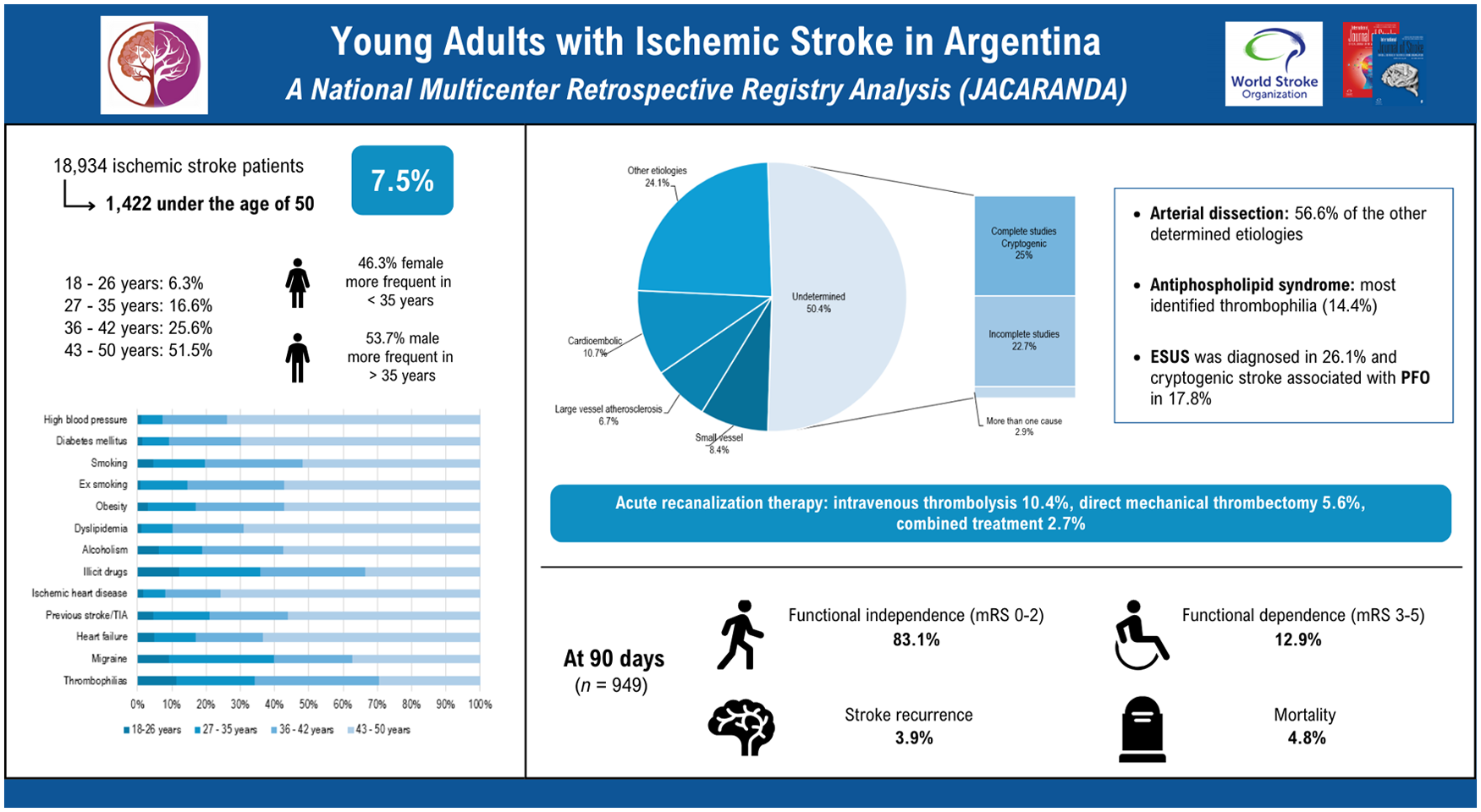
Among 18,934 ischemic stroke patients, 1422 (7.5%) were young adults. Median age was 43 years (interquartile range (IQR) 36–47), and 53.7% (n = 763) were male. The most prevalent risk factors were hypertension (31.0% (n = 441)), smoking (29.3% (n = 417)), and obesity (18.8% (n = 267)). Median National Institute of Health Stroke Scale (NIHSS) on admission was 3 (IQR 1–8). Acute reperfusion therapy was administered in 18.9% (n = 269). Stroke etiology remained undetermined in 50.4% (n = 717) of cases; within this group, 26.1% (n = 312) fulfilled criteria for embolic stroke of undetermined source (ESUS), and 17.8% (n = 198) were cryptogenic strokes associated with patent foramen ovale. Arterial dissection accounted for 56.6% (n = 193) of other determined causes. At 90 days, functional dependence was observed in 12.1% (n = 110), stroke recurrence in 3.9% (n = 37), and mortality in 4.8% (n = 44).
Conclusion:
In Argentina, nearly 1 in 13 ischemic strokes occurs in young adults. Despite generally mild presentations, functional dependence and mortality remain substantial. The high rate of undetermined etiology underscores the need for standardized diagnostic protocols in this population, whose strokes carry a disproportionate individual and societal burden due to their early onset.
Get full access to this article
View all access options for this article.
References
Supplementary Material
Please find the following supplemental material available below.
For Open Access articles published under a Creative Commons License, all supplemental material carries the same license as the article it is associated with.
For non-Open Access articles published, all supplemental material carries a non-exclusive license, and permission requests for re-use of supplemental material or any part of supplemental material shall be sent directly to the copyright owner as specified in the copyright notice associated with the article.
