




Abstract
Background:
The optimal blood pressure control strategy after mechanical thrombectomy (MT) is not well understood, especially for patients with successful recanalization. We hypothesized that low systolic blood pressure (SBP) after MT is associated with infarct growth (IG), even in patients with successful recanalization.
Aims:
The aim of the present study was to clarify the relationships between IG and SBP parameters in patients treated with MT.
Method:
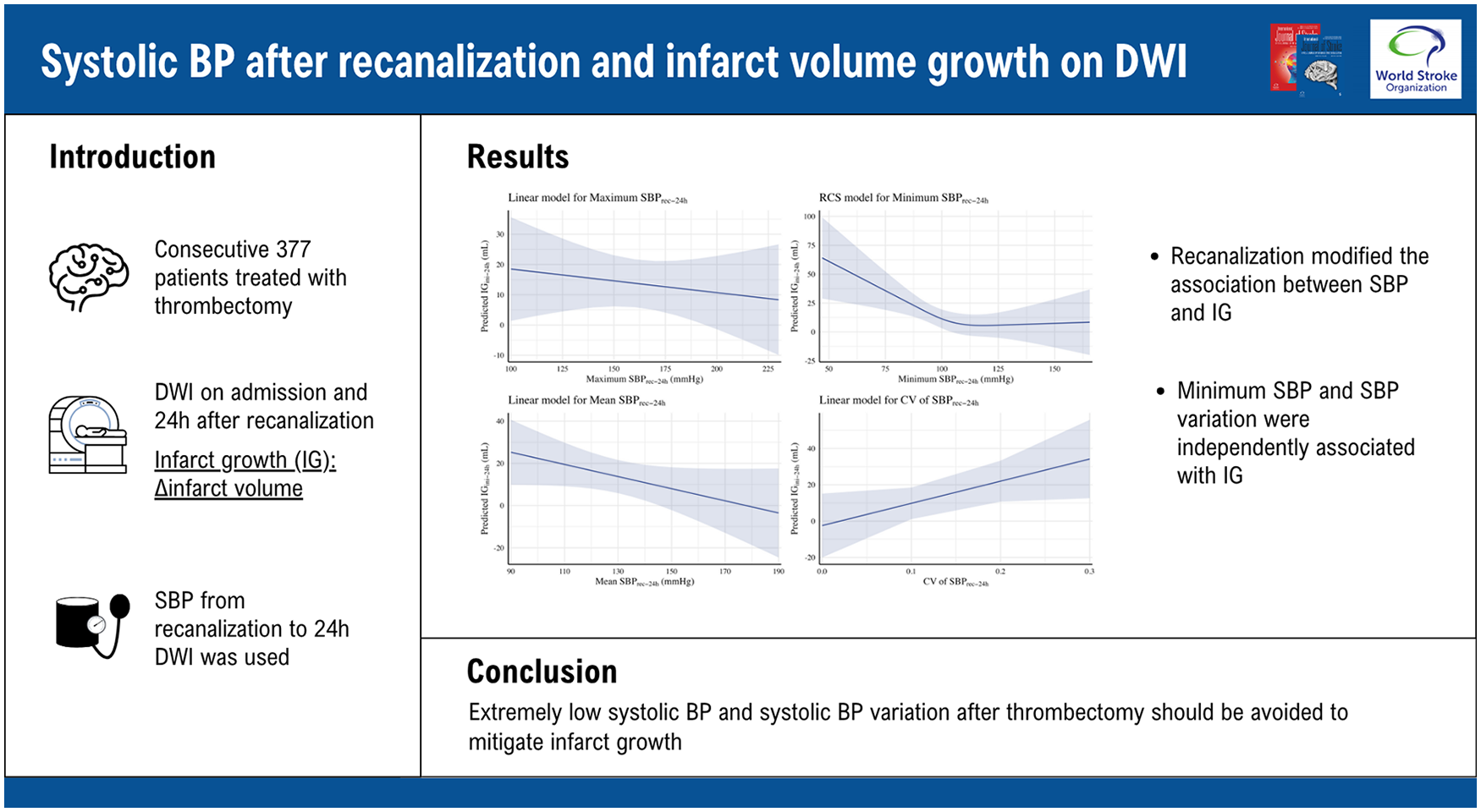
Consecutive acute stroke patients who underwent emergent MT from September 2014 through December 2019 were retrospectively enrolled. Diffusion-weighted imaging (DWI) was performed on admission and approximately 24 h after the procedure. IG was calculated as the difference between infarct volume on 24-h DWI and initial DWI. SBP from recanalization to 24-h DWI was used. The associations between IG and SBP parameters, including maximum, minimum, and mean SBPs and coefficient of variation (CV) of SBPs, were evaluated with multiple regression analyses.
Results:
A total of 377 MT cases (225 male (60%), median age = 76 (interquartile range (IQR) = 68–83) years, median National Institutes of Health Stroke Scale (NIHSS) score = 17 (10–23), median onset to initial DWI time = 131 (79–350) min) were enrolled in this study. Successful recanalization modified the association between SBP parameters and IG (p for interaction < 0.05). In cases with successful recanalization (n = 314), SBP was recorded 7007 times between recanalization and 24-h follow-up magnetic resonance imaging (MRI). Minimum SBP from recanalization to 24-h DWI (standardized coefficient = −0.144, 95% confidence interval (CI) −0.269 to −0.019, p = 0.024, i.e. low minimum SBP was associated with higher IG) and CV of SBP (0.122, 0.003 to 0.241, p = 0.045) were independently associated with IG, even after adjusting for various factors including age, sex, initial NIHSS score, baseline infarct volume, and symptomatic intracerebral hemorrhage.
Conclusion:
Minimum SBP and CV of SBP after recanalization were associated with IG in consecutive acute stroke patients who underwent successful MT. IG is a sensitive imaging marker for evaluating the effect of post-procedural SBP, and extremely low SBP after MT should be avoided to mitigate IG.
Keywords
Get full access to this article
View all access options for this article.
References
Supplementary Material
Please find the following supplemental material available below.
For Open Access articles published under a Creative Commons License, all supplemental material carries the same license as the article it is associated with.
For non-Open Access articles published, all supplemental material carries a non-exclusive license, and permission requests for re-use of supplemental material or any part of supplemental material shall be sent directly to the copyright owner as specified in the copyright notice associated with the article.
