



Abstract
Background:
It remains unclear whether the serum levels of the brain injury biomarkers (glial fibrillary acidic protein [GFAP] and ubiquitin C-terminal hydrolase-L1 [UCH-L1]) can be used to quantitatively evaluate brain tissue injury and predict prognosis in patients with intravenous thrombolysis (IVT).
Aim:
This study investigates the association between serum GFAP and UCH-L1 levels with functional outcomes in patients receiving IVT.
Methods:
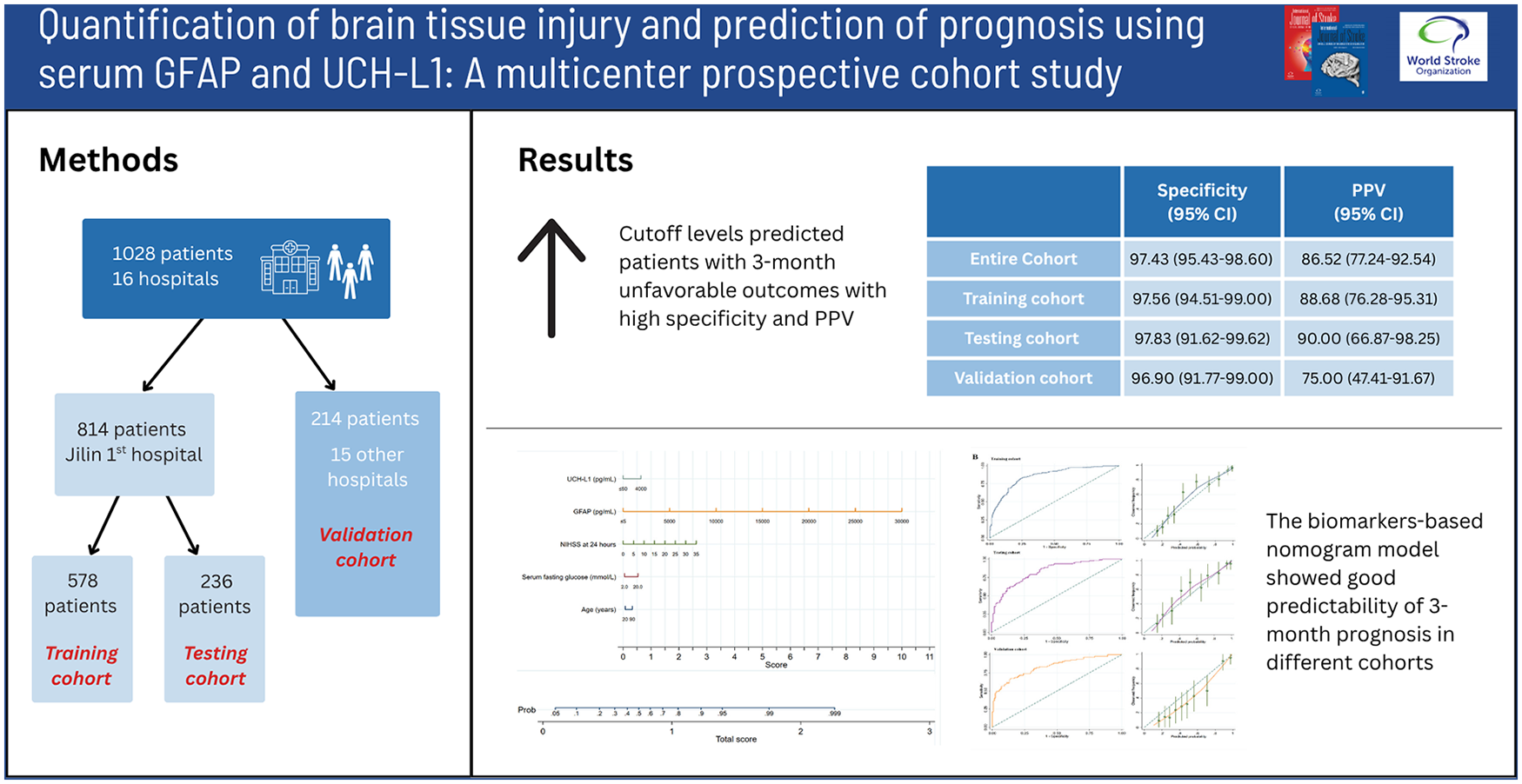
Patients were prospectively enrolled from 16 hospitals. We measured serum GFAP and UCH-L1 levels 24 hours after IVT. Infarct volume, hemorrhagic transformation (HT), and short- and long-term prognostic indicators were evaluated. GFAP and UCH-L1 cutoff levels for predicting 3-month unfavorable outcomes were derived, and a biomarker-based model was established and subjected to internal and external validation.
Results:
This study included 1028 patients. Higher GFAP and UCH-L1 levels were independently associated with larger infarct volume, HT, higher 24-hour and 7-day National Institutes of Health Stroke Scale scores, and 3-month modified Rankin Scale scores. The cutoff levels for GFAP and UCH-L1 (116 and 292 pg/mL, respectively) predicted patients with 3-month unfavorable outcomes with a specificity and positive predictive value (PPV) of 97.56% (95% confidence interval [CI], 94.51–99.00) and 88.68% (95% CI, 76.28–95.31), respectively, in the training cohort. In the testing and validation cohorts, specificity was 97.83% (95% CI, 91.62–99.62) and 96.90% (95% CI, 91.77–99.00), respectively, and PPV was 90.00% (95% CI, 66.87–98.25) and 75.00% (95% CI, 47.41–91.67), respectively. Furthermore, the biomarker-based nomogram model showed good predictability of 3-month prognosis in the different cohorts.
Conclusions:
Serum GFAP and UCH-L1 levels can be used to quantitatively evaluate brain tissue injury and predict the prognosis of patients with IVT.
Keywords
Get full access to this article
View all access options for this article.
References
Supplementary Material
Please find the following supplemental material available below.
For Open Access articles published under a Creative Commons License, all supplemental material carries the same license as the article it is associated with.
For non-Open Access articles published, all supplemental material carries a non-exclusive license, and permission requests for re-use of supplemental material or any part of supplemental material shall be sent directly to the copyright owner as specified in the copyright notice associated with the article.
