




Abstract
Background:
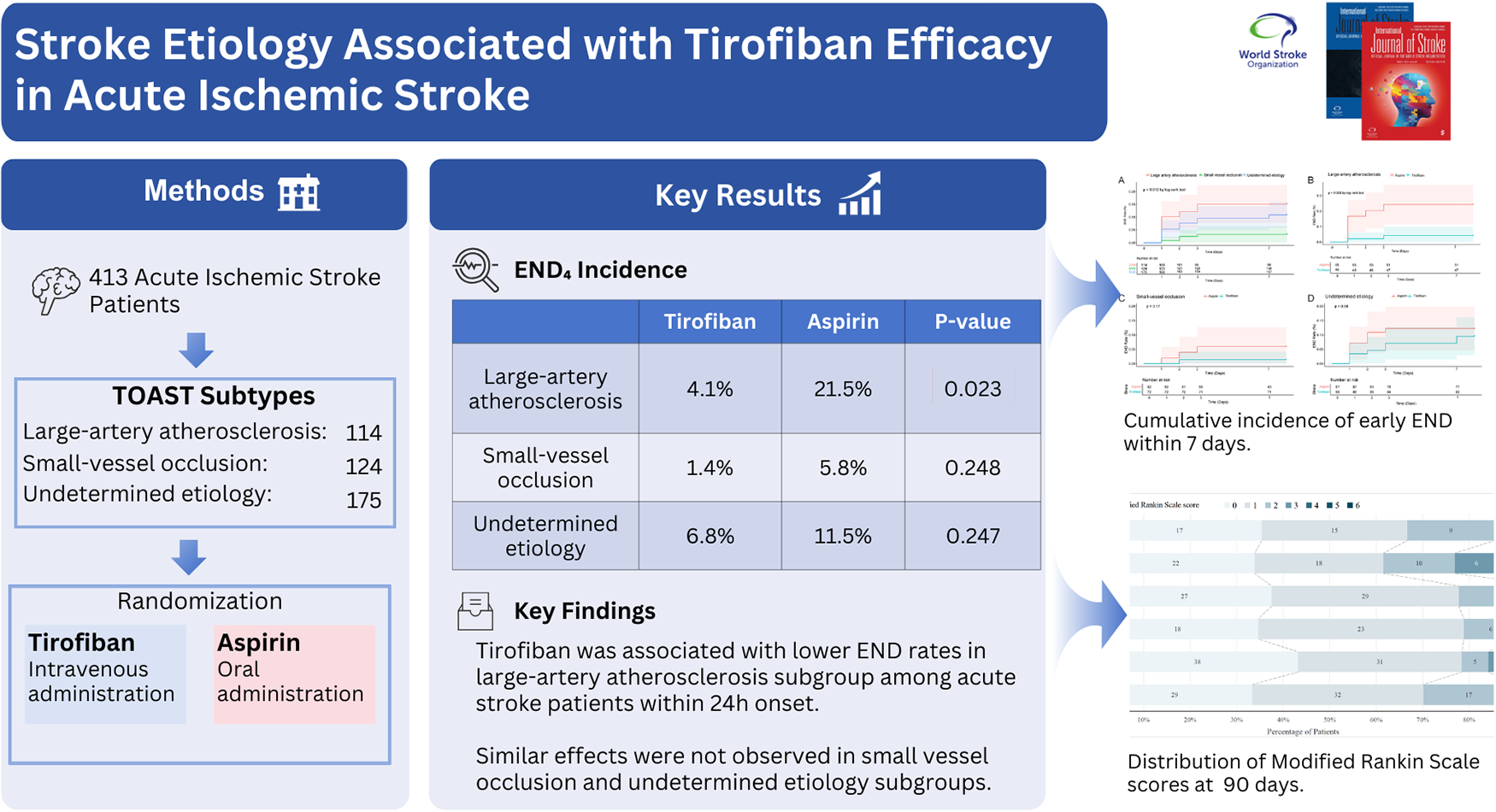
Different stroke etiologies are associated with varied incidences of early neurological deterioration (END) in patients with acute ischemic stroke (AIS). The Tirofiban for the Prevention of Neurological Deterioration in Acute Ischemic Stroke (TREND) trial demonstrated the efficacy of tirofiban in preventing END in patients with AIS. Herein, we conducted a pre-specified subgroup analysis of this trial data to investigate whether stroke etiologies influenced the effects of tirofiban.
Methods:
We performed a pre-specified subgroup analysis of the TREND trial, including 413 patients with AIS classified into large-artery atherosclerosis (n = 114), small-vessel occlusion (n = 124), and undetermined etiology (n = 175). The primary outcome was the incidence of END4 (defined as an increase in the National Institutes of Health Stroke Scale (NIHSS) score by ⩾ 4 points) within 72 h. Other outcomes included END2 (increase in NIHSS score by ⩾ 2 points), early improvement, functional outcomes at 90 days, and safety profiles.
Results:
Tirofiban significantly reduced the risk of END4 in patients with large-artery atherosclerosis (4.1% vs. 21.5%; adjusted odds ratio (OR), 0.17; 95% confidence interval (CI), 0.04–0.78; P = 0.023), while no significant differences were observed in small-vessel occlusion (adjusted OR, 0.24; 95% CI, 0.02–2.67; P = 0.248) and undetermined etiology (adjusted OR, 0.53; 95% CI, 0.18–1.55; P = 0.247) subgroups (P for interaction = 0.376). Similar trends were observed for END2, with a significant benefit observed in the large-artery atherosclerosis (adjusted OR 0.24; 95% CI 0.08–0.72; P = 0.011). The early improvement rates and 90-day functional outcomes were comparable between the treatment groups across all stroke subtypes. Safety outcomes were similar between antiplatelet therapies in each subgroup.
Conclusions:
In patients who developed ischemic stroke within 24 h of symptom onset, there was no evidence of a treatment interaction across stroke etiologies when comparing intravenous tirofiban to oral aspirin for reducing END. However, the absolute risk reduction observed with tirofiban was greatest in patients with large-artery atherosclerosis compared with those with small-vessel occlusion or undetermined etiology.
Get full access to this article
View all access options for this article.
References
Supplementary Material
Please find the following supplemental material available below.
For Open Access articles published under a Creative Commons License, all supplemental material carries the same license as the article it is associated with.
For non-Open Access articles published, all supplemental material carries a non-exclusive license, and permission requests for re-use of supplemental material or any part of supplemental material shall be sent directly to the copyright owner as specified in the copyright notice associated with the article.
