




Abstract
Background:
Collateral circulation provides compensatory flow to ischemic brain regions in acute large vessel occlusion (LVO), which had been associated with better outcomes after endovascular treatment (EVT).
Aims:
We aimed to reveal the pre-EVT collateral status and its associations with outcomes after EVT, in patients with acute LVO with different etiologies.
Methods:
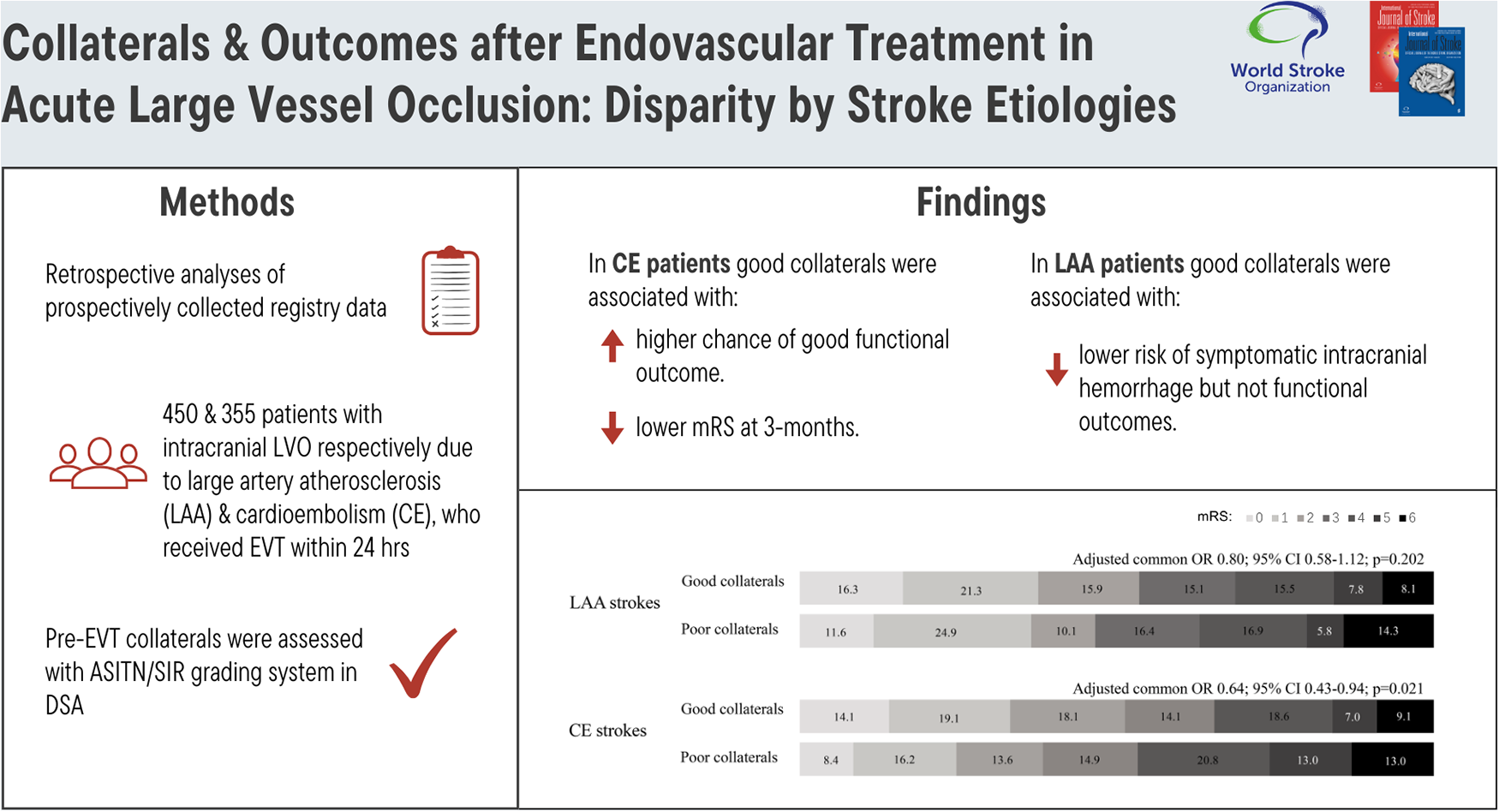
Based on a prospective, multicenter registry, we analyzed patients with acute, intracranial anterior-circulation LVO due to large artery atherosclerosis (LAA) and cardioembolism (CE), who underwent EVT within 24 h. Pre-EVT leptomeningeal collateral status was classified on digital subtraction angiography by ASITN/SIR grading system. Outcomes included good 3-month functional outcome (modified Rankin Scale [mRS] 0–2), 3-month mRS distribution, successful recanalization, early neurological deterioration, symptomatic intracranial hemorrhage (sICH), and 3-month mortality.
Results:
Among 805 patients (median age 66 years), 450 and 355, respectively, had LVO due to LAA and CE, of whom 57.8% and 56.6% (p = 0.742) had good pre-EVT collaterals. In LAA patients, good collaterals were associated with lower risk of sICH (adjusted odds ratio [OR]= 0.40; 95% CI = 0.17–0.94; p = 0.036) but not functional outcomes. In CE patients, good collaterals were associated with a higher chance of good functional outcome (adjusted OR = 1.55; 95% CI = 0.96–2.51; p = 0.072) and lower mRS at 3 months (adjusted common OR = 0.64; 95% CI = 0.43–0.94; p = 0.021). However, there was no significant CE/LAA and collateral status interaction on any outcome.
Conclusions:
The study revealed comparable pre-EVT collateral status in patients with LVO due to LAA versus CE who received EVT within 24 h, but the pre-EVT collaterals may have different protective effects for post-EVT outcomes in these two groups of patients.
Get full access to this article
View all access options for this article.
References
Supplementary Material
Please find the following supplemental material available below.
For Open Access articles published under a Creative Commons License, all supplemental material carries the same license as the article it is associated with.
For non-Open Access articles published, all supplemental material carries a non-exclusive license, and permission requests for re-use of supplemental material or any part of supplemental material shall be sent directly to the copyright owner as specified in the copyright notice associated with the article.
