



Abstract
Introduction:
Recent evidence suggests a possible role of non-stenotic carotid atherosclerotic plaques in the etiology of embolic stroke of undetermined source (ESUS).
Methods:
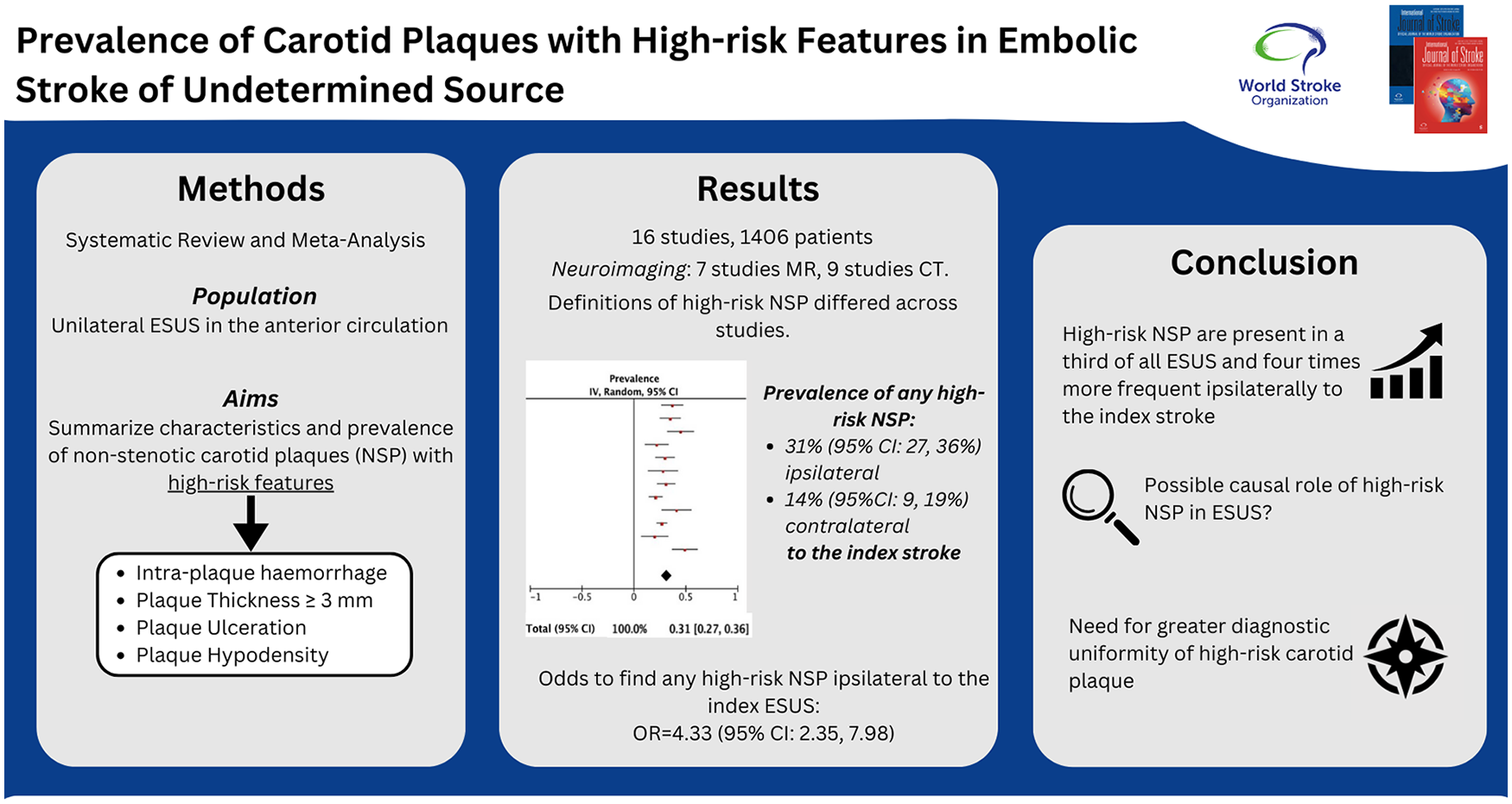
We conducted a systematic review and meta-analysis of prevalence and characteristics of non-stenotic carotid plaques (NSPs) with high-risk features (complicated NSP) in internal carotid artery in unilateral ESUS in the anterior circulation. We searched MEDLINE and Ovid-Embase databases. High-risk features were intraplaque hemorrhage, thickness ⩾ 3 mm, ulceration, and hypodensity. We assessed the risk of bias (RoB), extracted the data, calculated the pooled prevalence and 95% confidence intervals (CI) using Inverse Variance Weighting method, and Random Effect models.
Results:
We included 16 studies and 1406 patients with different imaging for NSP assessment (1 ultrasound, 11 computed tomography (CT)-angiography, 4 magnetic resonance (MR) angiography). The RoB was moderate to low in most studies. Definition of complicated NSP differed across studies. The combined prevalence of any complicated NSP was 31% (95% CI = 27–36%) ipsilateral and 14% (95% CI = 9–19%) contralateral to the index stroke, the finding of any high-risk NSP was fourfold higher ipsilateral to the index stroke (OR = 3.63; 95% CI = 2.09–6.33). The prevalence of single high-risk features ipsilateral to ESUS was as follows: 35% (95% CI = 30–41%) for thickness ⩾ 3 mm; 24% (95% CI = 8–39%) for ulceration; 45% (95% CI = −2; 93%) for hypodensity, 16% (95% CI = 5–26%) for intraplaque hemorrhage.
Conclusion:
Complicated NSPs are present in around a third of all ESUS, and are four times more frequent ipsilaterally to the index stroke. Our results confirm the possible causal role in ESUS and highlight the need for greater diagnostic uniformity of plaque at risk.
Keywords
Get full access to this article
View all access options for this article.
References
Supplementary Material
Please find the following supplemental material available below.
For Open Access articles published under a Creative Commons License, all supplemental material carries the same license as the article it is associated with.
For non-Open Access articles published, all supplemental material carries a non-exclusive license, and permission requests for re-use of supplemental material or any part of supplemental material shall be sent directly to the copyright owner as specified in the copyright notice associated with the article.


