




Abstract
Background
The World Stroke Academy (WSA) (www.world-stroke-academy.org) is the educational platform of the World Stroke Organization (WSO). It facilitates educational activities (e.g. webinars and eLearning modules) and supports the WSO mission by providing high-quality stroke education to healthcare professionals. It provides evidence-based educational materials in a variety of formats to meet the needs of the WSO membership.
Aim
This article introduces the WSA, its core activities, and outlines how to access the many educational resources it offers.
Results
The WSA offers high-quality peer reviewed stroke education material and uses outcome metrics to assess and improve the quality of medical training of healthcare professionals. This article also highlights the importance of identifying knowledge and knowledge-to-action gaps through the creation of special projects and initiatives. It describes three areas in which the WSA has carried out recent educational initiatives, namely: life after stroke, women in stroke, and stroke checklist/pre-printed stroke orders.
Conclusion
WSA material is freely available, and we would encourage the global stroke community to use, and contribute to, its resources.
Keywords
Introduction
Each year, there are 12.2 million new strokes worldwide, and 101 million people living with stroke aftermath. One in four people will have a stroke in their lifetime, a number that has increased 50% over the last 17 years.1,2 The World Stroke Organization (WSO) is the only global body solely focused on stroke. With around 3000 individuals and 105 society members spanning every global region, the WSO represents over 55,000 stroke specialists in clinical, research, and community settings.2,3 WSO is in official relation with the World Health Organization and has a United Nations Economic and Social Council (UN ECOSOC) consultative status, giving stroke profile and voice in the global health policy arena. The WSO works closely with global and regional policy makers to address key issues in health systems strengthening, prevention strategies and to improve access to healthcare. One of the ways that the WSO disseminates information on advances in stroke research and education and overcomes gaps in stroke care is through the use of the newly formed World Stroke Academy (WSA).
What is the WSA?
The WSA is the educational platform of the WSO. 4 It facilitates educational activities (e.g. webinars and eLearning modules) and supports the WSO mission by providing high-quality stroke education to healthcare professionals. 5 It provides educational materials in a variety of formats to meet the needs of the WSO membership, with the support of the WSO Education and Research Committees and the WSO Connector programs. The WSA provides stroke information for healthcare professionals with an aim to alleviate the global burden of stroke through the education of stroke practitioners worldwide. It also supports the coordination of the WSO’s online educational and promotional webinars, as well as various social media activities based on previous need assessment.6,7
The WSA Editorial team carries multiple responsibilities, from managing editorial decisions and leading strategic directions to effectively increase awareness, disseminate, and enhance the knowledge of stroke around the world in support of the WSO vision.8–10 The WSA is a team that welcomes new ideas and fosters diversity of opinions to achieve excellence, composed by its Editor in Chief Dr Gustavo Saposnik, Executive Manager Laura Ceci Galanos, Associate Commissioning Editor Dr Anita Arsovska, Social Media Leader Rodrigo Guerrero, Communication Specialist Florencia Casagrande, and Data Science Manager Emili Adhamidhis.
The WSA recently re-launched the newly designed Academy website, with the intention to host all educational materials, reviewed by WSA editors, WSA Leadership Group, WSO Education committee, and other bodies of the WSO. This upgraded platform is more user-friendly, enhancing learner engagement and utilizing advanced e-learning technology: www.world-stroke-academy.org
The WSA vision to support the WSO mandate is based on the following principles:
Teamwork, diversity, and collaboration.
Facilitating access to practical and high-quality material relevant to our daily stroke practice.
Improving communication among WSA, the International Journal of Stroke (IJS), and WSO to increase value for WSO members, colleagues, and the public.
The core educational elements of the Academy are e-learning modules, case studies, podcasts, webinars, webcasts from congresses, and papers of the month and core news (Figure 1), all covering: diagnosis, prevention, innovative therapies, acute treatment, neurorehabilitation, and life after stroke (see Table 1 for strengths and metrics).
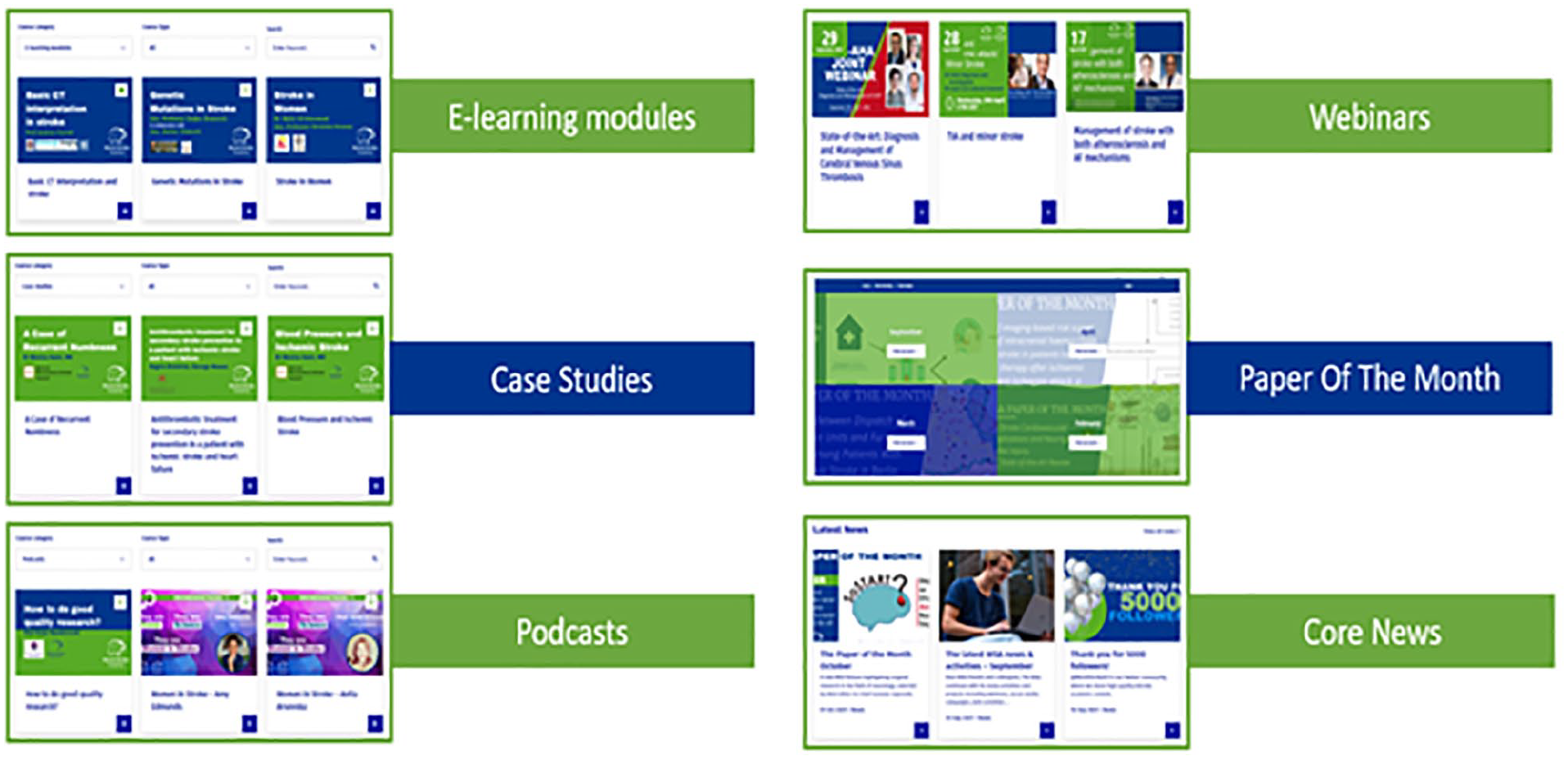
WSA web content.
WSA dissemination activities to overcome stroke care gaps.
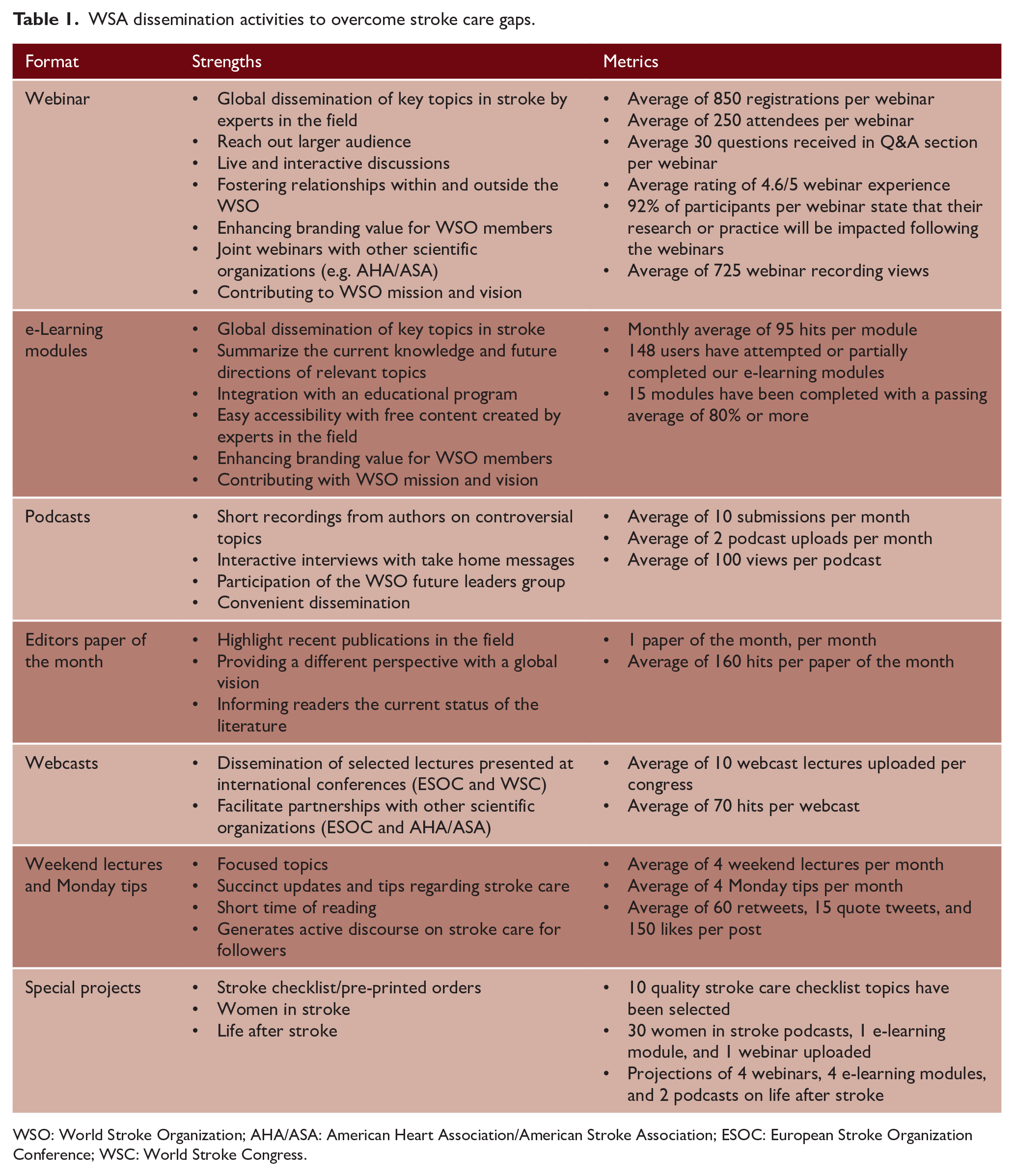
WSO: World Stroke Organization; AHA/ASA: American Heart Association/American Stroke Association; ESOC: European Stroke Organization Conference; WSC: World Stroke Congress.
At the WSA, we follow a peer-reviewed approach for every educational initiative (Figure 2).
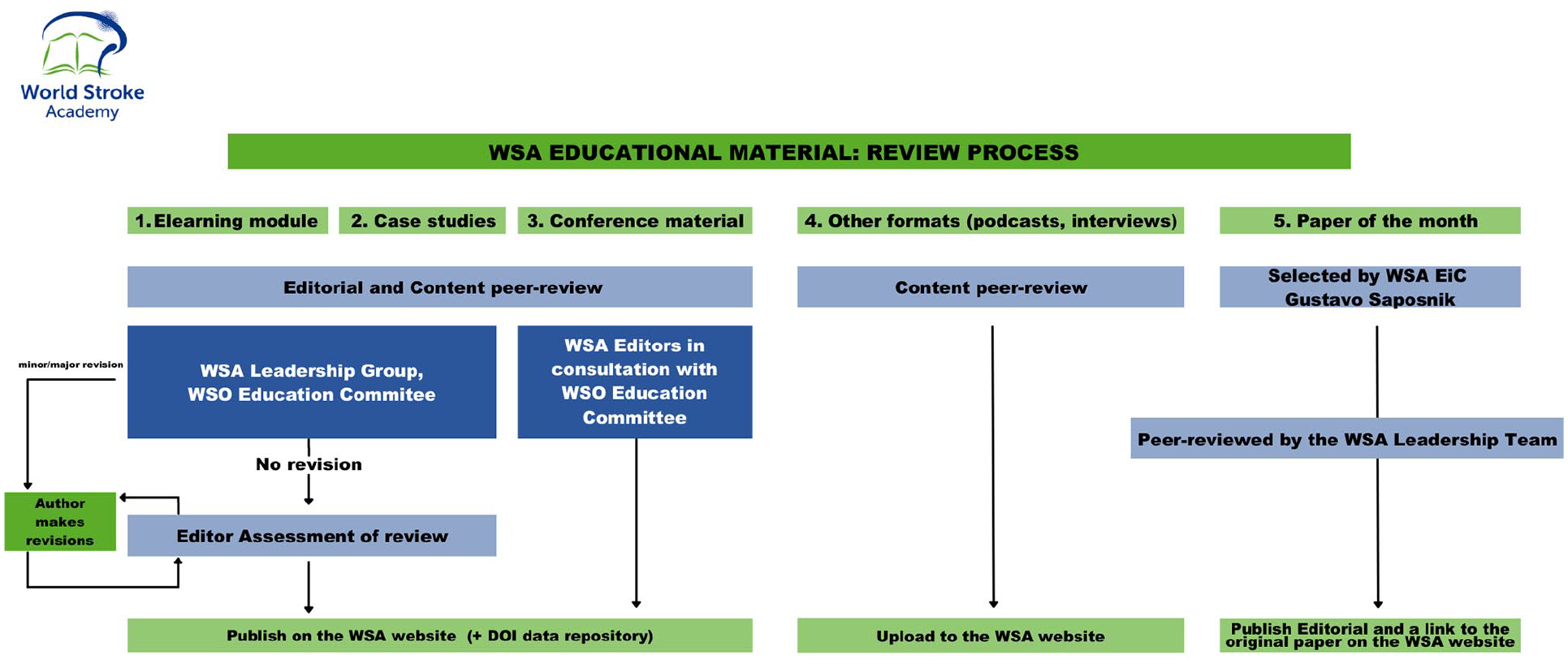
WSA review process.
Promotion on our dedicated platforms, Twitter and LinkedIn, is a key element of the Academy’s role in advocacy and dissemination of information. On Twitter, the @WorldStrokeEd page has now reached over 6000 followers whereas the newly created LinkedIn page, World Stroke Academy, is steadily growing with 250 followers. Engaging activities such as #WeekendLectures and #MondayTips, spearheaded by our social media leader Rodrigo Guerrero, are followed and re-shared by hundreds of users weekly.
In terms of new initiatives, the Academy is involved in a variety of projects in collaboration with both the WSO’s Future Stroke Leaders and the WSO Education Committee. Each initiative has a different format, ranging from evidence-based stroke care checklists to stroke diagnosis and management podcasts and life after stroke-based content. These initiatives are aligned with the WSO Roadmap to deliver quality of stroke care. Some useful links are summarized in Table 2.
Useful links.
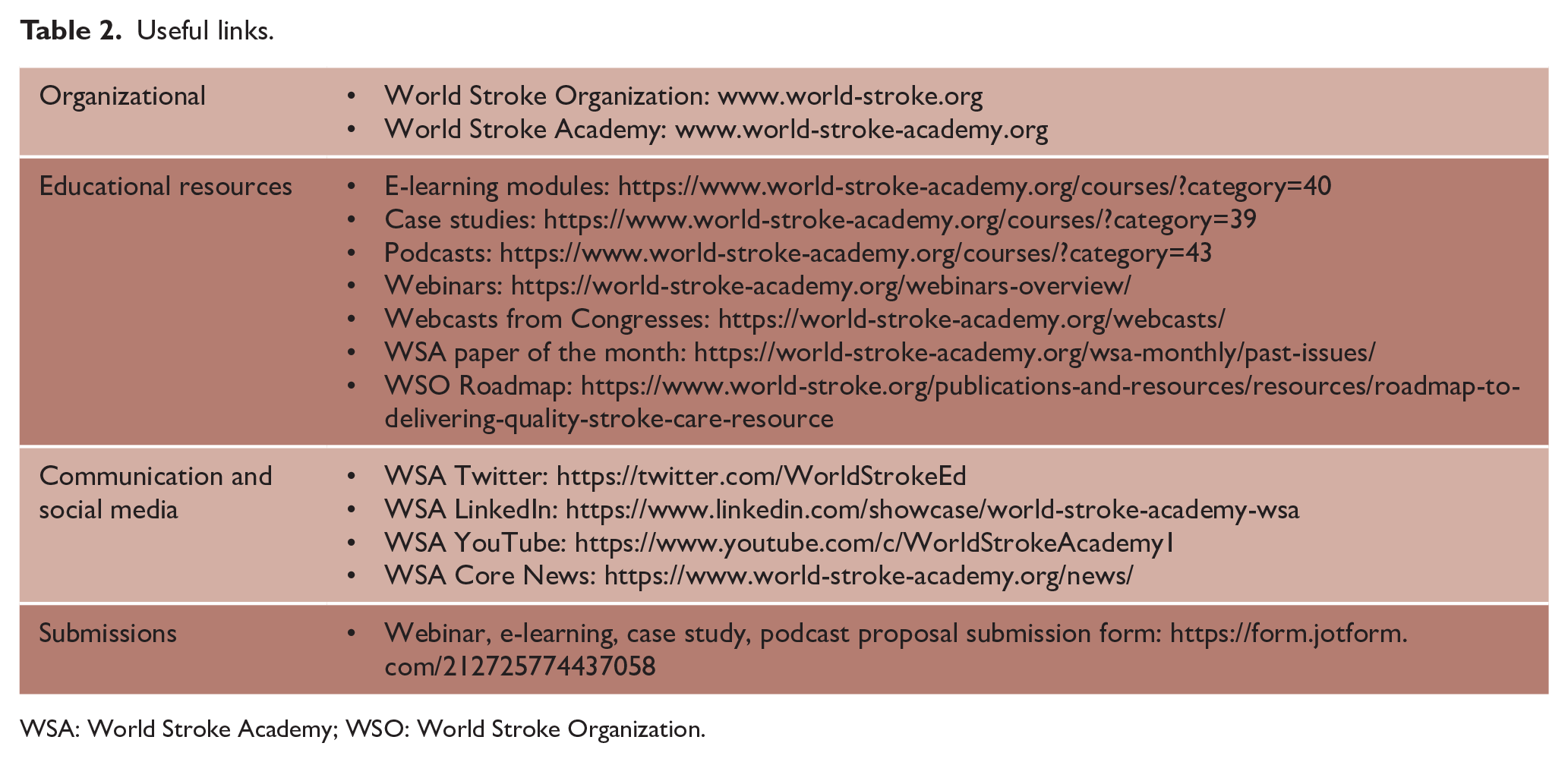
WSA: World Stroke Academy; WSO: World Stroke Organization.
Recent metrics
Since its launch, the Academy counts over 2100 visitors from 110 different countries with an average of over 500 new users per month. The Twitter community of the @WorldStrokeEd account counts over 6000 followers and the newly created WSA LinkedIn page counts over 350 followers. The WSA webinars, covering different stroke related topics, attract an average of 850 registered users and a similar number of attendees per webinar.
Special projects
The WSA is undertaking special projects in a number of areas of need.
Life after stroke
With the aim to improve the quality of psychosocial support available to stroke survivors globally, the WSA is building an e-learning module and webinar series, hosted by key opinion leaders, on life after stroke. This area of research is often neglected in many countries and is equally important for both stroke survivors and their families/caregivers.2,11,12 There is lack of educational provision on the topic of life after stroke as well as lack of government attention to long-term support for stroke survivors despite what we know about their needs. We need to take actions to ensure stroke survivors are getting the best possible recovery (optimization of recovery) to achieve the best possible outcome, to build on scientific evidence, 13 to reduce the overall social costs14,15 by introducing innovative strategies (e.g. public reporting of outcomes, use of validated risk prognostic scores, and implementing mobile stroke units and telestroke to deliver high-quality stroke care in underserved areas)16–18 and preventing substantial hardship (reducing costs for governments to care for stroke survivors), and to create a community for Allied Health Professionals working with stroke survivors and caregivers. 19 The WSA aims to increase the awareness around the topic of life after stroke through the creation and dissemination of educational material, host key opinion leaders that can shed light on specific life after stroke-related topics, and answer outstanding questions on the conditions that occur in this segment of their life, such as spasticity, pain, depression, anxiety, feeling of helplessness, cognitive impairment, dementia, intimacy problems, family problems, working issues, and many more.
Women in stroke
Women have unique characteristics when understanding the diagnosis and management of stroke.20–22 Similarly, several colleagues made major contributions to the role of sex and gender differences in stroke care.20,21 On International Women’s Day, in March 2021, a brand-new initiative was launched by the WSA: #WomenInStroke. The goal was to highlight women in the field of stroke and recognize their contributions, research, and mentoring. This was a novel initiative developed and promoted/coordinated by women about women’s empowerment in stroke care. Members of the WSO Board & Executive Committee were asked to nominate women who had contributed to one of the following areas of cerebrovascular diseases (basic science, clinical research, education, health policy, and advocacy). In total, 70 women representing all continents were nominated by their colleagues for their contribution to improve stroke care. The finalists were given an opportunity to do a written interview or a podcast. The WSA will continue building this important initiative and welcomes new educational material on this topic.
Stroke checklist/pre-printed stroke orders
Checklists provide an organized way to condense a large quantity of knowledge into succinct, actionable items to improve information recall and guide users through accurate task completion. Furthermore, checklists are an effective tool to consistently facilitate knowledge to practice translation by summarizing evidence into explicit actions.23–25 They are currently widely used as cognitive aids in both medical and non-medical fields. Examples in medicine include the use of surgical safety checklists and standardized order sets.26,27 The previous literature has shown that carefully developed and well-implemented checklists are effective in error prevention, standardization of management, and performance improvement in patient care.23–25 Clinical guidelines and best practices in stroke have been established and published by several professional organizations worldwide. However, these publications are not applicable to everyone as they are primarily based on standard practices in developed countries with established infrastructure and resources.28–30
Stroke care providers in low-resource settings face challenges due to limited access to diagnostic and treatment options, and actionable, high-quality evidence that can be adapted to local settings. 31 In this project, we are developing stroke care checklists with an emphasis on supportive care strategies, validated by international experts and accessible to a global audience. Our expectation is that this clinical tool could facilitate consistent stroke care delivery in areas and regions with limited resources, ultimately ensuring adherence to best practice developed by the WSO, reducing variability in management, and improving overall stroke care.
In conclusion, to quote Joel Barker, an American businessman: “Vision without action is a dream. Action without vision is simply passing time. Action with vision is making a positive difference.” By sharing a unified vision, we, the WSA, are looking forward to working together in supporting WSO’s mission of making a difference in improving stroke care globally.
Footnotes
Acknowledgements
The authors are very grateful for the leadership of the WSA Founders Prof. Michael Brainin and Prof. Peter Sandercock. Without their initiative, the WSA would not have thrived. The authors of this article are grateful to WSO Assistant Association Manager Gergana Ralenekova, WSO Future Stroke Leaders Program Coordinator Julia Shapranova, SSO Committee Chairs Michelle Nelson and Sharon McGowan, and Education Committee Chairs Gord Gubitz, Monica Saini, and Ramesh Sahathevan.
Declaration of conflicting interests
The author(s) declared the following potential conflicts of interest with respect to the research, authorship, and/or publication of this article: Laura Ceci Galanos (Executive Manager WSA), Dr Gustavo Saposnik (Editor in Chief WSA), and Mia Fredin Grupper (Executive Director WSO) are supported by the World Stroke Organization.
Funding
The author(s) received no financial support for the research, authorship, and/or publication of this article.
