



Abstract
High prior knowledge facilitates learning of new related material by providing structures enhancing comprehension and facilitating recall. Previous studies examining the effects of prior knowledge used single-event stimuli while neglecting the repetitive nature of everyday experience and the potential of repetition to generate knowledge structures. In the current study, we used the repeated event paradigm to investigate the interaction between the effects of prior knowledge and repetition on event memory. In Experiment 1, we validated three sets of stimuli in which we manipulated prior knowledge. Participants viewed and later recalled four instances of a repeated event (e.g., four variations of a story). As predicted, participants recalled more correct details and rated their level of understanding higher for instances where prior knowledge was high than low. In Experiment 2, we extended the examination by comparing the effect of prior knowledge on recall of a single event and instances of a repeated event. We replicated findings from previous research (typically using high prior knowledge stimuli): participants recalled more correct details of a single event compared to the final instance of a repeated event, and contrary to our expectations, this pattern was consistent across prior knowledge conditions. Exploratory comparison of recall between the single event and the first instance of a repeated event showed a small and nonsignificant difference. Findings of this study inform us about the underlying processes that impact recall of instances of repeated events for different levels of prior knowledge.
“The vanished mental states give indubitable proof of their continuing existence even if they themselves do not return to consciousness at all, or at least not exactly at the given time. Employment of a certain range of thought facilitates under certain conditions the employment of a similar range of thought, even if the former does not come before the mind directly either in its methods or in its results. The boundless domain of the effect of accumulated experiences belongs here. This effect results from the frequent conscious occurrence of any condition or process, and consists in facilitating the occurrence and progress of similar processes.” (Ebbinghaus, p. 2, 1964)
Introduction
Ebbinghaus describes the general facility of cognition to impact future processing based on existing knowledge structures. In his own experiments with syllable series, he discovered that when relearning series he had learned previously but was no longer able to recall, the time saved depended on the similarity of the organization of the “new” series to the original series, following an exponential curve: Relearning the same series was fastest, combining old series by leaving out one intermediate syllable was slightly slower, leaving out two, three, five, or seven intermediate syllables was even slower, and permutation of the syllables led to the slowest learning. However, any new organization of old material always resulted in faster learning times than would be required for learning new series (Ebbinghaus, 1964).
Prior knowledge facilitates learning of new similar or related material by providing structures enhancing comprehension (e.g., Johnson et al., 1973; Kintsch & van Dijk, 1978). Understanding how prior knowledge shapes memory for experiences has important real-life consequences in situations when an event, or a series of events, become the focus of an investigation. Although some experiences are truly unique, people’s daily lives consist of similar (repeated) events (e.g., Barsalou, 1988; Brown, 2016; Neisser, 1981). Importantly, for some of these repeated events, low prior knowledge may be expected when the experience is novel (e.g., traveling to a country with different cultural habits) or when intentions of the actors are unknown (e.g., events involving grooming, or manipulative behaviors). In such cases, prior knowledge is gradually built along with repeated exposure, but it is likely that memory for the initial instances would be impacted by low prior knowledge.
In the following three sections, we first describe the effects of prior knowledge on comprehension and memory. Then, we turn to the specific effects different levels of prior knowledge may have on recall of single events and instances of repeated events. Finally, we describe the current study: A validation of stimuli aimed to manipulate levels of prior knowledge in the context of repeated events (Experiment 1), and an experimental examination of the effects of different levels of prior knowledge on the recall of a single event and instances of repeated events (Experiment 2).
Effects of Prior Knowledge on Comprehension and Memory
When hearing or reading stories, people actively engage with the content via interpretation and prediction related to the meaning and consequences of actions or intentions of actors (Bartlett, 1932). In these processes, schemata as macro-structures of prior knowledge provide guidance regarding the relevance of information (Kintsch & van Dijk, 1978). Indeed, when reading a familiar story, readers made substantially more predictions than when reading an unfamiliar story (Afflerbach, 1990a).
When schemata are lacking or too general to facilitate the differentiation of relevant and irrelevant information, there is a lag in the construction of meaning because the material needs to be parsed and processed in smaller portions (Kintsch & van Dijk, 1978). Consequently, the material can only be processed at a more surface level that enables limited elaboration and integration of information (Craik & Lockhart, 1972). The schema-confirmation-deployment model describes the process of knowledge construction based on repeated experience (Farrar & Boyer-Pennington, 1999; Farrar & Goodman, 1990, 1992). When processing a series of novel events, cognitive resources are first directed towards attending to similar aspects of the events (i.e., the schema-confirmation phase), and only once a schema is developed, cognitive resources can be focused on the processing of finer (schema-consistent or -inconsistent) details (i.e., the schema-deployment phase; Farrar & Boyer-Pennington, 1999). Active involvement in comprehension is accompanied by monitoring and self-regulation. Readers evaluate their predictions based on new information and either verify or modify them (e.g., Collins et al., 1977), automatically (when prior knowledge is high) or systematically (when prior knowledge is low) construct hypotheses and revise their answers (Afflerbach, 1990b), and may also inhibit the generation of predictions when information is lacking (e.g., Bruce & Rubin, 1981).
Comprehension goes hand in hand with recall. Bransford and Johnson (1972) presented participants with a text passage that was accompanied with a contextual picture or a description of the topic before or after the passage was presented, or provided no contextual/topical information. When participants were provided with semantically relevant information before the passage, their comprehension and recall scores were substantially higher than in other groups (i.e., semantic information presented after the passage, passage repetition, presentation of broadly related or no semantic information). Similar findings were reported for familiarity: Steffensen et al. (1979) found that students from the U.S. and India provided a more complete recall of a description of a wedding from their own rather than a foreign culture (see also Kintsch & Greene, 1978).
In summary, prior knowledge (in the form of context or familiarity) affects how people make sense of what is happening and what (and how much) people can remember. High prior knowledge facilitates the construction of assumptions and the interpretation of the content during the experience and does so relatively automatically (van Dijk & Kintsch, 1983). Then, when the context of the situation and goals of the task are clear, one’s beliefs and opinions may perhaps step in the way of the interpretation (van Dijk & Kintsch, 1983), but the outcome should be relatively predictable: high level of understanding consistent across individuals and good memory. When prior knowledge is low, the context of the situation, or goals of the task are unclear, the level of understanding would likely be low and perhaps distorted depending on individual strategies (Bruce & Rubin, 1981; Kintsch & van Dijk, 1978); consequently, memory would be poor.
To date, studies into the effects of prior knowledge on cognition have typically used single-event stimuli (e.g., a story or a report) while neglecting that a substantial portion of people’s everyday experience consists of repeated events (e.g., Neisser, 1988; Renoult et al., 2012). In the following section, we outline the mechanisms that contribute to the differences in recall across instances of repeated events and then summarize the comparisons between recall of single and repeated events, which together inform our predictions regarding the effects of prior knowledge on recall of single and repeated events.
Prior Knowledge and Memory for Repeated Events
In a typical repeated-event paradigm, participants experience, view, or imagine a series of four or five novel but familiar events such as play sessions, magic shows, or occurrences of domestic violence (e.g., Connolly et al., 2016; Danby et al., 2017; Dilevski et al., 2020). After a delay, participants are asked to recall what happened during one or more of the instances (e.g., the first, second, third, and/or fourth play session). Although unique events are scripted for these studies, high prior knowledge for the specific activities and details, as well as rapid schema formation, can typically be assumed (e.g., Fivush, 1984). When asked to report what happened during an instance, participants’ main task is to decide on the attribution of recalled details to instances in which they occurred. This systematic source monitoring process (Johnson et al., 1993; Lindsay, 2008, 2014) is more effective for the boundary instances, as participants are generally better able to accurately remember the first and final instances than the middle instances (where misattributions occur more frequently; Connolly et al., 2016; Dilevski et al., 2020; MacLean, et al., 2018; Powell et al., 2003; Powell & Thomson, 1997; Roberts et al., 2015; Rubínová & Kontogianni, 2023). Mechanisms that contribute to these primacy and recency effects include novelty (the first instance), unique encoding context (the first and final instance that establish and conclude the repeated event—in cases where an end is expected), and limited interference from neighbouring instances (Rubínová et al., 2022).
When prior knowledge is low and new schemata are yet to be constructed, the primacy effect would likely be diminished, in addition to the expectation of poorer memory. Rubínová et al. (2021) presented participants with four versions of an unfamiliar story and found that after Story 2, participants recalled 16% to 19% more story themes, units, and unique details compared to immediate recall of Story 1, indicating that the second occurrence facilitated schema construction. However, this difference was not present in delayed recall, indicating that participants’ source and item memory of the first instance was preserved better than their memory of the following instances (Rubínová et al., 2021). It is possible that the schema that was developing throughout the four stories had a post-encoding benefit on participants’ memory of the first instance (see also Greve et al., 2019). Notably, however, the primacy effect in delayed recall in Rubínová et al. (2021) was negligible.
Before we describe the present study, we would like to highlight a difference between the more traditional word-lists paradigm and the repeated event paradigm. In the former, the primacy effect manifests as the recall of more words from the beginning of lists compared to the center of lists. In the latter, the primacy effect manifests as a more complete/accurate recall of what happened during the first instance of the repeated event compared to other instances. The primacy effect in the recall of lists of non-words is typically preserved (e.g., Gupta, 2005) and likely emerges because although participants encounter non-words (i.e., low prior knowledge stimuli), they do not need to construct new meaning (at least not to a degree comparable with attempting to comprehend a story). In contrast, when participants encounter a story that they do not fully comprehend (i.e., an instance with low prior knowledge), they need to engage in meaning construction. Repeated experience with similar stories facilitates meaning construction and consequently memory. This impact of low prior knowledge in repeated event paradigms would likely result in a reduced primacy effect (e.g., Rubínová et al., 2021).
Present Study
Context, setting, cultural schemata, previous experience, and general knowledge are all forms of prior knowledge that may facilitate comprehension and, in turn, recall of events. In Experiment 1, we described the development and validation of four sets of repeated-event stimuli in which we manipulated levels of prior knowledge. These sets used different ways of manipulating prior knowledge and were developed to increase stimulus sampling and consequently increase generalizability of the effects of prior knowledge on memory (Simons et al., 2017; Wells & Windschitl, 1999). Our primary hypothesis in Experiment 1 was that participants would recall more correct details of the repeated events in the high prior knowledge conditions than in the low prior knowledge conditions. Rejecting the null hypothesis will serve as a validation for each set of stimuli.
In Experiment 2, we planned to use whichever and all stimuli that were validated in Experiment 1 and extend the investigation by adding a single event into the design. Therefore, we examined the outcomes of the interaction between the processes that accompany repeated experiences, which on the one hand contribute to the confusion of details across instances that complicates accurate source monitoring, and on the other hand contribute to the building of prior knowledge that facilitates understanding and subsequent recall. Most previous studies (using high prior knowledge stimuli) have compared the recall of a single event with the recall of the final instance of a repeated event (see Connolly & Lindsay, 2001; Woiwod et al., 2019) and found superior recall for the single event. We expected to replicate this pattern in high prior knowledge stimuli, but we expected to find the opposite pattern for low prior knowledge stimuli, where repeated experience would likely facilitate understanding and consequently also memory for the final instance. In three exploratory analyses, we also assessed the effects of event type (single versus repeated), prior knowledge (high versus low), and their interaction in the comparison of recall between the single event and the first, second, and third instance of the repeated event. The manuscript of the first-stage registered report was registered on the Open Science Framework as a registered report protocol (Rubínová et al., 2022, https://osf.io/yn2pu).
Experiment 1
This study was a methodological examination of the validity of four sets of repeated-event stimuli for the manipulation of prior knowledge. In Set 1, we made use of existing schematic structures based on familiarity (Afflerbach, 1990a; Steffensen et al., 1979). We accompanied the same set of illustrations by a story describing a birthday party preparation (high prior knowledge) or a story describing an arranged ceremony (low prior knowledge). In Set 2, we provided a semantic structure either before (high prior knowledge) or after (low prior knowledge) the complete set of unfamiliar stories (Afflerbach, 1990a; Bransford & Johnson, 1972; Steffensen et al., 1979). Providing the semantic structure at the beginning should facilitate understanding of the stories (and encoding of story details) but such an effect is not expected when the structure is presented at the end (Afflerbach, 1990a; Bransford & Johnson, 1972; Steffensen et al., 1979). The stories in Set 2 described an alien searching for and mixing fluids and creating “elements” on his planet. Parts of the stories are written in an abstract form, and other parts contain some unexpected passages (e.g., elements growing out of the mixtures following a chemical reaction). In Set 3, we manipulated concept understanding via narratives that either facilitated (high prior knowledge) or did not facilitate (low prior knowledge) concept understanding (Bransford & Johnson, 1972). The narratives in Set 3 accompanied video recordings of a group of people performing actions in four different locations, and either contextualized the actions (high prior knowledge) or were unrelated/only loosely related to the actions (low prior knowledge). In Set 4, we provided (high prior knowledge) or did not provide (low prior knowledge) a concrete summary before abstract narratives (Bransford & Johnson, 1972). The narratives in Set 4 describe a farmer who tends to her animals or produce over 4 days and are written in a strictly abstract way (e.g., “little friends” is used instead of “bees,” “black, tarry liquid” is used instead of “coffee”). The summaries used in the high prior knowledge condition provide the concretization of each concept in the abstract narrative.
We had two main aims in this study: (a) To validate the stimuli for the manipulation of levels of prior knowledge (assessed via recall performance and ratings of comprehension), and (b) ultimately to create a database of repeated event stimuli that could be used by other researchers. In case none of our stimuli were validated for the manipulation of prior knowledge (see our first hypothesis below), we planned to amend the stimuli and collect new data (amendments would be described in supplemental materials).
We had three primary hypotheses for each set of stimuli. First, participants would recall more correct details 1 of all instances of the repeated event in the high prior knowledge conditions than in the low prior knowledge conditions (i.e., the main effect of prior knowledge would be significant). Second, we expected to see the typical pattern of primacy and recency effects in the recall across instances (i.e., more correct details recalled for the boundary instances than for the middle instances; two contrasts would be significant, one comparing the recall of Instances 1 and 2 for the primacy effect, and one comparing the recall of Instances 3 and 4 for the recency effect). However, we expected that the primacy effect would be driven by the high prior knowledge condition: the effect of instance would be moderated by prior knowledge (i.e., the interaction between instance and prior knowledge in the first contrast comparing the recall of Instances 1 and 2 would be significant). We did not expect any moderation of prior knowledge on the recency effect. To provide further validation of our stimuli, we collected participants’ ratings of comprehension, and we expected that comprehension scores would be lower for low prior knowledge stimuli compared to high prior knowledge stimuli.
Our primary hypotheses (and associated power calculations) were based on the quantitative recall measure of details that were recalled and correctly attributed to instances in which they originally occurred. To explore the full picture of recall performance including source memory, we also measured misattributions, the recall of external intrusions (not presented details), and we computed a qualitative measure of recall accuracy (a measure that is independent of recall quantity; e.g., Koriat et al., 2000). We expected that analyses of these measures would complement the main analysis of correct details, but we treated these analyses as exploratory because we did not power our sample for these measures.
Method
Design
This study used a 2 (prior knowledge: high/low) × 4 (instance: 1/2/3/4) design with prior knowledge as a between-subjects and instance as a within-subjects factors with four sets of materials that were analyzed separately. There were five dependent variables measured for each instance. The first three were input-bound (e.g., Koriat et al., 2000) and reflected the quantity of recall: (a) number of correctly reported details (this measure is related to our primary hypothesis); (b) number of misattributions (i.e., internal intrusions); and (c) number of external intrusions (i.e., details that were not presented). The fourth measure was output-bound and reflected the quality of recall: (d) recall accuracy (i.e., number of correct details reported divided by total number of details reported). The final measure reflected participants’ ratings of comprehension.
Power Analysis
We used simulation-based power analysis (package
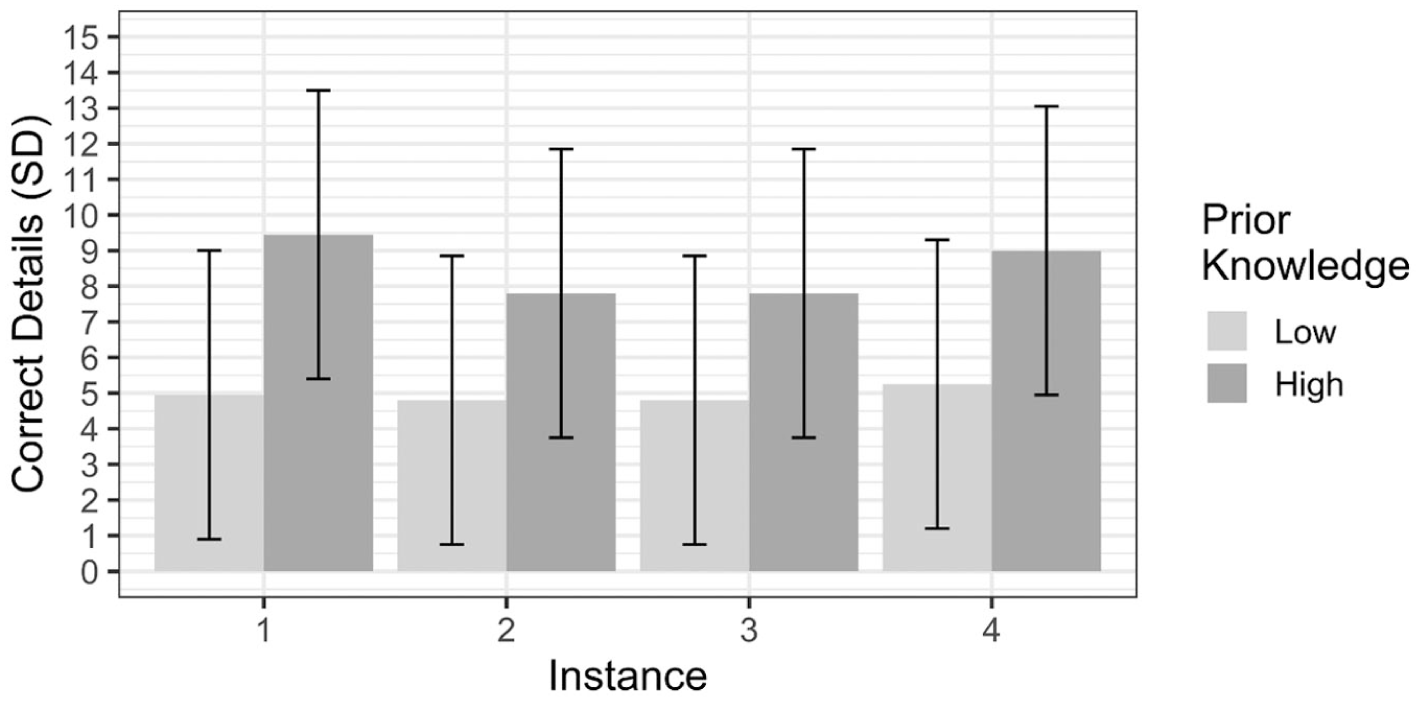
Pattern of means used for simulation-based power analysis in Experiment 1.
Participants
We recruited participants from a Prolific panel using the following pre-screen criteria: Age 18+ years, normal or corrected-to-normal vision and hearing abilities, English language fluency, and no known diagnosis of cognitive impairment. Participants who did not meet the inclusion criteria were not invited to participate. We also specified the following exclusion criteria to ensure high data quality. (a) Participants who indicated that they paid no attention to any of the stimuli (i.e., who indicated a rating <10% on a 0 to 100% scale). (b) Participants who indicated that they had not been motivated in completing the recall task (i.e., who indicated a rating <10% on a 0% to 100% scale labeled “Not at all motivated” and “Highly motivated” at the extremes). (c) Participants who did not respond correctly to three out of four attention check questions. (d) Participants who responded negatively to our data quality question.
Participants were recruited in five waves, starting with recorded data from 488 participants. Exclusions were processed in the order described above. We processed exclusions in each wave to determine the state of the remaining data, but here we report exclusions based on the fifth and final wave, where all exclusions were processed together (breakdown in waves is described in our script and remaining data from each wave by group are recorded in the counterbalancing sheet, see Online Supplemental Materials [OSM]).
In the fifth wave, we recorded a total of 607 responses. We removed three spam and 77 incomplete responses, data from seven participants who indicated low attention, data from eight participants who indicated low motivation, and data from 13 participants who responded negatively to our data quality question. No participants were excluded based on our attention check questions. As a departure from our preregistration, we additionally excluded data from one participant who—instead of providing a report of a story—described their approach to recall. There were data from 498 participants in the final dataset (we slightly over-recruited due to uneven random assignment to groups; see counterbalancing sheet, OSM). Demographic information associated with each set is described in Table 1. Participants were evenly split to low/high prior knowledge conditions in each set.
Demographic Information for Participants in Each Set.
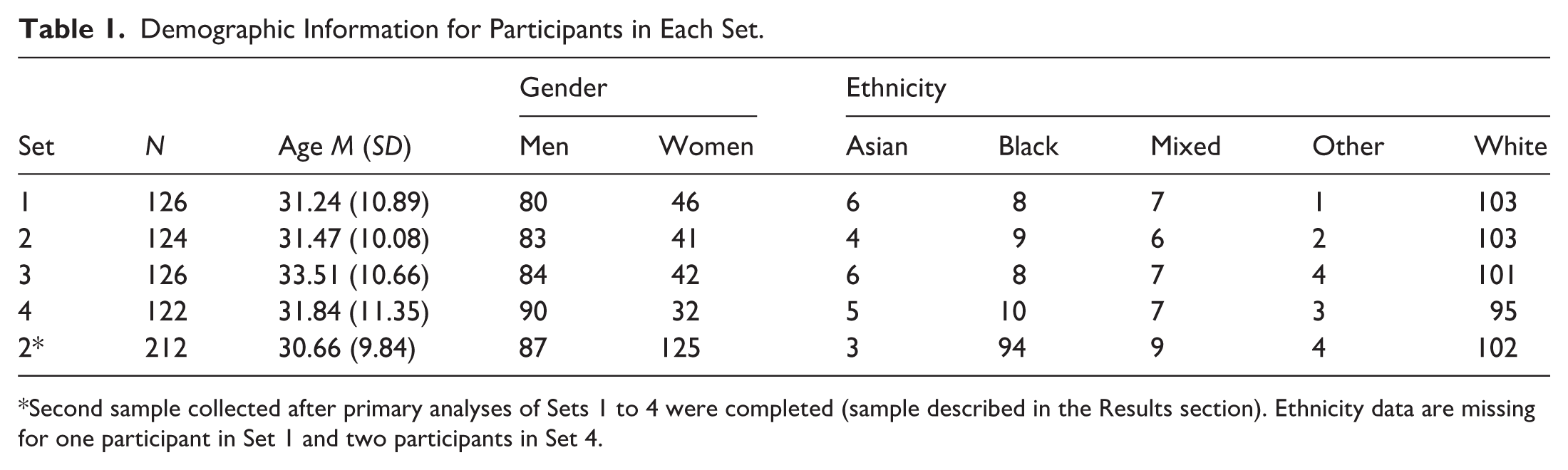
Second sample collected after primary analyses of Sets 1 to 4 were completed (sample described in the Results section). Ethnicity data are missing for one participant in Set 1 and two participants in Set 4.
Participants were paid in accordance with Prolific recommendations (i.e., 9GBP per hour). We expected that the experiment would take 45 min to complete (median completion time was 39 min), and each participant received 6.75GBP for participation.
Materials
Set 1: Familiar and Unfamiliar Stories
In the first set of stimuli, we manipulated prior knowledge by familiarity. We accompanied four sets of illustrations with stories describing the preparation of a birthday party (high prior knowledge) or an arrangement of a ceremony including unfamiliar concepts (low prior knowledge, adapted from Rubínová et al., 2021; see also Ahn et al., 1992). Examples of high and low prior knowledge stimuli can be found in Supplemental Appendix A (online Supplemental Material at qjep.sagepub.com). The stimuli were presented as videos (1.25–1.47 min); both conditions showed the same illustrations, but the narratives differed. All stories were 231 words long, and each contained 15 unique details (i.e., details that varied across stories). Of the 15 details in each story, 11 were the same in both conditions and 4 details differed across the conditions (see Tables A1 and A2 in the Supplemental Appendix A—online Supplemental Material at qjep.sagepub.com). The order of presentation of the four stories was be counterbalanced across participants. Complete text descriptions and counterbalancing sheets can be found in OSM.
Set 2: Script Accompanying Stories Containing Abstract and Unfamiliar Passages
The second set of stimuli comprised stories in which an alien searches for fluids on his planet and subsequently mixes them to create “elements” (e.g., see Supplemental Appendix B—online Supplemental Material at qjep.sagepub.com). The narratives were accompanied by abstract illustrations and were presented as videos (1.50–1.55 min). Each narrative was between 280 and 290 words long and contained 15 unique details. Two of the details were presented in a fixed order, and the remaining 13 details were counterbalanced (see Table B1 in Supplemental Appendix B—online Supplemental Material at qjep.sagepub.com and OSM). In the high prior knowledge condition, participants were presented with a script describing and explaining the stories before the first story; in the low prior knowledge condition, the script was presented after all the stories (the script was 289 words long; see Supplemental Appendix B—online Supplemental Material at qjep.sagepub.com).
Set 3: Narratives Contextualizing Group Actions
In the third set of stimuli, we presented participants with video recorded staged events during which a group of people perform actions in four different locations (adapted from Kontogianni et al., 2021). The videos were accompanied by a narrative that either provided a context for the actions (high prior knowledge) or provided only general information about the people (low prior knowledge; e.g., see Supplemental Appendix C—online Supplemental Material at qjep.sagepub.com). The stimuli were presented as videos (1.23–1.45 min). The narratives were between 228 and 231 words long, and each contained 15 unique details that were the same for the high/low prior knowledge conditions but the order of presentation of the details differed across the conditions and individual videos (see Tables C1 and C2 in Supplemental Appendix C—online Supplemental Material at qjep.sagepub.com). The order of presentation of the videos was counterbalanced across participants (see OSM).
Set 4: Abstract Passages with Concrete Settings
The fourth set of stimuli consisted of abstract descriptions of 4 days on a farm, during which a farmer tends to her animals or produce and constructs a device near her house. In the high prior knowledge condition, each description was preceded by a written passage that provided concrete concepts linked to the abstract content. Reading the passages enabled participants to create expectations about the content of the story (e.g., participants read that “bees” and “honey” were part of the story, so they would be able to interpret “little friends” as “bees” and “sticky liquid” as “honey” (e.g., see Supplemental Appendix D—online Supplemental Material at qjep.sagepub.com). In the low prior knowledge condition, these passages were not presented. The narratives were accompanied by abstract illustrations and were presented as videos (1.38–1.44 min). The narratives were between 254 and 261 words long and contained 15 unique details; the settings were between 59 and 74 words long (see Table D1 in Supplemental Appendix D—online Supplemental Material at qjep.sagepub.com). The last five details concerned the construction of a device (project details)—these details were presented in a fixed order (i.e., as part of the first, second, third, and fourth instance); the remaining 10 details were counterbalanced (see OSM).
Procedure
The study was advertised as a survey of enjoyment of stories. Participants were informed they would be presented with some stories and asked to evaluate them, and then complete some additional questions about the stories. Our instructions were intentionally vague in that they did not mention the number of stories participants would view as we wanted to prevent participants from creating expectations about story development. The second part contained a surprise memory test. All stimuli and the Qualtrics survey used for this study are available as OSM.
Stimuli Presentation
After participants consented to take part in the study, they were asked to confirm that they were completing the study on a desktop device in a quiet and undisturbed environment with their headphones ready. They were asked to play a sample audio recording and adjust the volume. Participants who did not pass the environment screening were not able to participate in the study. Participants who passed the screening were presented with general instructions: “You will be presented with some stories. Your task will be to evaluate the enjoyment and understanding of each story—please pay attention, each story will be presented only once. After the end of each story, you will be asked to provide a rating of enjoyment, attention, and understanding. Before the next story begins, there will be a short arithmetic task. Please note that for some of the stories, the visuals/videos serve an illustrative purpose. For this reason, the size of the video cannot be adjusted (the videos cannot be played in the full screen mode).” Participants then proceeded to view the first story.
After participants viewed the first story, they completed the enjoyment rating by moving a 100% sliding scale labeled “I did not enjoy the story at all” at the low extreme and “I enjoyed the story very much” at the high extreme. Then, participants were asked to indicate the level of attention they paid to the story by moving a 100% sliding scale labeled “I did not pay any attention to the story” at the low extreme and “I paid my full attention to the story” at the high extreme. Next, participants were asked to indicate their level of understanding the story: “How well were you able to understand the story and follow the story line?” by moving a 100% sliding scale labeled “Not at all” at the low extreme and “Very well” at the high extreme. An attention check question followed (e.g., “Please select the highest number: 3,546, 2,584, 1,359, 3,002” with numbers presented in a random order). Participants then viewed instructions for an arithmetic filler task. After 2 min, participants proceed to the next story. The procedure is illustrated in Figure 2.
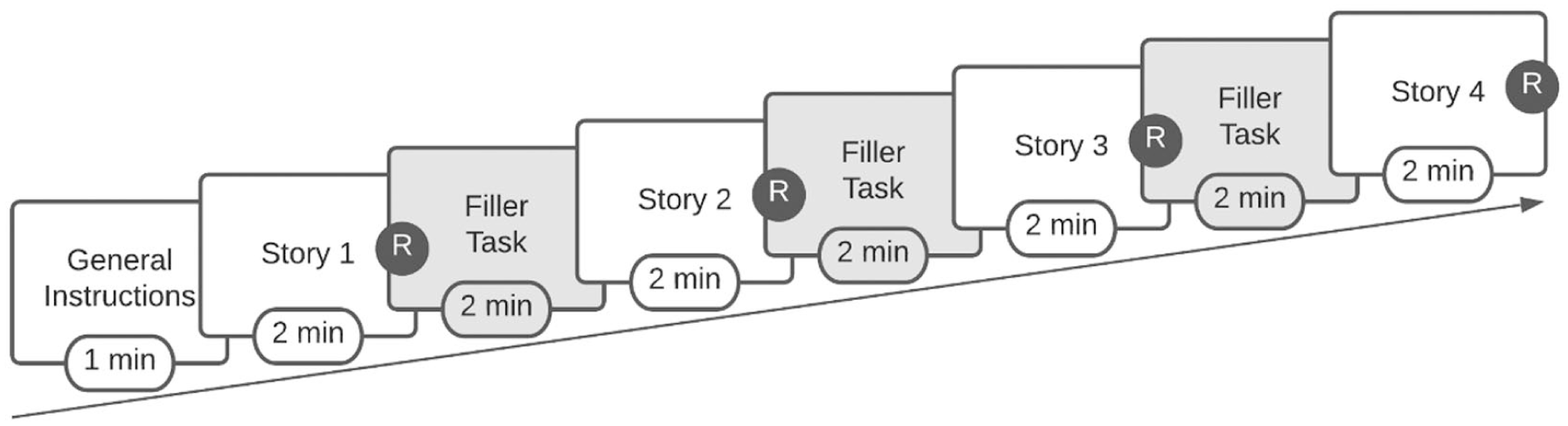
Flowchart of the procedure of stimuli presentation in Experiment 1.
Participants who were assigned stimulus Set 2 in the high prior knowledge condition read the general script before the first story; in the low prior knowledge condition, participants read the general script after the fourth story. Participants who were assigned stimulus Set 4 in the high prior knowledge condition read the concrete settings before each story; the settings were not presented in the low prior knowledge condition.
Memory Reports
After participants evaluated the enjoyment and attention related to the final story, they were presented instructions for a “Snakes” game filler task (5 min) and a Sudoku filler task (5 min). Then, participants were presented with the following instructions: “A little while ago, you were presented some stories and evaluated your enjoyment. Now, we will turn to your memory of the stories. Please think about the stories from the videos and write down everything you can remember from each story. Try to include as many details that were unique for each story as possible without guessing. Once you decide that you cannot remember any more and submit your final response, you will be asked to answer one final question. Then, the study will be completed— you will view the debriefing sheet and then you will be asked to transfer back to Prolific.” Participants were then presented with four spaces with headings that cued each of the stories: “Please report everything you can remember from the narration of the first/second/third/fourth story. Please write as complete a report as you can without guessing.” Participants saw a page with four spaces for text entry. They could report the narratives in any order and amend their descriptions until they indicated they could not remember any more. After participants submitted their reports, they were asked to think about the order in which they reported the stories and rank Story 1/2/3/4 in order corresponding to the order during report. Participants were then asked to indicate their motivation for the recall task on a 100% sliding scale labeled “Not at all motivated” at the low extreme and “Highly motivated” at the high extreme.
Data Quality Check
Participants were asked the following question: “Did you take this study seriously and do you think we should use your data? If not, please explain below,” with “Yes” and “No” as the answer options. Below this question, the following text was presented with space for text entry: “If you think we should not use your data, please explain why below. Note that your answers will not affect receiving award for study completion.”
Coding
Our approach to coding was based on identifying details of instances (or external intrusions) in narrative reports and preparing them for automatic coding using custom-defined formulas. Coding involved three steps: data entry, data validation, and automatic coding of data. In the first step (data entry), we reduced narrative reports to instance-specific details or their alternatives, including vague descriptions (e.g., “cake” in a report of Set 1 would be entered as a food item although it is a vague response because any instance indicating specification such as “strawberry” or “cheese” is missing). The second step (data validation) used the data validation tool in Microsoft Excel to highlight any entries that did not correspond to items in a pre-defined list (i.e., a list of all details from all instances; see OSM). In this step, we captured any typos and acceptable synonyms in reports and translated them into identifiable details (e.g., “Mike” in a report of Set 1 was translated into “Michael;” “river” in a report of Set 4 was translated into “stream”). We also translated any vague responses (e.g., “cake” in Set 1) into an “NA” (not recalled) code, translated any external intrusions (e.g., the occurrence of “Patrick” in Set 1) into an “new” code, and translated any reporting of multiple alternatives for one detail (e.g., the occurrence of “Mike or Rob” in Set 1) into a “conflicting” code. For all occurrences of conflicting recall, we checked for any further occurrence of each of the alternatives in reports of other instances (e.g., “Mike or Rob” in a report of Instance 1 and “Mike” in a report of Instance 2 resulted in a “conflicting” code for both Instances 1 and 2).
Trained research assistants completed data entry and validation according to a manual. The third step (coding of validated data) was programmed. Sample reports collected in the piloting stage (n = 8), Coding Sheets with a manual, sample entered data, and validation can be found in OSM. Complete data from 24 participants (approximately 20%) from each set were coded by a second trained coder. Overall, the data were coded by 5 trained coders (E.R. and three research assistants each coded one full set, one of the research assistants served as second coder for two sets they did not code previously, and a new research assistant served as a second coder for the remaining two sets). Estimates of inter-rater reliability (i.e., weighted Cohen’s kappa) were calculated based on the final codes (step three).
Data Entry
The first phase of coding comprised entering identifiable details from narrative reports into a spreadsheet that contained a list of unique details for each instance in each stimulus set (see Coding Sheet in OSM). The coder’s task was to identify pieces of the reports that corresponded to unique details and enter the pieces into the corresponding cells. This step reflected participants’ instance assignment (i.e., report of Instance 1 was entered as Instance 1 irrespective of whether the details corresponded to that instance—the accuracy of detail attribution was coded using formulas in the final step). If participants reported multiple options for one detail, all of these were entered into the cell.
Data Validation
Entered data were validated as: (a) one of the unique details (or acceptable alternatives, see OSM) that were presented within each set; (b) external intrusions (detail that was not presented within the set of stimuli); or (c) conflicting recall (in cases where participants report alternatives from multiple instances for one detail or repeat the same detail across multiple instances). Vague recall (detail that could not be identified as one of the unique details, including partial or coarse-grained recall of details) was treated as no recall.
Automatic Coding of Data
In the final step, we used custom-defined formulas based on lists of details corresponding to each instance (these formulas were part of the script shared as OSM). Validated data were automatically coded as: (a) correct details (details accurately attributed to instances in which they occurred); (b) internal intrusions (details attributed to instances in which they did not occur); (c) conflicting details (details attributed to multiple instances that contradict unique source attribution); (d) external intrusions (not presented details); and (e) not recalled details. For the purpose of statistical analyses, “conflicting” details were treated as “internal intrusions.”
Measures
Correct Details (Primary Measure)
For each story, we calculated the sum of recalled details correctly attributed to the story in which they were presented.
Misattributions
For each story, we calculated the sum of internal intrusions and conflicting details (i.e., details for which source cannot be determined).
External Intrusions
For each story, we calculated the sum of recalled details not presented in any of the stories.
Recall Accuracy
For each story, the sum of correct details was divided by the sum of all recalled details (i.e., correct details plus internal and external intrusions and conflicting details) to create a proportion of accurately recalled details. Analyses of recall accuracy are reported in OSM.
Statistical Analyses
Data were analyzed in a linear mixed model using the packages
Results
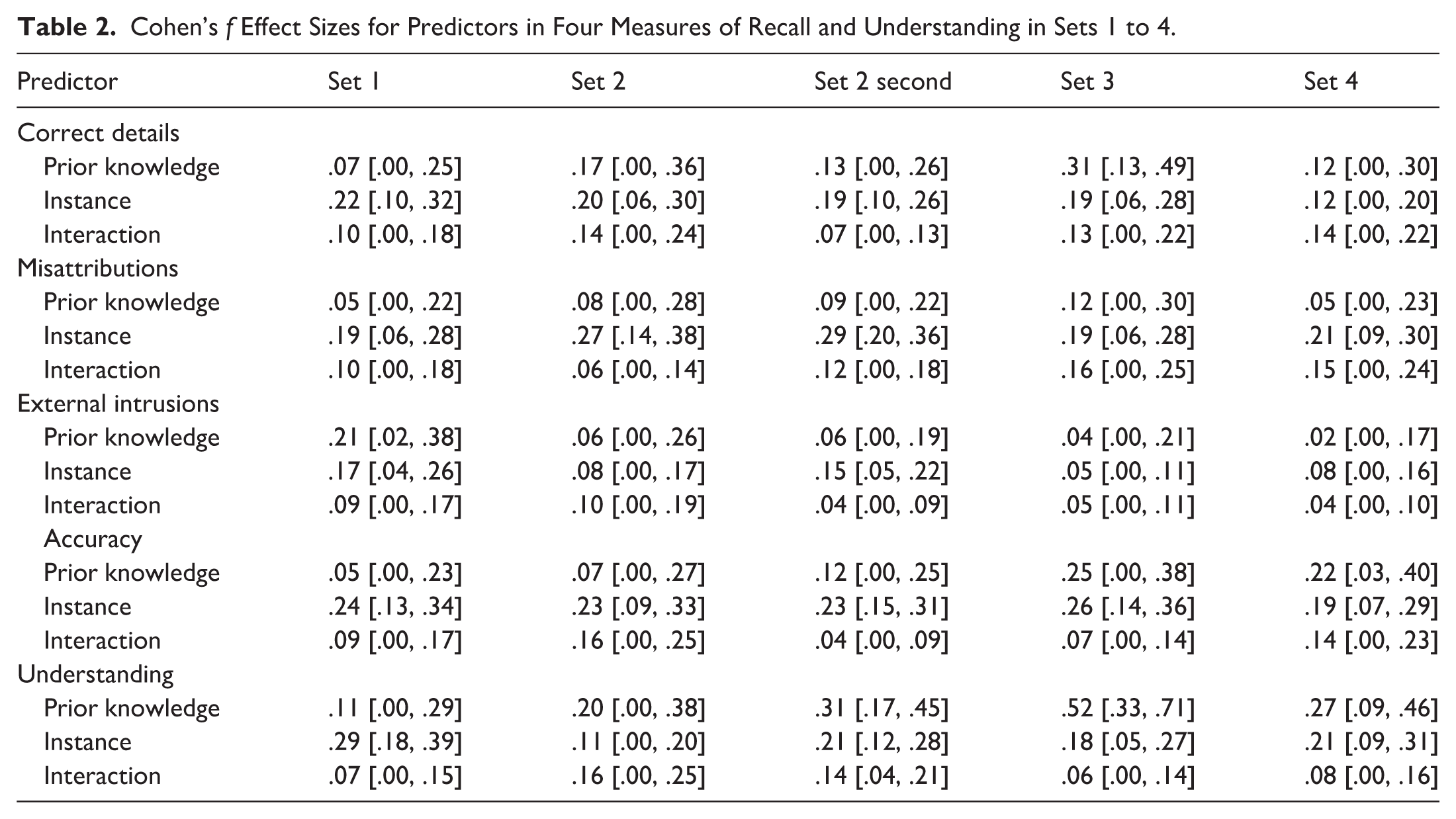
Point estimates (e.g., regression coefficients, effect sizes) are followed by 95% Confidence Intervals (CI) in brackets. Table 2 summarizes estimates of effect size (Cohen’s f). Note that we collected two samples for Set 2 (for further details, see section Test of Primary Hypotheses: Correct Details, Set 2).
Cohen’s f Effect Sizes for Predictors in Four Measures of Recall and Understanding in Sets 1 to 4.
Inter-Rater Reliability
Each set was coded by a trained research assistant. Raters were trained with pilot data with E.R. providing feedback and discussing any issues arising during the training phase. Independent trained raters then coded ~20% of data from each set to obtain estimates of inter-rater reliability (Sets 1–4: data from 24 participants; Set 2-second sample: data from 44 participants). Inter-rater agreement was almost perfect; Set 1: κ = .93 [.91, 0.96], Set 2: κ = .89 [.85, .92], Set 2 second sample: κ = .94 [.93, .96], Set 3: κ = .88, [.84, .91], Set 4: κ = .99 [.98, 1.00].
Comprehension
Figure 3 shows comprehension ratings across instances and prior knowledge conditions for Sets 1 to 4.
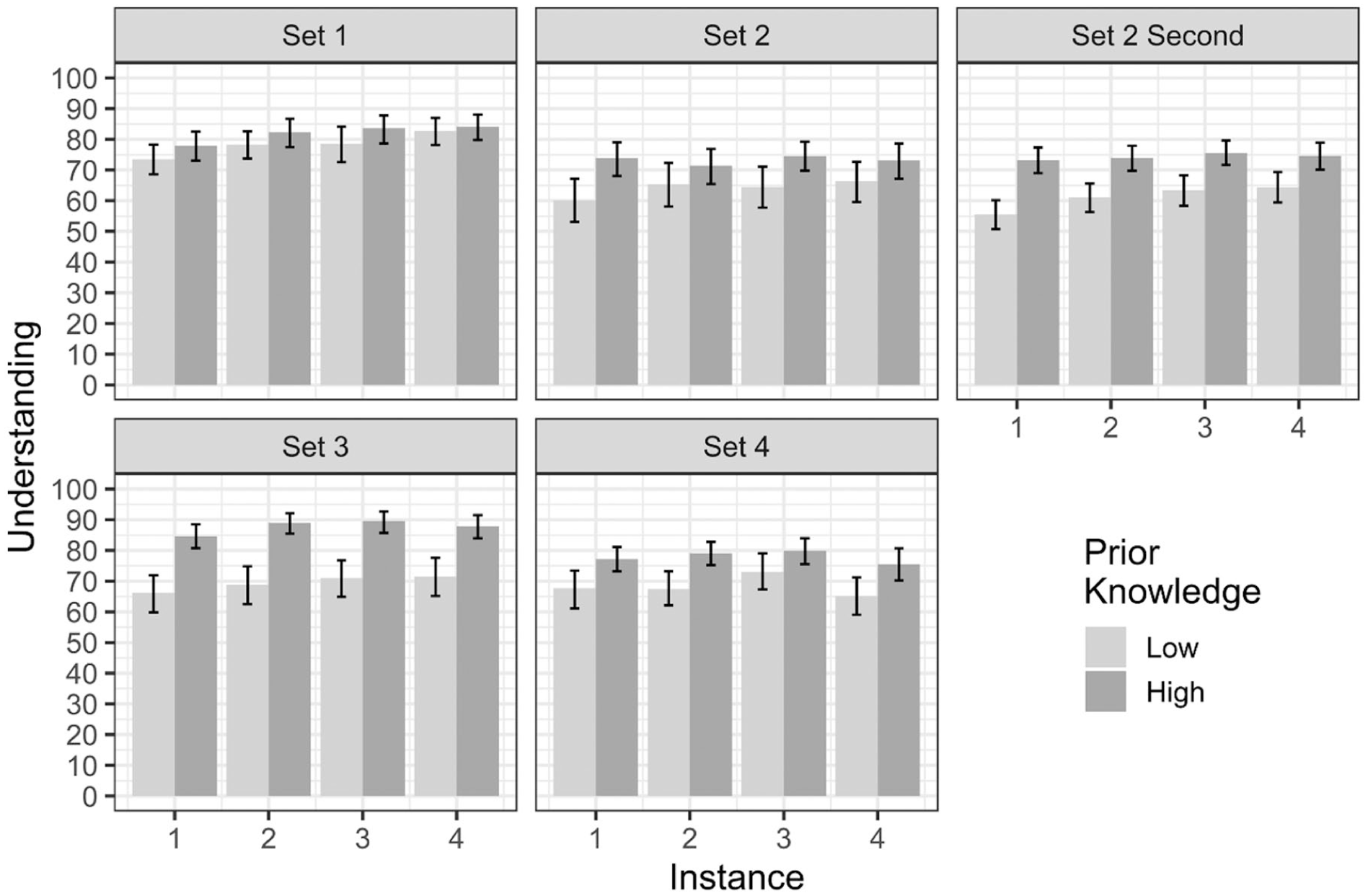
Mean ratings of understanding (with 95% CI) across prior knowledge conditions, instances, and sets.
Set 1
Participants’ ratings of understanding of the stories did not differ between prior knowledge conditions, b = 3.77, [−2.19, 9.73], t = 1.24, p = .218. Ratings of understandings increased between Instances 1 and 2, b = 4.60, [1.85, 7.34], t = 3.28, p = .001 (Figure 3). There were no further significant effects (ps ⩾ .097).
Set 2
Ratings of understanding were higher in the high than low prior knowledge condition, b = 9.15, [1.18, 17.11], t = 2.25, p = .026 (Figure 3). There was also an interaction between prior knowledge and instance in the first contrast, b = 7.76, [2.16, 13.36], t = 2.74, p = .007. This interaction specified that in the low prior knowledge condition, ratings of understanding increased between Instances 1 and 2, b = 2.34, [1.25, 9.43], t = 2.56, p = .011, but no such increase occurred in the high prior knowledge condition (p = .217). There were no further significant effects (ps ⩾ .118).
Set 2 Second Sample
There was an effect of prior knowledge, an increase in ratings of understanding between Instances 1 and 2, and their interaction. Ratings of understanding were higher in the high than low prior knowledge condition, b = 13.25, [7.45, 19.04], t = 4.48, p < .001, and increased between Instances 1 and 2, b = 3.19, [0.95, 5.44], t = 2.79, p = .005. A significant interaction, b = 4.92, [0.43, 9.40], t = 2.15, p = .032, indicated that a significant increase in understanding between Instances 1 and 2 was present only in the low prior knowledge condition, b = 5.65, [2.42, 8.88], t = 3.43, p < .001; the effect was not significant in the high prior knowledge condition (p = .644). There were no further significant effects (ps ⩾ .100).
Set 3
Ratings of understanding were higher in the high than low prior knowledge condition, b = 18.39, [12.18, 24.59], t = 5.81, p < .001, and increased between Instances 1 and 2, b = 3.51, [0.52, 6.50], t = 2.30, p = .022 (Figure 3). There were no further significant effects (ps ⩾ .363).
Set 4
Ratings of understanding were higher in the high than low prior knowledge condition, b = 9.62, [−2.19, 9.73], t = 3.00, p = .003. A significant increase in ratings of understanding occurred only between Instances 2 and 3, b = 3.16, [0.13, 6.19], t = 2.04, p = .042. Surprisingly, participants indicated lower ratings of understanding for Instance 4 compared to Instance 3, b = −6.12, [−9.15, −3.09], t = 3.96, p < .001 (Figure 3). There were no further significant effects (ps ⩾ .129).
Test of Primary Hypotheses: Correct Details
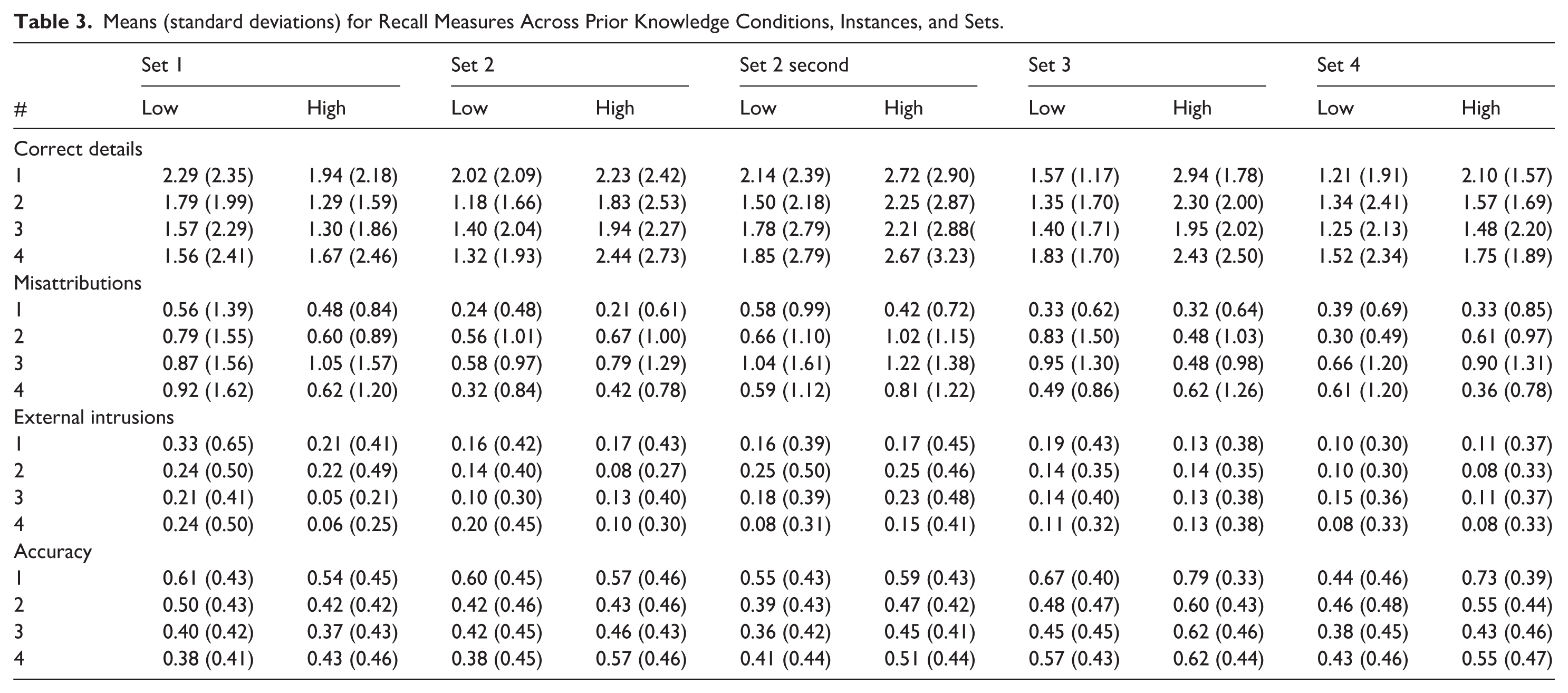
Table 3 includes means and standard deviations for all measures.
Means (standard deviations) for Recall Measures Across Prior Knowledge Conditions, Instances, and Sets.
Set 1
The difference in the number of correctly recalled details between low and high prior knowledge stimuli was not significant, b = 0.25, [−0.89, 0.38], t = 0.78, p = .434. More correct details were reported for Instance 1 than 2 (primacy effect), b = 0.57, [0.24, 0.90], t = 3.36, p < .001 (Figure 4). There were no further significant effects (ps ⩾ .263).
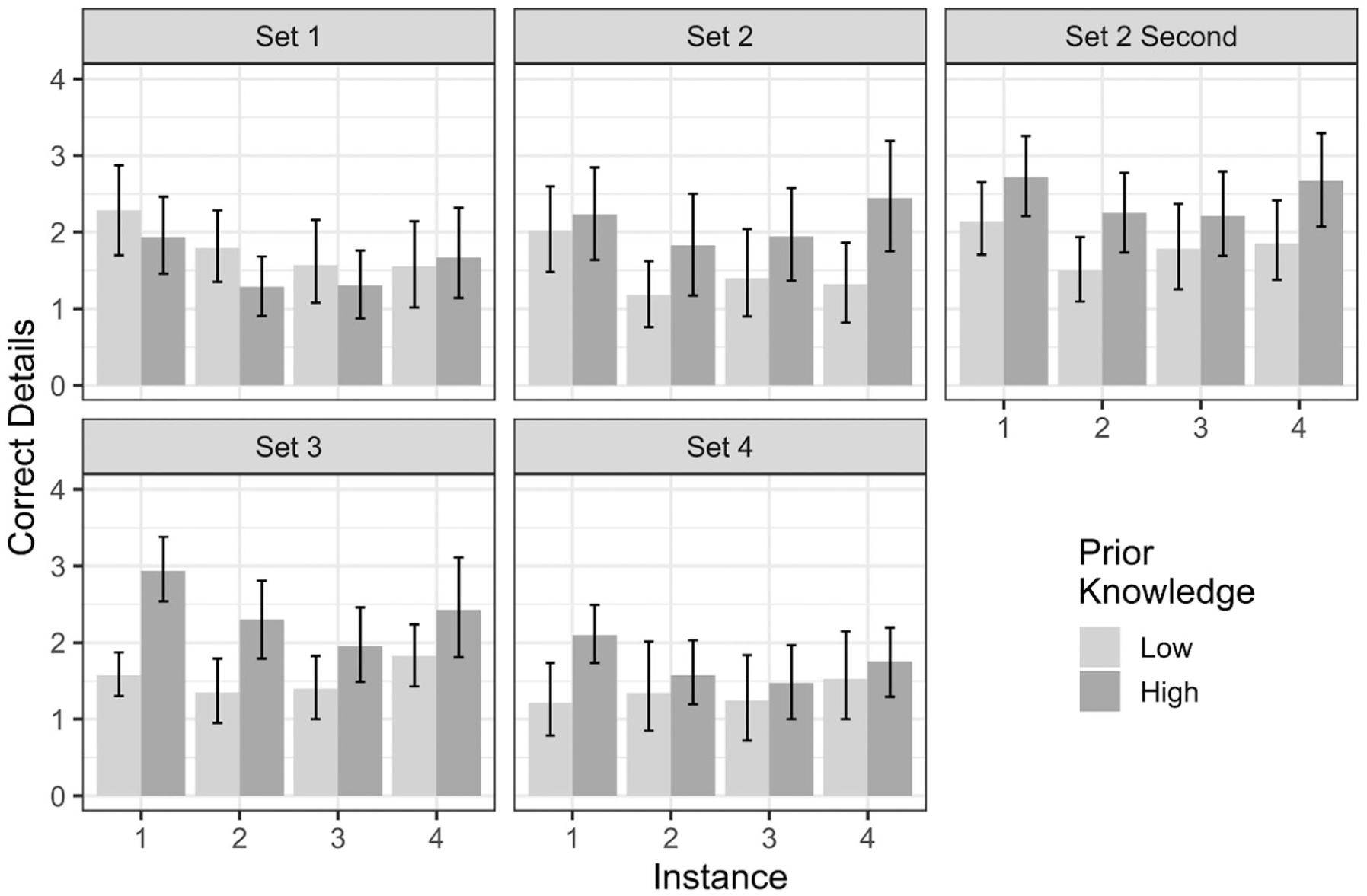
Mean number of correctly recalled details (with 95% CI) across prior knowledge conditions, instances, and sets.
Set 2
The difference in the number of correctly recalled details between low and high prior knowledge stimuli was not significant, b = 0.63, [−0.11, 1.37], t = 1.67, p = .098. More correct details were reported for Instance 1 than 2 (primacy effect), b = 0.62, [0.25, 0.99], t = 3.29, p = .001 (Figure 4). There were no further significant effects (ps ⩾ .127).
The size of the prior knowledge effect was small-to-medium—considerably smaller than we expected (Cohen’s f = .17 vs. .48; Table 2). We suspected that the null effect for prior knowledge was due to low statistical power, therefore we conducted a simulated power analysis based on our data. Specifically, we simulated 1,000 random draws of N participants from the low and high prior knowledge conditions in our sample, added them to the sample (i.e., we duplicated data for N participants in each condition), and re-ran the analysis. To estimate power, we calculated the proportion of times the prior knowledge effect was significant (i.e., p < .05), and increased N until the proportion reached .90. The resulting N was 44 (88 additional participants). Therefore, we collected and analyzed data from a new sample of 212 participants (i.e., the first sample of 124 + 88; this plan was preregistered, Rubínová et al. 2023, https://osf.io/8ub5f).
Data were collected in four waves and after processing all exclusions, our sample counted 212 participants. In the fourth wave, were recorded a total of 292 responses. We removed 44 incomplete responses and excluded data from eight participants for reporting low attention, 10 participants for reporting low motivation, and 16 participants who reported low data quality. We additionally removed data from two participants: one provided only one general description of the stories in one field and one provided only a dot as a response (note that this is a departure from our pre-registered plan).
Set 2 Second Sample
We found a nonsignificant difference in the number of correctly recalled details between low and high prior knowledge stimuli, b = 0.64, [−0.03, 1.32], t = 1.86, p = .064, and the size of this effect was smaller than in the first sample of Set 2 (Cohen’s f = .13 vs. .17; Table 2). More correct details were reported for Instance 1 than 2 (primacy effect), b = 0.55, [0.30, 0.81], t = 4.25, p < .001, and more correct details were reported for Instance 4 than 3 (recency effect), b = 0.26, [0.01, 0.52], t = 2.03, p = .043. There were no further significant effects (ps ⩾ .128).
Set 3
More correct details were reported in the high than low prior knowledge condition, b = 0.87, [0.38, 1.36], t = 3.45, p < .001 (Figure 4). More correct details were reported for Instance 1 than 2 (primacy effect), b = 0.43, [0.08, 0.78], t = 2.39, p = .017. There was also evidence of the recency effect: more correct details were reported for Instance 4 than 3, b = 0.45, [0.10, 0.80], t = 2.53, p = .012. There were no further significant effects (ps ⩾ .249).
Set 4
The difference in the number of correctly recalled details between low and high prior knowledge stimuli was not significant, b = 0.39, [−0.21, 1.00], t = 1.27, p = .206. The difference in the number of correctly recalled details between Instances 1 and 2 (primacy effect) was also not significant, b = 0.20, [−0.11, 0.50], t = 1.26, p = .208; and neither was the difference between Instances 3 and 4 (recency effect), b = 0.28, [−0.03, 0.58], t = 1.79, p = .075. But the interaction between prior knowledge and the primacy effect was significant, b = 0.66, [0.04, 1.27], t = 2.10, p = .036. Follow up analyses indicated that the primacy effect was only present in the high prior knowledge condition, b = 0.53, [0.09, 0.96], t = 2.38, p = .018 (Figure 4). There were no further significant effects (ps ⩾ .207).
Exploratory Analyses
Misattributions
In Set 1, more misattributions were reported in Instance 3 than 2, b = 0.26, [0.02, 0.51], t = 2.08, p = .038 (lowest p = .059). In both samples of Set 2, there were differences consistent with the primacy and recency effects: more misattributions were reported in Instance 2 than 1, first sample: b = 0.39, [0.17, 0.61], t = 3.51, p < .001, second sample: b = 0.4, [0.16, 0.52], t = 3.78, p < .001; and in Instance 3 than 4, first sample: b = 0.31, [0.09, 0.53], t = 2.81, p = .005, second sample: b = 0.42, [0.25, 0.60], t = 4.72, p < .001. In the second sample of Set 2, there was additionally a significant difference across the middle instances: more misattributions were reported in Instance 3 than 2, b = 0.29, [0.11, 0.46], t = 3.20, p = .001, and the primacy effect was qualified by a significant interaction with prior knowledge, b = 0.51, [0.16, 0.86], t = 2.83, p = .005, indicating that the effect was stronger in the high prior knowledge condition (Table 3).
In Set 3, consistent with the primacy effect, more misattributions were reported in Instance 2 than 1, b = 0.33, [0.10, 0.55], t = 2.87, p = .004, and there was an interaction between prior knowledge and instances in the third contrast comparing Instances 3 and 4, b = 0.60, [0.16, 1.05], t = 2.66, p = .008, which indicated a crossed pattern of misattributions. As indicated by the pattern of means in Table 3, more misattributions were reported in Instance 3 than 4 in the low prior knowledge condition, but the pattern was flipped in the high prior knowledge condition.
In Set 4, more misattributions were reported in Instance 3 than 2, b = 0.33, [0.11, 0.54], t = 2.97, p = .003. There was also a difference consistent with the recency effect: more misattributions were reported in Instance 3 than 4, b = 0.30, [0.08, 0.51], t = 2.67, p = .008, although this effect was much stronger in the high than low prior knowledge condition (see Table 3), as indicated by a significant interaction, b = 0.49, [0.06, 0.93], t = 2.22, p = .027. The distribution of misattributions according to their source instance are shown in Supplemental Figure 1 in OSM.
External Intrusions
In Set 1, more external intrusions were reported in the low prior knowledge condition, b = 0.12, [0.02, 0.22], t = 2.31, p = .023, and more external intrusions were reported in Instance 2 than 3, b = 0.10, [0.01, 0.20], t = 2.09, p = .038. There were no further significant effects in Set 1 (ps ⩾ .150).
In the second sample of Set 2, there was a pattern consistent with the primacy and recency effects: more external intrusions were reported in Instance 2 than 1, b = 0.09, [0.02, 0.16], t = 2.36, p = .019, and in Instance 3 than 4, b = 0.08, [0.01, 0.16], t = 2.23, p = .026 (all other ps ⩾ .173). In Sets 2, 3, and 4, there were no significant differences in external intrusions (ps ⩾ .138).
Discussion
Limited prior knowledge, and relatedly, limited comprehension, result in information processing at a shallower level (Craik & Lockhart, 1972; Kintsch & van Dijk, 1978). One of the consequences of limited comprehension is impaired memory (Bransford & Johnson, 1972). In Experiment 1, we manipulated prior knowledge via familiarity (Set 1: familiar and unfamiliar stories) and context (Set 2: context provided before or after events; Set 3: narratives well-matched to or detached from observed actions; Set 4: concrete settings for abstract events provided or not provided).
In terms of understanding, we found validation of the prior knowledge manipulation for Sets 2 to 4, where participants reported lower rates of understanding in the low prior knowledge conditions. Additionally, we also found that participants built their knowledge through their experience with the repeated event. Ratings of understanding increased between the first two instances (in the low prior knowledge condition in Set 2 and both prior knowledge conditions in Set 3), respectively between the second and third instances (in Set 4). In Set 4, there was an unexpected decrease in understanding in the final instance, indicating that perhaps parts of the final story (the completion of the project) were unclear to participants. We did not find differences in ratings of understanding between the low and high prior knowledge conditions in Set 1. In hindsight, we acknowledged that events within Set 1 in both conditions were quite simple, effectively limiting the potential of any familiarity effects to emerge (i.e., the events in the low prior knowledge condition could have been unfamiliar but still easy to understand).
The patterns of understanding related to the prior knowledge manipulation partially translated into recall performance. In Sets 2, 3, and 4, participants reported fewer correct details in the low prior knowledge condition (consistent with Hypothesis 1), but the simple main effect was only significant in Set 3. In Set 2, the pattern of correct recall performance was consistent with our predictions, but the true prior knowledge effect was likely smaller than we could observe in both samples we collected. In Set 4, the prior knowledge manipulation substantially impaired recall of the first instance and effectively eliminated the primacy effect (consistent with Hypothesis 3). In terms of Hypothesis 2, a clear primacy effect was found in Sets 1, 2, and 3, and in the high prior knowledge condition of Set 4 (see Figure 4); the recency effect was only found in Set 3 and in the second sample of Set 2. In Set 4, the ratings of understanding showed a reversed recency effect, but this pattern did not translate into recall performance.
Exploratory analyses of accuracy (i.e., the output measure of proportion of accurately reported details reported in OSM) were broadly consistent with patterns of correct recall. In Sets 3 and 4, accuracy was higher in the high than low prior knowledge condition, providing further support for Hypothesis 1. Primacy effects for recall accuracy were detected in Sets 1, 2, and 3; in Set 4, there was an interaction with prior knowledge indicating that the primacy effect was only present in the high prior knowledge condition.
Exploratory analyses of inaccurate recall complemented the primacy effects found in correct recall: fewer misattributions were reported in the boundary than the middle instances. This pattern reflects the contribution of source errors into the primacy and recency effects (Rubínová & Kontogianni, 2023). In Set 1, there were more external intrusions in the low prior knowledge condition, which relates to the culture-specific nature of the stimuli, where participants’ reported memory distortions for culturally unfamiliar details in line with their own cultural background (e.g., see Rubínová et al., 2021).
Our initial plan was to make the validation of stimuli for the manipulation of prior knowledge contingent on the significant simple main effect of prior knowledge in the analysis of correctly recalled details and to use the comprehension analyses as further evidence of the validation. From this perspective, only Set 3 met our original criteria (a significant main effect in correct recall and comprehension). However, when considering: (a) the overall patterns of findings including significant effects in comprehension analyses (Set 2, 3, and 4), (b) the interaction between prior knowledge and the primacy effect (Set 4), (c) the patterns of exploratory analyses described above (all sets), and (d) the benefits of stimulus sampling for subsequent experiments, we ultimately decided to consider Sets 2, 3, and 4 as validated for the manipulation of prior knowledge and therefore used these three sets in Experiment 2.
Experiment 2
In Experiment 2, we extended the examination of the effect of prior knowledge by comparing recall of a single event with recall of four instances of a repeated event. This design enabled us to examine the impact of the interaction between repetition and prior knowledge. Previous research (using high prior knowledge stimuli) has shown that participants recall more correct details of a single event when compared to the recall of details that were unique to the final instance of a repeated event, and sizes of these effects varied from small (Cohen’s d = 0.29 for nonstressful events in Dilevski et al., 2020) to medium (Cohen’s d = 0.71 for stressful events in Dilevski et al., 2020) to large (Cohen’s d = 1.37 in Deck & Paterson, 2021). For low prior knowledge stimuli, however, repetition (i.e., exposition to several variations of an event) would likely facilitate the construction of the event-related knowledge structure. In other words, participants would learn the typical sequence of actions, categories of concepts, or might infer the purpose of actions. Therefore, we expected that repeated experience would facilitate understanding and consequently also recall, which should be apparent when recall of a single event is compared with recall of the final instance of a repeated event.
The primary hypotheses in Experiment 2 concerned the comparison between recall of a single event and the final instance of a repeated event, which has been most prevalent comparison in the literature (Connolly & Lindsay, 2001; Woiwod et al., 2019). Our first hypothesis was consistent with Experiment 1: we expected to replicate the effect of prior knowledge for single event and repeated event stimuli with more details recalled in the high (compared to the low) prior knowledge condition (i.e., the main effect of prior knowledge will be significant). Our second hypothesis concerned the interaction between event repetition and prior knowledge, where we expected to replicate the typical finding of recall of more correct details for the single event compared to the final instance of a repeated event for high prior knowledge stimuli, but we expected to find the opposite pattern for low prior knowledge stimuli (i.e., the interaction between event repetition and prior knowledge will be significant). We did not expect to find a significant effect of event repetition. We planned to conduct exploratory analyses for the comparison between recall of the single event and the first, second, and third instances of the repeated event.
Method
The method of Experiment 2 closely resembled the method of Experiment 1; therefore, we only highlighted important differences in the following sections. All reports were coded by a trained research assistant who coded reports in Experiment 1.
Design
This study used a 2 (prior knowledge: high/low) × 2 (event repetition: single/repeated) between-subjects design.
Power Analysis
We calculated a simulation-based power analysis (Lakens & Caldwell, 2021) for an expected pattern of means for the number of correct details for the single event: 3.50 in the high prior knowledge and 1.40 in the low prior knowledge conditions, and for the final instance of the repeated event: 2.43 in the high prior knowledge and 1.83 in the low prior knowledge conditions (note that estimates for repeated event data were taken from Set 3, Experiment 1; Table 3). The assumed population standard deviation was set as 2.50 (see data from Set 3, Experiment 1, Table 3) and alpha was set as .05. The effect size was medium-to-large for prior knowledge (Cohen’s f = 0.39), small for event repetition (Cohen’s f = 0.09; note that this effect was not expected to be significant), and small-to-medium for the interaction between prior knowledge and event repetition (Cohen’s f = 0.21). The sample size necessary to achieve 90% power was 19 for the effect of prior knowledge and 59 for the interaction between prior knowledge and event repetition. Therefore, we intended to collect data from 236 participants (i.e., 59 per group). The expected pattern of means is depicted in Figure 5.
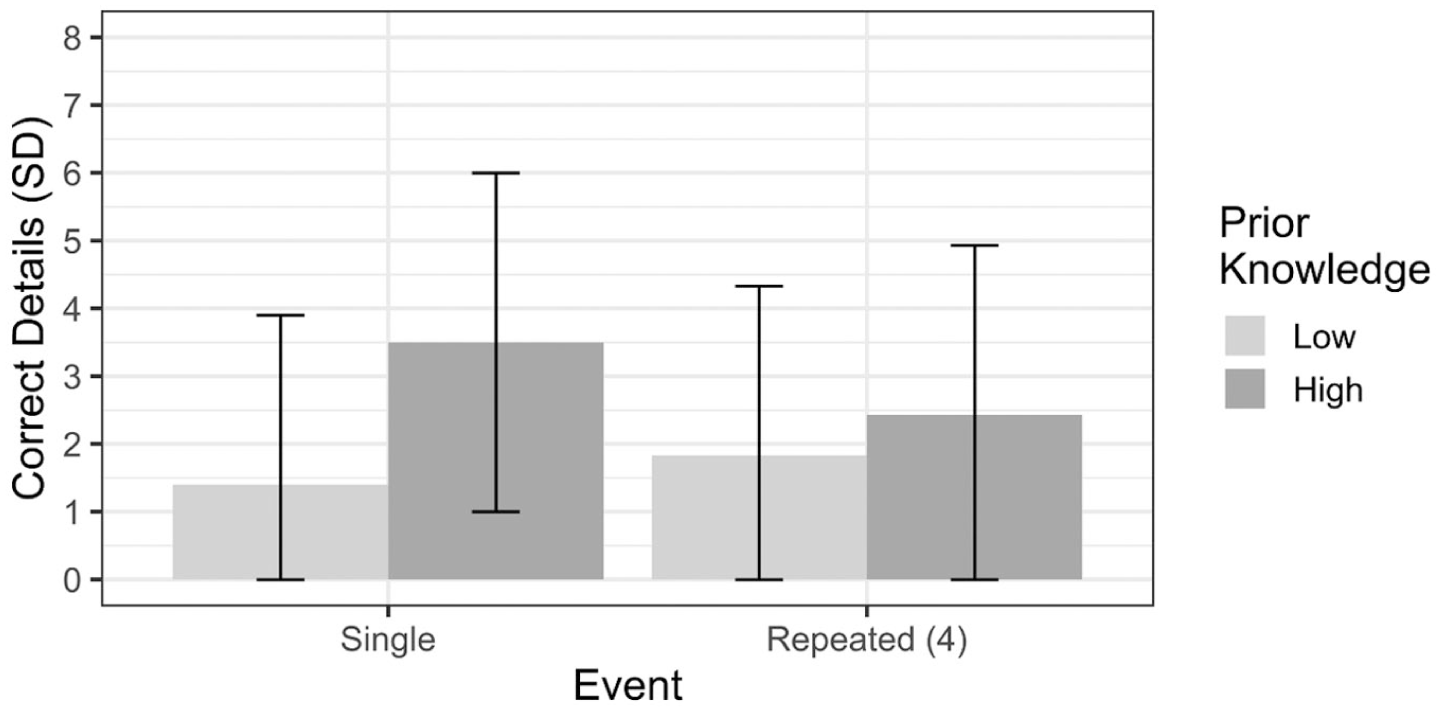
Pattern of means used for simulation-based power analysis in Experiment 2.
Participants
Participants were recruited from a Prolific panel using the pre-screen and exclusion criteria listed under Experiment 1 and were paid in accordance with Prolific recommendations (see Experiment 1). We added an item into the pre-screen criteria that excluded individuals who participated in Experiment 1 from recruitment.
In the single-event condition, we recorded 143 responses, out of which 18 were incomplete. Data from two participants were excluded due to low reported attention to stimuli (<10%) and data from four participants were excluded due to low reported motivation during the recall task (<10%). At data cleaning following the initial 48 responses, we realised that we failed to change the initial instructions from Experiment 1 that informed participants they would watch four stories. At the data quality question, 10 participants reported that we should not use their data, nine of which mentioned that the reason was they only saw one story. We kept data from these participants and only removed data from one participant who reported low engagement with the study. The final sample for the single-event condition included 118 participants.
In the repeated event condition, we recorded 176 responses, out of which 29 were incomplete. Data from one participant were excluded due to low reported attention to stimuli (<10%) and data from six participants were excluded due to low reported motivation during the recall task (<10%). Ten participants responded negatively to our data quality question, leaving a total of 130 participants.
The final sample of 248 participants included 107 females and 141 males; MAge = 34.93 (SD = 12.50) years; 167 participants identified as White, 41 as Black, 18 as Mixed, 15 as Asian ethnicity, and seven selected “Other” for this question.
Materials
We used Sets 2, 3, and 4 as described in Experiment 1 with the following distribution of participants across prior knowledge conditions and sets: single-event high prior knowledge condition: NSet 2 = 20, NSet 3 = 20, NSet 4 = 19; single-event low prior knowledge condition: NSet 2 = 21, NSet 3 = 20, NSet 4 = 18; repeated event high prior knowledge condition: NSet 2 = 23, NSet 3 = 24, NSet 4 = 21; repeated event low prior knowledge condition: NSet 2 = 20, NSet 3 = 21, NSet 4 = 21. In the single-event condition, we used the final instance of each set.
Procedure
Recruitment
Due to the difference in study duration in the single-event condition (approximately 20 min) and the repeated event condition (approximately 45 min), we recruited participants separately. We first recruited participants for to the single-event condition. Once recruitment was complete, we opened recruitment for the repeated event condition (study advertisement was not visible for participants who have already participated in the single-event condition).
Stimuli Presentation
The initial stages (i.e., consent, checks, and general instructions) were the same as in Experiment 1. Participants then proceeded to instructions for the single event or repeated event, depending on their condition. Single-event instructions were as follows: “You will now be presented with a story. Please pay attention to the story as it will be presented only once.” The repeated event instructions will be the same as in Experiment 1. The presentation of each story was followed by an enjoyment and attention rating and a filler task (see Experiment 1).
Recall
Following a 10-minute filler task, participants were asked to recall the single event or instances of the repeated event, respectively, depending on condition.
Statistical Analyses
Data were analyzed in an ANOVA with prior knowledge, event repetition, and their interaction as independent variables. There were four models, one for each comparison between the single event and the four instances of the repeated event. The main effect of prior knowledge and the interaction between prior knowledge and event repetition in the model including recall of Instance 4 directly assessed our primary hypotheses for the measure of correct details. Simulation data and scripts are available in OSM, as well as final data and scripts.
Results
Supplemental Table 1 in OSM summarizes descriptive statistics of ratings of understanding across conditions and sets.
Correct Details: Single Event versus Instance 4 2
Figure 6 shows the patterns of correct recall across all conditions. In line with our predictions, when comparing the number of correctly recalled details between the single event and the final instance of the repeated event and across prior knowledge conditions, we found a significant main effect of prior knowledge, F(1,244) = 5.14, p = .024, η2 = 0.02. Participants in the high prior knowledge condition recalled more correct details (M = 2.51, SD = 2.33) than participants in the low prior knowledge condition (M = 1.89, SD = 2.17). Contrary to our predictions, we also found a significant main effect of event repetition, F(1,244) = 9.28, p = .003, η2 = 0.04. Participants in the single-event condition recalled more details (M = 2.65, SD = 2.25) than participants in the repeated event condition (M = 1.81, SD = 2.22). The interaction was not significant, F(1,244) = = 0.42, p = .518, η2 = 0.002.
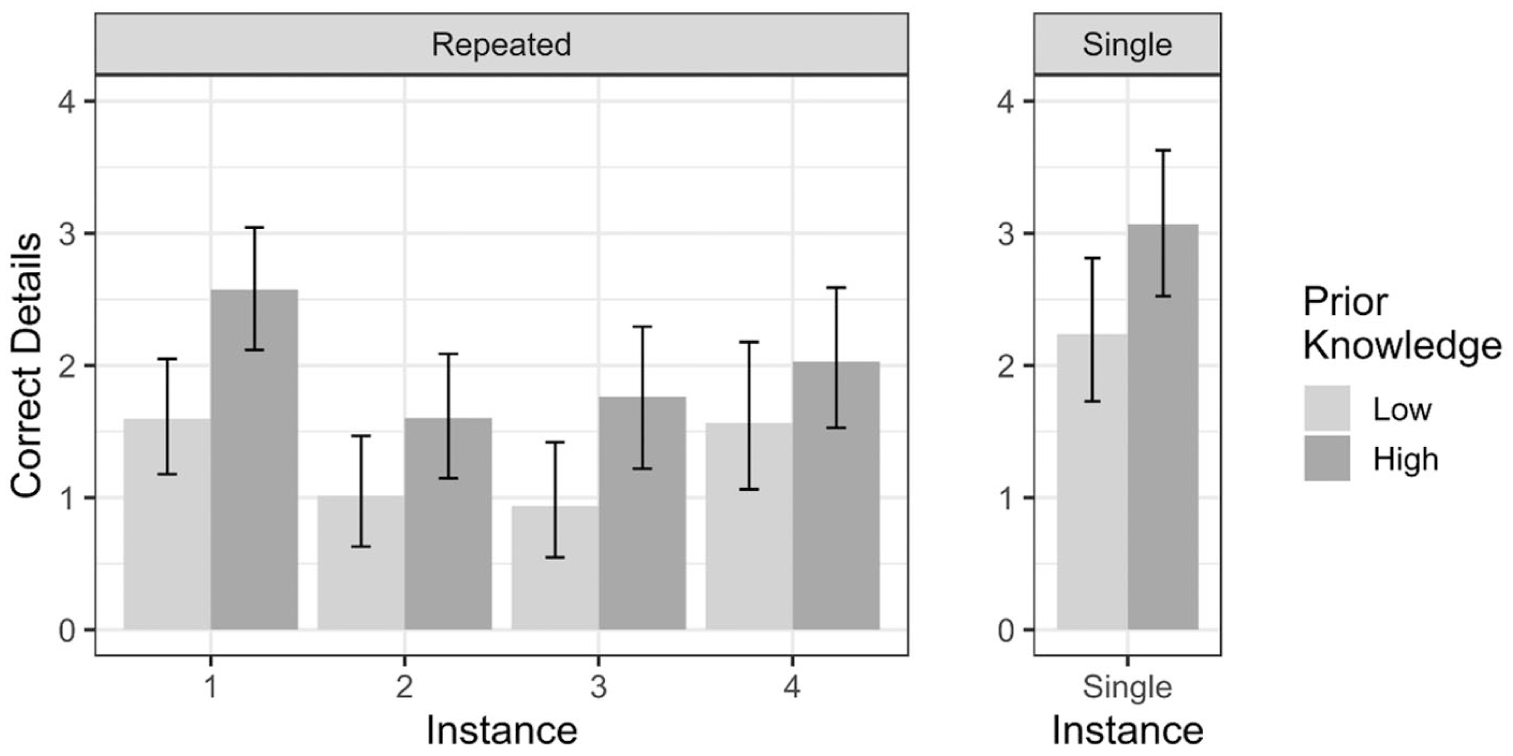
Mean number of correctly recalled details (with 95% CI) across conditions.
Exploratory Analyses
Correct Details: Single Event versus Instance 1
The main effect of prior knowledge was significant F(1,244) = 12.24, p < .001, η2 = 0.05. The main effect of event repetition was also significant, F(1,244) = 4.75, p = .030, η2 = 0.02, and the interaction was not significant, F(1,244) = 0.08, p = .778, η2 = 0.00.
Correct Details: Single Event versus Instances 2 and 3
The main effect of prior knowledge was significant F(1,244) = 7.35, p = .007, η2 = 0.03. The main effect of event repetition was also significant, F(1,244) = 26.89, p < .001, η2 = 0.10, and the interaction was not significant, F(1,244) = 0.22, p = .639, η2 = 0.00. Results of the comparison between the single event and Instance 3 were similar, therefore we opted to report them in OSM.
External Intrusions
There were no significant differences in the number of reported external intrusions across the conditions (ps > .151).
Discussion
We replicated the main effect of prior knowledge. Participants who received insufficient information to fully comprehend the stories recalled fewer correct details of those stories—in the single event and across all instances of the repeated event. We also found a main effect of event repetition. Contrary to our hypothesis, this effect was present across high and low prior knowledge conditions in the target comparison between the single event and the final instance of the repeated event. We expected that participants in the repeated event and low prior knowledge condition would show a benefit of accumulated knowledge across repeated stories that would be lacking in the single-event condition, but we did not find support for this expectation. Descriptively, the difference between correct details recalled in the low and high prior knowledge conditions was smaller for the repeated event than for the single event.
Planned exploratory analyses examined recall performance between the single event and Instances 1, 2, and 3. The effect of prior knowledge was present in all comparisons, and recall performance was superior for the single event compared to all instances of the repeated event. A noteworthy finding was revealed for the comparison of recall performance between the single event and the first instance of the repeated event: The size of the difference was half of the comparison between the single event and the final instance of the repeated event. The literature has long recognized that first instances of repeated events are recalled in more detail and more accurately compared to other instances (e.g., Connolly et al., 2016; Powell & Thomson, 1997; Rubínová et al., 2022), but we are not aware of any direct comparisons of recall performance between a single event and the first instance of a repeated event. First experiences in general have a unique position in memory, forming boundaries of lifetime periods (Brown, 2016; Robinson, 1992) and establishing repeated events, and thanks to unique encoding processes are likely protected from misattribution at retrieval, at least to a degree (Rubínová & Kontogianni, 2023).
General Discussion
Prior knowledge manifests in many forms, including cultural background that helps individuals appreciate (and partake in) folklore, the provision of context or setting (information that places events and actions into a known perspective), a description that links clearly to observed actions, or an information key that helps translate abstract descriptions into concrete instantiations. When prior knowledge is lacking or limited, comprehension of events, and subsequently also memory for those events, are negatively impacted. These effects are well documented for single events—situations where participants recall a single image, piece of text, or a story (e.g., Bransford & Johnson, 1972; Kintsch & Greene, 1978; Steffensen et al., 1979). In contrast, individuals who experience a sequence of similar instances should have the benefit of learning across the instances and consequently build structures facilitating comprehension and prediction of future instances (e.g., Afflerbach, 1990a; Ebbinghaus, 1964; Farrar & Boyer-Pennington, 1999; Fivush, 1984). To our knowledge, our research is the first to examine the impact of low versus high prior knowledge on comprehension and recall of repeated events.
In Experiment 1, we set out to develop and validate new sets of repeated event stimuli including the manipulation of prior knowledge. We also examined the unique patterns of memory performance in situations where the building of knowledge via repeated experience is combined with limited prior knowledge. In three out of four sets of stimuli, our manipulation translated into differences in ratings of comprehension: participants indicated lower understanding of low (than high) prior knowledge stimuli. Ratings of understanding increased with experience, and in two sets, this increase was more pronounced in low than high prior knowledge conditions. This pattern is consistent with theoretical predictions derived from levels of processing. When prior knowledge is low, repeated experience enables deeper processing (Craik & Lockhart, 1972) and emerging schemata facilitate the construction of meaning—comprehension—at a higher level (Kintsch & van Dijk, 1978).
The translation of differences in comprehension to memory performance across the three sets was assessed using a primary measure of correct recall performance (input-bound) and an exploratory measure of recall accuracy (output-bound proportion of accurately reported details; results reported in OSM). Based on patterns of data and findings across these measures, we validated three of the four sets of stimuli we developed and used these for a comparison of the impact of prior knowledge on recall of single and repeated events in Experiment 2.
All stimuli developed for the present research are openly available and can be used for research purposes in line with associated license and guidance (see OSM). In the following sections, we focus on the specific manipulations of prior knowledge across the sets of repeated event stimuli, related findings, and their theoretical and practical implications. We then summarize findings of the effects of prior knowledge in the single versus repeated event comparison and consider limitations of this research.
Manipulating Prior Knowledge in Repeated Events
Set 2 was conceptually based on seminal work by Bransford and Johnson (1972) who manipulated prior knowledge by presenting semantic information either before (high prior knowledge) or after (low prior knowledge) a target text passage. The text passage was easier to comprehend, and participants recalled more information from it, when semantic information was presented before than after the passage (Bransford & Johnson, 1972). Set 2 comprised of: (a) four stories featuring a character described as T-44 who searches for and collects fluids that interact and give rise to various elements when mixed, and (b) a script that explains who T-44 is, what it is trying to achieve, and how things work where T-44 is from (see Supplemental Appendix B—online Supplemental Material at qjep.sagepub.com). To manipulate prior knowledge, we presented participants the script either before the first story (high prior knowledge condition) or after the final story (low prior knowledge condition).
We expected that the lack of guidance as to what is relevant and how actions and events unfold to facilitate prediction means that smaller portions of information would be processed at a more surface level, as the meaning-making processing would be focused on knowledge-building rather than elaboration and integration of information (Craik & Lockhart, 1972; Kintsch & van Dijk, 1978). This expectation (Hypothesis 1) was confirmed by comprehension analyses. Participants rated understanding of stories lower in the low prior knowledge condition compared to the high prior knowledge condition, and these ratings also reflected the building of knowledge as an increase in ratings of understanding between the first and second story in the low prior knowledge condition. Analyses of correctly recalled details did not reveal a significant effect, but the pattern of differences across two samples of participants was consistent with our predictions: participants in the low prior knowledge condition recalled fewer correct details than participants in the high prior knowledge condition. The difference was much smaller than we expected and was nonsignificant, likely due to low statistical power (our samples were likely too small to detect the effect).
In Set 3, we used outdoor video recordings of a group performing actions in four different locations developed by Kontogianni et al. (2021) with added narratives to accompany the videos. To manipulate prior knowledge, we developed two sets of narratives: in the high prior knowledge condition, the narratives described actions that fit what was happening in the videos; in the low prior knowledge condition, the narratives described the same actions detached from the videos (e.g., instead of describing that the group was installing a device in a location for a specific use, the narrative described that the group tried to use the device the previous day). This approach resulted in two different sets of narratives that contained the same target details (see Supplemental Appendix C—online Supplemental Material at qjep.sagepub.com).
The manipulation in Set 3 intended to created conditions that would make it harder for participants in the low prior knowledge condition to understand the content of the narratives; not because participants would have insufficient semantic knowledge (as in Set 2) but because the narrative and the video were slightly misaligned. We expected that this manipulation would result in poorer memory performance. In Set 3, measures of comprehension, correct recall performance, and recall accuracy confirmed our expectations: participants in the low prior knowledge condition rated lower level of understanding of the stories, recalled fewer correct details, and their recall accuracy was lower. Consistent with the prediction of building knowledge through experience, participants across both prior knowledge conditions reported higher level of understanding between the first and second story.
Set 4 comprised: (a) four stories describing four days of a farmer in an abstract way (e.g., black tarry liquid), and (b) concrete instantiations of the abstract descriptions (e.g., coffee; see Supplemental Appendix D—online Supplemental Material at qjep.sagepub.com). Prior knowledge was manipulated by either providing participants with concrete instantiations before viewing each story (high prior knowledge) or not providing these instantiations (low prior knowledge), and we again expected that the lack of concrete information would create suboptimal conditions for elaborative processing and consequently memory.
The measure of comprehension provided support for validation of the prior knowledge manipulation in this set: participants with low prior knowledge reported lower levels of understanding. Participants built understanding of the stories more gradually than in other sets—ratings increased only between the second and third story. (There was additionally a decrease in understanding between the third and final story, likely due to the specific task the farmer completed on the final day.) The primary measure of correct recall performance did not show a significant difference between prior knowledge conditions but showed an interaction between prior knowledge and the primacy effect: low prior knowledge strongly disrupted correct recall of the first story and the disruption subsequently levelled off. Further support for validation of the prior knowledge manipulation emerged in analyses of recall accuracy reported in OSM: low prior knowledge was associated with lower recall accuracy.
Findings from Sets 2, 3, and 4 show that implementing arguably different manipulations of prior knowledge may lead to a negative impact on understanding, rates of correctly recalled information, and/or recall accuracy, albeit with slight differences across varying stimuli. Additionally, Set 4 perhaps best exemplifies a situation where prior knowledge was so low at the initial event that it eliminated the primacy effect. Indeed, despite ratings indicating lower levels of understanding of initial stories across all sets, correct recall performance showed clear primacy effects in Sets 2 and 3 across low and high prior knowledge conditions (Hypothesis 2). Recency effects were much less frequent (second sample of Set 2 and Set 3). The primacy effects likely prevailed thanks to the unique encoding of first experiences including their role in the rapid establishment of new semantic knowledge structures (e.g., Farrar & Boyer-Pennington, 1999; Fivush, 1984). Set 4 was the only to show a complete elimination of the primacy effect in the low prior knowledge condition (consistent with our Hypothesis 3).
One of the sources of motivation for this research was trying to better understand and predict memory performance in cases of sexual assault involving grooming or other types of experiences for which individuals initially lack understanding. Across Sets 2, 3, and 4, we saw that low prior knowledge impaired recall performance, and in Set 4, we saw that very low initial understanding may disrupt unique encoding processes associated with first experiences. A wealth of repeated event studies confirmed the long-term primacy effect (e.g., Connolly et al., 2016; Dilevski et al., 2020; MacLean, et al., 2018; Powell & Thomson, 1997; Powell et al., 2003; Roberts et al., 2015; Rubínová & Kontogianni, 2023) with some recommending that reports of first events should be sought in investigative settings (e.g., Rubínová et al., 2022). Our study is the first to highlight the importance of considering prior knowledge and its potential negative impact on the long-term primacy effect.
Prior Knowledge in Single and Repeated Events
In Experiment 2, we aimed to replicate and extend the manipulation of prior knowledge in single and repeated events using Sets 2, 3, and 4 as stimuli. Viewing a single story (or experiencing a single event) does not provide individuals a chance to build knowledge with experience, which may be critical when prior knowledge is low. Repeated experience should enable individuals to confirm their working hypotheses or intuitions regarding events they are experiencing and focus on deeper processing and encoding of unique details (Craik & Lockhart, 1972; Farrar & Boyer-Pennington, 1999; Farrar & Goodman, 1990, 1992). Based on this theoretical perspective, we expected that participants in the low prior knowledge and repeated event condition would benefit from viewing three stories preceding the final story (that was used as the target comparison) compared to participants in the low prior knowledge condition who only viewed one story. Together with the typical finding of superior memory for single event compared to the final instance of a repeated event, we expected to find an interaction between event frequency and prior knowledge. Contrary to our predictions, however, we only replicated the effects of prior knowledge and event frequency: Participants who viewed low prior knowledge stimuli recalled fewer correct details (cf. high prior knowledge stimuli), and participants who viewed a single story recalled more details than participants who viewed four stories. Why did we fail to find the expected interaction? The most likely explanation is the large extent of misattribution caused by interference from instances of the repeated event, which may have eliminated any benefits of knowledge-building associated with repeated experience.
We found superior correct recall performance (and recall accuracy) for the single event in comparisons with recall of all instances of the repeated event. Of particular interest, the difference in correct recall performance in the comparison between the single event and the first instance of the repeated event was considerably smaller than comparisons between the single event and other instances of the repeated event. In addition, exploratory analyses of recall accuracy reported in the OSM indicated a nonsignificant difference between the single event and the first instance of the repeated event, although recall performance was descriptively lower for the repeated event. This should perhaps not come as a surprise, given that the first instance of a repeated event would be encoded with unique source attributes, similarly to a single event. Exploratory analyses also indicated fewer misattributions reported in the first instance compared to the second instance of the repeated event, which is consistent with previous investigations (Rubínová & Kontogianni, 2023).
Limitations
Arguably, there are many aspects of this research that may limit generalizability of our findings to other situations where different levels of prior knowledge may be expected. We highlight three that we believe are of highest importance. First, we used three different manipulations of prior knowledge, and there are many more that we did not examine. However, the manipulations we used were variable and still converged on consistent impacts on comprehension and memory performance. Second, all our experiments were run within a single session. Such a procedure is detached from everyday remembering, but we deemed it suitable for the examination of fundamental memory processes in this research. It is possible that longer delays between instances would provide more time consolidation of individual stories and learning across stories in the repeated event condition, perhaps leading to the expected interaction between repetition and prior knowledge (Experiment 2). Finally, our findings are limited due to the specific focus on recall of details that were unique to individual stories. Our coding approach resulted in seemingly low patterns of recall (typically between one and four correct details, see Figures 4 and 6), though it should be noted that our coding scheme did not capture any schematic descriptions of the stories. For illustration, the following narrative recall: “Emily woke up to a sound. She walked down a puffy road to get her elixir. She worked in a green maze with red diamonds. She worked until she was weary and then was satisfied with how much she got done” (typos redacted) shows a rich memory of the event despite only containing two unique details: “green maze” and “red diamonds.” Coding generic or schematic descriptions might reveal further patterns associated with the manipulation of prior knowledge, building of knowledge with experience, or event repetition. Readers interested in examining any further aspects of the data (e.g., using different coding schemes) may access all datasets in OSM.
Conclusion
Prior knowledge facilitates comprehension and memory. When prior knowledge is lacking, comprehension is limited, and memory performance may be impaired, as documented in decades of research using single-event stimuli. Our research is a novel investigation into the impact of low prior knowledge on memory for single and repeated events. We developed and validated three sets of repeated event stimuli, where low prior knowledge (cf. high prior knowledge) was associated with impaired comprehension and impaired recall performance. We then replicated these effects across single and repeated events. In repeated events, we found typical long-term primacy effects across levels of prior knowledge in two of the three sets of stimuli. In the final set, low prior knowledge completely eliminated the primacy effect, highlighting the importance of considering the level of prior knowledge when examining recall of events.
Supplemental Material
sj-docx-1-qjp-10.1177_17470218261420154 – Supplemental material for Prior Knowledge and the Recall of Single Events and Instances of Repeated Events: A Registered Report
Supplemental material, sj-docx-1-qjp-10.1177_17470218261420154 for Prior Knowledge and the Recall of Single Events and Instances of Repeated Events: A Registered Report by Eva Rubínová, Heather L. Price and Sonja P. Brubacher in Quarterly Journal of Experimental Psychology
Footnotes
Acknowledgements
The authors would like to thank Ezra Persad and Adrianna Griep for their help with stimuli preparation.

Author Contributions
All authors developed the study concept. Eva Rubínová designed the studies, conducted power analyses and prepared analysis scripts, created the stimuli, and drafted the manuscript. All authors provided critical feedback on the manuscript.
Funding
The authors received no financial support for the research, authorship, and/or publication of this article.
Declaration of Conflicting Interests
The authors declared no potential conflicts of interest with respect to the research, authorship, and/or publication of this article.
Data Availability Statement
Notes
References
Supplementary Material
Please find the following supplemental material available below.
For Open Access articles published under a Creative Commons License, all supplemental material carries the same license as the article it is associated with.
For non-Open Access articles published, all supplemental material carries a non-exclusive license, and permission requests for re-use of supplemental material or any part of supplemental material shall be sent directly to the copyright owner as specified in the copyright notice associated with the article.
