



Abstract
The “good is up” metaphor, which links valence and verticality was found to influence affective judgement and to direct attention, but its effects on memory remain unclear with contradictory research findings. To provide a more accurate assessment of memory components involved in recognition, such as item memory and source-guessing biases, a standard source monitoring paradigm was applied in this research. A series of three experiments provided a conceptual replication and extension of Experiment 2 by Crawford et al., (2014) and yielded a consistent result pattern suggesting that the “good is up” metaphor biases participants’ guessing of source location. That is, when source memory failed, participants were more inclined to guess the “up” location versus “down” location for positive items (and vice versa for negative items). It did, however, not affect source memory or item memory for valenced stimuli learned from metaphor-congruent versus incongruent locations (i.e., no metaphor-(in)congruent effects in memory). We suggest that the “good is up” metaphor may affect cognitive processes in a more subtle way than originally suggested.
Introduction
The “good is up” metaphor
Metaphors are fundamental part of people’s conceptual system (Kittay, 1990; Lakoff & Johnson, 2008), bridging the realms of abstract and concrete concepts. They can be used as a cognitive scaffold for people to rely on and thereby to learn about, reason with, and illustrate abstract concepts (Lakoff & Johnson, 1980, 1999). The “good is up” metaphor as a primary metaphor in people’s life (Lakoff & Johnson, 1999) indicates that concepts considered to represent something positive are commonly associated with physically high spatial locations, whereas those considered to represent something negative are commonly associated with physically low locations. Our daily life experiences intuitively provide evidence to support this metaphoric association. In colloquial English, people often use “I feel up/down today” to indicate their positive or negative moods. On the expressive side, when feeling confident or powerful, people’s body postures tend to be more upright, whereas people tend to be slouched when feeling depressed or upset. In competitive events such as the Olympics, athletes spontaneously elevate the chest or raise their arms above the head to express pride of success, whereas they tend to display a hanging head or slump the shoulders to express shame of failure (Casasanto & Dijkstra, 2010; Riskind & Gotay, 1982; Stepper & Strack, 1993; Globig et al., 2019). Supportive evidence can also be found on the Internet, where users of social media or video websites use the “thumb up” or “thumb down” button as a simplified way to express positive or negative feedback. In fact, previous literature suggests that the “good is up” metaphor is not limited to the English culture or language. Its effects have also been demonstrated in Mandarin (Wu et al., 2019), German (Dudschig et al., 2015), Russian and French (Luodonpää-Manni & Viimaranta, 2010) contexts.
One cornerstone of the investigation on the “good is up” metaphor is research conducted by Meier and Robinson (2004), suggesting that metaphor-congruency (i.e., positive-up and negative-down, which are the congruent combinations under the “good is up” metaphor) facilitates participants’ affective judgement responses and that valenced word primes can direct participants’ attention to metaphor-congruent spatial locations. Moreover, functional magnetic resonance imaging (fMRI) studies have also provided confirming evidence of metaphor influence. Quadflieg et al. (2011) found similar neuronal states between discriminating the physical “up/down” connotation of a word stimulus (e.g., “attic” as having “up” connotation, “carpet” as having “down” connotation) and the “positive/negative” valence of a word stimulus (e.g., “party” as having positive valence and “accident” as having negative valence).
Researchers have also been investigating the effects of the “good is up” metaphor on memory. Overall, this literature shows mixed results as to whether metaphor-congruency or -incongruency may facilitate memory performance. One reason for the ambiguity may reside in the use of simple performance measures of memory in which different processes involved in memory-based judgements are confounded. Therefore, the present project aims at investigating metaphor-induced influences on memory using a source-monitoring paradigm and model (Bayen et al., 1996; Kuhlmann et al., 2021) that allows us to disentangle between the various processes contributing to memory-based judgements.
Diverging results in the literature
We started the series with an adaptation and modification of Experiment 2 from the study by Crawford et al. (2014) in which they manipulated the location of the presented valenced (i.e., positive and negative) stimuli in the encoding phase and used a recognition test to show the facilitating effect of metaphor incongruency on recognition memory. In line with the attention elaboration hypothesis (AEH, inconsistent materials get more attention), they found positive (vs negative) words learned in the down (vs up) location to be memorised better, indicating an incongruence effect in recognition memory. This stands in contrast to the study by Palma et al. (2011) who found metaphor-congruent recall in an impression-formation task. Similarly, when asked to recall the locations on a map where positive and negative events occurred (e.g., “A family wins a trip to Disney World” vs “A family is killed in a tragic car accident,” all virtual events learned in the learning phase), participants tended to recall the locations of positive events with an upwards bias and to recall the locations of negative events with a downwards bias (Brunyé et al., 2012). Note, however, that this work does not acknowledge that both memory and reconstructive processes (e.g., educated guessing) can contribute to participants’ responses in a memory test (Johnson et al., 1993; Kuhlmann et al., 2021). Crucially, the “good is up” metaphor might have distinct effects on these processes and failing to distinguish between them may contribute to the inconsistencies in findings mentioned earlier. In fact, previous studies have repeatedly shown that participants’ semantic knowledge, such as schemas or stereotypes, have differential (sometimes even opposing) effects on memory versus reconstructive processes, emphasising the necessity to separate and consider both (see next section). Assuming that metaphors, similar to schemas, are another example of semantic knowledge acquired outside the experimental environment, we borrowed from this schema-literature to derive our predictions.
Indirect effects of metaphors versus direct effects of stereotypes
As alluded, metaphors are conceptually close to schemas (or stereotypes) because they also tap into semantic knowledge. However, schema congruence or incongruence is arguably easier to detect than metaphor congruence or incongruence. Stereotype congruence versus incongruence is determined by directly comparing the encoded information (e.g., word “brutal”) to an activated category (e.g., profession “nurse”). In contrast, the metaphor-congruence status of words such as “bliss” or “death,” although with clear valence implication, is not immediately established. Rather, the metaphor-congruence or incongruence relies on accessing extrinsic information, that is, perceptual constraints in the environment have to be taken into account. Specifically, for the good-is-up metaphor, one first needs to decode the item’s valence status (positive or negative), then decode its pairing with a (salient) spatial differentiation (up or down), and finally decode the metaphoric implication of that location itself (positive or negative). Based on these considerations, we think it is likely that congruence/incongruence effects due to a metaphor will be weaker than effects due to a stereotype-based schema.
Results on schema congruency and predictions for metaphor-congruency
But what are the results on the effects of stereotype-based schema on memory? In the last two decades, this question has often been investigated in a source-monitoring framework that allows one to assess the differential contribution of memory and guessing processes to memory judgements that are usually confounded in overall assessments of memory performance.
Source monitoring
Source broadly refers to the origin of an information and thus encompasses (but is not limited to) the context in which an information is acquired, for example, when and where this information was perceived, or through whom or what media, etc. (Johnson et al., 1993). Source monitoring refers to a series of cognitive processes involved in the judgements about the source of information, such as remembering the source or reconstructing it based on plausibility or schemas (see Johnson et al., 1993 for the theoretical framework).
A source monitoring study typically consists of a learning phase in which items originating from (usually) two sources are presented (for example, words presented at an up or down location) and a testing phase in which participants are asked to identify a presented item as “old” or “new” (i.e., as having been presented in the learning phase or not). If participants classify the item as old, they are then asked to attribute the item to one of the two sources (i.e., they are asked to indicate whether the word was presented at either the up or down location in the learning phase).
In such a source monitoring paradigm, three main processes contribute to participants’ responses: “item memory,” which indicates the ability to recognise whether an item was studied or not; “source memory,” which indicates the ability to remember which source an item stemmed from; and “guessing biases,” which includes the tendency of guessing that an item was learned when not being able to recognise it (i.e., guessing an unrecognised item to be “old” or “new”), and the tendency of guessing that an item classified as “old” (no matter whether this judgement was due to memory or guessing) originates from a certain source when not being able to discriminate the source of this item.
The advantage of applying this standard source monitoring paradigm to this research is that the metaphoric and stereotype effects on recognition memory can be investigated with fewer confounds. Previous research confounds the contribution of memory processes versus guessing processes when investigating the metaphoric effects on recognition memory, which makes it hard to disentangle effects on memory from effects on guessing biases. Applying the standard source monitoring paradigm allows us to use the two-high-threshold multinomial model of source monitoring (2HTSM; Bayen et al., 1996). This in turn makes it possible to look at metaphoric effects on “pure” item memory, corrected for guessing, which is innovative for research on the present topic. A sizeable literature of applications of source-monitoring models has provided evidence for the validity of the measures it provides for item memory, source memory, and item and source guessing (for an overview, see Kuhlmann et al., 2021; for selective-influence studies in which manipulations of these processes were found to selectively influence the appropriate parameter, see Bayen et al., 1996, and Bayen & Kuhlmann, 2011).
Predictions for metaphor-congruency effects
Based on the results for schema-congruency effects, we argue that an effect of metaphor congruency on item memory or on source memory is unlikely to occur. Although schema-(in)congruency effects on memory seem to unfold in free recall tests, no such influences could be established for item memory (i.e., recognition tests, Bell et al., 2012; Ehrenberg & Klauer, 2005; Kroneisen & Bell, 2013; Küppers & Bayen, 2014). Second, regarding such influences on source memory, it has been argued that schemas should primarily have an influence on source memory rather than item memory, as it is the source that makes the item congruent or incongruent (Ehrenberg & Klauer, 2005). However, positive evidence for such an influence was only found when source-item combinations strongly contradicted schematic expectations (e.g., an oven in the bathroom), but was not apparent when this contradiction was only weak (e.g., books in the bathroom, Bayen et al., 2000; Bayen & Kuhlmann, 2011; Kuhlmann et al., 2012). As argued above, metaphor-induced (in)congruency is established in a more complex and indirect way, making metaphor violations less salient and less likely to contradict existing expectations compared to stereotype-based schemas. Therefore, we predicted no metaphor-induced influences on source memory.
Regarding source-guessing biases, recent research suggests, however, that schema-congruent source guessing might indeed be a psychological default mechanism. From this perspective, we now extend this expectation to the case of metaphor-induced congruency and its likely effects. In particular, in the schema literature, substantive evidence has accrued for schema-congruent source guessing (Bayen et al., 2000; Bayen & Kuhlmann, 2011; Bell et al., 2012; Ehrenberg & Klauer, 2005; Kroneisen & Bell, 2013; Schaper et al., 2019). If, therefore, in a source-monitoring situation, metaphors operate in a similar way as schemas, we would expect their effects to manifest in terms of metaphor-congruent source guessing, and not as congruence effects for item memory or source memory.
Other research in the schema literature also emphasises the importance of congruency for metaphor-related memory. Sherman and Bessenoff (1999) demonstrated more misattribution of stereotypic than counterstereotypic behaviours to target persons in cases where retrieval of the true source information for these behaviours was difficult or disrupted. Thus, schema-congruent guessing was found to be a heuristic used to compensate source memory failure. Schema-congruent guessing also occurred when participants had to re-align their first impressions of faces with behavioural descriptions (Bell et al., 2015). In another study, illusory recollections were found to be congruent with stereotypic associations to instructed sources at retrieval (as either coming from a doctor or from a lawyer), supporting the idea that not only an existing memory trace mediated the responses, but also schematic information presented in the retrieval situation that would inform guessing in cases of insufficient source memory (Dodson et al., 2008).
Based on these findings, we hypothesise that the “good is up” metaphor can also create the expectation of congruency in the way schemas do and consequently bias source guessing towards a metaphor-congruent direction. Namely, when participants fail to retrieve the source location of a valenced stimulus, they will tend to guess a metaphor-congruent location rather than a metaphor-incongruent one. Item memory and source memory, however, should be unaffected by metaphoric influence.
Overview of experiments
In Experiment 1, we examined memory for materials of positive or negative valence shown at the top or bottom of the screen: words (Experiment 1
Experiment 1
This and all other experiments in this research received ethical approval from the relevant university committee.
Experiment 1 is a conceptual replication of Experiment 2 from the study by Crawford et al. (2014) in which participants were instructed to memorise positive and negative words randomly presented at the top or bottom of the screen. Instead of a simple recognition task, a source-monitoring paradigm was applied. We used two different types of materials: Words (Experiment 1
Experiment 1a
In the findings by Crawford et al. (2014), a metaphor-incongruency effect on item memory occurred, that is, valenced words learned from metaphor-incongruent locations (e.g., “hostile” presented at the top) were better memorised than those from metaphor-congruent locations (e.g., “refreshing” presented at the top). However, as we argued above, such an effect is unlikely to show up for item memory or for source memory. We, therefore, do not expect such an effect to occur in this experiment.
Crawford et al. (2014) also found a negativity advantage on item memory, which we have no reason to question and, therefore, include in our predictions. Different from the design by Crawford et al. (2014), two instruction conditions were added. As explained in the Introduction, we think that metaphor-induced effects might be more indirect and weaker than stereotype-induced effects. It was therefore of interest whether different degrees of metaphor awareness would have an influence on the strength of such effects. Lebois et al. (2015) proposed that even obvious factors such as spatial locations or valence may only be effective if mentioned explicitly, otherwise participants would not pay attention to them. In this vein, the instructions of the first level of awareness only mentioned that the stimuli would have positive or negative valence. The second (moderate) awareness condition in this experiment explicitly mentioned that the stimuli to be memorised would have positive or negative valence and were going to be presented at up or down vertical locations (e.g., “You will be presented with 40 different words, with either positive or negative valence, at either the up or down location on the screen in a random sequence.”). In the last and third awareness condition, participants were additionally encouraged to use this knowledge as a memory aid. Higher awareness of the metaphoric association was expected to increase the expectation of valence–verticality congruency and consequently to increase the differences in memory parameters between metaphor-congruently and -incongruently presented words, if any, as well as to increase the predicted metaphor-congruent source-guessing biases.
Experiment 1
Method
Participants
Design
Experiment 1 (
Hypotheses
Hypothesis 1 (H1): There is no metaphor-incongruency effect on item memory; Hypothesis 2 (H2): There are metaphor-congruent source-guessing biases; Hypothesis 3 (H3): Increasing awareness enlarges metaphoric effects. Hypothesis 4 (H4): There is a negativity advantage on item memory. Hypothesis 5 (H5): There is no metaphor-incongruency effect on source memory. H5 was tested in an additional analysis presented in the “Discussion” section of the present experiments.
Materials
Norms of positive and negative word stimuli (M ± SD) in Experiment 1
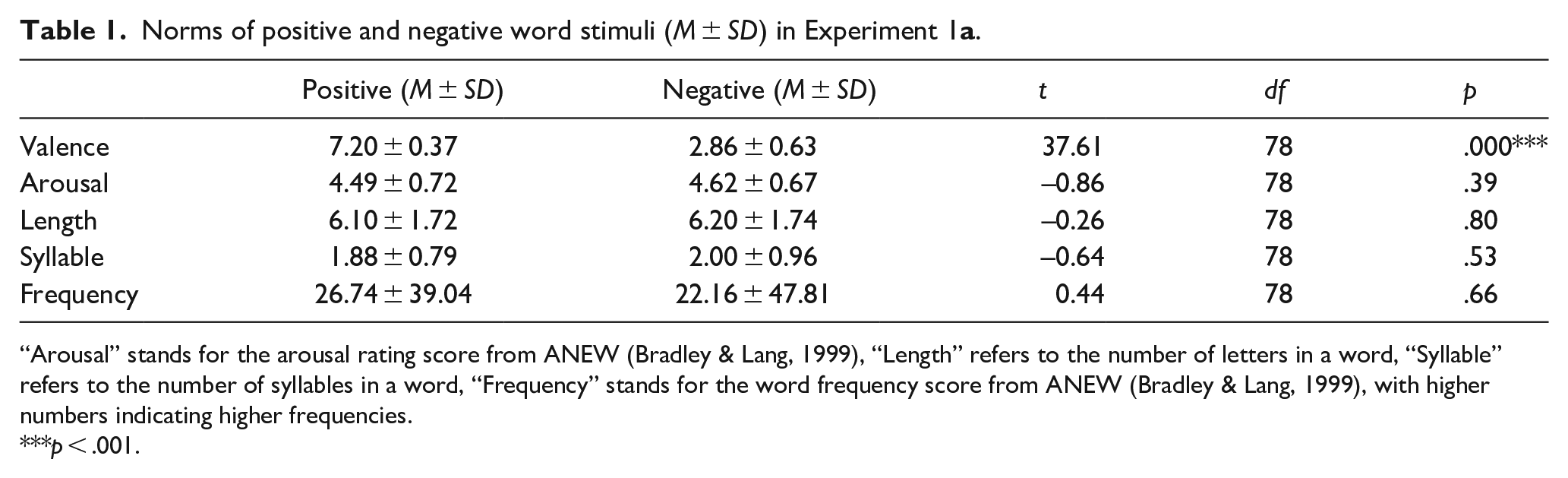
“Arousal” stands for the arousal rating score from ANEW (Bradley & Lang, 1999), “Length” refers to the number of letters in a word, “Syllable” refers to the number of syllables in a word, “Frequency” stands for the word frequency score from ANEW (Bradley & Lang, 1999), with higher numbers indicating higher frequencies.
p < .001.
Procedure
The test was self-paced. For each participant, 40 words were presented in the learning phase, half of them positive and half negative ones. Half of the words from each valence were presented at metaphor-congruent locations, the other half at metaphor-incongruent locations. In other words, in the learning phase, 10 trials each presented positive words at the top of the screen, positive words at the bottom of the screen, negative words at the top of the screen, and negative words at the bottom of the screen, in a random sequence. All words were presented in white font colour on a black background. In each learning trial, there was a fixation cue presented for 1,000 ms at the location where the word was going to appear, followed by the word for 1,000 ms. Then, a blank screen was presented for 1,000 ms as an inter-trial interval before the next trial began. In the following testing phase, the 40 learned words were randomly interspersed with 40 new words. In each test trial, one of these words appeared in the middle of the screen and participants were asked to respond whether it was a new (not studied) or old (studied) word by pressing the left or right arrow key (response mapping counterbalanced across participants). If the word was classified as old, participants were then asked to press the up or down arrow key to indicate whether the word had been presented at the up or down location in the learning phase. If the word was classified as new, the next trial began. There was a 500 ms inter-trial interval between test trials. After completing all 80 test trials, participants were debriefed, thanked, and dismissed.
Results and discussion
The data and code for data analysis of this and all other experiments in this report are available at: https://osf.io/w39uq/?view_only=89da5b4b57914a15b92d9a7907e1f99f
Modelling source-memory data
As commonly used in source monitoring research, the 2HTSM processing tree model of source monitoring was applied (Bayen & Kuhlmann, 2011; Buchner et al., 2009; Klauer & Meiser, 2000; Küppers, 2012; Küppers & Bayen, 2014; Meiser et al., 2007; Singmann et al., 2013). The model provides separate parameters for measuring item recognition, source discrimination, and guessing, based on the obtained frequency data of each source-response category (Bayen et al., 1996). 1 Figure 1 illustrates an adapted 2HTSM model structure (so-called “multinomial tree”) with each pathway in the figure specifying a combination of the cognitive processes involved that might contribute to a certain response in a test trial.
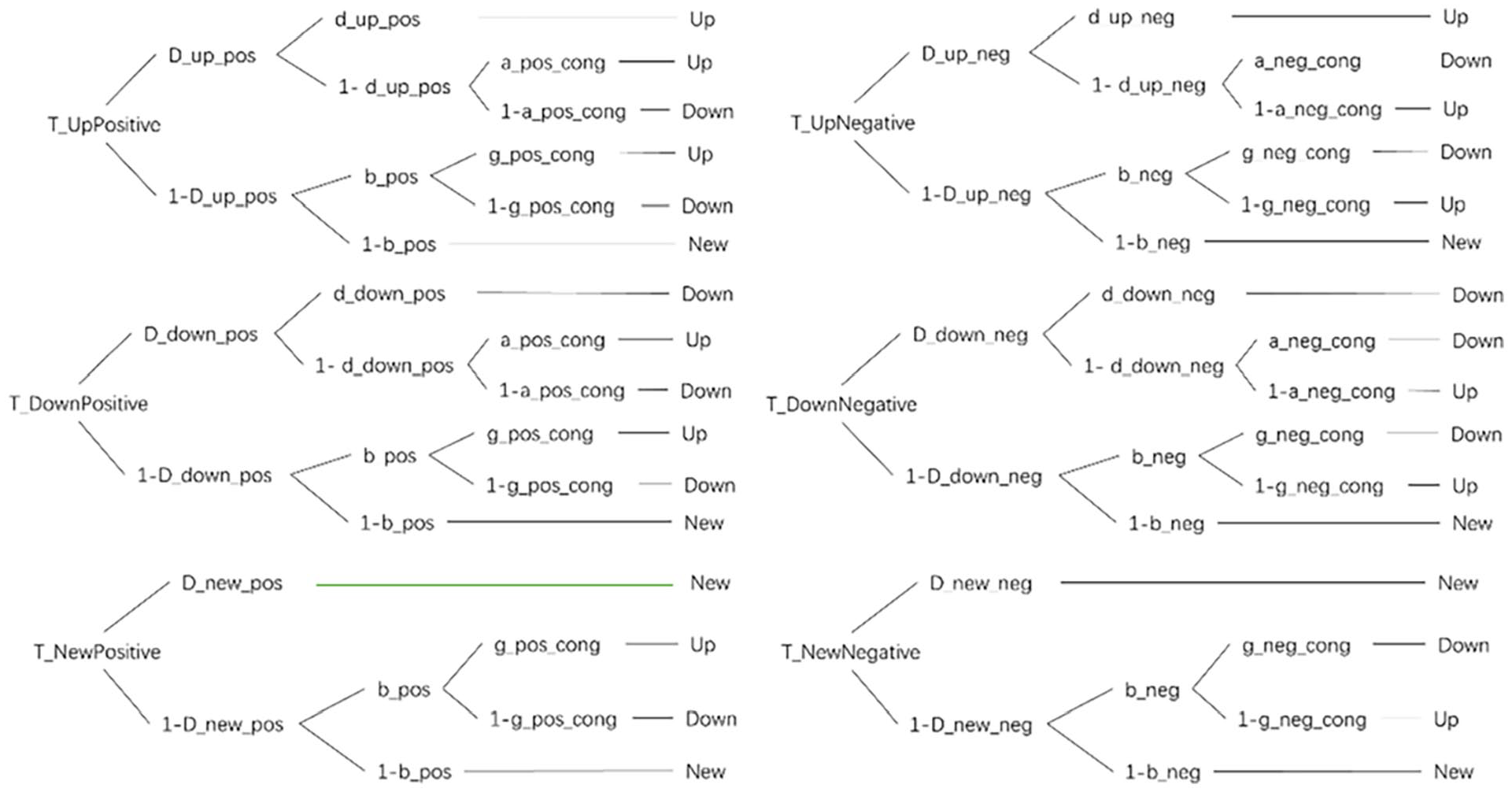
Adapted 2HTSM Model of Experiment 1 with six multinomial trees.
The root of each multinomial tree (left side of each tree in Figure 1) indicates the source of the test word. For example, “T_UpPositive” indicates a positive test word was presented at the up location in the learning phase. Each pathway leads to a possible response, “Up” or “Down” or “New,” as listed on the right side of Figure 1. Obviously, more than one pathway can terminate in the same observed source-response category. The branches of the tree are labelled by the parameters of the model (D, d, b, a, g) or by their complements (1 – D, 1 – d, 1 – b, 1 – a, 1 – g).
To illustrate, consider a positive word that originated from the up location as an example. When later presented in a test trial (see the first “tree” in Figure 1), the participant will recognise the word as “old” with probability D_up_pos (positive word, recognised). Furthermore, with probability d_up_pos (location of the word is up), the recognised word will be correctly identified as stemming from the up location; with the complementary probability 1 – d_up_pos, the participant will not be able to identify the word as stemming from the up location and will, therefore, guess the source of the word. With probability a_pos_cong (guess that positive words go up), the participant will guess that the word was from the metaphor-congruent source, which is the up location; with the complementary probability 1 – a_pos_cong, the participant will guess the item was from the metaphor-incongruent source, namely the down location. If the word is not recognised (with probability 1 – D_up_pos) the participant is in a state of uncertainty. He or she will then, with probability b, guess that it is an old word. In this situation, the participant will then guess, with probability g, for location “up,” or with probability 1 – g, for location “down.” If the participant guessed, with probability 1 – b_pos, that the item is new, the answer is “new.” For words that originated from other sources, the probabilities of the branches are to be understood in a similar way as above, just with different subscripts representing parameters. Notably, the model equations were formulated in such a way that the a and g parameters represent the probabilities of guessing the metaphor-congruent vertical location based on the valence of each stimulus irrespective of one particular source location (see Arnold et al., 2013; Kuhlmann et al., 2012).
To achieve mathematical identifiability, additional constraints must be imposed on the parameters. The table in Supplementary Appendix B1 shows the range of identifiable models, based on the submodels proposed by Bayen et al. (1996). We initially focused on models that include separate D_up_pos, D_down_pos, D_up_neg, and D_down_neg parameters to be able to replicate a possible effect of metaphor congruency on item memory as reported by Crawford et al. (2014). The analysis strategy was thus to leave the different D parameters free to assume different values in parameter estimation, then use hypothesis testing to compare D parameters for congruent items (i.e., items of types up_pos and down_neg) and those for incongruent items (of types up_neg and down_pos). We chose the most parsimonious submodels (with fewest separate parameters) allowing for different D parameters to avoid diluting the information in the data across overly many parameters and thus, we focused on submodels 5b and 5c (see Supplementary Appendix B, Table B1). A model selection procedure as described in Supplementary Appendix B was then conducted to settle on one of these two submodels for the hypotheses tests. This was followed by a goodness of fit test for the selected submodel to see whether it provided an adequate description of the data or whether more complex submodels would need to be considered (which—to foreshadow—was never the case). For parameter estimation in this and all subsequently reported experiments, we use a Bayesian hierarchical latent-trait approach (Klauer, 2010); for details, see Supplementary Appendix B. Group-level mean estimates of the posterior distribution for the parameters and corresponding 95% Bayesian credibility intervals (BCIs) are reported in Supplementary Appendix E. A 95% BCI of the differences between parameters in the posterior distribution that excludes zero was considered statistically substantial.
All finally selected models fitted well: Group 1
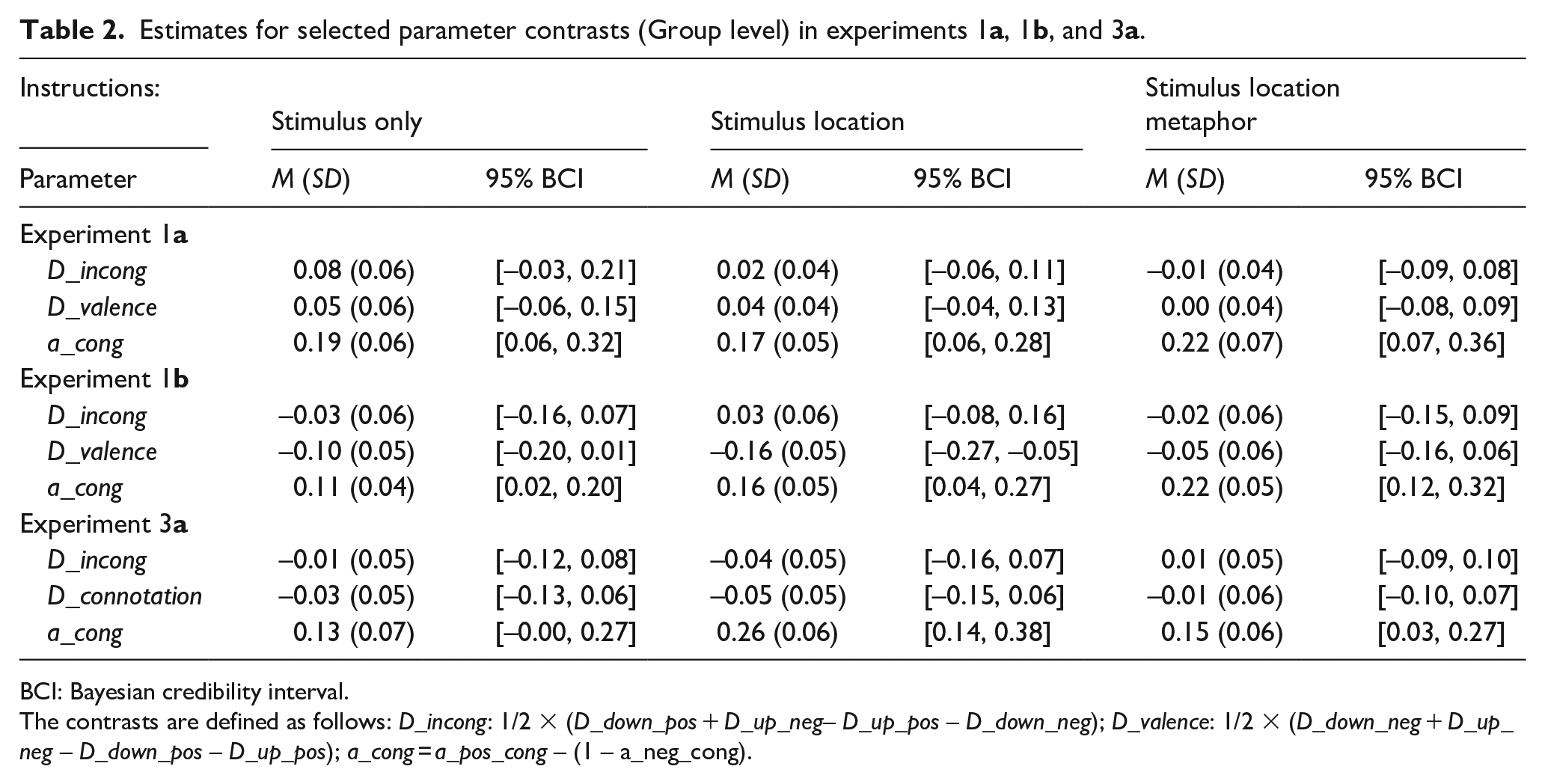
In this and the following experiments, our hypotheses about metaphor-congruence and valence were assessed by means of parameter contrasts such that, pooling across both presentation locations (up vs down), parameters indicating memory in congruent trials were subtracted from those indicating incongruent trials. For item memory, this was done by testing the parameter contrast D_incong, which is the parameter difference 1/2 × (D_down_pos + D_up_neg – D_up_pos – D_down_neg), to reveal any hypothetical congruence-related effect in each study. Values of D_incong > 0 indicate an incongruency bias in item memory. Accordingly, negative values (D_incong < 0) would indicate a congruency bias in item memory. By pooling across “up” and “down” locations, this contrast is also not confounded with possible effects of location. Similarly, hypothetical effects of valence were tested using the parameter contrast D_valence, which is the parameter difference 1/2 × (D_down_neg + D_up_neg – D_down_pos – D_up_pos). Values of D_valence > 0 indicate a negativity bias in item memory, whereas negative values would indicate a positivity bias. For congruence-related effects on source guessing, we tested the parameter difference a_cong = a_pos_cong – (1 – a_neg_cong), which is an unconfounded estimate for the congruence effect in guessing. Congruence-related guessing corresponds to values of a_cong > 0.
Figures 2 and 3 show the estimates of the guessing bias, a_cong, and Table 2 presents the parameter contrasts relevant to the hypotheses. Bayesian posterior tests are used to test one-tailed hypotheses, and a posterior probability (pp) of a null effect smaller than .05 is considered statistically substantial. 2
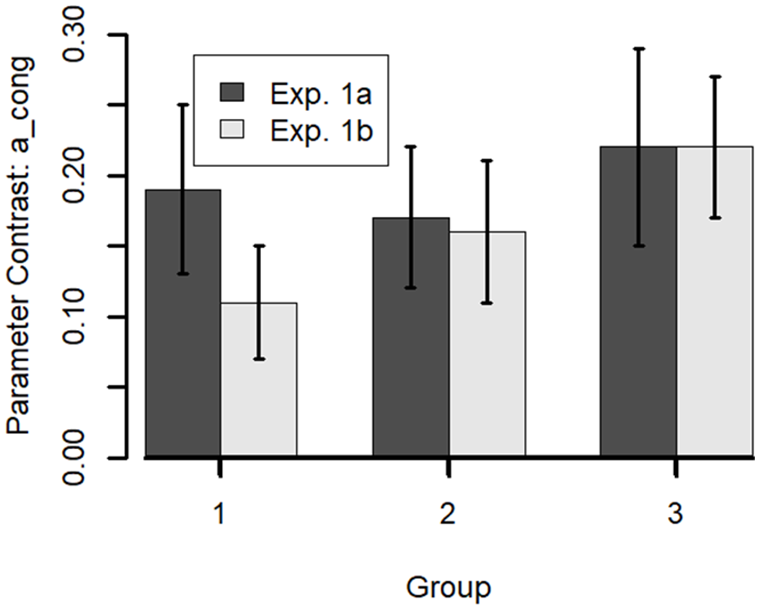
Estimates for source-guessing parameters (group-level) from the three groups in Experiment 1
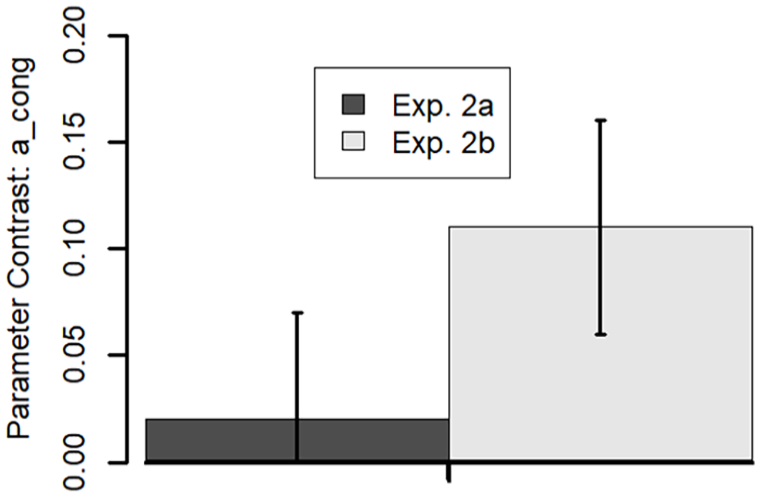
Estimates for source-guessing parameter contrast (group-level) from Experiments 2
Estimates for selected parameter contrasts (Group level) in experiments 1
BCI: Bayesian credibility interval.
The contrasts are defined as follows: D_incong: 1/2 × (D_down_pos + D_up_neg– D_up_pos – D_down_neg); D_valence: 1/2 × (D_down_neg + D_up_neg – D_down_pos – D_up_pos); a_cong = a_pos_cong – (1 – a_neg_cong).
Metaphor-incongruency effects on item memory were not found (confirming H1,
H2 regarding metaphor-congruent source-guessing biases received substantial support across all three groups (
In general, the expected effects of metaphor-(in)congruency were only demonstrated on source-guessing biases but not on item memory. Across the three groups of both experiments, the metaphor-congruent source-guessing biases were generally consistent, in line with previous research and supporting the existence of metaphoric effects on cognition. In a situation in which participants cannot recall where a stimulus had been presented, the metaphoric association can serve as a guidance for participants to generate the guessing responses. The lower estimates of item memory parameters D as found in Experiment 1
In this and all subsequent experiments, we assessed the possibility that source memory varies dependent on the absolute location (i.e., up vs down) and metaphor-congruency (i.e., congruent vs incongruent location). However, the MPT models used across all studies for evaluation of source guessing were of type 5b or 5c (see Supplementary Appendix B). Models of this type do not allow us to test the possibility that the strength of source memory (parameter d) differs between the up and down location. Although we did not hypothesise that there would be such effects, we nevertheless wished to assess this possibility. We, therefore, separately fitted models of type 6c and 6d for all studies (see Appendices B and D), which allowed for an estimation of location-dependent source memory parameters d for positively versus negatively valenced stimuli (respectively, stimuli with “high” or “low” physical connotation in Experiment 4). In each of these models, we evaluated the difference between the d parameters found for congruent trials (source memory for stimuli presented up vs down) minus the d parameters found for incongruent trials. In all cases and experiments reported in this article, the credibility intervals included zero, meaning that on the basis of this additional modelling, there were no indications for credible differences, regardless of direction or valence, between source-memory estimates for congruent and incongruent trials. For a summary of all relevant source memory parameters across all experiments, and the critical evaluation, see Supplementary Appendix D.
Experiment 2
The purpose of Experiment 2 was to provide further corroborating evidence on the hypotheses that substantial metaphoric effects can be found for source-guessing biases, but not for item memory. Because of the COVID-19 pandemic, face-to-face experiments were banned in the United Kingdom, hence instead of conducting online studies, a series of lab-based replication studies in China was conducted to provide better control of the experimental environment than seemed possible via online studies. Specifically, Experiments 2
On the basis of the previous experiments, we expected that metaphor-incongruency would have no effect on item memory, whereas source-guessing biases with respect to metaphor-congruent locations were expected to replicate.
Another modification in this experiment was that only the Group 1 “stimulus-only” instruction condition was kept. The reason for this was that in Experiment 1 the instruction did not affect memory and guessing.
Method
Participants
Design
Experiment 2 used a within-subjects design with factors valence (positive vs negative) and verticality (up vs down).
Hypotheses
H1: There is no metaphor-incongruency effect on item memory; H2: There are metaphor-congruent source-guessing biases; H3: There is a negativity advantage on item memory.
Materials
Procedure
Participants were tested individually in laboratory rooms at Wuhan University. The procedure was identical to Experiment 1
Results
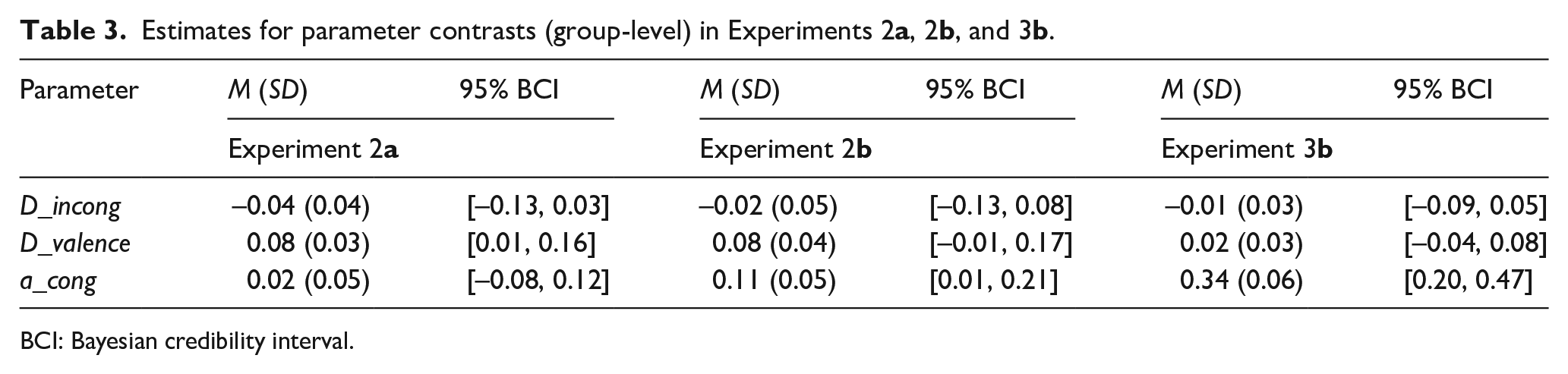
For model selection and estimation procedures, see Supplementary Appendix B; for estimates of the relevant parameter contrasts, see Table 3. The final selected model fitted well:
Estimates for parameter contrasts (group-level) in Experiments 2
BCI: Bayesian credibility interval.
H1 regarding no metaphor-incongruency effects on item memory was supported, pp > .05 in both
Experiment 3
According to the simulation theory (Barsalou, 1999, 2008), if the “good is up” metaphor plays a role in processing valenced stimuli, it is supposed to function via the automatic activation of the related physical concept, verticality. To assess the plausibility of this proposed mechanism, Experiment 3 was designed to test, in the United Kingdom and in China, whether concrete concepts with “up” and “down” vertical connotations (e.g., “sky,” “cellar”) trigger the same effects as words with positive and negative valence, respectively.
Experiment 3a: United Kingdom
Method
Participants
English native speakers (N = 105) were recruited from Cardiff University, United Kingdom, to take part in this study, of which 16 were male, mean age = 20.22 years (SD = 3.04). Participants took part in exchange of one course credit.
Design
We used a mixed design with factors connotation (high vs low, within-subjects), verticality (up vs down, within-subjects), and instruction (stimulus-only vs stimulus–location vs stimulus–location–association, between-subjects).
Hypotheses
Hypothesis 1 (H1): There is no connotation-incongruency effect on item memory. Hypothesis 2 (H2): There are connotation-congruent guessing biases; Hypothesis 3 (H3): Higher awareness of the spatial information and the connotation–verticality association was expected to increase the connotation-congruent source-guessing biases. Considering that we changed from valence to connotation, we wanted to check whether instructions would make a difference in this case.
Materials
A total of 80 words, half with high vertical connotation (e.g., “SKY”) and the other half with low vertical connotation (e.g., “PIT”), were selected from the materials that Lebois et al. (2015) used in their research on semantic processing, based on the provided norms on verticality (see Table 4). On a scale ranging from −9 to +9 indicating low to high vertical connotation, the mean ratings of high and low words were 5.75 (SD = 1.48) and −3.73 (SD = 1.03), respectively, which differed significantly, t(78) = 33.24, p < .001. The t-tests show no differences between high and low words on either length or syllable length, see Table 4. See Supplementary Appendix A5 for a full list of the selected materials.
Comparison of high and low connotation words stimuli (M ± SD) in Experiment 3
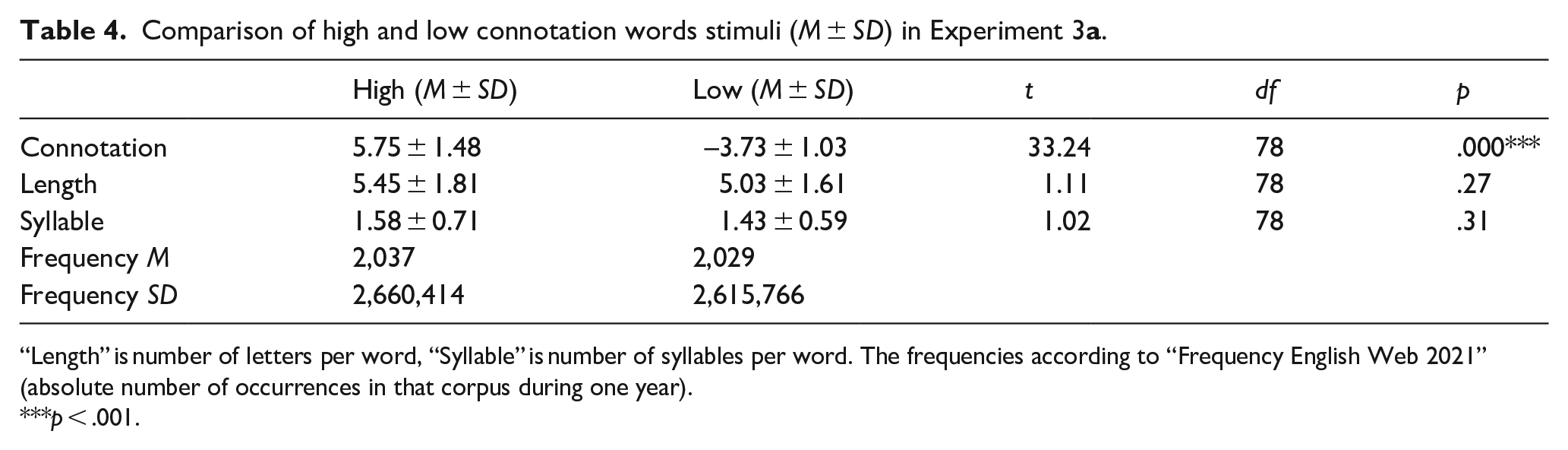
“Length” is number of letters per word, “Syllable” is number of syllables per word. The frequencies according to “Frequency English Web 2021” (absolute number of occurrences in that corpus during one year).
p < .001.
Procedure
This experiment was conducted online due to the COVID-19 pandemic when lab-based tests were not allowed in the United Kingdom. Informed consent was obtained from each participant before the experiment started. Moreover, due to the limitations of online data collection, the screen size and settings depended on participants’ own end devices, so could not be set uniformly vertical (i.e., in portrait orientation) as was done in the previous, lab-based experiments. All other procedures were identical to Experiment 1
Results and discussion
Due to concerns about data quality in online data-collection, the data were trimmed based on the average time taken for completing the test phase using the Tukey criterion. That is, the completion time needed to be within the range of [Q1 − 3 × IQR, Q3 + 3 × IQR], where Q1 (Q3) represent the lower (upper) quartiles, and IQR represents the interquartile range (see Tukey, 1977). Three participants were excluded because of very long times.
A similar adapted 2HTSM model as in Experiment 1
H1 regarding connotation-incongruency effects on item memory was not supported in any of the three groups—Group 1: pp = .88, Group 2: pp = .44, Group 3: pp = .62. H2 regarding connotation-congruent source-guessing biases was substantially supported across the three groups (Group 1: pp = .02, Group 2: pp < .001, Group 3: pp = .006). H3 regarding the influence of instruction on item memory and source guessing was not supported (pp for the linear increase across groups = .36). Again, the absence of the predicted connotation-incongruency effect on item memory in all three groups implies that the expected enlarging effect from higher awareness was not found.
Taken together, when using concrete words with high and low connotations in the same recognition memory paradigm, the expected effects were demonstrated on source-guessing biases, but not on item memory. The connotation-congruent guessing biases were quite consistent, analogous to the metaphor-congruent guessing tendencies demonstrated in Experiments 1
The connotation-incongruency did not show any influence on item memory. This lends some support to the assumption that metaphoric effects indeed do not affect item memory. According to the simulation theory (Barsalou, 1999, 2008), if the “good is up” metaphor plays a role in processing valenced stimuli, it is supposed to be mediated via the automatic activation of the related physical concept, verticality.
Experiment 3b : China
Participants
In a within-subjects design, N = 42 Mandarin native speakers were recruited from Wuhan University to take part in this study, of which 24 were male, mean age = 19.86 years (SD = 1.03). Participants received course credit or ¥10 for their participation.
Design
The design was the same as in Experiment 3
Materials
A total of 96 words from research materials of Lebois et al. (2015) were directly translated (without revision) to two-character Mandarin words. Based on the pretest, 80 words, half with high verticality connotations, the other half with low verticality connotations, were selected with mean ratings 6.41 (SD = 0.59) and 3.16 (SD = 0.73), respectively, on a scale ranging from 1 to 9 indicating low to high connotation. The ratings differed significantly between words with low and high verticality connotation, t(78) = –21.94, p < .001. See Supplementary Appendix A6 for a full list of the selected materials.
Procedure
The procedure was identical to Experiment 3
Results
Identical model selection and estimation procedure were conducted as in Experiment 3
H1 regarding no connotation-incongruency effects on item memory was supported, pp = .41. Similarly, connotation-incongruency effects on item memory were not detected in Experiment 3
Discussion
The hypothesis on the absence of metaphor-incongruency or connotation-incongruency effects on item memory could be maintained, and this conclusion also holds for words with physically vertical location connotations.
Source-guessing biases were consistent across both sub-experiments (Experiment 3). As the Ns were small for all three experiments run in China (Experiments 2
Potentially, in Experiment 3, we observed the stronger and more consistent source-guessing effects for physical connotation because the conceptual link between physical stimuli and spatial location is stronger compared with the link between valence and spatial location, with the former creating stronger expectations of congruency to guide source guessing.
General Discussion
This research presents six experiments to investigate the metaphoric effects of “good is up” in the context of recognition memory. Based on the extant studies, we investigated metaphoric effects on source-guessing strategies and item discrimination. More specifically, we expected metaphor-congruent source-guessing biases but no better discrimination for items presented at metaphor-incongruent locations. Substantial evidence was only obtained for source-guessing biases as being linked to the metaphor, not for item discrimination. This pattern of results was obtained in our series of lab-based experiments as well as in an online experiment (3
Summarising our argument with respect to the different memory components within the recognition situation, we, first, did not expect or find substantive metaphoric effects on item memory, in agreement with previous literature (Bell et al., 2012; Ehrenberg & Klauer, 2005; Kroneisen & Bell, 2013; Küppers & Bayen, 2014). Second, we did not find substantive metaphoric effects on source memory, which we explain with our assumption regarding the strength of metaphoric influences: As congruence/incongruence with respect to metaphor is more indirect and complex than with respect to stereotypes (see Introduction), the strength of metaphoric influences as manifest in our paradigm is probably to be classified as “weak,” as in the context of the relevant literature (Bayen et al., 2000; Bayen & Kuhlmann, 2011; Kuhlmann et al., 2012). Third, for guessing, we submit that similar to assuming schema-congruent source guessing to be the default (Schaper et al., 2019, 2023), we also assume an analogue default mechanism to hold for metaphors as well. As a result, we consistently observe metaphor-congruent source guessing. These aspects will be discussed in order.
The “good is up” metaphor does not influence memory
Regarding item memory, our results did not favour an effect of metaphor congruency on item memory. Previous studies that reported no effects of the “good is up” metaphor on recognition memory all used paradigms other than that used in this research, such as investigating person memory after an impression formation task (McMullan, 2016) or manipulating vertical locations of stimuli in the retrieval phase instead of the encoding phase (Experiment 3 from Crawford et al., 2014). This research started with a conceptual replication of Experiment 2 from the study by Crawford et al. (2014), which suggests that the vertical location of valenced words in the encoding phase can influence recognition memory. Our conceptual replication did not support their argument. Assuming the expectation of metaphoric congruency between valence and verticality is not strong enough, the stimuli presented at metaphor-incongruent locations cannot trigger strong feelings of violation in the encoding phase, and consequently do not receive more attention and elaboration. As a result, there are no substantial differences in item memory between metaphor-congruent and incongruent stimuli. The question arises of why the strength of expectation was insufficient. Three possible explanations are (a) that the materials do not sufficiently express valence, (b) the verticality dimension is not sufficiently activated, or (c) the association between “valence” and “verticality” is a priori rather weak. The latter is implied by our earlier argument about this association being more complex and indirect in case of a metaphor, as compared with implications of social stereotypes (see Introduction). Note also that valence is associated with many other (possibly competing) concepts other than verticality, the same being true for verticality itself (see Schubert, 2005). The different results of metaphoric effects on item memory can be partially due to a motivational factor as well. At learning, the motivation for participants to encode the stimuli via the spatial metaphor might not be strong. In other words, the use of metaphoric information does not in any obvious way contribute to better memory performance, which might lower participants’ motivation to use that information when encoding stimuli. However, at test, the motivation to use the spatial metaphor as heuristic might be relatively elevated because of the requirement of an immediate response even when participants do not remember the stimulus’ location.
Moreover, the differences in analytic approaches might contribute to the discrepancies in results. An advantage of the 2HTSM model analysis is that it provides an independent estimation of multiple components within recognition: item discrimination per se, versus guessing components that actually form an integral part of memory in recognition paradigms. This analysis allows for a more accurate estimate of these different memory components in a recognition situation, whereas the conventional analysis of variance (ANOVA) measures used by Crawford et al. (2014) fully neglect the contribution of these components.
In research investigating source memory, it was suggested that the inconsistency effect (on source memory) as predicted by the AEH only occurs when the expectation strength is high (Bayen et al., 2000; Bayen & Kuhlmann, 2011; Kuhlmann et al., 2012; Küppers & Bayen, 2014). This argument potentially explains the null metaphoric effects on source memory as observed here.
Guessing strategies
Metaphor-congruent source-guessing biases suggest that, as hypothesised, an activated “good is up” metaphor creates the expectation of metaphor-congruency, expressing itself via source-guessing responses when participants are unable to recall the presented location of a valenced stimulus. This is in line with previous research on schema-congruent guessing biases, which suggests that source guessing is particularly biased when a congruency is implied by an existing schema connecting a particular item with a particular source (Bayen et al., 2000; Ehrenberg & Klauer, 2005; Kuhlmann et al., 2016; Wulff & Kuhlmann, 2020). Interestingly, this research indicates that metaphors can function in the source-guessing process in a similar way as schemas do, creating an expectation and guiding guessing responses in a direction congruent with the expectations. Some evidence for metaphor-congruent source-guessing biases was obtained even when the metaphor was not mentioned explicitly as in the stimulus-only and stimulus–location awareness groups. This suggests that the association between valence and verticality expressed in metaphor-congruent source-guessing bias was implicitly represented in people’s minds. In essence, this is an interesting insight as we have argued above that establishing congruency/incongruency involving the meaning of a metaphor is likely to be more complex (and might have less of an impact) than when invoking a schema based on a social stereotype.
Combined with the connotation-congruent source-guessing biases demonstrated in Experiments 3
Negativity advantage on item memory is inconsistent
The hypothesis of a negativity advantage was supported in two of the experiments conducted in China, that is, Experiment 2
Conclusion
The “good is up” metaphor does not only play a role in our daily language use, but also plays a role in recognition memory. It provides a schema to guide people’s source guessing when they cannot recall the source of a piece of valenced information. The metaphor-congruent source-guessing biases reveal the use of heuristics based on the valence–verticality association. However, previous findings of schema-related effects on item memory or source memory were not replicated in this research, indicating that the metaphor may affect cognition in a more subtle way than expected.
Supplemental Material
sj-docx-1-qjp-10.1177_17470218241269272 – Supplemental material for The “good is up” metaphoric effects on recognition: True for source guessing but false for item memory
Supplemental material, sj-docx-1-qjp-10.1177_17470218241269272 for The “good is up” metaphoric effects on recognition: True for source guessing but false for item memory by Zixi Jin, Ulrich von Hecker, Nikoletta Symeonidou, Yi Liu and Karl Christoph Klauer in Quarterly Journal of Experimental Psychology
Footnotes
Acknowledgements
We would like to thank the social lab group members from School of Psychology, Cardiff University for their suggestions in the early stage of this research. And thanks to Alina Kias, Lea Krumpholtz, and Luise Metzger for their help with data collection.
Declaration of conflicting interests
The author(s) declared no potential conflicts of interest with respect to the research, authorship, and/or publication of this article.
Funding
The author(s) disclosed receipt of the following financial support for the research, authorship, and/or publication of this article: This research is a part of Zixi Jin’s PhD project funded by China Scholarship Council (CSC).
Preregistration
The experiments were not preregistrated.

Supplementary material
The Supplementary material is available at: qjep.sagepub.com.
Notes
References
Supplementary Material
Please find the following supplemental material available below.
For Open Access articles published under a Creative Commons License, all supplemental material carries the same license as the article it is associated with.
For non-Open Access articles published, all supplemental material carries a non-exclusive license, and permission requests for re-use of supplemental material or any part of supplemental material shall be sent directly to the copyright owner as specified in the copyright notice associated with the article.
