




Abstract
In many situations, such as driving and playing team sports, we are required to allocate our attention unevenly across multiple moving targets that have different levels of relevance or importance (priority) to us. While previous studies have demonstrated an apparent ability to allocate attention in an uneven way to objects/regions in multiple object tracking (MOT), how such differential prioritisation comes about is still an open question. In this study, we investigated the role of eye movements in an MOT task where two targets varied in their likelihood of being queried for a motion direction estimate. As the priority of a target increased, participants fixated on or near the object more frequently and longer, and their direction estimates were more accurate. We explored the role of different tracking strategies (centroid vs. target-switching), investigating how these are differentially employed depending on target priority. Our findings support the flexible deployment of attention in a graded manner and demonstrate that differential prioritisation primarily involves differential looking between targets.
Introduction
People are often required to allocate their attention simultaneously to different moving objects. Common instances include playing sports (e.g. tracking different players and the ball, in a game of football), CCTV monitoring (e.g. tracking potential criminals), driving (e.g. tracking other road users and pedestrians) and playing video games (e.g. first-person shooters). Attention allocation in dynamic environments is often studied using the multiple object tracking task (MOT; Pylyshyn & Storm, 1988; for review see Meyerhoff et al., 2017), where participants are required to track moving targets among visually similar distractors and then report the status of one or more cued objects (i.e. whether it was a target or distractor), the trajectory (i.e. final heading) or last known position (Crowe et al., 2019; Hadjipanayi et al., 2022; Howard et al., 2017).
MOT studies in which object speed (Chen et al., 2013; Liu et al., 2005) and proximity (Iordanescu et al., 2009) were manipulated provide evidence for unequal allocation of attentional resources across objects. In particular, Meyerhoff et al. (2018) showed that reduced inter-object spacing (i.e. when objects are temporarily closer together) captures visual attention, indicating how spatial proximity between objects significantly influences attention allocation in dynamic visual scenes. Alternatively, Liu et al. (2005) found that when half of the objects in MOT moved faster, tracking accuracy remained similar for both speeds. This result implies an unequal allocation of attention to compensate for the increased difficulty of tracking the faster-moving items and supports flexible resource models (Alvarez & Franconeri, 2007; Intriligator & Cavanagh, 2001; Scholl et al., 2001). Such models propose a continuous pool of attentional resources that supports tracking multiple moving objects, allowing greater allocation to certain targets. Further evidence in support of these flexible models comes from Cohen et al. (2011). They used a multiple identity tracking task that involved tracking objects with unique identities (see Oksama & Hyönä, 2008), asking participants to prioritise either location or identity. Performance was superior for the prioritised feature, again indicating the flexible and unequal allocation of attention.
Crowe et al. (2019) provided evidence for top-down strategic unequal attention allocation to individual targets. They examined the effect of the priority of targets on participants’ magnitude of error. The priority of targets was manipulated and signalled explicitly at the start of the trial, indicating the likelihood of each target being probed (in percentages, e.g. 25 and 75; 50 and 50). Participants tracked high-priority targets more accurately, suggesting that observers can allocate their attention unequally based on task demands, providing further support for flexible theories of attention allocation (Alvarez et al., 2005; Franconeri et al., 2010). However, these past studies on preferential prioritisation of targets during tracking inferred attention allocation from perceptual performance and did not directly measure attention (e.g. via eye-tracking; Deubel & Schneider, 1996). As a result, they did not account for how this differential prioritisation takes place and in what way attention is allocated unequally during tracking.
To address this question, Hadjipanayi et al. (2022) explored unequal attention allocation of different regions of the visual field, in a trajectory tracking MOT task, similar to the one employed by Crowe et al. (2019) but where the priority of regions was manipulated, rather than specific targets (objects remained in either one of two regions that could be differentially prioritised). Eye-tracking was used to assess how overt attention was allocated during tracking. Participants distributed attention unequally based on regional priority. Higher tracking accuracy and prolonged gaze were observed in high-priority regions, demonstrating strategic attention allocation. Nevertheless, Hadjipanayi et al. (2022) investigated regional prioritisation, rather than the prioritisation of individual objects. In the current study, we extended the methodology of Crowe et al. (2019), investigating unequal attention allocation of individual targets, with eye-tracking to gain insight into tracking strategies used to achieve differential prioritisation. Like Crowe et al. (2019), we manipulated priority over three levels assigned to two possible targets (a low-priority target paired with a high-priority target or two equal-priority targets). Participants had to indicate the direction of heading of the target cued at the end of the trial.
Incorporating eye-tracking into a replication of Crowe et al. (2019) will provide more robust evidence for unequal attention prioritisation in MOT, while also shedding some light on how differential prioritisation might be achieved and the role of peripheral vision (Hadjipanayi et al., 2022). A number of strategies might be used. Target-looking strategy suggests that participants saccade between targets to maintain high visual acuity (Oksama & Hyönä, 2008; Zelinsky & Neider, 2008). Supporting this strategy, Landry et al. (2001) found that during a simulated air-traffic control task, participants made more saccades when monitoring potential collisions, suggesting that fixations helped update target positions and distinguish them from distractors. Alternatively, the centroid-looking strategy (Fehd & Seiffert, 2008, 2010) posits that participants track a polygon-like shape formed by targets, fixating on its centre while using peripheral vision to monitor individual objects. By reducing target eccentricity, this approach facilitates target-distractor differentiation (Intriligator & Cavanagh, 2001). However, Zelinsky and Neider (2008) found that centroid tracking was preferred only at low visual loads (2–3 targets), with higher loads (4–5 targets) prompting a shift to target-looking. Additionally, Zelinsky and Todor (2010) identified ‘rescue saccades’, where gaze shifts to a target nearing a distractor, preventing tracking loss. These findings highlight the load-dependent nature of tracking strategies. Given that the current paradigm involves only two targets, centroid tracking remains a viable strategy.
This discussion of tracking strategies intersects with broader critiques of attentional theory. Rosenholtz (2024) and Hommel et al. (2019) argue that the term ‘attention’ has been applied too broadly, leading to imprecise and sometimes circular reasoning in the literature. For example, unequal attention allocation is frequently described as the differential distribution of attentional resources across targets, yet without a precise definition, this explanation risks tautology. Hommel et al. (2019) further highlight that attentional control is not a single, unified mechanism but rather a dynamic interplay between different selection processes, which can vary depending on task demands. This perspective aligns with research on MOT, where tracking strategies may reflect distinct attentional operations – overt eye movements for high-priority targets and covert shifts for peripheral monitoring. In response to such critiques, the present study seeks to explicitly distinguish between overt and covert attention in MOT. Overt attention involves eye movements that align the fovea with an object of interest, whereas covert attention refers to the allocation of attentional resources beyond the foveal field without explicit eye movements, relying on peripheral vision. Recent findings suggest that covert attention contributes to tracking performance (Hadjipanayi et al., 2022), underscoring the need for further exploration on the potential interplay between different tracking strategies during MOT.
Figure 1 illustrates predictions for perceptual performance and gaze behaviour. If attention allocation in MOT is influenced by target priority, we expect to observe systematic differences in tracking performance and gaze behaviour. Based on Crowe et al. (2019), we expect to find evidence in favour of unequal attention allocation, where participants will allocate their attention unevenly across multiple targets based on their assigned priorities. This would result in differences in perceptual performance across priority conditions, replicating results of Crowe et al. (2019). As illustrated in Figure 1A, participants are expected to have better tracking performance for the high-priority target (i.e. lower angular error when estimating direction of heading) and worse, yet still above chance, tracking performance for the low-priority target (i.e. higher angular error). We predict a graded effect in the gaze measures: as the priority of a target increases, the distance of fixation from the target is expected to decrease, and the proportion of time spent looking at the target is expected to increase. Such a graded pattern would indicate that participants primarily look at the high-priority target but do not completely neglect the low-priority target. Figure 1B illustrates predictions for the secondary analysis of this study, examining whether participants adopt centroid tracking or target-switching. According to Prediction B(i), these strategies function as distinct processes: centroid tracking involves fixating the midpoint between two targets, while target-switching entails alternating gaze between them. Target priority may determine strategy selection, with centroid tracking expected in equal-priority conditions and target-switching more likely in high and low-priority conditions, with more attention being allocated to high- versus low-priority targets. Alternatively, Prediction B(ii) suggests these strategies form a continuum rather than discrete categories, with participants primarily fixating on the high-priority target while occasionally also attending to the midpoint and less often to the low-priority target. Perceptual performance in these scenarios remains uncertain, as it depends on how effectively attention can be unequally distributed via peripheral vision (Hadjipanayi et al., 2022).
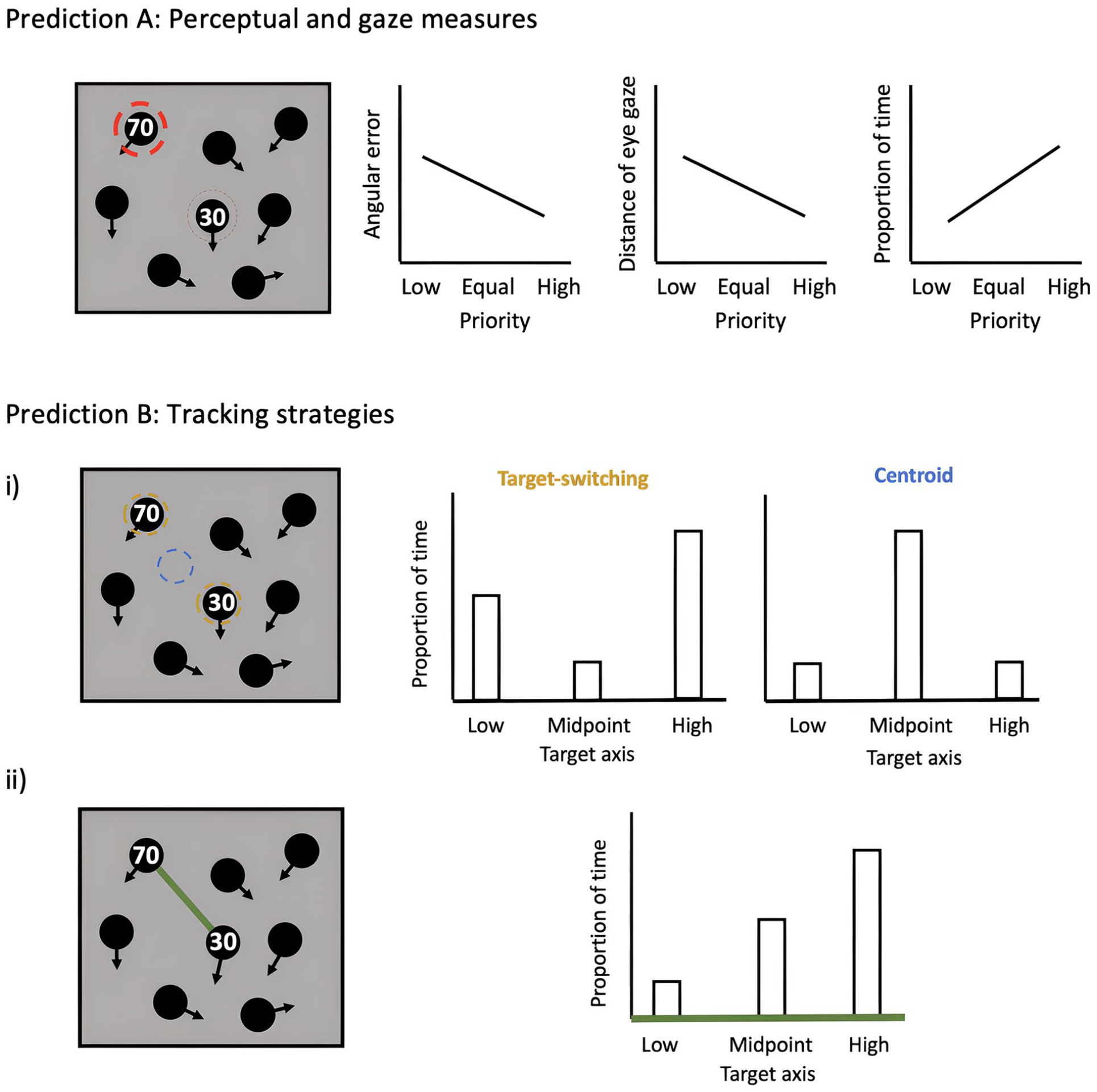
Different predictions depending on the attention allocation strategy. Left panels offer a schematic representation for each prediction regarding participants’ attention allocation during tracking. Arrows represent the movement of targets. Priority numbers were not present during tracking, but are placed here to indicate priority of targets. Red-dotted circles represent attention focus. The thicker the circles, the more the attention allocated to that target. Right panels offer a visual representation of expected results regarding perceptual performance and gaze measures. Prediction A: Tracking of multiple targets in a graded manner, allocating more attention to a target as its priority increases; Prediction B(i): Employing centroid or target-switching strategy depending on the priority level (centroid tracking will be expected in the equal-priority condition and target-switching in the high- and low-priority conditions); Prediction B(ii): Employing both centroid and target-switching strategies, with these two processes being the end points of a continuum, rather than completely distinct processes.
The pattern of results observed by both perceptual performance measures and gaze measures will be informative for different theories of attention allocation and the use of different gaze strategies. Importantly, we will assess to what extent the gaze patterns observed on average are representative of what happens on individual trials. For example, if we see differential allocation of overt attention to low- and high-priority targets (in line with Figure 1A), this might occur because participants focus primarily on the high-priority target in the majority of trials, and on the low-priority target in a minority of trials. However, to constitute strong evidence in favour of the flexible allocation of attention in MOT, it is important to demonstrate that differential prioritisation occurs at the level of individual trials. Therefore, we also present a more detailed analysis of the distributions of time spent on a given target within a trial, as a function of target priority.
Method
The design of this experiment closely follows Crowe et al. (2019).
Participants
Thirty-three individuals (24 females and 9 males; age 20.3 ± 2.8 years) were recruited from the University of Bristol in return for course credit. We performed a power calculation in R using the SIMR package suitable for an LME design (Green & Macleod, 2016). We calculated an effect size of d ≈ 1.07, for the difference in direction of heading judgements between high- and low-priority targets, derived from similar past experiments in our lab (Hadjipanayi et al., 2022). A sample of 33 participants gives us at least 99% power of detecting a similar effect at an alpha of .05. All participants self-reported normal or corrected-to-normal vision and were aged between 16 and 35 years.
Design
On each trial, there were eight discs. Two of them were initially identified as targets, and the remaining six were distractors. The priority of the two targets was manipulated in a within-subjects design with three levels: low (30%), equal (50%) and high (70%). Angular error was the main dependent variable for measuring tracking performance and was indexed by the absolute angular difference (in degrees) between the target’s actual direction of heading and the participant’s response. Higher absolute values represent greater error (where zero is perfect accuracy) and therefore lower tracking accuracy. For the eye gaze measures, we computed the distance between fixation and the targets and the distance from the midpoint between the targets for each sample. These distance measures were then averaged across samples within a trial. We also recorded the proportion of time spent looking at or near the targets and the midpoint between them for each trial.
Apparatus and stimuli
The MOT task was programmed and run using MATLAB 2019a (The MathWorks Inc., 2019; The MathWorks, Natick, MA, USA) and Psychtoolbox (Psychtoolbox-3.0.13; Brainard, 1997; Kleiner et al., 2007; Pelli, 1997). Stimuli were presented on a PC running Linux Mint 18 Sarah. A 24-inch ViewPixx 3D Lite monitor was used, with a resolution of 1,920 × 1,080 pixels running at 120 Hz. The stimulus display occupied a smaller window of 1,200 × 900 pixels. At a viewing distance of 70 cm, the screen subtended 46.6° × 24°. An EyeLink 1000 Plus (SR Research Ltd., 2013) video-based tracker was used to track participants’ eye movements at a sampling rate of 1,000 Hz. The eye tracker was calibrated at the beginning of every block of trials and sometimes within a block if required (using the inbuilt 9-point calibration routine). Recording terminated at the end of every trial.
On every trial, eight black (RGB value: 0, 0, 0) discs with a radius 1.14° of visual angle were presented on a mid-grey screen (RGB value: 128, 128, 128). The discs moved at randomly selected velocities (with an average speed of 10° per second). An elastic collision formula was applied if two discs collided with each other and the boundary. Discs initially appeared on the screen at quasi-random locations, at least 2.53° from the boundaries and 1.52° from other discs. The duration of movement was randomly drawn from a uniform distribution with a range of 6 to 8 s.
Procedure
Figure 2 illustrates the timeline of a given trial. At the beginning of the trial, the eight discs appeared on the screen, and the numbers indicating two of them as the targets appeared for 3,000 ms. These numbers represented the likelihood of each target being queried at the end of the trial. On trials with unequal priority, the high-priority target was queried with a probability of .7 and the low-priority target was queried with a probability of .3. In the equal-priority condition, each target was queried with a probability of .5. Then the numbers disappeared, and all eight discs started moving around the screen (the black arrows were not presented on the screen but are used here to represent movement). Participants were instructed to keep tracking the two targets amongst the distractors over the whole period of movement. At the end of the trial, all discs disappeared except one. Participants were then asked to indicate the direction they thought the ‘queried’ target was going. Participants first clicked inside the disc to ‘activate’ a ‘dial’ on the disc with an arm of 1.14° extending from the disc’s centre. The initial direction of the arm was set randomly. Participants then moved the arm (using the mouse) to indicate the estimated direction of travel and submitted their answer with a second left mouse click. After the participants’ response, feedback was presented on the screen. A green arrow of size 1.14° of visual angle appeared, indicating the target’s correct trajectory. The intertrial interval was a minimum of 1,000 ms but was often longer, as it was dependent on the participant fixating accurately and the experimenter initiating the trial manually.
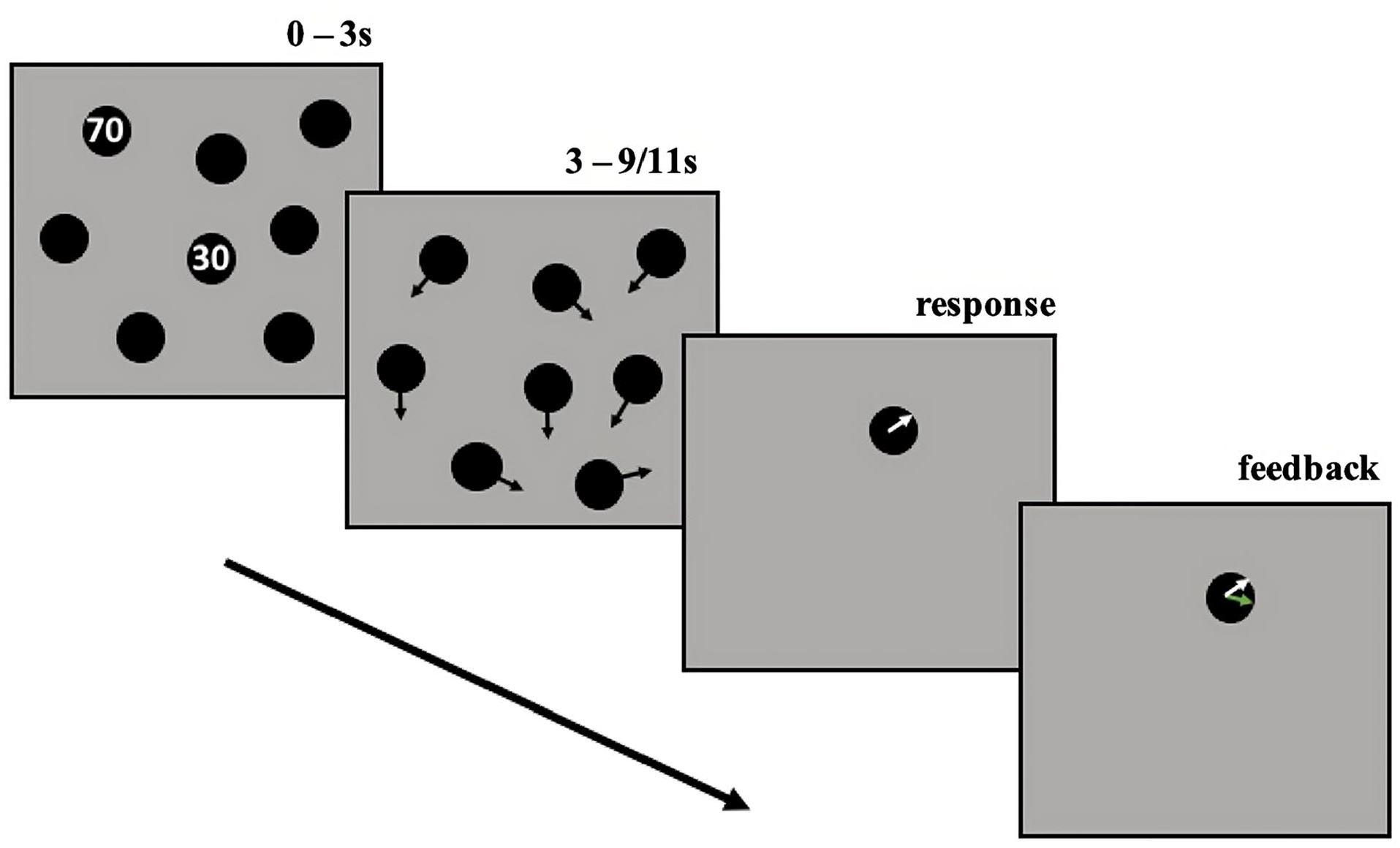
Trial timeline.
Participants were given clear instructions on what the numbers meant before starting 10 practice trials and had the opportunity to ask any questions. A total of 200 experimental trials were divided into 5 blocks of 40 trials each. Each block included the following number of each trial type: 21 trials with 70-30 where the high-priority target was probed, 9 trials with 70-30 where the low-priority target was probed, and 10 trials with 50-50. The order of trials was randomised for each participant. The experiment lasted around 60 min, and participants provided their informed and written consent before commencing. Ethics approval was obtained from the School of Psychological Science Research Ethics Committee (Approval Number: 10373). The study was conducted in accordance with the revised Declaration of Helsinki (2013).
Results
Linear mixed-effects models (LMEs; Baayen et al., 2008; Barr et al., 2013) were used to analyse the data using the lme4 package (Bates et al., 2015) for the R computing environment (R Core Team, 2015). Linear mixed-effects analyses were conducted with priority entered as a fixed effect and a random intercept for participant. Data for both perceptual performance and gaze measures were analysed and aggregated across trials to ensure normality of data. Reported test results are the p-values derived from a likelihood ratio test comparing the full model, including the predictor variable of priority, to the null model, which included a random intercept for participants only, without priority included.
Planned analyses
Perceptual performance
Figure 3 shows average tracking performance, as well as individual performance, in all three priority conditions. If people responded randomly, we would expect an average absolute tracking error of 90°. Clearly, participants performed better than chance. Priority associated with each target had a significant effect on the magnitude of angular error, χ2(1) = 31.95, p < .001, as target priority increased, the magnitude of angular error decreased (b = −0.35, SE = 0.05, t = −6.41, p < .001). The behavioural results for perceptual performance replicated the results of Crowe et al. (2019), demonstrating graded prioritisation.
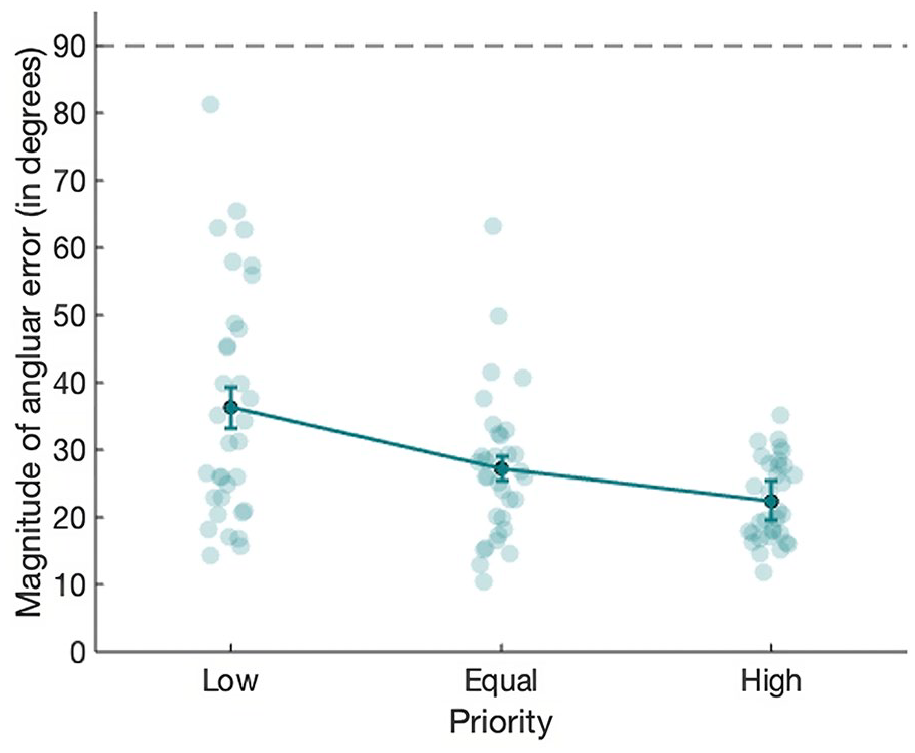
Magnitude of angular absolute error for each priority level.
Following Crowe et al. (2019) and Horowitz and Cohen (2010; similar to Zhang & Luck, 2008), data were further explored using a mixture modelling analysis to investigate different possible sources that could account for the differences in overall tracking accuracy. One possible source is the proportion of trials on which a participant guesses, where guesses may be, for example, due to participants losing track of the targets or completely withdrawing attention from them. A circular uniform distribution was used to represent participants’ responses when they lost track of the item and consequently guessed its direction (randomly between –180° and 180°). The second source is the precision of the item’s trajectory representations. A von Mises distribution (the circular equivalent of a normal distribution) centred on 0 was used to represent participants’ errors when the probed item was tracked successfully, but with a varying degree of precision (given by the concentration parameter, κ). The MASS package (Venables & Ripley, 2002) was used for the fitdistr function, and the circular package (Agostinelli & Lund, 2017) was used for the von Mises and circular uniform densities. The mixture of guessing and tracked errors was controlled by PG, the proportion of guessing.
Figure 4 plots the mixture model fits for error data pooled over all participants, at each of the three priority levels. The model fit illustrates a lower PG and a higher precision when tracking a high-versus a low-priority target, replicating the results of Crowe et al. (2019). However, similar levels of precision are observed between high- and equal-priority conditions. The clear difference in PG and precision between the high- versus the low-priority condition does follow the expected pattern (i.e. decreasing PG and increasing precision, as target priority increases). Nevertheless, it could be the case that for more fine-grained differences between the low- and equal-priority conditions and the equal- and high-priority conditions, more data would be required from each participant. To explore further, the impact of priority on the PG and precision of tracking (κ) for each participant at each of the three priority levels, these two parameters were entered into the LME analysis in the same way as the magnitude of angular error. To accommodate the potential trade-off between these parameters, we computed the ‘weighted precision’ as κ * (1 − PG). This measure arguably reflects better the width of the entire distribution. A significant effect of target priority was found on weighted precision, χ2(1) = 9.15, p = .002. Participants’ weighted precision was found to increase, as the target priority increased, b = 0.05, SE = 0.02, t = 3.13, p = .003.
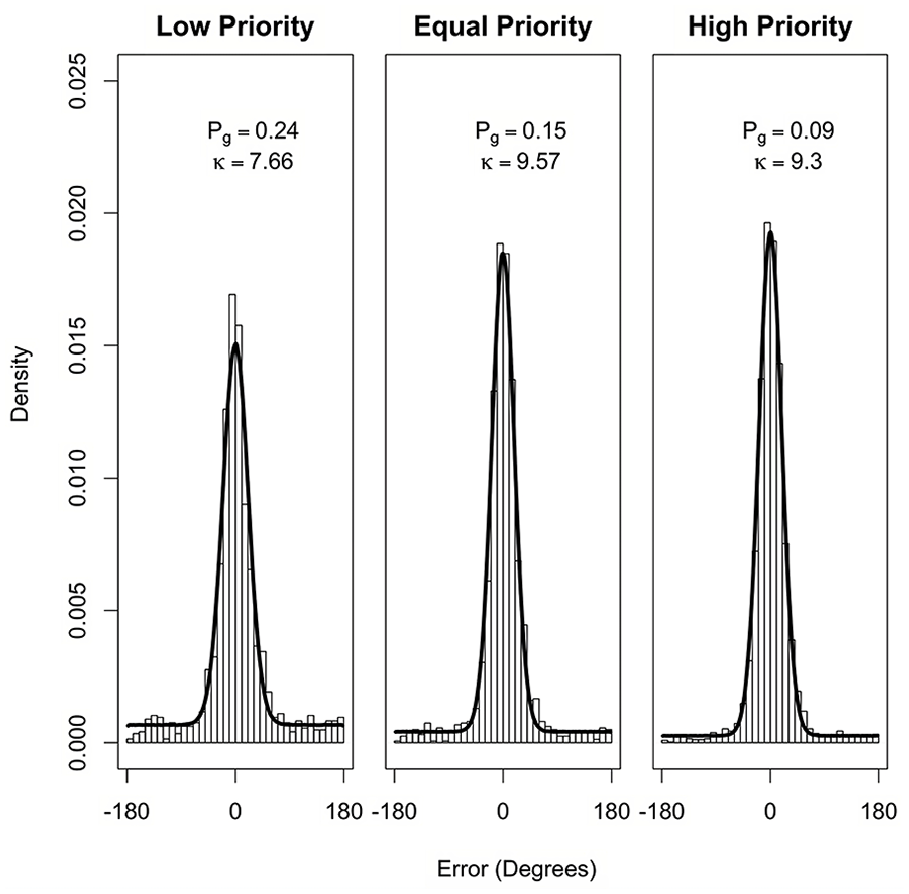
Mixture model fits for the combined data across participants at each of the three priority levels: low, equal and high.
Gaze measures
Participants’ blinks on each trial were excluded from further analysis. Two main gaze measures were calculated from the eye movement data: the (Euclidean) distance of participants’ eye gaze from each of the targets and the proportion of time spent looking at each target. Gaze measures regarding only the queried target were analysed. Given that participants did not know which target they would be questioned on during tracking, the results for the queried and non-queried targets are indistinguishable. Importantly, in this way, we ensure the independence of measurements for the low-, medium- and high-priority targets (i.e. come from different trials). Figures 5 and 6 show the descriptive statistics (i.e. mean and confidence intervals) for the distance of participants’ eye gaze from the queried target and the proportion of time spent looking at each of the two targets, respectively. In these analyses, the priority of the queried target was entered from the lowest priority level to the highest priority level (i.e. 30-50-70).
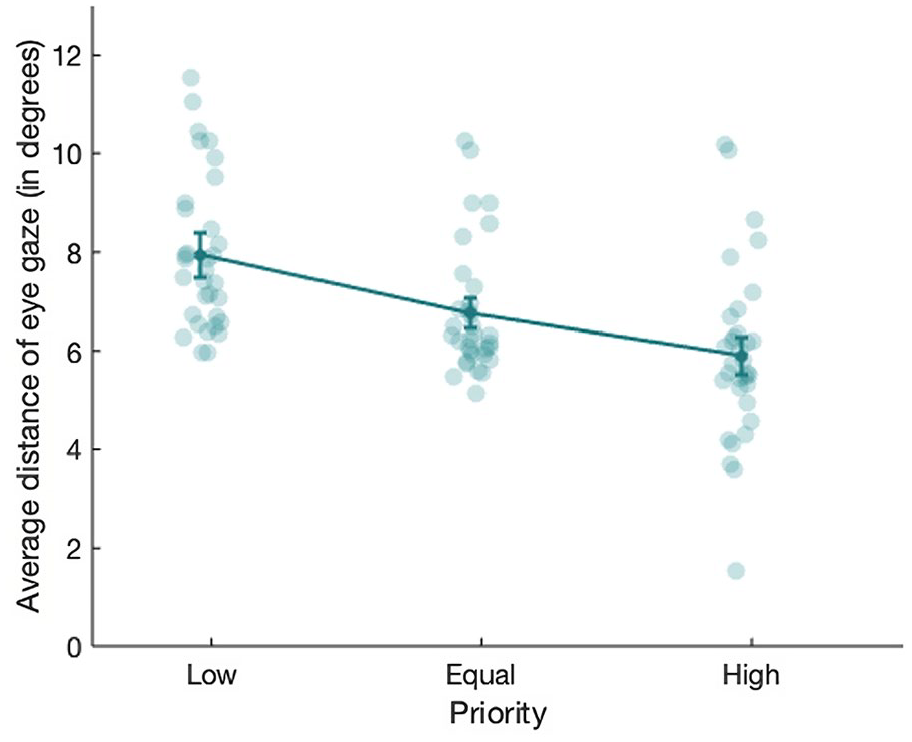
Average distance of eye gaze from the queried target in each priority condition.
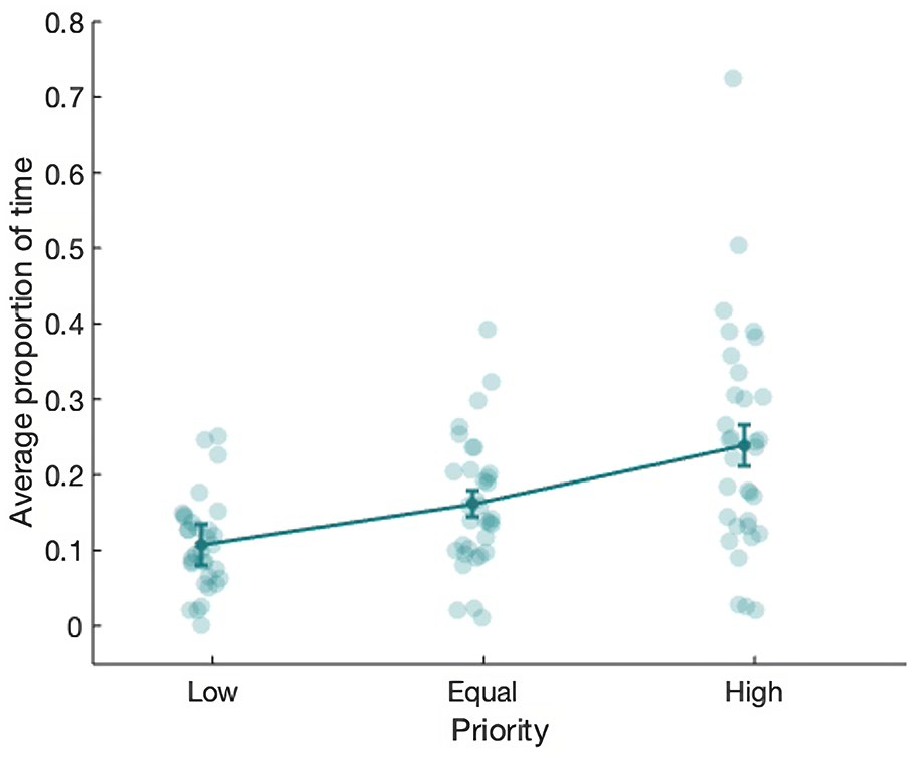
Average proportion of time spent looking at the queried target in each priority condition.
To calculate the distance of participants’ eye gaze from each of the targets, we computed Euclidean distance from eye position and from the centre coordinate of each target at each gaze sample, and then averaged across all samples for each trial. Figure 5 indicates the average distance of eye gaze of each participant individually from the queried target (averaged over trials), as well as the sample mean average distance (averaged over participants). The pattern of results clearly suggests that as the target priority increased, the average distance of participants’ eye gaze to the target decreased. The LME analysis shows there was a significant effect of priority on the average distance of participants’ eye gaze from the queried target, χ2(1) = 37.03, p < .001. Average distance decreased as target priority increased, b = −0.05, SE = 0.007, t = −7.05, p < .001.
For the gaze time measure, we classified each gaze sample within a trial as belonging to one of the following regions of interest: queried target, non-queried target, target’s midpoint location, screen centre, and anywhere else on the screen. A gaze sample was classified as belonging to one of the above locations if it was closest to that location compared to all others and if it was within 2° from the centre of that location (apart from the ‘anywhere else’ category). Figure 6 shows the average proportion of time each participant spent looking at the queried target across the three priority conditions (faint dots, averaged across trials), as well as the average proportion of time (averaged across participants). As can be seen in Figure 6, as the priority associated with the target increased, participants spent more time looking at it. The LME analysis suggests that there was a significant effect of priority on the average proportion of time participants spent looking at the queried target, χ2(1) = 36.22, p < .001, with b = 0.0034, SE = 0.00014, t = 6.95, p < .001.
The analyses so far suggest that high-priority targets were fixated more frequently and/or for longer. This result is consistent with the ‘target-switching’ strategy illustrated in Figure 1, but also with a ‘centroid tracking’ strategy if there was a bias in fixating towards the high-priority target and the midpoint location of the two targets. Therefore, we assessed the ‘centroid tracking’ strategy more directly. Figure 7 shows that in the equal condition (where both targets are equiprobably probed), the proportion of time spent looking at the queried (0.16 ± 0.18) and the non-queried (0.16 ± 0.17) was similar to the proportion of time spent looking at the midpoint of the two targets (0.17 ± 0.15). This suggests that in the equal-priority condition, participants often tracked the centroid location of the two targets as well, and not only the two targets independently. When the two targets were probed with unequal priorities (i.e. low on queried target – high on non-queried; high on queried target – low on non-queried; respectively), the proportion of time spent looking at the midpoint of the two targets (0.15 ± 0.13; 0.15 ± 0.14) was less than the proportion of time looking at the high-priority target (0.24 ± 0.23; 0.24 ± 0.22), yet more than the proportion of time looking at the low-priority target (0.11 ± 0.13; 0.11 ± 0.14). This finding suggests that when targets were probed with unequal probabilities, participants primarily tracked the high-priority target, but then prioritised the tracking of the centroid location of the two targets, instead of the low-priority target. This was done presumably to avoid losing complete track of high-priority targets and also monitor the low-priority target more effectively in peripheral vision.
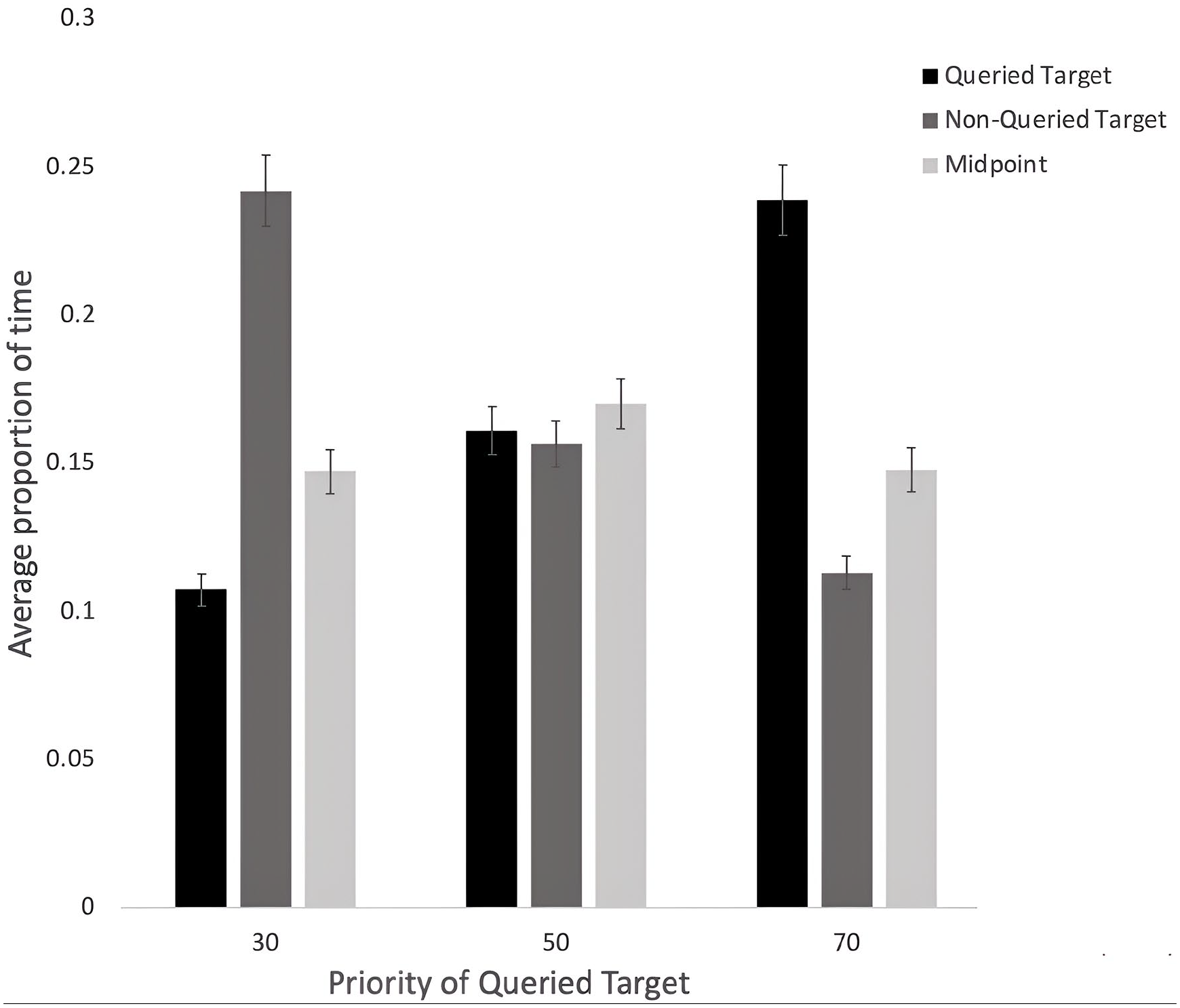
Proportion of time spent on the queried target, the non-queried target and their midpoint location.
Exploratory analysis
Having demonstrated that priority influences both gaze behaviour and perceptual accuracy, it is natural to ask whether there is a link between gaze and response accuracy. Therefore, the relationship between both gaze measures (i.e. average distance of eye gaze from the target and proportion of time spent looking at it) and absolute tracking error was investigated. To further test the relationship between gaze behaviour and perceptual accuracy, these two parameters were entered into the LME analysis, like the main analysis of this experiment. The average distance of eye gaze from the queried target was entered in an LME model as a predictor, and absolute tracking error as a response variable, corrected as a criterion, and participant identity in the error term. There was a significant effect of distance of eye gaze from the queried target on absolute tracking error of participants, χ2(1) = 280.32, p < .001, with b = 0.0511, SE = 0.003, t = 16.94, p < .001. A greater distance from the queried target (regardless of priority) was associated with greater absolute errors. Similarly, when proportion of time spent on the queried target was entered into the LME analysis as a predictor, there was a significant effect of proportion of time spent on the queried target on absolute tracking error, χ2(1) = 243.27, p < .001, with b = −34.551, SE = 2.18, t = −15.84, p < .001. That is, more time spent fixating the queried target (again, regardless of priority) was associated with lower absolute errors. These results demonstrate that the adaptive allocation of gaze has functional benefits for tracking performance.
It is possible that the effects of priority seen may reflect an unequal allocation of attention across trials, with the averages reflecting a mixture of trials in which the participant attended (exclusively) to the high-priority target and a smaller number of trials in which the participant attended (exclusively) to the low-priority target. For example, it is possible that participants adopted some form of ‘probability matching’ across trials (Eriksen & Yeh, 1985). To assess this possibility, an additional exploratory analysis was conducted on the proportion of time spent looking at each of the two targets (i.e. queried and non-queried) within a trial for each priority condition. A between-trial probability matching account predicts that participants will spend almost all their time within a trial on one of the two targets: for a given combination of target and priority, the distribution of the proportion of time spent on that target should have sharp peaks near 0 and 1, and very little density in between these extremes – in other words, a bimodal distribution. Within-trial probability matching implies the unequal allocation of attention within a trial and predicts a more unimodal distribution with more data falling between these two extremes.
Figure 8 shows the proportion of time spent looking at the queried target (top row, A–C) and at the non-queried target (bottom row, D–F). These distributions clearly do not align with the bimodal pattern anticipated by between-trial probability matching. However, the data are not fully consistent with within-trial probability matching either, with all distributions peaking close to 0. It is possible that a combination of both between-trial and within-trial probability matching is occurring. This mixture might be due to differences in strategies between participants or changes in strategies within participants throughout the experiment. It is evident from this analysis that the proportion of time spent looking at the high-priority target is not close to 1, while the proportion of time spent looking at the low-priority target is not close to 0 either. This pattern is strong evidence against a single-object tracking strategy and the complete withdrawal of attention from the low-priority target. This exploratory analysis shows that the effect of priority on perceptual performance and gaze measures, which is noted across trials (Figures 3–5), is also present within trials, providing stronger evidence for unequal attention prioritisation. Figure 8 shows that participants sometimes do not look at either of the targets. This is likely due to the fact that six visually identical distractors were included in the display, which could be easily confused with targets, and participants might have accidentally tracked distractors. It could also be a result of participants using not only their overt attention but also their covert attention during tracking (the role of peripheral vision during unequal attention allocation was more directly investigated by Hadjipanayi et al., 2022.
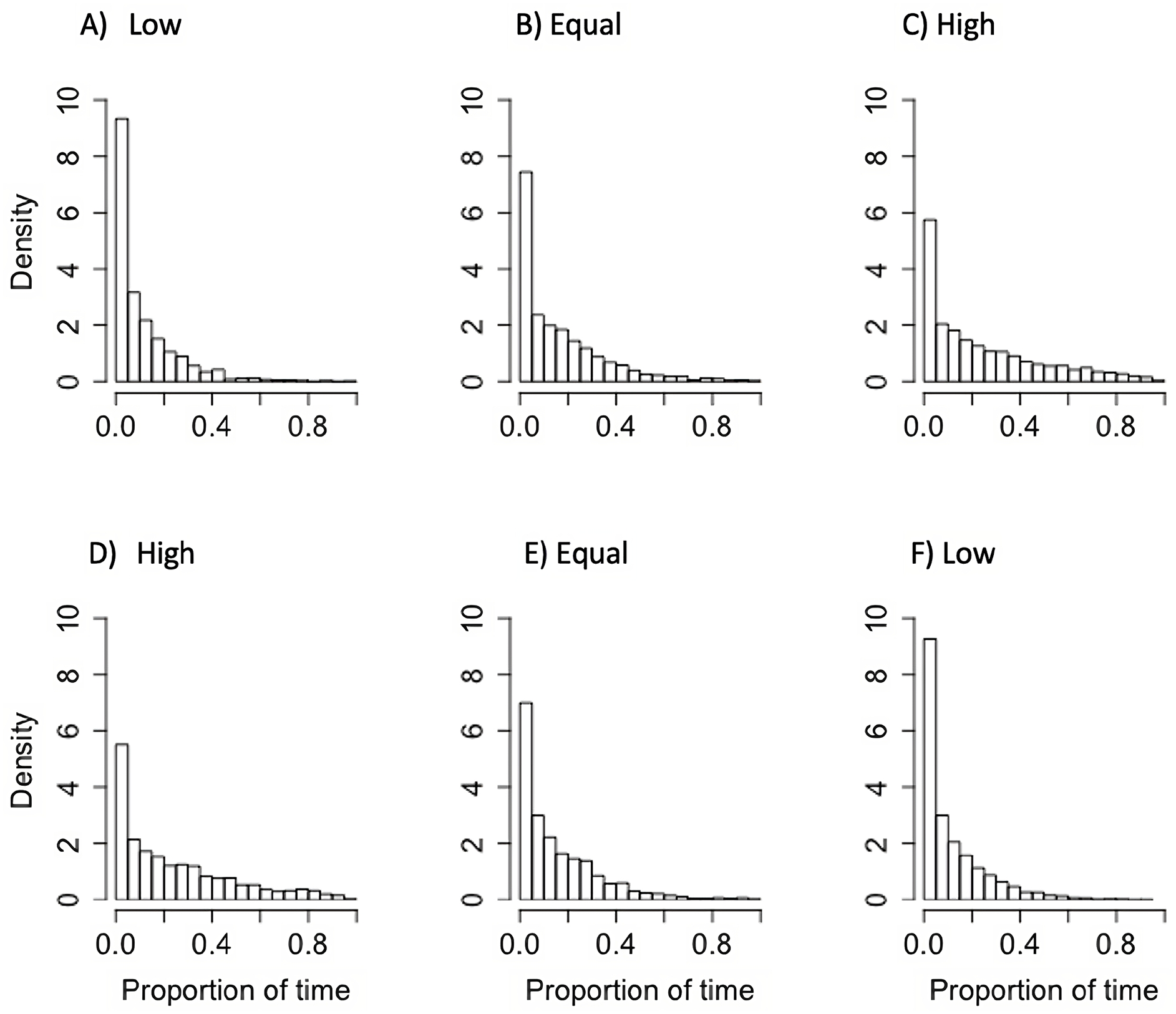
Proportion of time spent looking at the two targets within trials. (A–C) Proportion of time spent looking at the queried target on a trial level across all participants in (A) low-, (B) equal- (C) and high-priority conditions. (D–F) Proportion of time spent looking at the non-queried target on a trial level across all participants in (D) high-, (E) equal- and (F) low-priority conditions.
Discussion
In this experiment, we investigated participants’ ability to allocate their attention unequally during a trajectory tracking MOT task. We measured participants’ eye movements to explore how overt attention is deployed when targets vary in their importance. Priority was manipulated across three levels: low, equal and high. Participants’ perceptual performance was assessed by calculating their tracking accuracy (i.e. absolute angular error) when making trajectory judgements, while gaze measures of distance from each of the targets and proportion of time spent looking at each target were also measured.
Replicating the main findings of Crowe et al. (2019), perceptual performance during tracking improved as target priority increased, as shown by the lower magnitude of angular error. Analysis of participants’ eye movements revealed that participants’ eye gaze was closer to the higher priority target, while they also spent a greater proportion of time looking at the high-priority target compared to the low-priority target. This indicates that participants attended a target more closely when this was probed with higher probability, providing support for our initial predictions (Figure 1A). While devoting most of their attention to the high-priority target, participants did not completely neglect the low-priority target, as shown by above chance tracking performance for the low-priority target (Figure 3), the relatively low guessing rate for even low-priority targets (Figure 4) as well as the finding that some proportion of participants’ time during the trial was spent looking at the low-priority target (Figure 6).
As a secondary aim, the current experiment also investigated the use of centroid and/or target-switching tracking strategies during MOT (Figure 1, Prediction B). It was predicted that participants would either use centroid or target-switching strategies (Prediction Bi) depending on priority level (with centroid tracking in the equal-priority condition and target-switching tracking in the high- and low-priority conditions), or would use both centroid and target-switching strategies providing evidence that these two processes are endpoints of a continuum and not two distinct processes (Prediction Bii). Some support is also provided for Prediction Bii, as participants were found to use both centroid and target-switching strategies in their tracking. In the equal-priority condition, a similar proportion of participants’ eye gaze was devoted to tracking the midpoint location between the two targets and the two targets individually (Figure 7). This suggests that in the equal-priority condition, participants also tracked the centroid location of the two targets, and not only the two targets independently. When the two targets were probed with unequal priorities, participants primarily tracked the high-priority target but then prioritised the tracking of the centroid location of the two targets as well, instead of the low-priority target (Figure 7). This indicates that centroid and target-switching strategies are not necessarily two distinct processes but can rather be considered endpoints of a continuum that can be employed together during tracking, depending on the priority of the targets.
Current evidence in favour of unequal attention allocation between high- and low-priority targets is in line with the past literature showing that top-down instructions can guide goal-directed attention allocation (Brockhoff & Huff, 2016) and lead to graded prioritisation of some targets over others (Cohen et al.,2011; Crowe et al., 2019; Fitousi, 2016). Crowe et al. (2019) used the same trajectory tracking task to examine the effect of priority of targets on participants’ magnitude of angular error. As in the current experiment, Crowe et al. (2019) found that participants allocated more attention to targets that were high in priority versus targets that were low in priority. However, Crowe et al. (2019) only inferred attention from tracking accuracy. In the current study, we go further and supplement the perceptual performance findings by directly measuring overt attention through eye-tracking. Participants’ eye gaze was closer to the higher priority target, while they also spent a longer time looking at the high-priority target compared to the low-priority target. The gaze data suggest that participants attended a target more closely when this was probed with higher probability, providing evidence for preferential unequal attention allocation.
Our findings also offer some useful evidence regarding the structure of the attentional resource and whether this is fixed or flexible. Results from this experiment further strengthen the notion that participants have some flexibility in attention allocation, as they allocated their attention unequally depending on the probed priorities of the targets. This is in line with aspects of flexible theories like the FLEX model (Alvarez & Franconeri, 2007) that argue that attention allocation can dynamically change during tracking, such that some targets receive greater amounts of attention than others. Current findings therefore provide evidence against predictions of fixed architecture theories of tracking, like the Visual Index Theory (Pylyshyn, 1989, 2001, 2007) and Multifocal Theory (Cavanagh & Alvarez, 2005; McMains & Somers, 2004; Müller et al., 2003). Such theories assume that each target receives a fixed amount of attention (e.g. a visual Finger of Instantiation, FINSTs, or attentional foci), irrespective of their behavioural relevance. As a result, they would predict similar tracking performance across both targets in a given trial.
Our findings also offer insights into the allocation of overt attention during tracking and allow us to draw some conclusions on the gaze strategies participants employ (Fehd & Seiffert, 2008, 2010; Zelinsky & Neider, 2008). In the equal-priority condition, participants were found to pay a similar amount of overt attention to the two targets individually, as well as to their midpoint location, as indicated by both gaze measures (i.e. distance and proportion of time). This suggests that, when targets were probed with the same priority, participants relied on a centroid-looking strategy to some extent, as well as a target-looking strategy. In the conditions where the two targets were probed with unequal probabilities, participants primarily tracked the high-priority target but then prioritised the tracking of the centroid location of the two targets instead of the tracking of the low-priority target. This would presumably allow them to track the low-priority target to some extent in peripheral vision, but without losing track of high-priority target.
Our findings provide insight into the roles of overt (foveal) versus covert (peripheral) attention in unequal attention allocation during MOT. The results reveal that unequal allocation of attentional resources is not solely dependent on overt eye movements. While overt attention facilitates the tracking of targets through explicit gaze shifts, our data indicate that covert attention plays a crucial role in keeping track of peripheral targets. Using peripheral vision to track targets is obviously important during centroid tracking. Moreover, within a trial, participants do fixate both targets (as suggested by Figure 8), so while one of the targets is fixated, the other target must be monitored in peripheral vision to support target-switching. Therefore, overt and covert attention operate in tandem to support graded prioritisation of different objects in dynamic scenes. That said, our interpretation of centroid-looking should be approached with caution. It is difficult to determine whether gaze centred between two targets reflects active covert shifts of attention, or the use of more holistic, Gestalt-based tracking strategies that minimise the need for attentional shifts (Yantis, 1992). It is well established that covert attention alone can support object tracking without requiring overt gaze shifts (e.g. Hadjipanayi et al., 2022; Intriligator & Cavanagh, 2001). Future studies could benefit from methods that more directly distinguish between these mechanisms, such as combining eye-tracking with EEG or using post-trial probes to assess attentional locus.
Past studies have indicated that participants might employ a different strategy during MOT (i.e. centroid-looking vs. target-looking) depending on the load of the task. In particular, in low-tracking loads, participants are likely to employ centroid-looking strategy (i.e. when 2-3 targets are tracked), but then switch to a target-looking strategy when tracking demands increase (e.g. when collisions occur, when in close proximity with distractors, or with faster movement speeds; Zelinsky & Neider, 2008; Zelinsky & Todor, 2010). Therefore, our results show that the strategy that participants choose to use during MOT not only depends on tracking load (Zelinsky & Neider, 2008; Zelinsky & Todor, 2010), but also on the behavioural relevance and priority of different objects. The target-looking strategy was primarily used for tracking high-priority targets as this allowed observers to have a high degree of precision, afforded by foveal vision. For low-priority targets, a centroid-looking strategy is used more often than a target-looking strategy, as this is more functional for tracking the low-priority target without losing track of the high-priority target. That said, clearly it is possible that with more than just two targets, participants adopt a target-looking strategy almost exclusively. Moreover, spatial features of the display can also influence gaze allocation. For example, objects that are temporarily close together tend to attract gaze and attention more strongly (Meyerhoff et al., 2018). This suggests that gaze behaviour is not only shaped by intentional prioritisation but can also be biased by the immediate spatial arrangement of objects. Such bottom-up influences may compete with or even override top-down goals, particularly in dynamic tracking scenarios where objects frequently change position. Additionally, larger objects may attract more gaze simply due to their greater visual salience, further modulating attention independently of target priority (Meyerhoff et al., 2017). Future studies should explore when different tracking strategies are used and how the determining factors (e.g. bottom-up spatial features of the display, such as object speed and size, number of objects, and their proximity, as well as top-down factors, such as priority) might interact to determine strategy. Exploring the interplay between tracking load and attentional resources in scenarios with different levels of priority might reveal critical thresholds for strategy switching.
To conclude, the current experiment aimed to provide an insight into how participants allocate gaze (overt attention) to different targets when those targets have unequal priorities in an MOT task. Both perceptual performance measures and gaze measures suggest that participants prioritise tracking of the high-priority target but do not completely neglect the low-priority target, providing clear evidence for unequal attention allocation. Also, our study provides a novel insight into how attention is dynamically allocated across multiple targets based on priority. Unlike previous research that primarily examined the shift between centroid- and target-looking as a function of task difficulty (or attentional load), our findings highlight that target priority plays a crucial role in determining which strategy is employed, offering a more nuanced understanding of attentional control in MOT.
Footnotes
Data accessibility statement

Declaration of conflicting interests
The author(s) declared no potential conflicts of interest with respect to the research, authorship, and/or publication of this article.
Funding
The author(s) received no financial support for the research, authorship, and/or publication of this article.
Ethical approval
The experiment was granted ethical approval from the School of Psychological Science Research Ethics Committee at the University of Bristol (Approval Number: 10373). The experiment was conducted according to the revised Declaration of Helsinki (2013).
Consent to participate
All participants provided their informed and written consent before commencing the experiment.