



Abstract
Duration judgement is a central component of cognitive functioning; however, a substantial body of evidence suggests that time perception is impaired in individuals with schizophrenia and schizotypy, respectively. Conclusions about the similar aetiology of both are constrained by empirical evidence with no evidence about the performance of schizotypy in the temporal estimation task. For the first time, a temporal estimation task examined the impact of schizotypy on both the retrospective and prospective paradigms for visual stimuli. The task involved subjects estimating one of three durations (15 s, 30 s, or 45 s) of a kitten video in either a retrospective or prospective paradigm in Experiment 1 and a video of the River Nene in Northampton, United Kingdom, in Experiment 2. Critical findings that emerged from this study are that high schizotypy subjects appear to have a greater degree of accuracy estimating durations, which is driven by the context of the stimulus. This finding implies that the pacemaker/accumulator component of scalar expectancy theory can be used to further explore timing deficits in schizophrenic subjects and might further imply that timing deficits in schizophrenia are driven by attentional deficits.
‘Your claim to superiority depends on the use you have made of your time and experience’ (Brontë, 1847). The muses of Charlotte Brontë in the classic Jane Eyre evoke the importance of the perception of time for the human experience (Matthews & Meck, 2014). Therefore, any deficits to the perception of time are likely to have an impact on everyday life, necessitating further research into the perception of time. Many psychopathologies are associated with deficits in time perception, including depression (Thönes & Oberfeld, 2015), anxiety (Bar-Haim et al., 2010) and Schizophrenia (Thoenes & Oberfeld, 2017). Of these, Schizophrenia is of most interest; however, to explore the perception of time in schizophrenia, a robust theoretical model of time perception is necessary.
Beginning with Treisman (1963), researchers have attempted to provide a theoretically robust cognitive model of the perception of time, motivated by the fact that unlike traditional perceptual senses, the perception of time does not have a dedicated biological organ (Grondin & Laflamme, 2015), though some authors contest that time perception is driven by so-called neutral oscillators (Treisman, 2013). One of the most popular and successful models of the perception of time is the scalar expectancy theory (SET) developed by Gibbon (1977). This model of the perception of time features several mechanistic components: the first is an attentionally driven pacemaker which emits Poisson-distributed pulses (Meck & Church, 1984); the pulses traverse towards an attentional ‘switch’. This switch, it is argued is driven by attentional resources (cf. Zakay & Block, 1996). Once the pulses have ‘passed’ the switch, the pulses accumulate and are stored at the accumulator though some pulses can be ‘lost’ if there is variability in the switch (Zakay & Block, 1996). From the accumulator, important pulses (i.e. such as subjects being trained on a length of a duration) are passed and subsequently stored in reference memory with subsequent pulses stored in working memory. The durations stored in both Reference and Short-Term memory are then compared, and a decision is made on whether the durations held in Working Memory matches durations that are held in Reference memory (Gibbon, 1977). SET has been used since the late 1970s to model time perception and has provided useful empirical evidence on how human and non-human subjects perceive time. SET has been used as a theoretical model for schizophrenia and schizotypy (i.e. Reed & Randell, 2014; Carroll et al., 2008), respectively. Despite the successes of SET, there are difficulties in applying SET to investigating the Perception of Time in Schizophrenia, which depend on many factors, including the length of durations investigated (i.e. so-called ‘critical timings’), as well as the paradigm use (i.e. prospective or retrospective). Also, the assumptions of SET have been subjected to rigorous debate, particularly around the mechanistic properties of the pacemaker–accumulator.
A critique of SET is that the theory appears to be unfalsifiable due to several assumptions (Buhusi & Oprisan, 2013). One of these key assumptions if that there is a linear relationship between time and the number of ticks emitted from the pacemaker meaning that any deviation of this relationship leads to an invariance in the perception of time (Gibbon, 1977). Therefore, several researchers have proposed additional mechanistic properties of the pacemaker–accumulator model, including the neural oscillation model of time perception (Treisman et al., 1994). For example, it has been tenuously argued by Treisman et al. (1994) that the perception of time is related to several temporal pacemakers, within the alpha band (i.e.8 to 13 Hz ); and that accurate representation of the perception of time is dependent upon these pacemakers having a sequence of parallel harmonically related frequencies (Treisman et al., 1994). Any deviancy within the frequencies of these pacemakers could lead to deficits in the perception of time, in which faster alpha rates could produce overestimation of durations; whilst slower alpha rates are linked to underestimation of durations, which is especially pertinent to schizophrenia, given that patients with schizophrenia show abnormalities in neural oscillations (Yeum & Kang, 2018). Despite these two mechanistic approaches to the pacemaker–accumulator model, there are several pertinent issues around critical time and paradigm which researchers must consider when investigating time perception.
Within the timing literature – and particularly with respect to research into Schizophrenia – subsecond durations (i.e. durations
In terms of investigating time perception in schizophrenia, few studies focus on suprasecond duration or the retrospective paradigm representing a methodological gap in the literature. Furthermore, since most researchers focus on the prospective paradigm, with subsecond durations, the underlying assumption is that any reported deficits in timing are due to the pacemaker/accumulator model and consequently, attention, which further illustrates a gap in the timing literature as most studies focus on attentional deficits in schizophrenia. However, there are theoretical and methodological challenges in using schizophrenic subjects, which have contributed to the somewhat contradictory findings in timing deficits found within this population.
Deficits in the perception of time are a prominent feature of schizophrenia (e.g. Carroll et al., 2008; Elvevåg et al., 2003; Roy et al., 2012; Snowden & Buhusi, 2019) and psychometrically defined schizotypy (Reed & Randell, 2014); however, the direction of these timing deficits is often contradictory (Carroll et al., 2009; Elvevåg et al., 2003; Ueda et al., 2018), with some studies reporting underestimation of durations, and others overestimation of durations in the subsecond domains with respect to schizophrenia. Several potential reasons underlying these differences in time perception have been posited, including working memory, reference memory and attentional mechanisms, respectively (Thoenes & Oberfeld, 2017), but the precise cognitive mechanisms that give rise to temporal dysfunction in schizophrenia remain unclear (Thoenes & Oberfeld, 2017). These cognitive mechanisms are further complicated by the fact that subsecond durations are likely to draw on automatic processes, whilst suprasecond durations are likely to draw on higher cognitive durations (Carroll et al., 2009; Reed & Randell, 2014). The issue is further compounded by the fact that time perception can be studied either prospectively or retrospectively, of which both paradigms draw on different cognitive mechanisms that are of relevancy to schizophrenia (Reed & Randell, 2014). These contradictory findings in schizophrenia could be explained by typical antipsychotics (e.g. Haloperidol, Thioridazine etc.), which are known to impair performance of the cognitive mechanisms that are thought to be responsible for time perception. For example, several studies (i.e. Rammsayer, 1989, 1993) have demonstrated that dopaminergic antagonists often lead to deficits in time perception (Goldstone et al., 1979). Therefore, it could be argued that the contradictory findings in the literature, with respect to schizophrenia, are the result of a lack of control of subjects’ use of medication (Reed & Randell, 2014); implying that schizotypy might be useful for investigating timing deficits in schizophrenia, given the converging evidence of a similar aetiology between schizophrenia and schizotypy, respectively.
Schizotypy has provided a useful model for schizophrenia (e.g. Fenner et al., 2020; Reed et al., 2008; Tsakanikos & Reed, 2005), given that it is contended that schizotypy is the expression of schizophrenia-like behavioural traits in the non-clinical population (Lenzenweger, 2006). This contention is given further impetus by the finding that schizophrenic patients and subjects with high schizotypy scores show similar performance across many cognitive tasks (Dagnall & Parker, 2009; Lee et al., 2006; Reed & Randell, 2014; Tsakanikos & Reed, 2005; see Siddi et al., 2017 for review). Furthermore, evidence suggests that memory deficits in schizotypy are similar to those of schizophrenia (Vollema & Postma, 2002), which is relevant to time perception, particularly, retrospective time perception demonstrating that schizotypy might present opportunities in studying the aetiology of time perception in schizophrenia.
Despite the opportunities that schizotypy may present for furthering a theoretical understanding of timing processes in schizophrenia, there are many empirical gaps in the knowledge base. Importantly, when tested in timing tasks, those with high schizotypy scores sometimes have more accurate temporal judgement, tending to show less underestimation of time, at least at subsecond durations (Reed & Randell, 2015), which contrasts with studies of medicated schizophrenic subjects (e.g. Carroll et al., 2009). An explanation for these contradictory findings could be that subjects with schizophrenia (and the schizophrenia spectrum-like personality characteristics, such as schizotypy) that take part in tasks where attentional load is low (i.e. such as a temporal bisection task) show greater impairment than controls. Conversely, when attentional demands are high (i.e. a context-rich stimulus), schizophrenic subjects are more likely to pay more attention (Ducato et al., 2008) to the stimulus. In the context of SET, this finding could be explained by the contextual nature of a stimulus determining whether subjects will perceive a duration accurately or not. However, most studies investigating time perception in both schizophrenia and schizotypy are focused on subsecond durations, and within the prospective paradigm, meaning there are important theoretical considerations in terms of experimental design, given that subsecond durations are largely thought to be controlled by automatic cognitive processes (Grondin, 2010).
As discussed, subsecond durations are thought to be controlled by automatic and sensory processes (Thibault et al., 2013); while suprasecond durations are controlled by higher cognitive mechanisms (Grondin, 2014). Furthermore, prospective timing is based on attention and working memory, while retrospective timing is presumably based on reference memory (Klapproth, 2007; Zakay & Block, 1996), which demonstrates there are distinct cognitive mechanisms that drive time perception based on both task and duration, respectively. The majority of studies that have investigated time perception in schizophrenia and schizotypy are typically prospective and subsecond in nature (i.e. Temporal Bisection or Generalisation). A difficulty is that these tasks often give contradictory results from one another (cf. Carroll et al., 2008; Reed & Randell, 2014), making it difficult to delineate the nature and/or source of timing deficits for schizophrenia therefore, the Temporal Estimation tasks presents a unique task, for these populations, to examine suprasecond and retrospective time perception (Klapproth, 2007) thereby focusing on several elements of time perception and different cognitive mechanisms.
Few studies have used the temporal estimation task for schizophrenia (Ueda et al., 2022), and none at the time of writing has explored retrospective timing in schizophrenia or schizotypy, respectively. An advantage of the temporal estimation task is that it can be used in both a retrospective and prospective manner, thereby allowing researchers to investigate both attentional and memory aspects of time perception, as well as higher cognitive mechanisms that might be driving time perception (Klapproth, 2007). Under the prospective paradigm, the subject makes a duration estimation under the premise that timing is relevant (Klapproth, 2007; Zakay & Block, 2004); therefore, they are paying attention to the duration. Conversely, in the retrospective paradigm, subjects are not aware that duration is relevant until after the task (Klapproth, 2007), meaning they must draw on previously encoded information. Retrospective timing depends on remembered durations (Zakay & Block, 2004), thereby mapping onto memory (Klapproth, 2007), which may be subjected to deficits for those with schizophrenia (Rouy et al., 2021) and schizotypy (Sahakyan & Kwapil, 2016). Alternatively, Pouthas and Perbal (2004) suggest that prospective timing depends on attentional processes (Zakay & Block, 2004) and processing difficulties (Zakay & Block, 2004). Again, these map onto higher cognitive mechanisms, such as working memory and attention, both of which are suggested to be impaired in schizophrenia (i.e. McCutcheon et al., 2023; Seabury & Cannon, 2020) and schizotypy (Haigh et al., 2023; Huang et al., 2021); all of which are difficult to investigate with the subsecond time perception tasks, such as bisection or generalization.
Given these considerations, the current study used the temporal estimation procedure from Klapproth (2007) to assess retrospective and prospective estimation for subjects with low and high levels of schizotypy to investigate whether the attentionally driven pacemaker/accumulator mechanisms of SET drive deficits in timing in schizophrenia by utilizing schizotypy. A further aim was to further document the similarities between schizotypy and schizophrenia by extension to this novel task. This is important as Reed and Randell (2014), using a temporal bisection task, found greater accuracy in high schizotypy whereas Carroll et al. (2009) found the opposite with schizophrenic subjects; however, both of these studies used (a) prospective timing tasks and (b) subsecond durations. Based on previous findings, and the argument that schizophrenics might pay more attention to concrete stimuli, this study will test the assumption that timing deficits are based on attentional deficits, caused by an errant pacemaker/accumulator, by conducting two investigations. The first will employ a context-heavy stimulus (i.e. a kitten video), the second will employ a context-neutral stimulus (i.e. the River Nene, at Northampton).
Experiment 1
Experiment 1 will test the following hypotheses:
Method
Subjects
A total of 325 subjects (180 females; 145 males) were recruited via The School of Psychology’s subject pool (Swansea University) and the Prolific platform. The mean age of subjects was 34.74 (SD = 15.63; range 18–79) years. In terms of outliers, subjects whose reproductions
Power
Due to a computational error, an incorrect power analysis was initially made; however, given the sample size was already known, a G*Power sensitivity analysis was conducted to determine the Smallest Effect Size of Interest (SMSI) with the available subject size of 325subjects, desired power (i.e. 80%) and significance level
Stimuli and measures
The experiment was designed in the Gorilla.sc programme [Gorilla Experiment Builder]. Subjects completed the experiment on their own personal computers, which controlled all experimental events, and recorded their data. Responses were made on the subject’s own computer keyboard.
Stimulus
In terms of the target stimuli, a video depicting a kitten (Felis catus) was used to employ a potentially positively valanced cue, given how important attention is throughout the task (Lane et al., 1999), a context-rich video was required. The same video was used, and truncated, to create the 15 s, 30 s and 45 s durations for the randomized experimental conditions. The video presentation was preceded by a black cross presented on a white screen, which was displayed for 500 ms. The interval between the cross disappearing and the video being played was 1,500 ms.
Oxford Liverpool Inventory of Feelings and Experiences – Brief (OLIFE(B))
The O-LIFE(B) scale is a 43-item self-report scale for measuring schizotypy traits in the general population (Mason et al., 2005). The scale comprises four distinct subscales, each of which maps onto specific elements of Schizophrenia. Unusual Experiences (UE) maps onto the positive symptomology (i.e. perceptual aberrations), Cognitive Disorganization (CD) maps onto the cognitive symptoms, (i.e. lack of concentration) Introvertive Anhedonia (Impulsive Nonconformity [IN] maps onto the negative symptomology (i.e. loss of pleasure) and IN maps onto a lack of self-control (Premkumar et al., 2020). The scale is based upon empirically observed structures of schizotypal traits and has good validity in the general population (Green et al., 2008; Mason et al., 2005). O-LIFE(B) has been used extensively in examining the effect of schizotypy on behaviours and cognitions, including (though less so) time perception (Reed & Randell, 2014; Tsakanikos & Reed, 2005).
Given that UE, CD and IN map onto several elements of Time Perception (i.e. perceptions and cognitions) it can be difficult to analyse each of the subscales individually and mapping these onto SET, which itself has several components that map onto each of these components elements from O-LIFE(B) (Reed & Randell, 2014), which could lead to contradictory findings (i.e. as in Reed & Randell, 2014). Whilst some authors suggest against using the sum of the Schizotypy O-LIFE scale (Mason et al., 2005); others have taken this approach (Reed, 2023), in which the summing of UN, CD and IN are thought to give a measure for positive schizotypy (Reed, 2023). Therefore, we summed UE, CD and IN, given that each of the constituency components of these subscales combine to influence time perception more globally as opposed to locally, this summed variable was termed time-dependent – as opposed to positive – schizotypy. The decision was also taken to remove the IA subscale from the sum. The rationale for excluding IA was that depression has an effect on the subjective flow of time (Thönes & Oberfeld, 2015), as well as the link between IA and depression (Premkumar et al., 2020), which could further complicate any potential findings. The internal reliability (Cronbach
The alternative analysis would have been a Multivariate Multiple Regression, in which the 4 schizotypy subscales would have been used as predictor variables, and each of the 6 (i.e. prospective and retrospective 15 s, 30 s and 45 s, respectively) dependent variables (DVs) would have been outcome variables. Such an analysis would have been difficult to map onto SET. Furthermore, similar studies using this paradigm (i.e. Klapproth, 2007) typically use an ANOVA design, which is what the authors decided upon. Finally, given that Reed and Randell (2014) categorize the schizotypy groups into ‘Low and High’, we decided to use this approach in this study. Therefore, it was decided to sum the subscales and test the differences (i.e. ANOVA) between low and high schizotypy subjects in accordance with Reed and Randell (2014) and Klapproth (2007).
Design
The experiment was a 2 × 2 × 3 between-subjects design with paradigm (prospective and retrospective), and schizotypy level (lower versus higher) and duration of the kitten video (15 s, 30 s and 45 s) as between-subject factors. The DV was the estimate that subjects made to one of the three presented durations. For intersubject variability, the mean value was the DV, and the ratio value between actual and estimated durations was the DV. Both the intersubject variables and the ratio values were calculated in accordance with Klapproth (2007).
Procedure
Subjects first read the Subject Information Sheet and were then asked to consent to the study. Once subjects had agreed, they were then randomized into either the retrospective condition (in which they were told that they were partaking in a visual perception task) or the prospective conditions (in which they were told that they were partaking in a time perception task). Once subjects were assigned to either the retrospective or prospective condition, subjects were further randomized into one of the three durations (i.e. 15 s, 30 s and 45 s). Subjects then read the task instructions. Once they had read the instructions, they were instructed to press the spacebar to continue, which started the experiment. A black cross on a white screen was then shown for
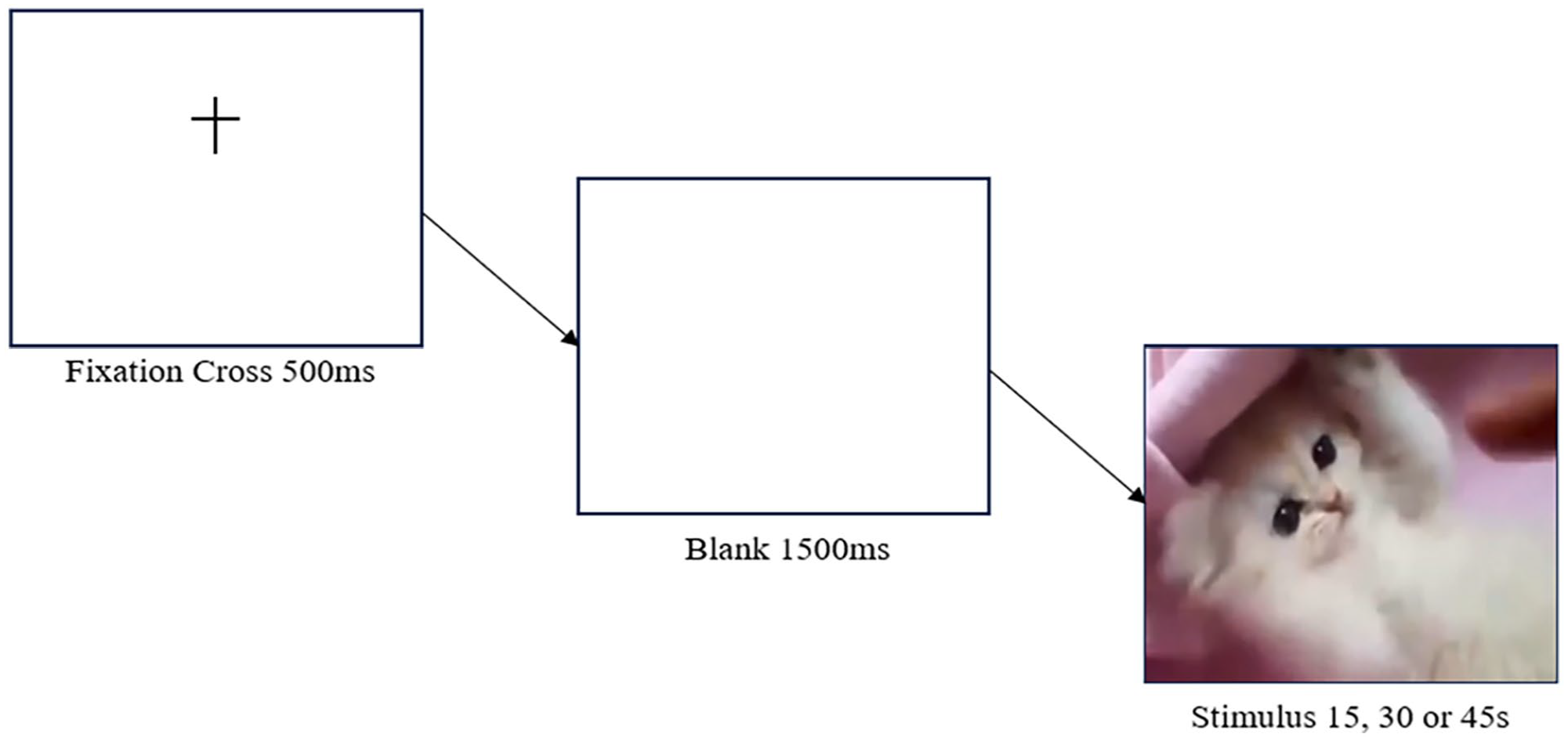
Schematic diagram of Experiment 1.
Data analysis
Despite the skew suggested by the violin plots, given that the sample for Experiment 1 is >200, the deviation of skew from normality will not make a substantive difference to the results (Tabachink & Fiddell, 2013). To further reinforce this, Kline (2011) argued that only skew values >3 could cause problems with data and given that all variables within Experimental 1 have skew values <3, the data are within acceptable parameters of skew (Kline, 2011). The data will be analysed with three Between-Subject Analysis of Variance (ANOVA) tests. The first ANOVA will have subject estimations as its DV, with Paradigm (prospective and retrospective), Duration (15s, 30s and 45s) and schizotypy (high and low) treated as Independent Variables (IV). The IVs in this study are Between-Subject factors; whilst the DV is the Within-Subject factor. The second ANOVA will use ratio as its DV, whilst the final ANOVA will utilize Intersubject Variability (InVa) as its DV. All significant Main Effects and Interactions will be further analysed using post hoc t-tests, using the Bonferroni-Corrected criteria.
Results and discussion
To test
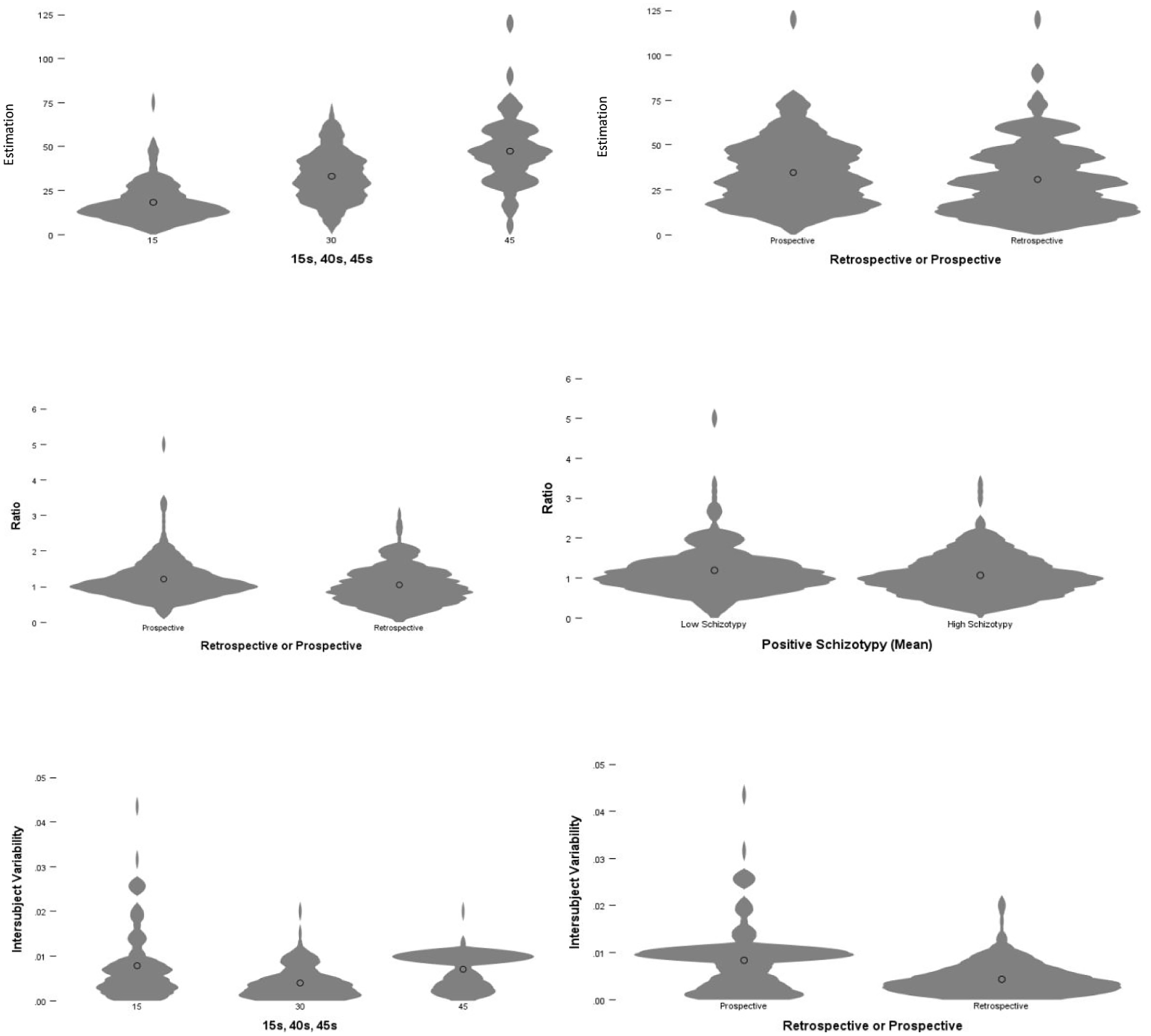
Results from Experiment 1.
To further analyse the main effect of condition, Bonferroni-Corrected Post Hoc t-tests were conducted, in which the significance level after the correction was
To unpack the main effect of paradigm, Bonferroni-Corrected Post Hoc t-test tests were also conducted which showed that the mean difference
To test
To further unpack the main-effects of paradigm, Bonferroni-Corrected post-hoc t tests were conducted, in which the mean difference
To test the final hypothesis
A Bonferroni-Corrected t-test was conducted to unpack the main effect of paradigm, in which the mean difference
The main effect of condition was also unpacked by using a Bonferroni-Corrected t-test, in which the adjusted
Finally, to unpack the interaction between Paradigm and Duration, six Bonferroni-Corrected t-tests were first conducted to determine duration intersubject variability within paradigm, in which the adjusted significance level was
Bonferroni-Corrected t-tests for Within-Paradigm in Experiment 1, in which the dependent variable is intersubject variability per duration.
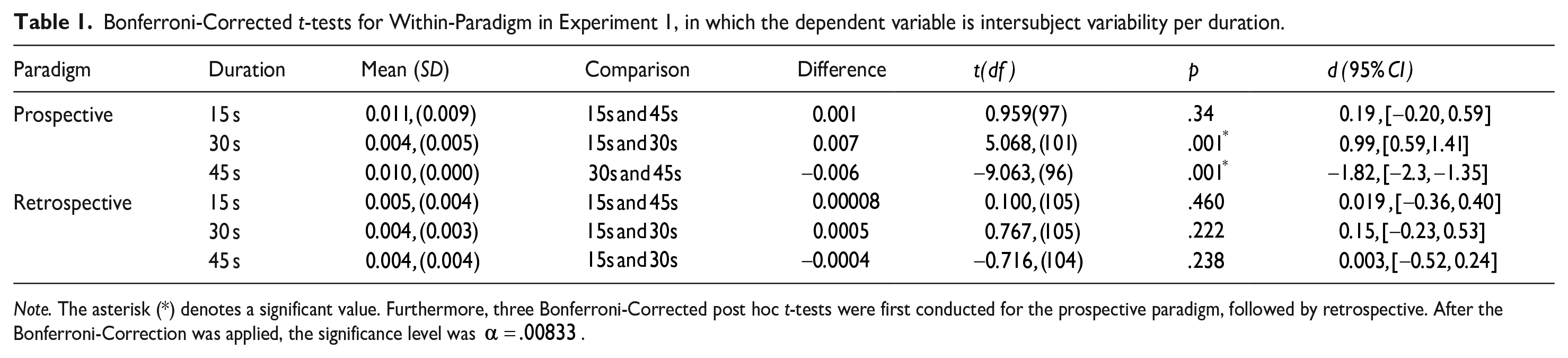
Note. The asterisk (*) denotes a significant value. Furthermore, three Bonferroni-Corrected post hoc t-tests were first conducted for the prospective paradigm, followed by retrospective. After the Bonferroni-Correction was applied, the significance level was
Bonferroni-Corrected t-tests for Between-Paradigm in Experiment 1, in which the dependent variable is intersubject variability per duration.
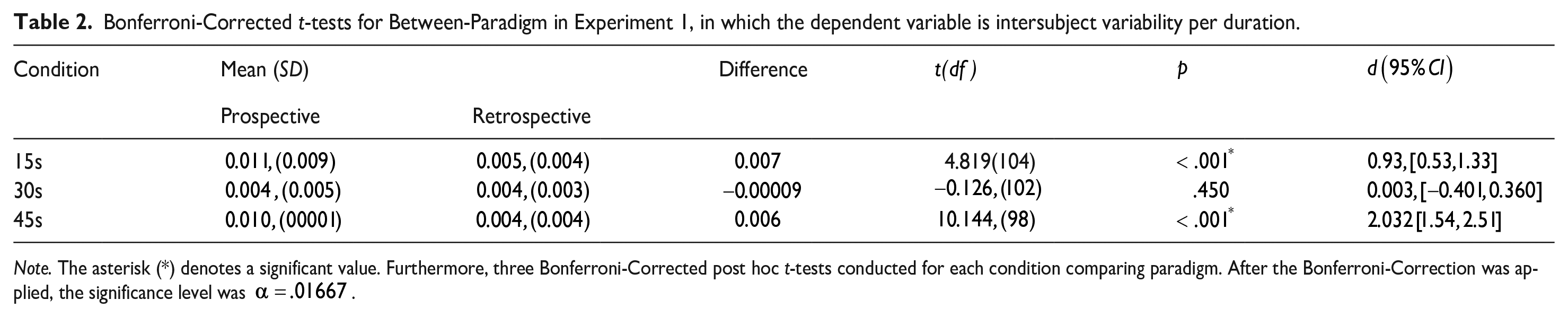
Note. The asterisk (*) denotes a significant value. Furthermore, three Bonferroni-Corrected post hoc t-tests conducted for each condition comparing paradigm. After the Bonferroni-Correction was applied, the significance level was
Therefore, for Experiment 1, we have confirmed the main hypotheses (
Experiment 2
Experiment 2 examined temporal estimations for low and high schizotypy similar to Experiment 1 however, this time, we used a contextually neutral stimulus in order to determine whether the finding in Experiment 1 that high schizotypy is more accurate in identifying durations, is the result of highly contextualized stimuli (Ducato et al., 2008). Given that it was argued in Experiment 1 that the lack of a pacemaker–accumulator deficit in high schizotypy was the result of them paying more attention to concrete stimuli (Ducato et al., 2008) than controls, it could be argued that the nature of the stimulus in Experiment 1 (i.e. a kitten video) led to high schizotypy achieving a higher degree of accuracy in identifying durations (Lenzenweger, 2006) given that the high schizotypy pacemaker–accumulator was more highly aroused (Treisman, 1963). Therefore, we aim to test several hypotheses that have been formulated based on the findings of Experiment 1.
Method
Subjects
A new sample of 213 subjects (185 Female; 28 Male) were recruited at the University of Northampton as described in Experiment 1, but this time, they were awarded 4 credit points, as opposed to a monetary reward. Subjects were between 18 and 54 (
Power
The sensitivity power analysis, discussed in Experiment 1, was conducted for Experiment 2, for 213 subjects. This yielded a Cohen’s
Stimuli and materials
The stimulus used in this study was a contextually neutral stimuli of the River Nene here at the University of Northampton, in the United Kingdom. A 60 s video was filmed by the principal researcher in 4K and then truncated to match the durations used in the study (i.e. 45 s, 30 s and 15 s, respectively).
Based on O-LIFE scores, we used the same strategy as Experiment 1 (i.e. sum the time-dependent subscales) and then conducted a mean split of the time-dependent schizotypy data after cleaning; of which for this sample
Design
Similar to Experiment 1, we used a between-subjects design, in which we had 2 schizotypy groups (low and high), 2 paradigms (prospective and retrospective) and 3 durations (15 s, 30 s and 45 s). Furthermore, subjects whose estimations were
Procedure
Similar to Experiment 1, subjects in the retrospective conditions were told that they were partaking in a visual perception task; whilst those in the prospective condition were told that they were partaking in a time perception task. In all cases, subjects were asked to pay close attention to the video, and all were presented with a set of instructions. Once they had read the instructions, they were instructed to press the spacebar to continue, which started the experiment, in which subjects received one of the three durations. A black cross on a white screen was shown for 500 ms. After the cross, a white screen was displayed for 1,500 ms. After the white screen, a temporal estimation task followed where subjects were asked to estimate, in seconds, how long the video lasted. Once they had entered a value via their keyboard, they were instructed to press the spacebar. Then completed a basic demographics questionnaire, and the O-LIFE questionnaire. A graphical representation of this design is shown in Figure 3.
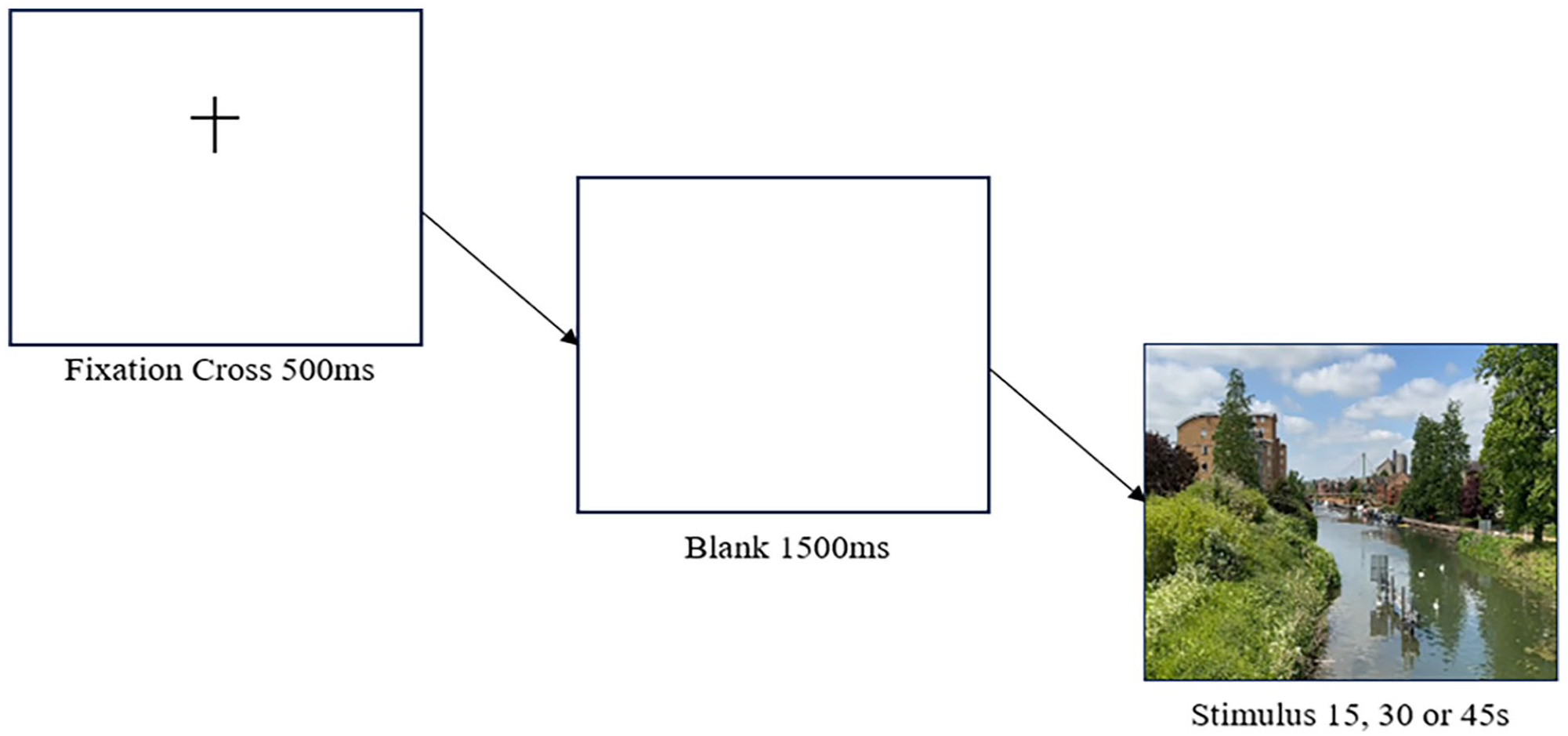
Schematic diagram of Experiment 2.
Data analysis
Similar to Experiment 1, the data will be analysed with three Between-Subject ANOVA tests. The first ANOVA will have estimations as its DV, with Paradigm (prospective and retrospective), duration (15 s, 30 s and 45 s) and schizotypy (high and low) treated as Independent Variables (IV). The IVs in this study are Between-Subject factors; whilst the DV is the Within-Subject factor. The second ANOVA will use ratio as its DV, whilst the final ANOVA will utilize InVa as its DV. All significant Main Effects and Interactions will be further analysed using post hoc t-tests, using a Bonferroni correction.
Results and discussion
Similar to Experiment 1, the violin plots suggest that some variables might be skewed. Given that the sample for Experiment 2 (after cleaning) is approaching 200 (i.e. 195) the deviation of skew from normality will not make a substantive difference to the results (Tabachink & Fiddell, 2013). To test
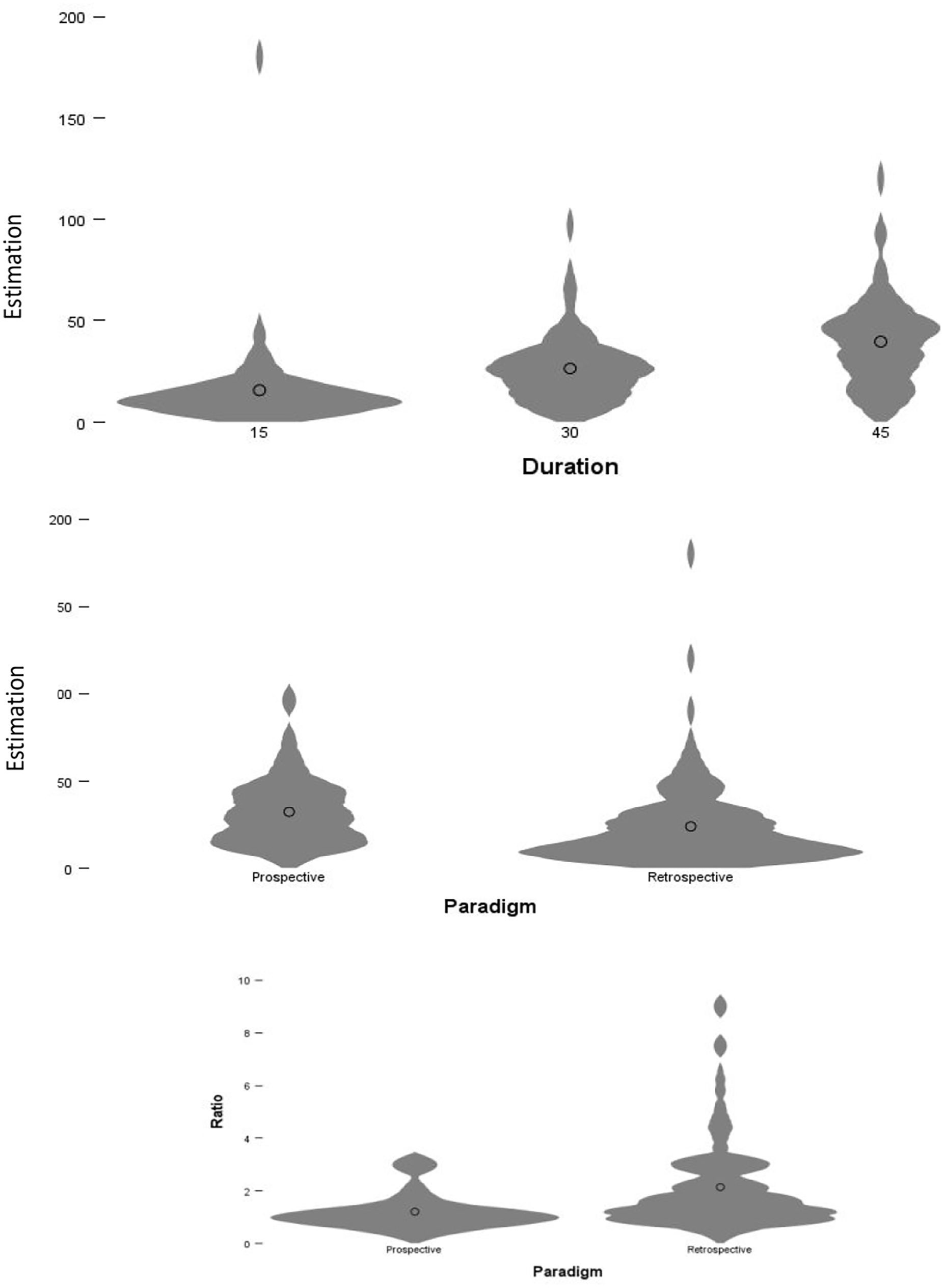
Results from Experiment 2.
The main effect of duration was further analysed by conducting Bonferroni-corrected post hoc t-tests, in which the alpha level was
To further analyse the main effect of paradigm, a Bonferroni-Corrected post-hoc t-test was conducted, in which the mean difference
The null hypothesis of
To test
We analysed the main-effect of paradigm by conducting a Bonferroni-Corrected Post Hoc t-test, in which the mean difference
To test the final hypothesis
Therefore, we have accepted our main hypothesis
General discussion
Overall, we report the results of a two-study investigation in exploring whether timing deficits in schizotypy (and, by extension, schizophrenia) are driven by the attentional mechanisms of the pacemaker/accumulator model. To test this assumption, we conducted two experiments: the first experiment utilized a contextually heavy stimulus (i.e. a video of kittens partaking in play); while the second experiment utilized a contextually neutral stimulus (i.e. the River Nene in Northampton, UK). Overall, our findings suggest that schizotypy timing is attentionally bounded within the context of the pacemaker/accumulator component of SET, as evidenced by Experiments 1 and 2, respectively. Furthermore, we suggest that these findings can be mapped onto schizophrenia to further disentangle the mechanistic properties of the perception of time in schizophrenic subjects.
In terms of the findings of Experiment 1, several key findings emerged. For the analysis of estimations, it was shown that high schizotypy subjects did not underestimate durations, despite there being a trend implying as such, meaning that
In terms of Experiment 2, we further explored whether high schizotypy were more accurate in Experiment 1 due to a highly contextualized stimulus (i.e. a kitten video). Therefore, we replicated Experiment 1 in all, but the stimulus used (i.e. in Experiment 2, we used a neutral stimulus of the River Nene in Northampton, UK). Several findings emerged: we hypothesized that given the neutral features of the stimulus in Experiment 2 that high schizotypy would not show any significant differences compared to low schizotypy with respect to reproductions.
In both Experiments 1 and 2, there was no evidence of high schizotypy demonstrating timing deficits relative to low schizotypy. It was hypothesized, at least for Experiment 1 that high schizotypy would demonstrate deficits in reproducing durations, given that in some tasks (i.e. Carroll et al., 2008), schizophrenics underestimate durations, and in others high schizotypy overestimate durations (i.e. Reed & Randell, 2014). Given that prospective timing is said to be driven by both attentional and working memory processes, which accords to the pacemaker–accumulator and working memory components of SET (Klapproth, 2007; Gibbon, 1977), the hypothesis for Experiment 1 argued that high schizotypy subjects would underestimate durations, given working memory deficits (Reed & Randell, 2014; Haigh et al., 2022; Huang et al., 2021) however, there is evidence that schizophrenic subjects pay more attention to concrete stimuli (Ducato et al., 2008) in low-attentional tasks (i.e. such as a kitten video). This implies that the lack of a deficit in the pacemaker–accumulator model of schizotypy is due to high schizotypy paying more attention to concrete stimuli if the aetiology of schizophrenia and schizotypy is similar (Lenzenweger, 2006), compensating for any perceived deficits in pacemaker/accumulator. In the context of neural oscillators (Treisman et al., 1994) mechanism for pacemaker/accumulator models, it has been argued that general timing is driven by numerous oscillators in the alpha range
The finding that
The final hypothesis to be tested
Thus, the main crux of this study is the following: (a) that high schizotypy accuracy in timing is driven by attentional deficits though, as opposed to a deficit in the traditional sense (i.e. on a negative axis); the deficit gives high schizotypy improved accuracy. We showed in Experiment 1 that high schizotypy was more accurate in identifying durations, given the contextual nature of the kitten video. However, in Experiment 2, this effect disappeared given that the stimuli were neutral. The other major finding of this study is that there appear to be different timing mechanisms driving both Prospective and Retrospective timing, as evidenced by Experiments 1 and 2, respectively.
Despite these novel findings (i.e. that the perception of time appears to be driven by the context of the stimulus in high schizotypy), further research should investigate whether this finding is found in baseline and schizophrenic conditions, using a similar paradigm. Given that it is argued that schizotypy and schizophrenia share a similar aetiology, we would argue that such a finding should be found in schizophrenia. Another potential avenue to explore is whether context can be used to correct deviant perception of time in schizophrenia. Evidence suggests that the perception of time can be modified by a click train (Wearden et al., 1996); which coupled with the results here, implies that the perception of time in schizophrenia could be moderated by having a context-rich stimulus.
In terms of the limitation of this study, one potential issue is a lack of an auditory equivalent to the visual task used. This would allow researchers to fully test the enhanced visual memory component in schizotypy and potentially schizophrenia. A further limitation was that due to the online nature of the experiment (i.e. using the Gorilla.sc software, as data were collected during the COVID-19 era), it was not possible to include an attentional check. Therefore, it is possible that subjects could have timed the durations (especially in the prospective paradigm) or they were not paying their full attention to the study. Therefore, any future studies should contemplate running both a visual and auditory analogue of this task and also, ensure that an attentional check is used in future studies, if an online experiment is utilized in future experiments.
In summary, across two experiments, we present evidence that high schizotypy (and possibly, schizophrenics) are more accurate in identifying judgement duration due to the contextual bases of the stimulus (Ducato et al., 2008). This investigation implies that the pacemaker/accumulator model in schizophrenia seems to be affected by the stimulus. Further investigation is required – particularly in clinical populations – to ascertain this result.
Footnotes
Declaration of conflicting interests
The author(s) declared no potential conflicts of interest with respect to the research, authorship, and/or publication of this article.
Funding
The author(s) received no financial support for the research, authorship, and/or publication of this article.
