



Abstract
We hypothesised that people of different language backgrounds (English vs. Mandarin Chinese) might think about evolutionary relationships among living things differently. In particular, some reasoning heuristics may come from how living things are named. Our research examined if sub-word and sub-lexical elements in written Chinese influence people’s inferences. Some taxon names in Chinese are conjunctive concepts that include another taxon: e.g., panda is called bear cat in Chinese, and the skunk character has a semantic radical (semantic component of a character) that means mouse. These conjunctions might influence Chinese readers to infer that conjunctive concepts share biological characteristics with their constituents (e.g., that skunks share biological properties with mice). Readers in a language (English) without lexical activation from constituents of conjunctive concepts would not be expected to show such effects. This research provided insights into how differences in prior knowledge due to different language backgrounds affect thinking and reasoning.
While reading a popular Chinese novel, the first author, a native reader of Mandarin Chinese, came across an unfamiliar character: “蕔.” However, this character did not negatively impact her general understanding of the text because she was able to recognise the radical in that character. A radical is a component of a Chinese character that can index either the semantic meaning or the phonetic pronunciation of the character. Semantic radicals suggest a meaning of the character and often contain information about a category to which the character may be related. In the case of “蕔,” the character has a semantic radical referred to as a grass “hat” (“艹”) that usually appears in the top part of characters representing herbaceous plants. Therefore, the author inferred (correctly) that the unfamiliar character probably was a type of herbaceous plant and, therefore, possessed properties of plants. This is an example of category-based induction, which, broadly speaking, is the focus of our research.
People from all cultures often encounter information outside their existing knowledge base. When little is known about the underlying properties of an unfamiliar item, the gaps in our knowledge push us to use inductive methods to determine the probability that a statement about the item is true (Rips, 1975). Category-based induction is a particularly powerful way for humans to fill in the gaps in their knowledge: If the unfamiliar item belongs in a certain category, it is likely to have properties that are possessed by other members of that category.
People in industrialised societies who are not biologists typically have relatively little scientific knowledge of animals and plants. Due to the resulting gaps in their biological knowledge, such people often rely on properties they assume are relevant, but often are not, such as habitat, food source, and morphological similarity to determine whether two living things are members of the same biological category and thus share unseen characteristics.
Native Chinese readers have additional information about the possible category membership of living things from the Chinese language, as discussed in the example of the grass “hat” in “蕔..” The names of some living things in Chinese include the name of another living thing. For example, panda is called bear cat in Chinese, and the skunk character has a semantic radical that means mouse. In this study, we examined whether such lexical information in Chinese characters might be considered an indicator of category membership, which would then affect category-based induction.
Induction based on conceptual similarity
People commonly infer that a novel object shares properties with other members of the category to which it belongs (e.g., Medin & Atran, 2004; Osherson et al., 1990; Rehder & Hastie, 2004). For example, knowing that a type of fertiliser is effective for promoting growth in white oaks, people infer that this fertiliser is also effective for promoting growth in red oaks (Coley et al., 1999). Because red oaks are assumed to belong to the same category as white oaks (the category of oak tree), and red oaks and white oaks are similar living things, it makes sense to infer that their growth can be promoted using the same type of fertiliser. This inference is a best guess based on available information and not a certainty because something about the difference between red and white oaks could make the fertiliser ineffective for red oaks.
When considering biological categories, two distinct, but overlapping, taxonomies are relevant. Folk-biological taxonomy categorises living things based on features such as similar habitats, food sources, and appearances. Cladistic (scientific) taxonomy categorises living things based on evolutionary relatedness. Both taxonomies are examples of category membership based on conceptual similarity.
Humans across cultures largely agree on how to classify living things into hierarchically organised folk-biological categories (e.g., Atran, 1999; Berlin et al., 1973). Berlin (1972, 1973) established the hierarchical levels of folk-biological taxonomy as follows: folk kingdom (e.g., animal, plant), life form (e.g., fish, insect, land mammal, tree), generic species (e.g., salmon, butterfly, dog, oak), folk-specific category (e.g., Pacific salmon, red oak), and folk-variety category (e.g., Pacific sockeye salmon, Texas red oak).
Although all levels of the folk-biological taxonomy carry inferential power, research suggests that the generic-species and life-form levels have higher inductive strength than do the other levels. The generic-species level was the strongest level for biological inferences across different cultures (Atran et al., 1997; Coley et al., 1997): Given the premise that a certain member of a generic species such as salmon (e.g., the folk-specific animal Pacific salmon) is susceptible to a disease, people are highly likely to infer that another member of that generic species (e.g., Atlantic salmon) is also susceptible to the disease. Belonging to the same generic species suggests that members have similar properties.
The level of life form, which is superordinate to generic species, was also found to be an important basis for biological inferences in the face of uncertainty. This level is especially privileged among people who live in an urbanised environment and thus have limited experience with nature. For example, given the premise that a certain member of a life form such as fish (e.g., the generic species salmon) is susceptible to a disease, people are likely to infer that another member of that life form (e.g., bass) is also susceptible to that disease. The second experiment in this article explored people’s use of life-form categories as a guideline for making inferences about living things.
Another basis for category-based induction is cladistic taxonomy, a scientific classification system that is governed by patterns of evolutionary relatedness (e.g., Baum & Smith, 2013; Hennig, 1966). Although folk taxonomy and scientific taxonomy overlap, the two systems differ in important ways. For example, fish, a folk-biological category that includes both bony and cartilaginous fish, is not a valid biological group based on evolutionary history: Bony fish such as salmon and bass are more closely related evolutionarily to mammals than they are to cartilaginous fish such as sharks and stingrays. Therefore, a particular fish is not always more likely to share characteristics with another fish than with a land animal. Cladistic taxonomy, based as it is in biological science, is less well-known and less intuitive to people than is folk taxonomy, which draws on people’s everyday experiences with living things (Atran, 1998).
When folk taxonomy and scientific taxonomy overlap, folk taxonomy provides an accessible heuristic that helps people quickly make useful judgements about living things. For example, the folk-biologically-based inference that leopards and tigers share biological characteristics because they look similar and are both land mammals is consistent with the scientifically-appropriate cladistic inference: These taxa share biological characteristics because they both belong to the Felinae clade, a group of cats that all descended from a most-recent common ancestor that possessed a bony hyoid (Kitchener et al., 2017). Heuristics are usually effective and save cognitive effort, which is why people use them. However, they can also lead to predictable and systematic errors, which serve as diagnostic cues for heuristic-based reasoning (Tversky & Kahneman, 1974).
Students often find it difficult to reason about evolutionary relatedness among living things in situations where scientific rather than folk-biological knowledge is needed to make correct judgements. Instead of judging evolutionary relatedness and making inferences based on the presented scientific evidence, students often fall back on familiar folk-biological categories, such as fish, trees, and sea mammals (e.g., Morabito et al., 2010; Novick & Catley, 2014).
Induction based on similarity in the names of living things
Some names of living things in Chinese are conjunctive concepts that include the name of another living thing. For example, panda is called bear cat, dolphin is called sea domestic pig, half of the skunk character means mouse, and half of the crocodile character means fish. Unlike alphabetic languages such as English, written Chinese is composed of logographic characters. These characters were developed from primitive characters that resembled drawings of the objects they represented. Hence, conjunctive concepts of animal names in Chinese might contain information reflecting how ancient Chinese people perceived and categorised animals at the time the written language was created.
Accordingly, we propose that similarity in the components of written Chinese characters and words might serve as an additional judgement heuristic that guides Chinese (but not English) readers’ inductive reasoning. The first author’s interpretation of an unfamiliar character in the novel she was reading, discussed at the beginning of this article, provides an illustrative example. Characters with a grass hat generally represent plants, so she reasoned that the unfamiliar character with a grass hat at least possesses plant-like properties. Using what we will refer to as the lexical similarity heuristic to infer meaning led her to the correct answer. In the present context, we hypothesise that the lexical similarity heuristic would lead Chinese readers to infer that pandas (bear cat in Chinese) have a characteristic known to be possessed by cats.
Chinese readers, like native readers of other languages, know that pandas are not cats. However, this would not necessarily prevent Chinese readers from using the obvious lexical similarity between the animal names in an inference task. For example, physical scientists at prestigious universities, who know that teleological reasoning is problematic, have been found to endorse unjustified teleological explanations about nature in certain circumstances (Keleman et al., 2013).
In the remainder of this section, we discuss two types of conjunctive concepts in written simplified Chinese language: Characters and compound words. We also present our hypotheses on how constituents of characters and compounds affect inferences through lexical activation.
Characters and semantic radicals
Some Chinese characters are simple characters. These characters are pronounceable and meaningful on their own. They can also be used as components within complex characters. Most Chinese characters are complex, containing most often two but sometimes more than two components. One set of stimuli in our research focused on Chinese characters for living things that include two components: A phonetic radical that indexes pronunciation and a semantic radical, which suggests that the meaning of the character is related to the semantic radical. The semantic radicals are potentially relevant for induction. For example, the character “蕔” discussed at the beginning of the article has a semantic radical of “艹” at the top of the character that means grass. The character “鼬” (skunk) has a semantic radical of “鼠” on the left side of the character that means mouse. We will refer to mouse as the constituent of the conjunctive concept skunk. Both characters of the word “骆驼” (camel) have the semantic radical “马” on the left side that means horse. We will refer to horse as the constituent of the conjunctive concept camel.
Compound words
The Chinese words for some animal names are conjunctive concepts in a different sense. These names are composed of a combination of two or three characters. For example, dolphin is “海豚” (sea domestic pig) in Chinese, which combines the character “海” that means sea and the character “豚” that means (domestic) pig. We will refer to domestic pig as a constituent of the conjunctive concept dolphin (sea domestic pig). Panda is “熊猫” (bear cat) in Chinese, which combines the character “熊” that means bear and the character “猫” that means cat. We will refer to cat as a constituent of the conjunctive concept panda (bear cat).
Conjunctive concepts and lexical activation
Previous research has found that priming semantic radicals in characters and the components of compounds affects Chinese readers’ recognition and comprehension of characters and compounds. In some recognition studies, native Chinese readers were asked to judge whether a target was a real Chinese character or compound. In some comprehension studies, native Chinese readers were asked to make a judgement about the semantic meaning of the character or compound. For example, Ding et al. (2004) found that when the target character contained a semantic radical that was primed by a previously-seen character with the same semantic radical, participants were faster and more accurate to judge whether the target character was a real Chinese character than when the semantic radical in the target had not been primed. Y. P. Chen and Allport (1995) found that participants were more likely to judge a pair of characters that share a semantic radical to have the same meaning than a pair of characters that share non-semantic-radical components.
Zhou et al. (1999) found that participants’ error rate and reaction time of judging if a compound is a real word improved when a constituent of the target compound was primed by a previously-seen word (see also Yang et al., 2023). In related research, Ma et al. (2016) found that when participants were shown a two-character prime word that was semantically related to the two-character target word, participants’ judgements of whether the target was living or non-living were more accurate and faster than when the prime word did not semantically prime the target. To our knowledge, no research has investigated whether lexical similarity from semantic radicals in complex characters or the constituents of compounds affects Chinese readers’ category-based induction. This is the primary question we addressed in the two experiments reported in this article.
The priming effects observed in studies with semantic radicals and compounds have been described as being due to lexical activation (e.g., Chen & Shu, 2001; Perfetti & Tan, 1998; Zhou et al., 1999). We extend the scope of influence of lexical activation from priming tasks to reasoning tasks, focusing specifically on the effect of lexical activation on inferences concerning unseen properties of living things. This new research direction can provide insights into how lexical activation is relevant not only to comprehending the meaning of Chinese characters and compounds but also to using the similarity of lexical information to support category-based inductions. We propose that the constituents of Chinese conjunctive concepts (i.e., the semantic radical in a Chinese character or the constituent of a Chinese compound) affect inductive inferences made by Chinese readers. For example, we hypothesise that Chinese readers will infer that the conjunctive concept of skunk shares characteristics with its constituent mouse due to the lexical activation from the presence of the semantic radical mouse. We similarly hypothesise that Chinese readers will infer that panda (bear cat) shares characteristics with its constituent cat, due to the lexical activation from the matching constituent. English readers, on the other hand, are not expected to show such effects because the shared constituent does not appear in the English names of the animals.
Current research
In two studies, participants were asked to judge the likelihood that a taxon named with a conjunctive concept in Chinese shares a specific character with an ancestor of the taxonomic group specified by the matching constituent. Assuming the character is one that reflects evolutionary history (such as enzymes that regulate cell functions), the correct basis for making such judgements is evolutionary relatedness: The more closely related the target taxon and the source taxon (the ancestor) are, the higher the inference rating participants should give. However, people often rely on folk-biological taxonomy as a judgement heuristic and make biological inferences based on non-evolutionary sources of similarity, such as physical appearance or habitat or folk-biological life form. Because the hierarchical folk-biological classification of living things is universal across cultures (Atran et al., 1997; Coley et al., 1997), when given a biological inference task, people of all cultures who live in an urban environment should respond similarly.
Previous research on inferences based on the folk-biological taxonomy did not consider that the names of living things in a language such as Chinese may include similarities in lexical information that native readers of the language might utilise when making category-based inferences. We hypothesised that lexical similarity provides an additional influence on how Chinese (but not English) readers make inferences about the likelihood of one taxon sharing a cell-function-regulating enzyme with another taxon. We also examined whether Chinese readers always use lexical information during category-based induction or whether there are constraints on their use of this heuristic.
In Experiment 1, we investigated whether Chinese readers use the similarity in the names of living things as a heuristic for making inferences. Although the lexical similarity heuristic is likely helpful for Chinese readers most of the time, we purposely selected stimuli for which the use of this heuristic would lead to inappropriate inferences. As discussed by Tversky and Kahneman (1974), systematic biases in judgements help to diagnose the heuristics that guide people’s reasoning under uncertainty. We tested eight target animal names that are conjunctive concepts: four compounds and four radicals. We predicted that semantic lexical activation from the constituents of conjunctive concepts in Chinese animal names would lead Chinese readers to be more likely than English readers to infer that a target taxon shares a cell-function-regulating enzyme with a member of the category that the constituent represents. The results of Experiment 1 led us in Experiment 2 to explore the role that life form plays in the effect of lexical activation on Chinese people’s inferences.
Experiment 1
Method
Participants
University undergraduates (N = 70; 50 females, 20 males; Mage = 19.01, SDage = 1.09) were recruited in partial fulfilment of requirements for their introductory psychology class using the web-based SONA system. The native (speaking and reading) language of 39 students was English (33 females, 6 males; Mage = 18.92, SDage = 0.94), and the native (speaking and reading, in simplified Chinese characters) language of 31 students was Mandarin Chinese (17 females, 14 males; Mage = 19.13, SDage = 1.25). Native simplified Chinese readers were screened with a comprehension question in simplified Chinese at the start of the experiment. Providing an inaccurate answer to the screening question would prevent participation (no student answered incorrectly). Participants provided additional information about their language background in the final survey, which helped justify any exclusion of data.
A power analysis using G*Power (Faul et al., 2007) based on the effect size of a pilot study of the current experiment specified 68 participants to achieve 80% power. We recruited 73 participants. The data from three students were excluded from the analyses: Two Mandarin Chinese speakers were excluded because their responses in the final survey about their language background indicated that their level of proficiency in Chinese was not native or bilingual. One native English speaker was excluded for spending over two standard deviations above the mean completion time of English participants (111.13 min, MENG = 13.08, SDENG = 16.97) completing the experiment. There were no outliers on completion time among native Chinese speakers (MCH = 16.51, SDCH = 13.20). The time criterion was set before data collection to exclude data from likely distracted participants. There were no missing data points: all participants answered all experimental questions.
Native English speakers were asked to report their race/ethnicity. Their responses were coded into five categories: White or Caucasian-American (38%), Asian or Asian American (27%), Black or African American (13%), Hispanic or Latinx (10%), and other (12%; e.g., mixed race).
Design and materials
The primary independent variable was language background: English versus Mandarin Chinese. Participants responded to 23 trials, which included 8 experimental trials, 12 filler trials, and 3 practice trials in one of two orders. One order was the reverse of the other except that the practice trials were always at the beginning and in the same order.
Stimuli
We tested the two types of conjunctive concepts (compound and radical), discussed in the introductory sections of this article, that are reflected in the written Chinese names of many living things. Note that only Chinese participants can interpret the conjunctive nature of these taxon names because the Chinese compounds and radicals do not exist in the English names of these taxa. We developed eight experimental trials that would be appropriate for diagnosing the use of the proposed lexical similarity heuristic: These items are expected to reveal the predictable biases Chinese participants were expected to have if they used this heuristic. Items were developed based on the requirements that they (a) were the commonly-used names of living things in real Chinese characters and (b) contained lexical information that was expected to mislead Chinese participants, but not English participants, to make inferences that diverged from scientific taxonomy.
The eight experiment trials included four compounds and four radicals. The three practice trials included one compound item, one radical item, and one no-conjunction item. The 12 filler trials included two compound items, four radical items, and six no-conjunction items. Ten filler items were designed so that both English and Chinese participants could easily determine the correct answer based on their prior knowledge. For these items, Chinese participants would have no reason to analyse the sub-word (i.e., constituent of compound) and sub-lexical (i.e., semantic radicals) elements of the written Chinese names. For example, the radical filler item parrot has a bird radical on the right side. Chinese participants would not need to analyse the name of the target taxon to infer that parrots are highly likely to share a characteristic with birds because parrots are presumably well-recognised as birds. Similarly, participants were asked how likely it is that the non-conjunctive item tiger shares a characteristic with an ancestor of modern apes: tigers are in the cat family, not the ape family, so they are certainly unlikely to share characteristics with apes. The remaining two filler items will be explained in the context of the evolutionary-relatedness questions (discussed below). All the items can be found in the online Supplementary Material A.
Participants answered two questions about each target taxon: an evolutionary-relatedness question and an inference question. The inference question is the critical question.
Inference questions
Participants saw a photo of the target taxon (e.g., panda) displayed in an 8.5 in. × 2 in. area. All pictures of the taxa were formatted to be 1.25 in. in their longer dimension and proportional in size to the original photo. The taxon names were displayed in the 42-point Helvetica Neue font (in lowercase letters in the English version of the programme) 0.95 in. above the pictures. We used a photo to represent each target taxon, in addition to the name, to make sure participants understood what animal they were being asked to judge so they could productively engage in the reasoning task.
Participants rated how likely, on a 6-point scale (1 = very unlikely, 6 = very likely), the target taxon was to share a cell-function-regulating enzyme with an ancestor of the category of living things represented by the constituent of the conjunctive concept. For simplicity, we will henceforth refer to this as the inference category. Following Novick and colleagues (Novick et al., 2011; Novick & Fuselier, 2019), enzymes were used as the blank character for the inference task because enzymes are likely to be shared based on a close evolutionary relationship.
For example, the panda (bear cat) problem asked: An ancestor of Felidae, the family that includes cats, used the enzyme designated as Enzyme Commission Number 1.5.99.5 to help regulate cell function. How likely do you think it is that pandas also use that enzyme to help regulate cell function?
In this problem, the target taxon is panda, and the inference category is Felidae. The skunk (mouse side) problem similarly asked: An ancestor of Muridae, the family that includes mice, used the enzyme designated as Enzyme Commission Number 2.1.3.11 to help regulate cell function. How likely do you think it is that skunks also use that enzyme to help regulate cell function?
In this problem, the target taxon is skunk, and the inference category is Muridae. Because the specific ancestor of the category of living things represented by the constituent of the conjunctive concept (e.g., Felidae, Muridae) was not shown in the question (indeed, scientists do not know the identity of these extinct taxa), and participants were highly unlikely to know anything about the ancestors of these groups, the inference questions provide a clean test of our predictions about the effect of lexical activation on making inferences: (a) Chinese participants had lexical information from matching components of the Chinese names that was unavailable to English participants, and (b) there were no other plausible bases for responding (e.g., knowledge derived from folk taxonomy) that were different for Chinese versus English participants.
The Enzyme Commission (EC) numbers are a formal system for scientifically classifying enzymes in which the four numbers represent a progressively finer classification. The EC numbers used in this experiment had real enzyme classifications for the first three numbers, but the fourth number was fabricated (i.e., not an actual classification/enzyme). Thus, the resulting EC numbers would look like they represented real enzymes to any participants with some prior knowledge of enzyme classification. 1
Evolutionary-relatedness questions
For these questions, participants saw three taxa, with the target taxon on the bottom and two choice taxa above it, as illustrated in Figure 1 for English participants. All triads were displayed in an 8.5 in. wide × 6 in. tall image directly above the question. In each triad, participants saw the same picture of the target taxon as in the inference question. The photos and names of the choice taxa were added above the target taxon.
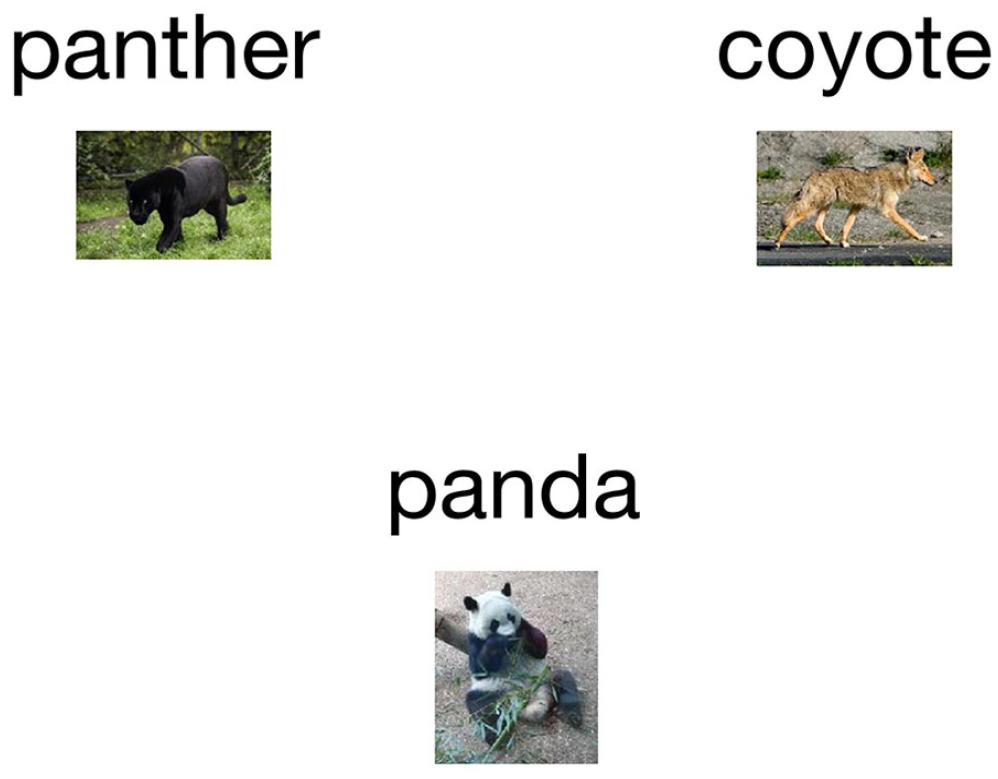
The panda problem triad used in the evolutionary-relatedness question.
The evolutionary-relatedness question was worded as follows: Which of A or B (the two choice taxa at the top of the image; panther and coyote in Figure 1) is the closer evolutionary relation to C (the target taxon at the bottom of the image; panda in Figure 1)?
The choice taxa for the experimental items were selected as follows: One taxon had a lexical match in Chinese with the target taxon. In the panda problem illustrated in Figure 1, panda (bear cat) has a lexical match with panther in Chinese because cat and panther are semantically related. To ensure the question was challenging for all participants, the other choice taxon (e.g., coyote in Figure 1), which was the correct answer based on data from evolutionary biology, was selected to be as comparable as possible in terms of size, habitat, and food source to the lexical-match choice in Chinese.
For the skunk radical item mentioned earlier, the two choice taxa were tree shrew and hedgehog. Tree shrew shares the mouse radical with skunk. Hedgehog is the correct answer. For the eight experimental trials, the lexical-match choices for Chinese participants were the wrong answers. For two filler trials, the lexical-match choices for Chinese participants were the correct answers. We counterbalanced the left and right positions of the evolutionarily correct answers across the triads.
One might expect similar results for the evolutionary-relatedness questions as discussed in the Introduction for the inference questions, namely that Chinese participants will be more likely than English participants to select the lexical match (panther in Figure 1) as the closer evolutionary relation to the target taxon due to lexical activation from the matching constituent. However, it is important to note that the presence of the three photographs provides more, and more varied, information than does the single target taxon in the inference question. This gives all participants an opportunity to consider both (a) other obvious types of similarity among the taxa and (b) their prior knowledge of these specific taxa. This is particularly true because participants were unlikely to know the actual evolutionary relationships among the depicted taxa. Although we tried to make the two choice taxa as similar as possible in terms of size, habitat, and food source, it was not possible to perfectly control for everything. For example, in Figure 1, the panda and the panther are more similar in colour than the panda and the coyote. And those two taxon names start with the same three letters in English (pan).
Although the Chinese participants had additional information, which was unavailable to the English participants, that would point to the incorrect choice in taxon, there could have been other cues, that we did not realise in advance, which would lead other participants to the same answer. It is admittedly difficult to imagine all the incorrect bases for reasoning students might use when one knows the correct answer. Thus, although it is reasonable to predict that Chinese participants would respond less accurately on these questions than English participants due to the availability of lexical activation from constituents of the Chinese conjunctive concepts, we do not have high confidence in this prediction. Due to the influence of prior knowledge and perceptual similarities among the photographs we used, the Chinese and English participants could show similar response accuracy for these questions. In sum, the lexical activation prediction for the evolutionary relationship questions is much weaker than that for the inference questions, and we would not be surprised if it was not supported.
Background questionnaire
A background survey was used to collect demographic information and language background from participants after they completed the experiment. The demographic questions asked about participants’ sex, age, and ethnicity (the last for English participants only). In addition, participants were asked to self-report their proficiency in reading, writing, and speaking up to three languages using a scale with five levels (1 = beginner, 5 = native/bilingual). We provided a description (based on The US Department of State Language Proficiency Definition) of each level to help participants respond accurately (e.g., “Level 5—Native/Bilingual: You are a native speaker, or you are fluent like mother tongue”).
Language check question
The Chinese version also included a Mandarin Chinese comprehension check at the beginning of the experiment. The Chinese participants were asked to read a short paragraph about a person who fanatically enjoys drinking tea in teahouses (Wang, 1984). This excerpt is from an essay written by a renowned contemporary Chinese writer and requires native or bilingual reading proficiency to understand. Chinese participants had to answer a four-option multiple-choice question asking what the excerpt was about.
Procedure
Participants completed the online experiment through a survey programmed using Qualtrics (Qualtrics, Utah, February–September, 2021). The survey was written in either English or Chinese depending on the participant’s native language. The Chinese version of the programme was identical to the English version except for the language difference, the addition of the language check question, and the deletion of the ethnicity question in the background questionnaire. It is important to note that for the Chinese participants, every word in the Qualtrics programme was written in Chinese; there was no English anywhere. The programme was written first in English, then translated into Mandarin Chinese, and then translated back into English to make sure the content of the two programmes was the same.
Participants were instructed to complete the experiment on a laptop with a screen size of at least 13 in. to ensure they could view each question without scrolling. They were also told that they had to complete the study in one sitting. Given the institutional review board (IRB) determination that this study met the requirements for exempt review (Vanderbilt IRB #221210), students were given a brief description of the study and were asked to affirm that (a) the nature and purpose of the research had been sufficiently explained and that (b) they freely volunteered to participate in the study. Exempt studies do not require a formal consent form. Participants in the Chinese version of the programme completed the language check immediately after agreeing to participate in the study.
Participants began the experiment by reading the following instructions (the English version is shown here): In this study, you will see 23 sets of three living things. Each set will have two items on top and one item below it. Each item will be represented by both a picture and a verbal label. The two items on the top are choice items, and the item on the bottom is the target item. You will be asked two questions about the target item. The first question asks you which of the two choice items is the closer evolutionary relation to the target item. The second question asks you to make an inference about the target item based on some information you’re given. Please give your best answer to each question.
Students paced themselves while working through the trials. 2 Then they answered the demographic and language background questions. The last screen provided a short debriefing.
Results
Overview
Statistical analyses were conducted for the eight experimental items using SPSS 28.0. We did not distinguish the compound and radical items in the analyses for two reasons: (a) We had no basis for predicting a difference between the two types of conjunctive concepts, and (b) the compound and radical items involved different living things and thus could not be compared without controlling for item differences among living things. For both the inference and evolutionary relationship questions, a preliminary analysis of these items showed that there were no order effects, so we collapsed across the order factor for the analyses reported here. The practice and filler items were not analysed.
Inference questions
We hypothesised that the Chinese participants would, inappropriately, give higher ratings than the English participants that the target taxon shares an enzyme with an ancestor of the inference category that matches the compound or radical in the Chinese name of that taxon. We conducted a one-factor, between-subjects analysis of variance (ANOVA) comparing the mean ratings of Chinese and English participants. Consistent with our prediction, the Chinese participants (M = 3.89) gave a significantly higher mean inference rating than did the English participants (M = 3.30), F(1,68) = 16.17, p < .001, ηp2 = 0.19.
To determine whether our prediction was supported for both conjunction types, we conducted two Bonferroni-Holm-corrected between-subjects ANOVAs. Conjunction type was collapsed for the English participants because lexical activation from the conjunctions was only (potentially) relevant for Chinese participants; conjunction type was not discernible to the English participants. Consistent with our predictions, the comparison of Chinese participants’ ratings for the four compound items (M = 4.06) to the ratings of English participants for all eight stimuli (M = 3.30) was significant, F(1,68) = 22.16, p < .001, ηp2 = 0.25. The comparison of Chinese participants’ ratings for the four radical items (M = 3.72) to the ratings of English participants for all eight stimuli (M = 3.30) was significant, F(1,68) = 7.42, p < .01, ηp2 = 0.10.
A final question we examined was whether all eight experimental items showed higher inference ratings for Chinese than for English participants. Table 1 shows the mean inference rating for each item for participants from each language group. We conducted a post hoc, exploratory ANOVA for each item (see the Online Supplementary Material B). We found that three compound items (beaver, panda, gnu) and the skunk radical item yielded a sizable difference (i.e., p ≤ .05 in the post hoc ANOVAs) in ratings in the predicted direction between Chinese and English participants. The Chinese participants gave numerically higher ratings than the English participants for three of the four remaining items (all except lizard). We will discuss how these exploratory analyses inspired the design of Experiment 2 in the Discussion.
Mean inference ratings (1–6 scale) for individual target items.
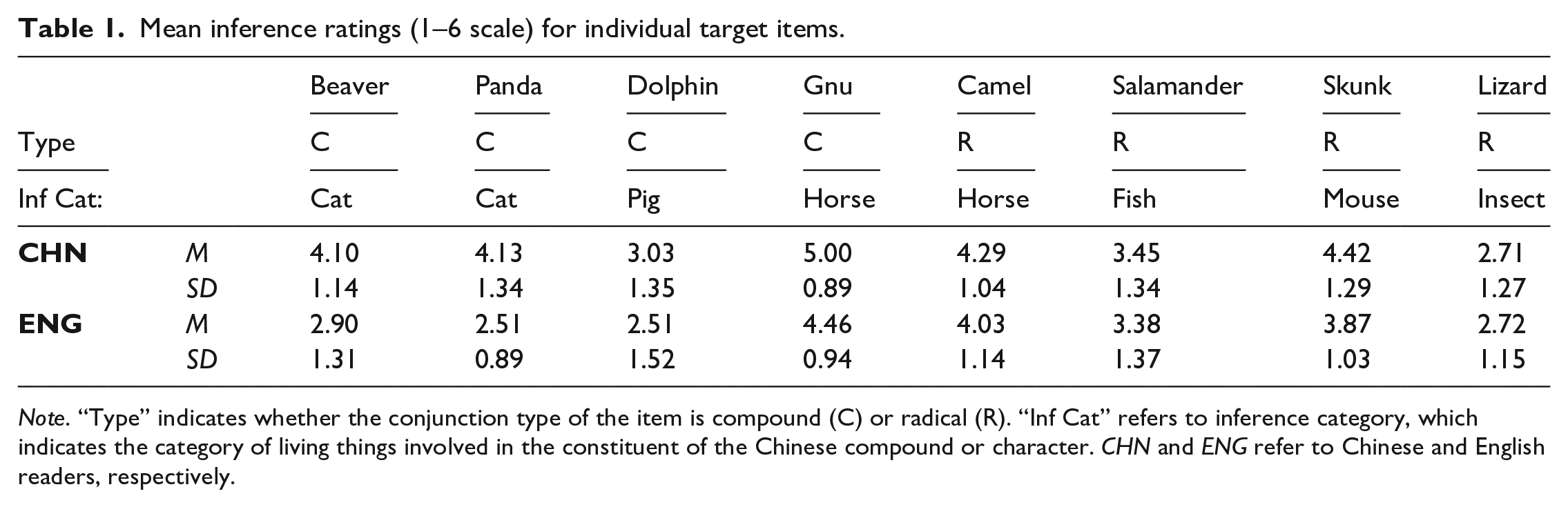
Note. “Type” indicates whether the conjunction type of the item is compound (C) or radical (R). “Inf Cat” refers to inference category, which indicates the category of living things involved in the constituent of the Chinese compound or character. CHN and ENG refer to Chinese and English readers, respectively.
Evolutionary-relatedness questions
As we suspected might happen, the evolutionary-relatedness question did not show a significant difference between Chinese and English participants. A one-factor, between-subjects ANOVA on mean accuracy for the eight experimental items revealed that Chinese and English participants were equally inaccurate in judging which of the two choice taxa has the closer revolutionary relation to the target taxon (MCHN = 0.29; MENG = 0.32): F(1,68) = 0.54, p = .47, ηp2 = 0.01.
Discussion
Lexical activation from constituents of Chinese animal names
Participants were asked to compare a specific animal (the target taxon), which was named as a conjunctive concept in Chinese, with an abstract ancestor of a group of animals (the inference category), which was defined by the constituent of the conjunction, to make an inference about how likely it is that the target taxon shares a cell-function-regulating enzyme with the constituent. Chinese participants had access to the lexical activation from Chinese characters and compounds while English participants did not. There were no alternative heuristics (e.g., folk-biological taxonomy) that would be used differently between Chinese and English participants in influencing their responses. The inference ratings supported our hypothesis that Chinese participants would use this lexical similarity heuristic to guide their category-based inductions: Chinese participants gave a significantly higher rating than did English participants for how likely it is that an animal that is named as a conjunctive concept shares a cell-function-regulating enzyme with a constituent of the conjunction. These results extend earlier research that has found effects of lexical activation from Chinese radicals and constituents of compounds on recognition and comprehension (e.g., Ma et al., 2016; Zhou et al., 1999) to also include such effects on inductive inferences.
The potential role of life form in supporting biological inferences
In the post hoc analyses (see Table 1 and the Online Supplementary Material B), we found that four of the eight items showed a sizable difference between Chinese and English participants in the predicted direction: beaver, gnu, panda, and skunk. The differences for three items were smaller: dolphin, camel, and salamander. Only lizard showed no difference between the two groups. We hypothesise that the size of the rating difference across items may reflect differences in whether the target taxon is of the same or a different life form as its constituent (i.e., the inference category). For example, panda (bear cat) and cat are the same life form (land mammals), whereas dolphin (sea domestic pig) and pig are different life forms (sea mammal and land mammal, respectively).
According to Berlin’s folk-biological classification system (Berlin, 1973; Berlin et al., 1973, 1974), life form (e.g., bugs, fish, birds, land mammals, sea mammals, trees) is one level of a hierarchy that describes how people naturally categorise plants and animals. As discussed in the Introduction, research indicates that the level of life form is an important determiner of how people who live in an urbanised environment intuitively categorise living things and engage in induction (e.g., Coley et al., 1997).
In Experiment 1, the items that yielded a large difference between the two language groups (beaver, gnu, panda, skunk) were all ones for which the target taxon is of the same life form as its constituent in the Chinese name. For example, skunk, which has a mouse side, and mouse are the same life form (land mammal). On the other hand, dolphin, lizard, and salamander are of a different life form than their constituents. For example, salamander, which has a fish side, and fish are different life forms (reptile/amphibian and fish, respectively).
The only item that provides an exception to this post hoc hypothesis concerning the importance of whether the life form matches or mismatches the target taxon is camel (horse side), as camel and horse are the same life form (land mammal). Although Chinese participants (M = 4.29) gave numerically higher ratings than English participants (M = 4.03), the difference was quite small. Participants from both language backgrounds might have been affected by their prior knowledge that camels are often used for the same purpose as horses (i.e., they both carry cargo for humans). We suspect that prior knowledge may have motivated English participants to believe that camels could use the same enzyme as an ancestor of the group that includes horses due to their perceived similarity in physical appearance and function.
Given these results, we hypothesise that Chinese participants’ inferences about the likelihood of a target taxon sharing a cell-function-regulating enzyme with its constituent are affected by whether the target taxon and the constituent are of the same life form. If the conjunctive concept is of the same life form as its constituent, the lexical similarity heuristic is warranted. But if the conjunctive concept is a different life form compared to its constituent, reasoners find it implausible that the conjunctive concept shares characteristics with its constituent. In this case, the lexical similarity heuristic is inhibited.
Given that the items for which Chinese participants gave a much higher rating than English participants (beaver, gnu, panda, skunk) all had the same life form as their constituents, the results of Experiment 1 also permit an alternative hypothesis: Chinese participants always give higher inference ratings than English participants when the target taxon and constituent are of the same life form. According to this alternative hypothesis, Chinese lexical activation does not contribute to the inference rating differences between Chinese and English participants. Rather, for some other (unknown) reason, Chinese participants believe that matching life form is a stronger criterion for induction than do English participants. Life form is the only factor that affected inference ratings. The design of Experiment 2 enabled us to test this life form only alternative hypothesis.
Specifically, in Experiment 2, we tested two hypotheses. The primary goal of that experiment was to determine whether life form moderates the effect of lexical activation on inferences—the life form plus lexical-match hypothesis, as suggested by our post hoc Experiment 1 item analysis. In addition, we tested the alternative life form only explanation of the Experiment 1 results.
Judging evolutionary relatedness
For the evolutionary relationship questions, Chinese participants were not more likely than English participants to pick the choice taxon that was a constituent match over the choice taxon that had a closer evolutionary relation to the target taxon. Although it would have been reasonable to find a similar effect of lexical activation for these questions as was found for the inference questions, as discussed in the Method section, we cannot rule out the influence of participants’ prior knowledge about or the observable similarities of the pictures of the three familiar taxa shown in the evolutionary relationship questions. If no prior knowledge was used to make the judgements of evolutionary relatedness, English participants’ accuracy should be around chance (0.50). Because their level of accuracy was below chance (M = 0.31), we believe these participants based their inferences on their prior knowledge about or their observations of the pictures of the three taxa. The similarly low accuracy of Chinese participants (M = 0.29) could be due to inaccurate prior knowledge, observations of the pictures, or the matching lexical information in written Chinese. Accordingly, in Experiment 2, we just used the inference question.
Experiment 2
The results of Experiment 1 suggested that the tendency for Chinese participants’ inferences to be affected by the constituents (semantic radical or component of compound) of the conjunctive concepts might be moderated by whether the conjunctive concepts were of the same life form as their constituents. Accordingly, we manipulated both language background (English vs. Chinese) and life form (same vs. different) in this study. The within-subjects factor of life form separated the target taxa, which were again conjunctive concepts, into two groups: those that had the same life form as their constituent (e.g., panda and cat; skunk and mouse) and those that had a different life form compared to their constituent (e.g., dolphin and pig; crocodile and fish). We included both compound and radical items as in Experiment 1. We hypothesised that when the target taxon was of the same life form as its constituent, Chinese participants would give a significantly higher inference rating than English participants that the target taxon shares a cell-function-regulating enzyme with its constituent. In contrast, when the target taxon was of a different life form compared to its constituent, we hypothesised that the rating difference between Chinese and English participants would be reduced or eliminated.
To test the alternative life form only hypothesis that the Experiment 1 results can be explained by Chinese participants believing that life form provides a stronger basis for inference than do English participants, in Experiment 2, we added a set of non-lexical-match items as controls. Each target taxon (e.g., skunk [mouse side], dolphin [sea domestic pig]) was paired with two inference categories: one that was derived from the constituent of the target taxon (i.e., a lexical match; e.g., mouse, pig) and one that was not a lexical match with the target taxon (but was similarly either of the same or a different life form; e.g., rabbit, dog). We predicted that Chinese participants would not give higher ratings than English participants when the target taxon and the inference category were of the same life form but the inference category was not the constituent of the target taxon. For example, we predicted that the Chinese participants would not be more likely than English participants to think that skunks (mouse side) share an enzyme with an ancestor of rabbits, an inference category that is of the same life form as a skunk but does not lexically match skunk. In other words, we hypothesised that life form does not dictate Chinese participants’ inference ratings but rather moderates the effect of lexical activation on their inference ratings.
Prior research (e.g., Atran, 1998, 1999) has found that people across cultures all categorise living things at the level of life form in the folk-biological taxonomy (Berlin, 1972, 1973). We expected all participants in our studies to have created similar life form categories (e.g., fish, insects, sea animals) because they all lived in an industrialised society and had access to the internet. Therefore, our final hypothesis was that there would be a main effect of life form: All participants should give higher ratings when the target taxon is of the same life form as the inference category than when it is of a different life form compared to the inference category.
Method
Participants
The participants were 71 adults (45 females, 26 males; Mage = 33.69, SDage = 11.39) recruited from Prolific (2022; www.prolific.co). The native (speaking and reading) language of 35 participants was English (23 female, 12 male; Mage = 34.40, SDage = 12.75), and the native (speaking and reading; reading in simplified Chinese characters) language of 36 participants was Mandarin Chinese (22 female, 14 male; Mage = 33.00, SDage = 10.02). Native language users were pre-screened for their first language on Prolific. Native simplified Chinese readers were additionally screened with the comprehension question used in Experiment 1 at the start of the experiment. This screening test prevented one ineligible person from participating in the experiment in simplified Chinese.
A power analysis using G*Power (Faul et al., 2007) based on the effect size of a pilot study of this research specified 66 participants to achieve 80% power. We recruited 83 participants after considering the higher attrition rate for participants recruited from data-collection websites than from the university subject pool. The data from 12 participants (6 from each language group) were excluded from the analyses, which left us with 71 participants for the data analyses. One English participant (96.75 min) and one Chinese participant (51.93 min) were excluded for spending more than two standard deviations above the mean completion time for their group completing the experiment (MENG = 17.49, SDENG = 15.19; MCHN = 14.64, SDCHN = 9.54). One English participant and one Chinese participant were excluded for not finishing the experiment. The other excluded participants were removed for a combination of three reasons (a few participants were excluded by more than one criterion) 3 : (a) the Qualtrics bot-detection function flagged them for potential response fraud (n = 6), (b) they spent too little time in the experiment (under 10 min; n = 6), and (c) they incorrectly answered two very easy filler questions (n = 4). These criteria were set before data collection to exclude data from likely distracted participants. There were no participants with missing data.
English participants were asked to report their race/ethnicity. Their responses were coded into four categories: White (66%), Black (14%), Asian (3%), Hispanic or Latinx (3%). Four participants (11%) provided responses that were not codable (e.g., South African).
Design and materials
The experiment has a 2 (language background: Chinese vs. English) × 2 (life form: same vs. different) design. Life form was a within-subjects factor. (We discuss the lexical-match “factor” below.) There were 31 target taxa (20 experimental target taxa and 11 filler target taxa): 10 experimental target taxa had the same life form as their constituents (e.g., panda and cat; skunk and mouse side), and 10 others had a different life form than their constituents (e.g., dolphin and pig; crocodile and fish side). We found additional items that were similar to those used in Experiment 1. Whether the target taxon has the same or a different life form as the inference category is determined by the name of the target taxon. For example, skunk is a same-life-form taxon because skunk (mouse side) is the same life form as the inference category of mouse family. Dolphin is a different-life-form taxon because dolphin (sea domestic pig) is a different life form compared to the inference category of pig family.
All participants received 62 trials presented in a random order, which included two trials for each of the 31 target taxa. For one trial, the inference category was a lexical match with the target taxon, and for one trial, it was not a lexical match. For example, an inference question in a lexical-match trial asked participants how likely skunks (mouse side) are to use the same enzyme to regulate cell function as an ancestor of the group that includes mice (Muridae). The non-lexical-match trial for this target taxon asked how likely it is that skunks use the same enzyme as an ancestor of the group that includes rabbits (Leporidae), which is not a lexical match with the target taxon. Using dolphin as another example, the inference questions for the lexical-match and non-lexical-match trials asked participants how likely dolphins (sea domestic pig) are to use the same enzyme to regulate cell function as an ancestor of the group that includes pigs (Suidae) versus dogs (Canidae), respectively.
The inference categories for both the lexical-match and non-lexical-match trials were of the same or different life forms as the target taxon depending on whether the target was a same-life-form taxon or different-life-form taxon. 4 We tried to make the inference categories in the lexical-match and the non-lexical-match trials as similar as possible in terms of life form, size, food sources, and habitats. However, this was not always feasible given that all stimuli were real living things. Hence, whether the inference category was a lexical-match of the target or not was not treated as an independent variable in this study. The non-lexical-match inference categories served as controls to test the alternative life form only hypothesis that Chinese participants believe that matching life form provides a stronger basis for inference than do English participants, regardless of whether there is a lexical match between the target taxon and the inference category.
As in Experiment 1, conjunction type was not the focus of this study. Our stimuli included 12 experimental compound items (22 trials) and 8 experimental radical items (16 trials). The greater number of compound than radical items is due to the nature of the Chinese language. In each trial, participants answered an inference question formatted similarly as in Experiment 1. The only change in the wording of the question was to replace “family” with “group.” For example, “An ancestor of Muridae, the family that includes mice” was changed to “An ancestor of Muridae, the group that includes mice.” This change in wording was needed because this experiment included a wider variety of taxonomic ranks (e.g., family, phylum, class) than Experiment 1. Providing a consistent description of the category of living things prevented participants from using the taxonomic ranks to inform their inferences. All participants answered the same background questionnaire used in Experiment 1.
Procedure
Participants completed an online experiment through Qualtrics (Qualtrics, Utah, September, 2022). They received a survey written in either English or simplified Chinese depending on their native language. The content of the two versions of the programme was nearly identical, as described for Experiment 1. The survey began by asking participants to set aside 40 min to complete the study in one sitting on a computer at least the size of a 13-in. laptop. Given the IRB determination that this study fell into the Exempt category, participants were given a brief description of the study at the beginning of the survey and were asked to affirm that (a) the nature and purpose of the research had been sufficiently explained and that (b) they freely volunteered to participate in the study. After reading the information sheet, participants read the following instructions (English version is given here): In this study, you will see 62 items of living things. Each item will be represented by both a picture and a label. You will be asked to make a judgment about the item based on some information you’re given. Please give your best answer to each question.
Participants paced themselves while working through all trials. The experiment concluded with the background questionnaire followed by a short debriefing paragraph.
Results
Predictions and analysis plan
We compared Chinese and English participants’ ratings of how likely the target taxon is to share a cell-function-regulating enzyme with an ancestor of the inference category. For the lexical-match trials, the inference category was the category of living things represented by the constituent of the conjunctive concept (e.g., mouse for skunks). Based on the results of Experiment 1, the main set of predictions concerned these items: Chinese participants were predicted to give higher ratings than English participants when the target taxon and its constituent are of the same life form. However, when the target taxon and its constituent are of different life forms, the rating difference was expected to be reduced or non-existent. In other words, we predicted that life form and language background would interact for lexical-match trials.
The non-lexical-match trials helped to determine whether (a) life form moderates the effect of lexical activation from conjunctive concepts on inference ratings or (b) dictates participants’ ratings. We hypothesised that Chinese participants would not give higher ratings than English participants when there was no lexical match between the constituent of the target taxon and the inference category. For example, the fact that pandas (bear cat) share the same life form as cows (land mammal) would not cause Chinese participants to give higher inference ratings than English participants because pandas do not share a lexical constituent with cows.
For both lexical-match and non-lexical-match trials, we also hypothesised that there would be a main effect of life form. Specifically, we predicted that all participants would give higher ratings for trials with same-life-form taxa than for trials with different-life-form taxa.
In summary, we planned two 2 (language background; between subjects) × 2 (life form; within-subjects) mixed ANOVAs using SPSS 29.0: one for lexical-match trials and one for non-lexical-match trials. We also planned to conduct a Bonferroni-corrected simple effect comparison for each ANOVA to compare the inference ratings of Chinese and English participants for each level of the life form factor.
Lexical-match items
The results for the lexical-match trials supported our primary prediction that life form moderates reasoning based on the lexical similarity heuristic. There was a significant interaction between language background and life form, F(1,69) = 7.99, p < .01, ηp2 = 0.10. The simple effect comparison showed that Chinese participants (MCHN = 3.98) gave significantly higher ratings than English participants (MENG = 3.55) for trials with same-life-form taxa, F(1,69) = 5.65, p = .02, ηp2 = 0.08. However, the two groups gave similar ratings (MCHN = 2.58; MENG = 2.57) for trials with different-life-form taxa, F(1,69) = 0.00, p = .98, ηp2 = 0.00.
As predicted, there was also a large main effect of life form, F(1,69) = 243.76, p < .001, ηp2 = 0.78. All participants gave higher ratings for trials with same-life-form taxa (MSAME = 3.77) than for trials with different-life-form taxa (MDIFF = 2.58). There was no main effect of language background, F(1,69) = 2.00, p = .16, ηp2 = 0.03.
Non-lexical-match items
The mixed ANOVA for the non-lexical-match trials also found a significant interaction between language background and life form, F(1,69) = 6.81, p = .01, ηp2 = 0.09. The simple effect comparison showed that Chinese participants (MCHN = 2.90) gave significantly lower ratings than English participants (MENG = 3.48) for trials with same-life-form taxa, F(1,69) = 8.42, p < .01, ηp2 = 0.11. The two groups gave similar ratings (MCHN = 2.01; MENG = 2.17) for trials with different-life-form taxa, F(1,69) = 0.88, p = .35, ηp2 = 0.01.
As for the lexical-match trials, there was also a large main effect of life form, F(1,69) = 185.03, p < .001, ηp2 = 0.73. All participants gave higher ratings for trials with same-life-form taxa (MSAME = 3.19) than for trials with different-life-form taxa (MDIFF = 2.09). There was a main effect of language background, F(1,69) = 4.90, p = .03, ηp2 = 0.07. Chinese participants (MCHN = 2.46) gave significantly lower ratings than English participants (MENG = 2.83).
Chinese participants’ low ratings or English participants’ high ratings or both in trials with same-life-form taxa contributed to the unexpected interaction and the main effect of language. We do not have a definitive explanation for the results of trials with same-life-form taxa when a lexical match was absent. However, it is clear that the results do not support the alternative life form only hypothesis and do not deviate from our prediction that Chinese participants would not give higher ratings than English participants for the non-lexical-match trials. Support for the alternative hypothesis would come from Chinese participants giving significantly higher ratings than English participants for trials with same-life-form taxa but not for trials with different-life-form taxa, regardless of whether there was a lexical match with the constituent. Our results showed that for non-lexical-match trials, Chinese participants gave lower ratings than English participants for trials with same-life-form taxa and gave similar ratings as English participants for trials with different-life-form taxa.
Discussion
The effect of lexical activation
Experiment 2 investigated whether life form moderates the effect of Chinese lexical activation on Chinese participants’ inferences about living things. For the relevant lexical-match trials, the results supported our hypothesis that life form moderates Chinese participants’ likelihood judgements of a conjunctive concept sharing a cell-function-regulating enzyme with its constituent. Chinese participants gave higher inference ratings than English participants that the target taxon shares an enzyme with its constituent only when the target taxon was of the same life form as its constituent. When the target taxon was of a different life from its constituent, there was no difference in the ratings for the two language groups. In other words, Chinese participants used the lexical similarity heuristic only when the outcome of making inferences based on lexical information did not violate the judgement heuristic based on folk-biological taxonomy (i.e., life form).
The results for the non-lexical-match trials ruled out the alternative life form only hypothesis that Chinese participants give higher ratings based solely on whether the target taxon shares a life form with the inference category. Chinese participants did not give higher inference ratings than English participants that the target taxon shares an enzyme with the inference category when the target taxon and inference category were not lexical matches but did have the same life form. These results allow us to conclude that life form moderates the effect of lexical activation from conjunctive concepts on, but does not dictate, Chinese participants’ inferences.
Consistent with our findings in Experiment 1, Chinese participants used constituents of Chinese conjunctive concepts (i.e., components of compounds and semantic radicals within Chinese characters) to guide their inductive inferences. However, this language-based similarity was only considered valid when it was consistent with the folk-biological categorisation of living things based on life form (Atran et al., 1997; Berlin et al., 1973; Coley et al., 1997).
The importance of life form
The main effect of life form for both lexical-match and non-lexical-match trials revealed, as expected, that the folk-biological categorisation of taxa based on life form is shared by Chinese and English participants. This finding is consistent with the conclusion given by Atran et al. (1997) that the level of life form is a privileged guideline for how people who live in an urbanised environment engage in category-based induction. In particular, Chinese participants were not more sensitive to life form than English participants as suggested by the alternative life form only hypothesis for the Experiment 1 results. When no language-based information was available (i.e., the non-lexical-match trials), the Chinese participants were not more likely than the English participants to judge that the target taxon shared an enzyme with an ancestor of the inference category.
General discussion
Language-based information informs biological inferences
Category-based induction is an important reasoning tool humans use to navigate in a world of uncertainty (Coley et al., 1997; Medin & Atran, 2004; Rips, 1975). In two studies, we asked participants to make an inference about how likely a target animal is to use the same enzyme to help regulate cell function as an ancestor of a group of modern animals. We used enzymes as the blank property because the likelihood of two taxa sharing an enzyme depends on their evolutionary history, which makes our task a biological inference task. We compared the inferences made by two groups of participants: English speakers who completed the experiment in English and Chinese speakers who completed the experiment in simplified Chinese.
When making judgements under uncertainty, heuristics are efficient shortcuts of thinking that are effective most of the time but occasionally lead to systematic biases (Tversky & Kahneman, 1974). For example, a heuristic based on folk-biological knowledge, acquired through experience with the natural world, is often used to make inferences about living things. This heuristic supports appropriate inferences when folk-biological and scientific taxonomies overlap but can lead to inappropriate inferences when the taxonomies diverge. Consistent with prior research (e.g., Novick & Catley, 2014), English-speaking participants were expected to use their knowledge about living things based on folk-biological taxonomy rather than evolutionary history to answer our inference questions. For example, one inference question asked how likely pandas are to use the same enzyme to help regulate cell function as an ancestor of modern cats. English participants might consider the life form, habitat, diet, and physical appearance of pandas and cats with which they are familiar. Although pandas and cats are the same life form (land mammals), they are otherwise quite different animals. Thus, English participants would probably judge that pandas are not very likely to use the same enzyme to help regulate cell function as the ancestor of Felidae.
Chinese participants presumably also consider folk-biological information when faced with a biological inference task. However, these participants, who were reading the experiment materials in simplified Chinese, had additional information they could use to inform their category-based inductions: the names of the animals. For example, panda is called bear cat in Chinese. Chinese participants might judge that bear cat and an ancestor of modern cats are likely to share the same enzyme because they share the sub-word element cat.
Many Chinese animal names are conjunctive concepts that include the name of another animal as a constituent. We proposed that the lexical similarity heuristic, a judgement heuristic based on a matching component in the names of living things, can also support biological inferences. This would affect how Chinese people make inferences about living things whose names are conjunctive concepts. The results of Experiment 1 supported our hypothesis: When the target taxon shared a constituent (a component of a compound or a semantic radical) with a group of animals represented by the constituent, Chinese participants gave significantly higher inference ratings than did English participants. For example, Chinese participants gave higher likelihood ratings than did English participants that pandas (bear cat) share an enzyme with an ancestor of modern cats and that skunks (mouse side) share an enzyme with an ancestor of modern mice. The systematic higher inference ratings compared to English participants showed that the similarity in lexical information is a judgement heuristic that Chinese participants were prone to use. Knowing that an ancestor of the inference category has an evolutionarily-relevant characteristic, Chinese participants were affected by lexical activation when they saw that the constituent of the target taxon’s name matched the inference category.
Prior research on the effects of lexical activation focused on the recognition and comprehension of Chinese characters and compounds (e.g., Y. P. Chen & Allport, 1995; Ding et al., 2004; Feldman & Siok, 1999; Ma et al., 2016; Zhou et al., 1999). We found that the lexical activation discussed in that research also extends to how Chinese participants make inferences. This extension deepens the understanding of how Chinese readers process Chinese characters and compounds. In addition to the meaning of characters and words, the activation of constituents within Chinese characters and words can elicit the associated concepts and knowledge related to these constituents. For example, the mouse side of the character in the word skunk can activate not only the meaning of the character (i.e., the animal mouse) but also that mice can be found in habitats such as forests or human dwellings, and mice can feed on grains and fruits. The associated concepts and knowledge can also be biological characteristics (e.g., an enzyme) specified in the context of a biological inference question.
The constraint of life form
Based on the post hoc item analyses in Experiment 1, we proposed that the effect of lexical activation on Chinese participants’ inferences was affected by life form, one level of the folk-biological classification that characterises how people naturally categorise living things (Atran, 1999; Berlin et al., 1973). In particular, we hypothesised that Chinese participants are more likely to use the lexical information about a matching constituent to inform their inferences when the target taxon and the inference category are of the same life form than when they are of different life forms. Specifically, we predicted that Chinese participants would give higher ratings than English participants when the target animal was of the same life form as its constituent but not when the target animal was of a different life form compared to its constituent.
The results of Experiment 2 supported these hypotheses. In addition, the results ruled out an alternative explanation for the Experiment 1 results that Chinese participants always give higher ratings than English participants when the target animal and the inference category are of the same life form (regardless of whether there is a lexical match between the target taxon and the inference category). When the inference category was not the constituent of the target animal (i.e., no lexical match and thus no effect of lexical activation), Chinese participants did not give higher inference ratings than English participants for same-life-form taxa. In summary, Chinese participants’ inferences were moderated but not dictated by life form.
More generally, our results support previous research on the importance of life form as a basis for supporting inferences (Atran, 1999; Atran et al., 1997). The inference ratings of all participants further supported the findings of Atran and colleagues that the level of life form in the folk-biological classification hierarchy is universal across cultures: Both Chinese and English participants provided higher inference ratings when the target animal shared the same life form as the inference category than when the target animal had a different life form compared to the inference category. Although we had no basis for considering the correctness of participants’ inferences in this study, their intuition to use life form as a guideline was reasonable. Animals of the same life form are generally more likely to share biological characteristics than are animals of different life forms.
Language and thought
The results of our research might call to mind the Sapir-Whorf hypothesis: According to Brown (1976; see also Kay & Kempton, 1984), linguistic differences between two cultures will be paralleled by non-linguistic cognitive differences. A weak version of this linguistic relativity hypothesis is that language background influences speakers’ perceptions of the world. However, our research was not designed to address this hypothesis. We did not test whether Chinese participants’ perception and conception of the target animals were affected by the constituents of the words and characters that represent those animals. For example, we did not ask participants whether they believe that skunks are related to mice or that pandas and cats are related. We also did not ask them to judge how similar skunks are to mice or pandas are to cats. Rather, we investigated whether Chinese participants heuristically considered the names of the animals to be informative for their inferences when prior knowledge did not yield a definitive answer. The different ratings given by Chinese and English participants for the likelihood of a target animal sharing a characteristic with a presumably extinct animal are not enough evidence to suggest that Chinese and English people perceive that animal differently on a daily basis.
To explore the connection between the Sapir-Whorf hypothesis and lexical activation from Chinese conjunctive concepts, future research could investigate whether lexical activation affects Chinese people’s understanding of the biological world. Methodologies employed by Boroditsky and colleagues (e.g., Boroditsky, 2001; Boroditsky et al., 2003, 2011; see also Miles et al., 2011) may inspire other evaluations of participants’ conception of animals. For example, Boroditsky and Schmidt asked German and Spanish speakers to remember a list of object-name pairs (e.g., chair-Mary, apple-Harry). They found that participants were able to remember word pairs better when the grammatical gender of the object was congruent with the gender of the name. In the context of lexical activation of constituents of animal names in Chinese, future research might test Chinese and English participants’ memory for pairs such as skunk-mouse or panda-cat, in comparison to skunk-rabbit or panda-cow (or skunk-cat and panda-mouse).
Conclusion
When Chinese people encounter unfamiliar characters, lexical information in the characters is a handy heuristic that allows them to infer the character’s meaning. Although this heuristic might lead to judgement errors and biases in some circumstances, such as those investigated in our research, it is a useful tool for navigating the complex world of Chinese characters because it is helpful most of the time. For example, ant is “蚂蚁” (insect side) in Chinese: Ants are indeed insects and are highly likely to share biological characteristics with other insects. Similarly, Chinese readers may correctly guess that the word “鹩鹛,” which contains two rarely used characters, represents a type of bird based on the radical of “鸟” (bird side) on the right side of both characters. The character “蕔” discussed at the beginning of this article demonstrated a scenario in which the sub-lexical element heavily influenced the first author’s (limited) understanding of this living thing: the “grass hat” or “艹” tells Chinese readers that this may be a type of herbaceous plant. Unfortunately, “蕔” does not have an English translation: it is a type of plant documented in ancient Chinese books. While sub-lexical and sub-word elements in Chinese such as “艹” may have helped ancient Chinese people categorise a newly-discovered plant and name it in text, “艹” also shapes modern Chinese people’s understanding of “蕔,” whose exact appearance and characteristics are lost in time.
Supplemental Material
sj-docx-1-qjp-10.1177_17470218241302677 – Supplemental material for The effect of lexical semantic activation on reasoning about evolution: A cross-linguistic study
Supplemental material, sj-docx-1-qjp-10.1177_17470218241302677 for The effect of lexical semantic activation on reasoning about evolution: A cross-linguistic study by Jingyi Liu and Laura R Novick in Quarterly Journal of Experimental Psychology
Footnotes
Acknowledgements
The authors thank Zhiyang Liu for translating the English materials into Chinese in this research. The authors also thank their undergraduate research assistants, Celia Waldman, and Eliza Lewis, for their incredible insights and hard work in this research.
Declaration of conflicting interests
The author(s) declared no potential conflicts of interest with respect to the research, authorship, and/or publication of this article.
Funding
The author(s) disclosed receipt of the following financial support for the research, authorship, and/or publication of this article: This research was funded by Vanderbilt University (given to the first author).
Ethical approval
IRB approval was granted by Vanderbilt University IRB #202223.

Notes
References
Supplementary Material
Please find the following supplemental material available below.
For Open Access articles published under a Creative Commons License, all supplemental material carries the same license as the article it is associated with.
For non-Open Access articles published, all supplemental material carries a non-exclusive license, and permission requests for re-use of supplemental material or any part of supplemental material shall be sent directly to the copyright owner as specified in the copyright notice associated with the article.
