



Abstract
Backward crosstalk effects (BCEs) are observed in dual-task studies when characteristics of Task 2 influence Task 1 performance. When Task 2 is a go/no-go task, responses in Task 1 are slower when Task 2 is a no-go as compared with a go trial. This no-go BCE has been argued to be due to response inhibition spilling over from Task 2 to Task 1. Growing evidence shows that response inhibition elicits negative affect leading to affective devaluation of associated stimuli. We tested for a functional role of the negative affective consequence of response inhibition in the no-go BCE by investigating its interaction with affective processing in Task 1. In four experiments, Task 1 was a valence categorisation task, and Task 2 a go/no-go task. In all experiments, the no-go BCE strongly depended on affective processing in Task 1. While this modulation could be attributed to an affective (mis)match between stimulus features in both tasks in Experiments 1 and 2, Experiments 3 and 4 provided evidence for an affective (mis)match between stimulus valence in Task 1 and affective consequences of Task 2 response inhibition. The results are discussed in the context of current theories of no-go BCEs in dual tasks.
Introduction
Dual tasking refers to a situation in which individuals aim to perform two tasks at the same time. This can range from simple tasks such as walking and talking, to more complex and challenging tasks such as checking e-mails while having a conversation on the phone. Although dual tasking is a prevalent phenomenon across all sectors of life, it often comes with performance costs, which refer to an increase in error rates and/or response latencies in one or both tasks when they are performed together, compared with when they are performed separately (Pashler, 1994; Welford, 1952). Researchers have taken a keen interest in studying the source of these performance costs as the understanding of their origin may offer possibilities for the optimisation of dual-task performance, for example, in applied contexts such as driving or for elderly individuals who experience difficulties when performing two tasks at once.
In cognitive psychology, the psychological refractory period (PRP) paradigm has become a popular paradigm to study the source of these performance costs (Pashler, 1994; for reviews, see Fischer & Janczyk, 2022; Koch et al., 2018). In this paradigm, stimuli of two tasks, S1 and S2, are presented in close succession, requiring quick serial responses to each of the stimuli (Pashler, 1994; Welford, 1952). An important manipulation in the PRP paradigm is the variation of the temporal interval between the two stimuli for each task, that is, the stimulus onset asynchrony (SOA). It allows for temporal sequencing of mental processes and an exact assessment of dual-task load, which increases the more both tasks temporally overlap. While the reaction time in Task 1 (RT1) is usually unaffected by SOA manipulation, especially the RT2 increases greatly the shorter the SOA (Pashler, 1994). This effect, known as the PRP effect, is explained by the response-selection bottleneck (RSB) model (Pashler, 1984, 1994; Welford, 1952), which attributes the increase in RT2 at short SOA to a capacity-limited processing bottleneck at the response-selection stage, which can only process one task at a time. Because of the assumed all-or-none bottleneck, response selection in Task 2 needs to wait until the corresponding response-selection processes in Task 1 are completed. While the PRP effect is a robust phenomenon, the nature of the processing limitation, for example, structural, strategic, or functional, is still debated (see Fischer & Janczyk, 2022; Musslick & Cohen, 2021).
Backward crosstalk effects
According to the original RSB model, Task 2 response selection should not affect Task 1 response-selection processes. In conflict with this strict claim, many studies have shown that the two tasks are not processed independently of each other and have reported effects where response features of Task 2 influence the ongoing response selection of Task 1 (e.g., Hommel, 1998; Schubert et al., 2008; for a review, see Fischer & Janczyk, 2022). These effects, known as backward crosstalk effects (BCEs), challenge the RSB model’s assumption that Task 2 response selection cannot begin before Task 1 response selection is completed.
Hommel (1998), for example, showed a BCE based on a shared dimensional overlap between the response features of two tasks. The letters H or S were presented in red or green, and participants were instructed to respond to the colour of the letter with a left or right button press in Task 1. In Task 2, participants were instructed to verbally respond “left” or “right” depending on the identity of the letter. In a compatible condition, the spatial code for both tasks matched, for example, pressing the right key for Task 1 and uttering “right” in Task 2. In contrast, pressing the right key for Task 1 and saying “left” in Task 2 denoted an incompatible condition. Responses in Task 1 were faster in compatible conditions as compared with incompatible conditions. This backward crosstalk showed that stimulus–response translation processes in Task 2 must occur prior to the completion of response-selection processes in Task 1 in order to influence them. To account for these results within the RSB framework, Hommel (1998) proposed to divide the original response-selection stage into a capacity-unlimited automatic response activation stage, responsible for the stimulus–response translation, followed by a capacity-limited response-selection stage (see also Lien & Proctor, 2002). Subsequent research has argued that automatic response activation processes in Task 2 are the source of the BCEs, while the response selection in Task 1 is its locus (see Janczyk et al., 2018; Thomson et al., 2015). Since the original study by Hommel (1998), many studies have reported BCEs with various dimensional overlap and experimental designs (e.g., Ellenbogen & Meiran, 2011; Fischer et al., 2007; Fischer & Hommel, 2012; Hommel & Eglau, 2002; Janczyk, 2016; Janczyk et al., 2014; Koob et al., 2020; Logan & Delheimer, 2001; Logan & Schulkind, 2000; Lück et al., 2023; Plessow et al., 2017; Scherbaum et al., 2015). In contrast to these so-called compatibility-based BCEs, other types of BCEs do not require an apparent dimensional overlap between the two tasks. For example, Miller and Alderton (2006) found that the force required to respond in Task 2 (soft vs. hard keypress) influenced the task-irrelevant force dynamics of the response in Task 1. Another type of BCE that arises without any dimensional overlap and has received much attention in the past decade is the so-called no-go BCE (Miller, 2006). It reflects the slowing of Task 1 response execution when Task 2 does not require a response, that is, a no-go response.
Miller (2006) first reported the no-go BCE, where Task 1 required a manual-choice response and Task 2 was a go/no-go task. In Task 1, participants were instructed to respond to the identity of the letter (X vs. O) with their left index or middle finger. In Task 2, participants responded to the pitch of the tone (e.g., high tone) with their right index finger in go-trials and withheld their responses to Task 2 in no-go trials (e.g., low tone). Miller (2006) observed increased RT1 when Task 2 was a no-go compared with a go. The no-go BCE was explained by the inhibition hypothesis, according to which inhibition from not executing a prepared response in Task 2 spills over to Task 1 and conflicts with the activation of a motor response in Task 1 (Miller, 2006). Since then, the no-go BCE has been replicated with different stimulus modalities in Task 2 (Durst & Janczyk, 2019; Durst et al., 2019; Mahesan et al., 2021), different response types, such as pedals (Durst & Janczyk, 2019) and mouse responses (Schonard et al., 2022), and also in combination with BCEs resting on dimensional overlap (Mahesan et al., 2021).
The exact locus at which the no-go backward crosstalk interacts with Task 1 processing, however, is still of debate. While some studies suggest a locus at (pre)bottleneck stages of Task 1, such as response selection (e.g., Ko & Miller, 2014; Röttger & Haider, 2017), others argue for a rather late post-bottleneck locus of the no-go BCE (e.g., Durst & Janczyk, 2018, 2019; for a more detailed discussion, see Schonard et al., 2022 and “General discussion” section).
Irrespective of its assumed locus, the assumption that the no-go BCE in Task 1 arises due to a general effect of inhibition due to suppressing a prepared response in Task 2 no-go trial is quite popular and has received much support (Durst & Janczyk, 2018, 2019; Schonard et al., 2022, but see Röttger & Haider, 2017). Janczyk and Huestegge (2017), for example, proposed a direct link between the strength of inhibition and the size of the no-go BCE, demonstrating that the stronger the advanced task preparation, the greater the active inhibition required to overcome the prepotent tendency to respond, resulting in a larger no-go BCE. At the same time, the characteristics of the underlying inhibition are to date only poorly understood. While response inhibition has been extensively studied for its role in executive control systems (Munakata et al., 2011; Verbruggen & Logan, 2008), there is much empirical and theoretical evidence that inhibition also impacts the emotional salience of associated stimuli (Clancy et al., 2019; De Vito et al., 2017; Doallo et al., 2012; Driscoll et al., 2020; Fenske et al., 2005; Gollwitzer et al., 2014; Kiss et al., 2008). The following section briefly reviews the link between affect and response inhibition, leading to the question of whether an affective component of no-go also contributes to the no-go BCE.
Affect and response inhibition
Inhibitory mechanisms are essential in cognitive processing and are recruited to suppress the activation and/or representation of irrelevant objects or responses (Arbuthnott, 1995; Gorfein & MacLeod, 2007; Koch et al., 2010; Nigg, 2000). Research points towards strong evidence interlinking such cognitive-control mechanisms and emotion, where they interact and integrate to steer adaptive behaviour (Fenske & Raymond, 2006; Raymond, 2009). One of the first studies investigating the effects of attentional selection and subsequent emotional evaluation was demonstrated by Raymond et al. (2003). In their study, abstract images were displayed either on the left or the right. The participants were to report the location of the target image while ignoring the distractor. Subsequent “cheerfulness” ratings showed distractors were rated more negatively than targets or novel unseen images. Thus, ignored stimuli were devalued, and the link between this emotional devaluation and attention is proposed to be mediated by inhibitory processes (Raymond, 2009).
Importantly, inhibitory processes, such as response inhibition, also trigger affective responses and consequently change how the associated stimuli are evaluated (Chen et al., 2016; Clancy et al., 2019; De Vito et al., 2017; Doallo et al., 2012; Driscoll et al., 2020; Driscoll et al., 2018; Kiss et al., 2008). For example, Kiss et al. (2008) investigated whether inhibiting responses would lead to an emotional devaluation of the inhibited (no-go) stimulus by recruiting a go/no-go paradigm in which participants discriminated between Asian and Caucasian faces. Faces of one ethnic group were labelled as go-trials and participants responded with a key press. Faces of the other ethnic group served as no-go trials, where participants were instructed to refrain from responding. The go/no-go task was followed by an evaluation task, in which participants rated the trustworthiness of the faces from the prior block on an evaluation scale. The results revealed that the faces associated with no-go trials were rated less trustworthy than the faces associated with go trials. This pattern of results has been replicated with various visual stimuli (Clancy et al., 2019; Clancy et al., 2020), showing that stimuli in which a response was withheld were rated as more negative than novel stimuli or go stimuli. Furthermore, stimuli associated with no-go responses even led to greater behavioural avoidance (Driscoll et al., 2018) and showed reduced motivation towards behavioural approach (Driscoll et al., 2018; Ferrey et al., 2012).
The immediate-affect account has been proposed to explain these devaluation effects, according to which inhibition immediately elicits a negative affect and thereby updates the coding of stimulus value (Clancy et al., 2019; Fragopanagos et al., 2009). Indeed, various neuroimaging (De Vito et al., 2017; Doallo et al., 2012) and psychophysiological studies (Clancy et al., 2019) have shown that the size of the stimulus devaluation is connected to the size of the inhibitory response. For example, Clancy et al. (2019) tested the immediate-affect account by measuring facial muscle activity, which is an indirect marker of underlying affective reactions. Their results showed that stimuli associated with a no-go response were not only affectively devalued but also that the magnitude of facial muscle activity associated with negative affect during inhibition predicted the later devaluation of no-go stimuli. Similar links were observed in imaging studies (De Vito et al., 2017; Doallo et al., 2012), thus providing converging evidence in support of the immediate-affect account.
The present study
Response inhibition has been argued to represent the underlying mechanism of the no-go BCE. Not responding to a no-go stimulus in Task 2 is realised by inhibiting the prepotent response tendency. This response inhibition conflicts with activating a response in Task 1. At the same time, there is strong evidence for the claim that response inhibition is associated with an affective consequence, in that the no-go stimulus is rated more negatively than go or novel stimuli.
In the present study, we aimed to investigate whether the affective consequences of response inhibition, that is, the aversiveness of not responding in Task 2, could make any contribution to the slowing of Task 1 processing. From this perspective, the negative affect of response inhibition should interact with Task 1 processing depending on the affective quality of Task 1 stimuli. That is, the size of the no-go BCE should be determined by the affective match or mismatch between Task 1 affective stimuli and the negative affect triggered by the response inhibition in Task 2. To test this assumption, we investigated the no-go BCE in dual tasks while introducing affective stimuli (positive vs. negative) in Task 1 and a simple go/no-go categorisation of stimuli in Task 2.
We expected that the inhibition-triggered negative affect conflicts with the processing of positive stimuli in Task 1. This should slow responding in Task 1 and increase the no-go BCE. Processing negative stimuli in Task 1, on the contrary, is affectively congruent with the negative affective consequence of response inhibition in Task 2. This affective match would not induce slowing of Task 1 processing and would lead to a reduced no-go BCE. Therefore, processing positive stimuli in Task 1 should increase, and processing negative stimuli in Task 1 should decrease the no-go BCE. The no-go BCE should be of intermediate size when affectively neutral stimuli are used in Task 1 (see Experiment 2).
Finding an interaction between Task 2 no-go trials and the affective processing in Task 1 is of theoretical importance for various reasons: First, it would provide further support for previous findings, showing that response inhibition is affectively connotated. Second, it would demonstrate that particularly the affective component of not responding contributes to the no-go BCE. In fact, it would imply the question to which extent the no-go BCE is an instance of an affective mismatch. Third, however, such an interaction would also have consequences with respect to the assumed origin and locus of the no-go BCE. Any interaction between the negative affective consequence of Task 2 response inhibition and valence processing in Task 1 needs to take place at central response-selection stages and thus locates the influence of an affective component of Task 2 response inhibition prior to the motor execution stage. If the affective component of the inhibition would act on the Task 1 response execution stage, no interaction with Task 1 valence categorisation should be observed.
Experiments 1a and 1b
Experiments 1a and 1b tested whether withholding a response in Task 2 interacts with the processing of affective stimuli in Task 1. Task 1 was a valence categorisation task in which participants responded to positive and negative words (Experiment 1a) or positive and negative facial expressions (Experiment 1b). In both experiments, Task 2 was a go/no-go task, in which colour served as a go- or no-go signal. The experiments were conducted in parallel as online experiments. We expected a large no-go BCE when Task 1 was positive stimuli as compared with negative stimuli, due to the affective mismatch between positive stimuli in Task 1 and the negative consequences of response inhibition in Task 2.
Experiment 1a—affective word stimuli in Task 1
Method
Participants
The sample size was adopted from a recent study investigating modulations of a no-go BCE (Mahesan et al., 2021). The respective 2 × 2 (two-levels) interactions yielded effect sizes between 0.21 and 0.28. A power analysis using MorePower 6.0.4 (Campbell & Thompson, 2012) revealed that an effect size of 0.21 (with a power of 0.8 and an alpha value of .05) required about 32 participants for the desired interaction between S1 valence and Task 2 trial-type. Therefore, we aimed for 32 participants but accepted additional participants who signed up for the experiment. In all, 33 participants (15 female; age = 17–34 years; Mage = 22.5 years, SD = 3.8; 31 right-handed) with normal or corrected-to-normal vision from the University of Greifswald took part in the experiment. The participants received course credits for participation and provided informed consent before the experiment. The study was conducted according to the Declaration of Helsinki and the ethical guidelines of the German Psychological Society.
Apparatus and stimuli
The experiment was conducted online. Consent and demographic information were collected using SoSci Survey (Leiner, 2019) and made available via www.soscisurvey.de. The experiment was created using Psychopy Builder (2020.2.4) and hosted on Pavlovia (https://pavlovia.org/). Stimuli were 192 affective German words taken from the Berlin Affective Word List—Reloaded (BAWL-R) (Võ et al., 2009) coloured in red or green, presented on a black background. Out of the 192 words, 12 words appeared in the practice block. In the experimental blocks, out of 180 words, 90 were positive (Mvalence = 1.5, Marousal = 2.7) and 90 negative (Mvalence = −1.6, Marousal = 3.5). The valence of the word served as Stimulus 1 (S1) and the colour of the word served as the stimulus for Task 2 (S2). Participants responded to S1 using their left index or middle finger (“a” or “s” key on the keyboard) and to S2 using their right index finger (“k” key) or withholding the response.
Procedure
In Task 1 of the dual task, participants were required to categorise an affective word stimulus as either positive or negative. Half of the participants responded with the left middle finger to positive and the left index finger to negative words. For the other half, the stimulus–response mapping was reversed. For Task 2, participants were instructed to respond with the right index finger when the word colour was green (go trial) and to withhold a response when the word colour was red (no-go trial). Participants were instructed to respond to the tasks serially, that is, to respond as fast and accurately as possible first to Task 1 and only after Task 1 response execution to Task 2.
A trial began with a fixation cross that stayed on the screen for 1,100 ms. The fixation cross was replaced by S1, which was presented in white on a black background. After an SOA of 100 ms S2 was presented, that is, the word colour turned either green or red. With S2 onset, the coloured word stimulus stayed on the screen for 2,500 ms or until response execution. Following the response, a single feedback was presented indicating whether both the responses were correct (“Richtig” in German) or if one or both of the responses were wrong (“Falsch” in German) for 500 ms.
The experiment began with 12 practice trials, followed by five experimental blocks of 36 trials each. A short break was provided between the blocks. In each experimental block, go trials were more frequent (66%, 24 trials) than no-go trials (33%, 12 trials), to ensure an increased preparatory state for executing a response to S2 and thus, to increase the required response inhibition in case of a no-go (Janczyk & Huestegge, 2017; Mahesan et al., 2021). As S1 consisted of 180 unique words, each of these words occurred exclusively with either a go or no-go S2.
Design and analysis
Practice trials were removed from the analysis. Before reaction time (RT) analysis, error trials in either of the tasks were removed (12.3%). RTs in either task above or below 2.5 SDs from the participant’s condition mean were considered as outliers and were also removed prior to RT analysis (2.4%). A 2 × 2 ANOVA with S1 valence (negative, positive) and Task 2 trial-type (go, no-go) as within-subject factors was conducted on the mean percent error in Task 1 (PE1) and RT1.
Results
The results of Experiment 1a are visualised in Figure 1 (left).
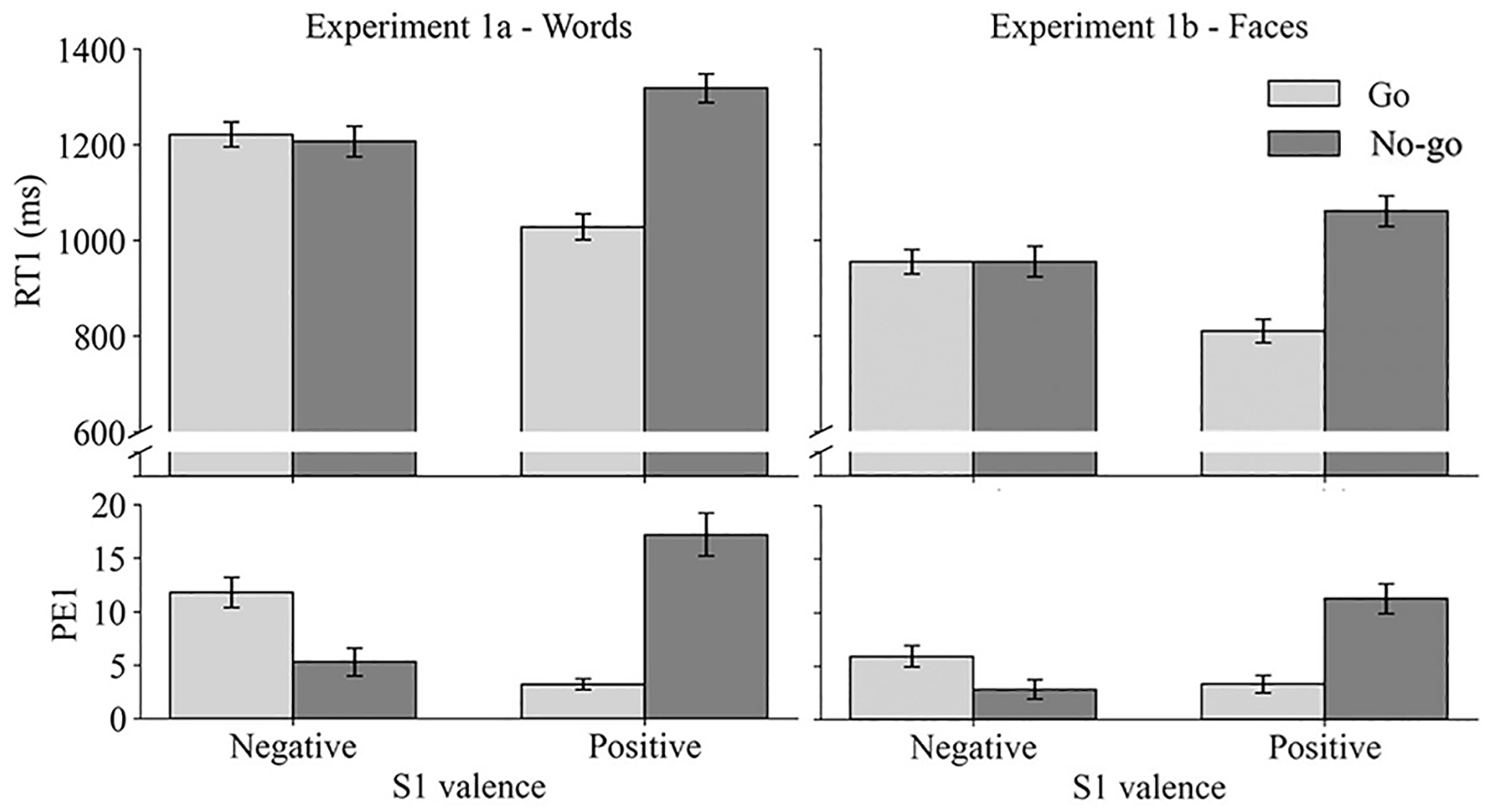
RT1 (in ms) and PE1 as a function of S1 valence (negative, positive) and Task 2 trial-type (go, no-go) for Experiment 1a (S1 words) and Experiment 1b (S1 faces). Error bars represent standard errors of the mean.
RT1
Participants were faster responding to positive words (1,173 ms) as compared with negative words (1,214 ms), F(1, 32) = 6.66, p = .015, ηp2 = .17. RT1s were increased by 138 ms when Task 2 was a no-go as compared with a go trial, F(1, 32) = 106.00, p < .001, ηp2 = .77, reflecting a substantial no-go BCE. Finally, the no-go BCE was influenced by S1 valence, F(1, 32) = 139.00, p < .001, ηp2 = .81. A large no-go BCE (290 ms) was observed when S1 was positive, t(32) = −13.34, p < .001, whereas the no-go BCE was absent when S1 was negative, t < 1.
PE1
The main effect of S1 valence was not significant, F(1, 32) = 2.38, p = .133, ηp2 = .07. Participants made more errors in Task 1 when Task 2 was a no-go (11.2%) as compared with go (7.5%), F(1, 32) = 10.49, p = .003, ηp2 = .25. Similar to RT1 data, the interaction between S1 valence and Task 2 trial-type was significant, F(1, 32) = 61.21, p < .001, ηp2 = .66. The no-go BCE was large when S1 was positive (13.9%), t(32) = −7.13, p < .001, but reversed when S1 was negative (−6.5%), t(32) = 4.37, p < .001.
Experiment 1b—affective face stimuli in Task 1
Method
Participants
A total of 39 participants (28 female, 1 diverse; age = 18–32 years; Mage = 21.5 years, SD = 2.9; 37 right-handed) with normal or corrected-to-normal vision from the University of Greifswald took part in the study. One participant was removed from the final analysis due to high error rates (>60% in Task 1), and one participant was excluded because of prior participation in Experiment 1a. Participants received course credits for participating in the study and provided informed consent before the start of the experiment. The study was conducted according to the Declaration of Helsinki and the ethical guidelines of the German Psychological Society.
Apparatus and stimuli
S1 were 108 faces from the Karolinska Directed Emotional Faces (Lundqvist et al., 1998) database, where 12 faces appeared in the practice block and the remaining 96 in the experimental block. Half of these faces displayed positive emotion (happy) and the other half were negative (sad). Of these faces, half belonged to females and the other half to males. S2 was again the colours green and red that now appeared around S1 as a border frame.
Procedure
The procedure was identical to Experiment 1a, except as noted otherwise. The experiment consisted now of eight experimental blocks of 36 trials each. Each experimental block contained the faces of three male and three female persons that displayed positive (happy) and negative (sad) facial expressions. These 12 affective faces were paired twice with an S2 go (green colour frame) and once with an S2 no-go (red colour frame). The stimulus–response mapping of Task 1 was counterbalanced.
Design and analysis
The design and analysis strategy remained the same as in Experiment 1a. Error trials (8.5%) of Task 1 and Task 2, as well as outliers (2.9%), were removed.
Results
The results of Experiment 1b are visualised in Figure 1 (right).
RT1
A no-go BCE was shown in that participants responded faster to Task 1, when Task 2 was a go (882 ms) as compared with a no-go trial (1,008 ms), F(1, 36) = 85.98, p < .001, ηp2 = .71. The main effect of S1 valence was not significant, F(1, 36) = 2.84, p = .100, ηp2 = .07. As in Experiment 1a, the no-go BCE was modulated by S1 valence, F(1, 36) = 104.07, p < .001, ηp2 = .74. When S1 was positive, a no-go BCE of 251 ms was produced t(36) = −11.98, p < .001, which was absent (0 ms) when S1 was negative, t < 1.
PE1
As in RT1, participants made more errors in Task 1 when Task 2 was a no-go trial (7.0%) as compared with a go trial (4.6%), indicating no-go BCE, F(1, 36) = 19.20, p < .001, ηp2 = .35. More errors were committed when S1 was positive (7.3%) compared with negative faces (4.3%), F(1, 36) = 22.62, p < .001, ηp2 = .39. Most importantly, the no-go BCE was modulated by S1 valence, F(1, 36) = 38.46, p < .001, ηp2 = .52. The no-go BCE was large when S1 was positive (8.0%), t(36) = -6.59, p < .001, and reversed when S1 was negative (−3.2%), t(36) = 3.68, p = .001.
Discussion
The results of Experiments 1a and 1b clearly showed that the no-go BCE was modulated by affective processing in Task 1. In both experiments, a large no-go BCE was found when S1 was positive. And it was completely eliminated in RT1 or even reversed in PE1 when S1 was a negative word (Experiment 1a) or a face with a negative expression (Experiment 1b).
As suggested, negative affect elicited by response inhibition (Clancy et al., 2019; Fragopanagos et al., 2009) in Task 2 no-go trials may interact with the processing of a positive S1, resulting in an affect mismatch and thus a large no-go BCE. However, the size of the no-go BCE when processing a positive stimulus in Task 1 was astonishingly large (i.e., 290 and 251 ms for Experiments 1a and 1b, respectively) compared with an average no-go BCE of about 50 ms in previous studies using affectively neutral stimuli (Durst et al., 2019; Mahesan et al., 2021; Miller, 2006). At the same time, the observed complete elimination (RT1) or reversal (PE1) of the no-go BCE when processing a negative stimulus in Task 1 is quite surprising, as a reversed BCE is usually found when advanced task preparation is reduced. In the present experiments, we deliberately introduced more go trials as compared with no-go trials in Task 2 to ensure sufficient preparedness for response execution.
To further investigate the interaction between affective Task 1 processing and Task 2 trial-type, we aimed to address a confounding factor in the experiments that makes it difficult to interpret the results to the full extent. That is, Task 2 stimuli were not counterbalanced when serving as go or no-go stimulus. The colour red in Task 2 always signalled a no-go trial, whereas the colour green always signalled a go trial. Given, the nature of the colours and the meaning associated with them, green could be associated with a positive affect, whereas red could be associated with a negative affect (Kuhbandner & Pekrun, 2013; Moller et al., 2009). Therefore, the interaction with affective Task 1 processing could in principle be caused by affective stimulus features of S2 (e.g., red colour—negative association) and less so by the negative affective consequences of not responding to the no-go stimulus. This potential affective connotation of the colours red and green could limit the explainability of our results via the inhibition-affect hypothesis. We addressed this issue first, by counterbalancing the Task 2 stimulus–response assignment in Experiment 2 and second, by using affectively neutral Task 2 stimuli in Experiment 3.
Experiment 2
The goal of Experiment 2 was two-fold: First, we aimed to determine to what extent the negative consequences of response inhibition in Task 2 and/or the affectively connotated stimulus features of S2 (i.e., red colour—negative and green colour—positive) are the driving force of the interaction between affective S1 processing and Task 2 trial-type. Second, we aimed to replicate the results of the previous experiments with a different no-go modality. Instead of colours, we now used a high versus low tone as stimuli in Task 2. Stimulus–response assignments were counterbalanced such that half of the participants received a high tone as a no-go stimulus, whereas the other half received a low tone as a no-go stimulus. In Task 1 we implemented a three-choice task, in which participants responded to negative, positive, and neutral words. The combination of high and low tones as either go or no-go stimulus in Task 2 with an affectively neutral stimulus condition in Task 1 mirrored previous studies demonstrating reliable no-go BCEs (e.g., Miller, 2006). Thus, we expected a standard no-go BCE for neutral word stimuli in Task 1. In addition, however, tone frequency is also linked to certain affective effects. A low tone is associated with negative affect, whereas a high tone is generally associated with positive affect (Horstmann, 2010; Morton, 1994). Therefore, we further expected an interaction between Task 2 trial-type and the affective word conditions in Task 1. There are at least two possible outcomes:
First, if the result patterns in Experiments 1a and 1b (i.e., a large no-go BCE for positive S1 and an eliminated no-go BCE for negative S1) were due to the negative affect triggered by Task 2 response inhibition, we expected to replicate our previous results irrespective of the counterbalancing condition. The negative affect of not responding should be elicited by response inhibition following any no-go stimulus. It is conceivable, though, that a positive no-go stimulus (e.g., high tone) may reduce the negative affect of response inhibition. In this case, the interaction would be less pronounced when the S2 no-go stimulus is positively connotated (high tone) as compared with when S2 no-go stimulus is negatively connotated (low tone).
On the contrary, if the mere (mis)match between affective stimulus features of S1 and S2 is the driving force of the result patterns in Experiments 1a and 1b, we should expect a fast Task 1 response when the affective features of S1 and S2 match and slower Task 1 response when they mismatch. Thus, a high tone in Task 2 should generally facilitate responding to positive words and slow responding to negative words in Task 1. Accordingly, a low tone in Task 2 should facilitate responses to negative words and slow responses to positive words in Task 1. As a consequence, this results in different predictions for the no-go BCE in each S2-response assignment. When low tones serve as no-go, positive S1 are responded to fastest when S2 is a high tone (go), reflecting an S1-S2 affective match, and slowest when S2 is a low tone (no-go), reflecting an S1-S2 affective mismatch. Analogously, responses should be slow to a negative S1 when S2 is a high tone (go), representing an affective mismatch, and fast when S2 is a low tone (no-go), representing an S1-S2 affective match. Together, this results in a pattern of a large no-go BCE for positive S1 and a reduced or eliminated no-go BCE for negative S1 as in Experiments 1a and 1b. Quite the opposite pattern is expected when high tones serve as no-go. Here, negative S1 is responded to fastest when S2 is a low tone (go), reflecting an S1-S2 affective match. Responses to a negative S1 are slowest when S2 is a high tone (no-go), reflecting an S1-S2 affective mismatch. Importantly, this creates a pattern of a large no-go BCE for negative S1, which is the reversed result pattern as in Experiments 1a and 1b.
Method
Participants
In all, 32 participants (21 female; age = 18–30 years; Mage = 23.1 years, SD = 3.1, 28 right-handed; 1 ambidextrous) with normal or corrected-to-normal vision from the University of Greifswald took part in the experiment. They received course credits or monetary compensation (4 Euro) for participation and provided informed consent before the experiment. The study was conducted according to the Declaration of Helsinki and the ethical guidelines of the German Psychological Society.
Stimuli, apparatus, and procedure
The experiment was conducted online. A new set of 90 words were chosen from the Berlin Affective Word List—Reloaded (BAWL-R) (Võ et al., 2009). Out of the 90 words, 6 words appeared in the practice block which was repeated twice, and 84 appeared in the experimental blocks. The words were selected according to their valence and arousal values. Out of 84 words, 28 were positive (Mvalence = 2.2, Marousal = 3.5), 28 were neutral (Mvalence = 0.0, Marousal = 2.7), and 28 were negative (Mvalence = −2.0, Marousal = 3.5). Seven experimental blocks were administered. Each block contained four distinct words per valence, which were in total repeated three times (twice with stimuli associated with a go trial and once in a no-go trial). S2 was high (900 Hz) and low tone (450 Hz). Half of the participants responded to the high tone (go stimuli) and withheld the response to the low tone (no-go stimuli) and the other half of the participants responded to the low tone and withheld the response to the high tone. Furthermore, one-half of the participants responded to negative words using the left ring finger, to neutral words with the left middle, and positive words with the left index finger (“a,” “s,” “d” keys). For the other half, responses to negative and positive words were reversed, and responses to neutral words remained the same (i.e., left middle finger). The rest of the procedure remained identical to the previous two experiments.
Design and analysis
A 3 (S1 valence: negative, neutral, positive) × 2 (Task 2 trial-type: go, no-go) × 2 (No-go tone: high, low tone) mixed factor design was applied. No-go as a high or low tone was manipulated between participants. Similar to the previous experiments, practice trials were removed prior to analysis. Error (13.7%) and outlier trials (2.7%) were removed prior to RT analysis. Greenhouse–Geisser corrections were applied when appropriate.
Results
The results of Experiment 2 are visualised in Figure 2.
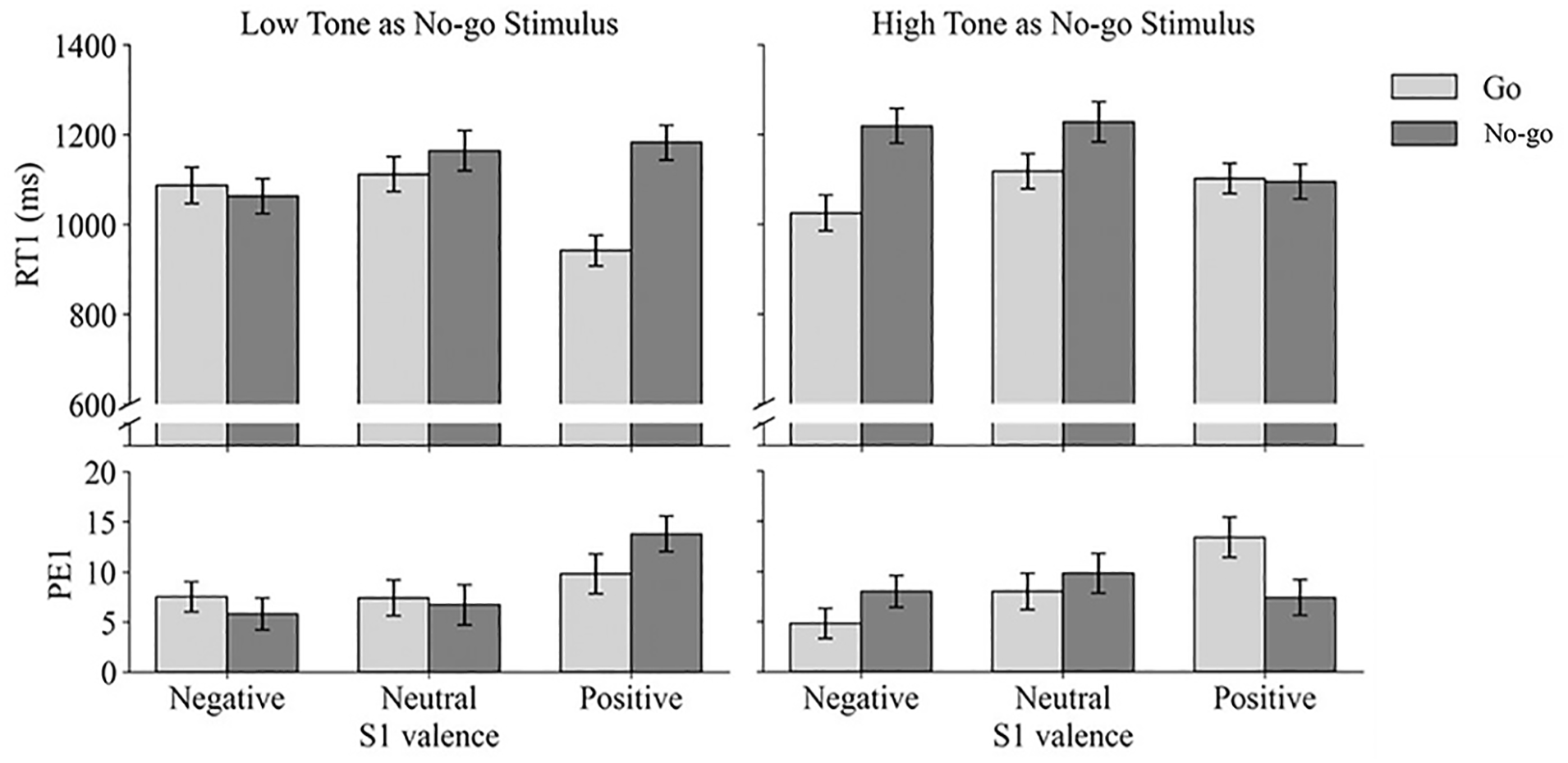
(Left) RT1 (in ms) and PE1 as a function of S1 valence (negative, neutral, positive) and Task 2 trial-type (go, no-go) when the low tone served as no-go stimulus. (Right) RT1 (in ms) as a function of S1 valence (negative, neutral, positive) and Task 2 trial-type (go, no-go) when the high tone served as no-go stimulus. Error bars represent standard errors of the mean.
RT1
An overall no-go BCE of 94 ms was observed, F(1, 30) = 106.37, p < .001, ηp2 = .78. Furthermore, RT1s were smallest when S1 were positive words (1,080 ms), followed by negative words (1,098 ms), and neutral words (1,155 ms), F(1.62, 48.72) = 16.50, p < .001, ηp2 = .36. In contrast to Experiments 1a and 1b, the S1 valence and Task 2 trial-type interaction did not reach statistical significance, F(2, 60) = 1.18, p = .315, ηp2 = .04, suggesting a similar no-go BCE irrespective of S1 valence. Importantly, however, we observed a significant three-way interaction between S1 valence, Task 2 trial-type, and type of no-go stimulus, F(2, 60) = 43.06, p < .001, ηp2 = .59.
Follow-up analyses confirmed an interaction between Task 2 trial-type and S1 valence in line with Experiments 1a and 1b, but only in conditions when the low tone served as no-go stimulus in Task 2, F(2, 30) = 33.96, p < .001, ηp2 = .69. Here, the no-go BCE was more pronounced when S1 was positive (240 ms), t(15) = −13.49, p < .001, rather than neutral (52 ms), t(15) = −2.12, p = .051, or negative (−24 ms), t(15) = 1.16, p = .262.
By contrast, when the high tone served as no-go stimulus in Task 2, this pattern was reversed, F(2, 30) = 13.53, p < .001, ηp2 = .47. Now the no-go BCE was largest when negative words (194 ms) appeared in Task 1, t(15) = −7.40, p < .001, followed by neutral words (110 ms), t(15) = −3.71, p = .002. The no-go BCE was absent when S1 was positive (−7 ms), t < 1. No other effects were significant, all Fs ⩽ 1.18, ps ⩾ .315.
PE1
The main effect of S1 valence was significant, F(1.67, 50.17) = 8.47, p = .001, ηp2 = .22. Participants made more errors when S1 was a positive word (11.1%), followed by neutral (8.0%), and the least when S1 was a negative word (6.5%). The three way-interaction was again significant, F(2, 60) = 16.15, p < .001, ηp2 = .35. Similar to RT1, the expected pattern of the interaction between S1 valence and Task 2 trial-type from Experiments 1a and 1b emerged only when a low tone signalled a no-go trial, F(2, 30) = 6.41, p = .005, ηp2 = .30. A no-go BCE of 4.0% was observed when S1 was positive, t(15) = −2.92, p = .011 and this no-go BCE was absent when S1 was negative (−1.7%), t(15) = 1.49, p = .157, and neutral (−0.7%), t < 1. Again, when the high tone served as the no-go stimulus, by and large, the opposite pattern of results emerged, F(2, 30) = 9.76, p = .001, ηp2 = .39. A no-go BCE of 3.2% was at least numerically present when S1 was negative, t(15) = −2.08, p = .055, which was then absent when S1 was neutral (1.8%), t(15) = −1.10, p = .291, and reversed to a negative value when S1 was positive (−6.0%), t(15) = 3.47, p = .003. No other effects were significant, Fs ⩽ 1.11, ps ⩾ .336.
Discussion
In Experiment 2 we tested whether the finding of a large no-go BCE for positive S1 and an eliminated no-go BCE for negative S1 in Experiments 1a and 1b was due to the negative affect elicited by response inhibition in Task 2 or due to the affective match/mismatch of stimulus features between S1 and S2.
The results were straightforward. The important interaction between S1 valence and Task 2 trial-type was not found. For the assumption that the affective consequences of response inhibition drives this interaction, it should have been found when a low tone served as a no-go stimulus (replication of Experiments 1a and 1b) and also potentially to a lesser extent when a high tone served as a no-go stimulus in Task 2. This was clearly not the case. Instead, the interaction between S1 valence and Task 2 trial-type crucially depended on the S2 response assignment, that is, whether a high tone or a low tone served as a no-go stimulus. When a low tone served as a no-go stimulus, the findings of Experiments 1a and 1b were replicated. The no-go BCE was the largest for positive S1 and was eliminated for negative S1. In contrast to Experiments 1a and 1b, this pattern was completely reversed when a high tone served as a no-go stimulus in Task 2. Here, a large no-go BCE was found when S1 was negative, and an eliminated or even reversed no-go BCE was observed when S1 was positive. Together, these findings are in line with the prediction of an affective match/mismatch between stimulus features of S1 and S2 that underlies the BCE. This might also account for the unusually large size of the alleged no-go BCE. Only for neutral S1, a no-go BCE of conventional size was found for both types of no-go stimuli in Task 2. However, the large BCE for positive S1 when a low tone is a no-go and the large BCE for negative S1 when a high tone is a no-go in Task 2 seem to rather represent a compatibility-based BCE consisting of an affective match/mismatch between S1 and S2 (see “General discussion” section for further discussion). Therefore, following our original intention to investigate the affective consequences of the no-go BCE, it is quite important to eliminate any S1-S2 affective match/mismatch by avoiding an affective quality of S2. Therefore, in the next experiment, we implemented purely neutral stimuli in Task 2.
Experiment 3
Experiment 3 served to further test whether not responding in Task 2 has negative affective consequences that impact affective Task 1 processing. As aforementioned, in the current experiment, we included purely neutral S2 stimuli to avoid S1-S2 affective match/mismatch. If response inhibition in Task 2 has a negative affective connotation, the effects of responding (go-trial) and not responding (no-go trial) in Task 2 onto Task 1 processing should be modulated by the affective stimulus processing in Task 1. To reiterate, we expect a large no-go BCE when S1 is positive and a reduced or absent no-go BCE when S1 is negative.
Method
Participants
A total of 32 participants (23 female, 2 diverse; age = 18–32 years; Mage = 22.2 years, SD = 3.3; 28 right-handed, 1 ambidextrous) with normal or corrected-to-normal vision from the University of Greifswald took part in the experiment. They received course credits or monetary compensation (4 Euro) for participation and provided informed consent before the experiment. The study was conducted according to the Declaration of Helsinki and the ethical guidelines of the German Psychological Society.
Stimuli, apparatus, and procedure
The experiment was conducted online. S1 were 90 words from the Berlin Affective Word List—Reloaded (BAWL-R) (Võ et al., 2009), out of which 6 appeared in the practice blocks which were repeated twice, and 84 in the experimental blocks. Neutral words were dropped and the list from the previous experiment was extended to create 42 positive (Mvalence = 2.3, Marousal = 3.0) and 42 negative words (Mvalence = −2.1, Marousal = 3.7). The digits 1, 4, 6, 9, and 5 were used as S2. Participants were asked to respond to all stimuli in Task 2 except 5, which served as a no-go stimulus. Participants were instructed to withhold their response on its appearance. In each block, no-go trials occurred in 33% (i.e., 12 trials), and go trials occurred in 66% (i.e., 6 trials of the digits 1, 4, 6, and 9, thus a total of 24 trials) of all trials. The rest of the procedures were identical to Experiment 2.
Design and analysis
A 2 (S1 valence: negative, positive) × 2 (Task 2 trial-type: go, no-go) repeated measures design was applied. As in previous experiments, practice trials were removed prior to analysis. Error trials (8.9%) of Task 1 and Task 2 and outlier trials (3.0%) were removed prior to RT analysis. Greenhouse–Geisser corrections were applied when appropriate.
Results
The results of Experiment 3 are visualised in Figure 3.
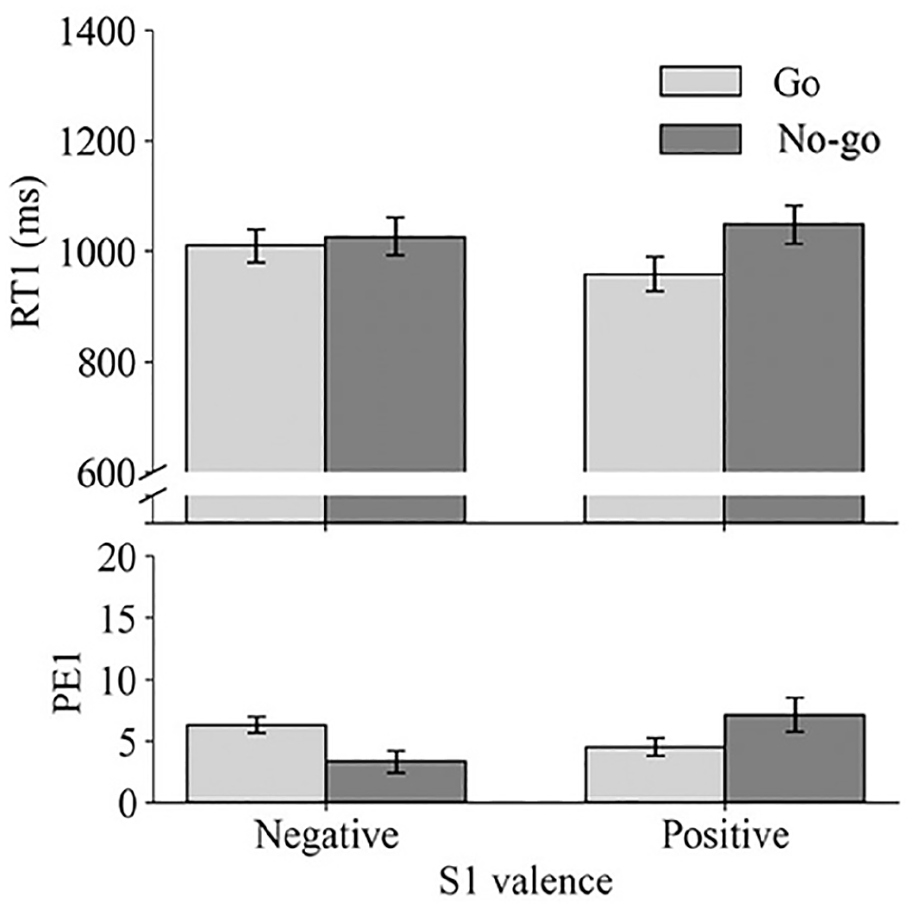
RT1 (in ms) and PE1 as a function of S1 valence (negative, positive) and Task 2 trial-type (go, no-go). Error bars represent standard errors of the mean.
RT1
The main effect of S1 valence was not significant, F(1, 31) = 3.11, p = .088, ηp2 = .09. A no-go BCE was observed, F(1, 31) = 18.41, p < .001, ηp2 = .37. Participants responded slower in Task 1 when S2 was a no-go (1,037 ms) compared with when S2 was a go (984 ms). Importantly, this no-go BCE was modulated by S1 valence, F(1, 31) = 13.84, p = .001, ηp2 = .31. A no-go BCE of 91 ms was observed with positive words in Task 1, t(31) = −5.45, p < .001, whereas the no-go BCE disappeared with negative words (17 ms), t(31) = −1.08, p = .288.
In addition, we performed a distribution analysis on mean RT1 to explore whether slower responses in Task 1 would decrease the no-go BCE. To assess the size of the no-go BCE across the RT1 distribution, percentiles (10%–90%) were computed for each participant as a function of S1 valence and Task 2 trial-type. A repeated measures ANOVA was then conducted with the factors percentile, S1 valence, and Task 2 trial-type on RT1. The interaction percentile and Task 2 trial-type were not significant, F < 1, showing that the no-go BCE was overall not affected by Task 1 response speed. The three-way interaction between percentile, Task 2 trial-type, and S1 valence, however, was significant, F(2.44, 75.73) = 5.14, p = .005, ηp2 = .14 (see Figure 4). When S1 was positive, the no-go BCE was not only present across all percentiles but even increased from the smallest percentile (10%, 65 ms) to the largest percentile (90%, 120 ms), F(1, 31) = 4.97, p = .033, ηp2 = .14 (linear contrast). When S1 was negative, a reliable BCE was only found for the first two percentiles but not for larger percentiles (Figure 4), which accounts for the overall absence of the no-go BCE. The interaction between percentile and Task 2 trial-type, however, was not statistically significant, F(1, 31) = 2.58, p = .118, ηp2 = .08 (linear contrast).
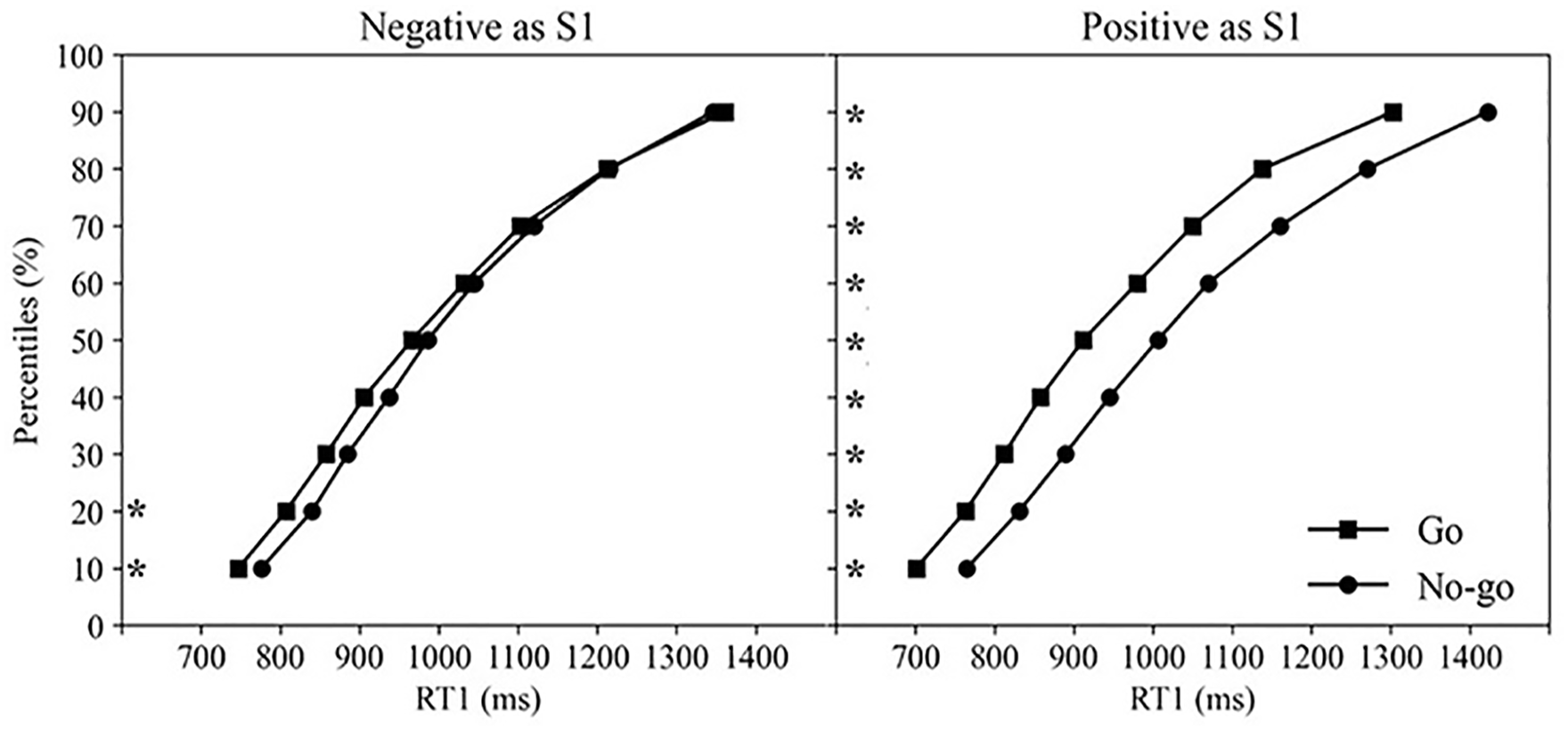
Percentiles (10%–90%) of Task 1 reaction times as a function of Task 2 trial-type (go, no-go) plotted separately for S1 valence (negative, positive).
PE1
The main effects of S1 valence and Task 2 trial-type were not significant, Fs ⩽ 2.66, ps ⩾ .113. However, the two-way interaction became significant, F(1, 31) = 22.52, p < .001, ηp2 = .42. As in the previous experiments, the no-go BCE was large when S1 were positive words (2.6%), t(31) = −2.41, p = .022, and it was reversed when S1 were negative words, (−3.1%), t(31) = 4.43, p < .001.
Discussion
In the current experiment, we recruited purely neutral stimuli in Task 2 to further test whether response inhibition in Task 2 interacts with affective processing in Task 1. Even with non-affective stimuli in Task 2, we were able to obtain an interaction between S1 valence and Task 2 trial-type. That is, a large no-go BCE was found when S1 was positive and it was absent/reversed when S1 was negative. Since the design in Experiment 3 rules out affective compatibility between stimuli of both tasks, the results are in line with the inhibition-affect hypothesis, which predicted that the affective consequence of not responding in Task 2 interacts with affective processing in Task 1.
One possibility to consider is that the no-go BCE could vary with general RT1 levels. That is, at longer RT1s, due to slower processing speed, the preparation for responding to Task 2 could be reduced, leading to a smaller or even absent no-go BCE. A distribution analysis of RT1 did not confirm this reasoning. Instead, the size of the no-go BCE across different RT1 levels was determined by the processing interaction between Task 2 trial-type and S1 valence. More specifically, the no-go BCE varied across percentiles with opposing trends observed for negative and positive stimuli. When the stimulus in Task 1 was negative, a no-go BCE was not found for larger percentiles. An increasing no-go BCE with longer RT1s, however, was observed when the stimulus in Task 1 was positive. The latter finding in particular speaks against the assumption that slower responses in Task 1 would reduce preparedness to respond in Task 2. We will get back to this in the “General discussion” section.
Experiment 4
In Experiment 3 we observed a larger no-go BCE when the stimulus in Task 1 was positive and a reversed/absent no-go BCE when the stimulus in Task 1 was negative. However, go trials were always more frequent than no-go trials in order to increase the size of the no-go BCE (Mahesan et al., 2021). To this point, it remains unclear to which extent the different frequencies of go and no-go trials in Experiment 3 may have created an affective influence on Task 1 processing. In addition, an infrequent no-go stimulus might reveal a surprise response (Wessel, 2018) that could potentially interact with Task 1 processing and conceal affective influences of response inhibition.
For this purpose, the proportion of go and no-go trials was balanced in Experiment 4. Task 2 stimuli consisted either of an even (i.e., 6 and 8) or odd (i.e., 7 and 9) pair of digits. Half of the participants received the even pair and the other half received the odd pair. One of the digits served as a go trial and the other as a no-go trial (counterbalanced). An even-even or odd-odd pair as a task stimulus set was implemented to avoid any bias (Wilkie & Bodenhausen, 2015), such as a preference for even numbers over odd numbers (Nishiyama, 2006). As in the previous experiments, we expected a large no-go BCE when S1 is positive and a reduced/absent no-go BCE when S1 is negative.
Method
Participants
In all, 33 participants (18 female, 1 diverse; age = 21–36 years; Mage = 25.8 years, SD = 3.1; 27 right-handed, 1 ambidextrous) with normal or corrected-to-normal vision from the University of Greifswald took part in the experiment. They received course credits for participation and provided informed consent before the experiment. The study was conducted according to the Declaration of Helsinki and the ethical guidelines of the German Psychological Society.
Stimuli, apparatus, and procedure
The experiment was conducted online. S1 were 62 words from the Berlin Affective Word List—Reloaded (BAWL-R) (Võ et al., 2009), out of which 6 words appeared in the practice blocks (which were repeated twice) and 56 words in the experimental blocks. Out of the 56 words, 28 words were positive (Mvalence = 2.4, Marousal = 3.0) and 28 were negative words (Mvalence = −2.2, Marousal = 3.8).
Each block contained four distinct words per valence, which were in total repeated four times (twice with a go stimulus and twice with a no-go stimulus). S2 was either one of two even or two odd digits, that is, 6 and 8 or 7 and 9, respectively. That is, the digits 6 and 8 served as S2 for half of the participants. Of these participants, one-half responded to the digit 6 (go trial), and the other half withheld the response to the digit 6 (no-go trial). Similarly, the digits 7 and 9 served as S2 for the other half of the participants. Here, one-half responded to the digit 7 (go trial), and the other half withheld the response to the digit 7 (no-go trial). In each block, go and no-go trials were equally balanced. The rest of the procedure was identical to Experiment 3.
Design and analysis
A 2 (S1 valence: negative, positive) × 2 (Task 2 trial-type: go, no-go) repeated measures design was applied. Practice trials were removed prior to analysis. Error trials (6.4%) of Task 1 and Task 2 and outlier trials (3.1%) were removed prior to RT analysis. Greenhouse–Geisser corrections were applied when appropriate.
Results
The results of Experiment 4 are visualised in Figure 5.
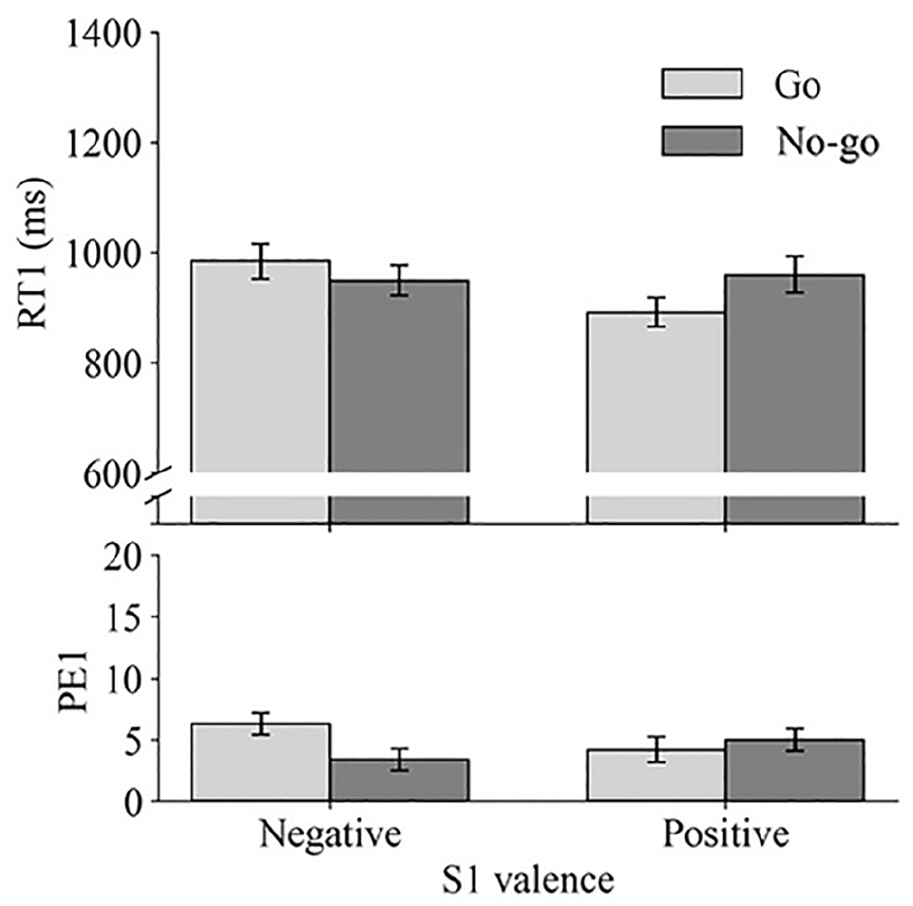
RT1 (in ms) and PE1 as a function of S1 valence (negative, positive) and Task 2 trial-type (go, no-go). Error bars represent standard errors of the mean.
RT1
The main effect of S1 valence was significant, F(1, 32) = 13.52, p = .001, ηp2 = .30. Participants were slower in responding to negative words (966 ms) as compared with positive words (925 ms). Participants were slower in responding to Task 1 when Task 2 was a no-go (954 ms) as compared with a go trial (937 ms), F(1, 32) = 4.49, p = .042, ηp2 = .12. As in Experiment 3, this no-go BCE was modulated by S1 valence, F(1, 32) = 20.38, p < .001, ηp2 = .39. When S1 was positive, a no-go BCE of 68 ms was observed, t(32) = −4.54, p < .001, which inversed to −35 ms when S1 was negative, t(32) = 2.82, p = .008.
Similar to Experiment 3, a distribution analysis was also conducted for Experiment 4 (see Figure 6). Here, the interaction percentile × S1 valence was significant. Across all percentiles, participants were faster in responding to positive S1 as compared with negative S1, F(2.21, 70.65) = 3.22, p = .041, ηp2 = .09. The interaction percentile × Task 2 trial-type was not significant, F(1.86, 59.56) = 2.31, p = .112, ηp2 = .07. Similarly, the three-way interaction percentile × Task 2 trial-type × S1 valence also did not reach statistical significance, F(1.68, 53.90) = 2.50, p = .100, ηp2 = .07. Replicating Experiment 3, the no-go BCE did not significantly vary across RT1 levels when S1 was negative, F < 1 (linear contrast). But it grew larger with increasing RT1 when S1 was positive, F(1, 32) = 4.61, p = .040, ηp2 = .13 (linear contrast).
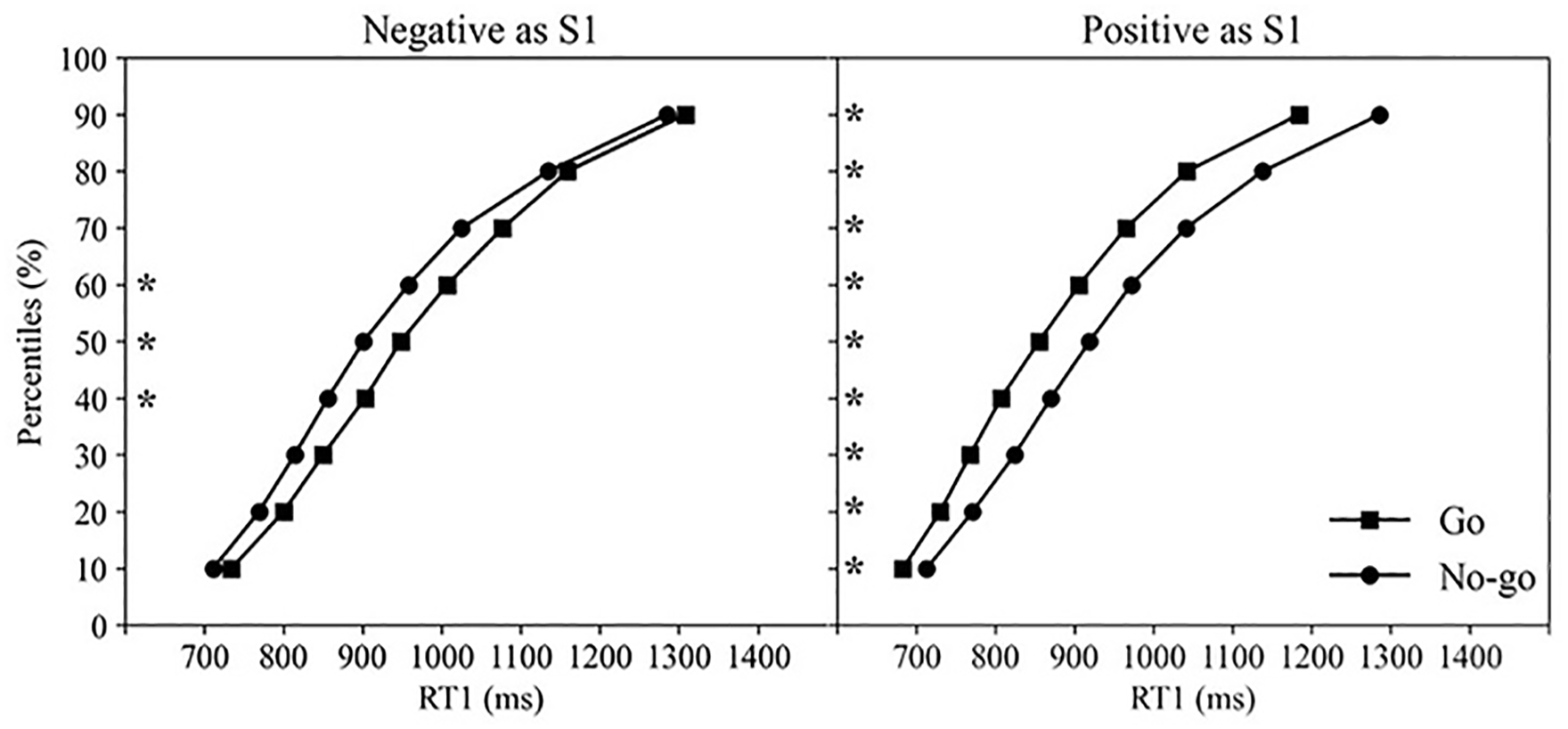
Percentiles (10%–90%) of Task 1 reaction times as a function of Task 2 trial-type (go, no-go) plotted separately for S1 valence (negative, positive).
PE1
The main effect of S1 valence was not significant, F < 1. An inverted no-go BCE of −1.1% was observed, F(1, 32) = 4.18, p = .049, ηp2 = .12. However, the interaction of S1 valence and Task 2 trial-type was not significant, F(1, 32) = 3.78, p = .061, ηp2 = .11.
Discussion
Experiment 4 aimed to replicate the findings of Experiment 3 and to rule out alternative explanations based on infrequent go and no-go trials. Frequent versus infrequent stimuli/trial-types could acquire a positive versus negative connotation. 1 In addition, infrequent stimuli/trial-types could induce a surprise response (Wessel, 2018), potentially inducing a slowing of response to Task 1. Therefore, go and no-go trials in Task 2 were in equal proportion. First, even with an equal proportion of go/no-go trials, our dual-task set-up produced a no-go BCE. Most importantly, and as in the previous experiments, this no-go BCE was modulated by S1 affective processing. That is, we found a large no-go BCE for positive words in Task 1 and an inversed no-go BCE when negative words were presented in Task 1.
Since the negative words were responded to slower as compared with positive words, we used a distribution analysis to explore if the slowed processing of negative words could explain the reversed no-go BCE. However, the three-way interaction of interest–percentile, Task 2 trial-type, and S1 valence did not reach statistical significance. Whereas for negative S1 the no-go BCE remained relatively stable for a wide range of RT1 levels, for positive S1 the no-go BCE even increased with higher RT1 levels. Thus, a general slowing of Task 1 responses cannot account for a decrease in no-go BCE.
General discussion
In the present study, we investigated whether the affective consequences triggered by response inhibition in Task 2 modulate the no-go BCE. No-go BCE is the observation that RT1s are longer when Task 2 is no-go as compared with go (Miller, 2006). The underlying mechanism of this no-go BCE is popularly explained via the inhibition hypothesis, where the response inhibition of not responding in Task 2 spills over to Task 1 (Durst & Janczyk, 2018; Miller, 2006). At the same time, accumulating evidence shows that response inhibition triggers negative affective responses (Chen et al., 2016; Clancy et al., 2019; De Vito et al., 2017; Doallo et al., 2012; Driscoll et al., 2020; Driscoll et al., 2018; Frischen et al., 2012; Kiss et al., 2008). In the current study, we investigated if this affective consequence of response inhibition determines the size of the no-go BCE by introducing positive and negative stimuli in Task 1 in Experiments 1a, 1b, 3, and 4, along with neutral stimuli in Experiment 2. We tested to which extent the negative affect triggered by response inhibition in Task 2 interacted with the affective processing in Task 1.
In Experiments 1a and 1b, the red colour indicated a no-go trial and the green colour indicated a go trial in Task 2. The no-go BCE was indeed modulated by the processing of affective words (Experiment 1a) or face stimuli (Experiment 1b) in Task 1. The no-go BCE was large when S1 was positive and was either reversed (PE1) or absent when S1 was negative. Furthermore, the no-go BCE was unusually large in magnitude when S1 was positive, compared with previous studies (Durst & Janczyk, 2019; Mahesan et al., 2021; Miller, 2006), and this may have been due to a confound—an S1-S2 mismatch between the positive S1 and the negative affect induced by the colour red (Kuhbandner & Pekrun, 2013; Moller et al., 2009). To investigate if such a stimulus-triggered match/mismatch plays a crucial role in modulating the no-go BCE, the go/no-go was counterbalanced between a high and a low tone in Experiment 2. Negative affect elicited by not responding should interact with affective Task 1 processing, irrespective of the stimulus that serves as a no-go. This finding, however, was not observed. Instead, when the low tone (affectively negative) served as S2 no-go, the BCE was large for a positive S1 and was absent when S1 was negative as in Experiments 1a and 1b. By contrast, when a high tone (affectively positive) served as a no-go stimulus, the pattern was reversed, with a large BCE for a negative S1 and an absent/reversed BCE for a positive S1. Therefore, the affective stimulus features of the high and low tones in Task 2 and their (mis)match with affective stimulus processing in Task 1 can easily explain the result pattern for both conditions, that is, when high or low tones serve as no-go stimuli in Experiment 2. An assumed affective (mis)match between stimulus features reflects a dimensional overlap between the two stimuli. Thus, it appears that at least parts of the BCE pattern attributed to a no-go BCE may correctly represent a compatibility-based BCE. Involvement of a compatibility-based BCE may also explain the large size of the BCE, which has sometimes been reported for compatibility-based BCEs (e.g., Fischer et al., 2007; Logan & Schulkind, 2000). At the same time, however, a no-go BCE was found in conditions without an affective feature (mismatch) when affectively neutral stimuli were used in Task 1. Here, both types of no-go stimuli slowed responses in Task 1 by about 50–100 ms, which is in line with conventional effect sizes obtained with the standard no-go BCE set-up, including neutral S1 and high/low tones as S2 go/no-go stimuli (Ko & Miller, 2014; Miller, 2006). Together, the results of Experiment 2 suggest an involvement of both types of BCE (e.g., Mahesan et al., 2021), a rather strong compatibility-based BCE on the basis of affective match/mismatch between S1 and S2 and a no-go BCE that appears when affectively neutral stimuli are used in Task 1.
These results bring to focus the need for completely neutral stimuli in Task 2 in order to reduce the involvement of a compatibility-based BCE when investigating to which extent the affective consequences of response inhibition interact with affective processing in Task 1. Therefore, in Experiment 3, we ensured the use of neutral stimuli in Task 2. Here, go trials were signalled by 1, 4, 6, or 9, and no-go trials were signalled by the digit 5. Without any (mis)match between affective stimulus features of S1 and S2, a no-go BCE was again observed when S1 was positive and the no-go BCE was absent (RT1) or even reversed (PE1) when S1 was negative. However, in Experiment 3, go trials were much more frequent than no-go trials. The frequent go trials could be perceived as more positive due to mere exposure (Zajonc, 1968). In addition, infrequent stimuli might trigger a surprise response (Wessel, 2018) that might affect Task 1 processing. To avoid any biases due to different frequencies of go and no-go trials, in Experiment 4, we recruited the go/no-go trials in equal proportions. As in the previous experiment, we observed a large no-go BCE when stimuli in Task 1 were positive but not when stimuli in Task 1 were negative. Using affectively neutral S2 and an equal proportion of go/no-go trials in Task 2, these results confirm that the interaction with affective processing in Task 1 was driven by the affective consequences of not responding in Task 2.
This supports previous findings that showed negative affective consequences of response inhibition and further extends it to a dual-task paradigm. Furthermore, since the negative affect triggered by suppressing a Task 2 response interacts instantly with the affective stimuli in Task 1, the current results also further support the immediate-affect account, according to which the negative affect is immediately elicited by response inhibition (Clancy et al., 2019; Fragopanagos et al., 2009). Our finding also extends previous studies showing that the anticipated affective action effect of a Task 2 response interacts with affective processing in Task 1 (Eder et al., 2017). In their study, participants categorised the valence of pictures in Task 1. The response to a high- or low-pitched tone in Task 2 produced either a pleasant or a highly unpleasant sound as an action effect. The authors showed that the anticipation of the emotional effect produced by the Task 2 response facilitated activation of the affectively compatible response and produced costs when selecting an affectively incompatible response in Task 1. In line with these BCE findings based on emotional task features, our results further show that also the affective consequence of withholding an action, that is, inhibiting a prepared response, influences the processing of affective stimuli in Task 1.
The present results contribute to the discussion about the locus of the no-go BCE. It was argued that the suppression of a highly prepared response in Task 2 no-go trial also inhibits the execution of a motor response in Task 1. While some studies make a strong case for locating the no-go BCE in the motor execution stage of Task 1 (Durst & Janczyk, 2018, 2019), other studies have identified pre-motor stages as the locus of the no-go BCE (e.g., Ko & Miller, 2014; Röttger & Haider, 2017). Ko and Miller (2014), for example, measured the lateralized readiness potential (LRP) and observed longer stimulus-locked to LRP onset intervals in Task 1 for Task 2 no-go compared with go trials. Thus, a no-go trial in Task 2 prolonged the decision component of selecting the Task 1 response prior to its execution. Ko and Miller (2014) argued for a pre-motor locus of the no-go BCE in Task 1 and reasoned that the no-go BCE is due to a rather global inhibitory process triggered by Task 2 selection process slowing down Task 1 response-selection process, by elevating the response-selection boundary. Our findings are in line with such an assumed early influence of Task 2 no-go processing on Task 1 response-selection processes. The interaction between the negative affective consequence of Task 2 response inhibition with affective processing in Task 1 locates the influence of an affective component of Task 2 response inhibition prior to the motor execution stage in Task 1. In fact, such a finding indicates that inhibitory control and its affective consequences are most likely immediately activated by the no-go stimulus (e.g., Giesen & Rothermund, 2014; Verbruggen & Logan, 2017; see Schonard et al., 2022 for a discussion) and directly interact with affective processing in Task 1.
A somewhat surprising finding in all experiments (except when a high tone served as no-go in Experiment 2) was that the BCE was not only reduced but completely disappeared or even reversed when Task 1 stimuli were negative. A crucial factor that determines if the no-go BCE reverses or not is the advanced task preparation of Task 2. The less prepared a participant is to perform Task 2, the less inhibitory control is required when an S2 no-go stimulus signals not to respond (Durst et al., 2019; Janczyk & Huestegge, 2017). To ensure a high preparatory state of Task 2 execution, however, we intentionally increased the ratio of go trials compared with no-go trials (e.g., Mahesan et al., 2021). In Experiment 4, however, go and no-go trials appeared equally often. Irrespective of the proportion of go and no-go trials, the result pattern of a large no-go BCE for positive S1 and an eliminated/reversed no-go BCE for negative S1 remained the same.
Furthermore, responding to negative stimuli is often slower than responding to positive stimuli (Barriga-Paulino et al., 2022; Pratto & John, 1991; Unkelbach et al., 2008, 2010). This pattern was also found in almost all experiments of the present study. Longer processing time in Task 1 may also have reduced the general response tendency in Task 2, thus decreasing the required inhibition in case of a no-go stimulus. However, the distribution analyses on RT1 in Experiments 3 and 4 did not confirm that a reliable no-go BCE would depend on small RT1 levels, as a no-go BCE was also found for larger percentiles. Yet, the no-go BCE showed a different pattern across RT1 levels depending on whether S1 was positive or negative. Whereas in both experiments the no-go BCE grew larger with increasing RT1 levels when the stimulus in Task 1 was positive, the no-go BCE did not significantly vary across RT1 levels when the stimulus in Task 1 was negative. At a descriptive level, no-go BCEs for negative stimulus in Task 1 were found at most for lower but not for larger percentiles. One possibility could be that the longer Task 1 processing takes (i.e., at higher percentiles), the more processing of Task 2 can influence Task 1. For a positive S1, these effects materialise as a stronger impact of negative consequences of response inhibition from Task 2 on the processing of positive stimuli, resulting in a larger conflict and consequently, larger no-go BCE. A stronger influence of Task 2 on a negative S1 may emphasise the affective compatibility with a negatively connotated no-go trial and the affective incompatibility with a more positively connotated go trial. Thus, at higher percentiles, responses to a negative S1 might be slower for Task 2 go trials and faster for Task 2 no-go trials, effectively eliminating the no-go BCE.
It could further be argued that processing of negatively valenced stimuli does not only slow responses but may per se lead to adjustments of dual-task processing, for example, facilitating task segregation and leading to smaller crosstalk between tasks. At least in the context of mood induction, it has been shown that negative mood reduced the compatibility-based BCE (Zwosta et al., 2013). However, in contrast to the effect of negative mood, there is no evidence that the processing of negatively valenced stimuli may facilitate task segregation. First, recent studies demonstrated an even increased compatibility-based BCE for negatively compared with positively valenced stimuli in Task 2. Allen et al. (2017), for example, investigated whether Task 1 affective processing (happy vs. angry) is influenced by emotionally salient Task 2 stimuli. In their Experiment 1, Task 2 consisted of a sound discrimination. Stimuli were positive (laugh), neutral (cork), or negative (punch). In Experiment 2, the sound of a punch was replaced with a scream to even increase the emotional salience of the negative stimulus. An increased compatibility-based BCE for negatively valenced Task 2 stimuli was explained on the basis of heightened emotional salience. In line with the arousal-biased competition model (Mather & Sutherland, 2011), a salient negative stimulus may adjust the attentional setting, leading to an increased influence of the Task 2 stimulus, resulting in a larger BCE. 2 Second, also the processing of negatively valenced Task 1 stimuli does not necessarily facilitate task segregation. In a compatibility-based BCE, Eder and colleagues found a BCE based on emotional task features also for negative stimuli in Task 1 (Eder et al., 2017). In addition, our data also do not support the notion that the specific processing of negative stimuli in Task 1 is responsible for the lack of BCE. In Experiment 2, a large BCE was found specifically for negative stimuli in Task 1 when a high tone served as a no-go stimulus in Task 2. Thus, it seems not plausible that the absence of a no-go BCE can be solely attributed to the processing of a negatively valenced stimulus in Task 1. Instead, the observed modulation of the no-go BCE seems to depend on the interaction between affective stimulus processing in Task 1 and the affective consequences of response inhibition in Task 2.
The finding of a complete elimination of the no-go BCE for negative S1 processing (especially in Experiment 3) offers another, quite speculative alternative explanation that questions the functional role of response inhibition in the no-go BCE. Response inhibition is certainly needed to suppress a highly prepared response in Task 2 no-go trial. The encounter with a no-go stimulus may automatically trigger inhibitory control and its affective consequences. What spills over onto Task 1 processing, however, may not be a global inhibitory process conflicting with Task 1 response execution. Instead, the negative affective consequences of response inhibition may spill over and positively or negatively influence Task 1 processing. In the case of a negative S1, an affective match with the negative affect of Task 2 response inhibition might eliminate the no-go BCE, whereas for a positive S1 the mismatch with the negative affect of Task 2 response inhibition might considerably increase the no-go BCE. Most studies, however, implemented affectively neutral S1 and a partial affective mismatch between neutral S1 and negative affect from Task 2 no-go trials might account for intermediate sizes of the no-go BCE. While this is highly speculative, it conforms with a recent conception of the no-go BCE devoid of any response inhibition. Röttger and Haider (2017) proposed that the no-go BCE is due to an incompatibility between the automatically activated abstract representation of Task 1 “go” conflicting with the abstract representation of Task 2 “no-go.” This account is thus similar to the compatibility-based BCE, placing the source of the no-go BCE in response activation of Task 2 and the locus in the response-selection stage of Task 1. The present findings comply with this view, but place the incompatibility to an affective mismatch between the negative affective consequences of Task 2 response inhibition with neutral/affective processing in Task 1.
Summary and conclusion
The present study investigated whether the affective consequences of response inhibition modulate Task 1 processing. To test this, we introduced affective stimuli in Task 1 to see if no-go BCE is modulated depending on the affective quality of Task 1 stimuli. Overall, our results show a large no-go BCE when Task 1 was positive, which either was absent or reversed when Task 1 was negative. Thus, the affective quality of Task 1 could be a deciding factor in the size and/or presence of the no-go BCE. These results further highlight the need for further research on the underlying mechanism of no-go BCE and on integrating inhibition and affect within the framework of dual-task interference effects.
Footnotes
Declaration of conflicting interests
The author(s) declared no potential conflicts of interest with respect to the research, authorship, and/or publication of this article.
Funding
The author(s) received no financial support for the research, authorship, and/or publication of this article.
