



Abstract
Ideomotor theory suggests that selecting a response is achieved by anticipating the consequences of that response. Evidence for this is the response-effect compatibility (REC) effect, that is, responding tends to be faster when the (anticipated) predictable consequences of a response (the action effects) are compatible rather than incompatible with the response. The present experiments investigated the extent to which the consequences must be exactly versus categorically predictable. According to the latter, an abstraction from particular instances to the categories of dimensional overlap might take place. For participants in one group of Experiment 1, left-hand and right-hand responses produced compatible or incompatible action effects in perfectly predictable positions to the left or right of fixation, and a standard REC effect was observed. For participants in another group of Experiment 1, as well as in Experiments 2 and 3, the responses also produced action effects to the left or right of fixation, but the eccentricity of the action effects (and thus their precise location) was unpredictable. On average, the data from the latter groups suggest that there is little, if any, tendency for participants to abstract the critical left/right features from spatially somewhat unpredictable action effects and use them for action selection, although there were large individual differences in these groups. Thus, at least on average across participants, it appears that the spatial locations of action effects must be perfectly predictable for these effects to have a strong influence on the response time.
Introduction
People act to change the environment according to their goals (see also Skinner, 1957, p. 1). This, in turn, means that people require knowledge about the consequences of their own bodily movements to make these movements purposeful and goal-directed.
Ideomotor theory and response-effect compatibility
Ideomotor theory, dating back to 19th-century philosophers (Harleß, 1861; Herbart, 1825; James, 1890/1981; see also Pfister & Janczyk, 2012; Stock & Stock, 2004), has brought this to particular attention, although its main idea had been forgotten (see Thorndike, 1913) and was not reconsidered until the work of Greenwald (1970). More precisely, it is assumed that participants first acquire bidirectional associations between bodily movements and the emerging consequences of those movements (see, e.g., Elsner & Hommel, 2001; Wolfensteller & Ruge, 2011). Then, a mental representation of the desired and aimed-at consequences is later used to select and activate the associated bodily movements. In other words, anticipation of an action’s effect is thought of as being an essential component of response selection.
The most compelling evidence for such anticipated representations of action effects prior to response initiation comes from response-effect compatibility (REC) studies. In the first such study, Kunde (2001) had participants press one of four horizontally arranged response buttons according to the colour of a centrally presented circle (Exp. 1). Four outlined squares were displayed on the computer screen and following a response, one of the squares became white as an action effect. In the compatible REC condition, this square was spatially compatible with the response. In contrast, in the incompatible condition, the location of the action effect was one of the spatially incompatible squares (note that the relation of response and effect location was fixed nonetheless and the incompatible effect location was not chosen randomly on each trial). Both REC conditions were presented block-wise to allow participants to predict the effect resulting from each response. Response times (RTs) were shorter in the compatible than in the incompatible condition, despite the action effect occurring only after RT was already measured. This REC effect has been replicated in numerous studies with spatial overlap between responses and effects (e.g., Janczyk et al., 2017, 2023; Pfister & Kunde, 2013), but also with overlap of the intensity (e.g., Kunde, 2001, Exps 2–3) or duration of responses and effects (e.g., Kunde, 2003). Anticipated action effects have also been considered as a source of the commonly occurring performance costs in multitasking (Schacherer & Hazeltine, 2020, 2021; Wirth et al., 2018; for a review, see Janczyk & Kunde, 2020).
A common explanation for the REC effect is that it results from endogenously created stimulus–response compatibility (SRC; see Fitts & Deininger, 1954): the anticipated action effect activates the compatible response and/or interferes with the incompatible response, much as an actual compatible or incompatible stimulus does in SRC (see Janczyk & Lerche, 2019; Kunde, 2001; Kunde et al., 2004; Shin & Proctor, 2012).
The nature of anticipated action effects
For an REC effect to occur, there must be dimensional overlap between responses and effects. What is less clear though is, must the effect be perfectly predictable or is some variation in the effects tolerated, as long as the main feature of relevance (i.e., that overlapping with and distinguishing between the responses) can be abstracted from the varying effects? Generalisation to more abstract levels has also been argued to allow more flexibility in action control (Koch et al., 2021, p. 2). While effects may show some variation in natural scenes, in the typical REC experiments, in contrast, the presented action effects are perfectly predictable in all aspects, without any need for generalisation.
There is some evidence that abstraction might play a role in learning associations between responses and their effects. In the learning phase of Hommel et al. (2003, Exp. 1), participants pressed left and right response keys that were predictably followed by a visually presented word as the action effect. For one group, these words were category words (e.g., left → “furniture” and right → “animal”), and in another group, these words were exemplar words (e.g., left → “chair” and right → “dog”). In a subsequent test phase, the category words were presented as stimuli requiring a left or right key press (similar to Elsner & Hommel, 2001, Exp. 1). Responses were faster in compatible conditions (“furniture” → left and “animal” → right) than in incompatible conditions (“animal” → left and “furniture” → right). This compatibility effect was of the same size for both learning groups, indicating that a generalisation from the subordinate exemplar level (e.g., “chair”) to the superordinate category level (e.g., “furniture”) had occurred (Rosch et al., 1976). These results were generalised to within-category exemplars and perceptual similarity in two further experiments (see also Esser et al., 2023; but see Eichfelder et al., 2023, for an unsuccessful attempt to replicate).
Results are—at best—mixed concerning generalisation in REC experiments though. Koch and Kunde (2002) presented two experiments with verbal colour responses (e.g., uttering “red” or “blue”). Presenting written colour words as visual action effects resulted in an REC effect which was larger when the colour word was written in the respective colour, but which was absent when a coloured neutral letter string was presented as the effect. At first sight, this REC effect with verbal responses and visual action effects may be taken as evidence that some abstraction mediates between the verbal response and the visual effect. However, it may also be argued that reading a visually presented colour word automatically results in phonological recoding which is (in)compatible with the verbal responses, and this might also be true for inner speech of the anticipated effect. Accordingly, Földes et al. (2018) tested this alternative explanation in terms of a phonological overlap with a bilingual version of an REC experiment. While replicating an REC effect with phonological overlap of vocal responses and action-effect words in the same language, no evidence for a similar effect was observed when phonological overlap was excluded by using translation-equivalent response and effect words of different languages. A similar result was obtained when responses were category words and effects were exemplar words or vice versa (Koch et al., 2021). In sum, the present state of results from studies with verbal action effects does not clearly suggest usage of generalised representations of action effects in REC experiments.
Further evidence in this direction comes, for example, from a study by Dignath et al. (2014, Exp. 3). In this experiment, participants’ responses produced action effects after intervals that differed predictably. For instance, one key press produced an action effect after 2,000 ms, whereas this delay was only 50 ms for the other response. RTs were shorter when the interval between response and effect was predictably shorter compared with longer. This result suggests that at least some features of an action-effect episode are represented in a percept-like manner. A similar result has been reported by Dignath and Janczyk (2017) even when the identity of the action effect was not predictable, but only the interval was.
In sum, the available evidence concerning generalised representations of anticipated action effects, abstracted from actual experienced entities, is rather scarce.
The present experiments
Given this unclear empirical state, we went a step back and tried to address the question of abstraction in a different way than the previous studies had. To do so, our experiments were based on typical REC studies. One feature of these experiments is that the spatial action effects are predictable in their nature and exact location. In our first experiment, action effects could occur at one out of three possible locations to the left and right of the screen centre (see Figure 1). For one group of participants, the fixed-location group, visual action effects always occurred in the same one of the three possible locations to the left or right. Thus, the exact location was predictable and we expected an REC effect in this group. In another group, the random-location group, the action effects also occurred to the left or right, but randomly at one of the three possible locations, and thus the exact location was unpredictable. Note that dimensional overlap (Kornblum et al., 1990) between actions/responses and effects existed on the spatial left–right dimension for both groups. Furthermore, there is evidence that the Simon effect can be found even when the left versus right spatial location (i.e., eccentricity of stimulus presentations) varies within the overall left and right regions (Hommel, 1993, Exp. 1), although the size of this effect may depend on eccentricity and on the presence of other landmarks within the left and right visual hemifields (Lamberts et al., 1992; Yamaguchi & Proctor, 2012). Yet, two different predictions can be made for the random-location group. First, if participants are able to generalise the critical left versus right feature, irrespective of the particular instances of the varying action effects, we expected to observe an REC effect in this group as well. Second, if participants do not abstract a “left” versus “right” feature from the randomly varying locations of the action effect and, consequently, use these generalised features in the course of action planning, no REC effect is expected in this group. Statistically, the interaction between REC and group will test between these two predictions. 1
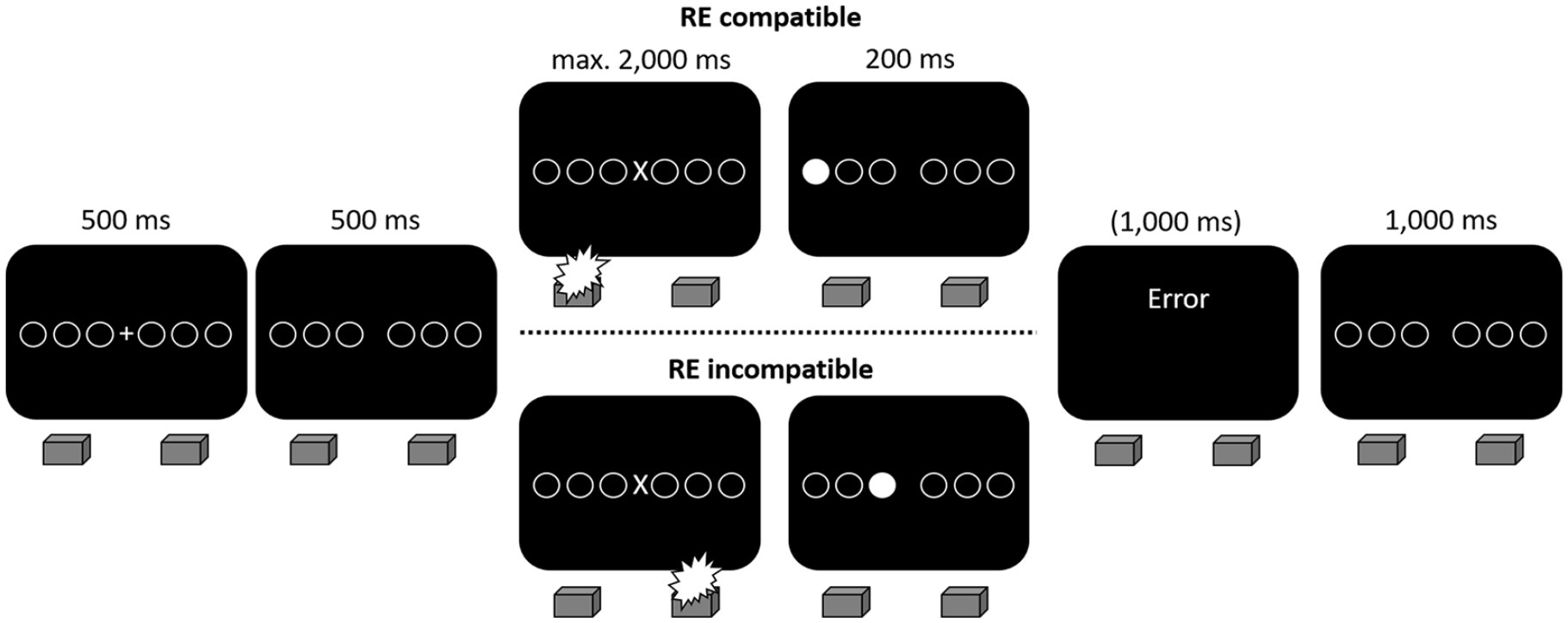
Illustration of the trial structure in the experiments.
We additionally varied whether a given trial was forced-choice or free-choice (Berlyne, 1957; Janczyk et al., 2020; Naefgen & Janczyk, 2018). In forced-choice trials, the stimulus demanded a particular response, while in free-choice trials, participants could choose themselves between the two responses. Typically, RTs are longer in free-choice compared with forced-choice tasks (e.g., Janczyk et al., 2015; Naefgen et al., 2018; Pfister et al., 2010). We included this as an additional within-participants manipulation, because it has been argued that action effects are used for selection only in free-choice tasks that are thought to operationalise “intention-based actions” (e.g., Herwig et al., 2007; Pfister et al., 2010, Exp. 1). Empirically, though, at least when both tasks are intermixed within the same blocks, REC effects of approximately the same size have been reported as well (Janczyk et al., 2017; Pfister et al., 2010, Exp. 2; Pfister & Kunde, 2013). Experiments 2 and 3 are based on Experiment 1 and follow-up on the results obtained with this experiment.
Experiment 1
Method
Participants
Forty-eight people from the Tübingen (Germany) area participated for course credit or monetary compensation (mean age = 21.4 years, 42 females). Participants reported normal or corrected-to-normal vision and were naïve with regard to the underlying hypotheses. Participants were randomly assigned to either the fixed-location group or the random-location group (both n = 24). 2
Stimuli and apparatus
Experimental procedures were controlled by a standard PC connected to a 17-in cathode-ray tube (CRT) monitor in a sound-attenuated experimental chamber. Responses were given with the left and right index fingers on external response keys placed to the left and right of the participant. The possible stimuli were the letters X, H, S, M, O, and T presented in white colour against a black background. For each participant, three of the six possible letters were randomly drawn. Two letters indicated the forced-choice task, and one of these was assigned to the left response and the other to the right response. The third letter indicated the free-choice task, in which either response could be given. Three white outlines of a circle were presented to the left and right of the screen centre and served as placeholders for the visual action effects, which consisted of colouring one circle entirely white.
Task and procedure
The participants’ task was to respond to the letter with a left or right key press. In forced-choice trials, the letter identity determined the correct response (and accordingly the accuracy of the participant’s actual response); in free-choice trials, participants could freely choose between the two responses (which were both correct, of course).
A trial began with the onset of the six circle outlines and a central fixation cross (500 ms). The fixation cross then disappeared for 500 ms and the letter stimulus was presented until a response was given or 2,000 ms elapsed. A correct key press was followed by a briefly flashing visual action effect (200 ms). In case of a response error (only in the forced-choice task) or a too-slow response, the respective error feedback was presented for 1,000 ms.
The experiment started with two familiarisation blocks of 10 randomly drawn trials, one with a compatible response-effect (RE) mapping, and the other with an incompatible mapping. Subsequently, 12 blocks with 45 trials each (three stimuli repeated 15 times) were administered; Blocks 1–6 and Blocks 7–12, each with one RE mapping in the same order as in the familiarisation blocks. This order was counterbalanced across participants, who were tested individually in a single session of about 30 min.
In the fixed-location group, the action effects always occurred in the outer, middle, or inner circle to the left and right of the screen centre (n = 8 participants were assigned to each variant). In the random-location group, the exact location varied randomly between the outer, middle, and inner circle, but all stimuli were combined with these positions equally often.
Design and analyses
Data from familiarisation blocks and the first blocks of each RE mapping condition were excluded as practice, as were trials without a response. Only correct trials were further considered for RT analyses, and trials associated with an RT deviating more than 2.5 SDs from the cell mean (calculated separately for each participant) were excluded as outliers.
The independent variables were group (fixed- vs. random-location) as a between-participants variable, and REC (compatible vs. incompatible) and task (forced-choice vs. free-choice) as repeated measures variables. Correct RTs were mainly analysed with a 2 × 2 × 2 mixed analysis of variance (ANOVA), and mean percentage error (PE) was analysed with a 2 × 2 mixed ANOVA (only for forced-choice trials, as no errors can be made in free-choice trials). For all analyses, α = .05 was adopted.
Results
Mean correct RTs (2.59% outliers) are visualised in Figure 2a and b (see also Table 1). RTs were slightly longer for the random-location group, F(1, 46) = 4.19, p = .046, ηp² = .08. RTs were longer in free-choice compared with forced-choice trials, F(1, 46) = 64.55, p < .001, ηp² = .58, and this was true in both groups, F(1, 46) = 0.27, p = .608, ηp² = .01 (for the interaction). The main effect of REC was not significant, F(1, 46) = 0.01, p = .906, ηp² < .01; however, it interacted with group, F(1, 46) = 9.03, p = .004, ηp² = .16. Neither the interaction of REC and task was significant, F(1, 46) = 0.31, p = .580, ηp² = .01, nor was the three-way interaction, F(1, 46) = 1.14, p = .291, ηp² = .02.
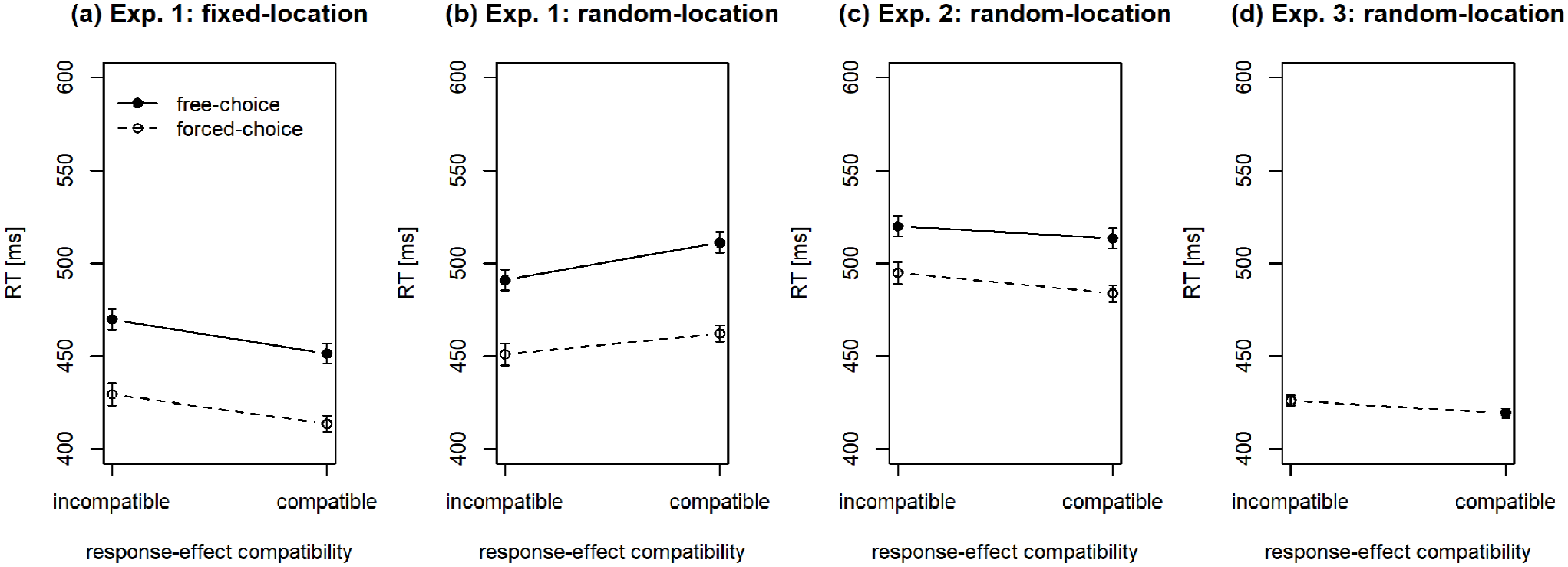
Mean correct RTs as a function of task and response-effect compatibility, separately for the fixed-location group of Experiment 1 (a) and the random-location groups of Experiments 1–3 (b to d). Error bars are within-subject standard errors according to Morey (2008).
Mean correct RTs/PEs as a function of task and response-effect compatibility (REC), separately for the fixed-location group and the random-location groups.
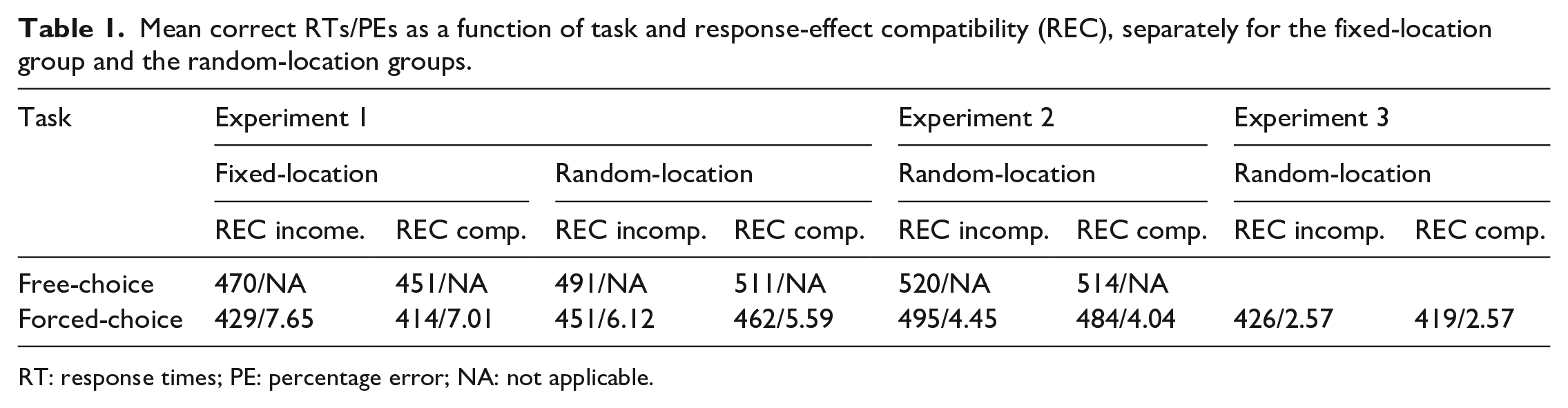
RT: response times; PE: percentage error; NA: not applicable.
Because REC and group interacted, separate 2 × 2 ANOVAs were run for each group. For the fixed-location group, RTs were shorter with compatible than with incompatible REC, F(1, 23) = 6.66, p = .017, ηp² = .22, and longer for the free-choice than the forced-choice task, F(1, 23) = 48.83, p < .001, ηp² = .68. The interaction was not significant, F(1, 23) = 0.19, p = .669, ηp² = .01. Collapsed across tasks, the REC effect was 17 ms (95% CI = [3;30]). For the random-location group, RTs were also longer in the free-choice than in the forced-choice task, F(1, 23) = 25.72, p < .001, ηp² = .53. Neither the main effect of REC, F(1, 23) = 3.29, p = .083, ηp² = .13, nor the interaction was significant though, F(1, 23) = 1.01, p = .325, ηp² = .04. Collapsed across tasks, the REC effect was −14 ms (95% CI = [−31;2]).
PEs are summarised in Table 1, and no effect was significant, group: F(1, 46) = 0.94, p = .337, ηp² = .02; REC: F(1, 46) = 1.42, p = .239, ηp² = .03; interaction: F(1, 46) = 0.01, p = .908, ηp² < .01.
Discussion
When the exact spatial location of the action effect was predictable (fixed-location group), the typical REC effect was observed. For the random-location group, in contrast, for which the exact location varied randomly from trial to trial, no sign of an REC effect proper was observed. In fact, the effect was descriptively reversed and the main effect just missed conventional significance. To put any interpretation on a firmer ground and to exclude a chance finding, in Experiment 2, we ran the random-location group again, but with a much larger sample size.
Experiment 2
Method
Participants
Sixty students 3 from the University of Otago at Dunedin (New Zealand) area participated for course credit or monetary compensation (M age = 20.7 years, 47 females, 1 non-binary). Other criteria applied as for Experiment 1.
Stimuli, apparatus, task, procedure, design, and analyses
Only the random-location condition of Experiment 1 was used. Otherwise, the only change was an increase of blocks from 12 to 16.
Results
Mean correct RTs (2.67% outliers) are visualised in Figure 2c (see also Table 1) and PEs are summarised in Table 1. RTs were longer in free-choice compared with forced-choice tasks, F(1, 59) = 55.23, p < .001, ηp² = .48. Contrary to Experiment 1’s unexpected finding of a reversed REC effect with varied locations, RTs were descriptively shorter with compatible REC, although this main effect did not reach significance, F(1, 59) = 2.83, p = .098, ηp² = .05. The interaction with free-choice versus forced-choice task was also not significant, F(1, 59) = 1.12, p = .295, ηp² = .02. Collapsed across tasks, the REC effect was 9 ms (95% CI = [−1;20]). For PEs, the effect of REC was not significant, F(1, 59) = 2.13, p = .149, ηp² = .03. 4
Because this analysis revealed some ambiguity about the (null-)effect of REC in this large sample, we ran a follow-up analysis to test for individual differences in the effectiveness of the REC manipulation using a method described in Miller and Schwarz (2018). With this method, an ANOVA is conducted considering the individual trials as the random units and using the individual-trial RTs as the values of the dependent variable. The ANOVA includes a participant factor in addition to the factors of REC (compatible vs. incompatible) and task (forced-choice vs. free-choice), and all factors are treated as between-subjects, since each trial is tested at only a single combination of factor levels. In such an analysis, finding that the REC effect varies significantly across participants (i.e., a significant participants × REC interaction, allowing for the random trial-to-trial variability in RT) would show that the REC manipulation must have had some effect, even though this effect went in opposite directions for different participants and was thus nonsignificant in the overall analysis (Miller & Schwarz, 2018). Accordingly, the most critical result of this analysis was the significant interaction of REC and participants, F(59, 35452) = 18.02, p < .001, ηp² = .03. This result supports the conclusion that the REC manipulation has an effect, though the effect is possibly reversed for some participants, leading to a smaller (or null) effect on average in the whole sample. The same conclusion holds when re-analysing the data with a mixed-effects model and observing a significant random effect of the REC manipulation (see the online Supplementary Material B).
To further explore the possibility of real reversals for some participants, we performed an analysis to assess the REC effect for each participant individually. Specifically, for each participant, we computed an (unpaired) t test comparing the RTs in the compatible condition with those in the incompatible condition (collapsing across the forced-choice and free-choice tasks and assuming equal variances). Figure 3a shows a kernel density plot of the observed t values of the 60 participants. A comparison of this curve with a random t distribution 5 suggests there was facilitation in the compatible condition for several participants with large positive t values. However, there are also strong negative effects for other participants, suggesting that these participants truly suffered some inhibition in this condition. Of course, some random variation in these individual-participant t values would be expected by chance even if there were no REC effect for any participant, but the observed variation in these t values seems to be beyond that. A drawback of this analysis is that REC was blocked and is thus confounded with practice and/or fatigue effects. To check whether such effects exist, we also compared the first four with the last three blocks of each half (and thus REC condition) with the same rationale. The resulting distributions are narrower than the one for the REC effect, suggesting that practice/fatigue effects cannot entirely account for the individual-participants REC effects.
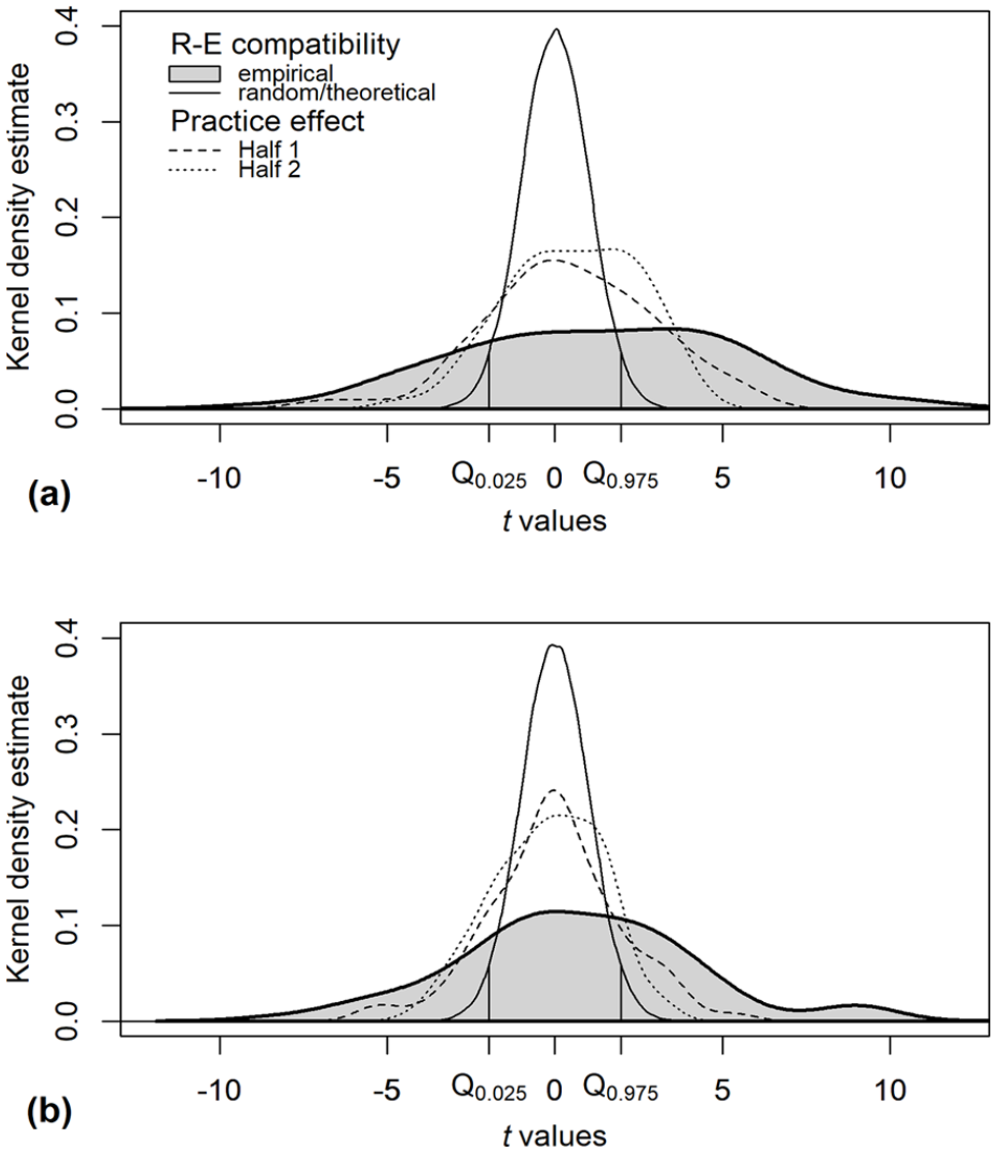
Kernel density plots of the empirical t values computed for each participant’s response-effect (R-E) compatibility effect, practice effect in Half 1, and practice effect in Half 2. (a) Experiment 2. (b) Experiment 3.
Discussion
The data from Experiment 2 are inconsistent with the random-location results of Experiment 1, and in particular, they contradict the strange observation of a (nearly significant) reversed REC effect in the random-location group. With a much larger sample size, it appears as if that observation was a chance finding. In the present dataset, however, an REC effect in the expected direction was still not significant within the random-location group. Thus, it still seems uncertain whether there is really an on-average REC effect with random effect locations, although a follow-up individual differences analysis on only the Experiment 2 data suggests that in this situation there are REC effects in opposite directions for different participants, which then cancel out on average.
Experiment 3
Given the inconclusive results of the first two experiments with respect to the existence of an on-average REC effect with random locations, this experiment was designed to focus even more specifically on determining the presence or absence of that effect. To further simplify the task in case this would promote generalisation of the REC effect across locations, we included only forced-choice trials. Thus, in each trial, the participant simply gave a left or right response to one of two letters that could be presented, and responses were followed by compatible or incompatible action effects in different blocks.
In frequentist terms, determining whether an effect is present or absent entails deciding whether the evidence is more consistent with the null hypothesis (H0) of no effect or with the alternative hypothesis (H1) that an effect is present—a decision for which frequentist statistics are not well suited (e.g., Rouder et al., 2009). Thus, we addressed the problem within a Bayesian framework using the Bayes factor (BF) to quantify the relative evidence regarding these two hypotheses (Rouder et al., 2009; for detailed introductions, see for example, Hoijtink et al., 2019; Schmalz et al., 2023). In brief, a BF = 1 indicates that the evidence favours the two possibilities equally, whereas BF values progressively less than (greater than) 1 indicate progressively stronger support for H0 (H1). We used the sequential BF testing procedure of Schönbrodt et al. (2017) with a maximum sample size of Nmax = 80 participants, as pre-registered at https://aspredicted.org/rk84j.pdf. We planned to stop sequential testing if we obtained BF < 1/6 or BF > 6, concluding in favour of H0 or H1, respectively.
Method
Participants
Eighty students from the University of Bremen (Germany) participated for course credit or monetary compensation (M age = 25.4 years, 53 females). Other criteria applied as for Experiments 1 and 2. Sample size was determined as per the pre-registration. As neither stopping rule applied, sampling stopped at Nmax = 80.
Stimuli, apparatus, task, procedure, design, and analyses
The experiment was similar to Experiment 2. However, only the forced-choice condition was used and thus the only variable of interest was REC (compatible vs. incompatible).
Analyses were done with both Bayesian (as the stopping rules were based on the BF) and frequentist paired t tests. As described in our pre-registration, we used Bayesian sequential sampling and calculated Bayesian paired t tests using the R-package BayesFactor (Morey et al., 2022). These were computed using the default settings of a Cauchy prior on the standardised effect size with the scale parameter set to √2/2 and with a noninformative Jeffreys prior on the variance. In addition, the individual differences analysis reported for Experiment 2 was run on the data from Experiment 3 as well.
Results and discussion
Mean correct RTs (2.56% outliers) were 419 and 426 ms (see also Table 1 and Figure 2d) in the compatible and incompatible REC conditions. This 7-ms difference was not significant, t(79) = 1.82, p = .073, d = 0.20, BF10 = 0.59, 95% CI = [−1;14]. PEs were 2.57 in both REC conditions, t(79) = 0.01, p = .995, d = 0.00, BF10 = 0.12. Thus, with an even larger sample than in Experiment 2, the REC effect was still not statistically significant, and the BF favours the null hypothesis.
Individual differences analyses of Experiment 3 data
Regarding the individual differences analysis, the most critical result is the significant interaction of REC and participants, F(79, 31729) = 18.25, p < .001, ηp² = .04. This result again suggests that the REC manipulation has an effect, but the effect is reversed for some participants, leading to smaller (or null) effect on average in the whole sample (see the online Supplementary Material B for the respective analyses with a mixed-effects model).
We then again conducted the analysis of the individual-participants’ REC effects, as we did for Experiment 2. Figure 3b shows the kernel density plot of the observed t values of the 80 participants. The comparison of this curve with the random t distribution again suggests facilitation in the compatible condition for several participants with large positive t values, and—at the same time—strong negative effects for other participants. 6 As in Experiment 2, these opposite-direction effects approximately cancel out so that no REC effect is seen on average across participants.
General discussion
The present study investigated whether action effects need to be perfectly predictable to serve as a basis of response selection according to ideomotor theory, or whether some variation is allowed as long as the relevant feature of dimensional overlap with the responses can be abstracted from the individual occurrences. To this end, participants performed an REC task with left versus right responses and left versus right action effects, thus producing a dimensional overlap (Kornblum et al., 1990) on the horizontal spatial dimension.
Summary of results
In the fixed-location group of Experiment 1, the exact spatial location of the action effect was predictable and the typical REC effect was observed (Kunde, 2001). More interesting for the present study was whether we would observe a similar pattern in the random-location group, for which the action effect also appeared at a location left or right from the screen centre, but the exact location varied randomly from trial to trial. In Experiment 1, this group revealed ambiguous results: the REC effect was descriptively reversed and just missed significance. To clarify this unexpected reversed result, this condition was repeated with an increased sample size in Experiment 2. In this case, a typical REC effect was observed descriptively, which was also of approximately the same size as that observed for the fixed-location group of Experiment 1 (see also Analysis 1 in the online Supplementary Material), and yet the REC effect was not statistically reliable with varied locations. Experiment 3 pitted the varied-location REC effect null and alternative hypotheses directly against one another within a Bayesian framework, and the results favoured the null hypothesis. Thus, our overall conclusion is that RT is unaffected, on average across participants, by the spatial consistency of a “left” versus “right” response with a generalised “left” versus “right” feature of the action effects.
This is not to say that the varied-location action effects were entirely without effect, however. Additional analyses of both Experiments 2 and 3 strongly suggested that there were significant individual differences between participants in the size of the REC effect (see also Analysis 2 in the online Supplementary Material A and the mixed-effects model analyses in the online Supplementary Material B; see also Kliegl et al., 2011, for similar observations). Together with the null effect on average, this implies that there was a facilitatory effect for some participants and an inhibitory effect for others, likely with no effect at all for a third group. For this to be the case, at least some participants must have extracted—and subsequently been influenced by—the generalised “left” versus “right” feature of the varied location action effects. The nature of this influence was inconsistent, however. For some participants, responses were faster when the generalised feature matched the required response side; for others, responses were slower (see Figure 3). We can only speculate on the reason for the slowing of the compatible response in the latter group of participants, but one possibility is that the spatial variability of the action effect perturbed the spatial precision of the same side’s response representation, thereby making it more difficult to produce the response on that side. For example, a spatially variable left-side action effect could introduce noise into the internal representation of the left-side response, and some time would be needed to overcome this response-level noise. What can at least be taken from the present study is that the precise spatial location of the (upcoming) action effect is not that important for the response-relevant left/right feature to be extracted from the action effect. However, the facilitatory or inhibitory consequences of that extracted spatial feature may well depend on its variability across trials.
Relations with other studies
As reviewed in the “Introduction”, the overall conclusion from several studies of verbal–semantic overlap of actions and their effects (Földes et al., 2018; Koch et al., 2021; Koch & Kunde, 2002) is that no generalisation takes place in REC experiments. This conclusion was based on analyses of REC effects on average across participants, and it is consistent with our conclusion that the REC effect does not generalise across varying spatial locations, on average across participants. On the contrary, our individual-differences analyses indicate that participants do abstract the critical left/right spatial feature defining the overlap with the responses from the varying action-effect locations, even though they are not—as a group—consistently facilitated or inhibited by the match of this feature with the response side. It is an open question whether generalised verbal–semantic features are similarly extracted and produce effects in opposite directions for different participants, because comparable individual-differences analyses were not reported for those studies.
Some results, however, indicate the implication of percept-like representations in action planning, at least to some degree. For example, the duration of a time interval (between a response and its effect) seems to be anticipated and to impact RTs as well (Dignath et al., 2014; see also Wirth et al., 2015). The time interval has even been shown to be separable from the identity of the action-effect proper in experiments where the identity of the (auditory) action effect was varied randomly and was thus not predictable (Dignath & Janczyk, 2017). Furthermore, if the identity was made predictable as well (in their Exp. 2), the RT difference between long and short intervals was not increased further. Also, the REC effect differed in size when the effect—that is, the colour word—was presented in the corresponding colour as well (Koch & Kunde, 2002). In addition, Földes et al. (2017) reported a larger REC effect when the modality of the action effect was modality-compatible with the action (e.g., vocal responses produced auditory action effects) than when it was not (e.g., vocal responses followed by visual action effects with the same semantic meaning).
Considered more broadly, two kinds of representational format are often considered in cognitive psychology (see, for example, Reed, 2016): a concrete (or modal) format retaining characteristics of the represented object and its sensory features, and an abstract (or amodal) format abstracting from these sensory features but retaining the meaning of the represented object (see also Barsalou, 1999). The present results may be interpreted as evidence that action planning can be affected by abstract, amodal representations, just as suggested by the Theory of Event Coding (TEC; Hommel et al., 2001), because TEC’s distal coding approach “allows perception and action planning to abstract from domain- and modality-specific (e.g., visual, kinesthetic, or muscular) coding characteristics” (p. 861). An additional influence of percept-like representations is also suggested, however, by the differing on-average effects of fixed-location versus varied-location action effects. If the action effects were only coded in terms of left/right category, then within-category variation should not have any effect.
A different way to interpret the present results would be to ask just what types of action effects have an influence on action planning. Clearly, an event must follow a bodily movement at least somewhat predictably to count as an action effect. These events can occur in the environment, as in our experiment, but can also relate to proprioceptive and tactile body-related sensations (see Pfister, 2019; Pfister et al., 2014); a distinction already made by James (1890/1981) as “remote” versus “resident” effects. Beyond that, though, a bodily movement need not be followed by the very same impression in all instances. Knocking on a surface may always result in an auditory impression, but the particular sound and loudness depend on the material (in addition to the strength of the knock). It is unknown, however, to what extent this variation in the action effect interferes with the influence of the anticipated action effect on action planning. There is some evidence (Kiesel & Hoffmann, 2004) suggesting that relations of actions and effects that depend on contextual features can be employed as long as the context makes the precise relation perfectly predictable. Yet, it is a different question whether an action effect needs to be entirely predictable or only predictable in those features that provide the dimensional overlap with the responses. The present results suggest that the features providing dimensional overlap need not be perfectly predictable to have some influence, albeit an influence that may differ among individuals. It seems clear that participants are able to extract the critical features from not-perfectly predictable action effects, although participants apparently differ in whether a match of these features with response features facilitates (or inhibits) their responses. Investigating the reasons for the observed individual differences seems worthwhile for future research.
Finally, the present Experiments 1 and 2 replicated the finding of longer RTs in free-choice compared with forced-choice tasks (e.g., Berlyne, 1957; Janczyk et al., 2015), but the effect of REC was comparable for both tasks (see, for example, Pfister & Kunde, 2013). Thus, the present results support the notion that action effects impact task performance in forced-choice and free-choice tasks to the same degree, rather than supporting a theoretical distinction between these tasks.
Conclusion
Perfectly predictable action effects appear to facilitate responding when they are compatible with the required response. For action effects that are not-perfectly predictable, however, the present experiments suggest that at least some people can abstract from such varying action effects the underlying features that overlap with responses and that these features can then influence action selection—albeit possibly inhibiting rather than facilitating the actions with which they are compatible. In other words, variation in the perceptual features of the anticipated action effects appear not to prevent their extraction as relevant environmental features, even though it may critically alter the influence of those features on action planning, producing interference for some participants as opposed to the facilitation that is present with non-varying features.
Supplemental Material
sj-docx-1-qjp-10.1177_17470218231184996 – Supplemental material for Generalisation of unpredictable action-effect features: Large individual differences with little on-average effect
Supplemental material, sj-docx-1-qjp-10.1177_17470218231184996 for Generalisation of unpredictable action-effect features: Large individual differences with little on-average effect by Markus Janczyk and Jeff Miller in Quarterly Journal of Experimental Psychology
Footnotes
Acknowledgements
The authors thank Iring Koch, Jim Grange, and two anonymous reviewers for their comments on a previous version of the manuscript, and Reinhold Kliegl for helpful discussions on the individual-differences analyses.
Consent to participate
Written informed consent was obtained prior to data collection.
Declaration of conflicting interests
The author(s) declared no potential conflicts of interest with respect to the research, authorship, and/or publication of this article.
Ethics approval
The study was performed in accordance with the ethical standards as laid down in the 1964 Declaration of Helsinki and its later amendments or comparable ethical standards.
Funding
The author(s) disclosed receipt of the following financial support for the research, authorship, and/or publication of this article: This research was supported within the Research Unit “Modal and amodal cognition: Functions and interactions” (FOR 2718; Project 381713393) funded by the German Research Foundation (Deutsche Forschungsgemeinschaft [DFG]), Grant JA2307/7-1 (Project 422180965, awarded to M.J.). J.M. acts as a Mercator fellow in this Research Unit.

Data accessibility statement
Supplemental material
The supplementary material is available at qjep.sagepub.com.
Notes
References
Supplementary Material
Please find the following supplemental material available below.
For Open Access articles published under a Creative Commons License, all supplemental material carries the same license as the article it is associated with.
For non-Open Access articles published, all supplemental material carries a non-exclusive license, and permission requests for re-use of supplemental material or any part of supplemental material shall be sent directly to the copyright owner as specified in the copyright notice associated with the article.
