




Abstract
Extinction training has proved effective to diminish the expectancy of the aversive unconditioned stimulus (US). However, the negative valence of the conditioned stimulus (CS) may still stay intact. In fact, several studies have suggested that the CS negative valence may be a factor that promotes the return of fear. Our study focuses on the role of changes in the CS valence as a potential mechanism to reduce the spontaneous recovery of threat expectancies. To do that, we evaluated counterconditioning (CC), a technique aimed to reduce the CS negative valence by paring it with a positive stimulus and compared its efficacy to that of a novelty-facilitated extinction (NFE) and a standard extinction interventions. Using a 2-day protocol, participants first learned the relationship between a figure and an aversive sound, using a differential conditioning paradigm, and were then randomly assigned to one of three different groups. For the CC group, CS+ or cue A was paired with a positive US. The standard extinction group was exposed to cue A alone. For a third NFE group, cue A was followed by a neutral US. Finally, on the second day, spontaneous recovery was tested. Our findings did not provide evidence to suggest that CC could be more effective to prevent or reduce the return of threat expectancies or influence valence ratings when compared with NFE and standard extinction.
Introduction
Anxiety disorders represent one of the main mental health issues our current society faces, with a prevalence of up to 25% in the adult population (Baxter et al., 2013; Remes et al., 2016). Exposure therapies, based on the principles of extinction (Pavlov, 1927), constitute an effective treatment for anxiety disorders (Graham & Milad, 2011; Vervliet et al., 2013): individuals are repeatedly exposed to the feared element in the absence of aversive consequences to promote the extinction of the fear response to the former. However, although exposure-based therapies are successful in reducing fear in the short term, they have problems to maintain their effects in the long term, ranging estimates of relapse from 19% to 62% (Craske & Mystkowski, 2006).
Experimental extinction in the laboratory has been widely used as a model for exposure therapies of anxiety disorders (Graham & Milad, 2011; Urcelay, 2012), as well as a model for the origin of relapse (Krypotos & Engelhard, 2019). In an acquisition phase, individuals learn that an originally neutral stimulus (conditioned stimulus; CS) predicts the presentation of an aversive, threatening event (unconditioned stimulus;
Finding a way to prevent the return of fear represents a widely studied matter (Dunsmoor et al., 2015; Vervliet et al., 2013), with an increasing interest on the study of new strategies that promote the maintenance of the extinction effects (Lipp et al., 2020; Vervliet et al., 2013).
Several studies have proposed the potential implication of emotional aspects related to the CS valence as a factor that promotes the return of fear (Baeyens et al., 1988; De Houwer et al., 2001; Dirikx et al., 2004, 2007; Hermans, Crombez, et al., 2002; Hermans, Vansteenwegen, et al., 2002). When a CS is paired with a USneg, the individual not only learns the association between these two stimuli. The CS also acquires negative valence features by being paired with an aversive stimulus (evaluative learning). A typical standard extinction (SE) treatment allows the individual to experiment a new situation where the CS is no longer followed by the USneg. The acquisition contingency between those stimuli changes, causing a diminished threat expectancy at the end of the extinction phase (Kang et al., 2018). However, and even though the SE treatment may be effective to reduce the expectancy that the feared stimulus will be presented, it may not reduce the newly acquired negative valence of the CS (Baeyens et al., 1988; De Houwer et al., 2001; Engelhard et al., 2014), which could be involved in the return of fear (Dirikx et al., 2004, 2007; Hermans, Crombez, et al., 2002; Hermans et al., 2005; Hermans, Vansteenwegen, et al., 2002; Zbozinek et al., 2015).
According to Lang’s (1995) emotion theory, emotions can be described using two dimensions: their affective valence (positive-negative) and the level of arousal (high-low) elicited. These dimensions interact to generate different emotions. For instance, fear would entail the combination of negative valence and high levels of arousal (Dirikx et al., 2004). Diminishing threat expectancy during an extinction treatment targets the arousal, but might leave intact the negative valence acquired by the CS.
Counterconditioning (CC) is a more promising technique to modify the negative valence of the CS. It involves the presentation of a different US following the CS during the treatment. Crucially, the original US is replaced with a new stimulus of opposite valence. For example, in the fear conditioning field, the original stimulus is a USneg, and the treatment stimulus should be a positive US (USpos). In this case, during CC, the individual not only learns that the CS is no longer followed by the USneg but also the CS changes its valence status by being paired with a positive stimulus (Baeyens et al., 1989; De Houwer et al., 2001; Engelhard et al., 2014; Hofmann et al., 2010). It appears that CC may be a more effective treatment than SE since it targets both aspects involved in the return of fear (Hermans, Vansteenwegen, et al., 2002; Kang et al., 2018).
However, the aversive-to-appetitive CC literature is sparse, especially in human fear conditioning (Kang et al., 2018; Keller et al., 2020). Raes and De Raedt (2012) found CC to be more effective to reduce an indirect measure of evaluative learning (measured with an affective priming task) than SE, although they did not have a test phase to assess the preventive effects of this treatment on fear return, as opposing to SE. A similar pattern of results was obtained by Engelhard et al. (2014; Study 2), who also found CC to reduce US expectancy to a greater extent than a control group (filler task), although they did not include a SE group or a final test phase. However, van Dis et al. (2019) found, in a two-experiment study, that although CC did indeed reduce the negative valence of the CS, it did not attenuate spontaneous recovery or reinstatement as measured by skin conductance responses (SCR), fear-potentiated startle and shock expectancy. Kang et al. (2018) did find reduction of spontaneous recovery following CC compared with a SE treatment. Surprisingly, even though threat expectancy diminished in the CC group, the negative valence of the CS did not differ from that of the SE group. The same pattern of results regarding CS valence was found by de Jong et al. (2000) in the treatment of spider phobia, suggesting that in some cases the classical exposure treatment may already be quite effective.
If the residual effect of the CS valence after a SE treatment is responsible for the return of fear, CC should be more effective to prevent or reduce it since it involves the presentation of the CS along with a US of positive valence (Baeyens et al., 1989; De Houwer et al., 2001; Engelhard et al., 2014; Hermans, Crombez, et al., 2002; Hermans, Vansteenwegen, et al., 2002; Hofmann et al., 2010), aimed to reduce both threat expectancy and the CS negative valence. However, CC represents a further change from SE in the sense that the CS is not presented alone but followed by another stimulus. The inclusion of the new stimulus could be promoting a stronger extinction learning due to a greater level of surprise (Keller et al., 2020; van Dis et al., 2019). Thus, solely comparing CC with SE, it is very difficult to establish which of those aspects (a change in the valence of the CS or the enhanced extinction learning) could explain the efficacy of CC in the reduction or even the prevention of the return of fear. Therefore, we considered the novelty-facilitated extinction (NFE) treatment (Dunsmoor et al., 2015; Krypotos & Engelhard, 2018; Lucas et al., 2018; Raes & De Raedt, 2012) as a control condition. This novel technique is identical to CC except for the valence of the US presented during extinction. While CC involves pairing the CS with a USpos, NFE requires the presentation of a novel neutral stimulus (USneu). It was first used by Raes and De Raedt (2012), who found that both CC and NFE (referred to by the authors as “neutral counterconditioning”) successfully changed the evaluative features of the CS, in contrast to extinction, on an indirect measure (an affective priming task). However, as previously mentioned, these authors did not include a test phase to measure the return of fear levels shown by the different groups.
Dunsmoor et al. (2015) conducted a study, including both animal and human participants, to assess the efficacy of NFE. They found that replacing an aversive shock with a novel neutral tone reduced spontaneous recovery, measured by freezing response in rats and SCR in humans, when compared with a SE treatment. Interestingly, these authors found a positive correlation between the level of spontaneous recovery (as measured by SCR) and self-reported intolerance of uncertainty in the SE group, but not in the NFE group. They explained these results by stating that the surprise generated by the presentation of a novel neutral stimulus promotes the learning of a new association, which may be stronger than the inhibitory memory formed during a standard treatment, as it terminates the ambiguity experimented during extinction (by presenting a
Lucas et al. (2018) also tested the efficacy of NFE. They used a partial reinforcement schedule for acquisition and a continuous schedule for extinction, finding that reinstatement (as measured by SCR) was prevented in the NFE group, but not in the SE group. The authors proposed that the reduction of fear after this treatment may occur since the CS goes from being an unreliable to a reliable predictor. They also replicated Dunsmoor et al.’s (2015) results regarding the correlation found between the level of fear recovery and self-reported intolerance of uncertainty in the group that underwent the SE treatment, but not in the NFE. However, a third study, by Krypotos and Engelhard (2018), failed to find evidence for the benefits of this treatment using a conditioned avoidance paradigm.
The main aim of the present study was to evaluate whether a CC treatment is more beneficial than standard extinction to prevent one particular form of return of fear, spontaneous recovery, using a human threat conditioning paradigm. We compared the effects of CC with those derived from a NFE condition to evaluate the specific role of the valence change in the potential benefits of the CC treatment. To the best of our knowledge, no other study has yet been conducted comparing the effects of CC, NFE and SE on spontaneous recovery, as measured by both threat expectancy and the effects on the CS valence.
The results we obtain will shed light on the role of changes in the CS valence as a potential mechanism underlying the benefits derived from CC, as well as on the importance of ceasing the uncertainty, generated by the omission of the US, typically associated with a standard treatment. Based on the literature, we expected the SE group to show a greater recovery of the threat response in comparison to the novelty-facilitated condition. This effect would stem from the reduction on the uncertainty in the novelty group by means of associating the CS with a novel outcome. Moreover, given that the CC treatment involves not only the presentation of a new stimulus, but also that the valence of that outcome is positive, we expected that the CS valence will be more effectively reduced in the CC group than in the other two conditions during the treatment phase. Thus, the CC group will exhibit a greater reduction on the levels of the spontaneous recovery of threat expectancies when compared with the NFE group. Note that we are not assuming any specific mechanism whereby reductions in the CS negative valence may correspondingly reduce the levels of spontaneous recovery.
In addition, beyond the predictions derived from this hypothesis, our study will serve to analyse possible differences in the extinction of CS valence ratings produced by the different treatments considered here, namely CC, NFE, and SE. Previous literature has found different results concerning these possible differences and, to our knowledge, this is one of the first studies in which these different treatments are included within the same experimental protocol (see Luck & Lipp, 2019, for a recent review). We also analysed whether CS valence ratings were subjected to spontaneous recovery and/or if there were differences in the magnitude of this spontaneous recovery according to the different treatments used. Luck and Lipp (2020), using a picture-picture evaluative conditioning paradigm, found that CS valence ratings did not spontaneously recover whereas valence ratings were subjected to reinstatement and so-called ABA renewal.
Method
Participants
The sample consisted of 257 college students (211 females) from the School of Psychology and Speech Therapy of the University of Málaga that received course credit for their participation. They were randomly allocated to one of the three different groups, stratifying for gender. Before starting the experiment, the experimenter briefly explained the task the participants were to complete. They were also informed about the possibility of leaving the study in any moment, if they wished to, and without any consequences. Finally, participants had to read and sign an informed consent to participate in the study. This study was approved by the Ethics Committee of our home University and was conducted in accordance with The Code of Ethics of the World Medical Association (Declaration of Helsinki).
Sample size (power analysis)
The critical analysis of this experiment is the comparison between groups in the first trial of the Test phase (see the Statistical Analyses section). The total sample size that we expected to be able to recruit was N = 265. After removal of those participants using the exclusion criteria described below (see the Exclusion Criteria section), we expected to have 225 remaining participants, 75 per group. Using the R package pwr (version 1.3; Champely, 2020), we conducted a power analysis to estimate the effect size we will be able to detect for the t-test between samples that will be used to compare the groups in the first trial of the Test phase using this sample size. For a value of α = .05, this sample size leads to a 90% probability (power) of detecting a medium effect size (d = 0.48).
Procedure
The design of the experimental procedure is summarised in Table 1. The experimental task consisted of a three-phase procedure (see Table 1; Culver et al., 2018; Kang et al., 2018; Morís et al., 2017; Thompson et al., 2018; van Dis et al., 2019) that took place over 2 days.
Design summary of the experimental procedure.
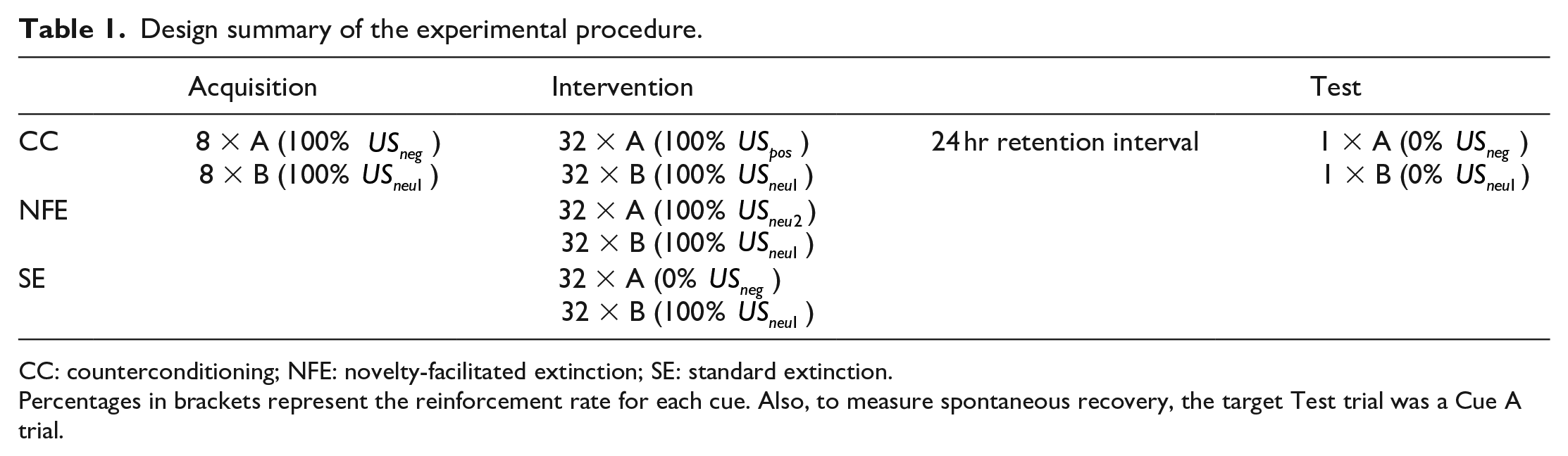
CC: counterconditioning; NFE: novelty-facilitated extinction; SE: standard extinction.
Percentages in brackets represent the reinforcement rate for each cue. Also, to measure spontaneous recovery, the target Test trial was a Cue A trial.
During the first day, participants completed the Acquisition and the Intervention phases. During Acquisition, participants were exposed to 16 trials: 8 Cue A+ trials; 8 Cue B− trials. In this phase, the Cue A+ was always followed by the presentation of an aversive stimulus (USneg; aversive sound), while Cue B− was presented along with a neutral stimulus (USneu1: neutral sound 1). Though our hypotheses are exclusively concerned with Cue A ratings, we also measured Cue B conditioning during the Acquisition phase to ensure that participants’ use of the rating scale and general understanding of the task were appropriate (i.e., ratings to Cue A and Cue B should differ across acquisition trials if conditioning proceeds as expected, a prerequisite for the viability of the study). Trials were presented using a pseudorandom order (i.e., out of each group of two trials, one of each type was presented in a randomly selected order).
The experimental manipulation took place during the Intervention phase, where participants were randomly assigned to one of three different groups: CC, NFE, or SE groups. This phase consisted of 32 presentations of Cues A and B. The different phases were not marked at all to participants. Since Cue A, the target cue, changes from being followed by the USneg to being paired either with a positive, a neutral or the omission of the aversive US in the different groups, it is important for participants to understand that there is continuity between the different phases. Therefore, the contingency for Cue B was maintained throughout the Acquisition and Intervention phases. For the CC group, Cue A was paired with a
On the second day, after a 24-hr retention interval, participants underwent the last phase (Test), which consisted of two trials: a presentation of a single Cue A and Cue B trials on their own, without any ensuing outcome. Importantly, the first test trial was a target Cue A trial to evaluate the spontaneous recovery effect.
Each trial began with a fixation point (a black cross, Courier New Font, size 180) presented on the centre of the screen during an interval from 2,500 to 3,500 ms (uniform distribution with 100 ms step). After that, the cue was presented, and a rating scale appeared on the lower part of the screen. Participants had to click on the rating scale to give their response following the instructions. Their response, a threat expectancy, was an estimation of the expected occurrence of the aversive outcome, using this measure as the conditioned response. The scale ranged from 0 (the aversive noise will not be presented) to 100 (the aversive noise is very likely to follow). The cue remained on screen after participants gave their expectancies, overlapping with the presentation of the outcome. In the case of the SE treatment, although participants did not experience any US during the Intervention Phase, the cue remained on screen to equate the trial duration between groups. At the end of each trial, the outcome disappeared, and the fixation cross of the next trial was presented for the whole duration of the inter-trial interval. In addition, we evaluated the CS valence on each phase (Acquisition, Intervention, Test), on a scale ranging from 0 (very unpleasant) and 9 (very pleasant).
Stimuli
A red circle with RGB values of 192, 80 and 77 and a blue square with RGB values of 85, 142 and 213 were used as cues, counterbalanced across participants. All visual stimuli were presented on a black coloured background in the centre of the screen. The
Materials
To explore the potential relation between self-reported intolerance of uncertainty and spontaneous recovery, participants completed the Intolerance of Uncertainty Scale (IUS), as well as the Trait Anxiety Scale, after the completion of the task.
The Spanish adaptation of the IUS
The IUS (Freeston et al., 1994; adaptation: González-Rodríguez et al., 2006) is a 27-item self-report measure that assesses the degree to which individuals find uncertainty to be distressing and undesirable (internal consistency of .91 and test–retest reliability of .78; Dugas et al., 1997). The IUS includes two subscales known as Prospective Intolerance of Uncertainty (11 items) and Inhibitory Intolerance of Uncertainty (16 items). Items are rated on a 5-point Likert-type scale ranging from 1 (not at all characteristic of me) to 5 (extremely characteristic of me).
The Spanish adaptation of the Trait Subscale of the State Trait Anxiety Inventory, Form Y
While the State Trait Anxiety Inventory (STAI) includes two subscales known as Trait Anxiety (20 items) and State Anxiety (20 items), participants only completed the first one, the Trait Anxiety subscale. This subscale (Spielberger et al., 1970; adaptation: Buela-Casal et al. (2011)) is a 20-item self-evaluation questionnaire that assesses the degree to which individuals suffer trait anxiety (internal consistency between .90 and .95, and test–retest reliability between .84 and .91). Items in the Trait subscale are rated on a 4-point Likert-type scale ranging from 0 (nothing) to 3 (a lot).
Measures: subjective ratings
USneg expectancy ratings
During each CS presentation, participants were asked “How likely is the aversive noise?,” on a scale from 0 (the aversive noise will not be presented) to 100 (the aversive noise is very likely to follow).
CS valence ratings
Participants had to rate the valence of the two cues. On the first day, at the end of the Acquisition and the Intervention phases, participants had to answer the question “How pleasant or unpleasant do you find this figure?,” on a scale from 0 (very unpleasant) to 9 (very pleasant). The same was asked on the second day for each cue after the corresponding expectancy rating.
US ratings
At the end of the experiment on Day 2, participants had to complete several rating scales regarding the pleasantness caused by the sounds they were exposed to, as well as the anxiety experienced due to the aversive sound. First, they were asked to indicate, on a scale going from 0 (very unpleasant) to 9 (very pleasant), how much pleasantness they felt when listening to each neutral or positive sound throughout the task. After this, they had to answer how much anxiety did the aversive sound cause them, on a scale going from 0 (low anxiety) to 9 (high anxiety). Importantly, participants had to rate only those USs they were exposed to.
Analyses
Data-analyses
Exclusion criteria
As in Morís et al. (2017; Experiment 3) and Quintero et al. (2022), we used some rejection criteria to exclude from further analyses data from participants who had a poor understanding of the contingencies programmed. In those two previous studies, the criteria were based on the distribution of data obtained for each group, removing participants that deviated more than two standard deviations in several measures. This poses a potential problem, given that if a given group has several participants that perform poorly in the task, the criteria will become more liberal, even in phases in which there are no differences between groups. Because of this, we opted to move on to a different set of criteria based on raw scores. Participants were excluded in case they met at least one of the following criteria:
If their mean expectancy response to Cue A on trials 5–8 of Acquisition is <70.
If their mean expectancy response to Cue B on trials 5–8 of Acquisition is >15.
If two or more responses to cue A on the last four trials of Extinction are >70.
If two or more responses to cue B on the last four trials of Extinction are >15.
We have chosen these criteria to ensure an adequate level of attention and learning across the task prior to the experimental manipulation, so that participants that are included have learned the contingencies during the Acquisition phase, and to ensure that participants are paying attention during the Extinction phase. Applying these criteria, we excluded 6.6% of the initial sample, which lies between the suggested percentages of excluded participants (Lonsdorf et al., 2019; Marin et al., 2019).
Statistical analyses
Statistical analyses were performed using R 3.6.1 (R Core Team, 2018) and JASP 0.14.1 (JASP Team, 2020). In all the repeated-measures analyses of variance (ANOVAs), the sphericity was tested, using Greenhouse-Geisser’s correction for the degrees of freedom if necessary. As regards the effect size statistics, we reported ω2 (Albers & Lakens, 2018) and, in the case of the t-tests, Cohen’s d.
Expectancy ratings
For the Acquisition phase, we conducted a frequentist repeated-measures ANOVA, including a between-subjects factor (Group: CC, NFE, and SE) and two within-subjects factors (Cue: A and B; and Trial: 1 to 8). We expected no differences between groups and a significant effect of Cue, with Cue A showing higher response levels (measured as threat expectancy) than Cue B, Trial, as well as a Cue × Trial interaction. A Bayesian repeated-measures ANOVA was carried out to check if the predicted absence of the significant differences was consistent with a stronger support for the null model.
For the Intervention phase, we also conducted a repeated-measures ANOVA, including a between-subjects factor (Group: CC, NFE, and SE) and two within-subjects factors (Cue: A and B; and Trial: 1 to 32). In this case, we expected a significant effect of Trial, Group, and Trial × Group due to potential differences in the extinction of threat expectancies for Cue A; a Cue and Cue × Trial effects given that we expected low responses to be maintained for Cue B; and, finally, a Cue × Trial × Group interaction. Then, we conducted another repeated-measures ANOVA but only on Cue A data, including a between-subjects factor (Group: CC, NFE, and SE) and a within-subjects factor (Trial: 1 to 32), to evaluate the course of extinction for the different treatments. It is important to note that our hypotheses are not specifically concerned with differential conditioning, and that Cue B has no interest beyond serving as a cue to ensure minimal discrimination during the task. Finally, and to make sure that there were no differences between the groups at the end of the Intervention on the ratings of Cue A, we conducted a Bayesian ANOVA comparing the mean response to Cue A in the last three trials of the Intervention phase of the different groups.
For the Test phase, we first conducted a repeated-measures ANOVA, including a between-subjects factor (Group: CC, NFE, and SE) and a two within-subjects factors (Cue: A and B; and Trial: last three Intervention trials vs Test trial), to evaluate the spontaneous recovery effect. We expected a significant effect of Trial, showing the recovery of the response with higher scores in the Test trial than in the last Intervention trial; Cue, with higher scores for Cue A than for Cue B; and a Cue × Trial effect. If there was any difference on the return of fear depending on the treatment, we expected a significant effect of Group and its interactions. Therefore, and in case we found a Group effect, we would perform a one-way ANOVA on Cue A data in the Test trial, including a between-subjects factor (Group: CC, NFE, and SE), to analyse the effect derived from our target manipulation. Based on previous literature, we further conducted several theory-driven two-tailed t-tests to evaluate differences between groups (CC vs NFE, CC vs SE, and NFE vs SE) on the Test trial to assess which intervention was more effective to diminish spontaneous recovery. If our hypotheses were supported by the results, we expected the CC group to show lower response levels than the NFE group, with the NFE group showing lower response levels than the SE group. These analyses were complemented by the corresponding Bayesian t-tests in case of absence of differences in the frequentist tests.
Valence ratings
We conducted a repeated-measures ANOVA for the acquisition ratings, including a between-subjects factor (Group: CC, NFE, and SE) and a within-subjects factors (Cue: A and B). We expected a main effect of Cue, with Cue A being rated as more unpleasant than Cue B. We did not expect either any Group effect or a Cue × Group interaction. From this point, and guided by our hypotheses, we only considered Cue A valence ratings. We performed a repeated-measures ANOVA, including a between-subjects factor (Group: CC, NFE, and SE) and a within-subjects factor (Phase: Acquisition and Intervention) on Cue A valence ratings. We expected a significant effect of Phase due to the extinction treatment, as well as a potential Group x Phase interaction, meaning an effect of the different extinction treatments on the valence ratings. We further conducted a one-way ANOVA, including a between-subjects factor (Group: CC, NFE, and SE), on Cue A data in the Intervention phase, expecting a significant effect of the Group factor. We then performed three two-tailed t-tests to evaluate differences between groups (CC vs NFE, CC vs SE, and NFE vs SE). Finally, regarding the Test phase, we first conducted a repeated-measures ANOVA on Cue A data, including a between-subjects factor (Group: CC, NFE, and SE) and a within-subjects factor (Phase: Intervention and Test), to evaluate a potential spontaneous recovery effect on valence ratings. Subsequently, we performed a one-way ANOVA on Cue A data from the Test trial, including a between-subjects factor (Group: CC, NFE, and SE). We expected a significant Group effect. Then, we performed three two-tailed t-tests to evaluate more precisely the differences between groups (CC vs NFE, CC vs SE, and NFE vs SE). All the frequentist analyses described in this section were supplemented by their corresponding Bayesian analyses where required.
Data collection and storage
The behavioural data (expectancy ratings, valence ratings, and reaction times) and questionnaire scores, as well as the analysis scripts, are available at Open Science Framework (OSF) repository (https://osf.io/6jhdx/). The data were completely anonymised, and the original data with identifiers have been deleted.
Results
Pre-analysis participant exclusion
After applying the previously explained exclusion criteria, 17 participants (6 from the CC group, 7 from the NFE group, and 4 from the SE group) did not meet the required criteria and were thus removed from the final sample, which consisted of 240 participants: 81 in the CC group (71 females), 78 in the NFE group (60 females), and 81 in the SE group (67 females). A chi-square test of independence revealed that there was no significant association between the number of excluded participants and the condition they were assigned to,
Expectancy ratings
Acquisition phase
We conducted a frequentist repeated-measures ANOVA, including a between-subjects factor (Group: CC, NFE, and SE) and two within-subjects factors (Cue: A and B; and Trial: 1 to 8). We found a significant effect of Cue,
1
F(1, 237) = 14,780.82, p < .001, ω2 = 0.79, Trial, F(2.66, 630.28) = 14.25, p < .001, ω2 = 0.002, and Cue × Trial, F(3.63, 860.47) = 649.73, p < .001, ω2 = 0.11,
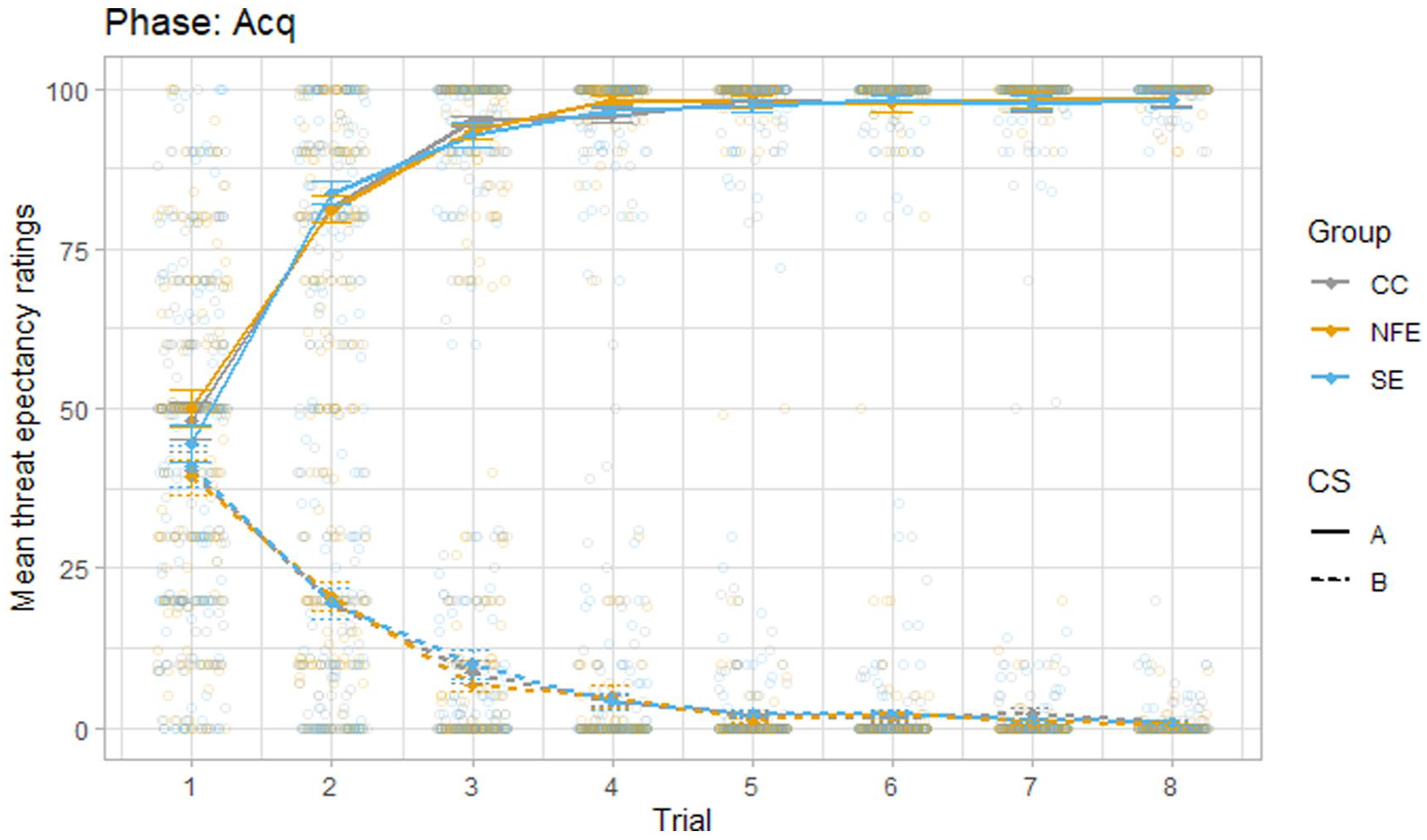
Mean threat expectancy ratings during the acquisition phase.
Intervention phase
During this phase (see Figure 2), a repeated-measures ANOVA showed a significant effect of Cue, F(1, 237) = 82.02, p < .001, ω2 = 0.02, Trial, F(3.44, 815.13) = 692.33, p < .001, ω2 = 0.47, Group × Trial, F(6.88, 815.13) = 2.09, p = .043, ω2 = 0.001, and Cue × Trial, F(3.38, 801.83) = 154.2, p < .001, ω2 = 0.08. There was no significant effect of Group, F(2, 237) = 2, p = .137, ω2 < 0.001, Group × Cue, F(2, 237) = 0.82, p = .444, ω2 < −0.001, or the Group × Cue × Trial interaction, F(6.77, 801.83) = 1.64, p = .122, ω2 < 0.001.
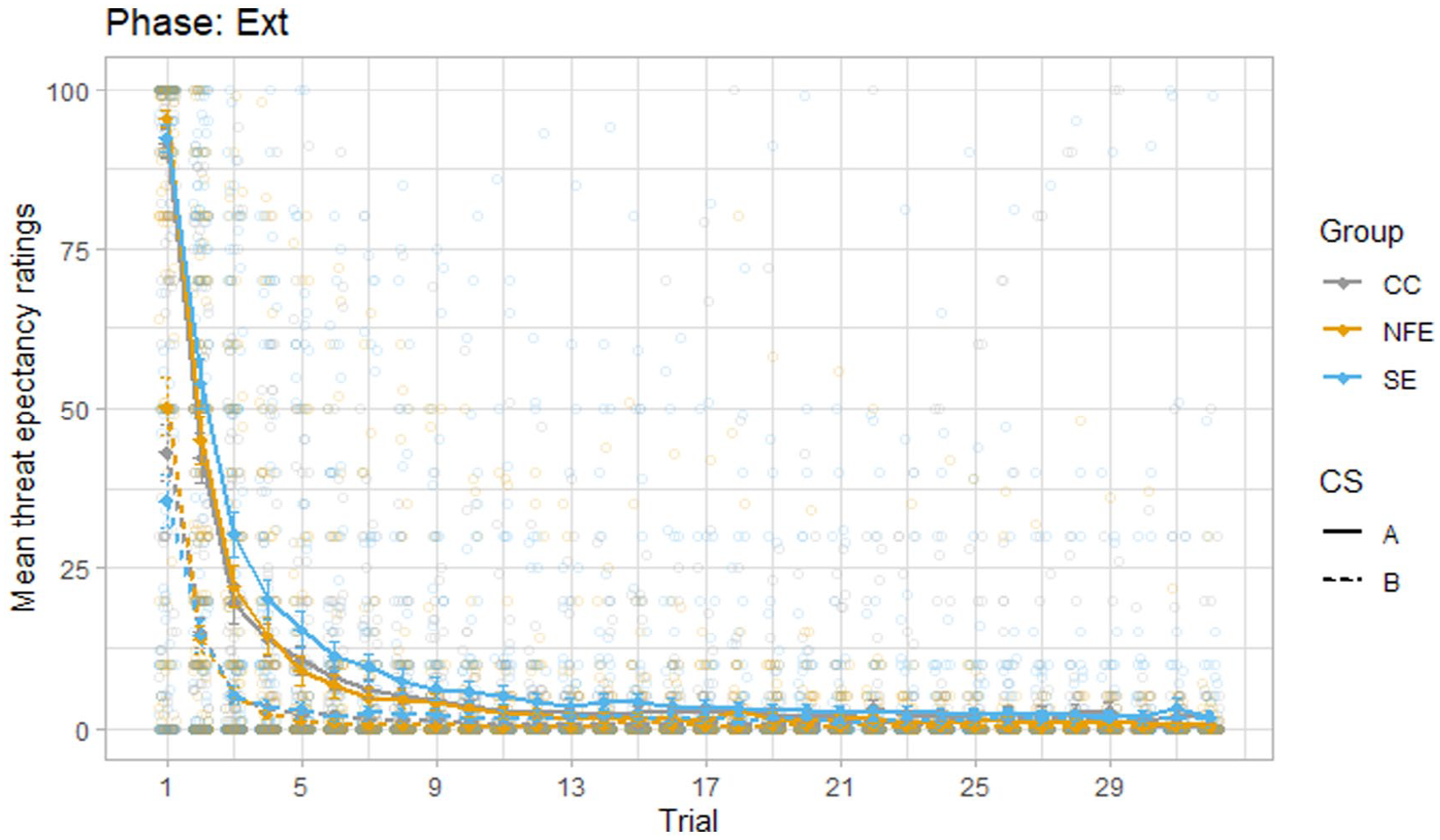
Mean threat expectancy ratings during the intervention phase.
We then conducted another repeated-measures ANOVA, but only for the data from Cue A. We found a significant effect of Trial, F(3.18, 754.05) = 625.83, p < .001, ω2 = 0.62, but no effect of Group, F(2, 237) = 1.96, p = .143, ω2 = 0.001, or the Group × Trial interaction, F(6.36, 754.05) = 1.7, p = .115, ω2 = 0.001.
Finally, a Bayesian ANOVA comparing the mean response to Cue A in the last three trials of the Intervention phase showed that the groups did not seem to differ regarding their expectancy ratings, with a
Additional analyses
Following the suggestions made by one of the reviewers, we conducted additional analyses to further investigate the significant Group × Trial effect. For this, another repeated-measures ANOVA collapsing cues A and B ratings was used. We first conducted a repeated-measures ANOVA for the first 8-trial block, which showed a significant effect of Trial, F(2.35, 557.21) = 785.46, p < .001, ω2 = 0.65, and Group × Trial, F(4.7, 557.21) = 2.9, p = .015, ω2 = 0.003. We did not observe a significant effect of Group, F(2, 237) = 1.45, p = .236, ω2 < 0.001. Then, we conducted the same analyses for the rest of the phase, finding a significant effect of Trial, F(3.13, 742.19) = 4.28, p = .005, ω2 = 0.004. We did not observe a significant effect of Group, F(2, 237) = 1.81, p = .166, ω2 = 0.005, nor the Group x Trial interaction, F(6.26, 742.19) = 0.93, p = .478, ω2 < 0.001.
In addition, we conducted a repeated-measures ANOVA, including two between-subjects factor (Group: CC, NFE, and SE; and Condition: A first or B first) and a within-subjects factor (Cue: A and B), to study the notable increase in cue B threat expectancy ratings in the first trial of the intervention phase. For this, we divided participants into two conditions: condition A, which encountered cue A on the first intervention trial, and condition B, which encountered Cue B on that same first trial. This analysis showed a significant effect of Cue, F(1, 234) = 407.94, p < .001, ω2 = 0.43, Group, F(2, 234) = 3.62, p = .028, ω2 = 0.004, Condition, F(1, 234) = 76.13, p < .001, ω2 = 0.05, the Cue × Condition, F(1, 234) = 85.82, p < .001, ω2 = 0.09, and the Group × Condition interaction, F(2, 234) = 3.2, p = .043, ω2 = 0.003. We did not observe a significant effect of the Cue × Group, F(2, 234) = 0.57, p = .569, ω2 < –0.001, nor the Cue × Group × Condition interaction, F(2, 234) = 1.45, p = .237, ω2 < 0.001. Post hoc comparisons using the Holm method revealed that the Cue × Condition interaction was due to cue B ratings being higher when cue A was presented first (M = 62.48, SD = 36.54) than when cue B was presented as the first intervention trial (M = 18.9, SD = 28.13),
Test phase
For the Test phase data (see Figure 3), we first conducted a repeated-measures ANOVA, including a between-subjects factor (Group: CC, NFE, and SE) and a two within-subjects factors (Cue: A and B; and Trial: last three Intervention trials vs Test trial), to evaluate the spontaneous recovery effect. We found a significant effect of Cue, F(1, 237) = 633.74, p < .001, ω2 = 0.19, Trial, F(1, 237) = 800.76, p < .001, ω2 = 0.31, and the Cue × Trial interaction, F(1, 237) = 675.41, p < .001, ω2 = 0.18. There was no significant effect of Group, F(2, 237) = 0.5, p = .605, ω2 < −0.001, Group × Cue, F(2, 237) = 0.44, p = .643, ω2 < −0.001, Group × Trial, F(2, 237) = 0.57, p = .565, ω2 < −0.001, or the Group × Cue × Trial interaction, F(2, 237) = 0.33, p = .718, ω2 < −0.001.
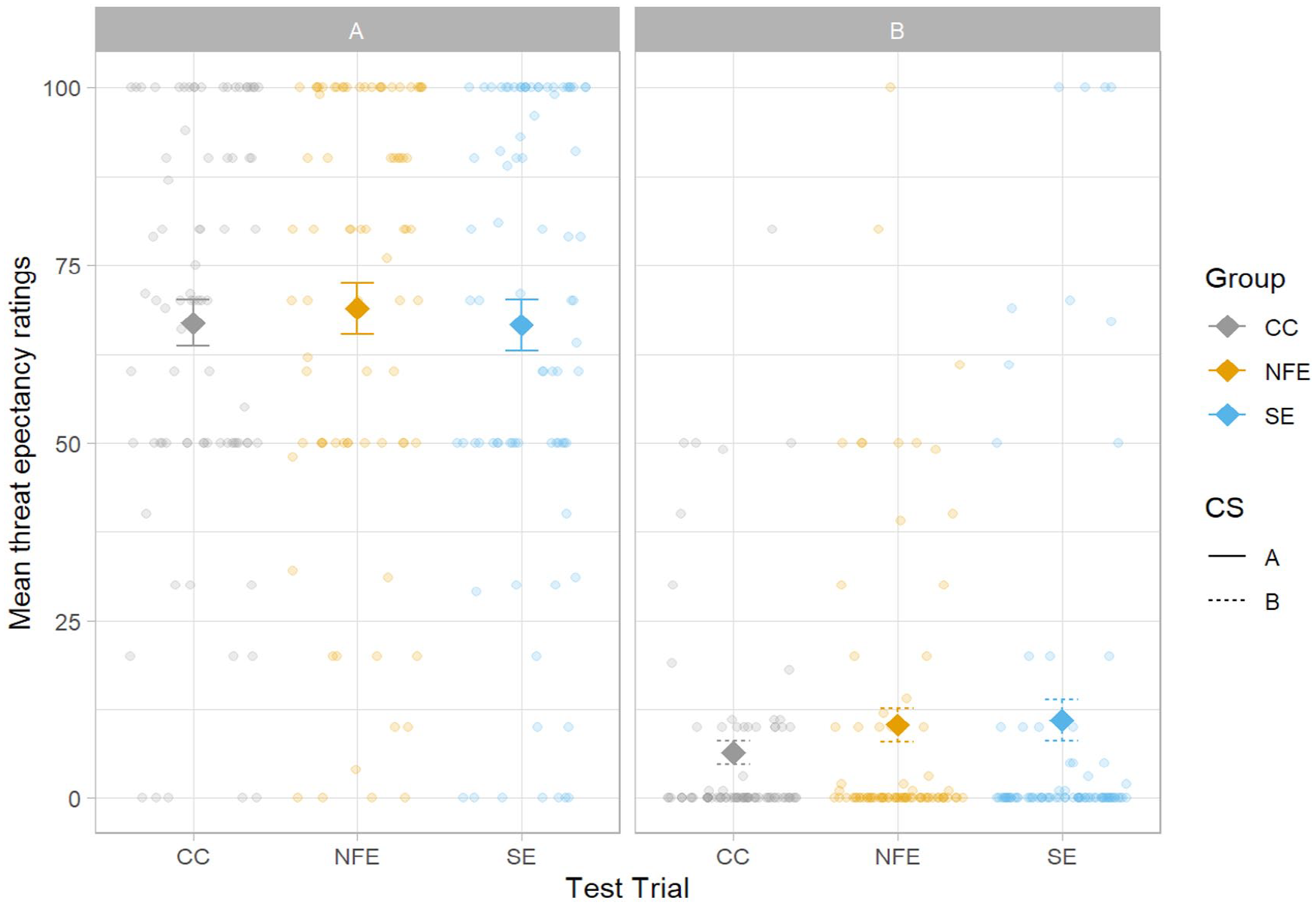
Mean threat expectancy ratings during the test phase.
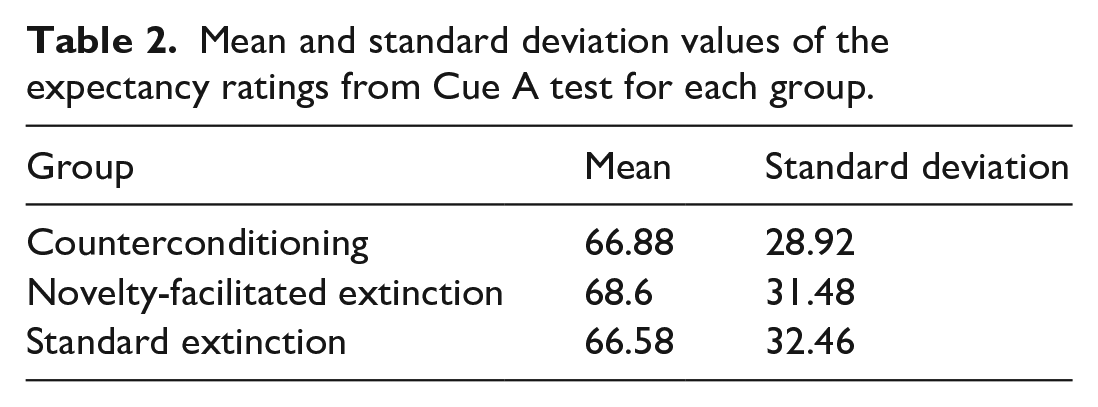
Based on previous literature, we conducted several theory-driven two-tailed t-tests on Cue A data to evaluate differences between groups (CC vs NFE, CC vs SE, and NFE vs SE) and assess the effectiveness of each intervention on the potential reduction of the spontaneous recovery effect. We found no differences when comparing the CC and NFE (ΔM2 = −2.00, 95% CI = [−11.46, 7.47], t(154.82) = −0.42. p = .678, d = –0.07,
Mean and standard deviation values of the expectancy ratings from Cue A test for each group.
Valence ratings
Regarding the valence ratings (see Figure 4), a repeated-measures ANOVA for the acquisition ratings showed a significant effect of Cue, F(1, 237) = 573.83, p < .001, ω2 = 0.64, but no effect of Group, F(2, 237) = 0.49, p = .614, ω2 < −0.001, or the Group × Cue interaction, F(2, 237) = 0.41, p = .666, ω2 = −0.001. From this point on, we will conduct the analysis considering only Cue A data.
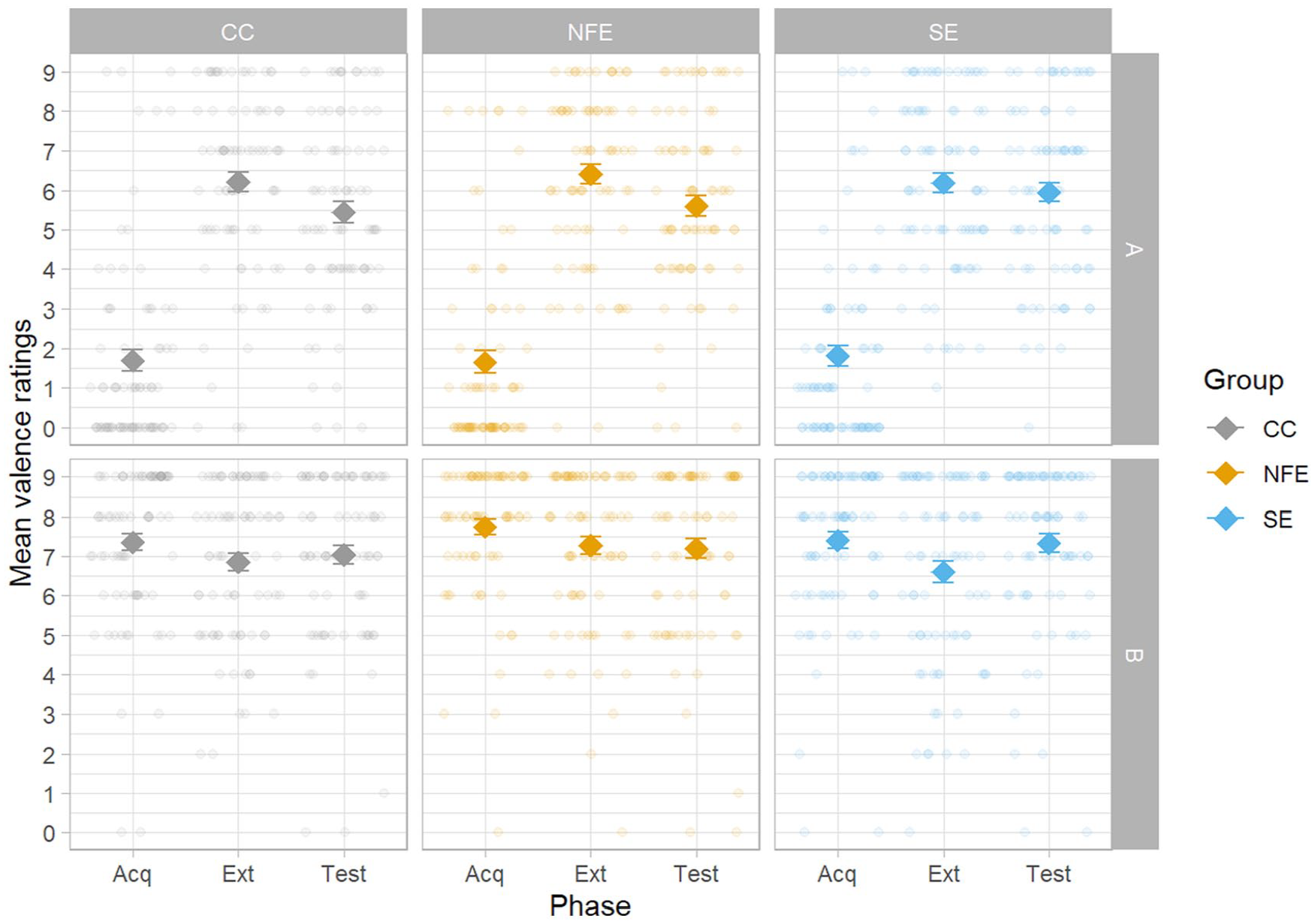
Mean valence ratings for each CS (A and B) after each phase in the different groups.
A repeated-measures ANOVA, including a between-subjects factor (Group: CC, NFE, and SE) and a within-subjects factor (Phase: Acquisition and Intervention) on Cue A valence ratings showed a significant effect of Phase, F(1, 237) = 495.22, p < .001, ω2 = 0.49. We did not observe an effect of Group, F(2, 237) = 0.05, p = .955, ω2 = −0.002, or the Group × Phase interaction, F(2, 237) = 0.3, p = .741, ω2 = −0.001.
We also conducted a one-way ANOVA, including a between-subjects factor (Group: CC, NFE, and SE), on Cue A data in the Intervention phase, finding no significant effect of Group, F(2, 237) = 0.25, p = .783, ω2 = −0.006.
We then performed three two-tailed t-tests to evaluate differences between groups (CC vs NFE, CC vs SE, and NFE vs SE) after Intervention. We found no differences when comparing CC versus NFE (ΔM = −0.20, 95% CI = [−0.9, 0.5], t(156.93) = −0.57. p = .572, d = –0.09,
Finally, regarding the Test phase, we conducted another repeated-measures ANOVA on Cue A data, including a between-subjects factor (Group: CC, NFE, and SE) and a within-subjects factor (Phase: Intervention and Test) to evaluate a potential spontaneous recovery effect on valence ratings. Again, we found a significant effect of Phase, F(1, 237) = 12.29, p < .001, ω2 = 0.02. We did not observe an effect of Group, F(2, 237) = 0.038 p = .683, ω2 = −0.003, or the Group x Phase interaction, F(2, 237) = 1.16, p = .316, ω2 < 0.001.
Subsequently, we performed a one-way ANOVA on Cue A data from the Test trial, including a between-subjects factor (Group: CC, NFE, and SE). We found no effect of Group, F(2, 237) = 1.03, p = .357, ω2 < 0.001.
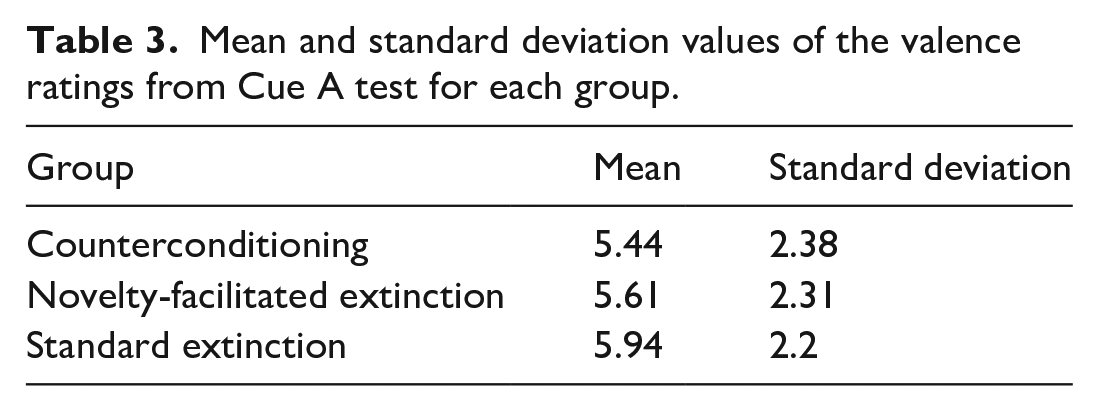
Then, we conducted several two-tailed t-tests to evaluate more precisely any potential differences between groups (CC vs NFE, CC vs SE, and NFE vs SE) on the Test trial. Again, we did not observe a significant difference when comparing CC versus NFE (ΔM = −0.16, 95% CI = [−0.89, 0.57], t(157) = −0.43. p = .67, d = –0.07,
Mean and standard deviation values of the valence ratings from Cue A test for each group.
To further support the findings that there were no differences regarding valence ratings between groups throughout the different phases, we conducted an additional Bayesian repeated-measures ANOVA including a between-subjects factor (Group: CC, NFE, and SE) and two within-subjects factors (Phase: Acquisition, Intervention, and Test; and Cue: A and B). The interactions including the Group factor obtained a
Regression analysis and correlations
Although we originally proposed some exploratory regression and correlation analyses concerning personality traits and CS valence, given that we did not find differences on the levels of spontaneous recovery between groups, we will not be reporting these analyses as their relevance is questionable.
Discussion
In this study, we were interested in the role of CS valence as a potential mechanism to reduce or even prevent the spontaneous recovery of threat expectancies. To investigate this, we compared the effects of three different treatments after the acquisition of a CS-US relationship. For the CC condition, the CS previously paired with a negative US was now followed by a positively valence US. In the NFE group, the CS was now followed by a neutral stimulus. Finally, the SE treatment consisted of CS-alone presentations. We expected a greater reduction on the levels of spontaneous recovery of threat expectancies in the CC group than in the other two treatment conditions. We also expected corresponding changes in valence ratings due to the type of treatment. However, our results did not support either of these hypotheses.
The results from the Acquisition phase showed that differential conditioning was successfully acquired and was similar in the three groups, with higher threat expectancies and valence ratings for cue A than for cue B. In the Intervention phase, the initial differences between groups in threat expectancy ratings later extinguished and reached asymptotic values, with no differences between groups at the end. As for the valence ratings, cue A was rated as more positive than during acquisition, whereas cue B ratings remained similar. In the final Test phase, we observed equivalent levels of spontaneous recovery of threat expectancies in all groups. Regarding the valence ratings, they decreased after the 24 hr interval from the end of Intervention to the Test trial, with cue A being rated as slightly less positive during this last phase.
Overall, our threat expectancy results have not provided evidence supporting the beneficial effect of a treatment where we target the CS negative valence during the Intervention phase. In all three groups, threat expectancies spontaneously recovered to a similar extent. Therefore, our findings are at odds with previous literature that have found a beneficial effect of CC or NFE (e.g., Dunsmoor et al., 2015; Engelhard et al., 2014; Kang et al., 2018; Lucas et al., 2018). Similarly, our results showed no differences between treatments regarding their valence. These ratings improved after treatment and decreased slightly afterwards, showing a spontaneous recovery effect of a similar magnitude for the different groups at test. It is worth mentioning, nonetheless, the differences between groups at the beginning of Intervention, maybe due to the different treatment conditions, supporting the potential effectiveness of the manipulation, at least partially and only at early stages of extinction.
It has been suggested that the negative valence the CS acquires by its pairing with a negative US during an acquisition phase may not be targeted by a SE treatment (Baeyens et al., 1988; De Houwer et al., 2001; Engelhard et al., 2014). In fact, this new affective status may stay intact and promote, to some extent, the return of fear. The aversive-to-appetitive CC literature has not only been sparse but also contradictory, especially in the human fear conditioning field. Although some studies may offer supporting results, other authors have found that CC may be just as effective, if not any less, than a standard treatment. In line with this, and similarly to our results, some authors have found that SE can also influence valence ratings (see Gawronski et al., 2015, for a potential explanation based on the type of measure; Kang et al., 2018; Meulders et al., 2015). It remains an open question the reason why, although we found extinction of expectancy and valence ratings, none of the treatments was effective enough to reduce participants’ judgements to a greater extent than SE. Zbozinek et al. (2015) suggested that CS valence could be a predictor for the return of fear after a reinstatement preparation, but not after a spontaneous recovery interval. It could be the case that, although we did observe a decrease in post-intervention CS valence, CC is abided by certain boundary conditions, for instance, the specific type of return of fear phenomenon it may help prevent. Future research needs to consider other phenomena, such as reinstatement or renewal.
However, CC not only involves the presentation of a positive US but it also represents a change from SE as the CS is not presented alone but paired with a novel stimulus. The later condition could be promoting an enhanced extinction learning by increasing the level of surprise (Keller et al., 2020; van Dis et al., 2019). To control for this alternative explanation, we included a NFE treatment. Different studies have supported the benefits of this type of intervention (Dunsmoor et al., 2015; Lucas et al., 2018). In a recently published paper, Wake et al. (2022) investigated whether this effect was due to the novelty of the stimulus or its ability to reduce the uncertainty associated with a SE procedure. Similar to Dunsmoor et al. (2015) or Lucas et al. (2018), these authors found that a SE intervention was associated with greater spontaneous recovery of fear, measured as the SCR, in individuals with higher levels of IU. However, this result was not obtained when analysing the two novelty-facilitated conditions included: one where the CS was associated with the novel US in half of the trials, and another one where they were always paired together. Therefore, they concluded that NFE may work similarly under both reliable and unreliable conditions, suggesting that novelty could be the underlying cause that explains the effectiveness of this type of intervention. If this was the case, then why did we fail to find a reduction on the spontaneous recovery of threat expectancies in the CC or novelty-facilitated conditions? In our study, the CS was always paired with a novel stimulus (either neutral or appetitive), which should have facilitated a beneficial effect of CC and NFE on the spontaneous recovery of threat expectancy. However, as our results showed, this was not the case, and the equivalent return of threat was observed across the three groups.
It is also worth discussing the slight increase in cue B ratings at the beginning of the Intervention phase. Although the different phases were not marked at all to participants, it seems that the experience with cue A as the first intervention trial could have led participants to perceive the experimental setting as changing, maybe even as an uncertain context where the contingencies and the relationship between the stimuli have changed. In fact, an analysis of this showed differences on cue B ratings depending on whether participants first encountered cue A, which received a different treatment from what they experienced during Acquisition, or cue B, which received the same treatment. In the future, it could be worth studying this effect under newly proposed theoretical frameworks (e.g., Gershman et al., 2017).
The present study has several strengths worth mentioning, including the large sample size, the use of previously validated stimuli or the inclusion of Bayesian analyses. Importantly, this research was conducted as a Registered Report, which means that the study proposal (which included the complete Introduction, Method, and Analyses Plan) was reviewed and received in-principle acceptance before data collection commenced and any results were available. This provides an additional level of transparency regarding all the design, analysis and interpretation choices made (Kathawalla et al., 2021; Munafò et al., 2017; Wagenmakers et al., 2012). In addition, the Stage 1 approved protocol, raw data and scripts are available at https://osf.io/6jhdx/.
Some limitations should also be noted. First, the sounds we used as USs could not have been as emotionally significant for the participants in our study as other stimuli used in previous research (i.e., cartoons or positive film clips; see Kang et al., 2018; or van Dis et al., 2019). Also, previous studies demonstrating the potential benefit of CC or NFE used electric shocks as the negative US. So, although validated stimuli were used, perhaps they did not have such an impact in our participants, which could have affected our results. Nevertheless, the negative US used here has proven its aversive properties in previous research (Cobos et al., 2022; Flores et al., 2018, 2020). It could be the case that the contrast between our negative and positive USs was not motivationally relevant enough for our participants, therefore hindering any beneficial effect of our manipulation. Additionally, we did not consider any physiological measure, like the startle response or SCR, which has been found to correlate with the effect of NFE (see Dunsmoor et al., 2015; Lucas et al., 2018; Wake et al., 2022). However, it is still unclear why it should be easier to find an effect of CC or NFE on this type of measures. In fact, other studies have found no reduction in the return of fear as measured by SCR, startle response or expectancy judgements (see Chen et al., 2022, or van Dis et al., 2019).
It should be noted that our results are in line with previous studies that failed to find a beneficial effect of CC or NFE. For instance, although Kang et al. (2018) found a significant effect of CC on threat expectancy when compared with a standard intervention, CS valence did not differ between groups. Relatedly, Krypotos and Engelhard (2018) failed to find a reduction in conditioned avoidance on a reinstatement test after NFE when compared with a standard treatment. In addition, their results suggested that this novel treatment, along with response prevention, tends to enhance subjective fear evaluations. Two other studies (Chen et al., 2022; Jozefowiez et al., 2022) published during the completion of the present experiment, have also failed to find a benefit from CC or NFE over SE on return of fear prevention, finding similar levels of spontaneous recovery, reinstatement, or renewal, measured as SCR or considering expectancy and valence ratings, respectively. Taken together, all these studies, along with van Dis et al.’s (2019) results, support the idea that CC or NFE may not be more effective than the traditional treatment. For instance, in the clinical setting, de Jong et al. (2000) found that exposure therapy with CC was no more effective in the long term or in altering CS valence than the traditional treatment when treating spider phobia, suggesting that classical exposure treatment may already be quite beneficial. Future research may need to address this issue. It could be the case that the type of stimuli used within these different fear conditioning preparations are not emotionally relevant enough to promote CS valence changes that could, in the long run, modify threat expectancy or influence physiological measures. Also, these treatments may help reduce only certain types of return of fear phenomena under some still-unknown conditions (for instance, the US modality, type of fear measure, individual differences). Finally, other underlying mechanisms should be taken into consideration, such as the role of novelty (Wake et al., 2022).
To conclude, the main aim of this study was to investigate if a CC intervention could be more effective than NFE or SE at reducing the spontaneous recovery of threat expectancies, and whether that potential benefit could be explained by a reduction in the negative valence of the CS. Our findings did not provide evidence to suggest that CC could be more effective to reduce relapse. In fact, our three treatments were equally effective and did not prevent the return of threat expectancies at a final test phase. However, future studies need to be conducted to further investigate the potential effectiveness of these treatments and their boundary conditions.
Supplemental Material
sj-docx-1-qjp-10.1177_17470218231165373 – Supplemental material for Evaluating the effects of counterconditioning, novelty-facilitated, and standard extinction on the spontaneous recovery of threat expectancy and conditioned stimulus valence
Supplemental material, sj-docx-1-qjp-10.1177_17470218231165373 for Evaluating the effects of counterconditioning, novelty-facilitated, and standard extinction on the spontaneous recovery of threat expectancy and conditioned stimulus valence by María J Quintero, Joaquín Morís and Francisco J López in Quarterly Journal of Experimental Psychology
Footnotes
Acknowledgements
The authors would like to thank Sara Daoudi and Tania M. Valle for their help with data collection.
Author contributions
All the authors have read the manuscript and have approved this submission.
Declaration of conflicting interests
The author(s) declared no potential conflicts of interest with respect to the research, authorship, and/or publication of this article.
Funding
The author(s) disclosed receipt of the following financial support for the research, authorship, and/or publication of this article: This work is supported by grants UMA18-FEDERJA-051 from Junta de Andalucía, and Grant PGC2018-096863-B-I00 from the Spanish Ministry of Science, Innovation, and Universities. M.J.Q. has been awarded with a PhD fellowship from the Spanish Ministry of Science, Innovation, and Universities (FPU Programme, FPU18/00917).

Data accessibility statement
Notes
References
Supplementary Material
Please find the following supplemental material available below.
For Open Access articles published under a Creative Commons License, all supplemental material carries the same license as the article it is associated with.
For non-Open Access articles published, all supplemental material carries a non-exclusive license, and permission requests for re-use of supplemental material or any part of supplemental material shall be sent directly to the copyright owner as specified in the copyright notice associated with the article.
