




Abstract
While reading is among the most important and well-researched topics of developmental psychology, sublexical regularities and how these regularities relate to reading skills have attracted less interest so far. This study tested general orthographic knowledge (GOK) using an indirect reaction time (RT)-based task, in which participants had to detect letters appearing within frequent and infrequent letter clusters. The aim of the method was to minimise the roles of phonological activation and metalinguistic decision. Three different age-groups of German-speaking individuals were tested: first graders (N = 60), third graders (N = 68), and adults (N = 44). Orthographic regularity affected RTs in all three groups, with significantly lower RTs for frequent than for infrequent clusters. The indirect measure of GOK did not show an association with reading measures in first graders and adults, but in the case of third graders it explained variance over and above age and phonological skills. This study provides evidence for phonology-independent GOK, at least in third graders.
Orthographic knowledge is the knowledge of print conventions (Castles & Nation, 2006), which is composed of at least two facets: general and word-specific (or lexical) orthographic knowledge (Conrad et al., 2013; Hagiliassis et al., 2006). The former refers to sublexical regularities of how letters are generally combined (e.g., double letters occur less frequently in word-initial positions than word-medially), whereas the latter refers to letter combinations in order to form specific words (e.g., the verb used to describe meeting someone is spelt with -ee-, whereas the word that stands for a type of food is spelt with -ea-; Apel, 2011; Conrad & Deacon, 2016; Conrad et al., 2013). Since in alphabetic orthographies letters stand for speech sounds, regularities in phonological and orthographic stimuli are closely correlated. The aim of this study is to assess general orthographic knowledge (GOK) while the activation of the corresponding phonological representations is kept as low as possible. To this end, a Go-NoGo-like target detection task was used, in which participants had to detect a target letter that was embedded in consonant clusters of varying bigram frequency. We also aimed to reveal how this phonology-independent GOK is related to reading skills and how this effect is qualified by reading experience. For this reason, we assessed GOK in three groups: beginning readers (first graders), intermediate readers (third graders), and expert readers (adults).
The common bases of phonological and orthographic regularities
The association of phonological and orthographic information is rooted in the assumed fundaments of orthographic knowledge. Some argue that GOK is rooted in the visual learning domain, while others suggest a heavy reliance on phonological processes (Barker et al., 1992; Castles et al., 2003; Hagiliassis et al., 2006; Mano, 2016; Protopapas et al., 2017). Since orthographic information is strongly correlated with phonological information, especially in transparent orthographies, the dual coding of information could also be beneficial for learning (Glicksohn & Cohen, 2013; Steinweg & Mast, 2016; Weiermann et al., 2010).
Previous studies have observed GOK in kindergarten children before the onset of formal literacy education. If preliterate children show an above-chance performance on GOK tasks, that provides evidence to phonology-independent visual representations of orthographic regularities. Various sources reported such above-chance performance in English-speaking kindergarten children (Cassar & Treiman, 1997; Ouellette & Sénéchal, 2008; Pollo et al., 2009).
Not all studies with kindergarten children have found orthographic knowledge though. Two longitudinal studies tested German-speaking children at the end of kindergarten. In one of the studies, only those children whose parents reported that the children were not able to read were included (Ise et al., 2014), whereas no such filter was applied in the other (Rothe et al., 2014). Only the latter found above-chance performance on the GOK task, but the effect itself was rather minor with a 53.98% hit rate (SD = 10.27%, chance = 50%). One possibility is that even this minor effect was a consequence of reading ability, which, in turn, is against the visual learning hypothesis.
Others argue that GOK depends heavily on phonological representations, phonological development, and reading development. Primary school children participate in formal literacy instructions, and they are exposed to printed material on a daily basis. Consequently, both their reading and phonological abilities show a constant increase (Bentin et al., 1991; Ehri, 1991, 1995, 2014; Landerl et al., 2019). If orthographic knowledge relies on phonological information, one expects a steep increase in GOK after the onset of reading instruction. This was in fact borne out by some studies (Badian, 2001; Juel et al., 1986).
The boosting effect of phonological processes, however, does not necessitate that orthographic knowledge fully depends on phonological information. Previous studies demonstrated that orthographic knowledge explains variance in reading and spelling skills over and above phonological skills. Conrad and colleagues (2013) used two orthographic knowledge tasks with primary school children (7- to 9-year-olds): one task assessing GOK and another assessing word-specific orthographic knowledge (based on Olson et al., 1994). The tasks were similar in the sense that participants observed homophonic pairs and had to choose the more frequent orthographic constellation. That is, in the GOK task, both stimuli were pseudowords, one spelled in a more conventional, whereas the other in a more unusual way (“zame” vs. “zaym,” see p. 1,236). In the word-specific orthographic knowledge task, one of the stimuli was an existing word, and the other its pseudohomophone (“stream” vs. “streem”). Conrad et al. (2013) did not report one-sample t-tests, however, based on the reported means, standard deviations, and number of participants all three age-groups (7-, 8-, and 9-year-olds) seem to have performed significantly above chance on both the tasks. Across the full sample, orthographic knowledge explained individual differences in reading (ΔR2 = 0.12) and spelling (ΔR2 = 0.15) over and above age and phonological skills. While each facet had a significant coefficient in the reported analyses, their contrastive contribution is not completely clear, as the two variables were entered in the same step after controlling for age and phonological skills.
Methodological difficulties in contrasting phonological and orthographic information
A foundational step of typical reading development is the automatised nature of grapheme–phoneme associations. Graphemes are the smallest units of written language in alphabetic orthographies. They may be composed of more letters but stand for only one phoneme each. Typically, graphemes automatically activate the corresponding phonological representations (Blomert, 2011; Froyen et al., 2008). Automation does not only apply on the level of letters: word meanings and phonological forms can also be activated automatically. This supports sight-word reading (Coltheart et al., 1993; Ehri, 1995) and also leads to the Stroop effect (Lukács et al., 2016; Stroop, 1935). If children constantly progress towards automatic orthographic–phonological associations, it should be challenging to control for the phonological activation of written stimuli.
Most studies have tried to address this issue by presenting homophonic stimulus pairs in a two-alternative forced choice task (e.g., Conrad et al., 2013; Rothe et al., 2014). In these studies, children observed letter strings that elicit the same underlying phonological representations (like “stream–streem” in English or “Dorf–Dorv” in German). There are two concerns with such a method: On the one hand, phonological representations are still activated. This activation could contribute to the orthographic decision, in turn explaining the previously observed correlation between GOK and phonological skills.
On the other hand, such a method encourages participants to rely on metalinguistic knowledge. Various studies have demonstrated that both phonological awareness (the ability to manipulate speech sounds) and morphological awareness (the ability to manipulate morphemes) show a positive relationship with reading skills (Alexander et al., 1991; Arnbak & Elbro, 2000; Kuo & Anderson, 2006; Landerl et al., 2019). Although phonological and morphological awareness are conceptualised as distinct skills, they share an important feature: both of them rely on the conscious usage of metalinguistic knowledge, which in turn can support language use (Campbell & Sais, 1995; Cummins, 1978). That is, even the use of homophonic stimuli loads on metalinguistic knowledge, which in turn overlaps with phonological or morphological awareness. Since the effect of general metalinguistic knowledge is not yet clear, it is advantageous to decrease its involvement.
One study aimed to address the automatic activation of the phonological content by decreasing the presentation times to 50 ms (Rothe et al., 2015). Consequently, the participants were forced to rely on more implicit decisions concerning GOK. The results showed that third graders were close to ceiling in deciding that word-initial double consonants are not allowed in German. On the contrary, children demonstrated difficulties in choosing between pseudowords, when the word pair only differed in a double consonant that was either a high- or a low-frequency bigram. The double consonant could appear word-medially (“simmap” vs. “siggap”) or word-finally (“wesull” vs. “wesubb”). It is possible, though, that the orthographic features differ in salience, and only the more salient features (like word-initial double letters) are processed when stimuli are only briefly presented.
Developmental perspectives on GOK
As discussed above, children have been shown to have GOK already in kindergarten (Cassar & Treiman, 1997; Ise et al., 2014; Ouellette & Sénéchal, 2008), and this knowledge is boosted when children enter school and are exposed to formal literacy instructions (Badian, 2001; Juel et al., 1986). The reason for storing GOK is yet unclear. One possibility is a reciprocal relationship between GOK and reading skills. That is, while the input of GOK is necessarily print exposure, such knowledge can also speed up sequential decoding or support the development of word-level orthographic representations, and in turn contribute to word and pseudoword reading (Apel, 2011; Conrad & Deacon, 2016; Conrad et al., 2013), as well as spelling (Hayes et al., 2006; Pacton et al., 2019; Treiman & Boland, 2017).
The aim of this study is to test GOK with a task that does not encourage phonological activation and metalinguistic decisions and to examine how GOK contributes to reading skills across development. To this end, we recruited three groups: beginning readers (first graders), intermediate readers (third graders), and expert readers (adults). Beginning readers of transparent orthographies sequentially analyse and individually decode graphemes (Frith, 1985; Wimmer & Hummer, 1990). Intermediate readers are in the process of developing orthographic representations stored within their orthographic lexicon and use these representations for sight-word reading (Share, 1999, 2004). Expert readers have a more extensive orthographic lexicon, which further facilitates sight-word reading (Ehri, 1995, 2014).
In accordance, we expected that the contribution of GOK to reading skills is the lowest in beginning readers. Due to the increasing size of the orthographic lexicon, the contributing effect should be more pronounced in intermediate readers. While adults should have the most fine-grained distributional representations, these representations are expected to be autonomous and less associated with reading skills.
The current design
We developed a Go-NoGo-like target detection task, which eliminates the disadvantages of the short stimulus presentation times. In this target detection task, participants are first shown a target letter, then they are exposed to a sequence of bigram stimuli (with only one bigram on screen at a time), and they are instructed to press the response key whenever the target letter is detected. In such a target detection task, participants are not instructed to rely on metalinguistic knowledge. Similarly, they are only instructed to mark the presence of the target letter, regardless of the phonological representation underlying the presented bigram. While participants may verbalise the target letter, this verbalisation may activate letter names. During the target detection, participants are also expected to respond as quickly as possible and phonological information is not required to solve the task. Both are expected to decrease the involvement of phonological activation.
The Go-NoGo-like target detection task used in this study presented target letters embedded in bigrams with low and high corpus frequency (e.g., the letter “g” in the low-frequency bigrams “gv” and “pg,” and high-frequency bigrams “gl” and “ng”). We used bigrams since they are the smallest letter combinations, and we expect holistic letter combination processing to be present during the processing of bigrams. This is in line with several important models of reading, as they assume an important role for bigrams, like the Grain-Size theory (Ziegler & Goswami, 2005), the “open-bigram” mechanism (Grainger & Van Heuven, 2004; Grainger & Ziegler, 2011), or the local combination detectors (Dehaene et al., 2005). We expect reaction times (RTs) to be shorter for high-frequency clusters than for low-frequency clusters. This RT difference is interpreted as a measure of GOK.
Method
Participants
A total of 151 children and 44 adults participated in the experiment. Data of 16 children had to be excluded due to missing basic information (age). Five other children were excluded due to missing experimental data (phonological awareness or GOK or reading) and two due to not being attentive in the target detection task (as signified by low accuracy <80%). No adults had to be excluded. Sixty of the remaining participants were Grade 1 (Mage: 7.25, SD: 0.37), whereas 68 were Grade 3 students (Mage: 9.31, SD: 0.45). The descriptive statistics are provided in Table 1. All pupils were recruited from primary schools in and around the city of Graz. All participants had German as their native language. Data collection took place individually in a quiet room of their primary school. Adults (Mage: 24.27, SD: 3.00) were recruited from the University of Graz and participated for credit points. Adults were tested in a laboratory cubicle at the university. All adult participants and the parents of all child participants signed an informed consent in accordance with the Declaration of Helsinki and the stipulations of the local ethics board.
Descriptive statistics.
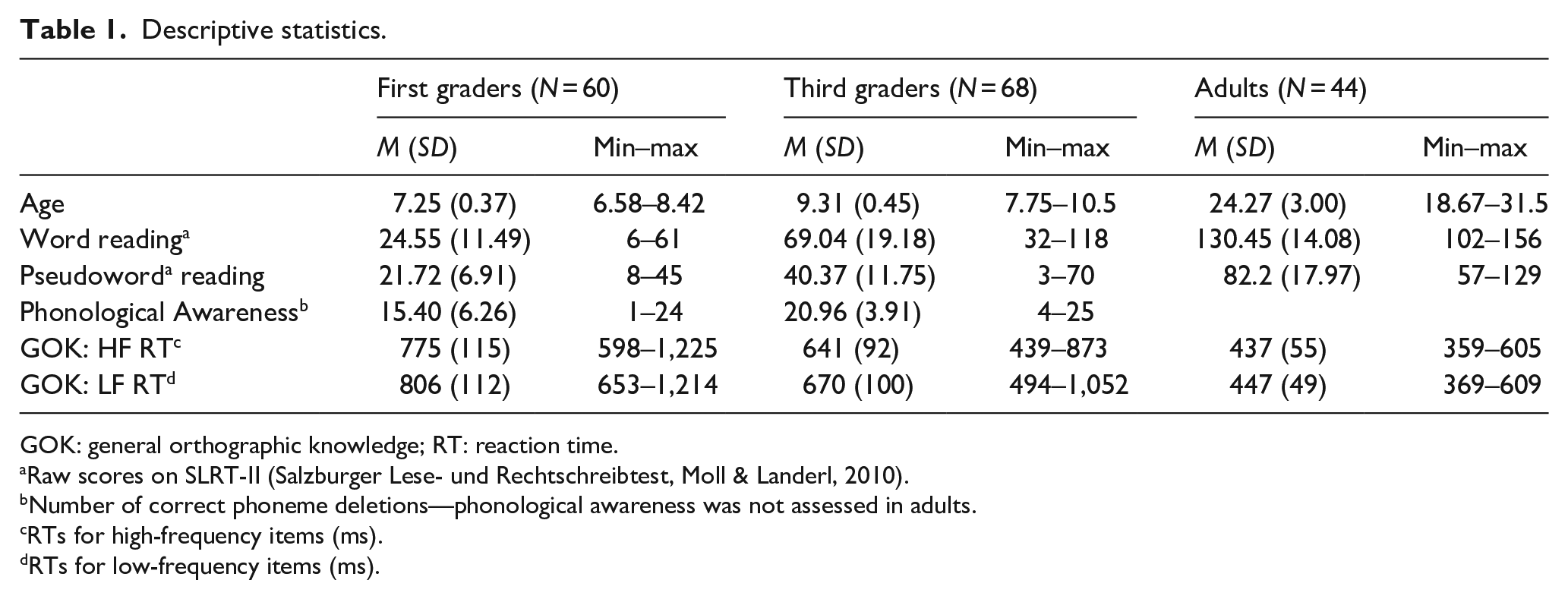
GOK: general orthographic knowledge; RT: reaction time.
Raw scores on SLRT-II (Salzburger Lese- und Rechtschreibtest, Moll & Landerl, 2010).
Number of correct phoneme deletions—phonological awareness was not assessed in adults.
RTs for high-frequency items (ms).
RTs for low-frequency items (ms).
Tasks
The study used three tasks: a standardised reading measure, a task assessing phonological awareness, and a GOK task.
Reading performance was assessed with the SLRT-II (Moll & Landerl, 2010). This is a standardised reading fluency task that is composed of a 1-min word reading and a 1-min pseudoword reading task. Participants are provided a list of words, and they are asked to read out the words loud. The raw score of the test is used, which is the number of correctly read words.
Phonological awareness was assessed with a phoneme deletion task (Banfi et al., 2018). Participants were first exposed to a pseudoword (prerecorded by a native female speaker) and had to repeat it. Upon request, the pseudoword was replayed to a maximum of two times (overall maximum of three presentations). If the stimulus was not repeated correctly, the experimenter provided a new target stimulus. For correctly repeated stimuli, participants were instructed to repeat the pseudoword without a given phoneme (e.g., “/folt/ without /f/”; instructions were provided auditorily). Answers were marked as correct or incorrect. Altogether there were 26 items, leading to a maximal performance of 26. Due to expected ceiling effect, the test was not administered with adult participants.
GOK was assessed using a computerised Go-NoGo-like target detection task. Participants were instructed that they would see letter clusters, and they had to press the spacebar whenever they detected a target letter. To ensure the understanding of instructions, four untimed practice trials were used with “X” as the target letter. The timed task consisted of eight blocks with a specific target letter for each block. The blocks were composed of 24 letter clusters. Letter clusters were presented for 2,000 ms with 250-ms interstimulus interval. If the spacebar was pressed, the presentation of the letter cluster was terminated, and the blank interstimulus screen was presented. There was a short self-paced break between the blocks. Due to a programming error, one of the blocks had incorrect instructions. Data from this block is not reported.
There were four target stimuli in each block, and each target stimulus appeared twice (altogether 8 data points per block) 1 ; thus, one-third of the items required an answer. Half of the target clusters were low-frequency clusters (1,000–6,000 appearances in dlexDB, Heister et al., 2011), while the other half were high-frequency clusters (540,000–6,365,000 appearances in dlexDB, Heister et al., 2011). In half of the blocks, the target stimulus appeared as the first letter of the cluster and in the other half as the second letter.
Data analysis
First, we examined whether response accuracies were affected by the frequency of letter clusters. This was assessed for each group. After that, the RTs were analysed.
Only RTs of correct target detections were used. RTs below 100 ms were considered anticipatory and were removed. Similarly, we removed RTs that were more than 2 SDs higher than the average (individual means and SDs were used for all participants). Individual mean RTs were computed for high-frequency and low-frequency clusters. First, we tested whether the RTs for low-frequency items were higher than the RTs for high-frequency items and whether this applies to all three groups.
Next, we calculated a measure of GOK by predicting the RTs for high-frequency letter clusters from RTs for low-frequency letter clusters using linear regression. The unstandardised residuals of the regression were used as the measure of GOK. Such unstandardised residuals negatively correlate with the difference between raw RTs for low- and high-frequency clusters. That is, for unstandardised residuals, the lower values characterise better GOK. This method was used to eliminate baseline RT differences and only retain frequency-related variance. Details of the regression are provided as Supplementary Material.
We expected to see a negative correlation of these residual scores with raw word reading and pseudoword reading scores from the SLRT-II. Finally, we used hierarchical linear regressions to test how the frequency effect contributes to literacy measures. The predicted variable was either word reading or pseudoword reading. The predictors were age and phonological awareness in Step 1. Phonological awareness was included to make sure that the contribution of GOK is independent of phonological skills. The GOK measure (residuals from the regression predicting RTs for high-frequency letter clusters from RTs for low-frequency letter clusters) was introduced in Step 2, with the expectation of a significant ΔR2 if GOK has an independent contribution to reading skills.
Results
All groups showed a target detection performance close to ceiling. First graders had a mean accuracy of 94.5% on high-accuracy bigrams and 93.4% on low-accuracy bigrams, third graders scored 97.3% on high-frequency bigrams and 97.0% on low-frequency bigrams, whereas both values were 98.8% in the adult group. We compared the target detection accuracies for high and low bigrams by group using a 2 × 3 mixed-model analysis of variance (ANOVA) with frequency (high vs. low) as within-subject variable and group (Grade 1 vs. Grade 3 vs. adults) as between-subject variable. The ANOVA only revealed a significant main effect of group, F(2, 169) = 14.537, p < .001,
Next, we tested whether RTs reflected frequency differences in the GOK task. RTs by frequency condition and group are provided in Figure 1. We conducted a 2 × 3 mixed ANOVA with frequency (high vs. low) as within-subject and group (Grade 1 vs. Grade 3 vs. adults) as between-subject variable. RTs were significantly shorter for high-frequency clusters, as revealed by a significant main effect of frequency, F(1, 169) = 38.782, p < .001,
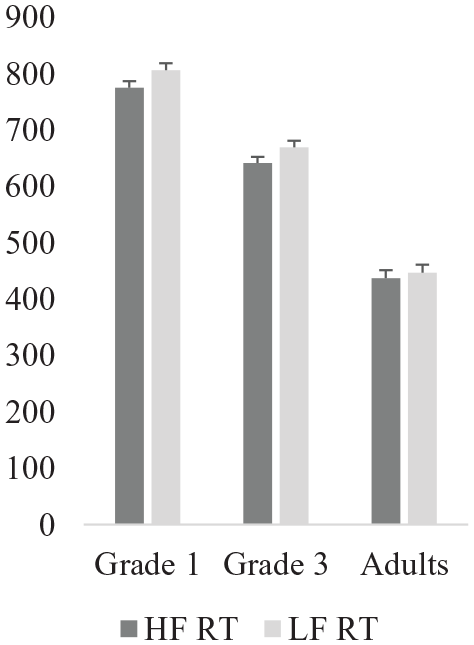
Reaction times in milliseconds by condition and group.
To test whether all three groups in fact showed a frequency-based difference in RTs, we conducted a repeated-measures ANOVA with frequency (high vs. low) as within-subject variable for each group. A significant frequency effect was observed in all three groups, F(1, 59) = 18.856, p < .001,
Next, we correlated the GOK measure (residuals) with word and pseudoword reading skills, as well as phonological awareness. Table 2 reports correlation coefficients. The results showed no significant correlation between GOK and reading measures in Grade 1 children (−.080 ⩽ all rs ⩽ .035, all ps ⩾ .541) and in adults (.028 ⩽ all rs ⩽ .190, all ps ⩾ .216).
Correlation between GOK, reading and phonological awareness across the three groups.
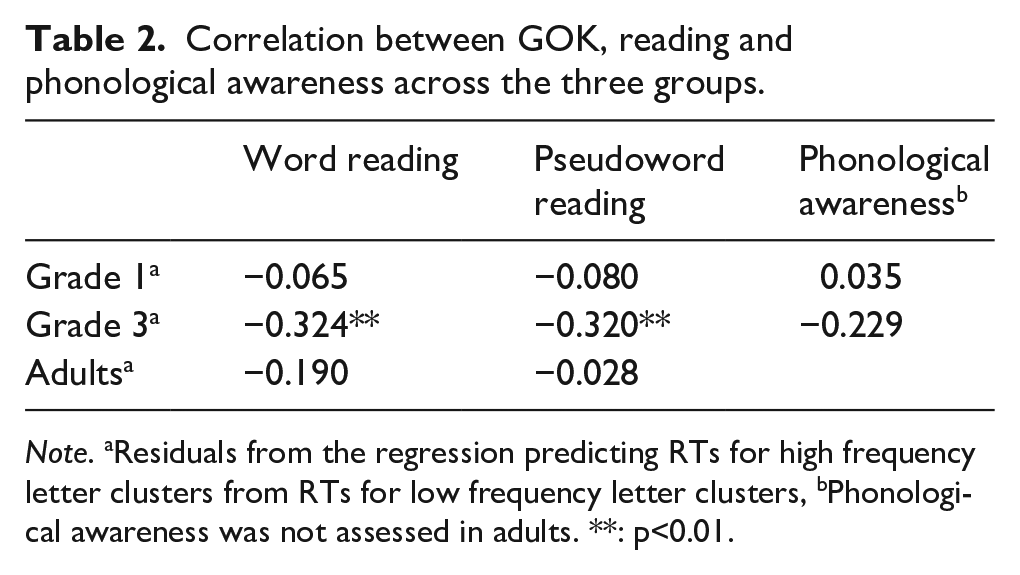
Note. aResiduals from the regression predicting RTs for high frequency letter clusters from RTs for low frequency letter clusters, bPhonological awareness was not assessed in adults. **: p<0.01.
We observed significant negative correlations in Grade 3 children between GOK and word reading, r = −.324, p = .007, N = 68, and between GOK and pseudoword reading, r = −.320, p = .008, N = 68. The correlation between GOK and phonological awareness was short of significance, r = −.229, p = .060, N = 68.
Since only the Grade 3 group showed a correlation between GOK and literacy measures, we only performed the planned hierarchical linear regressions for this group. Two hierarchical regression analyses were performed; details of the analyses are provided in Table 3. Age and phonological awareness were entered in Step 1 and GOK in Step 2. Model 1 analysed the independent contribution of GOK to word reading fluency and Model 2 to pseudoword reading fluency. Both analyses showed a significant change in the explained variance (ΔR2) upon entering the GOK measure to the model. In the case of word reading fluency: F(1, 64) = 6.321, p = .014, ΔR2 = 0.084, whereas in the case of pseudoword reading: F(1, 64) = 5.850, p = .018, ΔR2 = 0.076.
Hierarchical regression analysis for word and pseudoword reading fluency in third graders.
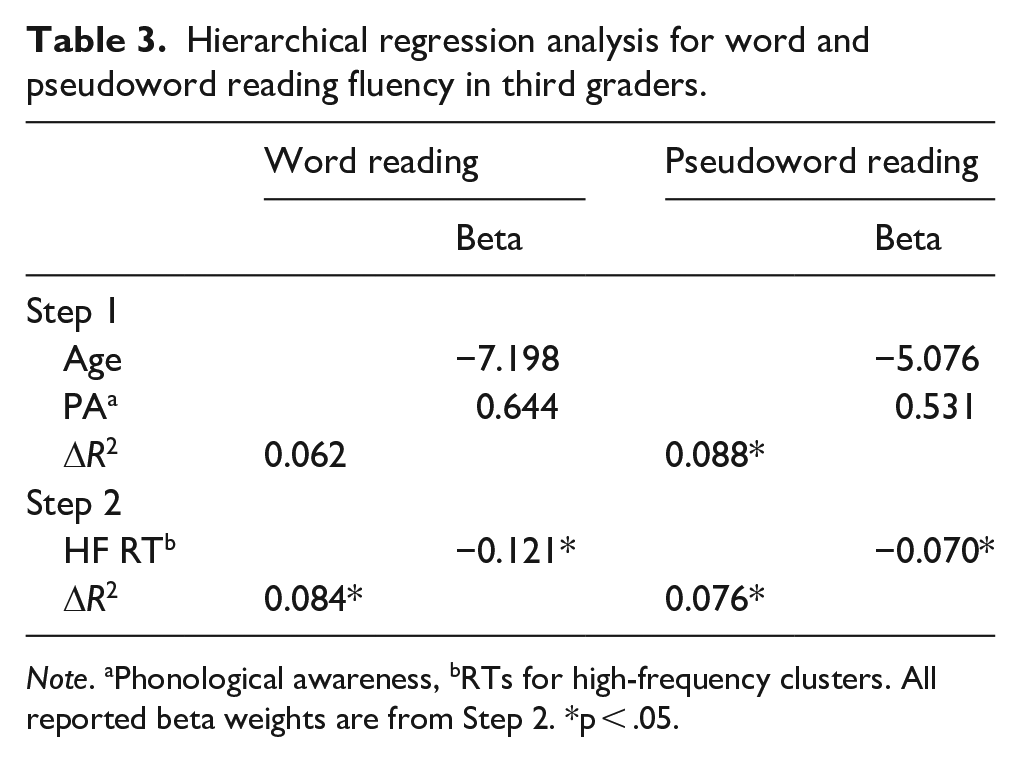
Note. aPhonological awareness, bRTs for high-frequency clusters. All reported beta weights are from Step 2. *p < .05.
Discussion
The central aim of this study was to investigate GOK and how GOK contributes to reading skills in three groups with different reading experience, when the GOK task does not encourage phonological activation or metalinguistic decision. All three groups exhibited longer RTs if the target stimulus was embedded in a low-frequency letter cluster compared with a high-frequency letter cluster. This provides evidence for parallel processing of letters presented in clusters, with more frequent clusters being easier to access. While all three groups were sensitive to letter cluster frequencies, this sensitivity only correlated with literacy skills in third graders. In third graders, however, GOK explained variance in word and pseudoword reading skills even after controlling for age and phonological awareness.
First, we provide evidence that GOK affects RTs in all three age-groups. That is, even first graders detected targets faster in high- compared with low-frequency bigrams. The preliminary expectation of a significant GOK effect in the RT domain is that individuals process clusters holistically and not sequentially.
Both phase and item-based models of reading development assume that the optimal way of reading is sight-word reading (Castles & Nation, 2006; Coltheart et al., 1993; Ehri, 1995, 1997; Frith, 1985; Share, 1995; Vellutino et al., 1994). In sight-word reading, participants already have an orthographic representation of the words to be read, and this representation is activated by the perceived word form. While some models argue for invariance in sight-word reading, word frequency affecting word recognition is one of the most reliable results in psycholinguistics (Brysbaert et al., 2011; Rüsseler et al., 2003; Wang et al., 2012). On the contrary, unknown words (as well as pseudowords) are decoded sequentially. That is, first, the sequence of letters is parsed into graphemes; second, graphemes are associated with the corresponding phonemes; and finally, the phonemes are blended into a single phonological representation. With the course of development, the size of the chunks increases: they consist not only of single graphemes, but also of syllables (Ehri & McCormick, 1998; Mano, 2016; Roembke et al., 2019). These chunks are formed based on analogy, that is, similarity to other known words (Gaskins et al., 1995; Wright & Jacobs, 2003). This analogical function predicts the use of distributional information: the more similar patterns are stored in the orthographic lexicon, the more likely that one of these will be activated during graphemic parsing.
This study also demonstrated that the chunks are not necessarily constrained to pronounceable units, but can be composed of consonant clusters, which are difficult to articulate. This provides further evidence that GOK is dissociable from phonological knowledge (Mano, 2016; Protopapas et al., 2017), even if the phonological representations of letters are automatically activated (Blomert, 2011; Kemény et al., 2018). We are not the first to report that GOK or at least a part of GOK operates relatively independently from phonological skills: this has been shown by the kindergarten studies cited in the “Introduction” (Cassar & Treiman, 1997), as well as studies reporting orthographic knowledge to have an independent contribution to reading and spelling skills over and above phonological skills (Conrad et al., 2013; Hayes et al., 2006; Pacton et al., 2019; Treiman & Boland, 2017). Our results are in line with these studies, suggesting an autonomous domain of GOK.
GOK’s contribution as the function of reading experience
The next question is why the contribution of GOK to literacy skills changes across age-groups. This may be explained by reading experience and reading processes. First graders are usually beginning readers, who rely mainly on sequential decoding. If letters are processed individually and the process itself is slow and laborious (Moll & Landerl, 2009), one should not expect that the processing of one letter is affected by the previous one.
On the contrary, we provided evidence for holistic processing, as even first graders processed high-frequency bigrams faster than low-frequency bigrams. If beginning readers are sensitive to frequencies, but the sensitivity is not related to reading, this can suggest a reading-independent memory representation of bigrams. Although these children already have some reading skills and extended letter knowledge, they may not yet process letter sequences as clusters when they apply their mostly sequential decoding strategies. This is in line with previous studies on the abstraction and learning of distributional information: various studies of statistical (and implicit and procedural) learning demonstrated that the learning mechanisms can operate on uninterpreted visual stimuli (Kemény & Lukács, 2016, 2019; Witt & Vinter, 2012).
While we assume that GOK in first graders is not fully orthographic, this is different in third graders. Third graders are intermediate readers, who have already integrated letter–speech sound associations (Blomert, 2011) and already store many words in their orthographic lexicon, which can be used for sight-word reading (Ehri, 1995, 2014). Since reading and reading-related processes are well integrated, this assumed integration can explain not only the association between GOK and reading, but also the contrast between Grade 1 and Grade 3 students.
Adults, however, showed no such association as third graders. There are two possible explanations for this phenomenon. On the one hand, it can be explained by the autonomous nature of GOK. Adults are considered expert readers. While their reading is automatised (Ehri, 1995, 2014), it has also become over-practised, which can lead to modularisation (Karmiloff-Smith, 1992, 1994). As a result, GOK can be represented as autonomous knowledge, highly independent of phonological information (Mano, 2016), or reading and spelling in general. Modularisation not only speeds up the process, but also dissociates it from other processes, just like the observed dissociation between GOK and reading in adults.
On the other hand, the lack of association can also be a consequence of the methodology. Adults demonstrated very low response latencies: the highest mean target detection time was 609 ms, which included the perception of the stimuli, the processing of the letter cluster, as well as response selection and response execution. While the RTs differed between high- and low-frequency clusters, perhaps the variances were too low to reflect the association with literacy measures.
Conclusion
The novelty of the article is twofold: On the one hand, the current design selectively tested the effect of GOK. On the other hand, the possibility of phonological activation was reduced to a minimum, both by the use of consonant clusters and by the use of target detection. Overall, the current results suggest a general visual knowledge in Grade 1 and letter-based, but phonology-independent knowledge in Grade 3. Adults, however, also show a good knowledge of orthographic regularities, but this knowledge is relatively independent of their reading abilities.
Supplemental Material
sj-docx-1-qjp-10.1177_17470218211018438 – Supplemental material for Phonology-independent general orthographic knowledge
Supplemental material, sj-docx-1-qjp-10.1177_17470218211018438 for Phonology-independent general orthographic knowledge by Ferenc Kemény and Karin Landerl in Quarterly Journal of Experimental Psychology
Footnotes
Declaration of conflicting interests
The author(s) declared no potential conflicts of interest with respect to the research, authorship, and/or publication of this article.
Funding
The author(s) disclosed receipt of the following financial support for the research, authorship, and/or publication of this article: The authors acknowledge the financial support by the University of Graz.

Notes
References
Supplementary Material
Please find the following supplemental material available below.
For Open Access articles published under a Creative Commons License, all supplemental material carries the same license as the article it is associated with.
For non-Open Access articles published, all supplemental material carries a non-exclusive license, and permission requests for re-use of supplemental material or any part of supplemental material shall be sent directly to the copyright owner as specified in the copyright notice associated with the article.
