



Abstract
Older adults are thought to compensate for slower lexical processing by making greater use of contextual knowledge, relative to young adults, to predict words in sentences. Accordingly, compared to young adults, older adults should produce larger contextual predictability effects in reading times and skipping rates for words. Empirical support for this account is nevertheless scarce. Perhaps the clearest evidence to date comes from a recent Chinese study showing larger word predictability effects for older adults in reading times but not skipping rates for two-character words. However, one possibility is that the absence of a word-skipping effect in this experiment was due to the older readers skipping words infrequently because of difficulty processing two-character words parafoveally. We therefore took a further look at this issue, using one-character target words to boost word-skipping. Young (18–30 years) and older (65+ years) adults read sentences containing a target word that was either highly predictable or less predictable from the prior sentence context. Our results replicate the finding that older adults produce larger word predictability effects in reading times but not word-skipping, despite high skipping rates. We discuss these findings in relation to ageing effects on reading in different writing systems.
Eye movement research shows that skilled young adults make rapid use of contextual knowledge to guide their recognition of words during reading. In particular, numerous studies show that words that are more predictable from the prior sentence context have lower fixation probabilities (and so skipped more often) and shorter reading times compared to less predictable words (for a review, see Staub, 2015). Such findings have been important for the development of formal models of eye movement control, such as E-Z Reader (Reichle et al., 1998, 2003) and SWIFT (Engbert et al., 2005), which incorporate word predictability as a key factor (besides word length and frequency) guiding the process of word identification during reading. Moreover, while word predictability has been investigated primarily with alphabetic scripts, effects are similar in Chinese (X. Li et al., 2014; Rayner et al., 2005; H. C. Wang et al., 2010; Zhao et al., 2019).
It remains to be more fully understood, however, whether this predictive use of context changes across the adult lifespan (for reviews, see Gordon et al., 2015; Paterson et al., 2020). Research on normative ageing shows that older adults (aged 65+ years) read more slowly than young adults (aged 18–30 years), by making more and longer fixations, and more backwards eye movements (regressions; e.g., Kliegl et al., 2004; McGowan et al., 2014; Paterson et al., 2013a, 2013b; Rayner et al., 2006; Stine-Morrow et al., 2010; Warrington et al., 2018, 2019; Whitford & Titone, 2016, 2017). Again, these effects have been investigated primarily with alphabetic scripts, although recent studies show similar effects in Chinese (L. Li et al., 2019; S. Li et al., 2018; J. Wang, Li, Li, Xie, Chang, et al., 2018; J. Wang, Li, Li, Xie, Liversedge, & Paterson, 2018; Zang et al., 2016; Zhao et al., 2019). Crucially, however, by comparison with other groups of slower readers (e.g., less skilled young adult readers or readers with dyslexia; Ashby et al., 2005; Rayner, 1985), some findings suggest that, compared to young adults, older readers of alphabetic scripts are also more likely to skip words (Rayner et al., 2006, 2009). An influential account of these effect proposes that older readers attempt to compensate for their slower lexical processing by making greater use of context to identify words (Rayner et al., 2006; see also McGowan & Reichle, 2018). This is described in terms of older adults adopting a “risky” reading strategy, and so more likely than young adults to guess upcoming words based on contextual predictability and so skip these words more frequently. However, they also are more likely to misidentify words, and so make more regressions to re-read text.
Eye movements provide a highly sensitive measure of reading behaviour (Rayner, 2009). However, early eye movement research provided little support for this account. For instance, Kliegl et al. (2004) showed that word predictability enabled faster reading by both young and older adults, but was realised differently for the two groups, by increasing word-skipping by young adults and decreasing the probability of older adults making multiple fixations on words without affecting word-skipping. Similarly, Rayner et al. (2006) found the high cloze predictability of a target word enabled faster reading by both young and older adults, with little effect on word-skipping. However, as this study manipulated font difficulty, participants may have had difficulty encoding text and so read more carefully than normal, potentially explaining why larger benefits of word predictability were not observed.
Moreover, while more recent studies provide stronger support, these are unclear if age differences in the use of contextual predictability affect both word-skipping and reading times for words. For instance, Steen-Baker et al. (2017) showed that a reduction in reading times for words with higher cloze predictability was greater for older adults. However, as the study investigated effects for target words located at the ends of sentences, it was unclear if this relationship between age and cloze predictability affected skipping. Similarly, while Choi et al. (2017) observed that contextual predictability facilitated the early processing of words more for older adults, they observed no age difference in effects on word-skipping. However, their study included surreptitious text changes and deliberate misspelling of target words, as well as a comprehension question after each sentence display, which may have led the older adults to read more carefully and skip words less often. Indeed, a study by Wotschack and Kliegl (2013) demonstrates that age differences in word-skipping can be modulated by the frequency and difficulty of comprehension questions that follow sentence displays. This study showed that older adults exhibited higher word-skipping than young adults when questions were easy and asked infrequently (i.e., on only 27% of trials). However, this difference was reduced when the questions were harder and asked more often (i.e., after every trial). Consequently, the use of frequent comprehension questions, as well as display techniques that may impose additional visual, attentional, and working memory demands, may account for the absence of age differences in predictability effects on skipping in some studies.
Given these complications, perhaps the strongest evidence to date comes from a recent study by Zhao et al. (2019). This was conducted in Chinese, as this writing system has characteristics likely to promote the use of contextual information. In particular, Chinese uses a logographic script in which most words comprise two (and sometimes more) characters, and only about 7% are one-character words. However, as text in this script does not use spaces or other visual cues to delineate word boundaries (see X. Li et al., 2015; Zang et al., 2011), contextual predictability may provide valuable cues to word segmentation (Shen et al., 2016). Moreover, these cues may be especially important for older readers, who appear to experience segmentation difficulty (S. Li et al., 2018). Zhao et al. therefore examined word predictably effects for two-character target words. Effects were greater for older than younger adults in reading times for words. However, effects on word-skipping did not differ across age groups. The findings therefore suggest that older readers do not use contextual predictability to skip words more often in Chinese reading. It nevertheless is possible that effects may be observed for very short words with high skipping rates (X. Li et al., 2014). Accordingly, we took a further look at this issue, using one-character target words to promote word-skipping and to conduct an even stronger test of word predictability effects in Chinese reading. We expected to observe age differences in effects of word predictability in reading times for words and the crucial question was whether these also would be observed in word-skipping.
Method
Ethics statement
The research was approved by the research ethics committee in the Academy of Psychology and Behaviour at Tianjin Normal University and conducted in accordance with the principles of the Declaration of Helsinki.
Participants
Forty young adults aged 17–23 years (M = 19 years) and 40 older adults aged 61–78 years (M = 68 years) from Tianjin Normal University and the local Tianjin community participated in the experiment. All were native Chinese readers. The two age groups were matched for years of formal education (young adults, M = 13 years, range = 12–16 years; older adults, M = 13 years, range = 9–18 years, t < 1), screened for normal visual acuity (>20/40 in Snellen values) using a Tumbling E chart (Taylor, 1978), and older adults were screened for non-impaired cognitive abilities using the Beijing version of the Montreal Cognitive Assessment (applying a standard exclusion criterion of scores < 26/30; Nasreddine et al., 2005). Acuity was higher for the young adults (M = 20/30) than the older adults (M = 20/33), as is typical (Elliott et al., 1995). Additional assessments were conducted using the Vocabulary subtest from the Wechsler Adult Intelligence Scale (WAIS-III) Chinese version (Wechsler et al., 2002) and WAIS-III Digit Span subtest (Wechsler, 1997). Vocabulary knowledge was poorer for the young adults (M = 15.3, SD = 1.4) than the older adults, M = 15.8, SD = .9; t(78) = 2.05, p < .05; note values refer to test scores, as is typical (Ben-David et al., 2015; Keuleers et al., 2015). In addition, digit spans were larger for the young adults (M = 15, SD = 1.8) than the older adults, M = 12, SD = 1.7; t(78) = 7.71, p < .001; note values refer to test scores, consistent with a short-term memory advantage for younger adults (Ryan et al., 2000).
The sample size was the same as used by Zhao et al. (2019), who reported power calculations indicating that this was sufficient to detect an interaction between age group and word predictability with power = 80%.
Materials and design
Stimuli were 62 sets of sentences containing one of a pair of interchangeable one-character target words (see Figure 1). These had high or low predictability from the prior sentence context. This was assessed using a cloze procedure with sentence fragments truncated immediately before the target word. Fifteen young and 15 older adults who did not participate in the experiment provided a continuation for these fragments. A word was selected as highly predictable if more than 70% of each age group guessed it to be the next word in the sentence, and as less predictable if fewer than 20% guessed it to be the next word. There was no age group difference in predictability scores, high predictability, t(61) = 1.12 and low predictability, t(61) = 0.76. Only single-character words were selected as stimuli. These were matched for number of strokes, high predictability, M = 9.16 strokes; low predictability, M = 9.29 strokes; t(61) = 0.23, p = .82, and for lexical frequency, high predictability, M = 179 counts/million; low predictability, M = 252 counts/million; t(61) = 0.66, p = .51, and first character frequency, high predictability, M = 379 counts/million; low predictability, M = 424 counts/million; t(61) = 0.32, p = .75, using the SUBTLEX-CH database (Cai & Brysbaert, 2010). All words had higher than average lexical frequencies so that all were likely to be familiar to readers. At the end of the experiment, we confirmed that all participants knew all of the target words. An additional 10 participants in each age group, who did not participate in the eye movement experiment, evaluated the naturalness of the sentences (using a 7-point scale). Sentences containing high and low predictability targets were considered equally highly natural, high predictability, M = 6.56; low predictability, M = 6.45; t(61) = 1.56, p = .12. The sentences were 16–25 characters long (M = 21), including the target word, which was always located near the middle of a sentence.
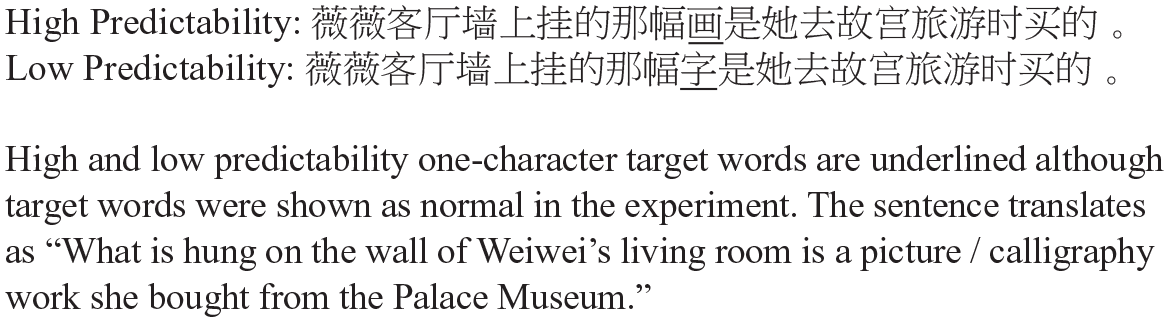
Example sentence stimulus.
Sentence frame and target word combinations were divided into two lists, each containing one version of each sentence frame and an equal number of sentences containing high and low predictability targets. Twenty participants from each age group were randomly allocated to each list. Accordingly, a mixed experimental design was used with the between-participants factor age group (young adult, older adult) and within-participants factor word predictability (high, low). Dependent variables included sentence reading time and measures of eye movements at the level of the sentence and target word.
Apparatus and procedure
An EyeLink 1000 Plus eye-tracker (SR Research, Canada) recorded right-eye gaze location every millisecond during binocular viewing. This system has high spatial (< .01° RMS) and temporal (1,000 Hz) resolution. Sentences were displayed in Song font as black-on-white text. At 75 cm viewing distance, each character subtended approximately 1° horizontally and so was of normal size for reading.
Participants took part individually and were instructed to read normally and for comprehension. At the start of the experiment, a 3-point horizontal calibration procedure was performed across the same line as each sentence was presented (ensuring .30° or better accuracy for all participants). Calibration accuracy was checked before each trial, and the eye-tracker recalibrated as required to maintain high spatial accuracy throughout the experiment. At the start of each trial, a fixation square equal in size to one character was presented on the left side of the display. Once the participant fixated this location, a sentence was presented with the first character replacing the square. Participants pressed a response key once they finished reading. The sentence was replaced on 25% of trials by a comprehension question requiring a yes/no response, and participants responded by pressing one of two response keys. The experiment lasted about 40 min for each participant.
Results
Accuracy answering comprehension questions (analysed using linear mixed-effects models, see following section) was greater than 80% for all participants, although higher for the young adults (M = 94%) than the older adults (M = 91%; z = 2.44, p < .05).
Following standard procedures, short (<80 ms) and long (>1,200 ms) fixations were removed (affecting 4% of fixations). Trials with track loss or error were also excluded (affecting 1.2% of trials) and data above three standard deviations from the global mean were removed (affecting < 3% of trials), although analyses removing no outliers or outliers more than three standard deviations from each participant’s mean produced the same pattern of results. The remaining data were analysed by Linear Mixed-Effects Models (LMEMs, Baayen et al., 2008) using R (R Development Core Team, 2016) and the lme4 package (Bates et al., 2011). For binomial variables, generalised LMEMs were conducted with the Laplace approximation. A maximal random effects structure was used (Barr et al., 2013), with participants and stimuli as crossed random effects. For sentence-level measures, age group was a fixed factor, and for target word measures, age group, word predictability, and their interaction were fixed factors. Older adults read more slowly than young adults and so differential effects of word predictability may reflect multiplicative slower processing of low compared to high predictability words by older, relative to younger, adults (Faust et al., 1999). We adjusted target word reading time data to take account of this using log-transformation (Wagenmakers et al., 2012). Effects based on both untransformed and log-transformed data are reported for transparency and because previous studies reported effects based on only untransformed data (Choi et al., 2017; Rayner et al., 2006). Contrasts of main effects and contrasts to examine interactions were defined using sliding contrasts (the contr.sdif function) in the MASS package (Venables & Ripley, 2002). As each variable had two levels, these produced effect coding for main effects equivalent to other methods. Following convention, t/z > 1.96 were considered significant, as when degrees of freedom are high, as in the present experiment, p is less than .05 when absolute t/z values are greater than 1.96.
Standard sentence-level and word-level measures are reported (Rayner, 2009). Sentence-level measures were sentence reading time (time from the onset of the sentence display until the participant pressed a key to indicate they had finished reading), number of fixations, average fixation duration (the average length of all fixations made during sentence reading), forward saccade length (mean length, in characters, of progressive eye movements) and number of regressions (backwards eye movements). Target word analyses included measures informative about first-pass reading, i.e., the initial processing of a word prior to a fixation to its right or a regression from the word. These were word-skipping (probability of not fixating a word), first-fixation duration (FFD, duration of the first fixation on a word), single-fixation duration (SFD, duration of the first fixation on a word receiving only one first-pass fixation), gaze duration (GD, sum of all first-pass fixations on a word) and regressions-out (RO, probability of a first-pass regression from a word). Word-skipping included all first-pass skips. However, analyses that examined skipping effects for saccades launched from only within three characters of the target word, and when the skip was not immediately followed by a corrective regression (and so indicative of oculomotor error), produced the same pattern of results. We also examined regression-path reading time (RPRT, sum of all fixations from the first fixation on a word during first-pass until a fixation to its left, including time spent re-reading) as a measure of integration difficulty (Liversedge et al., 1998). We report total reading time (TRT, sum of all fixations on a word) and regressions-in (RI, probability of a regression back to a word) as measures of later processing.
Sentence-level analyses
Table 1 shows sentence-level means, and Table 2 summarises statistical effects. Compared to the young adults, the older adults read more slowly, by making more and longer fixations, more regressions, and shorter forward saccades, consistent with other evidence of age-related difficulty reading Chinese (L. Li et al., 2019; S. Li et al., 2018; J. Wang, Li, Li, Xie, Chang, et al., 2018; J. Wang, Li, Li, Xie, Liversedge, & Paterson, 2018; Zang et al., 2016; Zhao et al., 2019).
Means for sentence-level measures.
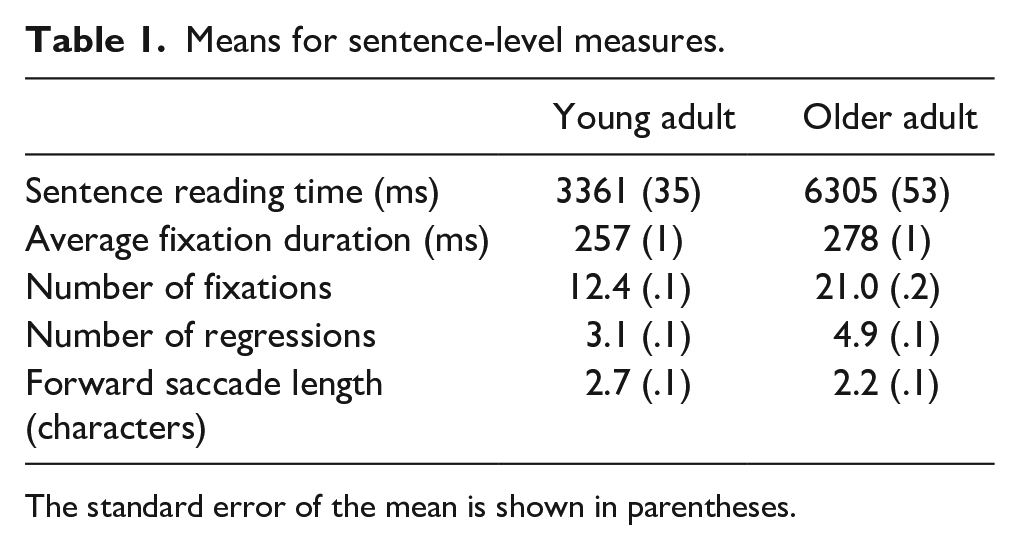
The standard error of the mean is shown in parentheses.
Statistical effects for sentence-level measures.
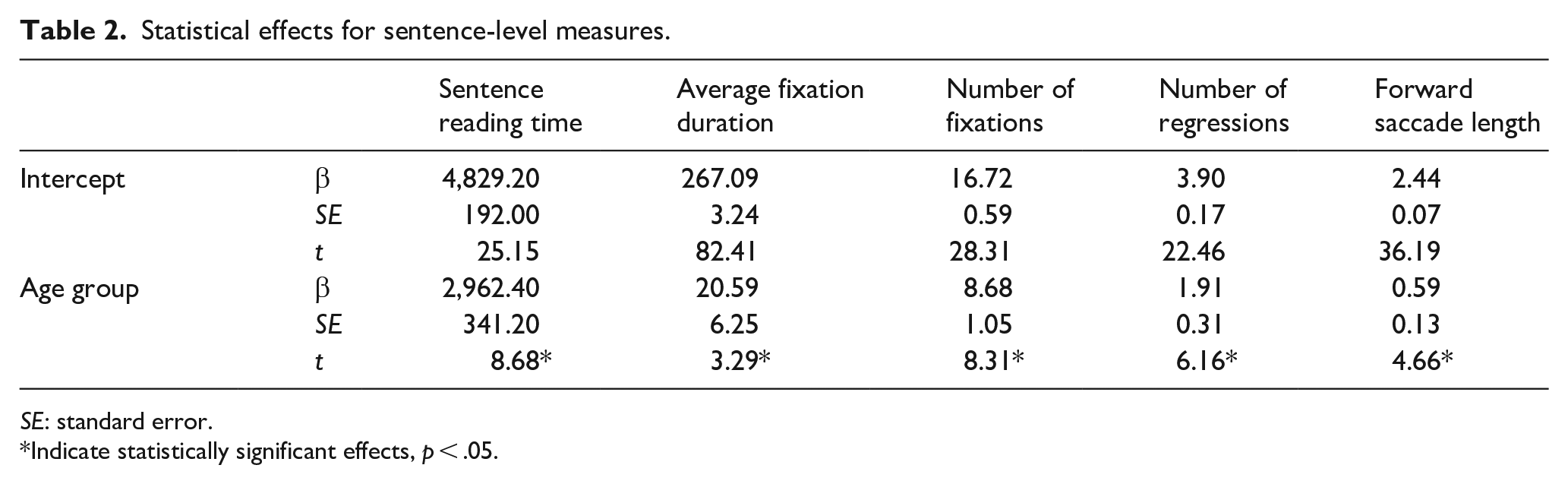
SE: standard error.
Indicate statistically significant effects, p < .05.
Target word analyses
Table 3 shows target word means, and Table 4 summarises the statistical effects. Target words were skipped less often and had longer reading times for the older than younger adults (with effects in FFD, SFD, GD, TRT), with similar effects in untransformed and log-transformed analyses. Compared to the young adults, the older adults also made more regressions back to target words. This pattern of effects also was consistent with previous demonstrations of age-related reading difficulty (S. Li et al., 2018; J. Wang, Li, Li, Xie, Chang, et al., 2018; J. Wang, Li, Li, Xie, Liversedge, & Paterson, 2018; Zang et al., 2016; Zhao et al., 2019).
Means for target word measures.
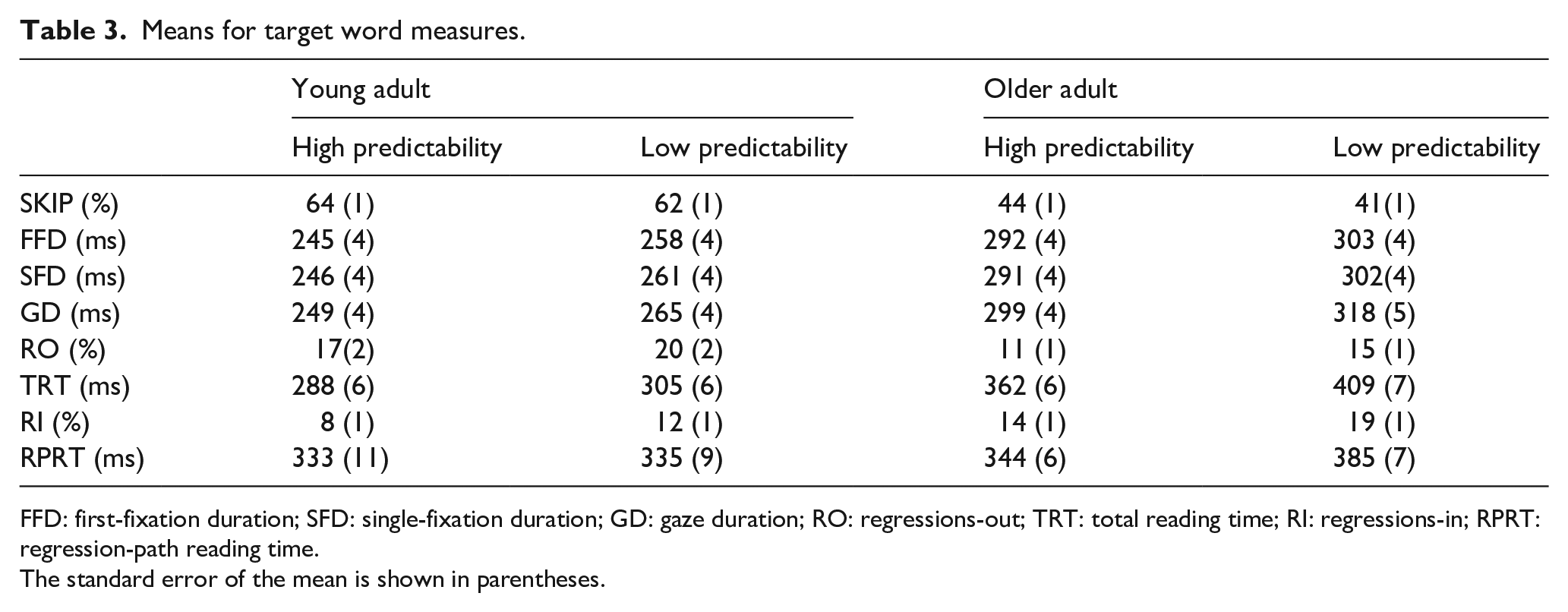
FFD: first-fixation duration; SFD: single-fixation duration; GD: gaze duration; RO: regressions-out; TRT: total reading time; RI: regressions-in; RPRT: regression-path reading time.
The standard error of the mean is shown in parentheses.
Statistical effects for target word measures.
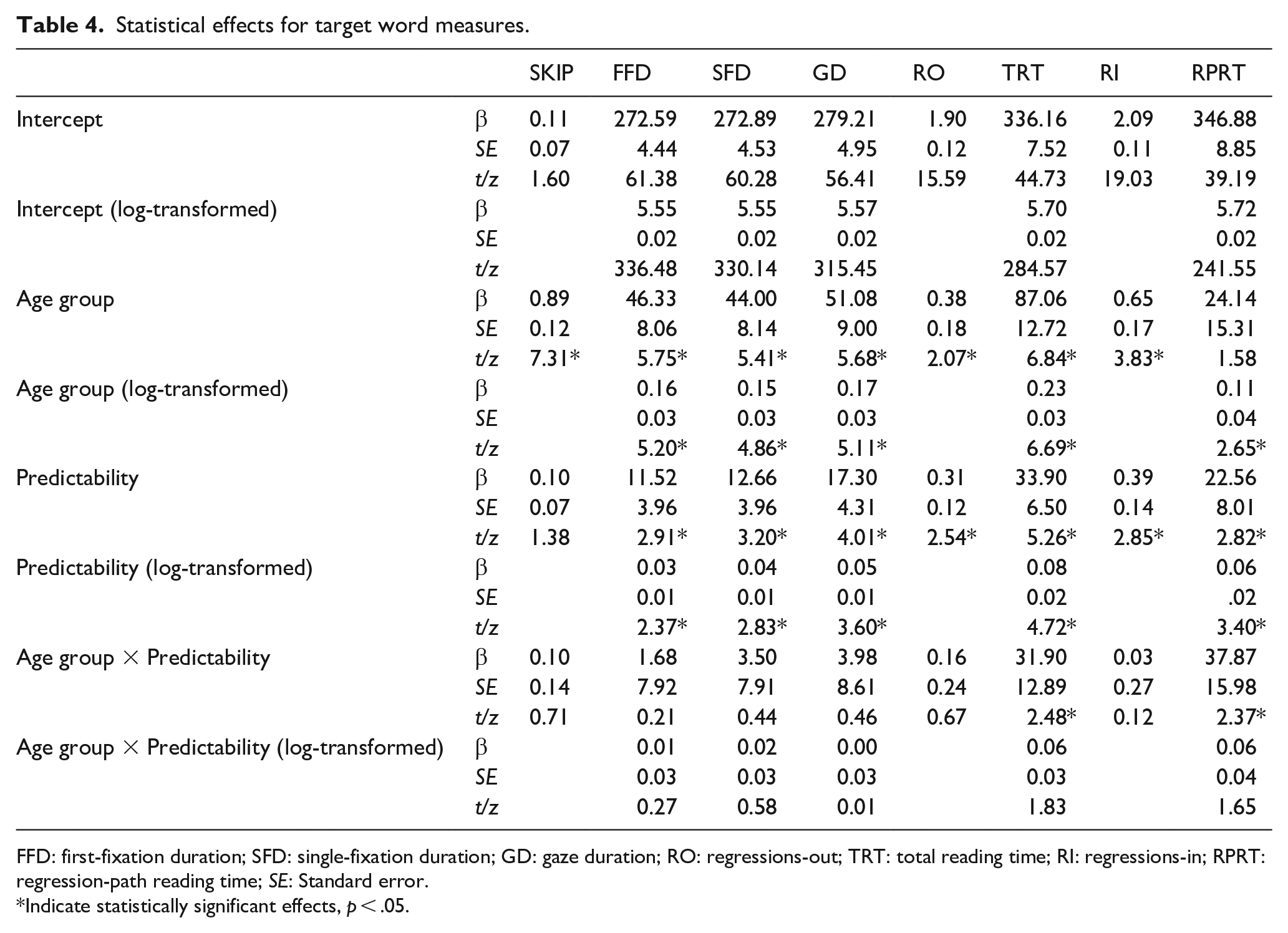
FFD: first-fixation duration; SFD: single-fixation duration; GD: gaze duration; RO: regressions-out; TRT: total reading time; RI: regressions-in; RPRT: regression-path reading time; SE: Standard error.
Indicate statistically significant effects, p < .05.
There were clear main effects of word predictability. Low predictability words had longer reading times than high predictability words (with effects in FFD, SFD, GD, RPRT, TRT), with similar effects in untransformed and log-transformed analyses. Readers also made more regressions for low compared to high predictability words. This was observed in both regression measures (i.e., regressions-out and regressions-in), suggesting a difference in the ease of integrating high versus low predictability words. These word predictability effects were resonant with those reported previously in Chinese (Rayner et al., 2005; Zhao et al., 2019).
Interactions between age group and predictability were significant in RPRT and TRT in untransformed but not log-transformed analyses, due to larger predictability effects for the older adults. As these provide measures of later word processing, it appears that word predictably influenced eye movements associated with the later, integrative processing of words more for the older than younger adults. However, it is unclear from the present findings whether this reflects a cost in integrating lower predictability words or facilitation of the integration of higher predictability words. Interactions between age group and word predictability were not significant in word-skipping or first-pass reading times (i.e., FFD, SFD, or GD). Word-skipping was generally high (>60% for young adults, >40% for older adults). The absence of interaction effects in first-pass reading times might be explained, therefore, by a reduction in power caused by the high skipping rate (and resultant reduction in first-pass fixations on target words). This high skipping rate was intentionally encouraged by the use of one-character target words and unlikely to reflect skim reading or some other disengaged reading strategy (see, for example, White et al., 2015), as reading times and the number and length of fixations were comparable to previous research with lower skipping rates (e.g., Zhao et al., 2019). Crucially, despite the high skipping rate, there was no indication of an age difference in predictability effects in word-skipping.
Effects of individual difference variables
Some research suggests that key individual differences, including working memory capacity and reading skill might influence word predictability effects in discourse comprehension (e.g., Ashby et al., 2005; Otten & Van Berkum, 2009). To explore the potential influence of these variables on word predictability effects in the present experiment, we computed additional LMEMs for RPRT and TRT that included individual difference scores for vocabulary knowledge and working memory (assessed using digit span measures) as co-variates. Model comparisons showed that inclusion of vocabulary scores did not improve model fit significantly for either RPRT (χ2 = 5.82, df = 4, p = .21) or TRT (χ2 = 8.53, df = 4, p = .08). Inclusion of digit span scores also did not improve model fit significantly for RPRT (χ2 = 2.07, df = 4, p = .72) but did improve model fit for TRT (χ2 = 10.97, df = 4, p = .03). An examination of the LME showed a main effect of digit span on TRT, which was larger for older adults (working memory, β = 7.89, SE = 3.44, t = 2.30; working memory x age group, β = 16.46, SE = 6.87, t = 2.40), consistent with larger working memory effects on sentence integration for older readers. Crucially, we also observed an interaction between age group and word predictability (β = 38.13, SE = 17.11, t = 2.23). However, there was no interaction between working memory and word predictability (β = 1.90, SE = 3.69, t = .51), and no interaction between age group, working memory and predictability (β = .06, SE = 7.38, t = .01). The results therefore suggest that working memory influences sentence integration (see, for example, Kemper & Liu, 2007), but does not mediate aging effects on the influence of word predictability.
Discussion
With the present research, we followed-up recent findings showing an adult age difference in effects of contextual predictability on reading times but not skipping rates for words in Chinese reading (Zhao et al., 2019). This earlier study used two-character target words and so we conducted a stronger test of effects on word-skipping by using one-character words that would be expected to be skipped more often. The results confirmed that the one-character target words produced high skipping rates for both age groups. We also replicated previous evidence of age-related reading difficulty for Chinese (L. Li et al., 2019; S. Li et al., 2018; J. Wang, Li, Li, Xie, Chang, et al., 2018; J. Wang, Li, Li, Xie, Liversedge, & Paterson, 2018; Zang et al., 2016; Zhao et al., 2019), and previous findings of word predictability effects in Chinese (Rayner et al., 2005; Zhao et al., 2019). The findings showed, in addition, that our manipulation of word predictability affected reading times but not skipping rates for words, replicating the basic findings for two-character target words in the Zhao et al. study.
The reading time effects we observed emerged later in the eye movement record, in regression path and total reading times rather than first-pass reading times for words. This was most likely because the high skipping rate in the present experiment substantially reduced the number of first-pass fixations on the target words, and therefore the likelihood of detecting a first-pass effect. Our findings nevertheless show, in line with other evidence, that older adults produce larger contextual predictability effects compared to young adults, which affects processing measures associated with the integration of words with prior sentence context (Steen-Baker et al., 2017; Zhao et al., 2019). Further research is needed to establish whether this is because older adults experience greater difficulty integrating lower predictability words or find it easier to integrate higher predictability words. However, the effects we observed are consistent with a compensatory use of contextual information to offset slower lexical processing (McGowan & Reichle, 2018; Rayner et al., 2006). It is even possible that, in line with this account, the effects are due to older readers incorrectly guessing the target word to be a highly predictable word in the low predictability condition and engaging in re-reading to revise this misanalysis. However, the effects we observed may also reflect greater use of contextual knowledge due to increased experience of reading in older adulthood (Payne et al., 2012; Verhaghen, 2003). Such effects therefore may vary with respect to individual differences in literacy and reading skills, such that older readers with poorer reading skills may make greater use of context (see, e.g., Payne et al., 2012; Steen-Baker et al., 2017).
Crucially, despite achieving high skipping rates, there was no indication of a difference in word predictability effects on word-skipping across age groups, and therefore no evidence that older adults make greater use of context to anticipate and skip upcoming words. Whether this lack of an effect in word-skipping is a consequence of specific task demands in Chinese reading is unclear. There is considerable evidence that older readers experience difficulty reading Chinese because of the visual complexity of characters (e.g., L. Li et al., 2019; Xie et al., 2019; Zhang et al., 2007), and difficulty segmenting words in naturally unspaced text (see S. Li et al., 2018). Because of these difficulties, they read almost twice as slowly as young adults and skip words infrequently. However, the present experiment showed that older readers do not use contextual knowledge to skip even very short words more frequently compared to young adults. Nevertheless, there may be effects on parafoveal processing of these words in the absence of word-skipping and further work is needed to understand age differences in parafoveal processing in Chinese reading.
The present findings clearly limit the applicability of the “risky” reading hypothesis by showing that a key component of the account is not supported in Chinese. However, it is noteworthy that support for this hypothesis is also lacking in research with alphabetic scripts. Early investigations of ageing effects on eye movements in reading showed that higher word predictability increased reading speeds similarly for young and older adults, with little effect on skipping (Kliegl et al., 2004; Rayner et al., 2006). Recent studies offer clearer evidence for age differences in predictability effects, however, by revealing larger effects for older compared to younger adult readers in eye movement measures associated with the integration of words with prior discourse context (Choi et al., 2017; Steen-Baker et al., 2017). However, methodological problems with these studies mean they are not informative about effects on word-skipping. There is therefore pressing need for further investigations of ageing effects on word predictability in alphabetic reading using methods appropriate for testing skipping effects. Such studies will be important for establishing whether effects similar to those reported here are observed cross-linguistically, in alphabetic scripts, as well as extending our understanding of how lexical prediction changes across the adult lifespan.
Footnotes
Author’s note
Sainan Zhao and Lin Li are joint first authors.
Author contributions
All of the authors contributed to the design of the experiment. Sainan Zhao and Lin Li prepared the stimuli, Sainan Zhao conducted the experiment, and Sainan Zhao and Lin Li analysed the data. Sainan Zhao, Lin Li, and Kevin Paterson prepared the manuscript.
Declaration of conflicting interests
The author(s) declared no potential conflicts of interest with respect to the research, authorship, and/or publication of this article.
Funding
The author(s) disclosed receipt of the following financial support for the research, authorship, and/or publication of this article: The research was supported by a grant from National Science Foundation of China to Jingxin Wang (grant no. 81771823), an award from the “Scientific Research and Innovation Program for Graduate Students of Tianjin” (grant no. 2019YJSB130) to Sainan Zhao, a research grant from Tianjin Normal University (grant no. 52WU2012) to Lin Li, and a 1000 Talents Visiting Professorship to Kevin Paterson.

Data accessibility statement
Data files and related resources are available from the University of Leicester online Figshare repository: 10.25392/leicester.data.9789545