




Abstract
Verbal and numerical formats (e.g., verbal: “low fat,” or numerical: “20% fat”) are used interchangeably to communicate nutritional information. However, prior research implies that verbal quantifiers are processed more intuitively than numerical ones. We tested this hypothesis in two pre-registered experiments measuring four indicators of processing style: (a) response time, (b) decision performance, (c) reliance on irrelevant contextual information, which we inferred from participants’ decision patterns, and (d) the level of interference from a concurrent memory task. Participants imagined they had consumed a given amount of a nutrient (represented in a pie chart) and decided whether a new quantity (either verbal or numerical) could be eaten within their guideline daily amount (GDA). The experiments used a mixed design varying format (verbal or numerical), concurrent memory load (no load, easy, and hard load in Experiment 1; no load and hard load in Experiment 2), nutrient (fat and minerals), quantity (low, medium, and high in Experiment 1; low and high in Experiment 2), and the assigned correct response for a trial (within and exceeding limits). Participants were faster and made fewer correct decisions with verbal quantifiers, and they relied more on contextual information (i.e., the identity of the nutrient involved). However, memory load did not impair decisions with verbal or numerical quantifiers. Altogether, these results suggest that verbal quantifiers are processed intuitively, slightly more so than numerical quantifiers, but that numerical quantifiers do not require much analytical processing to reach simple decisions.
Decisions are often made in a complex environment with an abundance of options, differentiated by information presented in differing formats. For example, information about food can be presented using numerical values (e.g., “20%”) or as a verbal quantifier (e.g., “low”). Ideally, the best format to present such quantified information should facilitate informed decision-making while not overtaxing cognitive resources. To use the food choice context as an example, people should be able to accurately perceive nutrient quantities communicated while shopping in an environment with information overload. Unfortunately, there is conflicting evidence on whether existing information formats (e.g., labels indicating the percentage of one’s “Guideline Daily Amount”; hereafter “GDA,” that a food provides) achieve these goals (Campos et al., 2011; Grunert et al., 2010; Levy et al., 2000; Scammon, 1977). While numerical formats are more precise estimates, numbers on food labels are often difficult to interpret (Campos et al., 2011; Liu & Juanchich, 2018). On the other hand, verbal formats may be intuitively easier to understand (Wallsten et al., 1993), but more vague in meaning (Budescu & Wallsten, 1995), and less carefully considered (Just & Wansink, 2014). There is also evidence that the format of a quantity can lead people to rely on different aspects of the overall information to make their decision (González-Vallejo et al., 1994; Liu et al., in press). This article presents two experiments that test whether verbal quantifiers are more intuitive than numerical quantifiers, and whether they lead to different decision patterns.
Levels of information processing: intuitive vs. analytical
When people process information, their thinking can range from intuitive (a more automatic, quick process that often involves mental shortcuts to simplify information) to analytical (a more complex process that operates consciously, slower, and requires more effort; Evans, 2008; Kahneman, 2011). These styles of processing, typically described as “System 1” and “System 2” (for an overview of dual-processing theories, see Evans, 2008, or De Neys, 2017), are posited to explain differences in the processing of verbal and numerical quantifiers: verbal and numerical formats appear to prompt intuitive and analytical processing, respectively (Windschitl & Wells, 1996).
Several properties of words and numbers support the proposition that verbal quantifiers could be more intuitively processed than numerical ones (Ayal et al., 2015; Budescu & Wallsten, 1990; Dunwoody et al., 2000; Liu et al., in press; Nordgren et al., 2011; Windschitl & Wells, 1996). In general, words are processed in an automatic manner, needing conscious effort to suppress the meanings they evoke (MacLeod, 1991). In contrast, numbers tend to be processed in a more intentional, algorithmic manner (Tzelgov et al., 1992), which requires more effort (Lan, 2003; Peters et al., 2009). This is not to say that verbal processing is always intuitive and numerical processing always analytical; indeed, verbal information can be crafted in a complex manner that requires much effort to comprehend (e.g., in verbal reasoning tasks; Evans, 2002), whereas basic comparisons of two numbers in terms of their surface magnitude can be done quickly and intuitively (Viswanathan & Narayanan, 1994). However, people can more easily understand that a verbal quantifier such as “low” means the amount depicted is small, whereas this is not readily understood from a numerical quantifier such as “20%” (Viswanathan & Childers, 1996).
Other evidence suggests that people might be more susceptible to intuitive biases when processing verbal quantifiers (Welkenhuysen et al., 2001; Windschitl & Wells, 1996). This could lead to poorer decision-making with verbal quantifiers. One might expect incorrect decisions to be naturally due to the vagueness of verbal quantifiers, which tap into a wide range of possible numerical meanings (Budescu & Wallsten, 1985). This could lead to over- or underestimations of an actual quantity that affects decision-making. For example, someone who estimates a high % of fibre to mean 60% might incorrectly assume they have eaten enough fibre if high only means 30% (Liu et al., 2019). However, this sort of estimation error should have a facilitative effect in cases where, for instance, someone who underestimates the intended meaning of high % minerals would more easily identify correctly when they have eaten too little. As such, assuming people over- and underestimate verbal quantifiers normally around the mean interpretation, vagueness itself should not affect decision-making at the group level. Indeed, some studies have found that people perform similarly at the aggregate level for decisions with numerical and verbal quantifiers (Budescu & Wallsten, 1990; González-Vallejo et al., 1994; Liu et al., in press).
According to dual-process theory, people making decisions based on verbal quantifiers would be expected to make more errors because they rely on their intuition. The type of errors that people make is therefore informative. Intuitive processes lead to reliance on effort-saving decision strategies, such as relying on contextual cues as a substitute to answer a question (Kahneman & Frederick, 2002). For example, people are more influenced by affective information when relying on intuition (Levin & Gaeth, 1988; Slovic et al., 2007). Closer examination of decision performance in past work showed that people given verbal quantifiers were influenced by how positive an outcome would be, as opposed to basing their decision on the value of the quantity when it was presented numerically (González-Vallejo et al., 1994; Liu et al., in press). This suggests that people rely more on the contextual information when they make more intuitive decisions with verbal quantifiers compared with more analytical ones with numerical quantifiers, which could lead to incorrect decisions if the context is not relevant to the decision.
Measuring intuitive and analytical processes using multiple indicators
Identifying intuitive and analytical processing styles is not a straightforward process. Traditional dual-process theories imply that the two processes differ in terms of speed and effort, and the outcome of the processes differ in accuracy (Evans, 2008; Morewedge & Kahneman, 2010). Although the assumption that there are two qualitatively difference processes has increasingly been challenged, the core postulates of the theory (that intuitive processing leads to quicker, easier, but less accurate decisions than analytical processing) continue to fuel academic research and influence advice to decision-makers globally (Melnikoff & Bargh, 2018). Direct comparisons between quantifiers and their average numerical translations for measures such as reaction time and decision quality—often measured as indicators of processing style (Evans, 2008; Horstmann et al., 2010)—show that on average, both may be processed in a similar time (Liu et al., in press) and lead to similar performance (Budescu & Wallsten, 1990; González-Vallejo et al., 1994). Because response time and performance are contingent on a wide range of factors, the extent to which they reflect processing style is debated. Some dual-process theorists have, for example, suggested that analytical processes could be fast (Glöckner & Betsch, 2008b) and intuitive processes could be accurate (Bago & De Neys, 2019). A more stringent manipulation may therefore be necessary to identify the level of processing prompted by verbal and numerical information.
The defining feature of intuition should be its automaticity, in that it does not load working memory (Evans & Stanovich, 2013; but see also Melnikoff & Bargh, 2018, for limitations of this argument). Analytical processing, in contrast, draws on cognitive resources: a person whose cognitive system is loaded with an extra task would have less capacity to process information analytically, and would rely more on intuition in their decision-making (Shiv & Fedorikhin, 1999). Researchers have successfully demonstrated that concurrent cognitive loads impair analytical reasoning, but not intuitive responses (De Neys, 2006).
Building on the assumptions of the dual-process theory and the hypothesis that verbal quantifiers are processed more intuitively and numerical quantifiers more analytically, we expected that verbal quantifiers would be processed quicker than numerical quantifiers, and that people would use strategies that rely on contextual information peripheral to the quantitative decision when making decisions with verbal quantifiers (for example, favouring gambles that present larger payoffs, regardless of their probability to win; González-Vallejo et al., 1994). This is in contrast to strategies that rely more on the quantity itself, which we expected when people make decisions with numerical quantifiers. Finally, we expected that manipulating a person’s cognitive load should interfere with performance on a decision task based on numerical, but not verbal quantifiers.
Research objectives
The two experiments reported aimed to test the hypothesis that verbal quantifiers are processed more intuitively than numerical ones. To that end, we used a decision task where participants had to judge if a combination of nutrition quantities (presented as “Guideline Daily Amounts”; or “GDAs”) was within or exceeding a specified limit. This allowed us to set two types of trials: trials where quantities fell within the GDA limit or exceeded it. Thus, participants could make two types of correct decisions (they could be correct that the quantities were within or exceeded the limit) and two types of incorrect decisions (they could be incorrect that the quantities were within or exceeded the limit). We also included different combinations of nutrient and quantity values in the task to create different associative contexts that should suggest different intuitive responses. For example, as illustrated in Figure 1, an intuition that the nutrient “minerals” is healthy (Oakes, 2005b) presents a conflict in a situation where the correct decision is that the quantity exceeds a healthy limit. We measured four indicators of processing style: response time, performance, level of reliance on contextual information, and the effect of interference from a concurrent task. Although response times and performance measures in themselves may not be conclusive evidence for intuitive or analytical processing (Evans & Stanovich, 2013; Horstmann et al., 2010), we also employed a memory load manipulation to tax cognitive resources, which should interfere with performance for analytical, but not intuitive decisions (De Neys, 2006; Trémolière et al., 2014).
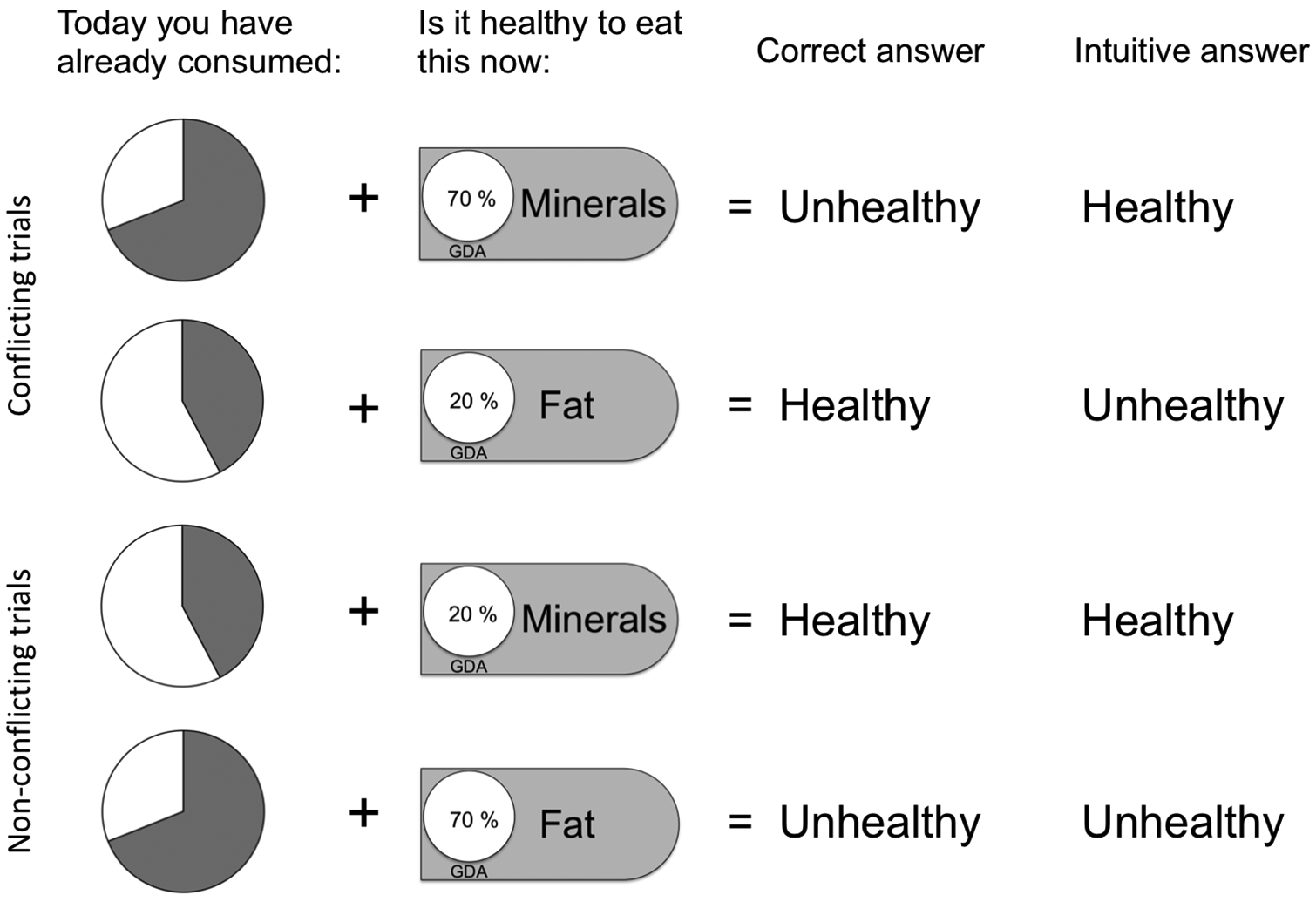
Examples of trials where the nutrient could present an intuitive conflict vs. no conflict in the decision task.
Based on our overall hypothesis, we expected quicker and fewer correct decisions with verbal quantifiers, which should also be more influenced by information about the nutrients (context) than decisions with numerical quantifiers. In addition, we expected that the concurrent cognitive load would decrease performance if a task were analytical. If, in the task, summing the quantities (verbal or numerical) to reach a decision required analysis, memory load should impair correct responding. If it did not require analysis, the memory load manipulation would not have an effect. If, as we expected, the verbal quantifier required less analysis than the numerical, we would see an impairment of the numerical decisions compared with the verbal ones under memory load.
We pre-registered the experimental design, hypotheses, and analyses prior to each experiment. These, along with the materials and data, are available on the Open Science Framework (OSF; https://osf.io/27xv9).
Experiment 1
Method
Participants
Sixty-six participants from a university lab database completed the study (68% female; age range 19–66 years, M = 23.88, SD = 7.90; 52% White, 26% Asian, 17% African; 53% with a university degree). We powered the study to capture a small-to-medium effect for the hypothesised interactions using a mixed variance analysis (Cohen’s f = .18, α = .05, 1-β = .80). A sensitivity analysis showed that the recruited sample size had 80% power to detect a medium between-subjects effect of format (f = .25). Participants were paid a £4 show-up fee and given the opportunity to earn additional payment to encourage diligent responding (they were offered £0.10 per correct response on the memory tasks and £0.05 per correct response on the decision tasks).
We measured participants’ preferences for intuition and deliberation (Betsch, 2004), their attitudes towards healthy eating (Steptoe et al., 1995), their use of food labels, and body mass index (BMI). Our sample had a preference for deliberation (M = 3.95, SD = 0.50) over intuition (M = 3.42, SD = 0.51), positive eating attitudes (M = 5.15, SD = 1.20) and half reported using nutrition labels regularly. Mean estimated BMI was in the healthy range (M = 22.60, SD = 4.33).
Design
Participants made decisions about whether a given quantity of a nutrient (representing a proportion of their GDA) was healthy to consume given what they had already consumed. We used a 2 (format: verbal or numerical) × 3 (memory load: none, easy, or hard) × 2 (nutrient: minerals or fat) × 3 (quantity: low, medium, or high) × 2 (correct response: within limits–healthy or exceeding limits–unhealthy) mixed design. Format was manipulated between subjects (random allocation for each participant), while the other factors were manipulated within subjects (randomly presented across trials). The different combinations of nutrients, quantities, and the assigned correct response allowed us to ascertain the decision strategy participants might use. From a normative perspective, assuming the verbal and numerical quantifiers were strictly equivalent, only information about the quantities should determine if participants decide if it was within limits (healthy) or exceeding limits (unhealthy). The nutrient was not relevant to the decision. However, it allowed us to identify trials that required participants to make a decision that would conflict with an intuitive response to the trial (see Figure 1).
Materials
The experiment was delivered using Inquisit4 (Millisecond Software, 2015; code available on the OSF). There were two task components: the GDA decision task and the memory task.
GDA decision task
To measure decision-making performance, we used a GDA decision task (Liu et al., in press). As shown in the top panel of Figure 2, in each decision trial, a fixation cross appeared for 500 ms, followed by a pie chart illustrating an amount of a given nutrient that participants should imagine they had previously consumed, which was presented for 3,000 ms. Participants were then presented with a new quantity (either verbal or numerical) of the same nutrient. Their goal was to decide if eating this quantity would fall within their GDA limit (“healthy”) or exceed it (“unhealthy”). They pressed the left arrow key for healthy and the right for unhealthy, or vice versa.
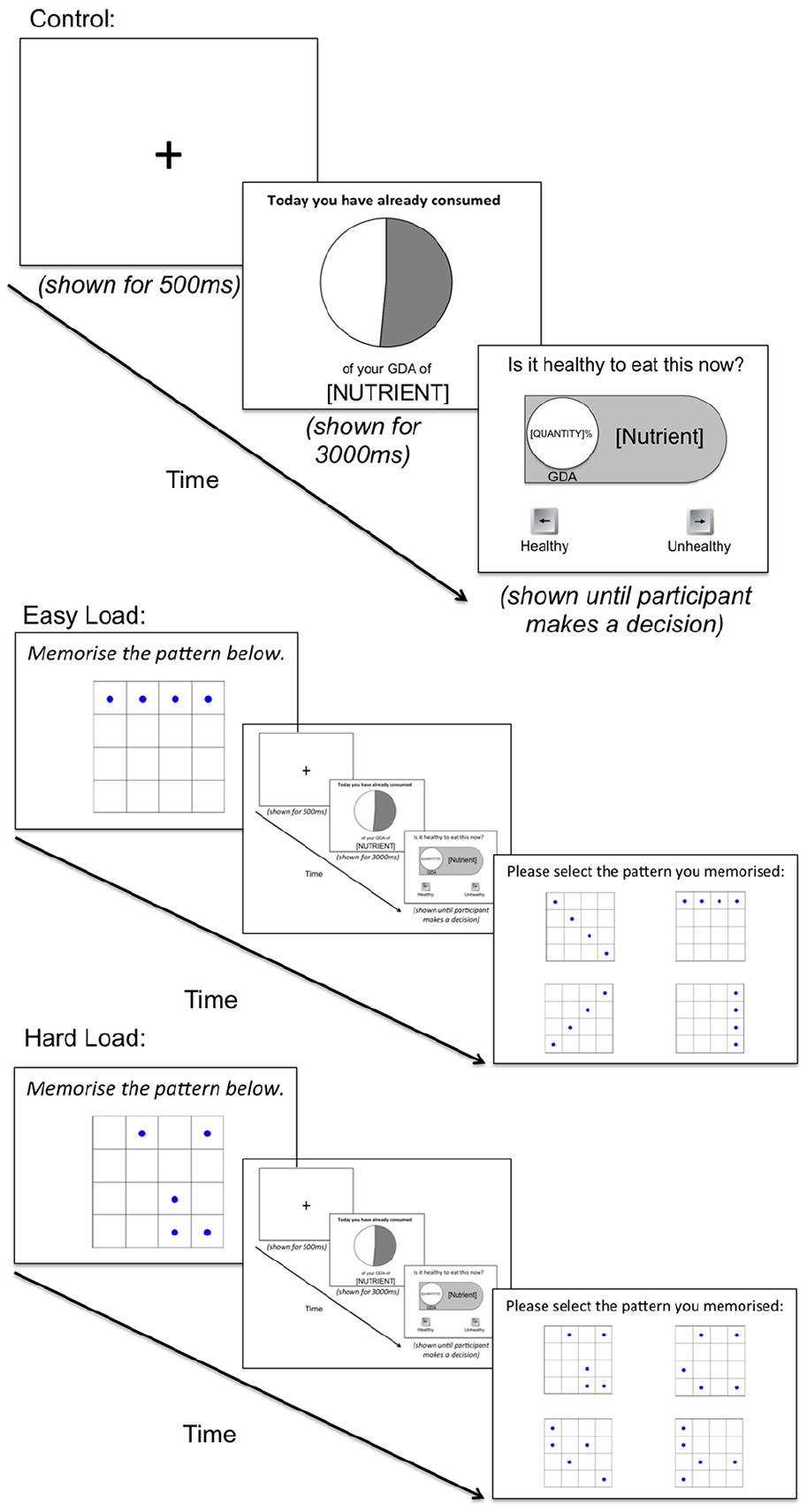
Example of a decision-making trial in the no load, easy load, and hard load conditions in Experiment 1.
As summarised in Table 1, the quantity that followed the initial nutrient intake was either low, medium, or high. Following similar procedures in developing comparable verbal and numerical conditions between quantity formats (Teigen & Brun, 2000; Welkenhuysen et al., 2001), we used corresponding quantities for the two conditions that had been found to be on average psychologically equivalent with similar samples in a similar context (Liu et al., 2019). The correct response in the task was determined by whether the two quantities added together fell within or exceeded 100% (of the GDA for this nutrient). The amount already consumed (shown in the pie chart) was set such that half the combinations were within the limit and half exceeded it. Based on this design, participants could make two types of correct decisions (they could be correct that the quantities were within or exceeding the limit) and two types of incorrect decisions (they could be incorrect that the quantities were within or exceeding the limit).
Quantity combinations used in the GDA decision task in Experiment 1.
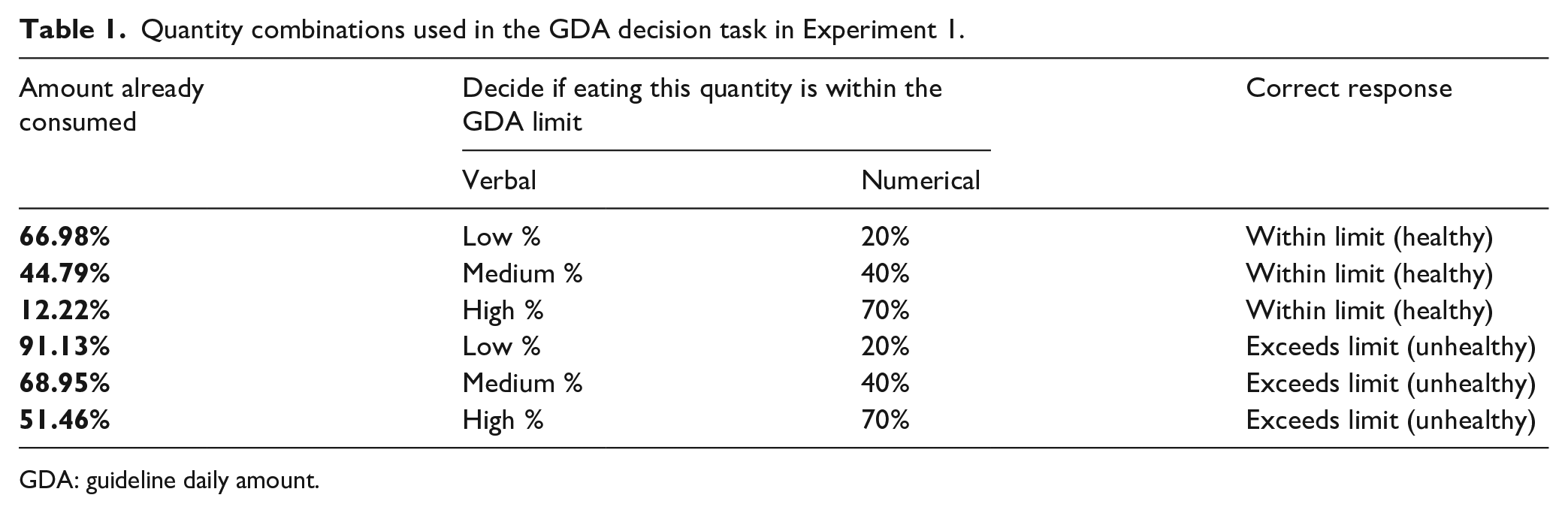
GDA: guideline daily amount.
Memory load manipulation
To manipulate memory load, we used a dot memorisation task (Białek & De Neys, 2017; Trémolière et al., 2014). Participants memorised a dot pattern in a 4 × 4 matrix (see the middle and bottom panels of Figure 2) presented for 2s before performing the GDA decision task. After they made their GDA decision, they selected which of four matrices had been presented. They were told whether their selection was correct. If they erred, they were instructed to try harder on the next trial. There were two memory load conditions, taken from Białek and De Neys (2017). In the easy load, four dots were arranged in a straight line, whereas in the hard load, five dots were interspersed. Of the three incorrect matrices, one was more highly similar to the correct one than the others (e.g., sharing three out of five dots). Previous work has established that this is a demanding secondary task that interferes with analytical but not intuitive processes (Białek & De Neys, 2017; De Neys & Schaeken, 2007; Trémolière et al., 2014). The simple pattern minimally burdens cognitive resources whereas the hard one further interferes with analytical reasoning (Białek & De Neys, 2017). Furthermore, we expected the visuo-spatial nature of the load to have a similar impact on analytical processing of either quantifier format.
Procedure
After providing informed consent, participants read the generic rules of the decision and memory tasks. Participants first practised the decision task and had to perform the final of the three practice trials correctly to move on. To reduce learning effects, they received feedback in these practice trials but not in the experimental trials. Next, participants practised three trials of the memory load task with a blank screen of 500 ms between memorisation and recognition. They had to perform the final practice trial correctly to proceed, otherwise they received more practice trials. Before the experimental phase began, they were informed that they could earn £0.05 per correct response on the GDA decision task and £0.10 per correct response on the memory task.
Participants were randomly assigned to either the verbal or numerical version of the decision task. Participants performed three blocks of 12 trials each, corresponding to the no load, easy load, and hard load conditions (see Figure 2). The order of presentation of these three conditions was randomly assigned. Within each block, participants made decisions for the 12 decision situations resulting from the randomised crossing of the three quantities, two nutrients, and two assigned correct response manipulations. Participants were given a break at the end of each block. When they had completed all three blocks, they provided a numerical percentage for the three verbal quantifiers, and selected which of five verbal quantifiers (very low–very high) best fit the three numerical quantifiers. This was to check if participants’ natural interpretations of the two quantifier formats were psychologically equivalent. Finally, participants provided demographic information.
Manipulation checks
Memory load manipulation check
Memory performance was good overall, with participants selecting the correct matrix significantly more for easy grids (91.2%) than for hard grids (87.2%), F(1, 1582) = 6.28, p = .012. Participants also took longer to select the hard matrices than the easy ones, F(1, 1582) = 205.57, p < .001. Cases where participants failed to select the correct grid could indicate that they had not sufficiently burdened their cognitive resources while performing the GDA decision task. Therefore, we excluded all trials where participants selected neither the correct grid nor its close target (which indicated a reasonable memory error even when participants were diligently memorising the grid; Białek & De Neys, 2017). 1
Numerical interpretation equivalence check
The mean numerical percentages associated with low, medium, and high verbal quantifiers were close to the numerical quantifiers used in the decision task: 17% vs. 20%, 36% vs. 40%, and 58% vs. 70%, respectively. The mean verbal–numerical translations varied widely and were generally right-skewed, with SDs of 12%, 14%, and 23% for low, medium, and high. The modal translations were 20%, 50%, and 70%. Translations of the numerical quantifiers (20%, 40%, and 70%) to verbal ones were low, medium, and high, respectively (except for 70% fat, for which the verbal translation was “very high”). We followed up with a logistic regression to ascertain if tendencies to under- or overestimate verbal quantifiers might result in participants selecting “healthy” or “unhealthy” more often (which would result in errors due to translation rather than processing style). This analysis found no significant effect of under- or overestimations on decisions, all p’s > .100. A full report of the analysis is included as supplementary material.
Results
To test the effect of format on response time, decision performance, contextual information use, and load impairment, we performed a multilevel model at trial level for response time and decision performance. As response times displayed significant positive skew (original skewness = 3.00), these were log-transformed prior to analysis (resulting skewness = 0.43). We ran the pre-registered statistical model including all two- and three-way interactions and then a simpler model that better targeted the hypothesised interactions, to avoid Type I error rate inflation (Cramer et al., 2016). The two models provided the same evidence regarding our hypotheses. We report here the results of the second one (see Table 2). Results of the full model are available as supplementary material on the OSF (https://osf.io/27xv9/?view_only=b95ebdffe4f94e8c8a7b82df4201f1fc). The model reported here included fixed effects for format, load, nutrient, quantity, assigned correct response, and the interactions for Format × Load, Format × Nutrient, Format × Quantity, Format × Assigned Correct Response, Format × Nutrient × Assigned Correct Response, and Format × Quantity × Assigned Correct Response. The analyses were performed in SPSS using a variance components matrix. The full random effects model did not converge, thus we removed random slopes until a convergent model was obtained, which included by-participant intercepts and random slopes for quantity. Follow-up pairwise comparisons for these effects can be found in the online Supplementary Material.
Effects of format, cognitive load, nutrient, quantity, and assigned correct response on response time and performance (analysed in multilevel models) in Experiments 1 and 2.
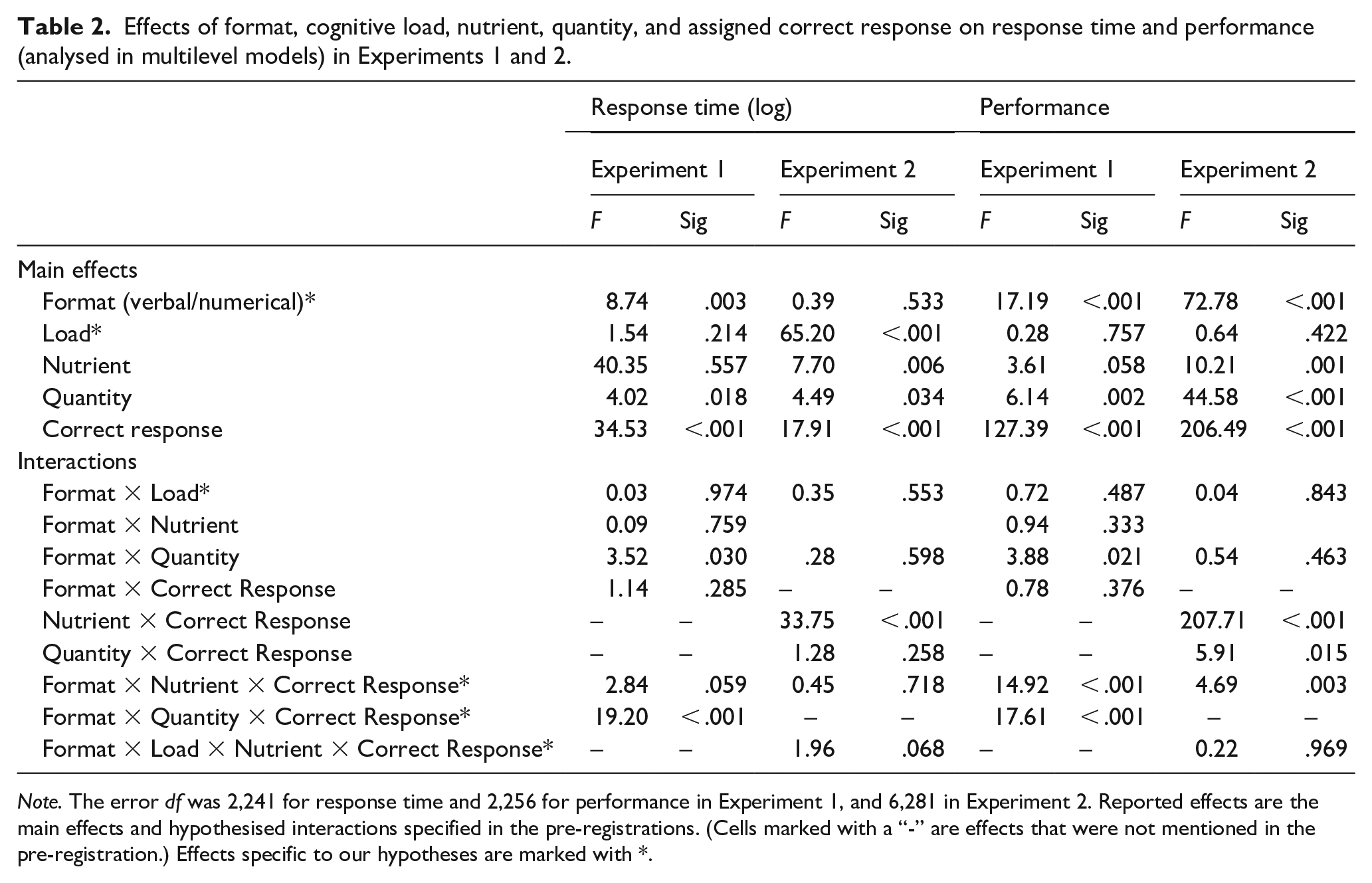
Note. The error df was 2,241 for response time and 2,256 for performance in Experiment 1, and 6,281 in Experiment 2. Reported effects are the main effects and hypothesised interactions specified in the pre-registrations. (Cells marked with a “-” are effects that were not mentioned in the pre-registration.) Effects specific to our hypotheses are marked with *.
Evidence for more intuitive processing of verbal quantifiers
Three of our measures showed more intuitive processing of verbal than numerical quantifiers. In line with our hypotheses, participants made slower decisions and gave more correct responses with numerical than verbal quantifiers (response time in seconds: Mnumerical = 2.53, SD = 2.02, Mverbal = 2.03, SD = 1.75; percentage of trials correct: Mnumerical = .83, SD = .38, Mverbal = .71, SD = .46), F(1, 2241) = 8.74, p = .003 (response time); F(1, 2256) = 17.19, p < .001 (decision performance). We also found evidence that participants relied more on associative processes and hence used irrelevant contextual information to decide in the verbal than the numerical condition. Because each trial had an assigned correct response, we could infer the type of error participants made based on the variables that interacted with the assigned correct response. For instance, a three-way interaction between format, nutrient, and assigned correct response could indicate that participants were mistaking the quantities to be within the GDA limit for one nutrient with verbal but not numerical quantifiers. Because the nutrients were either associated with healthiness (minerals) or unhealthiness (fat; Oakes, 2005a), we could identify if the mistakes matched a decisional conflict with these associations. Indeed, participants had more trouble making conflicting decisions in the verbal format than the numerical one (see Table 3), F(1, 2256) = 14.92, p < .001 (interaction with nutrient); F(2, 2256) = 17.61, p < .001 (interaction with quantity). In particular, the interaction with nutrient was a strong indication of how much context influenced decision-making in either format. Pairwise comparisons showed that participants had more trouble judging mineral quantities that exceeded (i.e., “unhealthy”) than mineral quantities that fell within the limit (i.e., “healthy”) when the quantifiers were verbal than numerical, F(1, 2256) = 28.86, p < .001 (unhealthy minerals); F(1, 2256) = 4.16, p = .042 (healthy minerals). This suggested the use of a “minerals are healthy” strategy that was more evident with verbal quantifiers. However, the converse prediction, that people would use a “fat is unhealthy” strategy, was not observed. Participants were more likely to judge quantities of fat as healthy than unhealthy, and they did so more accurately with numerical than verbal quantifiers, F(1, 2256) = 8.47, p = .004 (healthy fat); F(1, 2256) = 8.33, p = .004 (unhealthy fat). 2
Decrease in performance (% of correct answers) between trials where the correct decision was intuitive and when it was not.
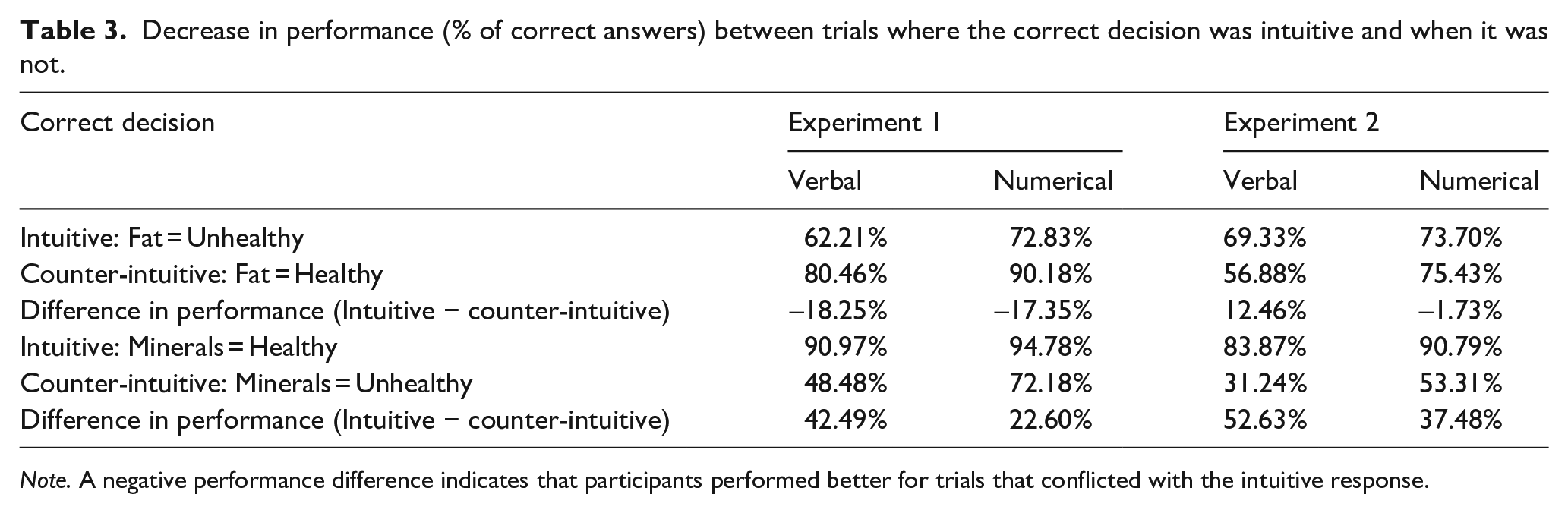
Note. A negative performance difference indicates that participants performed better for trials that conflicted with the intuitive response.
Mixed evidence for analytical processing of numerical quantifiers
Our fourth measure of processing, cognitive load, did not show the expected effect. We predicted the memory load would result in dampened performance in the numerical condition (expected to require analytical processing), as compared with unchanged performance in the verbal condition (expected to be intuitively processed). Such a pattern of results entailed an interaction effect between format and load, which was not statistically significant, F(2, 2256) = 0.72, p = .487. Furthermore, load did not affect overall performance, F(2, 2256) = 0.28, p = .757, suggesting that participants were intuitive for both formats.
Discussion
Experiment 1 investigated four indicators of processing style that provided mixed evidence for a processing difference between verbal and numerical quantifiers. Supporting the hypothesis that verbal quantifiers would be more intuitively processed, participants were quicker, but made fewer correct decisions with verbal than numerical quantifiers. Participants also relied more on associative thinking with verbal than numerical quantifiers, as they used irrelevant cues to guide their decision. Specifically, they were more prone to deciding that verbal (as compared with numerical) mineral quantities were within limits (healthy). However, cognitive load did not impair decision-making more in the numerical than the verbal condition. For both quantifiers, decision performance was not significantly different under memory load, suggesting that both were processed without much analysis.
To assess the robustness of our findings, we aimed to replicate Experiment 1, but with a modification. In Experiment 1, we determined equivalent verbal and numerical quantifier pairs (e.g., low and 20%) based on previous research (Liu et al., 2019). In Experiment 2, we addressed the possibility of individual variation in translations by piping participants’ numerical translations of the verbal quantifiers into the numerical decision task.
Experiment 2
The goal of Experiment 2 was to replicate the findings from Experiment 1 using the same measures of processing style (response time, decision performance, contextual information use, and interference effect of cognitive load), while accounting for individual variability in translations of verbal quantifiers. To this end, we had participants provide their own interpretations of the verbal quantities of fat and minerals, and used these values in the task, as well as to assess the accuracy of their decisions. To streamline the experimental protocol, we also reduced the number of quantity and load conditions to two each. We pre-registered an analysis model that was targeted towards our three pre-registered hypotheses. First, we predicted that people would make faster and worse decisions with verbal than numerical quantifiers. Second, we predicted that participants would rely more on irrelevant contextual cues to make decisions based on verbal quantifiers. Third, based on the assumption that verbal quantifiers would require less analytical processing than numerical quantifiers, we predicted that verbal quantifiers would be less affected by the addition of a concurrent cognitive load as compared with numerical quantifiers. The pre-registration for the experiment is available on the OSF (https://osf.io/27xv9).
Method
Participants
Based on the effects obtained in Experiment 1, we determined a priori that a minimum sample of 285 participants was required to achieve 80% power to detect a between-subjects format effect with α = .05. As the correct response for a trial depended on participants’ translations of verbal quantifiers in this experiment, we included a provision in case certain participants were outliers in their translations (expected to be no more than a third of the sample). We therefore targeted 426 participants from Prolific Academic. After excluding all participants who did not meet the pre-registered exclusion criteria, we had a sample of 420 participants (56% female; age range 18–74, M = 37.79, SD = 12.82; 91% White; 57% had at least a university degree). A sensitivity analysis using 1,000 simulations of the multilevel model in R gave 93% power to detect the main between-subjects format effect based on this sample size. Participants were paid £1.25 to take part in the study, with the opportunity to earn bonus payments based on their performance (£0.05 per correct memory task response and £0.03 per correct decision task response).
Design
Participants performed the same decision task as Experiment 1 in a 2 (format: verbal or numerical) × 2 (memory load: none or hard) × 2 (nutrient: minerals or fat) × 2 (quantity: low or high) × 2 (previously consumed amount) design. Format was manipulated between subjects (random allocation for each participant), while the other factors were manipulated within subjects (random presentation across trials). The two previously consumed amounts per quantity (see Table 4) allowed us to determine the correct response for the trial based on each individual participant’s translation of the verbal quantifiers.
Quantity combinations for the decision trials in Experiment 2 (eight per nutrient), as determined by the value of participants’ verbal quantifier translations and the amount shown in the pie chart.
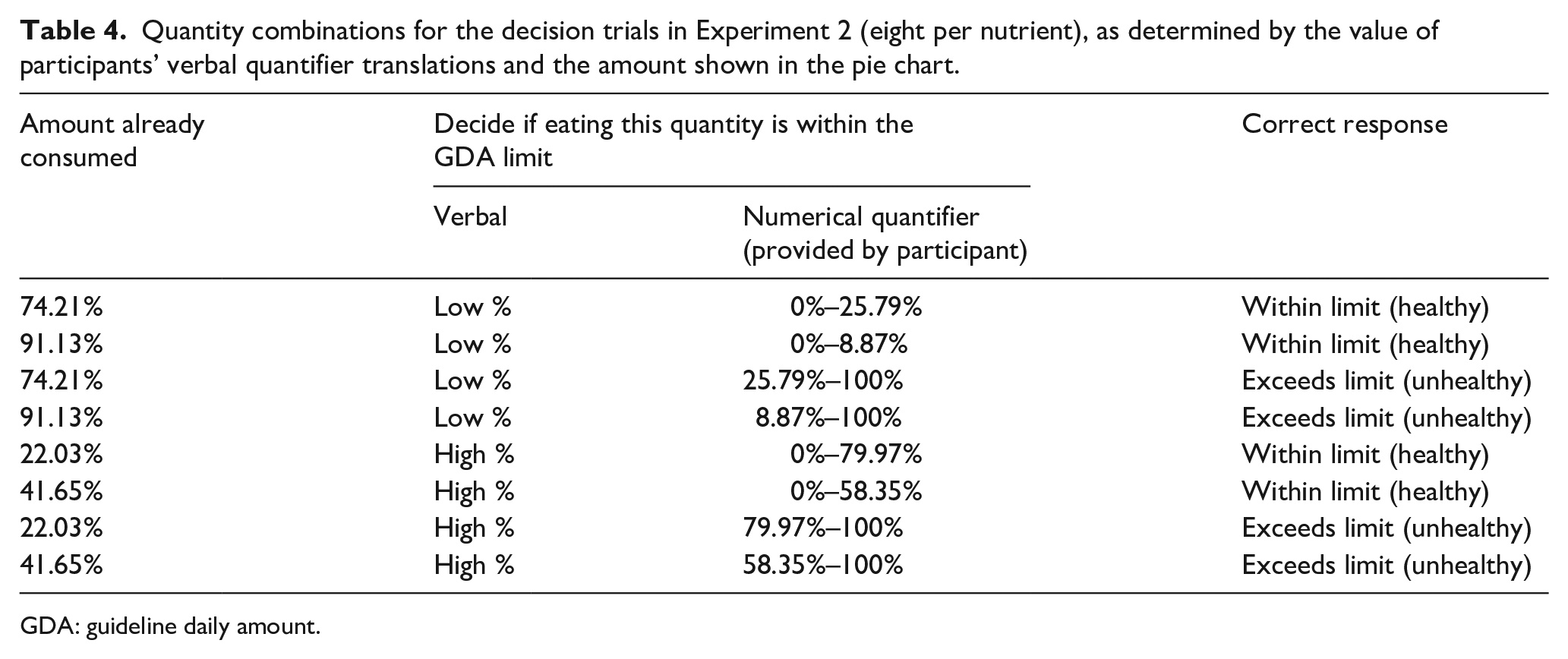
GDA: guideline daily amount.
Materials and procedure
The experiment was delivered using the web version of Inquisit5 (Millisecond Software, 2016; code available on the OSF). We added a translation element to the start of the experiment: after participants provided informed consent and read an explanation about GDAs, they provided their numerical interpretations (as a percentage) for each of these four quantities: low % fat, low% minerals, high % fat, and high % minerals. 3
Subsequently, the procedure and materials were the same as Experiment 1, except that there was no easy load block and no medium quantities, and the numerical decision trials used participants’ provided translations.
GDA decision task
We used the same task as Experiment 1, as illustrated in the top panel of Figure 2 (Liu et al., in press). However, we defined the correct answers to each quantity combination based on participants’ provided translations. As shown in Table 4, if the sum of the pie chart quantity and participants’ verbal-numerical translation exceeded 100%, the correct decision should be that the new quantity exceeded limits and was thus unhealthy. For example, if a participant translated “low %” as 10%, combined with a pie chart value of 91.13%, the quantities would exceed the GDA limit (“unhealthy”), and the participant’s response would be scored as correct if they decided it was unhealthy. In this example, if the translation were 5%, it would be within limits, thus a correct response would be “healthy.” Overall, 67% of trials had the correct response as being within limits. This indicated that as anticipated, approximately one third of the sample gave values that always added up with the prior nutrient consumption (shown in the pie chart) to be within the GDA guidelines and hence considered within limits, and healthy (sum of the two quantities ⩽ 100% of the GDA).
Memory load manipulation
We used the same load manipulation and procedure as Experiment 1, except that we did not include an easy load condition. Participants selected either the correct grid or its close target on 94% of the trials. We dropped the remaining 6% of trials with neither a correct nor close-to-correct answer, because failing to remember the grid indicates that participants did not pay enough attention to the memory task and hence their cognition might not have been sufficiently burdened during the GDA decision task (Białek & De Neys, 2017).
Results
Following our pre-registered protocol, we dropped data from 15 trials (<1%) where participants made a decision in less than the threshold for manual response to a visual stimulus (150 ms; Amano et al., 2006), and two trials for which the response time was more than 5 SD above the mean. We performed a multilevel model at trial level for response time (log-transformed due to significant positive skew; original skewness = 23.39, resulting skewness = 0.48) and decision performance.
To test our pre-registered hypotheses, we included the following fixed effects in the multilevel model: main effects of format, load, nutrient, quantity, and correct response, and interactions for Format × Load, Format × Quantity, Nutrient × Correct Response, Quantity × Correct Response, Format × Nutrient × Correct Response, and Format × Load × Nutrient × Correct Response. We ran the analyses in SPSS, using a variance components matrix. The full random effects model did not converge; hence, we dropped random slopes until we identified a convergent model, which included by-participant intercepts and random slopes for quantity. The results of the analyses are reported in Table 2.
Evidence for intuitive processing of verbal quantifiers
Participants again made more correct decisions with numerical than verbal quantifiers (percentage of trials correct: Mnumerical = .76, SD = .43; Mverbal = .62, SD = .49), although we did not find that they did so significantly more slowly (response time in seconds: Mnumerical = 1.89, SD = 2.16; Mverbal = 1.84, SD = 1.91), F(1, 6281) = 72.78, p < .001 (performance); F(1, 6281) = 0.39, p = .533 (response time). In terms of reliance on contextual information, we were primarily interested in how the nutrient (which contextualised the quantity) would affect decision performance, despite it being irrelevant to the decision. Participants used the valence of the nutrient to guide their decision: they were more likely to incorrectly decide that the “good” nutrient (minerals) quantity fell within limits (i.e., was healthy) when it did not, and that the “bad” nutrient (fat) exceeded limits (i.e., was unhealthy) when it did. This effect was supported by a three-way interaction of Format × Nutrient × Correct Response, showing that participants used this strategy in their decisions more for the verbal than numerical quantifiers, F(1, 6281) = 4.69, p = .003. Table 3 illustrates the greater performance impairment caused by relying on the nutrient in the verbal than numerical condition, F(1, 6281) = 58.98, p < .001 (minerals); F(1, 6281) = 55.28, p < .001 (fat).
Mixed evidence for analytical processing of numerical quantifiers
Decision performance was not more impaired by cognitive load in the numerical condition compared with the verbal one, F(1, 6281) = 0.04, p = .843. Load also did not impair overall performance, suggesting that numerical quantifiers did not draw heavily on analytical cognitive resources, F(1, 6281) = 0.64, p = .422.
Discussion
Experiment 2 showed that the general pattern of results found in Experiment 1 persisted even when we accounted for individual variation in participants’ translations of verbal quantifiers. Although participants were not significantly faster, they performed worse in the decision task with verbal than numerical quantifiers, and their pattern of errors was in line with the prediction that they would be more affected by contextual information (i.e., the identity of the nutrient) with verbal than numerical quantifiers. However, consistent with Experiment 1, we did not find evidence for a difference in performance under memory load between the conditions. Therefore, only three out of four of our hypotheses were supported.
General discussion
The study investigated whether verbal quantifiers were processed more intuitively than numerical ones in a decision task that required participants to decide if a combination of two nutrient quantities fell within a healthy limit. As single measures (e.g., response times) often cannot provide conclusive evidence of processing styles (Bago & De Neys, 2017), we used four indicators to identify intuitive processes: faster responses, lower decision performance, greater use of irrelevant contextual information, and a lack of interference from cognitive load, with the latter being the critical test of processing style. We expected participants to display these indicators of intuitive processing for decisions with verbal quantifiers more than numerical quantifiers. However, results were mixed. Verbal quantifiers led to fewer correct decisions and greater reliance on irrelevant contextual cues in both experiments, but verbal quantifiers led to faster decisions only in Experiment 1. Finally, the memory load did not affect decision performance for either verbal or numerical quantifiers.
Are both verbal and numerical quantifiers intuitive?
Evidence for intuitive processing of verbal quantifiers
Across all four measures of processing style, both experiments found evidence that participants completed the verbal decision task intuitively. Participants made their decisions quickly (around 2s) and their accuracy was not much above chance. The data also showed that participants relied on irrelevant contextual information to make their decision, for instance not overriding the conflicting association that “minerals are healthy” when identifying an exceeded quantity of minerals. More critically, their decisions remained unchanged under memory load, which we expected to tax performance only if analytical processing were required (Evans & Stanovich, 2013).
Mixed evidence for intuitive processing of numerical quantifiers
The evidence for whether numerical quantifiers were analytically or intuitively processed was mixed. Compared with the verbal condition, numerical quantifiers appeared less intuitive on three measures: participants made more correct decisions in the numerical than verbal condition, and they did so slower, although the pattern of slower responses was only significant in Experiment 1. They relied less on the irrelevant context, showing a greater ability to overcome associative conflicts in the decision task. However, our critical test of the effect of memory load did not differ across verbal and numerical formats. The fact that decision performance remained similar in both loaded and unloaded conditions suggests that participants did not use more analytical effort in the numerical condition.
Our findings support previous suggestions (Windschitl & Wells, 1996) that verbal quantifiers elicit intuitive processes, but not that numerical quantifiers elicit analytical ones. This seems surprising, since research on various domains reports that numerical information is effortful to process (e.g., nutrition, Campos et al., 2011; health care, Peters et al., 2009; medical risks, Edwards et al., 2002). This may, however, depend on the specific numerical quantities used. Numerical processing shows greater impairment under a concurrent load if the arithmetic task is more difficult (DeStefano & LeFevre, 2004). In both our experiments, numerical values tended to be rounded to the nearest 10, even those provided by participants in Experiment 2. These values might have been easier to process arithmetically. It is possible that more complex numerical values (e.g., non-rounded values such as 73% instead of 70%; Jaffe-Katz et al., 1989) would draw further on analytical processes and thus be affected by memory load.
Implications for theories of quantifier processing
We derived our hypotheses from the basic, dichotomous dual-process model as a direct empirical test of processing differences between the formats within this framework, which assumes that intuition is fast, does not load on working memory, and is prone to errors and biases (De Neys, 2017). Critiques of dual-process theory point out that response times and performance are insufficient on their own as indicators of processing style because intuition is not always inaccurate (Plessner & Czenna, 2008) and correct decision outputs that were traditionally classified as analytical can proceed quickly (Bago & De Neys, 2017; Glöckner & Betsch, 2008a). Our findings corroborate this perspective: in particular, the better decisions participants made with numerical than verbal quantifiers did not align with a consistently slower decision time, nor impedance from the memory load. This suggests that in some contexts, people can produce better answers without compromising decision speed. A more recent dual-process model conceptualises intuition as a process that produces both logical and heuristic responses initially, with analytical processing triggered if one detects a conflict between these responses and decides to investigate further (Pennycook, 2017). Applying this to numerical and verbal quantifiers, we see a possibility that a different intuitive response could be generated for each: a logical response for numerical quantifiers (based on the quantity) and a heuristic one (based on the context) for verbal quantifiers. Furthermore, Bago and De Neys (2019) posit that the role of analytical processing may not be to correct a mistaken intuitive response, but to rationalise and support one’s initial answer. Indeed, this sort of post hoc justification of an initial decision does occur when people make food choices (Rayner et al., 2001). A final decision could therefore reflect a multiple-step process in which aspects of the information compete in parallel to influence the decision (Busemeyer & Johnson, 2007). A choice between two foods, for instance, can depend on the accumulation of value signals on a sensory (e.g., taste) and a judgemental (e.g., healthiness) dimension, with healthiness accumulating slower than taste (Sullivan et al., 2015). It is possible that in the GDA decision task, where the objective was to judge a combination of quantities, the verbal format accumulated evidence quicker for the holistic goal (whether consumption was healthy), whereas the numerical format accumulated evidence quicker for the rule-based goal (consumption is healthy only if it does not exceed 100%).
Our two experiments also found a greater use of contextual cues in decision-making with verbal than numerical quantifiers, which further informs the difference in processing between the two quantifier formats. A traditional view of verbal quantifiers is that their vagueness impairs decision performance (Berry et al., 2004; Huizingh & Vrolijk, 1997; Mazur et al., 1999; Visschers, 2008). Our findings show that it is not just verbal vagueness driving this effect. First, we found that participants were less correct with verbal than numerical quantifiers even when we adjusted the numerical values and accuracy criteria to account for variations in participants’ translation of verbal quantifiers. Second, misinterpretation of verbal quantifiers cannot explain why participants would make a certain type of incorrect decision. When the quantifier was verbal (compared with numerical), participants relied more on the nature of the nutrient rather than on the quantity itself to assess whether eating it would exceed their daily limit. For example, a verbal quantity of a desirable nutrient (minerals) was more often judged as within limits when it actually exceeded limits. Thus, intuitions based on the learned associations of the nutrients with healthiness or unhealthiness (Oakes, 2004; Wansink & Chandon, 2006) intruded on a task where the nutrient should not have affected the decision.
Implications for food decision-making
Testing whether verbal quantifiers are indeed processed more intuitively than numerical ones is not only relevant from a theoretical and empirical perspective. At an applied level, it is also consequential because efforts to simplify consumer information (e.g., on nutrition labels) have been premised on verbal labels being less difficult to process than numerical ones (Cowburn & Stockley, 2005). Research has also shown that people often rely on mental shortcuts to make food judgements and choices (Gomez, 2013; Scheibehenne et al., 2007; Schulte et al., 2013). Using shortcuts based on contextual information for verbal more than numerical quantifiers thus has further implications on everyday food decisions. If verbal quantifiers increase people’s tendency to judge unhealthy amounts of “good” food as healthy, this could lead to overconsumption of these foods (Ebneter et al., 2013; Gravel et al., 2012; Wansink & Chandon, 2006). Our findings suggest that numerical quantifiers are less susceptible to these contextual influences, but contrary to previous beliefs (Malam et al., 2009), they do not necessarily require more effort or time to process. Numerical quantifiers might thus still be better at facilitating healthier eating decisions.
Conclusion
Our results indicate that when deciding whether a nutrient quantity was a healthy addition to one’s daily diet, verbal quantifiers were processed intuitively: participants made quicker and less correct decisions that relied on irrelevant contextual cues, and their ability to make decisions was not impaired when their working memory capacity was diminished. We predicted that numerical quantifiers would differ and be processed more analytically, but the evidence for this was more mixed. While participants were slower, more correct, and used less irrelevant information in their numerical decision-making, they were not impaired by a memory load. This suggests that contrary to previous assumptions, numerical quantifiers may result in quicker and more correct decisions.
Supplemental Material
QJE-STD-18-243.R1_Supplementary_Material – Supplemental material for The intuitive use of contextual information in decisions made with verbal and numerical quantifiers
Supplemental material, QJE-STD-18-243.R1_Supplementary_Material for The intuitive use of contextual information in decisions made with verbal and numerical quantifiers by Dawn Liu, Marie Juanchich, Miroslav Sirota and Sheina Orbell in Quarterly Journal of Experimental Psychology
Footnotes
Declaration of conflicting interests
The author(s) declared no potential conflicts of interest with respect to the research, authorship, and/or publication of this article.
Funding
The author(s) disclosed receipt of the following financial support for the research, authorship and/or publication of this article: The research was supported by a small grant from the Experimental Psychology Society.

Open practices
Notes
References
Supplementary Material
Please find the following supplemental material available below.
For Open Access articles published under a Creative Commons License, all supplemental material carries the same license as the article it is associated with.
For non-Open Access articles published, all supplemental material carries a non-exclusive license, and permission requests for re-use of supplemental material or any part of supplemental material shall be sent directly to the copyright owner as specified in the copyright notice associated with the article.
