



Abstract
Conducting ethical research with children and young people presents complex challenges, shaped by gatekeepers, power dynamics, and procedural requirements that can limit children and young people’s ability to participate fully and autonomously on their own terms. Obstacles arise at every stage, from designing consent forms and seeking informed consent from parents/carers and children and young people, to ensuring children, and young people’s right to assent, dissent and/or withdraw altogether is continually respected. This paper reflectively and critically examines these challenges, drawing on our experiences of working with over 600 children and young people aged between 3 and 15 years old, at various stages of a 5-year action research project. Focussing on three key areas of consent, assent, and dissent, it explores how our illustrated ‘assent mat’ provided children and young people with the means to set the terms of their engagement with the research activities. Through our reflections, we highlight that the ‘assent mat’ was the beginning of an ongoing dialogue with children and young people, one which reinforced our responsibility as researchers to ensure children and young people’s participation rights and autonomy are enabled and respected throughout a project.
Introduction
Conducting research with children and young people (CYP) can be a challenging process involving navigating consent, assent, data protection and safeguarding (the measures taken to protect CYP’s welfare, safety, and rights), all of which shape and at times constrain how researchers interact and conduct research with CYP. These processes can be a quagmire, impacting to what extent CYP can actively participate or choose not to participate with the research.
Since the late 1940s, predominately Western approaches to research ethics (broadly) have developed alongside international frameworks that promote the rights and wellbeing of individuals. 1 Primarily developed for clinical research with adults, these frameworks centre on the principles of respect and autonomy, competence, and researcher integrity (Mortari and Harcourt, 2012). Over time, attention has been paid to CYP’s involvement within research, with research ethics evolving alongside children’s rights frameworks, most notably the United Nations Convention on the Rights of the Child (UNCRC, 1989) whose articles state that CYP must be free to express their views (Article 13), that their views should be respected (Article 12), have a right to privacy (Article 16), should not be exploited (e.g. for research; Article 36), and whose best interests must be prioritised (Article 3). Today, researchers now primarily focus on conducting research with CYP rather than on them, adopting methods that promote, understand, and reflect their agency, views and experiences, reflecting the same values that are encompassed within children’s rights frameworks (Alderson and Morrow, 2020). Yet, ethical research with CYP can remain shaped by adult-centric procedures and assumptions which can limit participation.
Ethical research with CYP, particularly consent and assent, is shaped by broader contexts, including laws concerning data protection as well as processes to safeguard CYP. Informed consent is typically understood to be the process whereby participants understand the research, their involvement, and their rights (Mhic Mhathúna and Hayes, 2025). For CYP, consent usually involves formal parent/carer approval and, in some instances, by CYP themselves depending on age or legal frameworks. Whilst designed to protect CYP, the consent process may reflect adult assumptions about their competence and rely heavily upon gatekeepers (e.g. parents/carers, teachers, institutions) who determine whether CYP can participate and on what terms (Campbell, 2008). This process risk positioning CYP as passive rather than as active agents.
Assent seeks to address this imbalance by engaging CYP directly (Mhic Mhathúna and Hayes, 2025). Assent refers to CYP’s active and ongoing willingness to participate and whilst it does not replace consent, the absence of assent can undermine CYP’s agency and participation rights (Alderson and Morrow, 2020). Unlike consent, which is often treated as a procedural and formal process, assent is relational, and dynamic, requiring researchers to continuously revisit CYP’s comfort and understanding, whilst also remaining attentive to signs of dissent (Alderson and Morrow, 2020). This introduces its own set of challenges, including navigating power imbalances, safeguarding concerns, and recognising the many different forms of dissent.
Recent studies highlight a tension between procedural ethics, where consent and assent are treated as discrete formal steps, and relational ethics, which views ethical decision-making as a contextual, negotiated and ongoing act that unfolds in ‘real-time’ (Kucha and Pinter, 2021). This tension is particularly visible in early childhood research, where assumptions about CYP’s developmental capacity often shape adult decisions about who can participate (Cayouette et al., 2022). Early childhood scholarship therefore provides a foundation for understanding how research with all CYP can be enacted in practice.
Research with young children can be particularly challenging, particularly in how consent and assent are understood, negotiated and enacted, with the need to consider and respond to young children’s developmental capacity whilst also respecting their autonomy and ‘voice’. Procedural approaches often position young children as lacking the decision-making capacity to provide assent (Kelly et al., 2025), with some researchers such as Hein et al. (2015) arguing that only older CYP can provide meaningful assent. These views reinforce adult-centric assumptions about CYP’s competence and decision-making capabilities, and risk viewing assent as a symbolic exercise rather than supporting CYP’s agency.
Relational approaches challenge these assumptions. Quinones et al. (2023) argue that ethical decision-making emerges though ongoing interactions between researchers, CYP, and the research environment. Similarly, Van Goidsenhoven and De Schauwer (2022) highlights how CYP’s participation is often shaped by their interdependence with the adults in their lives, which complicates assumptions about their autonomy and competence. Both studies demonstrate how research ethics is not a single moment of consent or assent but is instead a process shaped by the environment, CYP’s relationships with adults, and wider context.
A growing body of early-years research demonstrates that young CYP can express preference and dissent through non-verbal communication long before they can articulate them verbally (Kelly et al., 2025). Kelly et al.’s (2025) review of assent and dissent with young CYP and their parents reveals that CYP as young as two can communicate preferences through non-verbal cues, even if they cannot make what parents consider ‘safe choices’ until aground age 5 (p. 13). Non-verbal communication increases when CYP express their preferences or withdraw from activities, underlining the importance of recognising subtle cues as meaningful forms of assent or dissent (p. 15). In contrast, written assent forms were found to be inappropriate with CYP up to age 8 (p. 16), further highlighting the limitations of procedural, form-based approaches.
Parents/carers play a key role in consent and assent for young CYP. They are not only gatekeepers but ‘active participants’ who shape how information is communicated and how CYP’s preferences are interpreted (Kelly et al., 2025: 2). Parents report that they are supportive of researchers seeking assent directly from their child (even those under the age of three) as they believed that CYP ‘should have complete choice over their actions and activities’ (Kelly et al., 2025: 13). Yet, some parents/carers felt uncomfortable expressing their own dissent to researchers, revealing another layer of power dynamics which can influence both parental and CYP decision-making. Early years practitioners and other gatekeepers are often attuned to the CYP in their care, and they can play a crucial role in interpreting CYP’s signals and supporting their participation (Mhic Mhathúna and Hayes, 2025: 10–11). The important role of gatekeepers highlights the need for researchers to build good relationships with all those involved in the research.
Despite this, barriers remain. Formal ethics review processes such as University Research Ethics Committees (URECs) often categorise young CYP as inherently vulnerable, imposing rigid procedural requirements that can inadvertently silence CYP and restrict participation (Mhic Mhathúna and Hayes, 2025). Whilst researchers may use assent to counter this, Mayne et al. (2016) caution against treating assent as secondary or less important to the formal parent/carer consent form as this risks disempowering CYP and undermining their agency. These critiques highlight the need for researchers to critically reflect on how consent and assent are enacted, and to advocate for approaches that foreground CYP’s agency.
Whilst older CYP are generally assumed to have the capacity to understand research information and make an informed decision regarding their participation, many of the ethical tensions observed in early childhood research persist. Similar to young CYP, older CYP’s ability to provide meaningful consent or assent is shaped by the social and institutional contexts in which the research takes place. School environments in particular are characterised by entrenched hierarchies rooted in adult authority, with teachers and institutional norms influencing CYP’s participation (Mackenzie et al., 2021). These dynamics can limit CYP’s freedom to negotiate their involvement on their own terms.
A large challenge concerns dissent. CYP often misunderstand their right to withdraw or dissent, believing that once they have agreed to participate they must continue (Mackenzie et al., 2021). Even when CYP are aware of their rights, social expectations within schools, such as the requirement to follow adult instructions, can discourage opting-out. Research therefore emphasises the importance of recognising the many ways dissent may be communicated, including silence, hesitation, disengagement, playful or nonsensical answers, or shifts in body language (Amevuvor, 2025; Brady et al., 2023). As with younger CYP, these subtle cues highlight the need for researchers to be attentive to non-verbal communication and recognise that the absence of explicit dissent ‘does not infer assent’ (Constand et al., 2015: 26).
Power dynamics further complicate consent and assent with older CYP. Power not only operates between adults and CYP but also amongst CYP themselves, shaping their interactions and influencing their participation (Cullen and Walsh, 2020). It is recommended that researchers alter their communication styles to resonate with CYP and continuously reflect upon how their own position and authority may shape CYP’s response (Cullen and Walsh, 2020). Parent/carer involvement may also present barriers, particularly when parents/carers are disengaged, unsupportive, or uncomfortable with the research topic, impacting whether parental consent is given (Cullen and Walsh, 2020). These dynamics highlight the need to go beyond providing an age-appropriate consent and assent process and ensure that CYP understand the project, their role, and their rights (Alderson and Morrow, 2020).
Tensions also arise between rules-based and situational approaches to consent. Rules-based approaches emphasise formal, active informed consent grounded in absolutes (Goredema-Braid, 2010), whereas situational approaches, such as relational ethics, recognise that behaviour or context can infer consent, assent, and dissent (Kucha and Pinter, 2021). Whilst rules-based consent is typically preferred in institutional settings, situational approaches may better accommodate research with CYP as ethical issues typically arise in ‘real-time’ and require a contextual response (Graham et al., 2015). This is particularly relevant in schools, where institutional norms and power relations may shape CYP’s participation and agency, and where procedural ethics alone cannot fully address the complexities of interactions between researcher and CYP (Graham et al., 2015).
In short, there is more to consent and assent than seeking approval. Whilst CYP ‘are informed and their refusal “considered”’ (Alderson and Morrow, 2020: 131), their views on participation (or withdrawal) are not always taken into account. This raises questions about whether CYP can freely exercise their rights, and how children’s-rights focussed the research process is in practice. Across all age groups, research emphasises that consent and assent are not procedures, but dynamic and ongoing processes shaped by relationships, context, and power. Ethical research with CYP requires researchers to actively listen, be responsive to shifts in comfort and engagement, and to create environments in which CYP feel able to express their preferences, uncertainties, and dissent (Amevuvor, 2025). Finally, researchers need to engage in critical self-reflection on the approaches to consent and assent that they use. This self-reflection can strengthen the research ethics process, supporting the development of approaches that are more children’s rights-centred and inclusive of CYP.
This paper contributes to this discussion by reflectively examining the navigation of assent, and dissent within Project Fortitude, a participatory action research project funded by the European Research Council from 2019-2025, that aimed to improve and develop the legal capability of CYP via game-based learning. The paper discusses the challenges encountered during the consent process, outlines our novel visual ‘assent mat’ that was developed to support CYP’s ongoing assent, and reflects upon the lessons learnt. Section one provides an overview of the project. Section two focusses on the consent process and the challenges we faced along the way. Section three focusses on our ‘assent mat’ and examines the key components of the assent process including dissent. Finally, the paper concludes by reflecting on ‘lessons learnt’, highlighting how we as researchers can further develop and enhance our approaches to conducting ethical research with CYP.
The research context: Project Fortitude
One of the central aims of Project Fortitude was to work with CYP to co-create game-based interventions that measure and improve their legal capability (i.e. their ability to deal effectively with the law-related issues they encounter in their everyday lives). The research was led by author 2 and based initially at the University of Leicester. It was suspended during Covid-19 and moved with author 2 to the University of Sheffield, where it was completed. All work with CYP received ethical approval from either the University of Leicester Research Ethics Committee or from the University of Sheffield’s Research Ethics Committee.
To design the game-based interventions and measures, we worked with over 600 demographically diverse CYP aged between 3 and 16 years old, including those with special educational needs and disabilities (SEND). Research was primarily conducted within a school setting (nursery, primary, secondary, and SEND) and involved whole classes, smaller groups, one-to-one sessions, and four child and young person advisory boards (CYPABs). The CYPABs, two primary school groups (Key Stage 2 (KS2), CYP aged 7–11) and two secondary school groups (aged 11–15), were involved during the last 3 years of the project. CYPABs typically met with researchers once per term to trial activities and provide feedback on designs, which helped to ensure that our research activities, interventions, and measures were effective. The remaining groups typically worked with us across a series of six to eight sessions, and CYP took part in research activities and provided ideas and feedback that informed the design of the interventions and measures. Across all groups, research activities were diverse and often creative. Our data collection was adapted to respond to this diversity, and included questionnaires (online and on paper), fieldnotes, audio-visual recordings, photographs, written work, and the creation of artefacts.
Most of our work with CYP was conducted on an opt-in basis via informed consent. However, at the request of one school, one cycle of the research used an opt-out approach. In this context, as will be discussed below, particular emphasis was placed on assent.
Consent
For the purpose of this paper, we use ‘consent’ to refer to the formal legal and institutional required permissions provided by parents/carers and other gatekeepers, and ‘assent’ to refer to CYP’s own ongoing agreement to participate. Consent is essential within research, ensuring that participation is informed and voluntary. For research with CYP, this entails ensuring that they understand the project and their role, knowing who has provided consent on their behalf and why, and recognising that their involvement is voluntary (Alderson and Morrow, 2020).
Consent processes vary across academic systems, reflecting national legislation and perceptions about CYP’s competency. For instance, within the UK where our project took place, General Data Protection Regulations (UK GDPR, 2016) state that CYP aged 13 or over can and need to consent to the processing of their personal data, with younger CYP requiring parent/carer consent (UK GDPR, Art. 8). The Information Commissioner’s Office (n.d.a, n.d.b), citing Article 12 of the UNCRC, 1989, recommends involving CYP in designing information on data management, seeking their advice about how, and what data should be processed. The Department for Education, n.d. recommends gaining consent from parents/carers for CYP up to the age of 16 as well as from the CYP themselves and, where necessary, other gatekeepers. Whilst national legislation guided our approach, we also followed UREC requirements on consent forms and information sheets, adapting these with UREC approval to be accessible.
We primarily worked on an opt-in basis, but one participating school requested an opt-out approach to ensure that their entire KS2 cohort (11 classes of approximately 30 children aged 7–11) had the opportunity to be involved. Opt-out approaches can widen participation benefitting both CYP’s ‘voice’ and the research (Lacy et al., 2012). However, they infer default consent and significant onus is placed upon CYP and/or their gatekeeper to actively withdraw or dissent, a concept which is not always understood (MacKenzie et al., 2021).
In line with the school’s request, we adopted an opt-out approach with three schools (one primary; two secondary) during that research cycle. To ensure CYP had a genuine opportunity to opt-out, headteachers received letters and consent forms, explaining the research and our activities, and agreed to us inferring consent unless a parent/carer or child opts-out or dissents. Letters were sent home to all parents/carers, explaining the research and giving 1 week from the date of the letter to let the school (class teacher) know that they or their child wish to opt-out. Additional meetings between researcher and headteacher or specific members of the school’s leadership teams were used to emphasise CYP’s participation must be voluntary, requesting this be expressed to all teaching staff. Researchers also visited all CYP in advance to introduce ourselves and the research. These visits enabled CYP to speak with their parents/carers and provide time for withdrawal. Perhaps due to strong endorsement of the research from the schools, no one chose to opt their child out of the research.
CYP could also withdraw at any point during each session. This was achieved via our illustrated ‘assent mat’, which, as discussed below, informed CYP of their rights and provide them the means to set the terms of their participation. In opt-out settings, the ‘assent mat’ proved successful, with CYP choosing when and to what extent they would participate within a session or particular activity, if at all.
The consent form
Aside from the opt-out approach, we largely followed an opt-in informed consent process and CYP and their parents/carers received participant information sheets and consent forms. Initially we sought written consent from CYP of all ages but found that the CYP’s signature was sometimes missing when we collected the forms, meaning we had to ask CYP to sign prior to taking part in activities or ask a teacher to do this with them. Because they were already excited about taking part in the research activities, this stage often felt rushed. For example, CYP often expressed that they were looking forward to activities and would also sometimes show impatience when we paused to check the paperwork. As a result, we observed that CYP would readily sign the form without question. This was counter to our intention in seeking their informed consent, so we decided to remove this requirement and focus solely on assent for CYP under 13, continuing to gather informed consent from CYP aged 13, or over.
All CYP received age-appropriate information sheets to improve accessibility. CYP aged 7–11 and with SEND (age 7 and over) received simplified sheets using large fonts, shorter sentences, illustrations from the assent mat, and short digestible sections. CYP aged 11–15 received text-based information sheets that were structured similarly to parent/carer information sheets. Parent/carer information sheets and consent forms were longer and more detailed to meet UREC requirements. The consent form broke down each element of the information sheet into sections, asking parents/carers to select ‘yes’ or ‘no’ on all aspects of the research, before signing.
Whilst consent forms are a fundamental part of the consent process, the literature highlights their limitations when conducting research with CYP. For instance, they are time-consuming, difficult to understand, and reliant on providing enough time for discussion, decision-making, and the changing of minds (Perrault and Nazione, 2016). Our experiences reflected this as some schools reported that parents/carers found completing the consent form challenging. This was particularly the case where English was not the parents/carers’ first language or where parents/carers experienced difficulties with the language and structure of the form. At the request of one school, we translated the consent form into five languages. Only a small number were returned, with some including a clear ‘no’ to their child taking part. This was disappointing in terms of recruitment numbers but encouraging as it showed the parent/carer were able to actively engage with the process.
CYP themselves often struggled, although this appeared to be less with the procedure but more with the idea of a consent form in the first instance. For instance, one Primary-aged CYP completed the form themselves in red crayon instead of passing it to their parent/carer. Based on our prior experiences, we had by this stage put systems in place to address the issue of incorrectly completed forms, or CYP wanting to take part but forgetting to bring back the form their parent/carer had signed. Prior to this, on occasion researchers had turned up to their first research visit with CYP and found that some or all of the consent forms had not been gathered in, resulting in the session being rescheduled. To address this, a member of the research team visited the school in advance of the scheduled research visit to collect forms and identify issues, giving time for them to be resolved. In a limited number of settings where parental engagement was reported to be challenging, we obtained ethics approval for consent to be given by a teacher by proxy, provided they had spoken with parents/carers, explained the project, and obtained their verbal consent.
Given the challenges, alternative formats for conveying information and seeking consent have been proposed. MacKenzie et al. (2021) argue that online methods are more ‘empowering’ when ascertaining consent directly from CYP; not only is it more accessible, it also allows for CYP to remain truly anonymous during the process, something that ‘is not possible when recruiting [. . .] in a school environment’ (p. 225). Other ‘user-friendly’ methods have been explored to explain the process, participant rights, and seeking informed consent. These include, for example, ‘comic consent forms’ (Grootens-Wiegers et al., 2015), storybooks (Pyle and Danniels, 2016), visual images (Ruiz-Casares and Thompson, 2016), and co-created methods (Thompson et al., 2026), which CYP agency in the consent process. However, enacting these methods requires harmonisation and understanding between URECs and researchers in the field, and researchers’ eagerness to adapt and try different methods needs to be balanced with their institution’s legal responsibilities and requirements. In the meantime, we suggest that focussing on assent may provide a suitable compromise.
Assent
Assent is often positioned as a fluid way to redress problems from the consent process, enabling CYP to control how and to what extent they participate (Dockett and Perry, 2011: 233–234). Amevuvor’s (2025) reflections on conducting research with her own child illustrate this. She notes she was not legally required to seek her child’s assent, instead relying on informed consent given by her husband, concluding: ‘[not] directly asking for her assent [. . .] was my first mistake. The second mistake was not considering assent as an ongoing process’ (p. 8).
Ensuring that assent genuinely reflects CYP’s wishes presents challenges, particularly in establishing that participation is free and voluntary and rather than influenced by peers, gatekeepers, socio-cultural expectations, or researchers themselves. Addressing these challenges arguably requires an inclusive but adaptable approach.
The ‘assent mat’
The most common method to gain assent is via written forms that mirror the consent process, offering a ‘concrete symbol that children are being taken seriously and demonstrating their right to choose whether or not to participate’ (Dockett and Perry, 2011: 245). However, written assent is not always comprehensible for CYP (Baydala et al., 2020: 104–105), and its ‘absolute’ nature does not easily accommodate ongoing change of minds, reinforcing power imbalance between researcher and CYP (Dockett and Perry, 2011: 245). Verbal or visual can be an effective alternative, improving comprehension and affording CYP greater control over their participation (Constand et al., 2015: 26). Regardless as to the method, the literature emphasises the need for a dynamic, flexible approach that accommodates CYP’s differing needs and preferences (Ungar et al., 2006).
We took a visual approach and developed an illustrated ‘assent mat’. It initially comprised of five laminated A4 illustrations, each representing a different ‘stage’ of the assent process (e.g. waving to signify being happy to participate). The illustrative style was chosen to appeal to a wide age range and be inclusive. Following feedback from one CYPAB, we adjusted the illustrations and added an additional one to represent safeguarding.
The ‘assent mat’ was used at the start of every data collecting session. Each illustration was accompanied by a short question or statement which encouraged an active response from CYP. The ‘mat’ served three purposes. Firstly, to inform CYP of their rights and gain their initial ‘assent’ for the session. Secondly, to facilitate open communication, supporting CYP to withdraw, ask questions or engage with their designated safeguarding lead (a staff member responsible for child protection and welfare). Thirdly, to facilitate ongoing dialogue between CYP and researcher, ensuring that assent reflected CYP’s wants at that moment. For us as researchers, the ‘mat’ forced us to focus on ‘assent’ as a concept and be consciously aware of the different ways assent and dissent may be expressed.
The ‘assent mat’ only formed part of the assent process. Once it was completed, it became our responsibility to ensure that CYP’s assent was respected and maintained throughout our interactions. The following subsections address each element of the ‘mat’ in turn, reflecting on this ongoing conversation between researcher and CYP.
‘Are you happy to be here?’
Discussion on assent often centre on CYP’s competency and agency. Some researchers argue that CYP may struggle to understand their role within research and therefore cannot assent (Hein et al., 2015). Such views sit at odds with children’s-rights approaches and rely on adult-centred assumptions that position CYP as passive and vulnerable, disregarding them as active social agents (Baydala et al., 2020: 101). Other scholars emphasise that psychological development does not restrict assent and instead researchers must adapt their methods to ensure that all CYP can choose the terms of their participation (Kelly et al., 2025). Indeed, research by Kelly et al. (2025) and Meaux and Bell (2001) highlight that even young CYP can understand the research process and express assent when age-appropriate methods are used. Applying this in practice can be challenging, particularly in school environments. CYP’s assent may be shaped by implicit expectations to comply with adults in positions of authority (e.g. teaching staff), as well as peer pressure, or a desire to please researchers and other adults in their lives (Baydala et al., 2020; Mishna et al., 2004), resulting in CYP feeling unable to actively exercise their autonomy and restricting their dissent.
The first illustration in our ‘assent mat’ was designed to address this by simply asking CYP ‘are you happy to be here?’ (Figure 1). Whilst the answer to this simple question was usually a resounding ‘yes!’ from CYP, we nevertheless remained mindful of tensions between CYP’s free and voluntary participation and the influence of ‘school culture’ which may make a positive response more likely. Therefore, rather than being used to seek a resolute answer, this initial question was used alongside the remaining stages of the ‘assent mat’ to ‘read the room’, enabling us to identify more subtle signs of dissent.

Checking CYP are happy to participate.
This approach proved effective in giving CYP a moment to pause and consider whether they really did want to participate at that moment, even in instances where the CYP answered immediately that they were happy to be there. For example, in one research activity, a CYP initially said they were happy to participate but later reported that they had been writing a letter to a pen-pal in class and would like to go back and finish it, so they returned to class and rejoined the following week.
There were also occasions when CYP responded ‘no’ to this question, and our experiences highlighted how institutional expectations and hierarchies can operate to override CYP’s autonomy in some situations. The most dramatic example occurred in our first session with a group of secondary school CYP, where many responded ‘no’ as that they did not want to miss their PE or art classes. As we explained their right to withdraw, the teacher intervened stating that they did not have permission to leave the classroom and must participate. Despite the researchers explaining the situation to the teacher, CYP were not given permission to leave and the CYP engaged in the activities planned by the team. However, to ensure that CYP’s right to withdrawal was respected as far as possible, we excluded all artefacts created by the group from our dataset.
This incident highlights the power imbalance between CYP, researchers, and school staff. Whilst we sought to uphold CYP’s right to withdraw, the teacher’s authority within the hierarchy placed us in a position where challenging their decision risked damaging the relationship with the school, and by extension, CYP’s future participation. The situation revealed the ethical tensions that arise when gatekeepers’ authority conflicts with children’s rights-based approaches to assent. It encouraged us to reflect on how to navigate similar dynamics in the future, including when it may be appropriate to pause or renegotiate research activities to respect CYP’s dissent. Indeed, in subsequent research activities, proactive discussions with teaching staff ahead of activities prevented similar situations.
Confidentiality and anonymity
The second stage of the ‘assent mat’ involved introduced CYP to confidentiality and anonymity and its boundaries (Figure 2). Confidentiality concerns the sharing identifying information without consent, whereas anonymity focusses on participants not being identifiable in the collection of data or research outputs (Gallagher et al., 2009: 19–20). Both have an important role in facilitating open and honest participation (Brady et al., 2023). Clear, honest communication is important, as breaking confidentiality and anonymity may be perceived by CYP as a ‘betrayal of trust’, affecting how they communicate with us (Gallagher et al., 2009: 20).

Explaining confidentiality and anonymity.
In earlier stages of the project when participant numbers were smaller, to maintain privacy and uphold anonymity we opted to assign each CYP with a coloured sticker, and later, when participant numbers exceeded the number of stickers available, with a fruit, or vegetable name badge, which CYP selected during our first visit. We explained to CYP that they would keep the same pseudonym throughout, enabling us to collect pseudonymised data whilst still being able to identify individuals if a safeguarding issue arose. For groups where written consent was obtained, researchers maintained a ‘register’, linking pseudonyms to forenames on encrypted University devices that could only be accessed by the researchers. For our opt-out groups, class teachers kept a list stored securely in their classroom. To emphasise the importance of anonymity, we addressed CYP by their sticker colour or fruit/vegetable ‘names’, and CYP were required to use their pseudonym when producing anything. Researchers also adopted fruit/vegetable names which CYP could refer to us as, which helped reduce some hierarchical barriers and supported rapport building, particularly in schools where CYP were usually required to address adults by their titles (e.g. ‘Miss’).
There are limits to confidentiality and anonymity, particularly when safeguarding concerns arise, meaning it is essential to set limits and communicate them clearly to CYP (Gallagher et al., 2009: 20). For us, this involved explaining to CYP that if they disclosed something and we felt they or someone else are at risk of harm, we would inform their school’s designated safeguarding lead. This process was successful. For instance, upon receiving data created by a CYP which detailed a story potentially alluding to sexual violence, despite only knowing the anonymised identity of the individual concerned, we were able to notify the designated safeguarding lead who identified the CYP, investigated, and reported back to us in line with our safeguarding policy.
Anonymity can feel restrictive for CYP who wish to claim ownership over their contributions (Gallagher et al., 2009: 20). Although the ‘assent mat’ helped us to explain the reasons for anonymisation and made the process ‘fun’, CYP were sometimes frustrated. This was particularly evident during creative activities. For instance, two Year 7 CYP designed a board game (Figure 3) and asked to be named and credited. When we reminded them that we could not use their real names, they incorporated their pseudonyms into the game’s visual design and asked us to credit those instead.
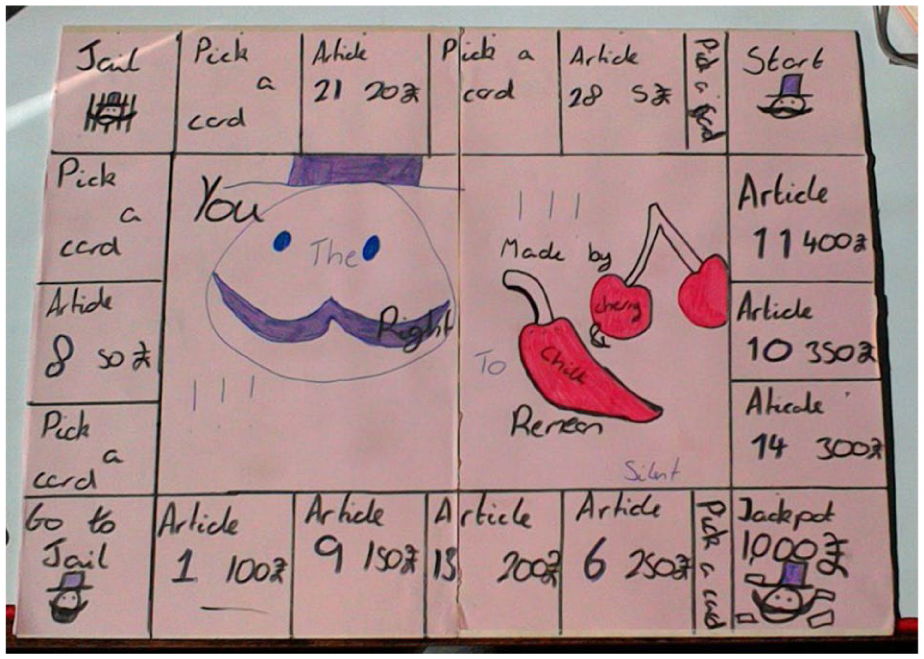
Example of two CYP, ‘Cherry’ and ‘Chilli’, exercising ownership over creative work.
‘Please ask questions at any time There is no such thing as a silly question. Do you have any questions now?’
Providing CYP the space to ask questions is crucial to assent, helping CYP to explore the research, their role, and decide to what extent they want to participate (Ericsson and Boyd, 2017). As Harcourt and Conroy (2005) argue, CYP are often accustomed to complying with adult expectations, which can make it difficult for them to ask questions, express uncertainty or dissent (p. 576). It is therefore important to demonstrate a genuine willingness to listen and respond in ways that are clear, honest, and not patronising (Dockett and Perry, 2011: 243).
This stage of our ‘assent mat’, supported with the statement ‘please ask questions at any time. There is no such thing as a silly question. Do you have any questions now?’, was designed to signal that we will willingly listen to and answer any question (Figure 4). Although our sessions had allocated time for questions, we emphasised that questions were welcomed at any time. Primary school-aged CYP often used this ‘assent mat’ section to ask a wide range of questions about the session, their role and participation, or simply to get to know us (e.g. our favourite animals). By providing continuous opportunities for questions, we sought to strengthen CYP’s confidence, autonomy, and ability to engage meaningfully within the research process. Through this approach, we aimed to emphasise our project’s commitment that CYP can speak and that they will be listened to.

Explaining it is fine to ask questions.
Notetaking, photographs, audio-visual recording
Assent extends beyond an agreement to participate. It requires CYP being aware of what data is being collected, how it is being collected, and ensuring they are comfortable with these methods (Sherwood and Parsons, 2021). The literature recommends discussing methods directly with CYP, adapting approaches to their preferences, or giving them control over equipment (Sherwood and Parsons, 2021). This gives CYP agency, which is necessary as data certain collection methods may impact on how receptive CYP are to participating (Ericsson and Boyd, 2017).
The fourth stage of our ‘assent mat’ focussed on this element (Figure 5). At the start of each session, we explained how data would be collected and emphasised that CYP could opt-out of any method at any time. This was successful, with CYP being selective over data collection methods. For instance, in an activity which involved CYP acting a short play they made, some were happy to be video recorded but not directly appear on camera. We adapted the activity so CYP could perform from behind a screen using puppets.

Explaining how data will be collected.
All visits involved researchers taking fieldnotes, which documented CYP’s ideas (often verbatim) and captured altered responses where external influences may have shaped CYP’s participation. In sessions, teachers occasionally intervened, instructing CYP to adjust answers that the teachers perceived to be incorrect. Researchers were also not immune to this, occasionally pointing out when CYP were providing ‘wrong answers’ to quiz-based activities leading to CYP to change their responses. We recognised that whilst these interventions were often instinctive and unintentional, they reinforced inequitable power relations, resulting in us not capturing CYP’s actual intended contribution. Fieldnotes were a reflective tool that allowed us to review interactions, ensuring that CYP’s actual and intended contributions were heard.
‘Who can you speak to if you have any worries?’
Safeguarding CYP is crucial to ethical research. The literature emphasises recognising and responding to indicators of harm, notifying CYP of safeguarding procedures and where we may need to break confidentiality (Gallagher et al., 2009). These discussions often focus on serious risks that present themselves to researchers during their work with CYP, but our project also aimed to equip CYP with the knowledge, skills, and confidence to seek help for a wide range of everyday issues that they considered important.
This stage of the ‘assent mat’ focussed on ensuring that CYP were aware of who they could speak to should any issue that worried them arise (Figure 6). As sessions normally took place in schools, this point of contact was their designated safeguarding lead. We addressed this through the prompt ‘who can you speak to if you have any worries?’. Its repetitiveness served an important function; initially, many CYP were unable to identify their designated safeguarding lead and instead answered this question with names of family members, friends, or teaching assistants. However, over time, CYP were able to readily name their designated safeguarding lead, demonstrating that this simple, repetitive interaction successfully raised awareness of safeguarding procedures that are present within their everyday lives.

Checking CYP know who to speak to if they are worried.
Dissent and withdrawal
The final stage of the ‘assent mat’ focussed on informing CYP about their right to dissent or withdraw (Figure 7). Research highlights that assent can be misinterpreted by researchers, with the absence of explicit dissent sometimes taken as agreement (Alderson and Morrow, 2020). CYP may also struggle to understand what withdrawal means in practice (Mackenzie et al., 2021). Dissent can take many verbal and non-verbal forms requiring researchers to be observant to a range of cues (Brady et al., 2023; Ericsson and Boyd, 2020).

Emphasising the right to dissent or withdraw.
Power structures and social hierarchies present significant barriers. CYP are sensitive to adult expectations, and the presence of teachers, parents/carers, or researchers may influence their decision-making (Montreuil et al., 2021). Some CYP may be more vulnerable to coercion due to their ‘ethnic identity, religious or political views, behavioural activities, or their socioeconomic position’ (Marshall, 2006: 35). These power imbalances are particularly pronounced within qualitative research, where CYP most likely engage directly with researchers (Mishna et al., 2004).
Building a rapport can help redress power imbalances (Mishna et al., 2004). Approaches like the ‘least-adult role’, where researchers cast aside typical ‘adult’ behaviours and expectations and adopt speech, behaviours and actions that are more familiar to what CYP use can build rapport (Mandell, 1988). Although as Atkinson (2019) notes, adopting the approach may introduce other challenges, such as behavioural issues. Ultimately, power imbalances cannot be removed entirely, and researchers must remain conscious of how these shape CYP’s ability to assent and dissent (Dockett and Perry, 2011).
Giving CYP opportunities to express their dissent was largely successful. Dissent was mostly expressed explicitly with CYP approaching us to opt-out of activities or setting conditions for their involvement. Except for the earlier example where one teacher prevented withdrawal, these interactions were welcomed and accommodated. Some CYP, mostly within primary school settings, used the opportunity to explore what dissent meant, and whether it would be respected. For instance, in the opt-out groups, CYP enjoyed the freedom to try an activity and then decide whether to continue. However, these expressions were not always supported by teaching staff, some of whom worried that CYP might begin to dissent from their normal everyday school sessions. We navigated this by preparing simple alternative activities (e.g. reading) and agreeing with teachers that CYP who withdrew would engage in these quietly.
Social hierarchies between peers also shaped CYP participation. Some CYP adjusted their involvement to align with friends, including opting-out of activities they initially wished to join. Whilst the literature recommends seeking assent privately to minimise influence (Baydala et al., 2020: 99), this is not always possible to accommodate in classroom environments.
Dissent was not always explicit. CYP also communicated their unwillingness or set limits on their participation though other actions, such as walking away from activities, showing emotional signs of unhappiness, being selective about which researcher(s) they engaged with, or being physically present but only observing (i.e. not actively taking part in activities). These examples support Alderson and Morrow’s observation that dissent is not always the explicit absence of assent (p. 137). Recognising and respecting the different ways dissent can manifest was essential to upholding CYP’s autonomy and maintaining a positive relationship between them and the research team.
Reflections and conclusion
In line with the action research approach adopted for the entire project, we found that working on a ‘trial and error’ basis helped us to effectively navigate some of the many challenges related to the informed consent process. In particular, we found that the focus on assent gave us the means to address these challenges whilst awarding CYP with more control and autonomy over their participation. The creation and use of an illustrated ‘assent mat’ was successful in facilitating conversation between CYP and researchers, allowing us to adapt to their wants and needs. Its repeated use gave CYP the language and means to express themselves to us, and seeing CYP chose to set the terms of their engagement was rewarding.
We also learnt lessons: balancing institutional and field-researchers’ ‘on the ground’ requirements is challenging and needs further exploration, and gathering consent forms well in advance of a research visit is useful and allows for any issues to be addressed. Additionally, clear communication and expectation setting with schools is vital, especially on the issue of withdrawal from the research activities; preparing alternative activities and/or agreeing with teachers what ‘dissenting’ participants will do is important and helps to keep the research visit manageable and safe. Arguably the biggest lesson learned was recognising that assent and dissent is expressed in different ways by each individual; it cannot be assumed, with some CYP preferring to communicate or set terms of their involvement in their own discreet ways. Doing this became the responsibility of the researcher, not the CYP, and we need to remain conscious of different shifts in engagement, reading beyond expected verbal ‘yes’ and ‘no’, to incorporate different forms of expressions, body language, actions, and hesitations that were signals to CYP’s evolving stance on participation.
Ultimately, the ‘assent mat’ was the beginning of a dynamic conversation between CYP and researchers. Whilst initially developed to introduce CYP to their rights as participants and provide a structure to the assent process, its purpose soon extended beyond an implicit agreement or a simple ‘I’m happy to be here’, and it helped to ensure that assent was an ongoing process. The reflections and discussion within this paper highlight how the approach to seeking assent can be an empowering practice for CYP, offering them greater agency within research, and prompting researchers to consider how consent and assent processes can be reframed as opportunities for ongoing dialogue rather than procedural steps.
Supplemental Material
sj-docx-1-rea-10.1177_17470161261437470 – Supplemental material for Beyond yes or no: Navigating consent and assent in research with children and young people
Supplemental material, sj-docx-1-rea-10.1177_17470161261437470 for Beyond yes or no: Navigating consent and assent in research with children and young people by Charlotte Mills, Dawn Watkins, Dimitra Magkafa and Ann Mary George in Research Ethics
Footnotes
Acknowledgements
The authors would like to express our sincere thanks to all the children and young people who took part in this research, and to their parents/carers, headteachers, and teaching staff for enabling them to do so. The authors also wish to acknowledge the work conducted on this project by Dr Sophia Gowers, Dr Naomi Lott and Dr Katherine Mycock, when it was based at the University of Leicester.

Ethical considerations
This study was approved by the University of Sheffield Research Ethics Committee via the following application approval numbers:
• 047535 (Children & Young People Advisory Boards) on June 10, 2022
• 049536 (Resources Development, including opt-out) on September 04, 2022
• 051199 (Game development - Primary & Secondary) on September 13, 2023
• 052065 (3-6s & SEND) on March 21, 2023
• 056740 (Inclusive Case Study) on September 15, 2023
• 063948 (Summer Advisory Board) on July 23, 2024
• 066187 (Board Game Development) on February 12, 2025
Earlier work was also approved by the University of Leicester Research Ethics Committee (approval no. 19190) on March 07, 2019.
Consent to participate
Funding
The authors disclosed receipt of the following financial support for the research, authorship, and/or publication of this article: This project has received funding from the European Research Council (ERC) under the European Union’s Horizon 2020 research, and innovation programme (grant agreement No. 818457).
Declaration of conflicting interests
The authors declared no potential conflicts of interest with respect to the research, authorship, and/or publication of this article.
Data availability statement
Data is not yet included in a depository. However, it is intended that data from the study will be made available in a depository in due course.
Supplemental material
Supplemental material for this article is available online.
Notes
References
Supplementary Material
Please find the following supplemental material available below.
For Open Access articles published under a Creative Commons License, all supplemental material carries the same license as the article it is associated with.
For non-Open Access articles published, all supplemental material carries a non-exclusive license, and permission requests for re-use of supplemental material or any part of supplemental material shall be sent directly to the copyright owner as specified in the copyright notice associated with the article.
