




Abstract
Children and young people are increasingly involved in social science research as co-researchers. In such roles they can take on a range of responsibilities from developing research questions and methods, to undertaking fieldwork and analysis, to knowledge exchange. As co-research with children and young people becomes more common, significant ethical concerns have arisen about how to pay them fairly for their involvement. Yet, there is no consensus about what constitutes ethical practice. The limited literature primarily originates from a health context, concentrates on the ‘Global North’ rather than the ‘Global South’, and focuses on children and young people as research participants rather than as co-researchers. Based on our experience from the International and Canadian Child Rights Partnership, which involves research teams of children, young people and adults from both the ‘Global South’ and ‘Global North’, this article critically assesses the rationales for different types of payment, following the well-rehearsed typology of reimbursement, compensation, appreciation, and incentives. Our critical assessment surfaces questions about the intergenerational positioning of children and young people, the commodification of their involvement in co-research, and the balancing of individual and collective social norms in different contexts. The article proposes a framework of reciprocity for respectfully acknowledging children and young people’s involvement. It removes the categories of compensation and appreciation and creates two new categories of recognition and resource exchange. Furthermore, it narrows the category of incentives to equity incentives. Reimbursement is expected but, as such payments are not based on principles of reciprocity, it is not included in the framework itself. Unlike existing typologies, this newly developed framework is specifically intended for co-research in the social sciences with children and young people, and is aligned with the social justice aspirations of co-research.
Introduction
Since the 1980s, there has been a paradigm shift from viewing children and young people 1 as immature and as having lower status than adults, to recognising them as competent social actors capable of expressing their own views (Bühler-Niederberger, 2010; Tisdall et al., 2023). Increasingly, they are involved not only as research participants but also in designing and leading research (e.g. Christiensen and James, 2017; Thomas, 2017). In ‘co-research’ children and young people collaborate with adult researchers in decision-making processes, from developing research questions, to undertaking fieldwork, analysis, and knowledge exchange activities (NIHR, 2021; Tisdall, 2021). 2 However, the inclusion of children and young people as co-researchers raises ethical dilemmas about payment 3 for their involvement (D’souza et al., 2025).
Limited literature addresses paying children and young people for such involvement, and there is no consensus about what constitutes good ethical practice (see Bradbury-Jones and Taylor, 2015; Cullen and Walsh, 2020; Wilson et al., 2020). Existing literature tends to focus on ‘Western contexts’ (e.g. see Afkinich and Blachman-Demner, 2020) and the payment of children and young people as research participants (e.g. Alderson and Morrow, 2020; Graham et al., 2013), rather than as co-researchers. Much of this literature leans towards practical problems and resulting guidance (e.g. INVOLVE, 2016; Shelton et al., 2021), rather than grappling with ethical dilemmas more deeply. The more conceptual literature is most commonly found in a health context, particularly from American clinical health research, with an emphasis on ethics committees weighing risks, and benefits for paediatric research (e.g. Crites et al., 2013; Steel, 2022; Wendler et al., 2002). Ethical issues remain under-considered and unresolved on the payment of children and young people who act as co-researchers and are involved in social science research.
This article addresses these gaps. It explores ethical dilemmas relating to the payment of children and young people acting as co-researchers within the social sciences. 4 Drawing on our perspectives as adult researchers and our recent work in the International and Canadian Child Rights Partnership (ICCRP), 5 we offer new conceptualisations and highlight specific ethical dilemmas for co-research with children and young people. We start by reviewing the rationale for including children and young people as co-researchers within the social sciences. We follow with a critical assessment of different payment categorisations, questioning their underlying assumptions and implications. Consideration is then given to cross cutting ethical issues associated with how much, how to pay, and the balancing of individual and collective social norms, particularly in the context of multi-country and cross-cultural projects. Drawing on previous categorisations, we develop a new framework particular to co-research with children and young people within the social sciences. The framework is underpinned by a social justice perspective and is based on the concept of reciprocity. The framework thus extends beyond the payment of children and young people to focus on the respectful acknowledgement of children and young people’s involvement as co-researchers.
Involving children and young people as co-researchers: A social justice perspective
A primary argument for involving children and young people in research is that they are ‘experts’ in their own lives (Kellett, 2011; Mason and Danby, 2011). Including them in research ensures the research is appropriately focussed on areas important to them with pertinent research questions, recruitment and data collection methods, and with data analysis and dissemination activities informed by their priorities (Ansell et al., 2012; Cunningham et al., 2024; Törrönen and Vornanen, 2014). Further, involving children and young people has emancipatory potential, supporting them to develop skills, confidence, and positive peer and intergenerational relationships (Brady et al., 2023; Graham et al., 2017). Such involvement aligns with children and young people’s right to access and give information under the United Nations Convention on the Rights of the Child (UN, 1989). It promotes epistemic justice by ensuring their interests are represented in knowledge production (Dixon et al., 2019; Montreuil et al., 2021), especially in matters that affect them.
Despite these arguments for involving children and young people as co-researchers, ethical regulations and processes can present barriers (Wilson et al., 2020). Ethics committees generally assume researchers will be adults and that children and young people will be research participants rather than co-researchers (Robinson, 2025). Issues of payment can require considerable justification and negotiation, with concerns that payment will unduly incentivise children and young people to participate. Concerns are not regularly raised by ethics committees about whether children and young people should be paid or acknowledged for their research involvement, even though adult co-researchers are likely to be rewarded through employment or other payments.
This article considers such issues, asking what constitutes equitable and respectful acknowledgement for children and young people’s research contributions. If it were decided that a form of payment should be made further dilemmas emerge relating to how much the payments should be, in what form, and when payments should be made.
Payment for children and young people’s involvement in research: A critical review
Wendler et al. (2002) provide a very widely-referenced typology for children and young people’s payment in research, with four categories: reimbursement, compensation, appreciation, and incentives. 6 Using this typology to frame our discussion we provide a critical review of the existing literature, identifying gaps and quandaries for the payment of children and young people as co-researchers in social science research.
Reimbursement
The term reimbursement refers to covering out-of-pocket expenses incurred through research participation, such as travel, meals, accommodation, and childcare (Gelinas et al., 2018; Van Blerk et al., 2015; Wendler et al., 2002). As reimbursing expenses is widely accepted as necessary for justice when researching with children and young people (Graham et al., 2013), we treat it as a given and do not discuss it further here.
Compensation
Payment as compensation relates to the time, effort, and inconvenience of research participation (Afkinich and Blanchman-Demner, 2020; Gelinas et al., 2018; Wendler et al., 2002). Wendler et al. (2002) argue that compensation should repay individuals and families for the burdens of being involved as research participants. They state: Compensation payments compensate parents and children for the time and inconvenience of research participation. Levels of compensation payments should be a function of the demands (clinical visits, hospital stays, research procedures) that research places on families. (p. 167)
Acting as a co-researcher can be burdensome and may involve frustration, challenges and inconveniences. Power differentials can make it difficult for young researchers to raise issues about problems relating to time or inconvenience, or other burdens of doing research; such issues need serious attention (see MacLachlan et al., 2024 for discussion).
Compensation payments are also made for the skills co-researchers bring to the research. This alternative justification, based on payments for skills, is referred to by Gelinas et al. (2018): . . . research participation can be usefully equated with other activities that are compensated, such as employment, in which it is widely accepted that treating people fairly and avoiding exploitation requires adequately recompensing people for their efforts; this is particularly true when those efforts contribute to socially valuable activities. (p. 769)
If children and young people are involved as co-researchers alongside adult researchers then fair compensation should be based on their time and effort, and on the skills they bring to the research.
While some young people have been employed as co-researchers with positive results, 7 employment is rarely the norm due to practical and institutional barriers (see Larkins et al., 2021). Barriers include age restrictions, difficulties with recruitment and payroll systems, and negative effects on families’ welfare provision. Consequently, compensation rarely takes the form of employment. This lack of employment status creates a division between the experienced (adult) researchers who are usually employed and the participants or co-researchers with lived or living experiences (Liabo and Roberts, 2019; NIHR, 2021).
The justification for ‘compensation’ for skills and services underlines that children and young people should be paid something as co-researchers but it does not provide guidelines for what amount or type of payment would be an equitable reward for their contributions.
Appreciation
Payments as appreciation are intended to show gratitude for participants’ contributions (Bradbury-Jones and Taylor, 2015). Wendler et al. (2002) describe these as ‘bonuses given after children’s participation to thank them for their efforts’ (p. 167). Graham et al. (2013) use this category in their seminal guidance on ethical principles for research with children and explain: Appreciation payments are bonuses or tokens given to children after their participation to acknowledge their contribution to the research and to thank them. This form of payment reflects reciprocity in providing direct benefits to participation as a consequence of their participation in the research. (p. 89)
Such explanations raise questions about what the appreciation payments are paying for.
Appreciation in the form of ‘thank-yous’ has connotations of politeness: a thank you can be one person expressing gratitude for another one’s contribution (Lanteigne and Crompton, 2011). ‘Thank yous’ are common in UK research practice, for example, at the end of the participants’ research involvement (Bradbury-Jones and Taylor, 2015). However, the ongoing and longer-term nature of co-research makes the timing of ‘thanks you’ payments problematic as, unless such payments are only given at the end of the project, they could be considered as compensation or incentives.
While the use of ‘payments’ and ‘bonuses’ are more aligned with employment wages, appreciation as ‘thank yous’ can encompass other, non-monetary transaction possibilities. In their practical guidance, the Pacific Aids Network (2014) provides a range of options: While offering payment in the form of monetary compensation is important, other forms of acknowledgement should also be included in projects. They can include thanking and acknowledging individuals for their contributions, offering other forms of rewards, such as access to training, participation in conferences, and support in developing CVs or access to future employment. (p. 1)
Such opportunities parallel those adult researchers may have. They can give legal and moral acknowledgement of children and young people’s role in knowledge production. Indeed, the implied equity may go beyond the category of appreciation and be more appropriately considered ‘recognition’ or ‘equitable acknowledgement’.
Appreciation is a broad category for co-research with children and young people that can extend from ‘bonuses’ to ‘thank yous’ to other forms of appreciation that are appropriate to the co-researchers and contexts concerned. For example, in previous research projects in which the authors have been involved, appreciation for children and young people’s involvement as co-researchers in school-based research has taken the form of certificates of participation and co-authorship of research reports. This category underlines the importance of both reciprocity and recognition.
Incentives
Payments as incentives seek to encourage participant recruitment and/or retention (Gelinas et al., 2018; Wendler et al., 2002). Until recently, incentives were regarded as problematic in social science research with concerns about unduly persuading children and young people to participate (Alderson and Morrow, 2020). However, incentives are now becoming more widely accepted as the shift in childhood research and related fields means that more children and young people are becoming research participants (Afkinich and Blanchman-Demner, 2020).
An argument made for incentive payments in medical research is that, if improving medical care is an important social goal, and having enough participants is necessary to ensure that research is successfully undertaken, incentives can be justified in order to achieve the necessary sample size, diversity, and consistency in participation (Gelinas et al., 2018; Steel, 2022). This creates a supply-demand market exchange, which could privilege studies with sufficient funding over others. For example, market research in the UK 8 can offer high incentives for children and young people to participate, which differ from the limited resources available to a typical UK PhD student undertaking an independent project. Having a research market could preclude studies that have laudable social goals from gaining sufficient participants in favour of those studies with better funding but less social potential.
There are equity-based arguments for incentives. Historically and systemically certain groups have been marginalised or excluded from research (see Ndlovu-Gatsheni, 2019; Smith, 2012). Targeted incentives, such as transportation and food vouchers or tokens of appreciation, have been shown to increase participation in health interventions among lower-income populations (Langer et al., 2021; Haley and Pin, 2022; Oliver, 2009). Incentives can help recruit participants from economically diverse backgrounds, particularly those who might otherwise not participate (Fisher, 2003; Wendler et al., 2002). Incentives are one (but not the only) way to ensure those at risk of marginalisation and exclusion are involved in research.
Evidence is mixed on the impact of incentives on children and young people’s research participation. Some studies suggest that financial compensation, either in the form of gift cards or money, was a major factor that contributed towards children and young people agreeing to participate (see reviews by Afkinich and Blanchman-Demner, 2020; Schelbe et al., 2015), while others indicate that compensation was not a major motivating factor (see Afkinich and Blanchman-Demner, 2020). Differences in studies’ methodologies require further consideration, as potential explanation for the varied findings. None of the studies identified addressed the impact of incentives for children and young people as co-researchers.
Cross-cutting issues: The payment of children and young people as co-researchers
Whether children and young people as co-researchers are paid for reasons of compensation, appreciation or incentivisation, there are cross-cutting issues that raise ethical dilemmas.
How much to pay children and young people intersects with their societal positioning in terms of them being younger than adults. What might seem a reasonable amount to pay an adult co-researcher may seem a great deal of money to a child or young person, and thus risks being seen as an undue incentive to become involved and a disincentive to withdraw (Bagley et al., 2007). Some literature is concerned about children’s ‘limited experience with money’ (Wendler et al., 2002: 167). To address such concerns, recommendations to pay via, or to, parents and guardians can be found in the literature (Fernhoff, 2002). However, this diminishes the direct relationship between the research and the children and young people, and there is no guarantee that the children and young people involved will benefit from the payment.
Further questions arise about how to pay children and young people. Payments may negatively impact on financial welfare support they or their families may be receiving (NIHR, 2021). Younger children are often precluded from being employed as co-researchers due to employment regulations that stipulate minimum ages for working: for example, the International Labour Organisation’s minimum age of work of 13 years for ‘light work’ and 15 years for employment or work more generally (Minimum Age Convention, 1973, No. 138). Haley and Pin (2022) caution that institutional guidelines around monetary payments, such as requiring social insurance numbers to process payments, can deter participation from ‘vulnerable’ groups. These requirements can be particularly harmful to those living in poverty as they add layers of state surveillance that participants may seek to avoid. Institutional guidelines may require monetary payments to be made directly into co-researchers’ bank accounts, but some children and young people do not have their own bank account. Several practical barriers can make monetary payments directly to children and young people difficult.
An alternative is to provide payments in the form of vouchers or gift cards. These can fit within institutional guidelines, with the vouchers or gift cards given directly to the children and young people without the need for bank accounts. However, vouchers are typically for marketised goods and services and, even if they were useable in a range of stores, they still may not be accessible or desirable to all children and young people. Thus, paying children and young people as co-researchers using vouchers or gift cards can ensure a direct relationship between themselves and the research, but this brings problems of marketisation and useability. Vouchers may also impact on social security arrangements of themselves and/or their families.
To add further complexity to decisions about how, and how much, to pay co-researchers, the cultural context has implications. For example, undertaking research in Malawi, Robson (2021) decided that it was not culturally appropriate to provide individualised ‘thank yous’ to children but to provide food, entertainment, and donations to the village as a whole. Similarly, one of the case studies in the ICCRP has an organisational policy of group rewards (e.g. fun social activities) rather than individual payments. However, other children participating in the ICCRP case studies expect an individualised money payment. If the payments are monetised, questions arise about whether all children and young people acting as co-researchers should receive the same amount, or the extent to which payment should be attuned to local circumstances. For example, the minimum hourly wage of $16.20 in Canada 9 equates to R221.77 in South Africa. 10 This is significantly higher than the minimum hourly wage in South Africa (i.e. R27.58 11 ). Thus, issues of context and equity arise, particularly when undertaking cross-national, comparative studies with children and young people as co-researchers.
These quandaries raise questions about the positioning of children, the payment amount and method, and how to ensure equity for children across different contexts, social norms and local economies.
A proposed framework for categorising forms of payment for children and young people
The common typologies in the literature, such as that of Wendler et al., do not adequately provide for, nor address, the ethical dilemmas associated with children and young people’s involvement as co-researchers in the social sciences. We thus propose a new framing, based around reciprocity (Figure 1), that acknowledges the benefits, risks, motivations, relationships, and ethical dilemmas of conducting co-research in the social sciences with children and young people.
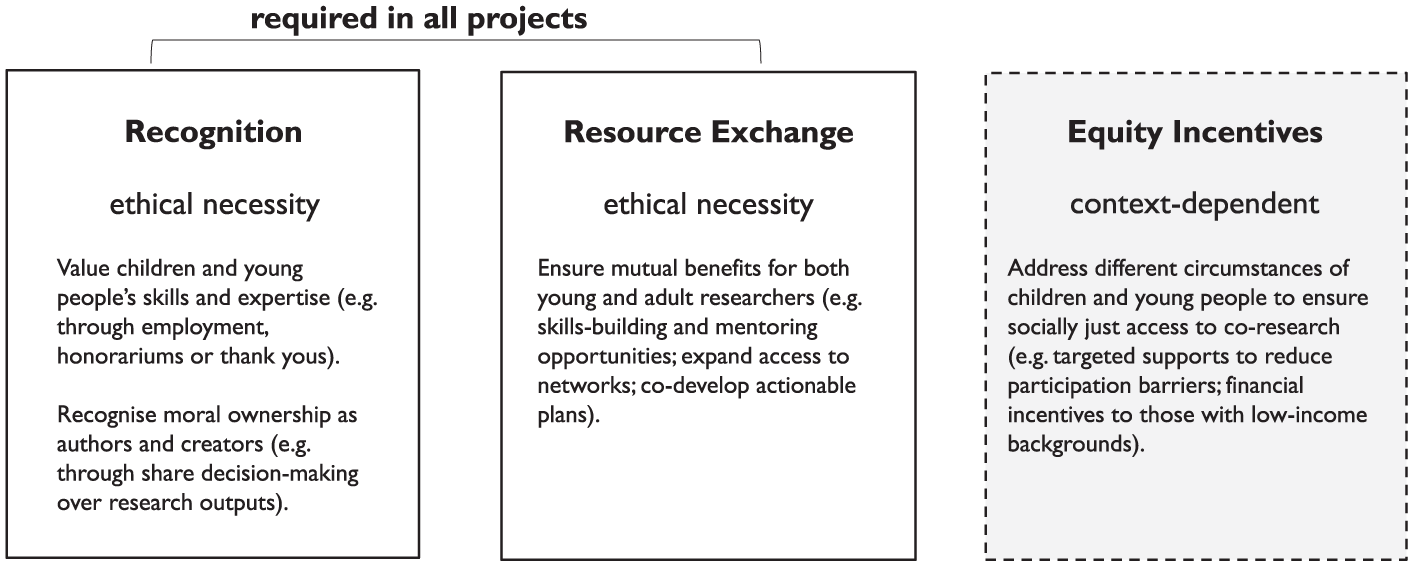
A Framework for Reciprocity in Co-Research with Children and Young People in the Social Sciences.
Reciprocity requires that ‘everybody benefits from working together’, getting ‘something back from contributing to that project’ (NIHR, 2021: 3). It seeks to (re)balance power relations in research, fostering mutual benefits and respectful, socially just relationships between research team members and between the research team and supporting families, communities and organisations. Indigenous conceptions of reciprocity (e.g. Kirkness and Barnhardt, 2001) emphasise the principle of ‘giving and receiving’, while recognising that power differentials still need to be considered (Von Vacano, 2019). Reciprocity, in this sense, does not imply equality, but rather mutuality and equity. Co-research is not a panacea for power relationships, which must be thoughtfully attended to throughout the research process.
The category of ‘reimbursement’ is not included within the framework. We argue that reimbursement is not a ‘benefit’ but a minimum requirement. We thus expect reimbursement to cover out-of-pocket expenses (e.g. lost wages, childcare, travel, subsistence or accommodation) for co-researchers and for others who support children and young people’s participation as co-researchers (e.g. travel expenses for carers accompanying children and young people; staff expenses for those supporting children and young people). Such reimbursement should be expected and resourced in all research activities.
Our framework includes three categories: recognition, resource exchange, and equity incentives. Of these, recognition and resource exchange are ethical necessities for all projects, while equity incentives should be considered and then decided on an individual project basis.
The category of ‘recognition’ affirms that children and young people should be acknowledged for their contributions as co-researchers. Such recognition should take two forms. First, their skills and expertise should be valued through payments in the form of employment contracts, thank yous or honorariums. We have not resolved the question of how much to pay 12 ; this requires ongoing deliberation around what is a fair amount in different contexts and suitably sensitive to social norms, legal requirements and social justice. Second, recognition involves respecting children and young people’s moral ownership, as authors and creators, in generating knowledge and sharing control with the adult co-researchers on how research outcomes are used.
The category of ‘resource exchange’ includes some of the aspects discussed under Wendler et al.’s (2002) category of appreciation and emphasises the mutuality of benefits important to reciprocity. For example, this might include skill-building workshops, mentoring opportunities, or pathways to extend ‘critical social capital’ to access powerful knowledge brokers and decisions makers (Cuevas-Parra and Tisdall, 2022). It could involve co-developing actionable plans for policy or service change based on research findings. 13 Resource exchange is not one-way, from adults to children and young people, as children and young people have considerable resources to share with adults on the research team. The organisers of research projects need to ensure there is resource exchange to the benefit of children and young people who are co-researchers, as well as to the benefit of the adult researchers and project as a whole. This may be particularly necessary and require critical consideration if young researchers are not being paid the same amount as adult researchers, for the reasons discussed above. Whatever form the resource exchange takes, children and young people should feel that it is socially just and reciprocal.
We have retained a category for incentives, but have narrowed its remit to ‘equity incentives’. The broader category of incentives does not capture the mutual benefits expected of reciprocity nor the intended spirit of collaboration with children and young people in co-research. By equity incentives, we mean practices that recognise historical and systemic barriers for certain groups’ participation in research, particularly in relation to power. Equity incentives aim to facilitate the involvement of those who have been structurally excluded, ensuring that opportunities to act as co-researchers are not restricted by circumstances of inequality. The term ‘equity’ is intentional, recognising the need to attend to people’s different starting points and contexts in order to achieve social just outcomes. Decisions about whether and how to offer equity incentives should be made collaboratively with co-researchers in each project.
Limitations
This paper draws heavily on Wendler et al.’s (2002) typology for the payment of children and young people in research. While this is only one typology, the categories within it are commonly used in other typologies concerned with the payment of children and young people in research (e.g. Gelinas et al., 2018). It is also acknowledged that this paper focuses on developing a framework for the payment of children and young people acting as co-researchers in social science contexts and Wendler et al.’s typology relates to research conducted in clinical research; however, it has been drawn upon due to the lack of existing typologies for children and young people as co-researchers in the social sciences.
Conclusion
The literature available on payments for children and young people as co-researchers has practical guidance, articulating pitfalls to avoid and noting considerable ethical and practical concerns. However, there is no consensus on what or how to pay children and young people as co-researchers. Our experience of working cross-nationally in the ICCRP—with children and young people of different ages, geographical locations and community and organisational contexts—has not found such guidance sufficient to ensure co-research meets its emancipatory, social justice claims. The debates around payment shine a light on the adultism of systems, structures and norms of institutional ethics policy and procedures, and suggest that these should be challenged, revised and improved so they become suitable for children and young people as well as adults.
Now that the ICCRP is underway, we are beginning to discuss the mutual benefits of the research with the child and young co-researchers. One suggestion is to set aside a budget that is then decided individually and collectively by the children and young people involved. 14 This does not resolve all of the questions about how, when and what to pay, but it does share the power to decide with the specific groups of children and young people involved. Collectively, the ICCRP is starting to gather systematically the views of adult and child/young researchers with the aim, in due course, to have both conceptual and practical guidance for children and young people’s co-research in social sciences research, which can assist with cross-sector, cross-sectional projects. We look to challenging and developing the framework started above to include future lessons and developments from our intergenerational project.
While a consensus is yet to be reached about the payment of children and young people as co-researchers in social science research, this article highlights the need to more clearly define and justify the ethical principles guiding how their contributions are acknowledged. Our proposed new framework, grounded in the concept of reciprocity, offers a starting point for considering and reframing children and young people’s contributions from a social justice perspective.
Footnotes
Acknowledgements
We would like to acknowledge the Indigenous People of lands upon which we live and work, and the intergenerational relationships and connections the ICCRP provides with diverse international children’s rights partners. We acknowledge funding by the Social Sciences and Humanities Research Council of Canada (895-2021-1003) and the Ontario Research Fund - Research Excellence (RE011-063), who have provided support for the International and Canadian Child Rights Partnership ( ). Further, the article has been developed from collaborative research funded by: AHRC GCRF Changing the Story Large Grant; Economic and Social Research Council/ UKRI ES/S004351/1, ES/T001399/1, ES/T004002/1 (also GCRF); ESRC Impact Acceleration Account; Royal Society of Edinburgh; World Vision International.
ORCID iDs
Ethical considerations
Not applicable.
Funding
The authors disclosed receipt of the following financial support for the research, authorship, and/or publication of this article: Social Sciences and Humanities Research Council of Canada (895-2021-1003) Ontario Research Fund - Research Excellence (RE011-063).
Declaration of conflicting interests
The authors declared no potential conflicts of interest with respect to the research, authorship, and/or publication of this article.
Data availability statement
Not applicable.