




Abstract
What are participants and researchers agreeing to when they consent to having data archived and what do they imagine the future life of their data to be? In this paper, we reflect on a project that deliberately started rather than ended with the archive. The Everyday Childhoods project invited children and their families to take part in the creation of an open access public archive documenting everyday childhoods using a range of multimedia data. Families and researchers were invited into the archive, encouraged to imagine different kinds of secondary use and to speak directly to future user of their data through short films and postcards. This paper raises questions concerning the place of the archive in different disciplinary traditions; the roles of researcher and archivist in safekeeping, gatekeeping and caring for data collections; and the place of qualitative longitudinal research as a site of innovation within a new data landscape.
Starting and ending with the archive
This paper reflects on what it means to begin, rather than end, with the archive in qualitative longitudinal research (QLR). For researchers, whose datasets are iteratively generated through multiple research phases and varying timescales, questions of archiving have long been a source of concern (Neale, 2020). As a result, QLR has become an important site of innovation in archiving practice within qualitative social research, providing a critical space for exploring issues of ongoing consent, anonymity and ownership. However, digital transformations of data and archiving in research have presented new challenges for QLR, including issues of preservation and continuity when data formats and storage methods have proven ephemeral. This paper proposes that for QLR to address these issues, it is necessary to ‘start with the archive’ in research – orienting ourselves from the beginning to the challenges and opportunities that the digital landscape presents for research and archiving. In this paper, we offer a prospective approach to research and archiving, setting out four principles that facilitated a collaborative approach that was sensitive to participant hopes and fears about the use of their data. These principles are proposed as an exemplar of how researchers can work with their participants to begin to orient themselves to their future archives.
The archiving and reuse of QLR was pioneered in the UK by the Economic Social and Research Council (ESRC) funded ‘Inventing Adulthoods’ study (Holland et al., 2004; Henderson et al., 2006; Holland et al., 2006). This work was consolidated and extended in the ESRC-funded ‘Timescapes’ initiative, an archive that sought to link and scale up qualitative longitudinal enquiry (Hughes and Tarrant, 2020a; Neale and Bishop, 2012). The Timescapes archive has continued to be an important resource for qualitative longitudinal enquiry and innovation, including the utilisation of big data approaches to text analysis (Andrade and Andersen, 2020; Edwards et al., 2019) and the linking qualitative and quantitative longitudinal data sources (Elliot, 2008; Irwin, 2009, 2020; Østergaard and Thomson, 2020; Sharland et al., 2017; Thompson, 2004).
This ‘data re-use’ trajectory has a distinctive character yet remains in conversation with insights from interdisciplinary archive studies. In recent years, the archive has been conceptualised as a ‘boundary object’ (Moore, 2017) that facilitates conversations between and within the humanities and social sciences (Geiger et al., 2010), sharing methodological and theoretical traditions as well as highlighting differences in the temporal processes and epistemological underpinnings of different modes of research. Certain qualitative longitudinal datasets such as Timescapes and the Mass Observation (MO) Archive have become a focus of data re-use and have formed the testbed for experimentation and innovation (Hubble, 2005; Timescapes, 2019). Digital methods, in particular, have encouraged researchers to open the process of data generation and mediation to new audiences that might include participants themselves as well as communities (lay and academic) with an interest in these documents (Berriman et al., 2018; Puwar and Sharma, 2012). The field of community archiving is increasingly recognised as an important space for innovation, breaking down some of the divisions between researcher/researched and front stage/backstage that have shaped academic enquiry and associated ethical debates around confidentiality, anonymity and ownership (Flinn, 2007; Hughes and Tarrant, 2020b; Moore, 2017).
Qualitative social research continues to be shaped by powerful habits that understand the making of an archive as the final stage of a research process. Often these archives are held in private by researchers and, due to ethical concerns and promises, do not become publicly available for use by others (Mauthner, 2014; Parry and Mauthner, 2004). Norms of anonymity within social science frameworks can be difficult to maintain with rich case history material (Thomson, 2007) and are increasingly challenged by norms from oral history and community archiving, where the idea of co-production and testimony have authority (Crow and Wiles, 2008; Moore, 2012). As qualitative researchers embrace the immediacy of digital methods, it becomes more apparent that the making of an archive has the potential to be a prospective and collaborative endeavour between researchers and research participants (Back and Puwar, 2012; Marres, 2012; Puwar and Sharma, 2012). This potential is amplified in longitudinal research, where the possibility of sharing documents with participants and using documents as prompts for reflection and further data collection is being embraced (Luttrell, 2020; McLeod, 2003; Staunæs and Kofoed, 2015; Thomson et al., 2018).
In this paper, we report on an example of such research practice, where an existing longitudinal cohort is invited to participate in the creation of an archive – the Everyday Childhoods collection. 1 The project invited participants to think creatively about what it might mean to ‘become data’, and to understand better the processes of preservation and access involved in storing and sharing a dataset. Funded initially as an exercise in methodological innovation 2 – we worked with children and families in order to explore tensions between protection and consent – as well as helping an established archive to explore the challenges of preserving and storing digital data. The project built on the knowledge and experience of the MO Archive and the Timescapes Archive in order to make an intervention into the fields of QLR and methods for researching children and childhood.
Curating childhoods: from conception to published dataset
The Everyday Childhoods Project is the umbrella name for a series of funded and unfunded projects including the ESRC-funded ‘Face 2 Face: Tracing the Real and the Mediated in Children’s Cultural Worlds’ (2013–14) and the Arts and Humanities Research Council (AHRC) funded ‘Curating Childhoods: Developing a Multimedia Archive of Children’s Everyday Lives’ (2014–15). 3 In this section we briefly outline four key phases of the Everyday Childhoods project (see Figure 1) illustrating the stages involved in starting and ending with the archive. This also provides context for the elaboration of ‘principles’ that forms the main part of the paper.
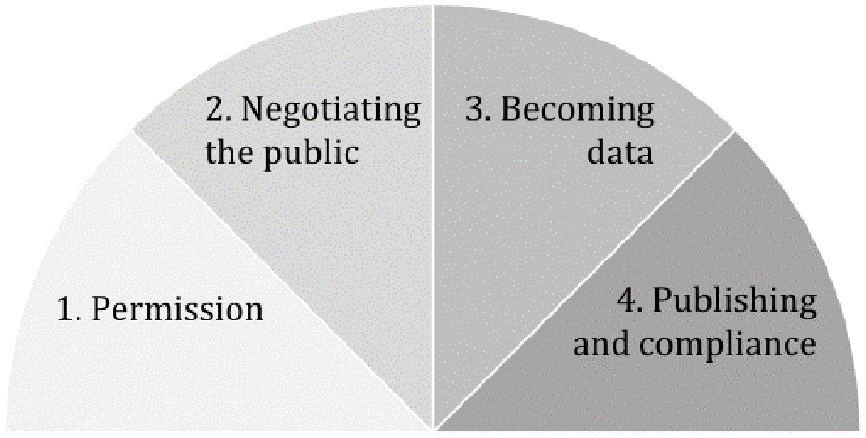
A diagram displaying the different stages of a project that ‘starts’ and ‘ends’ with the archive.
(i) Permission
From the outset, the project sought to innovate in the field of QLR in terms of embracing digital methods and addressing the micro-temporalities that had been neglected in interview-based QLR – for example, the changing affective atmospheres of a day or the changing rhythms associated with transitions between seasons. Working intensively over 2 years with a small group of children and young people, we saw the project as an opportunity to interrogate the norm of anonymity for participants, something made only more sensitive by our intention to work with six children from the age of 7 years. An advantage that we had in this was that the parents of the youngest of our participants had themselves been involved in an earlier study on new motherhood that was deposited and shared in the Timescapes archive. Their children had also been present in this earlier research, although not the primary focus of the researcher gaze (Thomson et al., 2012). As such, the children and families could be assumed to be unusually ‘informed’ about what it means to become data. A second cohort of seven tween-agers (11–15) were also recruited to the study, bringing much less experience as research subjects, accessed through parents and carers.
The development of an application for ethical review was a key part of this stage of the study – demanding that we justify how and why we were departing from social science research norms around anonymity and providing a convincing account of how we would balance tensions between our desire to encourage participation with a commitment to protect participants from harm. This stage of the work involved conceptual development including the forging of a series of principles that have provided a scaffold for our thinking throughout the project and which are elaborated with examples in the next section. The principles did not in themselves resolve ethical dilemmas. For example, one of the compromises that emerged from the ethical review was an agreement not to record participants’ faces in our visual data (photographs and videos). Within our research team, there were differing perspectives on this method as a strategy for anonymisation. Two colleagues questioned why in their role as documentary film makers they could gain the consent of children to show their faces, but as researchers they could not. Such discussions helped us think about how ethical norms emerge within different areas of practice shaped by distinct legal and economic imperatives (Thomson and McGeeney, 2018: 55). Soon after, we gained approval from the ethics committee, we undertook consultation work with a small group of young people to explore views around confidentiality and to test out the acceptability of our proposed methods. We also worked to ensure that young people were closely involved in influencing the different stages of documentation, publication and archiving.
(ii) Negotiating the public
Our approach was underpinned by an understanding of ‘childhood publics’, which recognised how social media and new technologies can amongst other things provide opportunities to join and shape public discourse, something that could be facilitated by participatory research methods (Nolas, 2015). Using two key methods (a ‘favourite things’ interview and ‘day in a life’ observation), both of which employed multimedia documentation including photographs, sound recordings and observational notes (for a full discussion see Thomson et al., 2018), we worked with young people and their families to document aspects of their everyday lives. The intention to create a public archive using these documents was part of the original contract with participants; however, negotiating informed consent assumes that we all understood the implications of data representation, archiving and sharing. A first step in building this common understanding involved creating edited highlights of the documents gathered and synthesised into multimedia formats – sharing with young people examples of what their data entailed. The favourite things data (photographs and recorded talk) were embedded in an interactive 360-degree facsimile of the child’s bedroom, and the day in a life observations were animated using the online presentation platform Prezi. These documents were then shared with participants and families as a strategy of building informed consent, as well as becoming a prompt for further reflection and talk (a final recursive interview with the child and their parent/s).
(iii) Becoming data
The next stage of the research enabled us to work with research participants to more fully understand what it means to ‘become data’. Having agreed with the Mass Observation (MO) Archive that the dataset generated by the Face 2 Face project would be deposited with them, we invited our participants to join us in the archive for a workshop in order to think through the meanings and implications of secondary analysis. This included a one-day workshop at the Keep Archive where archivists, researchers, participants and their parents came together for a tour of the building (following the ‘ingestion’ process for new collections) and to engage in exercises where key concepts (such as raw and cooked data – see Cohen, 2004) and potential re-uses of the data were explored. All original participants were invited, and the final workshop group included four of our tween-ager panel (aged 11–14 years) and one of our younger panel (aged 8 years). The children were accompanied primarily by mothers, as well as an older sister and a younger brother. The activities included young people recording messages to future users and the creation of short films capturing participants understandings of technical terminologies. We also invited the parents to participate in a focus group discussion, which provided a space to explore their views on digital technology, privacy and research. 4 All of these resources, including the multimedia documents, were stored on the project website, which acted as a portal for the archive itself.
(iv) Publishing and compliance
The final stage took place during and after the funded period of the Curating Childhood project and involved the preparation and publication of the dataset as an open access archive. Our creation of easily shareable multimedia documents can be seen as a form of DIY archiving, using commercial digital platforms such as Prezi – which have no policies on preservation – meaning that the documents have uncertain, and likely finite, futures. 5 In addition to their uncertain life online, the digital materials were also held in the Keep Archive on a hard drive, while we identified an appropriate digital infrastructure that would preserve them in open access and searchable form. We eventually settled on using the digital archival platform Figshare, which works with born digital datasets and is compliant with the Core Trust Seal data repository certification. Data and metadata were carefully processed and inputted into Figshare’s repository, and we worked closely with the University of Sussex’s Research Data and Digital Preservation Technologist to ensure that the platform’s affordances complied with our original ethical commitments. Although this phase did not directly involve the input of participants, it was shaped and informed by their contributions throughout the project and realising this final stage of the project – outside of funded time – was part of our commitment to publishing their data with due care and attention.
Principles for prospective collaborative research
During the early development of the Everyday Childhoods study, we devised four principles to help guide our intention of collaboratively creating a research archive with participants. The principles focused on the ethical concerns we anticipated in working with a multimedia dataset and with participants. Over the course of the study, the principles have been elaborated in order to capture our learning. They are not intended as a universal or generalisable rules, but rather serve as a series of provocations for a re-sequenced social science that is prospective, collaborative and engaged with the challenge of balancing the imperatives of protection and participation. Here, we elaborate the principles illustrating them with examples taken from the research process.
(i) Possibility
The evolution of digital methods in the social sciences has had a profound impact on research ethics (Mauthner, 2012; Zimmer and Kinder-Kurlanda, 2017), with researchers and research ethics committees caught in a state of constant catch-up with digital innovation. Our study aimed to explore new opportunities for publicly sharing research data using digital platforms whilst also exploring the ethical challenges this gives rise to. This involved reflecting on how the new possibilities of digital methods mapped onto and overlapped with the existing ethical terrain of childhood and youth research.
In the UK, there have been long-standing concerns that research with children is becoming increasingly ethically onerous with children (Alderson and Morrow, 2020; Morrow and Richards, 1996), with university research ethics committee frameworks adopting highly cautious approaches (Carey, 2018). Arguably, the framing of children as a group who are vulnerable by default within university ethical governance has had a disabling effect on the ability of researchers to collect rich and detailed accounts of children’s lives (Balen et al., 2006), with researchers torn between conflicting impulses to ‘protect’ and to facilitate ‘participation’ (Wiles et al., 2006). Our research was concerned with how the digitisation of research may further amplify and entrench the ethical vulnerability of children within ethical governance, particularly against a wider backdrop of concerns about the risks of digital documentation and sharing in children’s everyday lives (Livingstone et al., 2012; Thomson and McGeeney, 2021). Our research set out to explore the intersections of the ethical terrains of digital and childhood research, paying particular attention to how these are configured within QLR design.
We began from a position of ethical possibility, asking what kinds of assurances, protections and care might be necessary in order to generate ‘children’s publics’ in such a way that is generative without harm being inflicted on participants – both researchers and researched. A focus on possibility does not mean abandoning concerns for children’s safety, but rather involves finding a balance between possibility and protection than permits innovations and dialogues across research and ethics. Our concept of possibility is inspired by Moore’s (2012) concept of a feminist-informed ‘careful ethics’. Moore describes how anonymisation has become a default ethical practice in data sharing and archiving, and questions whether it may lead to erasures (e.g. of participant co-authorship of data). She suggests that when anonymisation practices are led simply by codes of ethical governance, we lose sight of how research is bound up in relational and situated practices, where what is ethical can be negotiated between participants and researcher.
Through a lens of careful ethics, we engaged our participants (as well as their families and other gatekeepers) in dialogues about the ethical possibilities of digitally documenting, sharing and archiving their everyday lives. This included, for example, a pilot interview phase where children and young people were asked to reflect on what ‘sharing your life’ meant in a digital context, and what they felt they would be comfortable sharing with researchers and what might be ethical hotspots or could invite awkwardness. This helped us shape our methods around the kinds of concerns that might be marginalised or absent from more formal ethical evaluations. These discussions continued throughout the research and, like other QLR studies (Holland et al., 2006), we were able to establish relationships of trust with participants that enabled us to have increasingly frank discussions about what they felt it was possible to document and share about their lives. This included a request communicated through the mother of a participant with complex disabilities to include one of the photos we had taken of his face in our publicly shared data, and in so doing ‘humanising’ him. In this case, the parents felt that the anonymisation was not necessary (everyone he knew, knew he was taking part), and they wanted people to ‘see’ who he was as well as what he was doing. Being public was seen as an ethical necessity, especially in the context of experiencing marginalisation and invisibility. This was a decision that was made collaboratively between the participant, their mother and the researchers. A commitment to possibility allows us to respond to this claim and, for good reason, to be inconsistent in our practice.
(ii) Co-production
Our second ethical principle is informed by two methodological approaches: participatory research design in childhood and youth studies (e.g. Bradbury-Jones and Taylor, 2015; Lundy et al., 2011) and community-archiving projects (Flinn, 2007; Moore et al., 2016). Since the late 1980s, scholarship with childhood and youth studies has argued for treating children as agentic and reflexive social actors in their social worlds, including in their participation in social research. This has prompted much methodological reflection on how research design can incorporate children and young people’s shared production and authorship of research. Realising co-production of research in practice has, however, proven practically and ethically challenging (Bragg, 2007). Not least in terms of asymmetries between researchers and participants – underlined by age, status and power differentials (Alderson, 2008). Studies have also tended to limit co-production to particular phases and stages of the research process, most commonly data collection, but also research design and data analysis. Much less common is the involvement of children in planning the sharing, archiving and re-use of data. Within QLR, archiving and re-use are key moments in the life of a study’s data and, as we argue, can be a key site for collaboration. In order to enact the careful ethics that Moore describes, it’s important to consider what forms of relational dialogue and practice might be possible in deciding the shaping of these research phases.
Looking beyond childhood and youth studies, community archive projects again provide a rich source of inspiration for embedding co-production in research-archiving practices. We were fortunate during the Everyday Childhoods project to work closely with the MO Archive. The MO’s Archive relies on the contributions of volunteers who submit diaries on their everyday lives and respond to themed directives set by the archive (e.g. on climate change, memories of school, etc.) Many of the MO respondents have relationships with the archive that have endured for decades. Generally, MO respondents are adults, and children’s contributions have largely been limited to one-off submissions to the archive as part of schools-based projects. One of the reasons the MO Archive became involved in the Everyday Childhoods project was a concern that children’s lives were underrepresented in their collection. This was partly attributed to ethical uncertainties about involving children, leading to a tendency to ‘play it safe’ (Berriman et al., 2018).
Our approach to co-production drew inspiration from both methodological approaches – understanding children as co-producers of research, and using community-based archives as a model for treating data as relational sites of authorship and ownership. One of the ways we enacted this in practice was through our preparation of multimedia data materials for public dissemination. These included curating multimedia representations of each child’s ‘day in a life’ observation using the digital presentation platform Prezi, and interactive representations of the children’s bedrooms displaying their ‘favourite things’ using Pano2VR. In each instance, these multimedia documents went through multiple stages of curative review by the research team, participants and their parents. Participants and their parents were presented with initial designs of the multimedia documents by the researchers and were then involved in discussions about what they felt comfortable/uncomfortable sharing and how well they felt the documents reflected their experiences. Our aim throughout these discussions was to provide opportunities for participants to be involved in the practice of curating the data, and to reflect on their participation in the research. This spirit of collaboration was largely welcomed. For the children, it provided an opportunity to verify that the researchers had recognisably captured their lives, and to suggest corrections or the deletion of anything they would prefer was not shared. Parents tended to welcome the opportunity to see the child’s contribution to the project as a whole – gaining insight beyond their purview (such as school) and taking the long view on material that might become more sensitive over time. Whilst this curative review phase involved labour for the research team, we also learnt a great deal from the participants reflections’ on the research process gathering another layer of insight and analysis. As other researchers also note, looking together at data constitutes an important research method in its own right resulting in conceptual and ethical density (Luttrell and Clarke, 2018; Staunæs and Kofoed, 2015).
A further way we engaged in co-production with participants was through the creation of a series of YouTube videos aimed at archivists and researchers. These videos were filmed during the workshop at the Keep Archive and were pitched to participants as a way of communicating to researchers what issues and concerns should be prioritised when archiving children and young people’s research data. Prior to the creation of the videos, we discussed with participants what issues researchers would typically prioritise, such as anonymity, embargoing data and confidentiality. Participants, including both children and parents, were then invited to share what concerns they felt researchers should prioritise, including being ‘mindful’ of whose data they were using, and being ‘respectful’ in the way the data was used. Participants and members of the research team were then filmed describing the ethical issues that should be prioritised by researchers. These video clips were subsequently edited and published into a series of videos addressing themes such as ‘consent’ and ‘looking after data’. 6 In this instance, co-production involved the development of resources from the collaborative reflections between participants and researchers.
(iii) Shareability
The digitisation of data and archives has presented new opportunities and challenges for how data is publicly shared and made accessible for re-use. Until very recently, a major constraint of data re-use was the potential distance a researcher would need to travel to physically access a dataset. The development of online archiving and data sharing platforms (including Omeka and Figshare) has provided new ways to share datasets, as well as enabling researchers to re-think how they publish data. The increased shareability, and visibility, of data has given rise to ethical questions of how and when to share research data, and with whom. One of our aims was to think about how our research could ethically, sensitively and collaboratively make the everyday lives of children visible. From the outset, we wanted to generate a dataset that could be shared with others in a way that would not compromise the privacy of participants or undermine the quality of the dataset for secondary users. As noted earlier, this led to us incorporating strategies for anonymity into our data collection methods in anticipation of making the data shareable, including avoiding documenting faces in visual data and avoiding the use of real names and places in field notes.
As part of our ongoing discussions with participants and their families, we talked about who the ‘audiences’ for the project’s data might be. This was especially a focal point for our recursive interviews, where participants reflected on the research process and reviewed the multimedia visualisations that we planned to share via our project website. One of the recursive interviews with 14-year-old Abi and her mother focused on whether to include a fieldnote description of Abi surreptitiously switching between school-sanctioned shoes and a pair of Dr Martens over the course of a school day. Both were concerned that its inclusion could potentially make Abi’s rule breaking visible to the school and lead to her being chastised. Our discussions about data sharing culminated in our archive workshop at the Keep. This workshop brought together participants, family members, the research team and archivists and involved reflection on how data would be archived and made available for re-use. One workshop activity involved children, parents and researchers reflecting on scenarios involving different potential users of the dataset (e.g. students, journalists, documentary makers) at different future points in time (e.g. 1 year, 10 years) Moving along a physical scale, participants were asked to position themselves along a continuum of ‘very comfortable’ to ‘very uncomfortable’. Participants were then asked to share why they had chosen this position, and to share any concerns they might have about sharing the data with particularly audiences.
During this exercise, we noted that children often looking to their parents for guidance and would move along the continuum with their parents. This exercise revealed less concern about when data might be used in the future, but more concern about who might be the audiences for the data. As facilitators, we were surprised by opposition on the part of young people that university students might work with data as part of teaching activities, yet excitement that journalists might be interested in the material. We reflected that social proximity might be a factor in shaping views (the closer the link, the greater the unease) as well as concerns that students may not be as ‘careful’ in handling data as other data users.
A further challenge for our research was finding methods of sharing our data that met the promises we had made to our funders (of public and open access data) and to our participants (of due care and consultation). Our initial proposal had been to archive the dataset within the MO collection. However, at the point of handing over the dataset, we found the archive’s evolving digital infrastructure would not enable us to make the dataset as public as we had hoped. This meant that for a period, the dataset sat as a hard drive in archive, whilst we found a suitable means of making the data ‘public’. We eventually settled on the online open access data repository Figshare. The platform provided much of the technical infrastructure we had sought (open access and online with a core trust seal), but further work needed to take place in order to ensure that the platform met our requirements for anonymisation and embargoing negotiated with participants, and that there were identifiable people who we and our participants could communicate with in the future about the care of their data – including the University’s research data and digital preservation technologist, and the University’s data officers. The publishing of the Figshare dataset marked a key moment in making the dataset fully shareable, though it did not necessarily mark the end of the process of sharing. For example, we continue to contend with errors that appear when datafiles on Figshare are downloaded, illustrating how data sharing via digital platforms continues to be an unfinished process.
Over the period of our work on this project, the expectation on the part of public funders that datasets should be shared has gained momentum. Whilst we strongly support a culture of data re-use, our project also reveals the labour-intensive process of making a dataset shareable in an ethically careful way (Hadfield, 2010). Researchers can experience pressure to share their data in an environment where the infrastructure is still evolving and where the work of painstakingly preparing and depositing the data falls on the shoulders of the research team. We believe that this work and its challenges need to be visible, recognised and compensated.
(iv) Posterity
Within the UK, a significant driver of concern with posterity in the social sciences has been the growing emphasis by research councils on extending the value and utility of taxpayer-funded studies. This has led to greater investment in archival infrastructures at a national and HE institutional level, as well as a growing requirement for studies to outline their long-term ‘data management plan’ with a view to archiving by default. 7 Posterity has become a significant methodological issue within QLR research community, with a key affordance of the methodology being the accumulation and layering over time of participant’s case histories (Thomson, 2007). In this context, posterity is concerned with ensuring the future accessibility of records and data across research phases spanning years and even decades. A further concern in our study was the role of research in creating data traces of people’s life, and how making these available for future users requires a significant personal commitment – and high level of trust (Holland et al., 2006) – on the part of research participants. Making clear what this commitment to posterity entails can be difficult for both participants and researchers to fathom, requiring an engagement with speculative futures about how the life of a dataset will unfold. From the outset of the Everyday Childhoods study, we explained to participants our intention to archive the dataset and to make it available for reuse, as well as our desire to involve them and their families in discussion about how this would be achieved. This involved both the researchers and participants exploring together what the futures of the dataset might entail.
The idea of ‘enduring consent’ has been developed as a way of conceptualising what it might mean to entrust data to future use (Hughes and Tarrant, 2020b). For many of our younger participants, posterity and archives were quite abstract concepts. Many associated archives as records or places that were old and dusty. This presented challenges for imagining the archive not as a site of obsolesce, but as where data is given new life – what in new work we characterise as ‘reanimation’ (Moore et al., 2021). Our conversations with teenagers about archives made connections with the social media environments they inhabited and their understandings of how their online data traces could endure into the distant future. Our participants described how acts of sharing on social media had to be calculated in terms of potential repercussions, and that sharing by definition involves elements of risk, such as being scrutinised by others (Berriman and Thomson, 2015; Jaynes, 2020). These discussions over the duration of the project provided ways to explore ideas of what the future life of the study’s data might look like, and to examine conceptions of posterity in relation to the participant’s life experiences.
For example, in the workshop sessions held at the archive, we held small group activities where the participants were split by age (younger children, teenagers and parents). These activities involved discussion concepts such as enduring consent, and how individuals might make decisions about their data in the long term. One of the interesting responses from the teenage group was that all of the participants felt they would want continue to consult with their parents about any decisions relating to the data going forward, even once they had become adults. For us, this highlighted how decisions linked to research consent cannot simply be understood in terms of an adult/child binary of independent/dependent, but rather need to be understood as potentially relational acts of enduring consent between not only researchers, but also other trusted parties including archivists, data managers as well as those gate keepers and family members who support young people’s capacity for informed consent .
These discussions were developed in a later workshop, where activities enabled participants to explore feelings about their data being re-used at future points in time. One activity invited workshop participants (including children, parents and researchers), to write a postcard addressed ‘To Future Archive Users’ (Figure 2) expressing their hopes and concerns about the future use of the data. These postcards provided a record of what mattered to participants in making their data available into an unknown future, particularly their priorities for its reception. Messages from the children’s postcards ranged from hopes that the data would be useful to others (‘make good use of it’) and their desire for future users to handle their data with care, responsibility and respect (‘looking after it very well’, ‘be respectful when handling’, ‘try to keep it as accurate as possible’). Postcards were also written by researchers and reflected their own concerns and investments in the dataset. These included concerns that future users would not have the benefit of their background knowledge and relationships with participants, which may lead to misinterpretations about their and intentions. Arguably, researchers have more to lose in having their data archived than do research ‘subjects’ (Evans and Thane, 2006). All participants agreed to the postcards being made available with the archive, acting as a ‘message in a bottle’ that would accompany the dataset, and which would enable the archive’s contributors to speak directly to the future archive user.
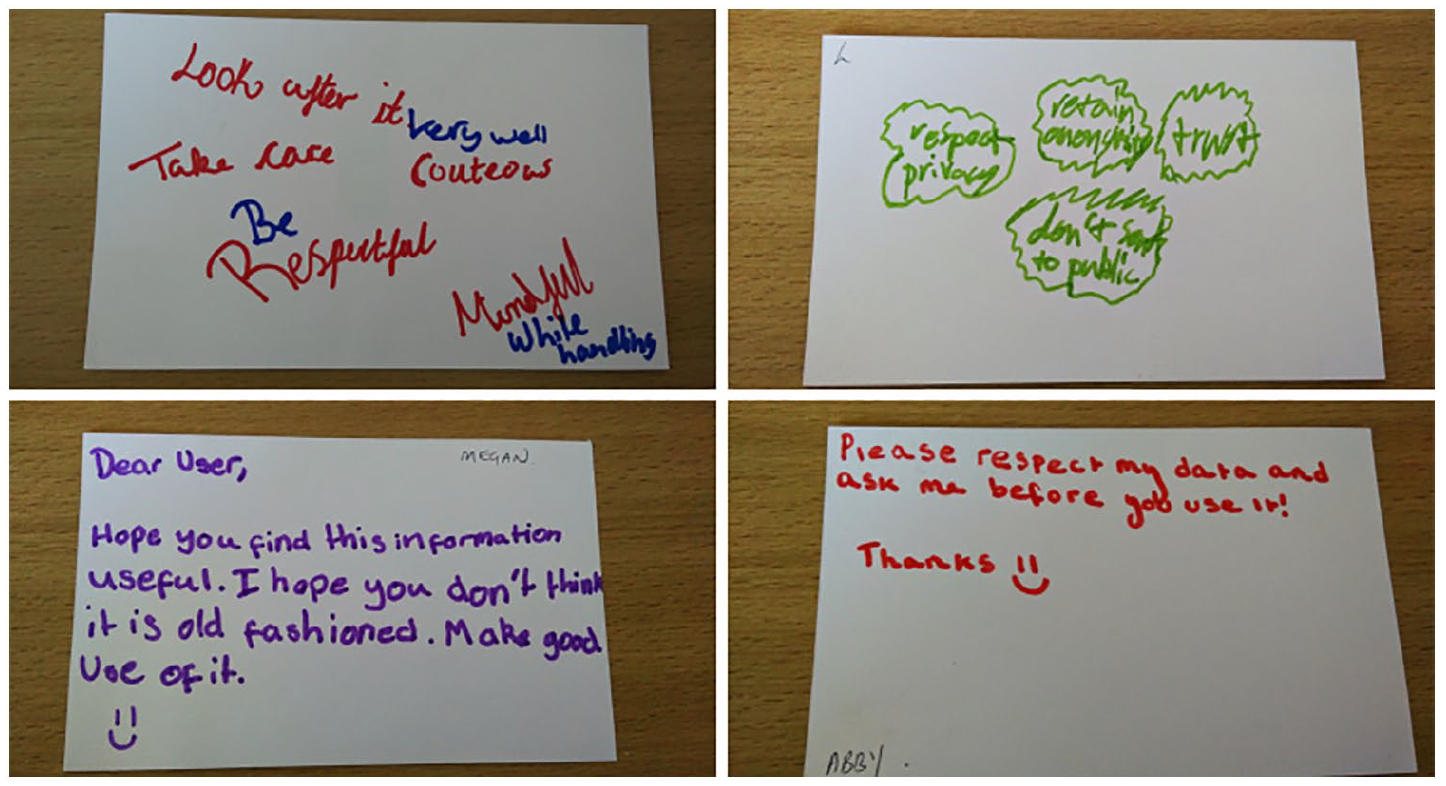
Examples of postcards written by children, parents and researchers to future archive users of their research data.
Conclusions
QLR can be understood as part of a wider family of temporal methods in which time is designed into research in order to realise the relationship between past, present and future, capturing the subjective experience of lived time (McLeod and Thomson, 2009; Neale, 2018). By focusing on the prospective character of QLR, we allow for processes of data management, preservation and re-use to be included in a model of what comes next in the research process. Starting, rather than simply ending with the archive, enables us to reconceptualise our research endeavours within an interdisciplinary ‘archive project’ that includes but goes beyond social sciences to include historical and community archiving traditions (Geiger et al., 2010; Moore et al., 2016). In the context of a digital landscape, a focus on the collaborative making and sharing of archives has the potential to invigorate research enquiry while also raising new challenges for preservation and continuity as we face the fragility and time-limited nature of digital formats. Turning the promise of preservation and continuity into an authoritative and institutionally supported practice is labour intensive and technically demanding. Our experience, shared in this article, provides a case study of why and how such a project may be delivered as well as revealing key staging posts and learning. We recognise that our experiences on a longitudinal project may be distinctly different from qualitative enquiries that are shorter in timescale and have larger numbers of participants. However, a turn to time in research more generally suggests that qualitative studies can be maintained over many years and funding cycles and returned after the passage of time (Luttrell, 2020; Walkerdine et al., 2001; Weis, 2004). If we are to anticipate working this way, there is a need to include the preservation of research into budgets and timescales.
Our principles for prospective collaborative research offer just one set of possibilities for how researchers can work with participants to reflect on how data is shared, archived and re-used. Such dialogues are unlikely to be exhaustive in mapping the potential futures of a dataset (there is of course much we can’t predict or anticipate), but initiating and inviting these discussions is of growing importance given the commitments that we are asking participants to make when consenting to participate in a study. These principles offer researchers, archivists and collaborators within and beyond the QLR community some of the methodological tools and concepts needed for engaging participants in the preservation and future life of their data. Within the UK, where archiving is a condition for publicly funded research, we imagine this will speak to a growing range of researchers (see also Hughes and Tarrant, 2020a). Internationally, norms of qualitative archiving and re-use are still emerging, and our hope is that this contribution will provide an intellectual case for prospective and collaborative practice from within the qualitative research community. Our paper also speaks to the challenges posed by reflecting on these issues with children, teenagers and their families. We hope to have shown that the documenting and archiving of children’s lives is not only possible but can be undertaken in a way that offers children and their families and carers with opportunities to talk about the future of their data.
Longitudinal research methods have the potential to be a site of innovation in a range of ways, forced to adapt and incorporate changing technical landscapes and changing social understandings of what it means to be involved in and contribute to research. The Everyday Childhoods project has been exceptional in allowing us to work with two generations of families, capitalising on their expert knowledge of what it means to be involved in research and to ‘become data’ in a literal way. Revisiting research documents from our own past can be an emotionally rich and challenging experience that produces an extraordinary perspective (Thomson and McLeod, 2015). The innovations that we report here begin with the forging of a new set of ethical principles – insisting on the possibility of creating public archives that are ethically robust and careful, yet which push us to think critically about taken for granted approaches to managing risk and imagining harm in social research. Our approach also pushes us to think about how datasets are managed, stored and made available now and in the future and the very real practical challenges involved in this. We have certainly learned a great deal in this process, including the gaps that exist between the roles and understandings of researchers and archivists. Our experiences have inspired us to imagine research as an invitation to collaborate in the creation and curation of public knowledge, with the digital archive as a shared boundary object that forces us to think beyond disciplinary and professional categories embracing the kinds of context collapse that are a feature of our digital landscape. Drawing on an authoritative exemplar of methodological innovation from a national research landscape that is itself world leading in the pioneering of qualitative archiving and re-use, we aim to make a contribution to an emerging international debate.
Footnotes
Funding
The author(s) disclosed receipt of the following financial support for the research, authorship, and/or publication of this article: This research was undertaken with funding support from the Economic and Social Research Council (grant reference DU/512589109) and the Arts and Humanities Research Council (AH/M002160/1).
