




Abstract
More than 800 (co-)authors participated in a large-scale cross-sectional survey on inappropriate attribution of authorship and the use of explicit authorship guidelines in psychological science (response rate 29.6%, predominantly from Europe and North America). Almost half of the respondents had been involved in a study where someone was added as an author who did not contribute substantially (gift authorship) at least a few times. Being involved in a study where someone was not listed as an author when they contributed substantially (ghost authorship) was experienced considerably less frequently. In approximately half of the respondents’ research settings, the use of explicit authorship guidelines is actively encouraged, leading to more frequent discussion of authorship in earlier stages, as well as to the perception of authorship decisions as fairer. Encouraging the use of explicit authorship guidelines is a simple yet effective intervention. Importantly, the American Psychological Association’s (APA) authorship guidelines are considerably more lenient than the widely used criteria of the Committee on Publication Ethics and the International Committee of Medical Journal Editors.
Introduction
Amidst a growing scrutiny of so called ‘questionable research practices’ (John et al., 2012) or ‘unacceptable research practices’ (ALLEA – All European Academies, 2023), inappropriate authorship practices in science have largely remained unaddressed. Considering the central role that publications play in academic recognition and, consequently, the careers of researchers, this is remarkable. Aspects such as hiring, tenure and promotion are profoundly influenced by the number of publications, citations and by the prestige of the journals in which one’s work is published. Likewise, the likelihood of securing research funding and the attainment of scientific awards are affected (Johansson et al., 2023). Furthermore, Marušić et al. (2011: 14) estimated that the ‘prevalence of ethical problems in authorship is more than 10-fold greater than the 2% prevalence of research misconduct of fabrication, falsification or data modification’.
Two prevalent and persistent problems with authorship are gift (or ‘honorary’ or ‘guest’) and ghost authorship. Gift authorship involves adding an individual to a paper as a form of tribute or for political or opportunistic reasons, even when their contribution does not meet the criteria for legitimate authorship. Examples are heads of research units or researchers whose sole contribution is providing funding for the reported studies. Ghost authors, on the other hand, are researchers who have made substantial contributions to the work but are not granted authorship, not to dilute the value of authorship for other (co-)authors or to conceal potential conflicts of interest, for example, in the case of industry-sponsored research (Rennie and Flanagin, 1994).
An early study on authorship practices in psychology was conducted by Vasta (1981). In this study, 28% of the respondents answered affirmatively when asked whether they had ever ‘personally been involved in a situation where you believe your authorship was not commensurate with your input’. Furthermore, 21% considered gift authorship acceptable. The following anecdote illustrates how authorship concerns were not taken seriously at the time. When Vasta initially submitted his manuscript to American Psychologist, William Bevan, the acting editor and President of the American Association for the Advancement of Science and of the APA at the time, rejected the paper, asserting that Like sex before the seventies, the matter of how authorship is settled is little spoken about but widely understood in the community – Joint authorship decisions like decisions about sex . . . do, or should, have a degree of intimacy about them (Tarnow, 2000: 183).
In another early, large-scale study in the biomedical sciences Flanagin et al. (1998) estimated that 19% of publications contains gift authors, and in 11% a ghost author is missing from the author list in the same field. Subsequent studies (Al-Herz et al., 2014; Eisenberg et al., 2011) indicate that the problem has escalated to the point where one in every three papers may suffer from gift authorship. Similar studies have shown that the same problems emerge in other disciplines (Swazey et al., 1993; Tarnow, 2002). In a recent large-scale international study involving almost 4000 respondents from the biomedical sciences, Schroter et al. (2020) found that nearly 75% of the respondents reported having been involved in a study where a gift author was added and 34% had dealt with a ghost author. Only 19% indicated that they had never experienced gift or ghost authorship in any of their publications. In 2018, Godecharle et al. reported highly similar results: in their study, 76% of university researchers in biomedicine observed ‘Giving authorship credit to someone who has not contributed substantively to a manuscript’ and 34% reported to have observed ‘Denying authorship credit to someone who has contributed substantively to a manuscript’. In 2020, a Wellcome Trust survey investigated the perceptions and experiences of the research culture among over 4000 UK-based research staff at various career stages. The results revealed that 40% of the respondents had observed others taking inappropriate credit for their work (Moran et al., 2020). However, the sample was (intentionally) skewed towards biological and biomedical sciences. A more recent large-scale survey of researchers based in the United States and (predominantly) in Europe targeted researchers in the humanities, social sciences, natural sciences and medical sciences. More than half of US-based researchers and 70% of researchers based in Europe admitted to having experienced ‘including authors who hadn’t contributed sufficiently’ (Allum et al., 2023).
Although these results seem to indicate that inappropriate authorship attribution occurs across disciplines, they mainly stem from the biomedical sciences. Recent studies on awareness and usage of authorship guidelines in the behavioural sciences appear to be lacking. This study aims to investigate authorship decisions as well as experiences of inappropriate authorship attribution by researchers publishing in psychology journals using the questionnaire of Schroter et al. (2020). We opted to focus on psychology for several reasons. On the one hand, focusing on a single discipline created a clear scope for our study. On the other hand, psychology is a considerable extensive field, allowing to some extent generalizing our results to the behavioural sciences. Furthermore, research integrity has received quite some attention within psychology in the wake of recent misconduct cases (e.g. the Diederik Stapel case: Levelt Committee et al. (2012)) and the so-called ‘replication crisis’ (Open Science Collaboration, 2015; Shrout and Rodgers, 2018).
Method
Privacy and ethics
The study protocol was reviewed for ethical and privacy-related issues and approved by the Social and Societal Ethics Committee of KU Leuven (SMEC) under reference number G-2021-2960. On the landing page of the questionnaire, respondents were provided with information regarding anonymity and confidentiality (cf. https://osf.io/2uvgr/). They provided informed consent for the collection, storage, processing, and analysis of their responses by clicking ‘Continue’ at the bottom of the landing page.
The questionnaire
We used the questionnaire that Schroter et al. (2020) used in their study on the awareness, usage, and perceptions of authorship guidelines in the biomedical sciences with minor adaptations. The primary adaptation involved referencing the authorship criteria outlined by the American Psychological Association on their website (https://www.apa.org/research/responsible/publication; no longer online; American Psychological Association, n.d.) instead of those of the International Committee of Medical Journal Editors (ICMJE, n.d.). Additionally, instead of inquiring about ‘the last paper [they] co-authored,’ we asked respondents about a specific recently published paper (i.e. the paper used to select the convenience sample – see Section ‘Data Collection’). We mentioned the name of the journal and the title of their paper in the invitation emails and in Questions 7, 8 and 9 (e.g. Question 9: ‘Thinking of your paper “[title of the paper]” in [name of the journal], were explicit authorship criteria used to decide who should be an author?’; cf. Supplemental Material on https://osf.io/2uvgr/). To ensure anonymity, we excluded the question about respondents’ institutional affiliation (Question 13 in the Schroter et al. questionnaire). Instead, we asked about the continent of their main institution (Question 14). Furthermore, we expanded response options beyond ‘female’ and ‘male’ in the gender-related question to increase inclusivity.
Finally, we gave respondents the opportunity to enter a prize draw for a €100 Amazon voucher (one for Waves 1 and 2 combined, one for Wave 3) and to request a summary of the results of the study.
Each respondent received a personalized link (generated by Qualtrics), preventing multiple responses from individual respondents. Respondents could pause when filling in the questionnaire, come back later and continue where they left off previously. Response options in Qualtrics were set to ‘Request response’, meaning that respondents could skip questions but only after having seen a warning that they were about to – and then answering nonetheless or proceeding without answering that specific question.
It should be noted that the questions did not mention ‘gift’ nor ‘ghost’ authorship explicitly. Instead, respondents indicated ‘How frequently have you been involved in a study where someone has been added as an author who
The questionnaire is available from https://osf.io/2uvgr/. It was not validated by Schroter et al. (2020), therefore we did not attempt to validate our version of the questionnaire. Furthermore, because the questionnaire was pre-tested by Schroter et al. (2020), we deemed it not necessary to pilot the questionnaire before sending out invitations.
Data collection
This was a cross-sectional survey study. 1 Three waves of email invitations to complete the questionnaire were sent using Qualtrics software (Qualtrics, Provo, UT). Wave 1 (January 2021) and Wave 2 (March 2021) were sent to authors mentioned on the byline of full papers (i.e. excluding commentaries, replies and editorials) published in the second semester of 2020 in selected journals published by the APA (Supplemental Table 1). Journals were selected to cover a range of disciplines in the field of psychology, impact factors, and number of authors per paper. Wave 3 (February 2022) was sent to authors of papers published in the second semester of 2021 in journals not published by the APA but referring to the APA guidelines in their instructions to authors. Non-responders were sent reminder emails at 2, 4 and 6 weeks after the initial email was sent out (see https://osf.io/2uvgr/).
Email addresses were retrieved from publicly available sources on the internet. Professional (i.e. institutional) email addresses were used, except when authors provided their private email address on the published paper. A flow diagram of the selection of potential respondents is presented in Figure 1.
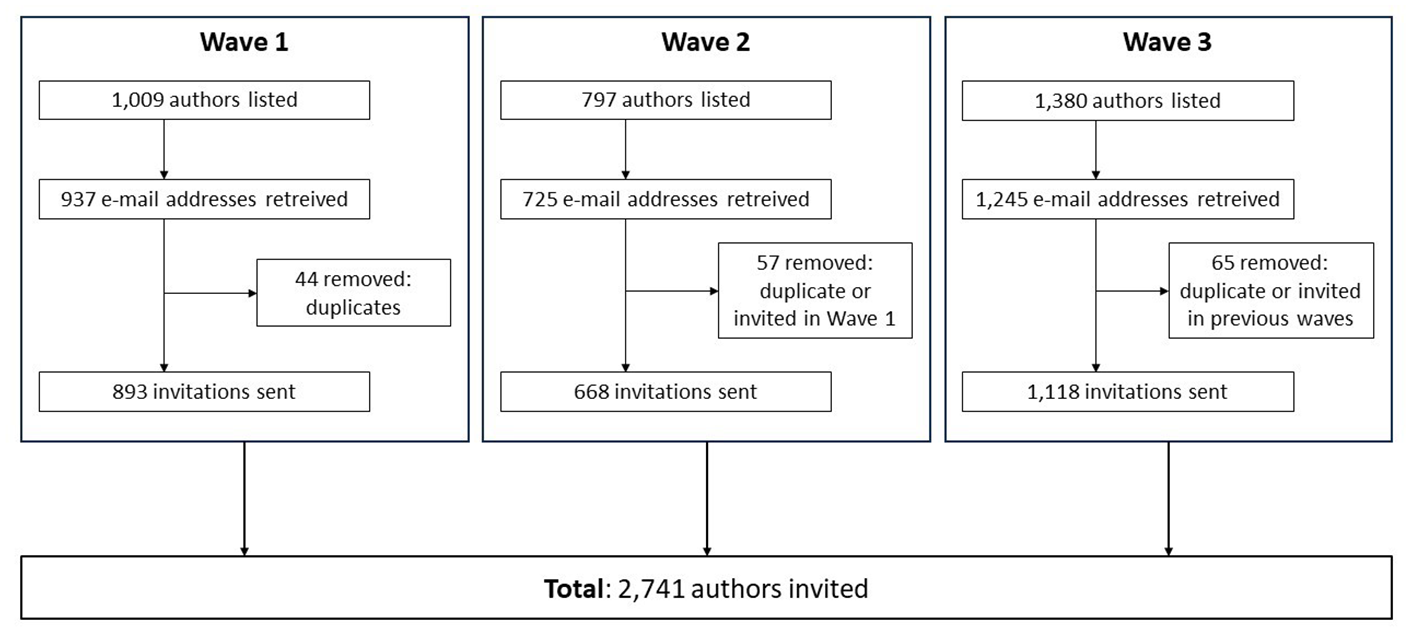
Flow diagram of the selection of authors into the survey.
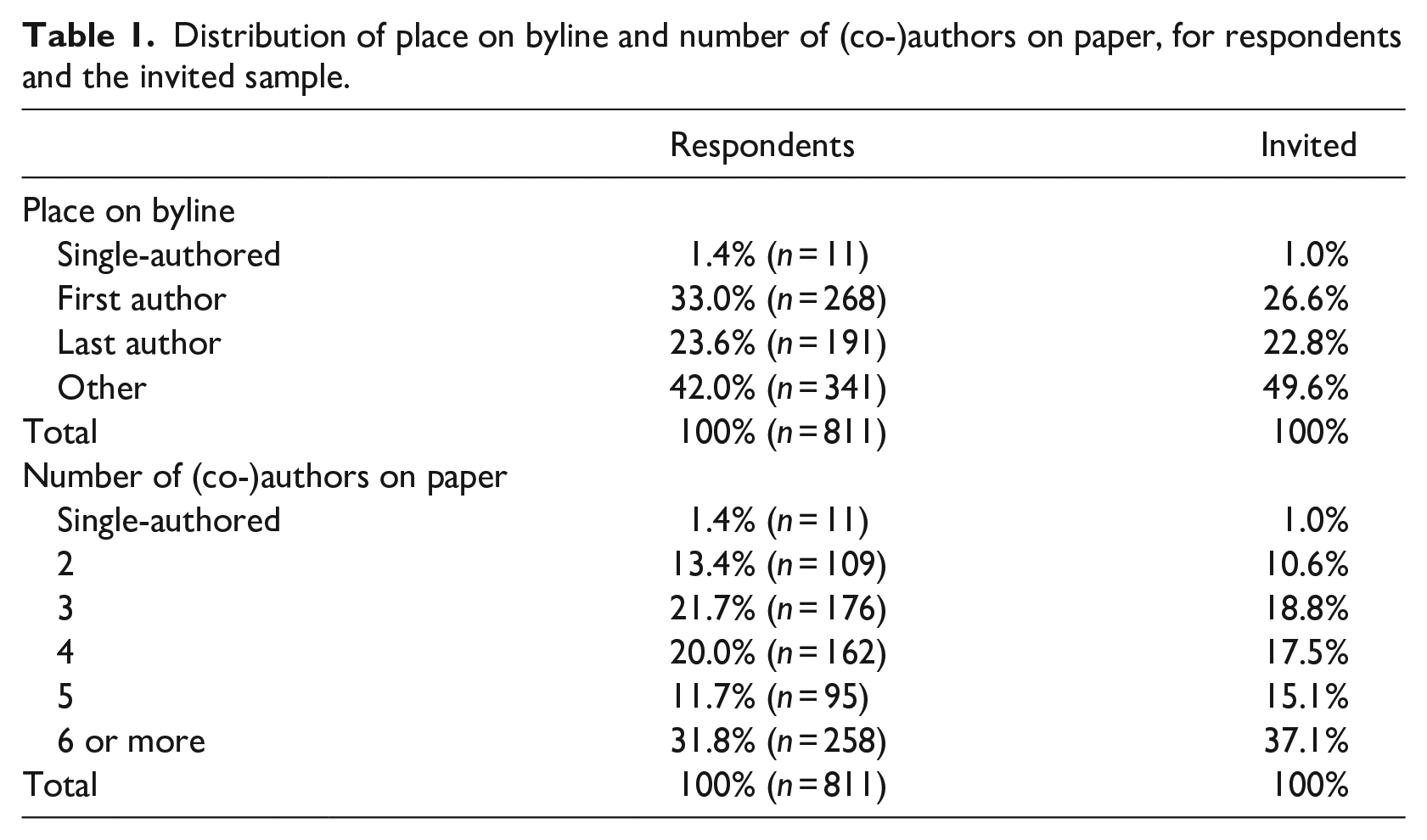
In total, 2741 individuals were invited to complete the questionnaire. The median number of (co-)authors on the selected papers was five. Approximately half of the invited researchers was mentioned on papers that had 2, 3 or 4 (co-)authors (46.9%), and 28.4% was corresponding author (Table 1).
Distribution of place on byline and number of (co-)authors on paper, for respondents and the invited sample.
Analysis
Relationships between categorical variables were tested using Chi-square tests using IBM SPSS Statistics for Windows (Version 21.0). Most tests were performed on the entire sample, missing data were not replaced, percentages reported here are calculated on valid responses. Items were not weighted.
When comparing locations of respondents’ main institution, only Europe and North America were included (n = 707). 2
When analysing the relationship between the active encouragement of explicit authorship guidelines and when authorship eligibility and authorship order were discussed, only ‘frequently’, ‘sometimes’ and ‘not’ responses were included (i.e. ‘other’ responses were excluded). Including only ‘meaningful’ responses facilitated the interpretation of the Chi square analyses by removing some ‘noise’ from the Chi square tables and avoided significant results due to differences in the frequency of ‘other’ responses. 3
Finally, when analysing responses related to their recently published paper, 11 single-authored papers were excluded from the analysis as for most single-authored papers discussing authorship attribution and order is irrelevant.
Results
Out of the 2741 authors who were invited, 811 completed the questionnaire (response rate 29.6%). There were, in total, 20 missing responses distributed across six questions; the maximum number of missing responses per question was seven. 335 respondents identified as female (41.3%), 458 as male (56.5%), 3 as non-binary/genderqueer (0.4%), and 15 preferred not to disclose their gender (1.8%).
Europe (45.9%; n = 373) and North America (41.2%; n = 334) were the most prevalent locations of respondents’ main institution, followed by Asia (7.4%; n = 60) and Australia (4.2%; n = 34). Less than 1% of the respondents’ main institutions were in South or Central America (0.9%; n = 7) or Africa (0.4%; n = 3). There was a significant difference in the location of respondents’ main institution between the waves. For Wave 1 and Wave 2 combined (i.e. APA-published journals), approximately half of the respondents’ main institutions were in North America (53.6%; n = 240), while one-third were in Europe (37.3%; n = 167). This pattern reversed in Wave 3 (i.e. non-APA journals), where more than half of respondents’ main institutions were in Europe (56.7%; n = 206), and of a quarter in North America (25.9%; n = 94), X² (1, N = 707) = 52.92, p < 0.001. 4
Overall, respondents’ characteristics were comparable to that of the invited population (Table 1). 55.1% of the respondents was (co-)author on a paper with 2, 3 or 4 (co-)authors.
Authorship guidelines
22.7% (n = 184) of the respondents indicated that their institution had an authorship policy, 38.8% (n = 315) reported the absence of such a policy at their institution, and 37.9% (n = 307) did not know. In comparison to American respondents, a larger proportion of European respondents indicated that their institution had an authorship policy (18.9% vs 25.5%), whereas more American than European respondents were uncertain (42.2% vs 33.2% ‘don’t know’ responses), although the difference was not significant, X² (3, N = 707) = 8.00, p = 0.046. A large majority of the respondents (88.9%; n = 721) believed the use of explicit authorship guidelines is beneficial, with only 3.8% (n = 31) considering it not beneficial and 7.3% (n = 59) being uncertain.
Inappropriate authorship attribution
The respondents experienced gift authorship more frequently than ghost authorship. Approximately half of the respondents had been involved at least once in a study where someone was added as an author who did not contribute substantially (64.1%; n = 519), whereas fewer than one in five reported being involved in a study at least once where someone was not listed as an author although they contributed substantially (26.6%; n = 215; Table 2).
Experiences of inappropriate authorship allocation.
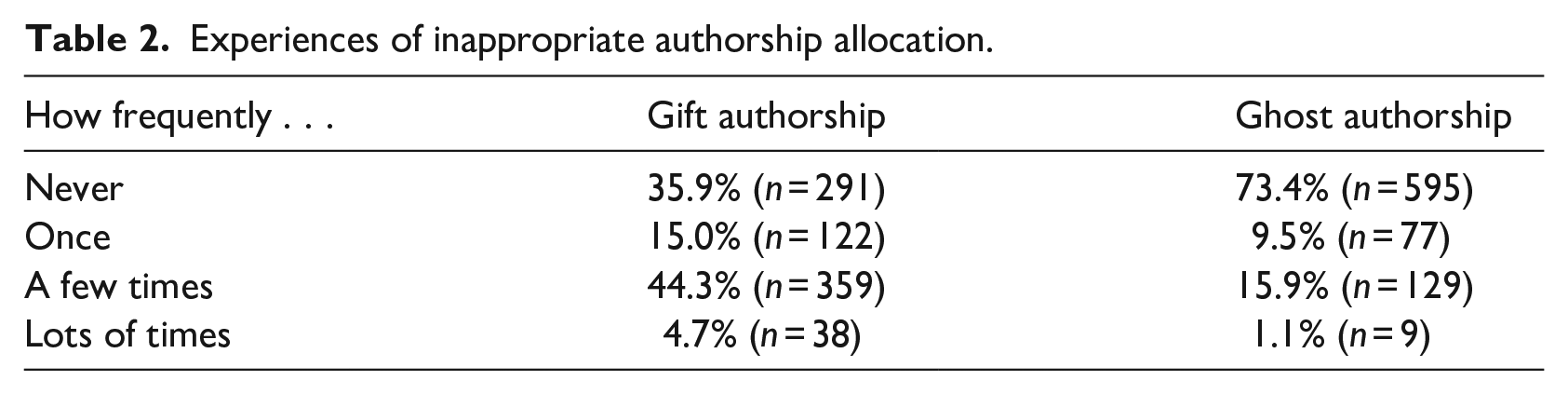
We compared our findings with those reported by Schroter et al. (2020) using Chi square tests (‘never’ vs all other responses) for gift and ghost authorship, respectively. Respondents in our study reported to have experienced both gift and ghost authorship significantly less frequently, X² (1, N = 4598) = 44.50, p < 0.001 and X² (1, N = 4596) = 18.94, p < 0.001, respectively.
There was no relationship between the availability of an authorship policy at the respondents’ institution and the experience of gift nor ghost authorship, X² (9, N = 810) = 12.02, p > 0.05 and X² (9, N = 810) = 4.50, p > 0.05, respectively. However, if a respondent’s institution actively encouraged the use of explicit authorship guidelines the experienced frequency of gift authorship was lower, X² (12, N = 810) = 30.53, p < 0.01.
Negotiating authorship in practice
Regarding their recently published paper, approximately half of the respondents indicated using explicit authorship criteria to decide who qualified as an author (50.3%; n = 402). 5 Conversely, 37.5% (n = 300) did not use such criteria, and 12.3% (n = 98) did not know whether explicit criteria were used. If respondents’ institution had an authorship policy, a larger proportion used explicit criteria for their recently published paper (66.1% vs 47.6%), X² (4, N = 795) = 35.10, p < 0.001. Similarly, a larger proportion of the respondents who indicated that the use of explicit authorship guidelines is actively encouraged in their research setting actually used explicit authorship criteria to decide who qualified as an author on their recently published paper: 81.0% of the respondents for whom explicit guidelines are often encouraged used explicit guidelines compared to 55.6% of the respondents for whom guidelines are sometimes encouraged and 30.6% of the respondents for whom guidelines are not encouraged, X² (4, N = 641) = 119.84, p < 0.001.
Approximately half of the respondents discussed authorship order only once (46.3%; n = 370), one-third discussed it a few times (36.1%; n = 289), and 14.3% (n = 114) never discussed authorship order. European authors discussed authorship order mainly once (53% ‘Only once’; 27.6% ‘A few times’; 16.5% ‘Never’), whereas a larger proportion of American authors discussed it more often (38.2% ‘Only once’; 46.2% ‘A few times’; 11.3% ‘Never’), X² (3, N = 691) = 31.55, p < 0.001.
Figure 2 shows the distribution of when respondents discussed who should be an author and the order of authorship. Who should qualify as an author was most often discussed during the study’s design (54.3%). Authorship order was equally often discussed during the study design as during the writing of the paper (37.1% and 35.3%, respectively). Furthermore, compared to respondents for whom the use of explicit authorship guidelines was not encouraged, respondents for whom the use was actively encouraged discussed both authorship eligibility and authorship order more often during the study’s design, X² (2, N = 650) = 21.76, p < .001 and X² (2, N = 650) = 19.99, p < .001, for authorship eligibility and authorship order, respectively; and during the course of the study, X² (2, N = 650) = 9.61, p < 0.01 and X² (2, N = 650) = 11.98, p < 0.01, respectively.
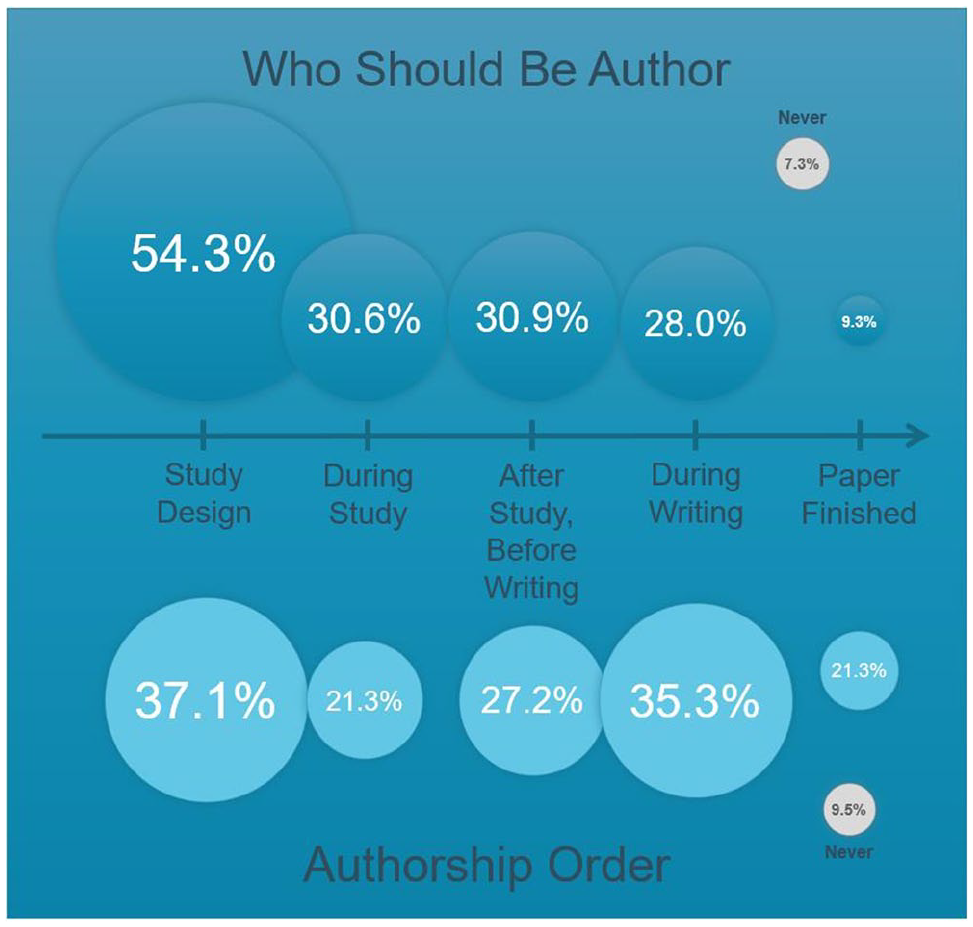
Distribution of when respondents discussed who should be an author and the order of authorship.
The large majority of the respondents thought that the decision on who should be an author (93.9%; n = 751) and the decision on the order of authorship (92.1%; n = 737) fairly represented who did what. However, if the use of explicit authorship guidelines was not encouraged in their research setting, a larger proportion of the respondents thought the decision on who qualified as an author and on authorship order was not a fair reflection of who did what, X² (4, N = 641) = 16.81, p < 0.01 and X² (4, N = 641) = 15.99, p < 0.01, respectively. Similarly, if no explicit authorship criteria were used to decide who should be an author on their recently published paper, a larger proportion of the respondents thought the decision on who qualified as an author and on authorship order was not a fair reflection of who did what, or did not know whether it was fair, X² (4, N = 800) = 49.03, p < 0.001 and X² (4, N = 799) = 50.86, p < 0.001, respectively.
American Psychological Association authorship guidelines
57.0% of the respondents (n = 462) indicated that they are very familiar with APA’s criteria for authorship, approximately one-third had heard of the criteria but was not familiar with their content (32.6%; n = 264), and 10.5% (n = 85) had never heard of the criteria. Respondents contacted for papers in APA journals (Waves 1 and 2) were more familiar with the APA criteria for authorship than respondents contacted for papers in non-APA journals (Wave 3), X² (2, N = 811) = 25.25, p < 0.001. This was, however, not related to the distribution of European and American respondents across the waves, as the relationship between the location of respondents’ main institutions – America versus Europe – and familiarity with APA’s criteria was not significant, X² (2, N = 707) = 1.47, p > 0.05. Respondents reporting that the use of explicit authorship guidelines is encouraged in their research setting claimed to have better knowledge of APA’s criteria for authorship than those for whom it is not, X² (4, N = 650) = 91.42, p < 0.001.
Discussion
We conducted a cross-sectional survey among researchers who recently published in selected psychology journals to assess their experiences with gift and ghost authorship, their authorship negotiation practices, and their familiarity with American Psychological Association (APA) authorship guidelines. Our questionnaire was materially the same as the one used by Schroter et al. (2020).
Our results suggest that gift and ghost authorship are prevalent in the field of psychology. Gift authorship occurs much more frequently than ghost authorship (cf. Pruschak and Hopp, 2022): Almost two-thirds of our respondents stated to have experienced gift authorship at least once, whereas about a quarter had experienced ghost authorship at least once.
Our results strongly indicate that encouraging the use of explicit authorship guidelines has beneficial effects. Similar to what Schroter et al. (2020) report, authorship eligibility was more likely to be discussed early in the research process (during the design of the study, or during its course) and to be perceived as fairer when the use of authorship guidelines was frequently encouraged in respondents’ research setting. Because discussing authorship at any stage of a research project may prevent authorship disagreements (Ni et al., 2021), encouraging the use of explicit guidelines may be a straightforward yet effective intervention. It should be noted, however, that not discussing authorship eligibility or authorship order is not necessarily problematic when things are clear from the outset or for single-authored papers.
The APA’s Publication Manual (7th Ed.) states that authorship should be granted to ‘not only persons who do the writing but also those who have made substantial scientific contributions to a study’ (American Psychological Association, 2020: 24). We found that knowledge of APA’s authorship guidelines was questionable, with only slightly more than half of the respondents (57%) being very familiar with APA’s guidelines, compared to the 74% familiarity with the ICMJE criteria in the biomedical sciences reported by Schroter et al. (2020). It is worth emphasizing that our respondents were researchers who had recently published in journals endorsing APA’s guidelines. Unlike Ni et al. (2021) who observed that female researchers were more likely to discuss authorship at the beginning of a project and that male researchers were more likely to determine authorship unilaterally at the end we did not observe effects of gender.
Importantly, differences in authorship criteria should be taken into account and streamlining criteria is advised. For example, many guidelines require involvement in drafting or revising a paper to be eligible for authorship, which becomes problematic with the growth of interdisciplinary collaboration, technology-driven projects, and large consortia (Borenstein and Shamoo, 2015; Holcombe, 2019; Johann, 2022; McNutt et al., 2018; Nogrady, 2023). The Committee on Publication Ethics (COPE), recognized by more than 12,000 journals from all research disciplines, stipulates that ‘the minimum requirement for authorship, common to all definitions, are (1) substantial contribution to the work and (2) accountability for the work that was done and its presentation in a publication. It is important that authors know, understand, and adhere to the criteria for authorship within their respective disciplines’ (Committee on Publication Ethics, 2019: 4). This guideline states unambiguously that authorship does not only yield merit, but also comes with responsibility.
An additional problem with most authorship guidelines and criteria is the reference to ‘substantial contributions’, leaving a sizeable amount of room for interpretation (Borenstein and Shamoo, 2015; Teixeira Da Silva and Dobránszki, 2016a) in which researchers tend to overestimate the importance of their own contribution (Hosseini and Gordijn, 2020). Reaching agreement can be especially challenging for multicenter studies when large numbers of investigators and contributors are involved, which is why Carfagno et al. (2022) have drafted criteria to delineate ‘substantial’ contributions in industry-sponsored research in the biomedical sciences. Arguably, it may be recommended to transition from authorship to contributorship (Borenstein and Shamoo, 2015; Holcombe, 2019; Hosseini and Gordijn, 2020; Pruschak and Hopp, 2022), echoing an argument already made in 1997 (Rennie et al., 1997) and clearly formulated by Resnik: ‘scientists should more clearly define the responsibilities and contributions of members of research teams and should distinguish between different roles, such as author, statistician, technician, grant writer, data collector, and so forth’ (Resnik, 1997: 237). In this view, authorship can be limited to those who write and, importantly, credit – currently concealed in acknowledgements and author notes – can be correctly assigned to contributors for their contribution without making them authors (Borenstein and Shamoo, 2015; Patience et al., 2019). The CRediT-taxonomy (National Information Standards Organization, n.d.) has been developed especially with this aim and is gaining rapid adoption among scientific journals and publishers, including the APA. Moreover, it has been designed as a machine-readable standard which, if incorporated into the meta-data of published papers, can be mined (Holcombe, 2019). As a result, universities, funders and researchers can easily locate researchers who have the specific expertise their project or consortium needs. In addition, what someone contributed, and how, could be easily obtained from an online search – promoting transparency and fairer assessment in hiring, tenure and promotion decisions (Borenstein and Shamoo, 2015; Pruschak and Hopp, 2022).
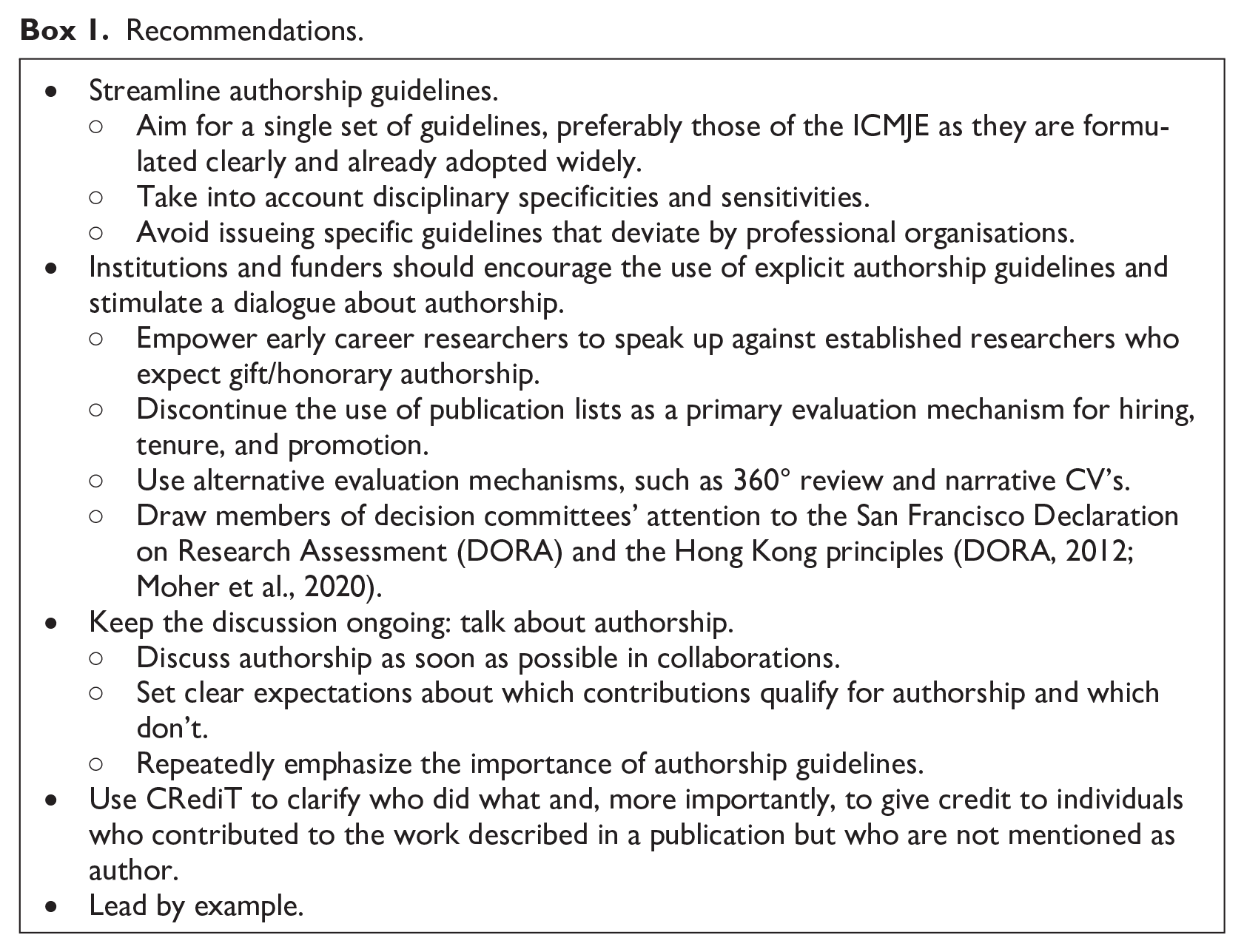
We have listed a set of recommendations in Box 1. We believe these may contribute to a reduction in inappropriate authorship practices, in the field of psychology and beyond. These should not be set in stone, however as the publication landscape is rapidly evolving. For example, the advent of generative artificial intelligence (GenAI) already created new challenges regarding authorship – and peer review, for that matter (cf. the growing number of published articles that contain snippets of typical ChatGPT output on Retraction Watch 6 ). Likewise, paper mills are a growing problem that needs monitoring and a targeted approach.
Recommendations.
Although our results indicate that inappropriate authorship attribution occurs frequently in psychology, both gift and ghost authorship are experienced less frequently than in the biomedical sciences (Godecharle et al., 2018; Schroter et al., 2020). There is a methodological difference between the Godecharle et al. study and ours: we inquired about ‘being involved’, whereas Godecharle and colleagues asked about ‘observed’ gift and ghost authorship. Although this may explain why Godecharle and colleagues found a higher prevalence of gift and ghost authorhsip than we did, it can not explain why our results differ from those reported by Schroter et al. (2020). Considering that also other QRPs tend to be more prevalent in (bio)medicine compared to the humanities (Allum et al., 2023), our results suggest that the same applies for inappropriate authorship attribution. Although we can only speculate, one potential explanation for the distinction is that research papers in (bio)medicine mention on average more authors on the byline (Hudson, 2016). Adding one or more additional co-authors dilutes authorship less and may be perceived less ‘wrong’. Alternatively, the increased emphasis on research integrity resulting from recent misconduct cases (cf. Levelt Committee et al., 2012) and the replication crisis (Open Science Collaboration, 2015) may have resulted in greater awareness of rightful conduct.
Study limitations
First, the results reported here stem from a convenience sample: researchers publishing in selected scientific journals in the field of psychology. Evidently, not all respondents were trained psychologists. Hence, the results are indicative of authorship practices in the field but should not be considered representative.
Second, these are cross-sectional results and they should not be interpreted in terms of causality. It makes sense to interpret relationships between variables as cause-and-effect, for example, active encouragement of the use of explicit authorship guidelines leads to less frequent experiences of gift authorship. Our results do not allow making such inferences: they only show that two phenomena co-exist.
Third, although the attained response rate is substantially higher than that of comparable studies (Malički et al., 2023; Patience et al., 2019; Pruschak and Hopp, 2022; Smith et al., 2020), we cannot exclude a certain amount of bias due to self-selection into the survey. The majority of the respondents’ institutions were located in Europe or North America and as such represent a predominantly Western view on science. The results should not be taken as representative for scientists from other continents or cultures.
Fourth, the results are based on self-report and we did, nor could, check whether respondents answered truthfully. The results may, therefore, to a certain extent be biased by social desirability.
Finally, due to the different authorship guidelines endorsed by research institutions, journals, publishers, and disciplines (Johansson et al., 2023; Pruschak and Hopp, 2022; Teixeira Da Silva and Dobránszki, 2016a, 2016b), there is not a single accepted definition of gift and ghost authorship. However, the questionnaire did not inquire about ‘gift’ nor ‘ghost’ authorship, but about whether ‘someone has been added as an author who did not contribute substantially’ and ‘someone was not listed as an author when they contributed substantially’, respectively. We believe that these formulations duely reflect APA’s criteria and alleviate some of the ambiguity that the terms ‘gift’ and ‘ghost’ authorship might have introduced.
Supplemental Material
sj-docx-1-rea-10.1177_17470161241262244 – Supplemental material for Gift and ghost authorship and the use of authorship guidelines in psychology journals: A cross-sectional survey
Supplemental material, sj-docx-1-rea-10.1177_17470161241262244 for Gift and ghost authorship and the use of authorship guidelines in psychology journals: A cross-sectional survey by Steven De Peuter, Jana Reck, Steffi Bellekens and Gert Storms in Research Ethics
Footnotes
Acknowledgements
The work described in this article was part of the MSc theses of Jana Reck and Steffi Bellekens. They assisted in data collection, analysed part of the data, and wrote MSc theses that served as inspiration. The authors are also grateful to all respondents for accepting our unsolicited invitation to take part in the survey.
Author contributions
Conceptualization: Gert Storms. Investigation: Steven De Peuter, Jana Reck and Steffi Bellekens. Methodology: Steven De Peuter and Gert Storms. Resources: Jana Reck and Steffi Bellekens. Supervision: Gert Storms. Writing – Original Draft Preparation: Steven De Peuter. Writing – Review and Editing: Steven De Peuter, Jana Reck, Steffi Bellekens and Gert Storms.
Declaration of conflicting interests
The author(s) declared no potential conflicts of interest with respect to the research, authorship, and/or publication of this article.
Ethical approval
The study protocol was reviewed for ethical and privacy-related issues and approved by the Social and Societal Ethics Committee of KU Leuven (SMEC) under reference number G-2021-2960. On the landing page of the questionnaire, respondents were provided with information regarding anonymity and confidentiality (cf.  ). They provided informed consent for the collection, storage, processing, and analysis of their responses by clicking ‘Continue’ at the bottom of the landing page.
Funding
The author(s) received no financial support for the research, authorship, and/or publication of this article.
Data accessibility statement
The data cannot be shared: the landing page of the questionnaire specified that ‘All survey data will be treated confidentially and only the research team will see your responses. Responses will only be presented in aggregate form; no individuals will be named.’
Supplemental material
Supplemental material for this article is available online.
Notes
References
Supplementary Material
Please find the following supplemental material available below.
For Open Access articles published under a Creative Commons License, all supplemental material carries the same license as the article it is associated with.
For non-Open Access articles published, all supplemental material carries a non-exclusive license, and permission requests for re-use of supplemental material or any part of supplemental material shall be sent directly to the copyright owner as specified in the copyright notice associated with the article.
