




Abstract
The COVID-19 pandemic posed many ethical and practical challenges for academic research. Some of these have been documented, particularly in relation to health research, but less attention has been paid to the dilemmas encountered by educational and social science research. Given that pandemics are predicted to be more frequent, it is vital to understand how to continue crucial research in schools and other learning communities. This article therefore focuses specifically on research ethics in educational and social science during the pandemic of 2020–2022. The research involved interviews and workshops with University College London (UCL) academics, professional staff and graduate students and encompassed those involved in reviewing ethics applications, researchers dealing with ethics in projects that continued despite disruptions caused by COVID-19, and successful research projects specifically designed to study the effects of COVID-19 in various contexts. The article discusses some of the crucial knowledge and practical experiences that were accumulated. The operational and epistemological lessons learned from this particular institution may have wider relevance to research ethics processes in higher education environments where academics and students are grappling with post-COVID-19 ethical dilemmas and inform broader debates about how research institutions can build institutional knowledge to improve practices of ethics review at the times of health emergencies in future. Our evidence points to the significance of inter- and multidisciplinary, collaborative approaches that flatten institutional hierarchies and to the crucial role played by professional staff. In addition, we argue that ethics review processes must be underpinned by critical debates about wider issues of unequal power relationships between research partners, the nature of knowledge production, ownership and utilisation. To enhance equity and epistemic justice in research practices, ethics education should be an ongoing integral part of research ethics within research institutions.
Introduction
The COVID-19 pandemic had tremendous methodological and ethical implications for educational and social science research. As the immediate practical concern was the risk of spread of virus because of field-based research activities, many researchers swiftly resorted to digital methods of data collection to navigate COVID-19 related restrictions (Newman et al., 2021; Saberi, 2020). Consequently, social science research has faced new ethical dilemmas about participants’ anonymity, consent, confidentiality and potential harm in the process of conducting research in digital spaces (Surmiak et al., 2021). During the pandemic, many researchers had to amend and adapt their methodological approaches, renegotiate their plan of action with their research partners, and undertake professional development training to be responsive to various risks of which they needed to be aware and find new ways of conducting their fieldwork. In particular, there are complex ethical dilemmas that researchers have had to navigate to ensure that both participants and researchers are safeguarded and that their wellbeing is prioritised.
Broadly, the primary focus on public health research during COVID-19 has been on how to ‘contribute to containing the spread of this epidemic and helping those affected to receive optimal care’ (Yeo and Shah, 2021) as well as longer term priorities on developing global research platforms to improve preparedness for similar health pandemics through research and development (World Health Organization, 2020). Wider ethical concerns relate to equity and justice around distribution of resources (e.g. research funding, vaccines and livelihood support to the most affected communities) and how far ‘ethical principles of justice, beneficence, utility, respect for persons, liberty, reciprocity and solidarity’ are followed in this process (Yeo and Shah, 2021). In educational settings, continuity of teaching and learning while ensuring safety and well-being of teachers, students and their parents is also a significant part of ethics. In practical terms, the COVID-19 pandemic has exposed ethical challenges but also created opportunities to learn lessons from new methodological practices in social environments that must account for the ‘living-with’ COVID-19 and potentially future large scale health emergencies (Iltis and McMillan, 2021).
In terms of research during the pandemic, there are pertinent issues relating to methodological approaches and ethics around the design, implementation and dissemination of findings. Particularly, studies that are conducted using technologies can pose both unique opportunities and unique challenges relating to appropriateness of the virtual format; adoption of the right technology to engage with participants; participant selection, equity, access and capacity to partake in the study; researcher positionality; informed consent, risks and confidentiality (Roberts et al., 2021). Much social and educational research focuses on the impact of the pandemic on educational loss (Donnelly and Patrinos, 2022), teacher and student wellbeing (Kim et al., 2022; Schwartz et al., 2021) and the pandemic’s economic and social impact on communities (Yeyati and Filippini, 2021) but less attention has been paid to complexities around research ethics when researchers have more or less willingly adopted remote methods of data collection.
In this article, we focus on some of the practical challenges in overcoming ethical dilemmas in educational and social science research. We draw upon the reported experiences of academics and professional staff who were involved in research activities in various contexts globally as well as in reviewing research ethics application in University College London (UCL), and of some graduate students who had to adapt their doctoral research to navigate several months of restrictions in accessing their research contexts. We report on some of the crucial knowledge and practical experience that have been accumulated in relation to how researchers have dealt with ethics in research projects that continued despite disruptions caused by COVID-19 or successful research projects that were designed to study effects of COVID-19 in various contexts. Even though our study focused on experiences of one UK university, given that our research was concerned with a large number of research projects that were implemented both in the UK and internationally, we argue that the lessons learned may have wider relevance to research ethics processes in higher education environments where academics and students are grappling with post-COVID-19 ethical dilemmas. Additionally, the findings of our study inform broader debates about how research institutions can build institutional knowledge to improve practices of ethics review at the times of health emergencies in future.
Research ethics and challenges for review boards
In sudden outbreaks of infectious diseases that restrict human mobility and in-person interactions, there are immediate methodological and ethical implications for both ongoing research projects and those that are designed to respond to the pandemic. Consequently, a swift review of ethics and approval becomes an urgent priority for institutional review boards. Reviewers and research ethics committees need to process ethics applications swiftly and appraise the existing research frameworks accounting for both methodological rigour as well as the urgency to produce research evidence whilst some of the conventional research approaches might no longer be viable. This leads to considerations about the quality of ethics review supporting the new processes (Calia et al., 2021; Iltis and McMillan, 2021; Saxena et al., 2021). Moreover, it has been suggested that the pressure from funding agencies could also influence research quality (Calia et al., 2021). Research ethics committees often grapple with difficult decisions around how to review the projects and provide appropriate guidance ensuring that there is a balance between public and individual risks of research activities and the public good of the research (Rothstein, 2020). Additional challenges ethics review boards might face include limitations and availability of appropriately trained staff in reviewing and overseeing an increasing workload of COVID-19 research, as well as accommodations to existing research which would have been paused (De Vos, 2021; Iltis and McMillan, 2021). An increase in work pressure due to workload is combined with the need for learning new skills, balancing overlapping responsibilities and urgency to prioritise researcher safety (Iltis and McMillan, 2021; McMillan, 2021; Randles, n.d.).
Some of the ethical dilemmas caused by increased vulnerability during COVID-19 demanded of ethic boards a renewed appreciation of risks. These included new safeguarding issues arising when working with vulnerable populations such as those with mental health issues (Sollis et al., 2021), migrant workers (Amin, 2021) and care home residents (Banks and von Koeppen, 2021; Gruber et al., 2021; Iltis and McMillan, 2021) who directly or indirectly faced potentially life-threatening risks of COVID-19 (Gruber et al., 2021; Iltis and McMillan, 2021). It was important to recognise that participation in COVID-19 social research could be distressing for these sub-groups when the scale and severity of risks were usually unknown particularly at the beginning of the pandemic. The pandemic in this respect was also a time of innovation, with researchers developing new strategies to engage underserved communities (Huyser et al., 2021; Iltis and McMillan, 2021) and negotiating changes in working conditions (Iltis and McMillan, 2021). There have been instances of interprofessional working leading to new research opportunities as well as opportunity to develop new methods (Sy et al., 2020). In particular, the pandemic has seen a shift to online research to facilitate participant safeguarding (Krause et al., 2021; Self, 2021; Sy et al., 2020), and to facilitate research co-production during this time (Arya and Henn, 2021; De Vos, 2021).
However, the shift to online methods has also raised new types of challenges. While these methods offer some advantages such as saving time, costs and reducing travel-related carbon footprints, greater access and response rates, and real-time data with improved quality, several authors have pointed out risks of shifting to remote research, such as concerns around access and capacity (Arya and Henn, 2021; De Vos, 2021; McMillan, 2021; Self, 2021; Sy et al., 2020), consent – particularly in the case of digital ethnographies (Góralska, 2020), and other ethical issues with online interviews (De Vos, 2021). Hence, the COVID-19 pandemic has highlighted the need for contingency plans to support the research infrastructure in times of crisis (Krause et al., 2021). It has also reminded researchers to build lasting, mutually beneficial partnerships with what Krause et al (2021) terms ‘field citizens’ and the importance of mutual support and networking between researchers (Saxena et al., 2021). All of these methodological shifts and ethical dilemmas consequently have serious implications for research ethics boards.
Even though the horrific period of the COVID-19 pandemic has now passed, and the world has returned to ‘normality’, characterised by the situation of ‘living with COVID-19’, many of the research practices have implicitly embedded the legacies of new approaches that were adopted during the pandemic. Hence, this study has a wider scope in terms of understanding the transformative effects of the pandemic on ethics review and ethical research practices, importance of continuous professional development of university staff on research ethics, institutionalisation of online and blended teaching and research and debates about decolonising research methodologies. These shifts broadly point out to the importance of system preparedness and agility for research practice during the times of emergencies and protracted crises.
UCL’s Research Ethics Committee (UCL REC) is the main adjudicator and scrutineer of ethics practice in the University, with the Institute of Education maintaining its own Research Ethics Committee (IOE REC) and a Research Ethics Officer overseeing administration. At the onset of COVID-19, research ethics policy was set centrally by UCL. Subsequently, a UCL Fieldwork Framework Group (FFG) was formed of staff from across the University to respond to the fast-changing environments around COVID-19 by advising on policy. Added layers of scrutiny, assessment and mitigation of potential risk were added to the ethics approval process. Deans were made responsible for the approval of each staff and student ethics application in their Faculty. Delegated authority was possible, and, at the IOE, this included the IOE Head of Research Ethics and the IOE Director of Operations who had to, additional to the usual ethics approval process, review each application. No additional workload resources were given to support this process, nor to its administration. The IOE REC was able to devise its own approach to aspects of policy and practice within UCL guidance. Examples of IOE specific approaches involved: a reduced review time to respond to the pandemic of 7 days to complete ethics review (for context, the current requirement is 30 and 15 days for standard and expedited review) and specific training events linked to new guidelines offered to researchers along with opportunities for all applicants to discuss and receive support from Departmental Ethics Coordinators, the Research Ethics Officer and the IOE Head of Research Ethics. Proformas to assist application and review were piloted and created. Areas within this material included specific, revised risk assessment processes including information on local guidance concerning COVID-19 alongside a requirement to address areas such as mental health and stress and equality, diversity and inclusion issues – for example, regarding those at particular kinds of risk or vulnerability within the contexts created by COVID-19. Applicants and reviewers were also asked to address philosophical, theoretical and methodological issues in relation to the ethical dimensions of the research and such contexts. Ethics boards tend to be practically tilted towards health sciences, which is more so for studies during the times of health pandemics. However, within UCL’s FFG, involvement of the IOE ensured the representation of ethics perspectives in relation to social science research.
Ethical dilemmas for social science research during pandemics
Public health emergencies are not new and there is a growing body of knowledge about how to conduct ethical research during emergencies, particularly since the 2003 outbreak of the Severe Acute Respiratory Syndrome (SARS), the 2009–2010 H1N1 influenza pandemic, and the 2014-2016 Ebola outbreak in West Africa. The World Health Organization (2020) points out that countries that have limited resources and underdeveloped health systems, and particularly those hit by natural disasters and violent conflicts, are likely to be most affected by the outbreaks. The ethical guidance on research by the World Health Organization (World Health Organization, 2020) provides comprehensive guidelines on public health research and the recently published report on research in global health emergencies by Nuffield Council on Bioethics (2020) highlights the significance of ethically conducted research, adhered to ‘fairness, equal respect and helping reduce suffering’ in improving current and future emergency preparedness and response.
Some literature has emerged to highlight the research experiences of social scientists during COVID-19 (Briggs et al., 2021; Kara and Khoo, 2020a, 2020b, 2020c). Additionally, challenges faced by researchers and managers (Iltis and McMillan, 2021) have usefully represented a spectrum of voices beyond that of research ethics specialists to understand the changing face of research ethics during the pandemic.
Ethical dilemmas around conducting social science research during the times of health emergencies require significant interdisciplinary adaptation, accounting for social and economic structures and appropriate arrangements within the research settings, contexts and environments. For example, COVID-19 disrupted the education of the world’s 6 billion children for a significant amount of time (UNICEF, 2020), exposing the vulnerability of education systems that both logistically and culturally lacked agility and techno-adaptability to substitute the centuries-old educational models. Given that pandemics are predicted to be more frequent, it is vital to understand how learning and teaching can continue in safe environments; how to identify any loss of learning during the pandemic; how to continue crucial research in schools and other learning communities; and how to innovate pedagogical practices to build resilience and mitigate the adverse effects of the pandemic within education systems in low-tech and socioeconomically disadvantaged communities. COVID-19 safety measures may be more difficult to follow for socially and economically disadvantaged families who live on daily wages from frontline/service work; have difficulties in isolating when they catch the virus; are more likely to lose their jobs during lockdown; and may also lose social support as public resources are channelled to emergency response and ongoing essential social care programmes are deprioritised.
While conducting research in these contexts, human wellbeing is paramount, it is also vital to ensure that participation in research does not expose researchers and participants to increased risks of the virus or cause distress. As the social environment during pandemics is rapidly changing, ethics also must adapt to contextual realities and draw upon interdisciplinary knowledge and methodological practices. For example, the researcher must be attentive to the emotional wellbeing of participants who may have lost family members, friends or relatives during the pandemic and must also adapt to new health-related sensitivities and ethical implications in addition to existing best practices in research ethics. However, there is a dearth of research around how to navigate ethical challenges and conduct high quality education and social science research during the times of public health emergencies. Particularly, conducting research in international contexts where research is designed by Northern scholars who are trained in northern epistemic traditions exposes tensions around power hierarchies and potentially, the exploitative nature of social science research (Schroeder et al., 2019). Contextual diversity, poverty in the global South, extreme differentials in power and history of colonialism (Schroeder et al., 2019) complicate ethical dilemmas around research within the context of varied levels of pandemic effects and government regulations. In this sense, social researchers could benefit from clear guidance about how to navigate ethics during evolving social and health environments of the pandemic as well as an approach that underpins ethics (both theory and practice) as a decolonial practice.
This article reports on the study that aimed at investigating experiences and perspectives of researchers including research active academics, doctoral students and professional staff at UCL to generate insights that could be relevant to ethics boards and researchers more widely in social science discipline during times of similar health emergencies in future. We argue that the ethics review boards must be agile to unexpected or sudden changes in research circumstances by building robust institutional mechanisms that are equipped to respond swiftly, efficiently and supportively when pandemics occur. Most importantly, ethics review processes must be underpinned by critical debates about wider issues of unequal power relationships between research partners, the nature of knowledge production, ownership and utilisation. To enhance equity and epistemic justice in research practices, ethics education should be an ongoing integral part of research ethics within research institutions.
Researching ethical responses to the pandemic: Methodology
The study focuses on research ethics policies and practice during COVID-19 within one UK university. Since this is a large multidisciplinary research institution, we argue that the experiences of participants from diverse disciplinary backgrounds could be similar to their counterparts elsewhere. The research design consisted of individual qualitative interviews with academics and professional staff, focus group discussions (FGDs) with doctoral students and academics who were involved in decolonising education initiatives at the university and an online workshop with academics whose research projects were affected by COVID-19. The study was conducted between December 2021 and May 2022.
Firstly, 26 UCL members of staff representing various disciplines of social sciences such as education, anthropology, sociology and psychology were invited to participate in the study, of which 18 were interviewed. Participants included purposively selected academics leading research projects, those in the leadership roles of university’s ethics committee and supporting ethics review process and members of professional staff. Interviewees were identified based on their role in research leadership or administration and their research track-record. The reason for purposive sampling was to ensure ‘better matching of the sample to the aims and objectives of the research, thus improving the rigour of the study and trustworthiness of the data and results’ (Yeyati and Filippini, 2021). As we describe the backgrounds of the participants, the aim is to enhance credibility of data emanating from participants’ professional experience and to allow the reader to reflect on dependability, and possible transferability of the findings in other similar contexts (Shenton, 2004). These interviews lasted for about 30–45 minutes focusing on participants’ personal and professional experiences during the pandemic, their consideration of research ethics (including changes, challenges, successes) and reflections or learning points.
Then, we organised three group discussions. The first FGD was held with a group of PhD students from the IOE – UCL’s Faculty of Education and Society, whose fieldwork was affected by the COVID-19-related safety measures in their research contexts as well as by new ethics guidelines required by the university. Doctoral students, as emerging researchers who were both learning about research ethics and putting ethical principles into practice through their studies, provided distinctive perspectives about navigating ethical dilemmas during uncertain times. Research elsewhere reveals that early career researchers faced significant obstacles and difficulties due to limited access to data or participant availability, diminished scholarly support networks due to erosion in interactions with scholarly communities, restricted access to institutional resources and challenges in maintaining a healthy work-life balance, often causing mental health problems (Pyhältö et al., 2023). This FGD concentrated on how the pandemic had affected their research designs and on their experiences of the ethics review during this time as well as broader ethical implications for their studies. PhD students were approached via the IOE PhD student forum and 12 current students expressed interests, but only six of them were able to attend the FGD.
Secondly, we conducted an FGD with scholars who were promoting decolonisation of education and social science research across various departments of the university. Recognising the critique around and limitations of ‘procedural’ and ‘everyday’ ethical practice models that primarily scrutinise the researcher-researched relationship, we intended to examine ethics and power dynamics in the relationships within research teams and ethics review boards (Cascant Sempere et al., 2022). Even though there is a growing body of research around decolonising research methodologies (Igwe et al., 2022; Khupe and Keane, 2017) and decolonising research ethics (Cascant Sempere et al., 2022; Castillo et al., 2023; Chaurey, 2020), ethical concerns for social science research during COVID-19 have not been explored from a decolonial lens. The FGD with the decolonial research scholars was also inspired by Māori scholar Linda Tuhiwai Smith’s critique of dominant academic research that is complicit in European imperial and colonial projects, had in fact, become ‘one of the dirtiest words in the indigenous world’s vocabulary’ (Abu Moghli and Kadiwal, 2021; Smith, 2021). Accordingly, we centred the discussion around the intersection of decolonial research practices and approaches to decolonising research ethics during the pandemic, considering research priorities, epistemic injustices and historical and current power dynamics around the processes of knowledge production and its application. For this reason, we purposively selected and held an FGD with academics who were leading a decolonial café at IOE.
Finally, one online workshop was organised with participants who were identified through COVID-19 research repositories that maintained a list of IOE ethics reviews undertaken during the pandemic. A total of eight from this group were able to participate in the workshop. During the workshop, various scenarios of ethical dilemmas were presented, enabling the participants to share their experiences pertaining to research ethics during the pandemic and reflecting on working with vulnerable populations, professional services and research ethics administration. These hypothetical scenarios, as presented below, drew on our earlier interviews and thus broadly represented ethical dilemmas faced by researchers at UCL:
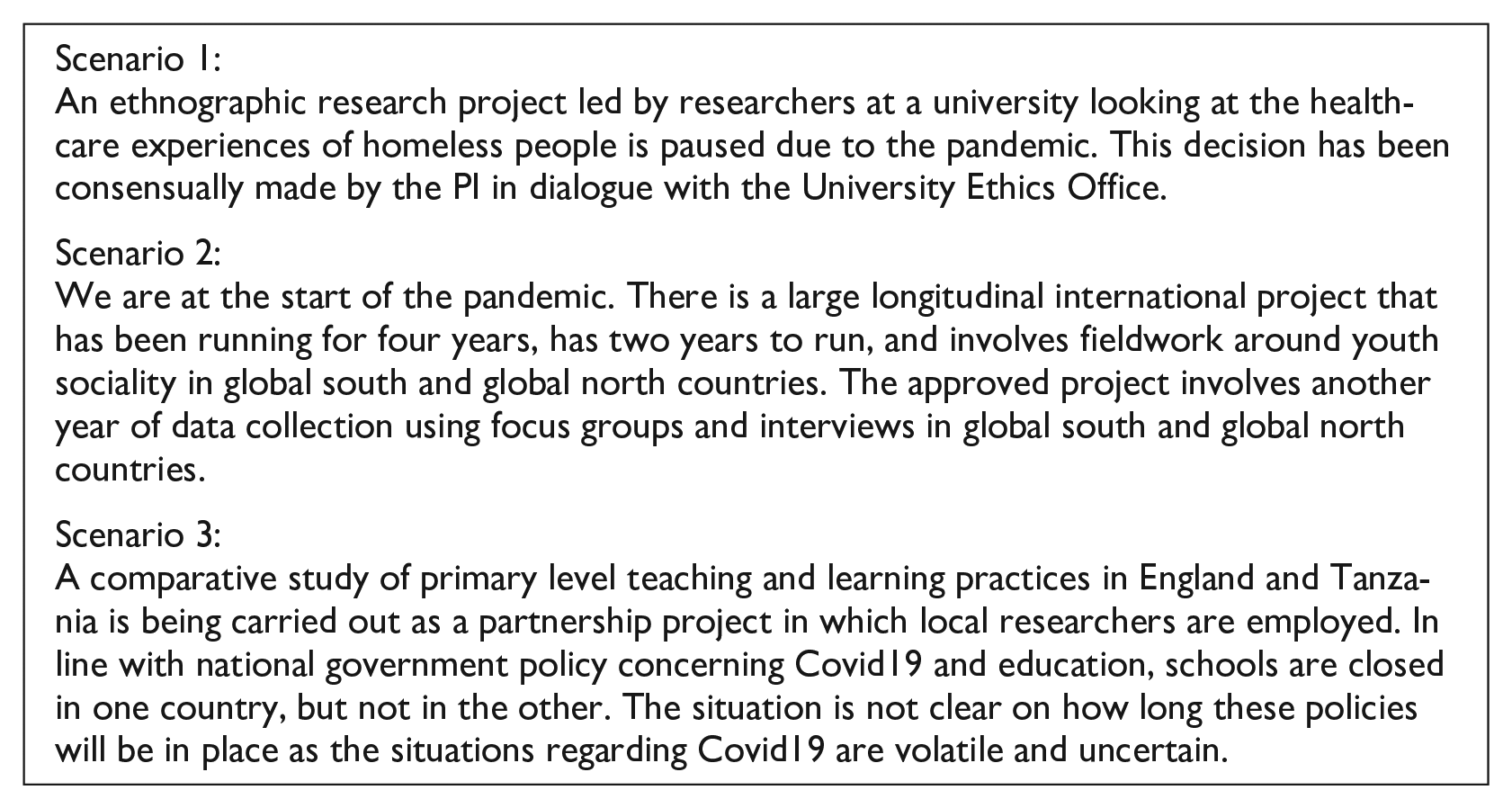
All the interviews and FGDs were recorded and transcribed on UCL Microsoft Teams. The data was analysed thematically using NVivo12. The coding framework and transcripts were reviewed by the research team to develop four broad themes that emerged from the data.
The study received ethical clearance from the IOE Research Ethics Committee. All participants were provided with a Participant Information Sheet, an Informed Consent Form and an opportunity to discuss the study prior to their participation in the study.
Analysis and findings: unsettled normativities, temporalities and spatialities, relationalities and materialities of the research ethics assemblage
The study reveals a range of heterogeneous and contingent elements around processes of research ethics that we call ‘a research ethics assemblage’ during the times of COVID-19. This involves significance of the researcher’s role in adapting ethical and methodological approaches relating to the kinds of data needed and research methods required to align with safety and ethical responsibilities in the research contexts. Hence, we present our findings under four broad themes: (a) unsettled normativities, (b) temporalities and spatialities, (c) relationalities and (d) materialities of research activities. At technical levels, ethics tools such as ethics forms and other ethics instruments needed to reflect adaptive approaches around consent, confidentiality and anonymity considering potential risks arising from mobility restrictions, social distancing and school closures. In particular, we draw attention to what appeared to be stabilised or disrupted, in terms of temporality and spatiality, materialities and relationalities, in fast-changing complex social and public health circumstances. Our emphasis is on the implications for education and social science research specifically and how the localised faculty Research Ethics Committee was not just responsive but also active in this process.
Unsettled normativities
The pandemic was a time when the normativities of research were put into question. One workshop participant, a researcher, reflected the accounts given by many, stating that the period was typified by ‘learning very fast or things being very dynamic and changing’, with another summarising a group discussion as follows: Cutting across the conversation was the kind of fact that there were no easy answers, no stock answers to these questions and that it really reflected the importance of research ethics as practice and a constant process of thinking, rethinking, negotiating according to the space [of] our collaborators, our research participants. So, it was an ongoing process of reflective practice. (Workshop – participant 30, senior research academic)
Prior to the pandemic, participants reported that the ethical priorities were focused on institutional alignments (e.g. between different faculties of UCL, balancing the rights and safety of groups such as children and young people, data protection under new GDPR requirements, issues pertaining to in-person fieldwork). These were subject to rapid change under COVID-19, often identified by specific tensions at the onset of the pandemic, for example, between a ‘thorough’ response and the need for urgency; between a ‘rush to pause’ and ‘consequence’, the need to ‘prevent spread’ or infection by COVID-19 as compared to the importance of accessing and representing people’s experiences. As one of the participants in the workshop noted: Not catching COVID-19 and not spreading COVID-19 was strong to do no harm - but how that might be balanced with the benefit of understanding . . .the homeless experience and how healthcare could better support homeless people during the pandemic? (Workshop – participant 14, mid-career researcher)
A specific focus was placed on minimising ‘risk’ and ensuring the safety of both researchers and participants, even though the concept of ‘risk’ remained a subject of ongoing debate. However, this shift was not static, evolving in response to the dynamic and changing contexts of the pandemic, alongside the continually shifting guidance on research ethics. For example, given the diverse, international contexts of research, there was a need to be responsive to situations where rules on lockdowns were modified or lifted within some country contexts but not in others, or where the ethical guidance from the university differed from context-specific COVID-19 policies: The timeline of COVID-19 is different in different countries and ethical rules are changing and then having to constantly sort of adapt things for those . . . different scenarios which are moving, but at different rates. . .suddenly the rules are completely different from what you planned when you secured ethics clearance for the study .. it’s that problem of the rules always changing and being unpredictable, and either in multiple places or even in one place, I think is probably the greatest ethical issue for me. (Workshop – participant 34, mid-career researcher)
This highlighted the importance of flexibility, trust and adaptability of institutional ethics guidance and demanded high levels of sensibility and moral responsibility on the part of the researchers.
Participants reflected on ethics pre-during-post pandemic to highlight how ethics practices have been merged and transformed. One of the key areas of permanent shift was characterised by the recognition of online methods of research and scholarly interactions. As one of the academics described, ‘I started off being quite against online methods and I came to see that actually [they] offer something enriching . . . intimate, beautiful and harrowing and powerful, and particularly because of the kinds of care and solidarity that we see in the interview encounter’ (Interview – participant 24, senior researcher). Additionally, another participant commented that online methods that were usually considered ‘supplementary’ had now become the ‘central assumption’ in research methodology and more critically, adaptability, multiplicity and flexibility in methods during research became the norm that ‘it is not just about one design and then keeping to it throughout and trying to then make it work through only one method . . . if there is a crisis situation like this then there needs to be a phase, a developmental phase where you can take a step back and think about what other routes might be possible to achieve the same goal’ (Interview – participant 25, senior researcher).
Temporalities and spatialities
At the beginning of the pandemic, participants felt there was a dearth of guidance and opportunity to consult that could help navigate the changes. Professional services, research leadership, field experts and academics worked – together and independently – to review existing research, medical and government guidance and develop new research ethics resources for the researchers. Issues were reviewed on a case-by-case basis, which was time- and resource-consuming but was prioritised by staff involved in the ethics review process. The rigorous assessment of individual cases and complex ethical dilemmas associated with multidisciplinary research projects helped generate well-rounded ethical guidance that would not have been possible by examining ethics scenarios within a single discipline.
For some, there was a sense of research time being speeded up, as aspects of research deemed crucial to pandemic insights were triaged, expedited and ‘brought on stream really quickly’ and other projects had to file amendments and undergo rigorous scrutiny. It was acknowledged that this relied on additional labour by reviewers, professional services staff and a number of other relatively invisible support mechanisms that enabled this to happen and to maintain rigour – while those staff were themselves sometimes hit by illness or caring responsibilities during the pandemic. One of the ethics review board noted: A lot of our reviewers, for example, who we depend on, would be off sick or ill, and for extended periods. . . applicants obviously send in their applications and expect it to be delivered within that certain time. (Interview participant 16 – senior professional services) Everyone [was] working very hard and with few resources. (Interview participant 16 – professional services)
Hence, it was important to have clear guidance and positive relationships with reviewers to deal with ethics applications on a timely manner so that the researchers could carry on with their research and build evidence to inform social and educational policies and practice: I remember the speed and things changing. . . lots of guidance coming out really, really quickly and guidance being updated on the IOE ethics website, which is really helpful and there was an open communication as well between myself and the Chair of the IOE Ethics Committee, which was really helpful. For our project as well. . . there was an urgency. So, when I think there’s an urgency, I think there is an ethical obligation for ethics to be both thorough and, you know, moving swiftly and there’s support mechanisms that need to be in place for that to be able to happen. (Interview – participant 35, professional services staff)
As indicated above, the role of ethics board often goes beyond the formal process of ethics review during precarious and rapidly changing social circumstances. The availability of the board members for consultation and provision of tailored guidance to individual researchers renders a sense of collegiality and professional commitment to high ethical standards. This contributes to building a sense of research ethics among researchers not as an administrative hurdle but an essential professional responsibility that is delivered through a collective effort between researchers and their ethics reviewers. It also promotes an idea of ethics review as a constructive support mechanism that enables researchers to uphold high ethical standards in social science and educational research practices. Interviewees who had successfully obtained grants during the pandemic acknowledged how ‘pivotal’, as one participant noted, this speeding up had been for them to be able to carry out their research. Yet equally, these intensities were perceived as exceptional and specific to the context and unlikely to persist. There was also awareness of the ethical ‘mistakes’ that could potentially occur due to continually changing guidelines, adapting to online methods and work overload, among both researchers and reviewers. One of the workshop participants voiced concerns: It is quite hard for reviewers as well, because sometimes I had to review research in a context that I was completely unfamiliar with and I had to take the applicant’s word for it. (Workshop – participant 32, mid-career researcher)
Some participants argued that being able to seize the moment in terms of developing research bids focused on COVID-19 was itself a mark of privilege that was not available to all – and in fact reflected geographies of privilege and the spatial distribution of the impact of the pandemic. For instance, those with caring responsibilities and concerns for kinship groups outside the home, including in other countries, did not feel that research was therefore something for which they had time and space while they were constantly worried about wellbeing of their loved ones and in many cases involved in organising medical assistance and mobilising diasporic communities to advocate for emergency aid to crippling health systems in their contexts of origin. As participants noted: As soon as the pandemic hit, I see privileged researchers . . . treating it as a data collection opportunity. . . . I felt quite offended because that’s the time some of us were firefighting because our families lost jobs . . . . millions were displaced and moving from one city to go back to their home and dying in the process, were scapegoated and violated. . . . I was literally on the ground trying to do what I could do whereas the other colleagues who were . . . sheltered through the class and geographical location, were actually using it to create research, collect data and then publish papers. So, I just saw disparity in how privileges can work differently. [Decolonial focus group – participant 18, mid-career academic researcher] It was the burden on us as researchers and I was very conscious of that in the study that I was running. . . Two of us had very small children. . . I had . . . no school, no childcare at all. (Workshop – participant 28, senior academic researcher)
The first quote above from the decolonial research group exposes the structural disadvantage faced by migrant academics whereas the second quote reflects the disproportionate effects of the pandemic across social class, family circumstances and positions of power and privilege. Debates about research ethics rarely reach the domain of structural inequalities and injustices within institutions. Nevertheless, the pandemic did rupture rigid institutional structures and their conventional policies, enabling them to adapt to rapid changes in research environments. As one of the participants noted: ‘Getting things done got a hell of a lot easier, much more practical’ (Interview – Participant 13, senior academic researcher). In some cases, these were changes that had been requested for some time and formerly deemed impossible, but which were now swiftly enacted. Examples given included online vivas for doctoral students who would have spent thousands of pounds on their trips just to attend face-to-face examination, hybrid working and online meetings in general. Here, the changes were likely to endure precisely because they had been argued for since before the pandemic.
Others, however, described the tensions between fast forwarding some research and pausing others. They argued that the institution ‘played it safe’ in ways that encouraged researchers also to do the same, particularly in the early days of the pandemic. This had various impacts, including ‘curtail[ing] our trust in students’ as well as jeopardising livelihoods of the research partners who were not compensated for the time lost while the research activities were paused. One workshop participant described the ‘rush to pause’ in the beginning, where research that was not seen as vital to the pandemic recovery efforts was deemed less necessary or as significant and hence put on hold, but without considering the wider consequences for its partners and collaborators. Participants identified a range of challenges related to such tensions, emphasising the complexities of considering dynamics involving decision making, care, risk, responsibilities, ‘burden’ and the relationships between those involved in different roles in relation to research studies: What comes to my mind really is the health side of things, like, not infecting people with COVID-19 while you’re undertaking research. (Workshop – participant 36, mid-career researcher) Meeting with dementia patients. . .immediately they could no longer meet with that cohort, because they were obviously at particular risk. (Interview – participant 4, senior professional services staff) I guess the ethical issue in addition to those that have been raised is burdening participants at times that is incredibly stressful and burdensome already for them. (Workshop – participant 37, mid-career researcher) The extra burden. . .hopefully, it didn’t place too much on parents and teachers . . . [which was] the main, major concern that we had. (Workshop – participant 37, mid-career researcher) I was living with a very vulnerable person, so I couldn’t go out into the field and come back and risk the person living with me. (Student focus group – participant 22, doctoral student) The suggestion from (the) Ethics Committee, and I guess state level policy was to stop (research), and we just didn’t feel that was ethical. We had these . . . really close relationships with our (fieldwork) team so to just drop that because the research had to stop . . . felt like an extractive set of relations with these (participants). (Interview – participant 13, senior academic researcher)
Some ethical conflicts during this time were partly due to issues in integrating ethical infrastructures from different countries or different institutions and contradicting guidelines at different timepoints during the pandemic. However, there were also questions around theories and practices of ethics, for example, in relation to power, positionality and to decolonial perspectives defining who holds the responsibility for ethical action within a decolonial view of research. The renewed focus of ethics review boards, some argued, was on ‘safeguarding of participants. . . [as] the number one priority’ during the pandemic. However, some saw this as a failure to engage with ethics as a process, seeing it just as a bureaucratic exercise – an approach which creates a schism between theory and practice and where ‘risk’ is defined as an individual issue of protecting individuals from health risk rather than looking at a wider picture of ethical relationships and processes. Nevertheless, the iterative approach embraced by UCL in fostering change allowed for continuous evolution in tandem with the unfolding pandemic—a departure from conventional decision-making paradigms.
Whilst historically, research bureaucracy had been a slow process, the pandemic was a catalyst for change, with palpable advantages reported by professional services staff who commented positively on the breakdown of traditional hierarchical barriers in favour of a collaborative modus operandi that made for rapid decision-making and an action-oriented working environment.
It’s asked new questions about our understandings of the tensions and dilemmas and opportunities that are created . . . and we’re still understanding the pandemic. . . it’s how you communicate and create communities of knowledge that can share those discoveries. (Interview – participant 13, senior academic researcher)
For others, both ethics and research were slowed down in ways that opened up new conversations and possibilities. This new situation offered space for creativity and innovation, reflection, embracing different cultural contexts to situate research norms – overall a renewed engagement with ethics as a process rather than a one-off event.
So I’ve experienced lots of barriers, but also lots of creative opportunities for engagement outside of face-to-face encounters that has been really exciting. (Interview – participant 2, mid-career academic researcher) It’s forced myself to think much more carefully about the tensions in ethics, procedures and in my own ethical approach to research. (Interview – participant 2, mid-career academic researcher)
The decolonial research group highlighted that COVID-19 had opened up space and time for engaging in crucial conversations about researchers’ positionality, commitment and awareness of the context, especially in the field of development studies. The colonial history of the field, political economy of international aid and involvement of Northern researchers in international research raised questions about ethics, power relationships and epistemic justice (Unterhalter and Kadiwal, 2022). The members of the decolonial research group noted that the challenging research environment during COVID-19 advanced conversations on these issues which were at the periphery before the pandemic.
There was a lot more reflection, there was a lot more discussion. There was a lot more care. There was a lot more kind of reaching out. (Decolonial focus group – participant 19, early-career researcher)
They also pointed out that the absence of so-called ‘external experts’ on the ground meant more space for communities in the global south to come together and define and discuss their own research interests and perspectives about the issues that needed research inquiry.
The whole space is one where these international experts fly in [to] tell people what to do and fly out again . . . one of my colleagues was telling me that because they weren’t able to do that, a whole lot of local people were engaging in debates and discussion, and in forms of engagement that usually were dominated by so-called international experts, and that there are some really good things that have come out of that . . . . communities of practice that emerged. . . . people feel more confident to articulate that . . . you don’t need these international experts to come in. (Decolonial focus group – participant 17, mid-career researcher)
Hence, it was revealed that the research environment during COVID-19 helped open up wider conversations about ethics in international research in social sciences. It was an opportunity to critically reflect on power imbalances between northern researchers and research partners in the Global South as well to critique data extraction from disadvantaged communities with few direct benefits to or recognition of those who contributed to knowledge production.
Relationalities
One of the aspects commented on by participants was the rise in connection, collaboration and mutual support between researchers during the pandemic – which led to solidarity within the research process and experimentation beyond the boundaries of traditional ways of knowledge production and dissemination methods. While mutual support was sometimes felt to be a response to lack of guidance and processes leading to a grassroots approach, participants commented on a flattening of hierarchies within the research infrastructure that led to a positive experience in research engagement. COVID-19 therefore produced new collaborations across disciplines, such as a Fieldwork Framework Group at UCL, an interdisciplinary think tank that comprised professionals from different areas of work – ethics, policy, graduate research, research operations and leadership. It produced new communities of practice as the decolonial focus group discussed above, or what another participant described as ‘communities of knowledge’ that aimed to share practices while being ‘accountable and fair’. Staff cherished the opportunity to discuss difficult ethical matters with senior staff on the ethics committee or Fieldwork Framework Group and receive individualised support that targeted individual scenarios. For their part, senior figures acknowledged the necessity for this in an evolving context with shifting guidelines.
However, there were issues with harmonising guidelines and practices between countries that had different COVID-19 regulations as well as in research re-start guidelines relating to differences in the pandemic’s manifestation. There were also difficulties harmonising guidelines between institutions (e.g. university ethics board guidelines and research site guidelines), and within different arms of an institution or of the bureaucratic process – for example, issues emerging from defining risk assessment as different from the ethics process. As one of the doctoral students pointed out: The university said, you know, you’re more than welcome to go and do fieldwork, so on and such forth, face-to-face, like, as long as you’ve gone through the appropriate processes spoken to your supervisors, whatever. But in reality, that’s been really, really, really tricky. (Student focus group – participant 25, PhD student)
Successful strategies in place at an IOE faculty level included developing fast-track pathways for COVID-19 research, and prioritising staff wellbeing and support strategies. Addressing the challenges of research ethics also arose from relationships across institutional hierarchies, such as between professional services and academic staff. The transparent – and arguably unusually respectful – relationship between senior management and professional services allowed for professionals to take a lead in designing fast-track routes and move to online research (sometimes in conversation with professional services from other institutions) that allowed research to continue without delay. However, this could produce its own dilemmas – as when the UK government lifted many restrictions that were nonetheless felt still to be necessary – such that professional logics and autonomy came to the fore. As some of the participants highlighted: At the beginning of the pandemic. . . ethics applications were reviewed very fast because there was a new kind of emergency system put in place. for new projects or .. changing projects. . .I was doing a new project and that did feel important, really important. . . here things went quite smoothly. (Workshop – participant 28, mid-career researcher) I was really glad that there was an expedited route available to staff at the time that was, I think pivotal in helping me get my study up and running. (Interview – Participant 8, mid-career researcher) So, for me, putting people first, putting researchers first, putting the academics first, and getting them to put themselves first guided a lot of the decisions and the way I approached many of the difficult contexts with COVID-19. (Interview - Participant 10, research leadership) I think it only worked so well because we have luckily a chair of research ethics and a Director of Research who do value the input of Professional Services, I’m 100% sure [of] that. (Interview – Participant 16, professional services staff)
Among researchers, distance fieldwork posed both challenges and opportunities. For many it was a relatively new practice, with limited methodological experience, knowledge and skills about appropriate use of digital technologies at a time when there was no or minimal guidance. On the positive side, it was reported that mutual support between academics, the development of guidelines for research staff and students, and collaboration amongst colleagues to design appropriate tools, all enhanced creativity and methodological innovations. Efforts were made to demystify online fieldwork, while exploring its strengths and weaknesses in each unique context.
There were questions raised about whether or how far ‘playing it safe’ may have diminished relationships of trust with students and colleagues. One participant described having an altered perception of risk, particularly meaning no longer allowing ‘borderline’ cases of student ethics applications due to a perception that the institution was asking them to ‘play it safe’.
The pandemic exacerbated inequalities in some cases – for instance, by limiting the type of research that could be conducted with more vulnerable populations and making them more severely underserved. The shift to options that drew on emergent online practices of data collection where face-to-face data collection was removed as an option was a development that was identified by some as replicating and deepening social exclusion and division: There’s been an issue of resourcing. . .access to online technologies, we know we’ve been able to see some of the digital divide happening across so many different settings and both within and across countries. (Workshop – participant 30, senior academic researcher)
The COVID-19 induced lockdowns also signified research activity as a ‘relationship’ with commitment and responsibility between researchers and participants that the researchers felt should not come to an end because of a top-down decree on whether or how the research should be carried out. They saw ethical research as challenging extractive neoliberal logics that dominated the process of knowledge production in universities. The pandemic opened up new questions about the ‘extractive’ and exploitative nature of research with communities that did not benefit from that research. In this sense, research itself was seen as a duty of care and justice, which one participant described as something their team felt should be continued regardless of funding: How do we carry on these relationships, and coproduction relationships when. . . it may not generate any research. . .? So, we may not be able to deliver to ESRC, but we know this is important from an ethical and political perspective to carry on. (Interview - Participant 13, senior academic researcher)
The pandemic ignited conversations and collaborations with participants, be it to establish new research priorities or to understand how methods could be adapted to suit their needs – an opportunity that, for some, resulted in testing new and creative ways of doing research: So, we were working with participants who were suddenly experiencing enormously different landscapes. You know, socially, culturally, emotionally, the same for the researchers. The same for the reviewers. The same for us as university workers. (Interview – participant 6, senior academic researcher)
One of the most obvious dilemmas in ethics discourse during this time was how to adhere to ethical standards when the conventional practice of face-to-face fieldwork relationships shifted to online data collection. Researchers transitioning from in person to digital fieldwork commented on positive aspects such as increased reach, accessibility and flexibility, but also highlighted some limitations in accessibility, issues with confidentiality, anonymity, difficulties in building rapport and divisions linked to material resources such as access to the internet, to devices or adapted devices and to divisions of knowledge, familiarity and ease with internet mediated communication. Some were relatively optimistic about the benefits of online methods, identifying how ‘you can work across the globe as we all know in a very easy fashion’ and claiming that ‘ethical problems of online methodology. . . In most instances [are] less than the possible ethical problems that have come through face-to-face research’ (Interview - Participant 12, Senior academic researcher and ethics board member).
Others problematised in some detail the challenges of online research – in particular, how ‘the home’ that had been imagined as a ‘safe space’ during the pandemic was, in many circumstances such as refugee camps, for populations living in unstable accommodations or for participants who were at risk of domestic violence, not safe at all. Therefore, the research space became one of potential interruptions or overhearing that had to be seriously considered to ensure participant safety.
Rather than digital methods that were experienced by some participants as a poorer alternative to in-person methods, some participants argued for more creative approaches that would require different ways of being together with participants so that the long-term relationships could be built around the data collection process. The change to digital methods was also not as drastic for some teams who had already been using them as part of their practices, because of their specific advantages when working with certain populations – in terms of limiting travel, being more flexible with times and economic ways of collecting data. One participant engaged in research with people with restrictive health conditions described being disappointed at hearing colleagues refer to online methods as lesser, a deficit or fall away from the imagined ‘gold standard’ of in-person methods: Everybody was panicky and was seeing (moving online) as a deficit and . . . poorer version . . . I felt really. . . shocked and actually quite annoyed at times because there are specific kinds of research settings and contexts where the virtual environment is the only one that’s ethically acceptable and should be pursued in the first place. (Interview – participant 12, Senior acacemic researcher and ethics board member)
Risk was positioned as a domain that could not be viewed entirely based on criteria used in relation to research ethics that existed before the pandemic. Instead, the concept of ‘risk’ exhibited an iterative nature, wherein understandings of the factors influencing risk underwent constant evolution. This evolution was shaped by emerging knowledge and responses to the pandemic, exhibiting variations across disciplines, domains (including medical, political policy and social groups and practices), and contexts, while also being subject to ongoing contestation. As one of the workshop participants argued: There were no easy answers, no stock answers to these questions and that really reflected the importance of research ethics as practice and a constant process of thinking, rethinking, negotiating according to the space of our collaborators and research participants. So, it was an ongoing process of reflective practice. (workshop – participant 30, senior academic researcher)
Drawing on Judith Butler’s insights, ‘vulnerability’ can be conceptualised as our profound dependency on one another to live (Butler, 2016), a reality starkly illustrated by the impact of COVID-19. The ongoing debate revolves around striking a balance between mitigating risks to stakeholders and avoiding compromises to data quality, especially when opting for methods that may be less optimal for addressing specific research questions.
Materialities of research activities
The materiality of the research undertaking was one of the novel challenges exposed by the pandemic. Human bodies, the physicality of research participants and researchers, and their potential vulnerability to exposure to infection, impacted often taken for granted methods of research engagement. The participants commented on the psychological and emotional effects of COVID-19 as well as those of COVID-19 related social practices and governments’ policy responses to the pandemic. The emotional ‘load’ of risk and vulnerability and how to respond to these circumstances was raised as an issue: There would be researchers who actually said, ‘you know, we can’t manage and we need to. . . You know, we feel very stressed. . . we don’t quite have the tools to convert our research online or remotely’. (Interview - Participant 10, research leadership) And the workload on the staff was so heavy at that time because everyone was, . . . first of all, just nervous like in their personal capacity about the pandemic. (Interview - Participant 11, mid-career academic researcher and ethics reviewer)
However, no extra resources responding to the additional ethics workload were offered by the management of the IOE. For example, the extra workload involved in implementing and supporting new review processes by the IOE’s Research Ethics Officer, and the requirement for the IOE Head of Research Ethics to lead the development, implementation and staff training related to the new processes and, additionally, to review every ethics application was to be undertaken within their usual workload.
Few students in the focus group expressed dilemmas about balancing protective measures against the risk of transmission of the virus and building rapport with the participants during their interviews: I’m just thinking, if wear a mask, it would make me a bit socially distant from participants, but because no one else there wears a mask and I was thinking, what if I caught COVID-19 in (my fieldwork site) . . . I’ve taken all the vaccines like fever, yellow fever or any other vaccines, all the tablets. . . I’ve taken all the necessary measurements. But still there’s a risk, and what if I transmit the virus- like two of the students where they don’t have very good health. . . medical services. . .yeah, there’s a dilemma. (Student focus group, participant 26, PhD student)
It appeared that one of the crucial points of intervention of research ethics committees at the beginning of the lockdown was a sense of requiring that risk in health terms be foregrounded. New processes became more or less visible: I see research ethics in research integrity as fundamental for the work of researchers, but sometimes the work that goes behind the scenes in order to enable these is almost invisible. It’s almost like some colleagues, only through no fault of their own. . . . they would only notice these if something goes wrong. (Interview, participant 15, professional services staff and research integrity specialist)
As the COVID-19 policies and restriction measures on ‘lockdown’ fluctuated over the time, the levels of social interactions also changed with implications for online methodologies. Consequently, researchers grappled with the challenges and intricacies involved in deciding when and how to resume or initiate face-to-face data collection, navigating the complexities of building or re-establishing relationships. Notably, public discourse often depicted the home as a safe space for research interviews, yet researchers remained cognisant of the otherwise reality, necessitating vigilance to ensure privacy, especially in instances of crowded living conditions. A participant during the workshop highlighted sensitivities around online interviews as: A change in methods does definitely change the ethical considerations that you have to take into account. . .about confidentiality as well. . .[during online interviews] if I’ve got a black screen, I’ve got no idea who else could potentially be in that room with that person. (Workshop – participant 36, mid-career researcher)
Research integrity also overlaps with research quality, with considerations about the limits of online methods in capturing full and rich data – particularly the loss of observational and contextual data and the quality of research outputs that might not fully account for this limitation. Over the post-COVID-19 two years or so, the conversation on research integrity has shifted to the ethical use of artificial intelligence in research, the critical point about the importance of quality and context seems to have been overshowed, undermining legacies and implications of COVID-19 on ethics in education and social science research.
Regarding digital accessibility, access to expensive equipment like smart phones, tablets and computers, the hidden costs of internet connectivity and electricity, not to mention technological skill, knowledge and inclination, pose a real barrier to reach certain research participants. Some participants highlighted the potentially unequal effects of the material on research participation: You can perhaps assume that there might be (. . .) differential access to things like technology and stable broadband, which I think has all become a bit essential for us in the last couple of years. And, so, I suppose one ethical issue would be that the crisis had different kind of crisis points of different countries. You know, if you were able to do the research in one place but are not another, what does that mean about who gets heard and who doesn’t? (Workshop – participant 36, mid-career researcher)
However, interestingly, some participants noted that digital literacy and access to online technologies was broadly customary across different socioeconomic groups: Everybody is a lot more connected. Everyone is used to using smartphones and digital devices for everyday life. But I think that’s made a huge difference and it’s simplified things and. . . Maybe made them safer. (Interview – Participant 5, research delivery staff)
While some felt that the restrictions and caution during the pandemic made for ‘less adventurous’ projects, others held that restrictions on face-to-face fieldwork forced researchers to adapt their methods to new social environments, giving rise to methodological creativity and innovations in the face of constraints. As a result, new opportunities emerged for research co-design, participant-led data collection and access to wider geography of research sites. One participant intriguingly articulated the novel insights gained through online methods, recounting their experience of virtual participation facilitated by a camera positioned in their room. The greater the experimentation with camera positioning, the more avenues unfolded for a dynamic researcher-device nexus. This shift in camera placement facilitated a departure from the usual gaze of the researcher, decentering them and shifting the focus towards the embodied experiences and perspectives of the participants instead.
Some participants noted how COVID-19 had taught longlasting skills of remote research with clinically vulnerable groups – beyond those at risk of COVID-19 or living with long COVID - that would be continued into the future. They also noted the benefits of enabling participants to choose to participate in different ways.
Another key aspect of materiality involved resourcing, which involved the pay and conditions for researchers who were on temporary and precarious contracts, compared to those permanently employed. This particularly applied to research contracted by the university overseas and what happened to overseas researchers when their projects were put on hold. In this sense, universities that paused research ostensibly on ethical grounds to prevent health risks were complicit in abandoning their ethical responsibilities towards their research partners whose livelihoods were compromised. Additionally, the research pause was detrimental to doctoral students with limited finances who were at risk of jeopardising their entire study and qualification. They were arguably also the group least resourced to adapt fieldwork approaches, negotiate conflicting guidance, or even change methods altogether.
Unsurprisingly, most recipients of grants and funding providers did not have protocols in place to deal with the disruption caused by the pandemic, resulting in loss of income, unanticipated costs and stress regarding unmet deadlines and suchlike. One of the roles of the institution was to deal with the inadvertent consequences of this, by understanding requirements of different stakeholders, and using available tools (such as furlough) to safeguard livelihoods where possible. While research staff livelihood is seldom considered within research ethics, the pandemic raised this as a field for action. In some cases, research teams were able to redirect their budgets to accommodate changes and additional costs (e.g. fieldwork and travel budgets being repurposed to equip teams with online data collection equipment). One participant described how funding uncertainties meant a researcher applied for and got another job, thus setting back the project still further, while another remarked that diversity could suffer if intensities meant that only researchers who could ‘hit the ground running’ were appointed: The general risk to stopping the study entirely and what that would mean for potential future benefits for those participants and advocacy, but also field work staff and / or researchers. And what happens particularly on short term contracts. But even thinking about career wise. And what will be lost for the participants as well as you know? . . . How we could change things and whether that would be similar or not, and all those kinds of weighing up of risks and benefits of different kinds. (Interview – participant 13, senior academic researcher)
The ethics application form also became a material device that was or could be redesigned to respond to the changing research contexts and, as part of this, to promote ethical behaviour. Previously, it was acknowledged that risk assessment could be treated as a ‘box ticking exercise’, not to be taken seriously, that suddenly acquired new meaning and urgency. Some academics highlighted that both academics and research students found it difficult to work with the ethics forms and they needed to think very creatively and rigorously about ethics during the pandemic.
There was also a debate among interviewees about whether the formal ethics processes served the purpose and the extent these required improvisation, account for positionality, awareness and in-depth knowledge of contexts as well as space to reflect on the acknowledgement and evidence of decolonial thinking. One of the participants eloquently argued: A robust framework, in my opinion, is not a framework that has everybody satisfactorily fill in form. A robust framework. . . . generates researchers who are ethical on the ground and are continually conducting risk assessment. . . . . I would like to see a much greater emphasis on problem solving. . . It would be good to get students and staff as well to work through examples in classes. And to get them to undergo various kinds of mental simulation. And to.. design the form knowing that that’s taken place. (Interview – participant 1, senior research academic and risk assessment specialist)
The decolonial group compared how proposed research with children generated an automatic ‘red flag’ in many situations of ethical review and wondered if research in international contexts could be flagged in similar ways to highlight the need for researchers to show decolonial orientations and insight, such as a capacity to reflect on positionality and its impact on knowledge production, preferably earlier in the process than is often the case for many doctoral researchers. One of the participants in the workshop noted: Even though I think all researchers know that the ethics form is just the form and things probably change, the fact that that’s [decolonial approach] not acknowledged on the forms is weird. . . It would be a better representation of the way we actually do our research if there’s a section that gets you to think forward. (Workshop – participant 36, mid-career researcher)
Nevertheless, the participants acknowledged the limitations of the ethics review process in this regard. One of them lamented: We keep saying it’s not the cultivation of an ethical project, but the cultivation of an ethical researcher. How do you develop an ethical sensibility in students? How do you assess that sensibility on a form? Can you? What would it look like for us to start? (Interview – participant 1, senior research academic and risk assessment specialist)
However, the experience of rapid changes in ethics guidance and ethics forms was arguably beneficial to researchers during COVID-19. The new ethics guidelines and questions in the forms stimulated researchers to consider new ethical dilemmas and specificities about their individual contexts which they might not have accounted for, rather than enforcing adherence to externally defined rules.
Learning from the COVID-19 research ethics experience: New directions
Overall, this study revealed that research community in social sciences learnt enormously from ethical challenges, having to deal with new kinds of risks and to adapt their methodologies rapidly in the process. These included greater appreciation of researchers’ and participants’ vulnerability, increased respect for the needs of minority communities in terms of risk and accessibility requirements, and skills development on application of digital methods and fast-track research pathways. Participants championed the adoption of a post-pandemic ethos characterised by adaptability – a readiness to flexibly adjust research frameworks and plans. This approach would empower them to swiftly adapt to evolving circumstances and sustain a collaborative environment. These speculations also merge with the hope for a better research ethics education and culture, which acknowledges ethics as intrinsic to research rather than accessory, in which considerations about positionality are crucial and embedded within the bureaucratic processes.
The COVID-19 pandemic has exposed shortcomings and fragility in the ethics review systems in research institutions as well as stimulated debates about how we think about research, deal with ethical issues, conceptualise the role of ethics review committees as well as the responsibilities of researchers. It has also challenged how we consider power dynamics between research partners from ethical perspectives. Health pandemics occur frequently and exacerbate socioeconomic inequalities by disproportionately affecting the most disenfranchised and vulnerable communities (Corssa et al, 2022; Haelermans et al., 2022; Murshed, 2022). To this end, it is vital to critically reflect on how research is designed, knowledge produced, and communities served in the process of ‘building back better’. Hence, the conversation about research ethics during pandemics must not end with the experience of ostensible post-pandemic normality, but continue to ask how best to learn from experience and build institutional knowledge of research ethics to equip all researchers with critical knowledge about the legacies and implications of COVID-19. As one of the participants asserted, the pandemic has changed the world for ever, including the way we think about research, ethical practices and the role of ethics boards and the way we engage in partnerships and with partners in research projects (Interview – participant 34, mid-career academic). What may be considered trivial pre-pandemic could be significant as we live with COVID-19.
Some innovations that have previously been ruled out but that proved eminently achievable under COVID-19 (e.g. online vivas, online data collection and research meetings) not only continued but also opened the door for more consistent use of new ways of working. The learning across institutional hierarchies was also very much continued through a cross-departmental seminar series that provides wider ethics education and insight as well as the events through decolonial cafes that encourage staff and students to reflect on power dynamics. There has been a significant cultural shift away from ethics as an institutional governance mechanism to a contextually appropriate dialogical approach, reconfiguring the supportive role of ethics committees in that process.
We consider the research experiences during COVID-19 as useful lessons that could advance both the institutional ethics processes as well as broader debates about research ethics in social sciences. These lessons could be summarised in two broad thoughts: operational and epistemological. The operational dimensions speak to the need for relevant institutional knowledge and mechanisms that are well equipped to produce and disseminate new guidelines as well as to ensure appropriate staffing and training to reviewers of ethics applications. The epistemological aims consist of reframing research ethics by considering the power relationships that research engenders and alludes to a critical approach to understanding research as equity and justice in relation to knowledge production and the communities it serves. Both thoughts intertwined, what emerges from this study is the importance of ethics education – a critical engagement with broad notions of research ethics, acknowledging the legacies of coloniality and epistemic injustices, and fostering continuous reflexion and adaptation of ethics review process as the idea of ‘ethics as a practice’. A salient theme emerged about the importance of mapping ethics as an iterative framework, beyond the technical exercise, a process that is a creative act of ongoing critical thinking and learning experience. The challenge is for the bureaucratic and process-based aspect of this process to facilitate critical thinking and learning, and to situate this within a broader, ongoing discourse of research ethics in which all students and academics share responsibilities.
Footnotes
Acknowledgements
Authors would like to thank all the research participants who shared their experiences and insights about research ethics during the COVID-19 pandemic.
Declaration of conflicting interests
The author(s) declared no potential conflicts of interest with respect to the research, authorship, and/or publication of this article.
Funding
This study was supported by funding from UCL Grand Challenges (Human Wellbeing).
Ethical approval
The study received approval from IOE Research Ethics Committee at University College London.
