




Abstract
This paper addresses the issue of how local and global norms and requirements are negotiated in the early stages of development of Social Science research ethics policy in a Global South context. A review of relevant literature followed by analysis of relevant national and institutional policies highlights both tensions and creative potential for ongoing research ethics initiatives. It was found that safety, trust and confidentiality issues are common problems reported by social science researchers in Kyrgyzstan. National level documents do not directly address these ethical research issues, but the need for international research ethics principles is recognized. A limited number of institutional policies address research ethics issues, with the majority of relevant documents being codes of conduct focused on virtue ethics. The paper argues that this analysis of the current situation in Kyrgyzstan is likely to be of relevance to many countries, where those responsible for governance of research at all levels are grappling with the tensions of navigating research ethics in ways that are meaningful in local contexts while being congruent with Global North ethics requirements of funders and publishers.
Keywords
Introduction
The development of higher education research is essential to the reform agenda of Central Asian countries. Recent policy initiatives in Kazakhstan, Kyrgyzstan, and Uzbekistan recognize the current under-development of research and knowledge production. This has led to the establishment of national research and knowledge production goals and, concomitantly, a focus on issues of research ethics. Within this context, ethical research is critical to research quality. This has been recognized in Kyrgyzstan, with the Concept of Scientific and Innovative Development explicitly stating the intention to “implant international standards. . .related to the ethics of research and development” (Government of the Kyrgyz Republic, 2017: 34). However, a number of researchers working within the Central Asian context report having encountered ethical difficulties when conducting fieldwork research (Whitsel and Merrill, 2021). Although biomedical research in Kyrgyzstan is regulated by a number of national laws and regulations (Zurdinov et al., 2007), Bekmurzaev et al. (2018) claim that “The legal framework and institutional policies in this area (i.e. research) give virtually no indication of who can or should do what kind of research, on what topics, and under what conditions’’ (p. 102). Similarly, the findings of Jonbekova (2020) suggest that most Kyrgyzstani higher education institutions (HEIs) do not have ethics approval processes. This implies an absence of institutional policies guiding social science research, but no systematic analysis of the national and institutional policies has been conducted to provide evidence for such claims.
The aim of this paper is to analyze this rapidly developing policy context of social science research ethics. The overarching research question addressed in the paper is:
How are local and global norms and requirements being integrated into the development of social science research ethics policy in Kyrgyzstan?
This question is addressed through a literature review of the current situation, followed by analysis of available national and institutional policy documents.
Literature review
In recent years, ethical systems and norms developed in the Global North through ethical regulatory institutions (e.g. Institutional Review Boards, Ethics Review Boards) and numerous documents of ethical principles (e.g. the Nuremberg, Helsinki Codes, the Belmont Report) have increasingly been applied to countries of the Global South and extended to social sciences and humanities with little account taken of contextual and disciplinary peculiarities. Although compliance with ethical standards in research involving humans is widely accepted as essential, the blind application of western research ethics principles and procedures to studies conducted by social scientists working in diverse contexts may have unforeseen impact on social science research activities.
With the internationalization of science and research, the applicability of western-led ethical regulations has been questioned by scholars in social science research (Czymoniewicz- Klippel et al., 2010; Whitsel and Merrill, 2021) and in diverse cultural contexts (Gray et al., 2017). Gray et al. (2017) highlight the need to “challenge the universalist assumptions built into the international guidelines’’ (p. 23). Jonbekova (2018: 16) has criticized the replication of Western codes, which “do not fit every context and, if used as a prescriptive practice, can create fear and discomfort among participants’’. Robinson-Pant and Singal (2013: 417) state: “It is being recognized that existing ethical codes and paradigms. . . tend to be rather restrictive and insensitive to multiple and complex cultural and contextual differences.” Appadurai (cited in Whitsel and Merrill, 2021) claims that research ethics policies and procedures not only fail to achieve their aim of protecting human participants but also limit the research imagination of social scientists. Pointing out the dynamic reality of research fieldwork, Merrill and Whitsel (2017) claim that the universalized ethical principles are based on a strict “powerful researcher-vulnerable participant” model. They argue that in the context of research fieldwork, relationships between researcher and participant are less distinct, and thus power balances may shift.
The West-generated scientific research procedures and biomedical research ethics principles have been not only imposed by transnational organizations and research centers, but also mimetically copied by countries in the Global South. As argued by Tlostanova (2006), it has been common practice to “catch up” with the so-called developed West. Silova (2018) asserts that this is related to the political and economic dependency of most Global South countries on Western donor organizations, which push them to adopt international policies in order to secure a certain level of legitimacy and/or financial aid. The results of such practices, however, may be destructive for scientific and research activities, shoehorning researchers into the interests of external bodies. Moreover, as Silova (2018) claims, such practices assume “the superiority of Western theory in researching education in other cultural contexts” and have a tendency to homogenize “the multiplicity of non-western realities, devaluing epistemic differences and overlooking alternative interpretations” (p. 194). She argues that scholars, researchers, and policy influencers need to rethink the purposes, values, methods, and ethics of research and extend our thinking beyond the confines of Western conceptions of doing research (Silova, 2018).
Turning to Kyrgyzstan in particular, there is currently limited research on research ethics in the country. An analysis of 13 studies identified through an extensive literature search in English, Russian, and Kyrgyz languages revealed that a fundamental concern reported by foreign researchers who conducted fieldwork studies in Kyrgyzstan was their own safety and the safety of the research participants. This includes authorities’ increased interest in the researcher’s work, referred to as “spy-mania” (Borbieva et al., 2016). One reason for increased interest on the part of authorities could be specific topics of research (Bekmurzaev et al., 2018; Borbieva et al., 2016; Kurambayev and Freedman, 2020; Wilkinson, 2007, 2008). However, it is not only authorities who can view Western researchers as spies, as this can also be true for prospective participants (Meyer, 2016; Shamatov et al., 2010). For example, a PhD student who conducted linguistic fieldwork in Kyrgyzstan to learn about various dialects of the Kyrgyz language encountered suspicious attitudes of his research participants toward him and his research, which he explains as being due to local people’s concerns with their immediate safety and long-term consequences for themselves and their community members (Meyer, 2016). This kind of mistrust of researchers has clear implications for research ethics, as basic principles of benevolence and trust are at risk.
A comprehensive review of ethical problems faced by social science researchers in Central Asia, including Kyrgyzstan, is provided in the articles by Jonbekova (2020) and Jonbekova and Kuchumova (2020). Having conducted qualitative semi-structured interviews among 21 educational researchers, Jonbekova (2020) found out that the problems are grouped around three major themes: “gaining access to participants and data, data collection, and data dissemination” (p. 5). These problems were then extended to the discussion of an underdeveloped research culture and limited understanding of research ethics in her article with Kuchumova (Jonbekova and Kuchumova, 2020). Jonbekova’s findings are consistent with other studies on this topic in the region, namely, restricted access to information (Janenova, 2019; Kurambayev and Freedman, 2020), to research participants (Bekmurzaev et al., 2018; Janenova, 2019; Meyer, 2016), difficulty with the use of informed consent in the data collection process (Janenova, 2019; Whitsel and Merrill, 2021), and ethics approval (Bekmurzaev et al., 2018; Merrill and Whitsel, 2017).
Importantly, the issues of trust and confidentiality were raised in all of the analyzed papers. These issues impacted access to research participants and readiness to sign informed consent forms. If the research participants in the reviewed studies were familiar with a researcher (Wilkinson, 2008), or a researcher was vouched for by a friend (Bekmurzaev et al., 2018; Jonbekova and Kuchumova, 2020), or had established trust (Janenova, 2019; Whitsel and Merrill, 2021), research participants were eager to participate in the study and sign the consent forms. These findings are consistent with the findings by Berekeyeva et al. (2024) who found that only 46.3% of the Central Asian researchers in their sample managed to obtain written informed consent by having participants sign a form. Somewhat contradictory results were reported regarding confidentiality. Despite the fact that the majority of the studies stress participants’ concerns about confidentiality, Merrill and Whitsel (2017) describe a different situation where some research participants occupying public roles want publicity instead of confidentiality and might be offended if left unnoticed.
This analysis of the limited literature available reveals that issues of safety, trust, and confidentiality are at the top of the list of concerns in social science research in the country. Some analysts explain this by the unstable political situation in the country (Wall and Molinga, 2008). Moreover, just like Kazakhstan and Uzbekistan, Kyrgyzstan is characterized as an autocratic state (Collins et al., 2023) that results in elevated levels of bureaucratic control, surveillance, and censorship, posing safety considerations for both researchers and participants (Janenova, 2019). Indeed, the political situation may force scholars conducting research into conflict and security-related topics to seek legal assistance to protect themselves and their research participants (Bekmurzaev et al., 2018), choose politically correct topics (Jonbekova, 2020; Jonbekova and Kuchumova, 2020), or misrepresent themselves or their research when questioned about it (Wilkinson, 2008). Interestingly, as Meyer’s (2016) fieldwork reflections explicate, not only local but also global socio-political situations (North American in Meyer’s case) can make a recognizable impact on research, and more specifically on access to participants and information, thus making prospective informants suspicious of foreign researchers and unwilling to consent to speak (Bekmurzaev et al., 2018; Jonbekova, 2020; Jonbekova and Kuchumova, 2020; Kurambayev and Freedman, 2020; Whitsel and Merrill, 2021).
Some researchers think that legal and institutional regulation of research activities can help protect researchers and participants (Bekmurzaev et al., 2018). However, others think that in such a situation, institutional review boards or normative ethics rules are of little help, explaining this view in terms of their limited focus, mostly on research participants (Borbieva et al., 2016), and at times creating unnecessary obstacles for conducting social science research (Jonbekova and Kuchumova, 2020; Merrill and Whitsel, 2017).
Methodology
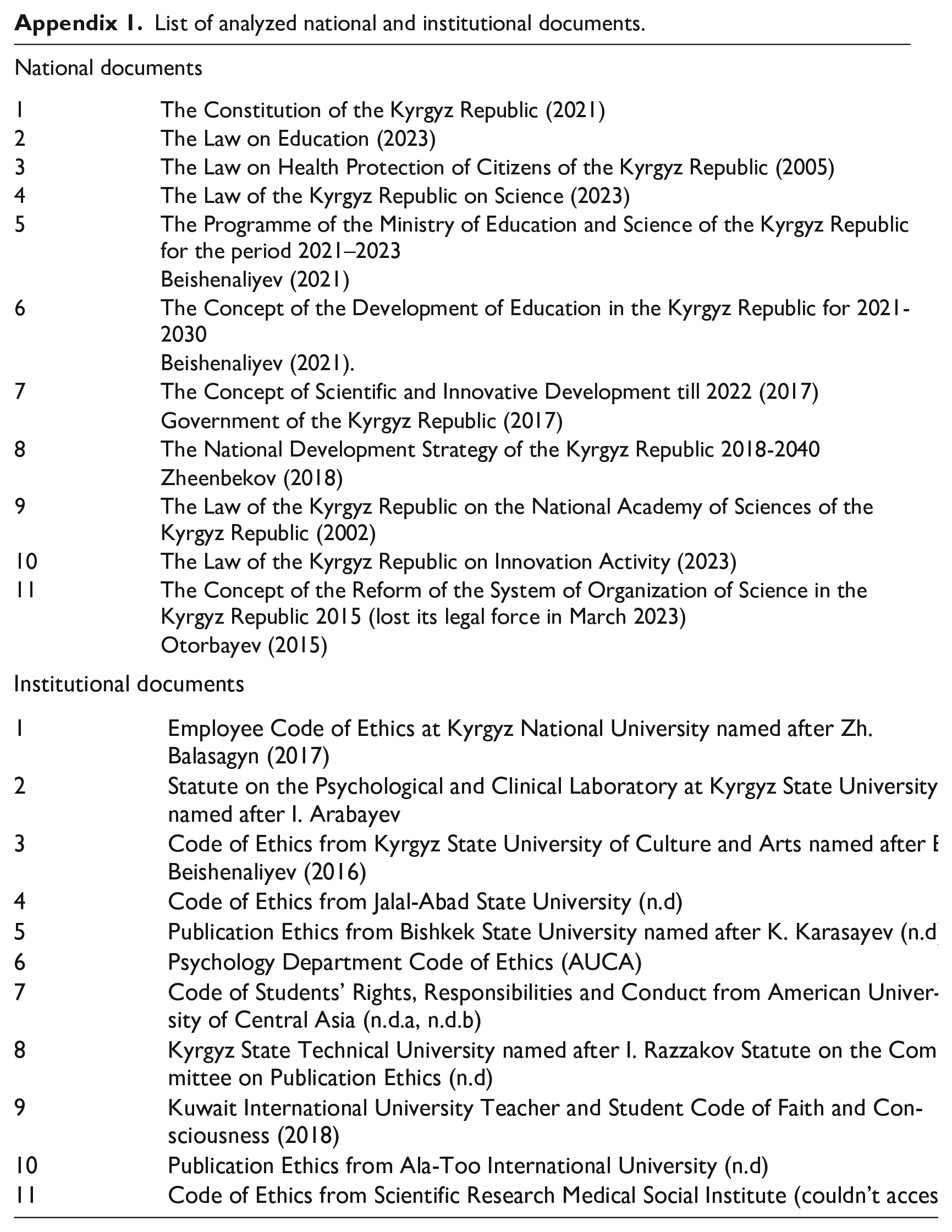
Analysis of documents is essential to understand the political, legal and regulatory frameworks of actual and possible activity, in this case in the field of research ethics. Documents have been a key source of data in qualitative research for many years (Bowen, 2009). This paper uses two types of documents to examine the topic of social science research ethics in Kyrgyzstan: national policies and institutional policies. Overall, 11 national policies and 11 institutional policies were analyzed (see Appendix 1).
National laws, strategies, and concepts were purposefully extracted from government websites. The inclusion criteria involved the relevance of the documents to either science and research or education. The laws were selected on the principle of being in force, while strategies and concepts were checked for their present-day applicability.
We then analyzed the websites of 26 higher education institutions (HEIs) in the Kyrgyz Republic, comprising 16 public and 10 private HEIs, retrieved from the list available on the website of the Ministry of Education and Science of the Kyrgyz Republic. The criteria for selection of HEIs were the presence of social science programs in HEIs and the availability of their own websites. The selected HEIs’ websites searched manually for the presence of ethics policy documents, research ethics committees, and departments with ethics-related courses. During the search, special attention was paid to such sections of the websites as “Research,” “Science and Development,” “Policy documents,” and “University structure and organization.” While our primary focus is on research ethics, we only found one document related directly to research ethics in the initial search phase. Therefore, we decided to extend our search to other related documents such as the codes of conduct that often encompass ethics guidelines relevant to the broader university community. In our analysis, we considered these documents to gain a comprehensive understanding of the research ethics landscape within higher education institutions.
Documents from government and institutional websites were extracted in the Russian language since most of them are available either in Russian or Kyrgyz languages. The concept-driven and data-driven categories and subcategories were identified in Russian and then translated into English by one of the authors whose native language is Russian and who holds a bachelor’s degree in English Philology. Only one institutional document (AUCA Ethics Code of Psychologists of Kyrgyzstan) was extracted in the English language as it appears on the website concerned.
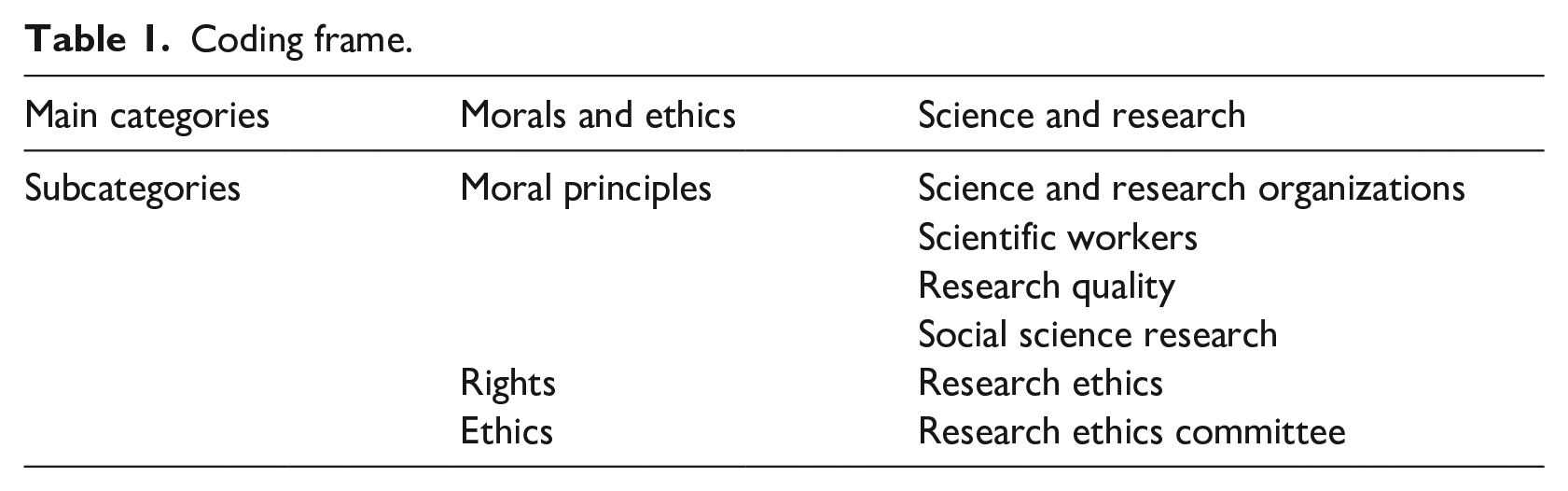
Qualitative content analysis (QCA) was applied to assess national and institutional policy documents. This method is used to describe the meaning of qualitative data and is systematic and flexible (Schreier, 2012). QCA is divided into a series of steps involving the creation of a coding frame, segmentation, trial coding, evaluation and modification of a coding frame, and main analysis (Schreier, 2012). The coding frame is developed from concept-driven and data-driven categories and subcategories. To start the initial content analysis of the documents, we developed research ethics concept-driven categories (i.e. “ethics,” “research,” “ethics committee,” “ethical principles,” “morality,” “values,” and “social science”) to identify relevant information and to separate it from non-relevant information. The documents’ line, phrase, sentence, and paragraph segments were selected for the analysis. Then the trial coding, using predefined categories, of the policy documents was conducted. The pilot phase of the analysis revealed data-driven categories. Therefore, having finished the pilot phase we built a coding frame on the basis of concept-driven and data-driven categories and subcategories (See Table 1).
Coding frame.
Analysis
National policy documents
There is no single national document that discusses social science research ethics in Kyrgyzstan. National concepts and strategies developed in coordination with international agencies provide a vision for future development, whereas laws and statutes give an overview of the current legal basis for the development of social science research ethics policy in the country. For clarity, this section is organized based on different types of documents, namely (1) Concepts and Strategies, (2) Laws and Statutes, and (3) Institutional Policies. The coding frame categories of morals and ethics, as well as science and research, are presented within each section.
Concepts and strategies
In Kyrgyzstan, the quality of research is aligned with the socio-economic and political priorities of the state (Beishenaliyev et al., 2021), and is thought to contribute to the socio-economic development of the country (Otorbayev, 2015 1 ; Zheenbekov, 2018).
The Concept of the Reform of the System of Science Organization in the Kyrgyz Republic (Otorbayev, 2015) extensively discussed the need to improve research quality. Following on from this, the Concept of Scientific and Innovative Development explicitly states the intention to “implant international standards. . .related to the ethics of research and development” (Government of the Kyrgyz Republic, 2017: 34), emphasizing the need to reform the state system of training and certification of scientific personnel, that is, develop a regulatory framework for the creation and development of a new model for training scientific personnel in the Kyrgyz Republic, develop qualification criteria, and introduce requirements for mandatory scientific publications in international journals with a high impact factor from the Scopus, Web of Science, RSCI, etc..
These Strategy and Concept papers often refer to
Laws and statutes
In contrast to concepts and strategies, which set strategic goals and objectives to achieve, national laws and statutes draw a picture of the current state of affairs. The reviewed laws cover human rights in general along with general statements about research organizations, researchers and research ethics.
Human Rights
Three of the analyzed documents stipulate the rights of the people of the Kyrgyz Republic: The Constitution of the Kyrgyz Republic (Government of the Kyrgyz Republic, 2021), The Law on Education (Government of the Kyrgyz Republic, 2023a), and The Law on Health Protection of Citizens of the Kyrgyz Republic (Government of the Kyrgyz Republic, 2005). They refer to citizens’ civil rights, rights to education, and medical care. Importantly, The Constitution guarantees the right to private life and confidentiality of personal information: It is not allowed to collect, store, use, and distribute confidential information, information about a person’s private life without his consent, except in cases established by law (Article 29.4).
In other words, the confidentiality of the information gathered during research is ensured at a state level. Besides that, The Constitution stipulates that any medical, biological, and psychological experiments with people are prohibited without their voluntary consent, properly expressed and certified (Article 56.6). Principles of confidentiality and informed consent in Kyrgyzstan are already explicitly stated in the country’s main legal document.
Similarly, another national document The Law of the Kyrgyz Republic on Science (Government of the Kyrgyz Republic, 2023b) refers to human rights by stipulating the obligations of scientific workers to follow the principle of non-maleficence in their research activities: Respect the rights and legitimate interests of other subjects of scientific activity; carry out scientific activities without violating human rights and freedoms, without causing harm to the life and health of other persons, as well as the environment (Article 8.2.).
Science and research organizations
Scientific organizations in Kyrgyzstan are financed and supported by the government (Government of the Kyrgyz Republic, 2021) with the National Academy of Sciences coordinating priorities in the sphere of fundamental and applied science (Article 22.5). The most recent national policy in the field of science—the Law of the Kyrgyz Republic on Science (Government of the Kyrgyz Republic, 2023b) stipulates general rights of scientific and research organizations to determine the main directions of their research activities, importantly delegating the determination of these rights to institutional level (Article 9.3).
Researchers and research ethics
Five of the 11 documents mention research and academic staff. The Law of the Kyrgyz Republic on Science (Government of the Kyrgyz Republic, 2023b) guarantees researchers free expression of their scientific views and protection from encroachments on the freedom of their creativity (Article 8.1.3), the right to independently determine the topics and methods of research, taking into account state policy in the relevant field of science (Article 8.1.7), and the right to freely unite in collectives, create legal entities and scientific associations (Article 8.1.8).
The Law makes clear that it is scholars and researchers themselves who carry the responsibility for the direction, methods, and reliability of scientific research and their results (Article 8.3.1), as well as the responsibility for upholding and dealing with violations of the norms of professional ethics and moral rules (Article 8.3.3). Although norms of professional ethics and moral rules are mentioned in the document, no definition is provided, leaving the right to define those norms and rules to organizations and researchers themselves.
Research Ethics Committee
Although there is no specific national policy document on social science research ethics in particular, there is a national Ethics Committee that grants permission to conduct social science research with human participants. The Ethics Committee was established in 2003 at the Scientific and Production Association “Preventive Medicine” at the Ministry of Health of Kyrgyz Republic. The aim of the committee as stated in its statute is to provide independent review, advice, and decision-making on ethical issues related to social and biomedical research involving humans. However, from 2016 to 2020, only 3 of the 103 cases reviewed were in the social science area, with the majority being in medicine (this is based on an analysis of their meetings’ protocols available on the organization’s website). The small number of reviewed projects in social sciences can be explained by the fact that review is optional for social science research projects.
Thus, the qualitative content analysis of national policy documents revealed the absence of policies regulating social science research in particular, but there are policies that provide guidance on research activities in the country and that maintain common research ethics principles of confidentiality, informed consent, and non-maleficence. While there is no state-level document on research ethics, the Concept of Scientific and Innovative Development (Government of the Kyrgyz Republic, 2017) proposes the need for the introduction of international research ethics principles, and states that research organizations and associations have the right to decide on ethics norms themselves. Finally, a National Ethics Committee housed in the Ministry of Health has a remit to review research in the social science field but is rarely used for this purpose.
Institutional policies
It was clear from review of national level documents that responsibility for social science research ethics is largely delegated to institutions, so the next step was to identify institutional policies guiding social science research ethics. For this purpose, the websites of 26 2 higher education institutions (HEI) in the Kyrgyz Republic, including 16 public and 10 private HEIs, were analyzed. Websites were searched for the presence of ethics policy documents and research ethics committees.
The analysis of the websites revealed 11 documents about ethics (see Appendix 1). Some of the university websites, although they indicate having documents about ethics, do not provide accessible links to the document. This is a limitation of our study since there is a possibility that some of the sampled HEIs have ethics documents but either do not publish them on their websites or, due to technical issues, their documents are not accessible. Only 9 of the 11 ethics documents identified could be retrieved for analysis.
Qualitative content analysis of the documents revealed the same main categories of “Morals and Ethics” and “Science and Research,” but the list of subcategories was narrowed to “Ethics,” “Research Ethics,” and “Research Ethics Committee” as discussed in the following sections.
Morals and ethics
Ethics
The analyzed documents distinguish between “Codes of Conduct” and “Publication Ethics.” Codes of Conduct are documents that stipulate the rights and obligations of students, faculty, and staff, define the norms of behavior, and the relationships between actors involved in the academic process. These codes are based on common moral and ethical standards that reflect the ideals of good, justice, humanism, and honesty while propagating the moral principle of respect for the rights and dignity of other members of the academic community (see Appendix 1).
The Kyrgyz State Technical University, named after I. Razzakov, has a Committee on Publication Ethics with the document Study design and ethical approval. The committee was founded in 1997 to address breaches of research and publication ethics. The first section of its document contains clauses on ethics approval from appropriate research ethics committees and procedures of informed consent. It also states that the committee’s guidelines are based on international biomedical research guidelines. Another university in Bishkek, Ala-Too International University (n.d), has publication guidelines called Publication Ethics and Publication Malpractice that are published online. These guidelines stipulate researchers’ responsibility for originality of the submitted manuscripts, reliability of the research results, and the editor’s responsibility for data confidentiality.
Among the public universities with social science specializations, only Bishkek State University, named after K. Karasayev, has a publication ethics document available online. Although this document does not specify human participant research ethics, it contains the following Clause 3.3.: Authors should provide only true facts and information in the manuscript; provide sufficient information for verification and repetition of experiments by other researchers; not use information obtained privately without informed consent; prevent fabrication and falsification of data.
This raises the issue that research ethics principles of confidentiality and informed consent, while not explicitly stated as research ethics principles, could still be present in institutional documents that do not focus specifically on research ethics.
Science and research
Research ethics
There are two available research ethics documents: The Statute on the Psychological and Clinical Laboratory at Kyrgyz State University named after I. Arabayev (2018) and the Ethics Code for Psychologists of Kyrgyzstan (2013).
The Statute on the Psychological and Clinical Laboratory at Kyrgyz State University named after I. Arabayev (2018), states that the head of the laboratory is responsible for the psychologists’ compliance with the code of ethics and professional ethics and for the safety and proper use of confidential information by the laboratory staff (p. 3).
An explanation of professional ethics is provided in the Ethics Code for Psychologists of Kyrgyzstan developed by the Psychology Department at AUCA in 2013. This document addresses the community of psychologists in Kyrgyzstan to discuss the ethical aspects of teaching, research and practice. Though it is not an officially adopted document, it was developed by psychologists of Kyrgyzstan in cooperation with representatives of the teaching staff of universities in Kyrgyzstan, practising psychologists, and students (Otorbayev, 2015: 1). This suggests that this Code serves as a reference document regarding professional ethics for the community of Kyrgyzstani psychologists.
It is stated that the Code of Ethics applies to all professional activities of psychologists including research. In particular, the document contains a clause saying: The psychologist’s decision to undertake a research project implies his responsibility for the foreseeable scientific and social consequences, including the impact on individuals, groups, and organizations involved in or directly affected by the research, as well as indirect effects, such as the impact of scientific psychology on public opinion and on the development of ideas about social values (Clause 4.7.1.).
This code is based on the principles of respect for human rights, confidentiality, professionalism and competence, responsibility, and honesty. Research ethics principles of autonomy, beneficence, and justice are discussed within the principle of respect for human rights, whilst the principle of informed consent is discussed within the principle of responsibility.
Research Ethics Committee
Besides the documents, the analysis of the websites revealed three Ethics Review Boards: the Ethics Review Committee of the University of Central Asia (n.d), the Institutional Review Board of American University of Central Asia (2013, n.d.a, n.d.b), and the Ethics Review Board at Kyrgyz-Turkish Manas University. 3
The UCA website indicates that the ERC has guidelines but no documents were available on the website. Still, there is a short paragraph on its functions that includes the committee’s responsibility for the protection of research participants, promotion of high ethical standards, and ethics clearance of research with humans.
The AUCA website maintains a separate webpage that provides a definition of IRB, its review types, application process, important dates, exemplary forms, research ethics training, and IRB exam. Since IRB at AUCA is guided by principles that are internationally recognized in documents such as The Belmont Report, all of the steps that are required for ethics clearance at Western-type universities are a part of IRB clearance at AUCA. Moreover, the university provides online training for its faculty and students.
To summarize, the analysis of 26 sampled HEIs with a predominant focus on social science disciplines/programs, revealed the existence of 11 ethics-related documents and three ethics review committees. Of the 11 documents only nine could be extracted for analysis. These included five codes of conduct, two publication ethics document, and two documents on regulation of research activities.
Additionally, it was found that research ethics principles were evident in institutional documents that do not specifically deal with research ethics. Besides usual research ethics principles, the Codes of Conduct propagate the ideals of good (justice, humanism, honesty, respect for the rights and dignity of other people) that are similar to virtue ethics; in contrast to principlism, they prioritize the personal virtues of a researcher (such as trust, compassion, justice, fairness, loyalty, and others) over established rules and standards (Israel, 2014). It seems that certain disciplines (e.g. psychology) and internationally-oriented universities are addressing research ethics issues most explicitly. This can be explained by the greater academic and research autonomy of international universities, compared to national universities, that allows for reformation of teaching and research practices in accordance with the education obtained in the US and Europe (Sanghera and Iliasov, 2008: 456).
Discussion
The aim of this paper was to examine the ways in which local and global norms and requirements are being integrated into the development of social science research ethics policy in Kyrgyzstan as the country seeks to develop a coherent policy that integrates international standards. While safety, trust, and confidentiality issues were the main issues reported by foreign social science researchers conducting fieldwork in Kyrgyzstan, national-level documents do not generally address these ethical research issues directly. In this respect, there seems to be little convergence between national policy and the situation on the ground. At the same time, the analysis of institutional policies revealed a limited number of policies that address research ethics issues, with the majority of them focusing more on codes of conduct. This converges slightly more with the literature, but also suggests that the research of most social science researchers in Kyrgyzstan is being conducted without reference to any specific national or institutional research ethics policy.
This analysis raises important questions about how countries such as Kyrgyzstan and other Central Asian countries, with national priorities to become knowledge-producing countries, are navigating the local and global needs and requirements of research ethics in a meaningful way.
In terms of national policy, there is an explicitly stated intention in The Concept of Scientific and Innovative Development to “implant international standards. . .related to the ethics of research and development” (Government of the Kyrgyz Republic, 2017: 34). Among institutions, the universities that have ethics review boards are more internationally oriented than most other universities in Kyrgyzstan. In the literature review, many of the papers analyzed discuss research and research ethics in Kyrgyzstan from an international perspective. In this respect, national priorities (for research and knowledge production) converge with institutional priorities (participation in global knowledge and research networks) and individual concerns (conducting ethical research in Kyrgyzstan and disseminating findings to a global academic community), in a particular constellation that is shaped by global trends in research production and dissemination.
However, this convergence is not without tension, as the pressure to conform to “global” (heavily western-biased) research expectations is fraught with questions about who and what research is for. Although many Global South countries are keen to follow “international standards,” research standards in many places in the Global North no longer serve the original purpose of protecting research participants, but rather are accused of prioritizing the safeguarding of research institutions from potential legal consequences arising from studies conducted under their jurisdiction (Shanks and Paulson, 2022). The question that arises is whether Global South countries want to emulate such practices or whether there are alternatives that would be more respectful of the context, the research relationship, and the researchers and participants themselves.
Connected to this, it is noteworthy that much of the discussion of social science research ethics in national and institutional policies has a strong leaning toward virtue ethics which stresses the character and moral quality of researchers rather than their actions (Israel, 2014). Most of the institutional and national documents reviewed propagate the ideals of humanistic values. In other words, research ethics in this particular context is understood as a matter of researchers’ own responsibilities rather than governmental regulations. As claimed by Morris and Morris (2016), research oversight consists not only of research standards and ethics principles but of the development of the researcher’s character, that is, virtue ethics to deal with ethical dilemmas. Regardless of ethics approvals and IRB compliance, it is researchers themselves who make decisions on the ground about research as it is being conducted in relationship with others, based on their own morals and understandings of good and bad. This does not negate the need for formal ethics processes, of course, but the leaning toward virtue ethics in the current situation in Kyrgyzstan may be an important foundation for culturally relevant research ethics.
Conclusion
The aim of this article was to analyze the rapidly developing policy context of social science research ethics in Kyrgyzstan. This was undertaken by reviewing literature on ethical issues faced by social science researchers in Kyrgyzstan and analyzing policies regulating science and research at the national and institutional levels. Through this process, we aimed to address the overarching research question, which asked about the integration of local and global norms and requirements in the current development of social science research ethics policy in Kyrgyzstan. Our analysis showed that this area is still very fragmented, with no coherent national or institutional approach. At the same time, there is potential for convergence and policy development in terms of legal consensus, globally oriented perspective, and culturally appropriate research ethics. The current situation is a creative space for policy development which could go in different directions. As in many countries, the challenge will be to find ways of developing structures, policies, and processes that are meaningfully ethical, both to researchers and participants in the local context, and to the requirements of funders and the global norms for research ethics. As stated by Msoroka and Amundsen (2018) “Universality with diversity requires making room within a universal one-size-fits-all ethics approach for a deeper consideration of how cultural values and beliefs bear influence on the process of ethical deliberation” (p. 14).
This analysis captures one moment in time, from limited data. While there is still much work to do, we hope that this paper provides a snapshot analysis of the ways in which global trends in research ethics impact and are reflected and negotiated in research ethics policy development in an under-represented part of the world.
Footnotes
Appendix
List of analyzed national and institutional documents.
| National documents | |
| 1 | The Constitution of the Kyrgyz Republic (2021) |
| 2 | The Law on Education (2023) |
| 3 | The Law on Health Protection of Citizens of the Kyrgyz Republic (2005) |
| 4 | The Law of the Kyrgyz Republic on Science (2023) |
| 5 | The Programme of the Ministry of Education and Science of the Kyrgyz Republic for the period 2021–2023 |
| Beishenaliyev (2021) | |
| 6 | The Concept of the Development of Education in the Kyrgyz Republic for 2021-2030 |
| Beishenaliyev (2021). | |
| 7 | The Concept of Scientific and Innovative Development till 2022 (2017) |
| Government of the Kyrgyz Republic (2017) | |
| 8 | The National Development Strategy of the Kyrgyz Republic 2018-2040 |
| Zheenbekov (2018) | |
| 9 | The Law of the Kyrgyz Republic on the National Academy of Sciences of the Kyrgyz Republic (2002) |
| 10 | The Law of the Kyrgyz Republic on Innovation Activity (2023) |
| 11 | The Concept of the Reform of the System of Organization of Science in the Kyrgyz Republic 2015 (lost its legal force in March 2023) |
| Otorbayev (2015) | |
| Institutional documents | |
| 1 | Employee Code of Ethics at Kyrgyz National University named after Zh. Balasagyn (2017) |
| 2 | Statute on the Psychological and Clinical Laboratory at Kyrgyz State University named after I. Arabayev |
| 3 | Code of Ethics from Kyrgyz State University of Culture and Arts named after B. Beishenaliyev (2016) |
| 4 | Code of Ethics from Jalal-Abad State University (n.d) |
| 5 | Publication Ethics from Bishkek State University named after K. Karasayev (n.d). |
| 6 | Psychology Department Code of Ethics (AUCA) |
| 7 | Code of Students’ Rights, Responsibilities and Conduct from American University of Central Asia (n.d.a, n.d.b) |
| 8 | Kyrgyz State Technical University named after I. Razzakov Statute on the Committee on Publication Ethics (n.d) |
| 9 | Kuwait International University Teacher and Student Code of Faith and Consciousness (2018) |
| 10 | Publication Ethics from Ala-Too International University (n.d) |
| 11 | Code of Ethics from Scientific Research Medical Social Institute (couldn’t access) |
Declaration of conflicting interests
The author(s) declared no potential conflicts of interest with respect to the research, authorship, and/or publication of this article.
Funding
All articles in Research Ethics are published as open access. There are no submission charges and no Article Processing Charges as these are fully funded by institutions through Knowledge Unlatched, resulting in no direct charge to authors. For more information about Knowledge Unlatched please see here:  .
.
This study was supported by Nazarbayev University under the Collaborative Research Grant No. 021220CRP0922 for which the authors are grateful.
Ethical approval
Ethical approval was obtained from the Institutional Research Ethics Committee at Nazarbayev University under approval number 433/07082021.